
Aerial Agricultural Spraying Systems Market Size and Share
Market Overview
| Study Period | 2022 - 2032 |
|---|---|
| Market Size (2027) | USD 2.37 Billion |
| Market Size (2032) | USD 4.35 Billion |
| Growth Rate (2027 - 2032) | 12.90 % |
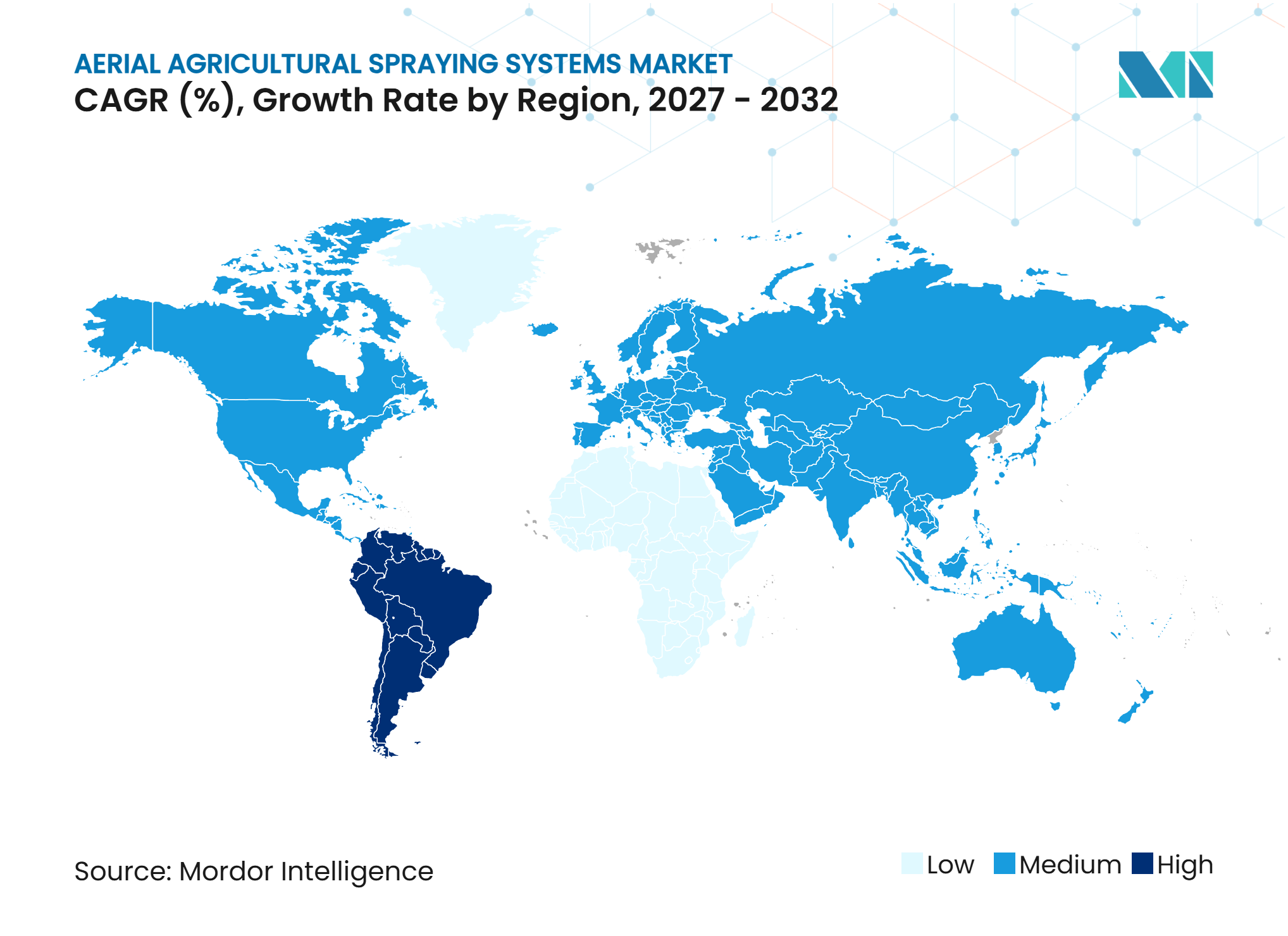
| Fastest Growing Market | South America |
| Largest Market | Asia-Pacific |
| Market Concentration | High |
Major Players *Disclaimer: Major Players sorted in no particular order Image © Mordor Intelligence. Reuse requires attribution under CC BY 4.0. | |
Aerial Agricultural Spraying Systems Market Analysis by Mordor Intelligence
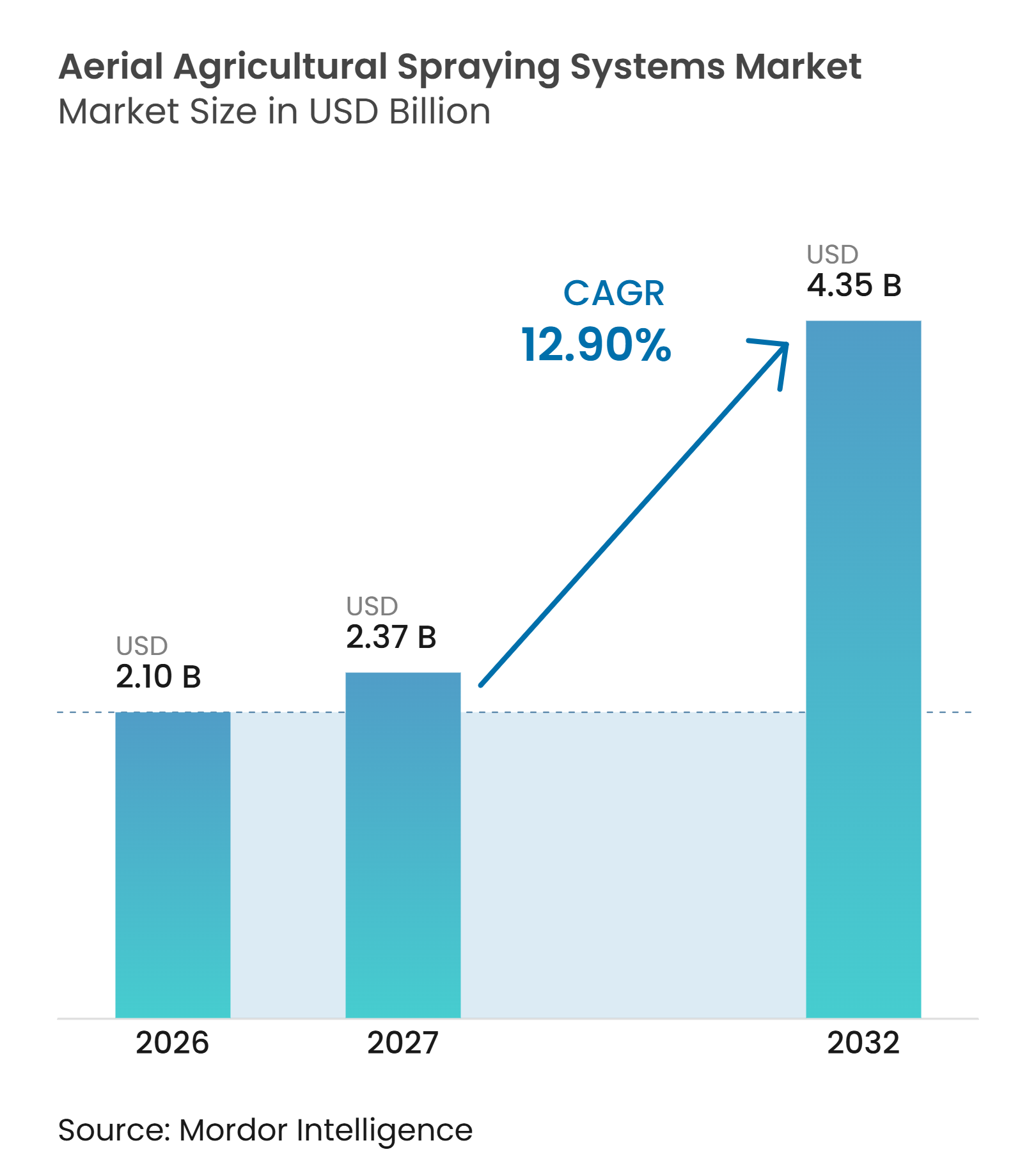
The global aerial agricultural spraying systems market size was valued at USD 2.10 billion in 2026 and is estimated to grow from USD 2.37 billion in 2027 to USD 4.35 billion by 2032. The market is projected to grow at a 12.9% CAGR during 2027–2032. Fleet additions, farm labor constraints, and more precise liquid application systems are supporting demand for aerial agricultural spraying systems across major crop regions. Replacement demand for batteries, nozzles, chargers, and flow-control equipment adds recurring sales once operators have established fleets. Public support is lowering the cost barrier for cooperative and service-based purchasing models, especially in India, where the Namo Drone Didi scheme provided central financial assistance of 80% of the drone package cost to women self-help groups (SHGs) offering spraying services to farmers, with each package including four spare battery sets, a nozzle set, and a fast battery charger[1]. Regulatory approval for flight operations and pesticide use remains the main condition for wider deployment in several markets. Larger payload systems and biological input applications are broadening the use cases available in the global aerial agricultural spraying systems market.
Key Report Takeaways
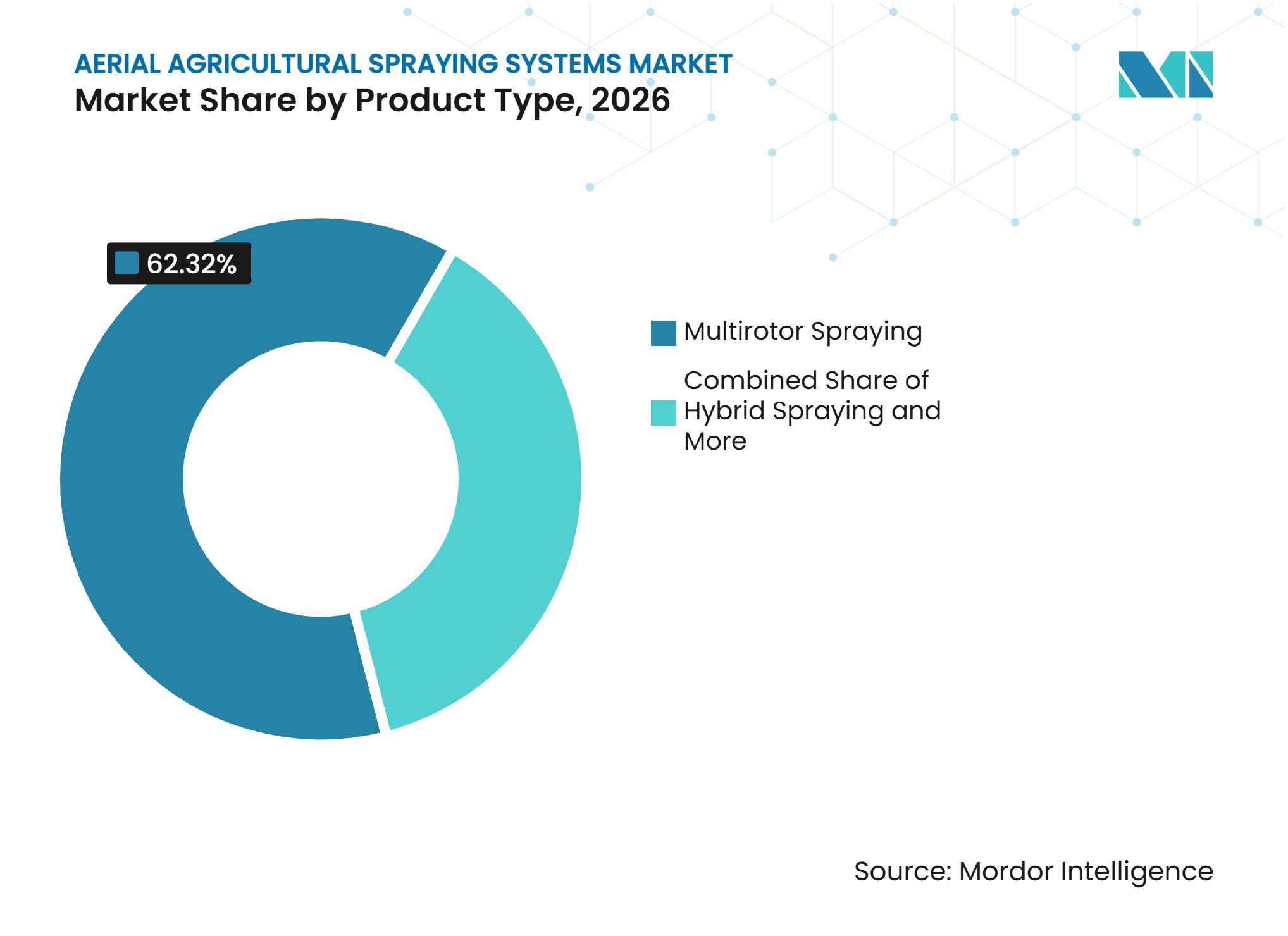
- By product type, multirotor spraying held 62.32% of the global aerial agricultural spraying systems market share in 2026. Hybrid spraying is projected to grow at a 22.13% CAGR during 2027–2032.
- By payload capacity, the up to 20 liters segment held 58.11% of the global aerial agricultural spraying systems market size in 2026. The more than 100 liters segment is projected to grow at an 18.17% CAGR during 2027–2032.
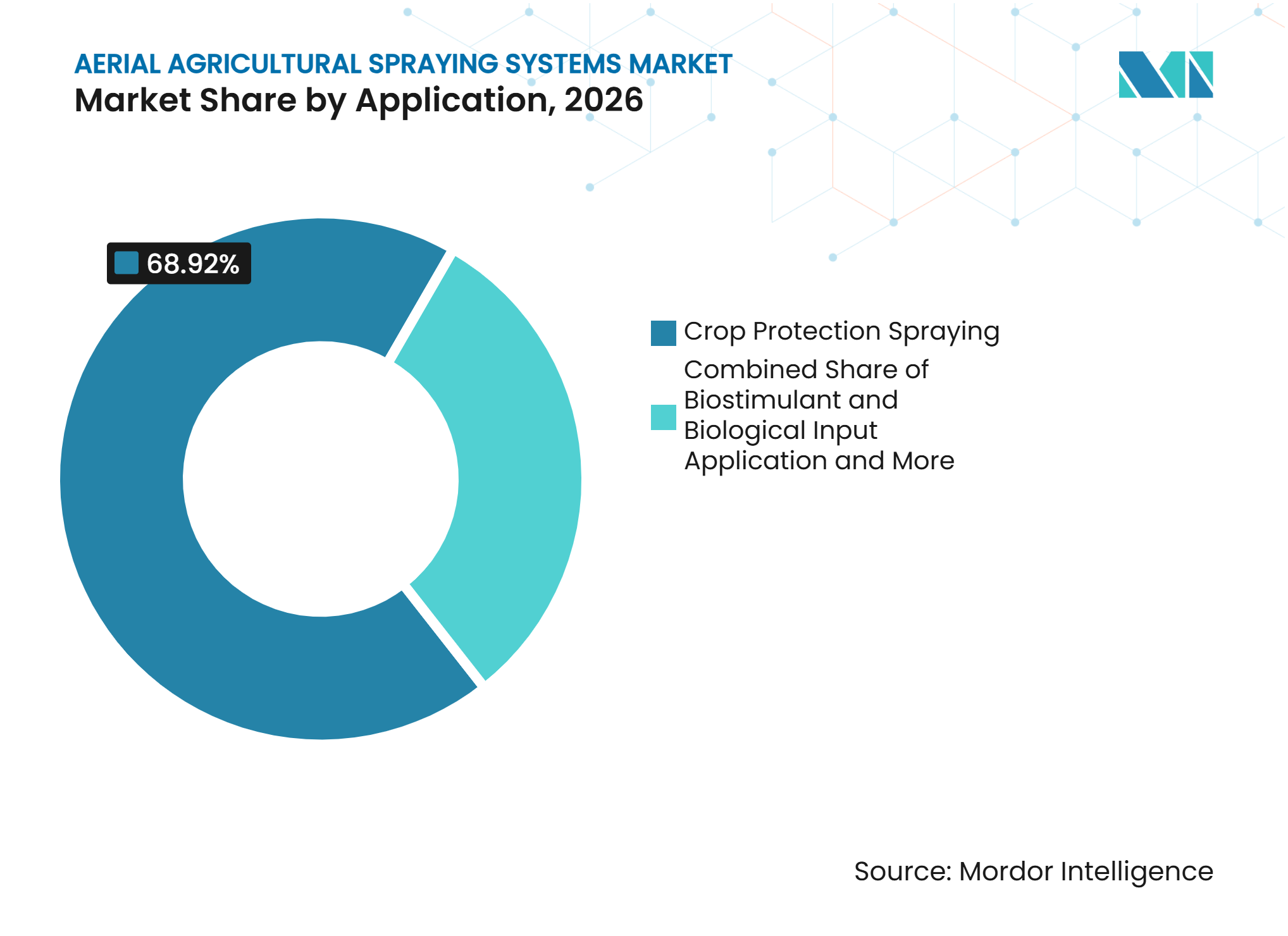
- By application, crop protection spraying accounted for 68.92% of the global aerial agricultural spraying systems market share in 2026. Biostimulant and biological input application is projected to grow at a 20.35% CAGR during 2027–2032.
- By geography, Asia-Pacific held 52.21% of the global aerial agricultural spraying systems market share in 2026. South America is projected to grow at an 18.67% CAGR during 2027–2032.
Note: Market numbers in this report are based on Mordor Intelligence's proprietary estimation framework, which combines nine months of actuals with Q4 projections for base year 2026.
Market Trends and Insights
Drivers Impact Analysis of Aerial Agricultural Spraying Systems Market*
| Driver | (~) % Impact on CAGR Forecast | Geographic Relevance | Impact Timeline |
|---|---|---|---|
| Expansion of Agricultural Spraying Drone Fleets | +2.4% | Global, led by China, Japan, India, Brazil, and the United States, where fleet deployments and treated acreage are increasing | Long term (≥ 4 years) |
| Labor Shortages Increasing Demand for Remote Aerial Application | +1.8% | Global, especially Japan, South Korea, North America, Europe, and labor-constrained horticultural regions | Medium term (2–4 years) |
| Precision Flow Control Reducing Input Waste and Drift | +1.4% | Global, with strong relevance in the United States, Europe, Japan, and Australia, where environmental compliance and input efficiency are priorities | Medium term (2–4 years) |
| Public Subsidies Accelerating Spraying System Purchases | +1.7% | China, India, Japan, and selected European and South American markets | Short term (≤ 2 years) |
| Difficult Terrain and Crop Canopies Favoring Aerial Access | +0.9% | South America, Southeast Asia, India, China, and hilly or fragmented farming areas globally | Long term (≥ 4 years) |
| Locust Control and Emergency Crop Protection Programs | +0.5% | Africa, the Middle East, South Asia, and parts of South America | Short term (≤ 2 years) |
| Source: Mordor Intelligence | |||
Expansion of Agricultural Spraying Drone Fleets
A growing installed base creates demand for complete systems and replacement components across the global aerial agricultural spraying systems market. DJI Agriculture announced in November 2025 that its global agricultural drone shipments for 2025 surpassed 200,000 units, and its July 2026 launch materials put the number of DJI agricultural drones in use worldwide at more than 600,000. The same July 2026 release introduced the Agras T55 with a 50-liter spraying capacity and the Agras T100 Dual Battery Spraying System with a 90-liter spray tank capacity. The larger product range allows operators to select equipment for orchards, small plots, and broad-acre farms. Aging fleets also require batteries, chargers, atomizers, and nozzles, which supports a recurring revenue stream. This installed-base effect reduces reliance on new platform purchases alone.
Labor Shortages Increasing Demand for Remote Aerial Application
Farm labor shortages are increasing interest in remote aerial application where manual or conventional aerial work is difficult to staff. Japan's Ministry of Agriculture, Forestry and Fisheries (MAFF) reported in March 2026 that drone-treated area reached an estimated 1.196 million hectares in fiscal year 2024[2]. In June 2025, the National Federation of Agricultural Cooperative Associations (JA Zennoh), KDDI Corporation, and KDDI Smart Drone agreed to develop autonomous remote spraying services, targeting commercialization by fiscal year 2027. The agreement responded to a shrinking farm workforce, and MAFF's 2025 Census of Agriculture and Forestry counted 1.036 million core agricultural workers with an average age of 67.7 years. Service operators can use remote fleet management to spread equipment costs across several farms. That model can move purchasing toward professional operators with higher utilization needs.
Public Subsidies Accelerating Spraying System Purchases
Purchase support can shorten the investment cycle for cooperatives and smaller farming groups. India's Namo Drone Didi scheme provides selected women self-help groups (SHGs) with central financial assistance of 80% of the cost of an approved drone package, capped at Indian rupee (INR) 800,000 (USD 8,727). The scheme also offers a 3% interest subvention on loans that cluster-level federations of SHGs raise for the remaining cost under the Agriculture Infrastructure Fund (AIF). India's Union Budget 2026–27 allocated INR 676.85 crore (USD 73.84 million) to the scheme, the same amount as the 2025–26 budget estimate. These measures help service providers acquire equipment that individual smallholders may not purchase directly. They also favor suppliers that can meet public procurement and dealer qualification requirements.
Precision Flow Control Reducing Input Waste and Drift
Precision flow control makes aerial systems more relevant where operators need to manage droplet size and application rate. Guangzhou XAG Co., Ltd. (XAG) states that the RevoSpray 5 system on its P150 Max drone supports droplet sizes from 60 to 500 microns and a maximum flow rate of 32 liters per minute, which rises to 46 liters per minute with a four-nozzle kit. A 2025 peer-reviewed review in the International Journal of Agricultural and Biological Engineering identified nozzle type, flight speed, and flight height as key parameters affecting spray deposition and drift in unmanned aerial vehicle applications. Equipment with controllable atomization can help operators meet drift-management requirements. The benefit is especially relevant in markets where environmental compliance affects operating permissions. Better recordkeeping and consistent spray settings can also strengthen the case for professional service models.
Restraints Impact Analysis of Aerial Agricultural Spraying Systems Market*
| Restraint | (~) % Impact on CAGR Forecast | Geographic Relevance | Impact Timeline |
|---|---|---|---|
| Fragmented Rules for Agricultural Drone Operations | -1.1% | Global, particularly North America, Europe, and markets with evolving beyond-visual-line-of-sight and operator-certification rules | Medium term (2–4 years) |
| Limited Aerial Use Approvals for Crop Protection Products | -0.9% | Europe, the United States, Canada, Australia, and countries with strict pesticide-registration regimes | Long term (≥ 4 years) |
| Spray Drift Liability and Weather-Window Constraints | -0.8% | Global, with high relevance in Europe, North America, Australia, and densely populated farming regions | Medium term (2–4 years) |
| Battery Endurance and Payload Limits for High-Capacity Applications | -0.7% | Global, especially large farms in North America, South America, Australia, and Africa | Short term (≤ 2 years) |
| Source: Mordor Intelligence | |||
Fragmented Rules for Agricultural Drone Operations
Different registration, pilot licensing, airspace, and remote-operation rules increase the cost of entering multiple markets. The Federal Aviation Administration issued a proposed rule for beyond visual line of sight operations in August 2025, and the final rule had not been published as of October 2026. A finalized performance-based framework could reduce the need for individual waivers in some United States operations. In Europe, agricultural spraying can require a Specific Operations Risk Assessment and authorization from national aviation authorities. Those processes vary by jurisdiction, which can delay fleet deployment and service expansion. Manufacturers cannot resolve this barrier through product improvements alone.
Limited Aerial Use Approvals for Crop Protection Products
System demand remains limited when crop protection labels do not permit aerial or drone application. In May 2026, the Council of the European Union agreed its position on amending Directive 2009/128/EC to let member states exempt certain drone types from the aerial spraying ban, subject to European Food Safety Authority risk-assessment guidance and a delegated act identifying eligible drones. France's Law No. 2025-365 of April 23, 2025, allows drone application of biocontrol, low-risk, and organic-farming products in specified settings, including slopes of at least 20% and banana plantations. The law also created an experimental pathway of up to three years for additional use cases. Broader equipment sales depend on progress in chemical registration and label amendment processes. Hardware capability alone cannot replace legal application authorization.
*Our forecasts treat driver/restraint impacts as directional, not additive. The impact forecasts reflect baseline growth, mix effects, and variable interactions.
Aerial Agricultural Spraying Systems Market Segment Analysis
By Product Type:
Multirotor Systems Lead While Hybrid Platforms Extend CoverageMultirotor spraying held 62.32% of revenue in 2026. Hovering and tight maneuvering make these systems a good fit for fragmented plots, irregular field boundaries, orchards, and paddy fields. That flexibility supports their wide use across Asian farming systems and in other regions with small field sizes. Fixed-wing spraying platforms serve selected broad-acre uses, where long flight paths and open terrain match their operating profile. Pyka Inc. introduced the Pelican 2, an autonomous electric fixed-wing spray aircraft, in February 2025. It has a 300-liter payload and a stated work rate of up to 90 hectares per hour. Rotary-wing manned aircraft systems remain relevant to established contractor networks in markets with a long history of aerial application.
Hybrid spraying is forecast to grow at a CAGR of 22.13% from 2027 to 2032. Hybrid designs combine vertical takeoff and landing with the forward-flight efficiency of fixed-wing platforms. A 2025 review of agricultural spraying unmanned aerial vehicles in The Aeronautical Journal found that this configuration offers more endurance and coverage. It also keeps the vertical takeoff needed in confined areas. The category suits operations that need greater range without losing low-altitude precision in the global aerial agricultural spraying systems market.



By Payload Capacity:
Smaller Systems Retain Volume While High-Capacity Tiers Grow FasterThe up to 20 liters segment accounted for 58.11% of revenue in 2026. Compact systems fit the smaller plots and lower capital budgets common in many Asia-Pacific farming areas. Their lighter payload also makes them practical for operators who move between scattered fields. The more than 20 to 50 liters and more than 50 to 100 liters ranges serve professional contractors who want more output per day. These mid-range systems bridge the gap between smallholder operations and large commercial fleets.
The more than 100 liters segment is forecast to grow at a CAGR of 18.17% from 2027 to 2032. Large-acreage operators care most about coverage per flight and smaller ground crews. DJI launched the Agras T100, which has a 100-liter spraying tank, globally in July 2025 and introduced its dual-battery spraying system in July 2026. Higher-capacity equipment also needs mixing tanks, charging equipment, and field power infrastructure. These added assets can raise switching costs once a professional operator in the global aerial agricultural spraying systems market has chosen a platform ecosystem.
By Application:
Crop Protection Provides the Largest Base While Biological Inputs Grow FasterCrop protection spraying accounted for 68.92% of the global aerial agricultural spraying systems market size in 2026. Pest and disease treatment creates recurring demand across rice, wheat, soybean, cotton, and plantation crops. The segment benefits where aerial application can reach wet, steep, or canopy-dense fields. Foliar fertilizer application is a stable secondary use, particularly where precise nutrient application can reduce manual field work. Locust and emergency agricultural pest control creates irregular demand that depends on outbreak conditions and public response programs.
Biostimulant and biological input application is forecast to grow at a CAGR of 20.35% from 2027 to 2032. These inputs can favor aerial delivery when farms need rapid treatment at specific crop stages. In January 2026, Bioiberica reported that applying its Terra-Sorb complex by drone raised yields in Indiana field trials. In June 2025, ABZ Innovation reported trials with Bio-Nat Kft. that used a drone with controlled droplet application nozzles to apply microbial biostimulants to cereal and horticultural crops in Hungary. In September 2026, the Irish Aviation Authority granted ZenaDrone a Specific Operations Risk Assessment approval for drone application of fertilizer, lime, biostimulants, and other non-plant protection products. This approval supports a separate regulatory pathway for some biological and soil-related inputs.

Geography Analysis
Asia-Pacific held 52.21% of global revenue in 2026. China's manufacturing base, Japan's labor constraints, and India's purchasing support programs create a broad regional demand base for the global aerial agricultural spraying systems market. DJI stated that its global agricultural drone shipments exceeded 200,000 units in 2025. Japan's drone-treated area reached an estimated 1.196 million hectares in fiscal year 2024, according to the Ministry of Agriculture, Forestry and Fisheries. India's Namo Drone Didi scheme targets 15,000 drones and supports group-based ownership, which can expand access beyond individual farm buyers[3].
South America is forecast to grow at an 18.67% CAGR during 2027–2032. Brazil is central to regional expansion because large farms, terrain constraints, and contractor models can support higher equipment utilization in the global aerial agricultural spraying systems market. Guangzhou XAG Co., Ltd. (XAG) introduced the P150 and P60 in Brazil with CNH at Agrishow 2025. Pyka Inc. announced a follow-on order from SLC Agrícola for Pelican 2 aircraft in January 2026 after a prior operating season. Brazil's aviation and agricultural compliance requirements remain important because commercial scale requires operator authorization, field protocols, and product-use compliance.
North America uses aerial spraying systems alongside established manned aircraft and ground-rig operations. In Europe, France's 2025 legislation permits specified drone applications. A wider European Union change is still under negotiation and depends on European Food Safety Authority guidance and a delegated act. The Federal Aviation Administration's 2025 proposed beyond visual line of sight rule may shape U.S. operations, and its final version was still unpublished as of October 2026. In the Middle East and Africa, Food and Agriculture Organization of the United Nations drone training for desert locust control in Oman in January 2026 and Mauritania in September 2026 is helping build a certified operator base.
Competitive Landscape
Market Concentration
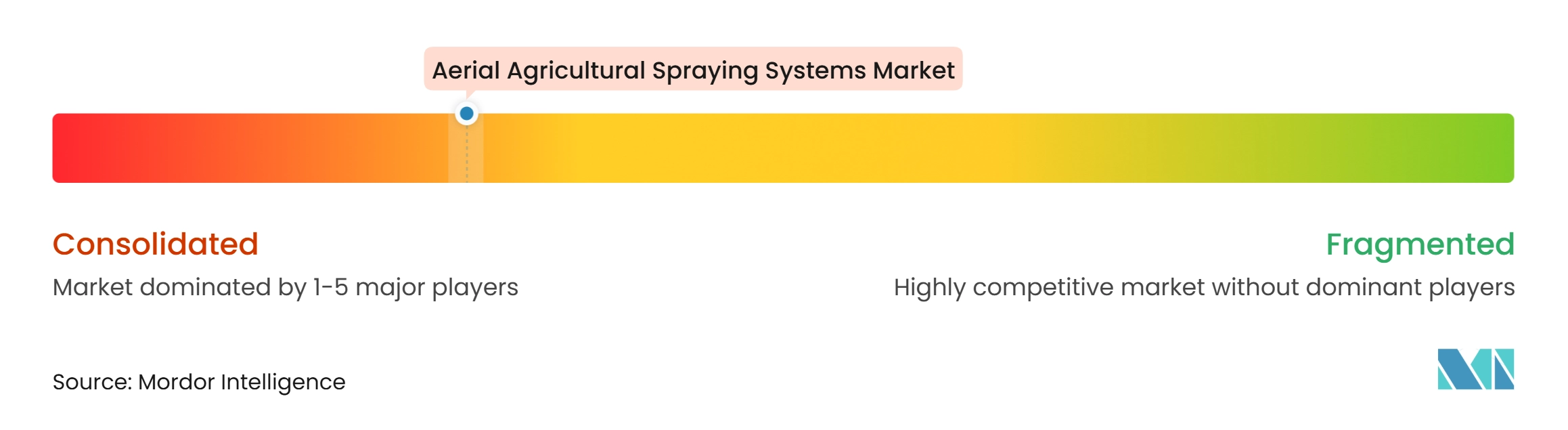
The global aerial agricultural spraying systems market is consolidated. Competition centers on product range, dealer and service coverage, release timing, and the ability to support operators with batteries, chargers, software, and replacement parts. DJI expanded its portfolio in July 2025 with the Agras T100, T70P, and T25P, and its key markets outside China include Brazil, Mexico, Thailand, and Japan. Yamaha Motor Co., Ltd. holds its strongest position in Japan. In September 2025, five of its FAZER R unmanned helicopter models received Type 2 type certification from the Ministry of Land, Infrastructure, Transport and Tourism. Frequent portfolio updates can encourage fleet replacement and help dealers serve users with different payload requirements.
Guangzhou XAG Co., Ltd. (XAG) uses distribution partners to reach professional operators. It sells the P150 and P60 in Brazil through CNH's precision-farming network and has sold the P150 Max through its authorized U.S. dealer network since February 2026. EAVISION used live demonstrations at Agrishow 2026 in Brazil to present its J150 to farmers and distributors. Pyka Inc.'s Pelican 2 provides an alternative platform configuration for higher-payload, fixed-wing autonomous crop protection work.
Compliance, payload, endurance, and application quality shape supplier differentiation. The U.S. procurement environment can favor platforms that meet security and sourcing requirements. Hylio, Inc. states that all its products comply with the National Defense Authorization Act (NDAA), and its Blue HYL-150 ARES was placed on the Blue Unmanned Aircraft Systems Cleared List in April 2026. SKK Holdings Limited (Rantizo, Inc.) positions its U.S.-built Harvest 100 for buyers that require NDAA-aligned sourcing. The October 2026 closing of SKK's purchase of Rantizo's drone assets gave the business access to public markets. This report does not disclose company-level market shares.
Aerial Agricultural Spraying Systems Industry Leaders
-
DJI (DJI Agriculture)
-
Guangzhou XAG Co., Ltd. (XAG)
-
Yamaha Motor Co., Ltd.
-
EAVISION
-
Hylio, Inc.
- *Disclaimer: Major Players sorted in no particular order
Aerial Agricultural Spraying Systems Market Companies Covered in this Report
- DJI
- Guangzhou XAG Co., Ltd. (XAG)
- Yamaha Motor Co., Ltd.
- EAVISION
- Hylio, Inc.
- Pyka Inc.
- SKK Holdings Limited (Rantizo, Inc.)
- Xmobots Tecnologia Ltda.
- Draganfly Inc.
- TopXGun
- ABZ Innovation
- Rotor Technologies, Inc.
- Heilongjiang Huida Technology Co., Ltd.
- Shandong Joyance Intelligence Technology Co., Ltd.
- Exedy Drones
Recent Industry Developments in Aerial Agricultural Spraying Systems Market
- October 2026: Pyka Inc. and Grupo HAME began Guatemala's first autonomous electric aerial crop-spraying operations in Tecún Umán, San Marcos, after Guatemala's Dirección General de Aeronáutica Civil approved the Pelican aircraft for agricultural spraying. The deployment supports Black Sigatoka management in Grupo HAME's banana operations.
- February 2026: Guangzhou XAG Co., Ltd. (XAG) introduced the Federal Communications Commission-approved P150 Max to the U.S. market at the Spray Drone End User Conference. The company stated that the drone has an 80-kilogram maximum payload, lets one operator control two drones, and can recharge in as little as 7 minutes using two chargers and a mist-cooling tower.
- February 2025: Pyka Inc. unveiled the Pelican 2 and secured commercial operation authorization from the Federal Aviation Administration. The company stated that the aircraft has a 300-liter payload and a work rate of up to 90 hectares per hour.
Global Aerial Agricultural Spraying Systems Market Report Scope
The Aerial Agricultural Spraying Systems Market Report is Segmented by Product Type (Multirotor Spraying, Fixed-Wing Spraying, Hybrid Spraying, and Others), by Payload Capacity (Up to 20 Liters, More Than 20 to 50 Liters, More Than 50 to 100 Liters, and More Than 100 Liters), by Application (Crop Protection Spraying, Foliar Fertilizer Application, Biostimulant and Biological Input Application, and Locust and Emergency Agricultural Pest Control), and by Geography (North America, South America, Europe, Asia-Pacific, Middle East, and Africa). The Market Forecasts are Provided in Terms of Value (USD).
Segmentation Overview
| Multirotor Spraying |
| Fixed-Wing Spraying |
| Hybrid Spraying |
| Others (Rotary-Wing Manned Aircraft, Etc.) |
| Up to 20 Liters |
| More Than 20 to 50 Liters |
| More Than 50 to 100 Liters |
| More Than 100 Liters |
| Crop Protection Spraying |
| Foliar Fertilizer Application |
| Biostimulant and Biological Input Application |
| Locust and Emergency Agricultural Pest Control |
| North America | United States |
| Canada | |
| Mexico | |
| Rest of North America | |
| South America | Brazil |
| Argentina | |
| Chile | |
| Colombia | |
| Peru | |
| Rest of South America | |
| Europe | Germany |
| United Kingdom | |
| France | |
| Spain | |
| Italy | |
| Russia | |
| Rest of Europe | |
| Asia-Pacific | China |
| Japan | |
| India | |
| Australia | |
| Singapore | |
| South Korea | |
| Rest of Asia-Pacific | |
| Middle East | Saudi Arabia |
| United Arab Emirates | |
| Turkey | |
| Rest of Middle East | |
| Africa | South Africa |
| Kenya | |
| Nigeria | |
| Rest of Africa |
| By Product Type | Multirotor Spraying | |
| Fixed-Wing Spraying | ||
| Hybrid Spraying | ||
| Others (Rotary-Wing Manned Aircraft, Etc.) | ||
| By Payload Capacity | Up to 20 Liters | |
| More Than 20 to 50 Liters | ||
| More Than 50 to 100 Liters | ||
| More Than 100 Liters | ||
| By Application | Crop Protection Spraying | |
| Foliar Fertilizer Application | ||
| Biostimulant and Biological Input Application | ||
| Locust and Emergency Agricultural Pest Control | ||
| By Geography | North America | United States |
| Canada | ||
| Mexico | ||
| Rest of North America | ||
| South America | Brazil | |
| Argentina | ||
| Chile | ||
| Colombia | ||
| Peru | ||
| Rest of South America | ||
| Europe | Germany | |
| United Kingdom | ||
| France | ||
| Spain | ||
| Italy | ||
| Russia | ||
| Rest of Europe | ||
| Asia-Pacific | China | |
| Japan | ||
| India | ||
| Australia | ||
| Singapore | ||
| South Korea | ||
| Rest of Asia-Pacific | ||
| Middle East | Saudi Arabia | |
| United Arab Emirates | ||
| Turkey | ||
| Rest of Middle East | ||
| Africa | South Africa | |
| Kenya | ||
| Nigeria | ||
| Rest of Africa | ||
Key Questions Answered in the Report
What is the global aerial agricultural spraying systems market forecast through 2032?
The market is forecast to reach USD 4.35 billion by 2032, growing at a 12.9% CAGR during 2027–2032.
Which product type leads the global aerial agricultural spraying systems market?
Multirotor spraying leads with a 62.32% share in 2026.
Which payload category is growing fastest in the global aerial agricultural spraying systems market?
More than 100 liters is forecast to grow at an 18.17% CAGR during 2027–2032.
Which region is growing fastest in the global aerial agricultural spraying systems market?
South America is forecast to grow at an 18.67% CAGR during 2027–2032.