
Adaptive Bitrate Streaming Market Size and Share
Market Overview
| Study Period | 2020 - 2031 |
|---|---|
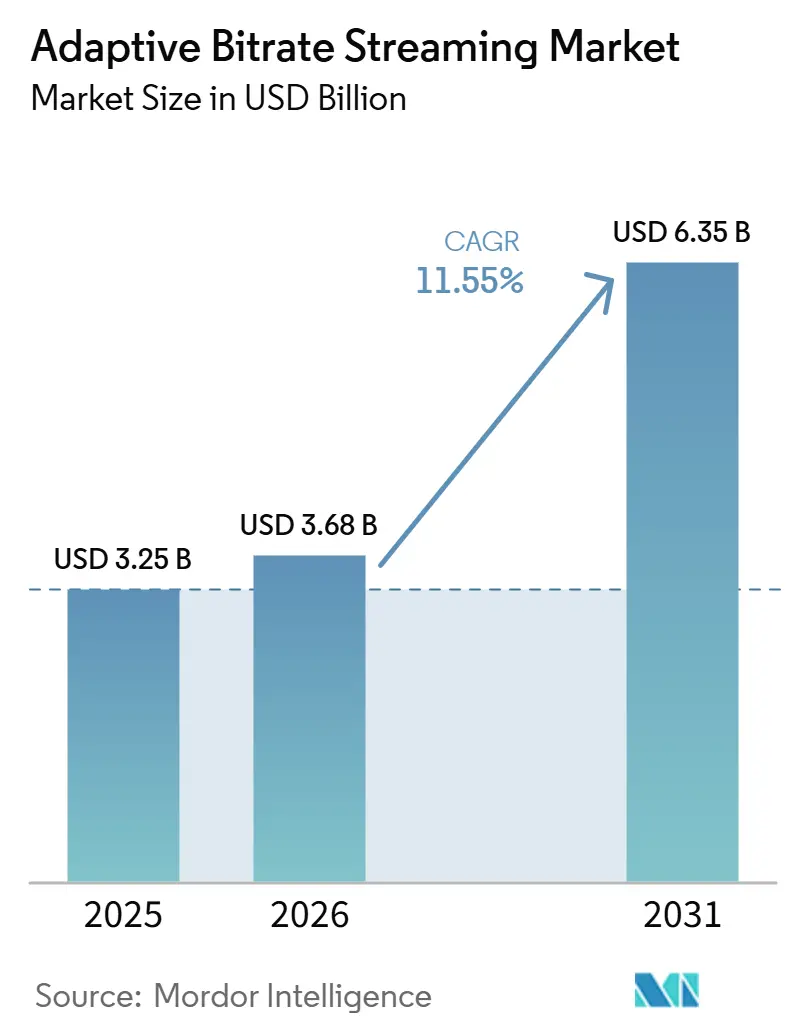
| Market Size (2026) | USD 3.68 Billion |
| Market Size (2031) | USD 6.35 Billion |
| Growth Rate (2026 - 2031) | 11.55 % |
| Fastest Growing Market | Asia-Pacific |
| Largest Market | North America |
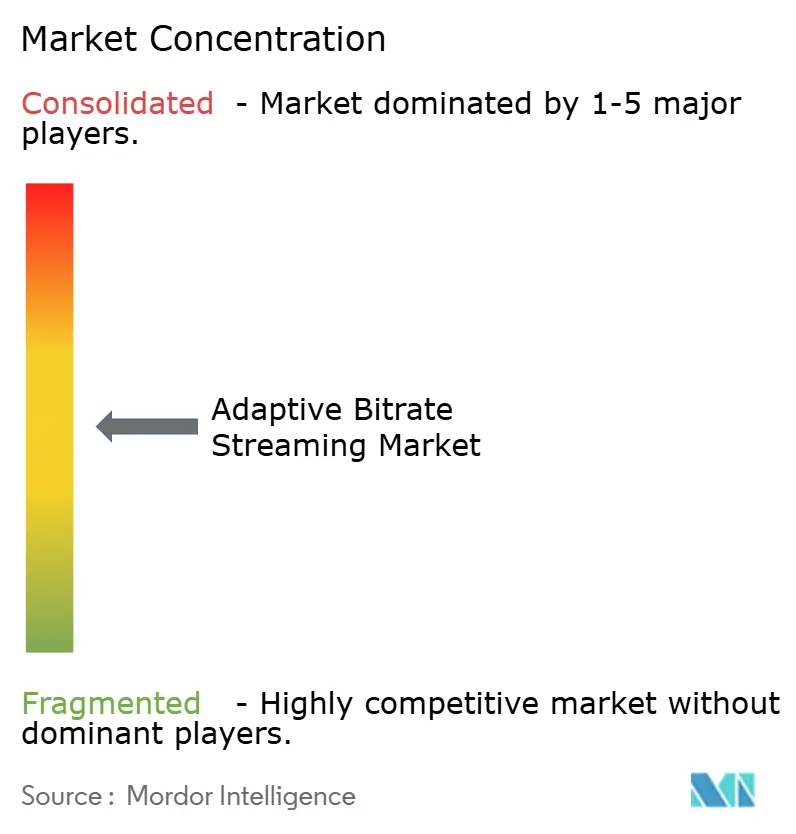
| Market Concentration | Medium |
Major Players *Disclaimer: Major Players sorted in no particular order Image © Mordor Intelligence. Reuse requires attribution under CC BY 4.0. | |
Adaptive Bitrate Streaming Market Analysis by Mordor Intelligence
The adaptive bitrate streaming market size is expected to grow from USD 3.25 billion in 2025 to USD 3.68 billion in 2026 and is forecast to reach USD 6.35 billion by 2031 at 11.55% CAGR over 2026-2031. Demand is moving from linear broadcast toward managed on-demand and live IP video delivery, which makes quality adaptation central to large-scale viewing. Investment in 5G, fiber-to-home networks, and public broadband programs is expanding the device base for video services in developing economies. Platform operators are placing greater emphasis on lowering the cost of each stream as subscriber growth becomes less important than monetization. This is increasing the value of content-aware encoding, cloud delivery, and player software that can improve quality while controlling delivery costs. The adaptive bitrate streaming market also benefits from live sports rights moving toward direct digital distribution, where providers must manage high and sudden viewer demand.
Key Report Takeaways
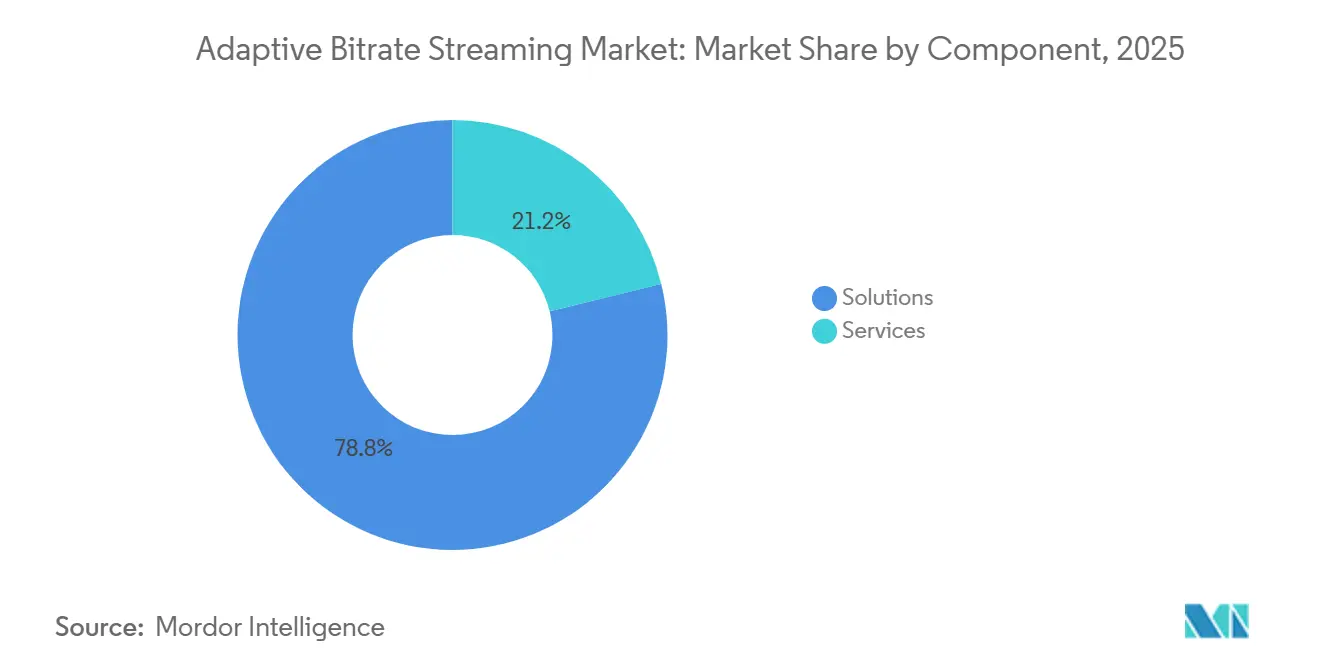
- By component, solutions held 78.82% of total revenue in 2025, while services are projected to expand at a 12.07% CAGR through 2031.
- By streaming type, video-on-demand streaming accounted for 60.65% of the adaptive bitrate streaming market size in 2025, while live and linear streaming is expected to grow at an 11.94% CAGR through 2031.
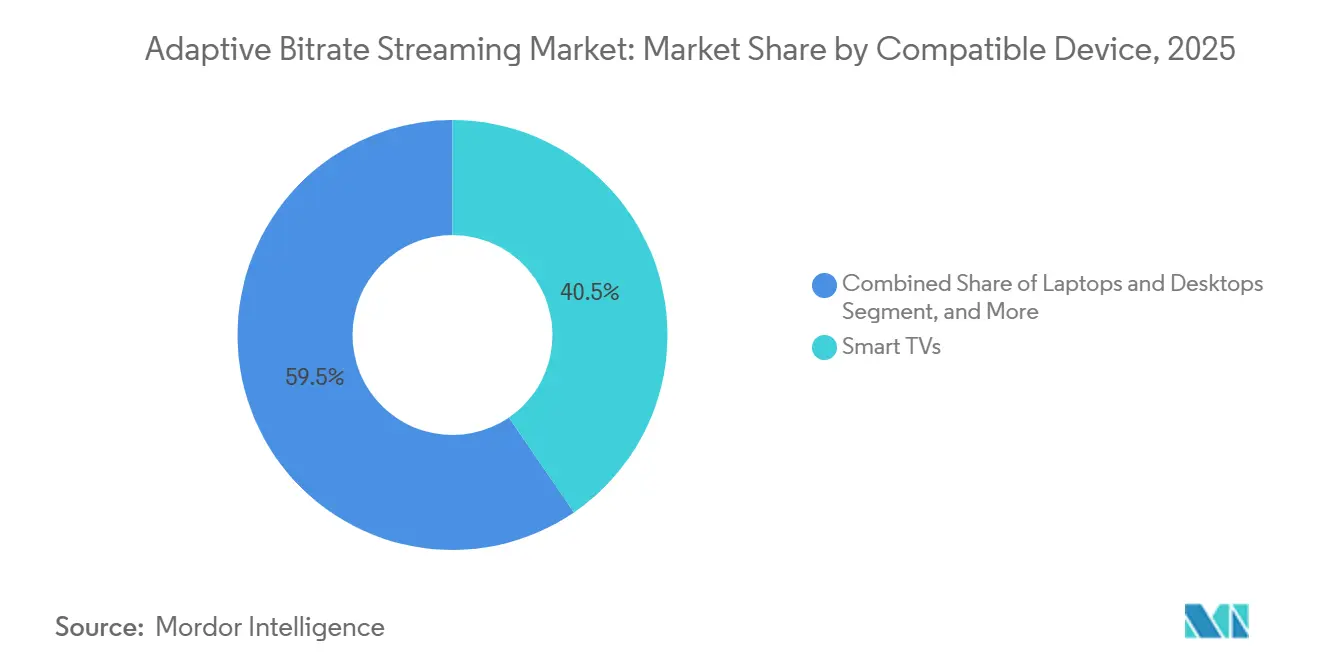
- By compatible device, smart TVs captured 40.45% of revenue in 2025, while gaming consoles are projected to record a 12.16% CAGR through 2031
- By end use, OTT and digital media platforms held 30.35% of revenue in 2025, while sports rights holders and live-event operators are expected to advance at an 11.83% CAGR through 2031.
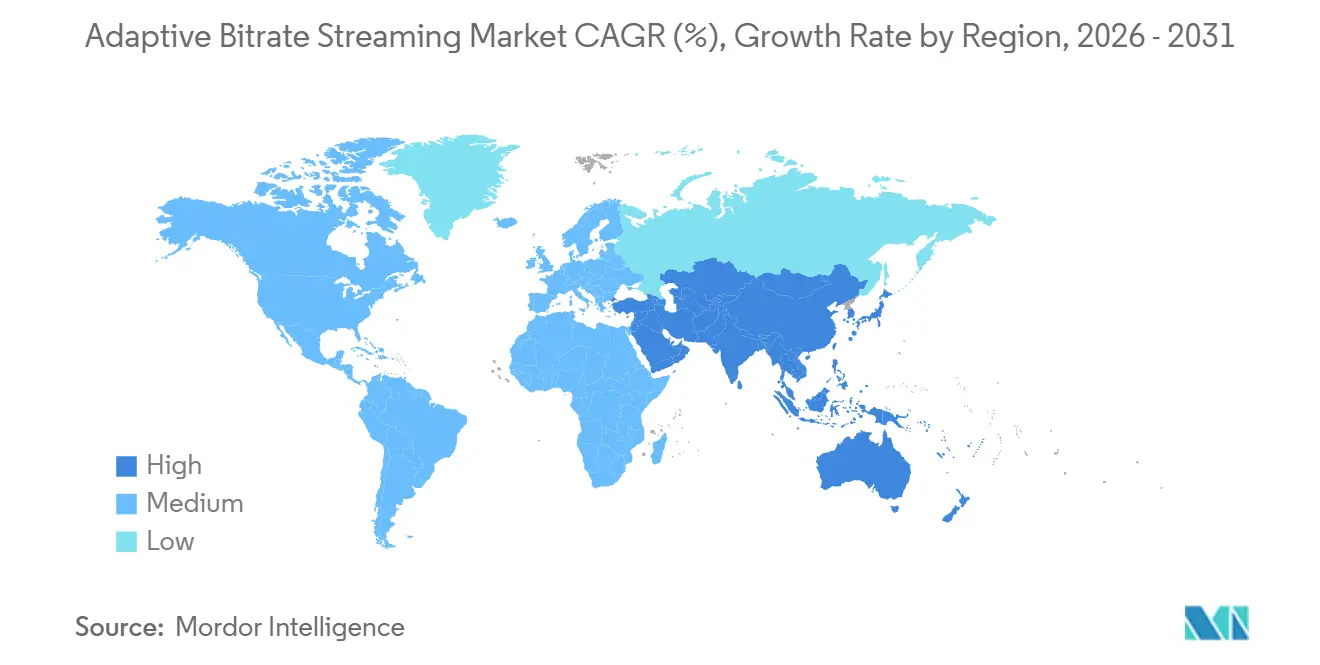
- By geography, North America led with 45.50% of revenue in 2025, while Asia-Pacific is projected to expand at an 11.89% CAGR through 2031.
Note: Market size and forecast figures in this report are generated using Mordor Intelligence’s proprietary estimation framework, updated with the latest available data and insights as of January 2026.
Market Trends and Insights
Expansion of OTT and Live Streaming Consumption
Premium sports rights are increasingly being delivered through streaming services, creating sustained demand for adaptive video infrastructure within the adaptive bitrate streaming market. The NBA announced an 11-year media agreement in 2024 that places games across Amazon Prime Video, NBCUniversal, and Disney platforms beginning with the 2025-26 season.[1]NBA, “NBA Announces New 11-Year Media Agreements,” NBA, nba.com These services need to distribute live video to large audiences while adjusting stream quality to each viewer's connection. Amazon stated that its Prime Video agreement includes regular-season and playoff NBA games, which broadens the role of streaming in national sports distribution. This shift supports recurring spending on encoding, packaging, delivery, and live manifest management rather than isolated software purchases. The adaptive bitrate streaming market therefore has a growing opportunity where sports platforms need reliable performance during sudden audience peaks.
Growth of Connected TV and Mobile Video Consumption
Connected televisions are becoming an important destination for streaming services across subscription and ad-supported services, which shifts investment toward consistent living-room playback. Built-in applications on smart TVs require video players to work across different operating systems and screen capabilities. This creates demand for player software, adaptive encoding, and delivery tools that can maintain quality across a varied set of devices. Advertising also depends on accurate timing for server-side ad insertion, where video segments and ad breaks must remain aligned. In South and Southeast Asia, mobile viewing presents a separate demand pattern because users often move across networks with different speeds. The adaptive bitrate streaming market serves this need by adjusting video quality as available bandwidth changes during playback.
AI-Enabled Content-Aware Encoding and Predictive Bitrate Selection
Content-aware encoding is changing how providers balance video quality and processing costs for both extensive video catalogs and live channel workflows. Amazon Web Services reported that Amazon IVS multitrack video can reduce server-side transcoding input costs by up to 75% by using unused creator-side GPU resources.[2]Amazon Web Services, “Multiple Video Quality Levels and Lower Costs with Amazon IVS Multitrack Video,” AWS Blog, aws.amazon.com The company cited a reduction in the cost per hour of a standard channel from USD 2.00 to USD 0.50 for the stated workflow. Harmonic introduced an AI overlay service in 2026 for its VOS360 Media SaaS and Spectrum X server environment, including AI functions for live content processing. Its announced use of NVIDIA GPU acceleration supports functions such as automated HD-to-UHD upscaling in live workflows. The adaptive bitrate streaming market is affected because per-title and content-aware workflows can reduce the resources required to prepare and deliver large video libraries.
Adoption of Cloud-Native Encoding and Delivery Workflows
Cloud-native workflows allow providers to scale encoding capacity for live events without maintaining fixed hardware for maximum demand. They separate processing capacity from fixed equipment, which makes it easier to respond to short peaks in viewing during sports, entertainment, and other scheduled programs. Brightcove entered 2026 with plans for live captions in more than 90 languages, contextual advertising, and publishing integrations for TikTok, Instagram, and Facebook reels.[3]Brightcove Inc., “Brightcove Doubles Down on AI and Customer Experience with Ambitious 2026 Roadmap,” Brightcove, brightcove.com These capabilities are delivered through cloud-managed workflows rather than traditional on-premises systems. Providers can then align infrastructure spending more closely with actual streaming volume and event schedules. The adaptive bitrate streaming market is consequently moving toward service contracts and usage-based billing that rise with video volume.
Restraints Impact Analysis of Adaptive Bitrate Streaming Market*
| Restraint | (~) % Impact on CAGR Forecast | Geographic Relevance | Impact Timeline |
|---|---|---|---|
| High CDN, storage, and transcoding costs for multiple renditions | -1.3% | Global | Short term (≤ 2 years) |
| Device, operating-system, and player fragmentation | -0.9% | Global | Long term (≥ 4 years) |
| Content protection, privacy, and cross-border compliance complexity | -0.6% | Europe, Asia-Pacific, and global | Medium term (2-4 years) |
| ABR codec, patent, and licensing cost pressure | -0.4% | Global | Medium term (2-4 years) |
| Source: Mordor Intelligence | |||
High CDN, Storage, and Transcoding Costs for Multiple Renditions
Adaptive delivery requires providers to create and store several versions of each video across regional, national, and global audiences, which raises the cost of serving broad catalogs. This burden is more difficult for smaller services that lack the scale of large cloud platforms and must still compete for content investment. Newer codecs can add processing requirements even when they reduce the bandwidth needed for delivery. Providers can limit some cost by matching rendition ladders to actual viewing behavior and removing versions that receive little use. However, this approach needs detailed analysis across large catalogs and may be difficult for smaller teams to operate. The adaptive bitrate streaming market can therefore face slower adoption among providers that must balance quality improvements against storage, delivery, and processing expenses.
Device, Operating-System, and Player Fragmentation
Video providers must support different browsers, television operating systems, mobile devices, game consoles, and content protection systems that can change their software requirements over time. Each platform can require separate testing, player integration, and quality management. This creates an ongoing engineering cost even when a device category has a smaller viewing audience. Cloudflare launched a Media over QUIC relay network in 2026 across more than 330 cities, describing it as a unified transport layer for interactive and large-scale media delivery. The network was developed through work at the Internet Engineering Task Force with engineers from Cloudflare, Meta, Google, and Cisco. Commercial device support remains early, so the adaptive bitrate streaming market will continue to require broad player and device compatibility in the forecast period.
*Our forecasts treat driver/restraint impacts as directional, not additive. The impact forecasts reflect baseline growth, mix effects, and variable interactions.
Adaptive Bitrate Streaming Market Segment Analysis
By Component:
Solutions Lead in the Adaptive Bitrate Streaming Market While Services Expand FasterSolutions accounted for 78.82% of the adaptive bitrate streaming market share in 2025. This category includes encoding and transcoding engines, packaging and manifest management, player software, software development kits, and workflow orchestration. Encoding and transcoding retain a large revenue role because broadcasters and digital platforms need to prepare video for different devices and network conditions. Player and bitrate-selection software are also becoming more important because the viewer experience depends on how the device chooses among available video versions. Akamai launched Adaptive Media Player 2 with Bitmovin in 2025, combining player, analytics, and Stream Lab technologies with Akamai delivery and cloud infrastructure.
Services are forecast to grow at a 12.07% CAGR through 2031, the highest rate within this component split. Managed delivery, viewing-quality monitoring, and integration work support this faster expansion. Providers increasingly need help with hybrid cloud deployments and live delivery configuration, not only with software licenses. This gives vendors an opportunity to develop recurring service relationships with broadcasters and platform operators. The adaptive bitrate streaming industry is also seeing higher demand for operational support as customers combine multiple clouds, delivery networks, and player environments.


By Streaming Type:
VoD Remains Largest While Live Delivery Changes ArchitectureVideo-on-demand streaming represented 60.65% of the adaptive bitrate streaming market size in 2025. Its position reflects the large installed base of subscription video libraries and the efficiency of preparing content before it is watched. Operators can refine video-on-demand encoding settings over time and apply per-title optimization before distribution. This provides a more controlled workflow than live video, where providers must prepare, package, and deliver content as an event happens. Deep libraries also make predictable storage and encoding processes important for providers with extensive catalogs.
Live and linear streaming is projected to expand at an 11.94% CAGR through 2031. Live delivery requires rapid segment availability, real-time playlist updates, and stable quality during a broadcast. The technical requirements differ from those of video-on-demand services because content must be encoded and delivered as an event occurs. Sports and premium event services require reliable playback when a large audience arrives at the same time. The adaptive bitrate streaming market is gaining a higher-value live use case as sports and interactive media providers place greater emphasis on low delay and reliable playback.
By Compatible Device:
Smart TVs Lead in the Adaptive Bitrate Streaming Market and Gaming Consoles Grow FastestSmart TVs captured 40.45% of the compatible device segment in 2025 and remain a central viewing surface in the adaptive bitrate streaming market. Their position reflects the use of built-in streaming applications as the main interface for home viewing. Television applications must work across device brands and operating systems, which increases the need for widely compatible players and adaptive formats. The 2025 release of Akamai Adaptive Media Player 2 expanded supported device coverage to Samsung, LG, Vizio, Hisense, and Roku environments. This illustrates the practical need to address different smart TV platforms rather than a single device standard.
Gaming consoles are expected to grow at a 12.16% CAGR through 2031. Their dual role in gaming and entertainment makes them a relevant screen for premium video delivery. Console users can expect high-quality video formats, which increases the need for reliable rendition switching and capable video players. Smartphones and tablets remain important in mobile-first markets because network performance can vary throughout a viewing session. The adaptive bitrate streaming industry must therefore balance living-room quality requirements with the flexible access needs of mobile and workplace users.

By End User:
OTT Platforms Anchor Adaptive Bitrate Streaming Market Demand While Live Events AccelerateOTT and digital media platforms held 30.35% of the end-user segment in 2025 and are central buyers in the adaptive bitrate streaming market. These customers purchase encoding, packaging, player, delivery, and analytics capabilities at high volume across their video operations. Their broad technical needs make integrated workflows valuable because they reduce the burden of managing separate providers. Broadcasters and pay-TV operators are also moving from cable and satellite distribution toward IP delivery, where adaptive playback is necessary for competitive digital services. Telecom operators and internet service providers use adaptive streaming in managed television services to compete on video quality and delivery consistency.
Sports rights holders and live-event operators are projected to grow at an 11.83% CAGR through 2031. The NBA media agreements directed live distribution toward major digital platforms, which reinforces the need for systems that manage high concurrent demand. Enterprises and education providers also use video for internal training, compliance material, and remote learning. The adaptive bitrate streaming market has demand across media and nonmedia buyers, although live events have the strongest forecast momentum.
Geography Analysis
North America Adaptive Bitrate Streaming Market
North America held 45.50% of the adaptive bitrate streaming market share in 2025. The region combines established streaming services, connected television use, and major sports rights that are moving toward digital distribution. The NBA announced agreements with Amazon, NBCUniversal, and Disney that began with the 2025-26 season. This supports demand for systems that can manage large live audiences across connected devices.
APAC Adaptive Bitrate Streaming Market
Asia-Pacific is expected to grow at an 11.89% CAGR through 2031, making it the fastest-growing regional area. Mobile-first video use supports demand for adaptive playback because network capacity can differ across locations and times of day. India remains a major growth area because its large audience and sports content require delivery systems that can handle high concurrent viewing. Japan and South Korea support demand for premium video experiences, including 4K HDR services and advanced broadcast formats. The regional video sector benefits from the range of use cases, from mass mobile video to high-quality home streaming.
South America and MEA Adaptive Bitrate Streaming Market
South America, the Middle East, and Africa form an emerging group with different drivers. Saudi Arabia and the UAE are expanding digital media services as part of wider entertainment and technology programs. In Africa, mobile broadband video use makes adaptive switching more important where network conditions can change significantly. The adaptive bitrate streaming market has room to expand in these regions as 4G and 5G access becomes more widely available.

Competitive Landscape
The adaptive bitrate streaming market has a moderately fragmented structure. Amazon Web Services, Google, and Akamai compete through cloud, network, and ecosystem capabilities. Bitmovin, Harmonic, Wowza, Telestream, and Synamedia compete through video encoding, latency control, and specialized workflow tools. Partnerships combine specialist technology with large-scale cloud and delivery infrastructure.
Harmonic announced a 2026 AI overlay service for live content processing and a next-generation Spectrum X media server. Brightcove's 2026 roadmap includes AI-driven live captioning, audio descriptions, contextual advertising, and a Video Cloud redesign. Akamai and Bitmovin launched Adaptive Media Player 2 in 2025, integrating Bitmovin technology with Akamai CDN and cloud infrastructure. These releases show that vendors are using AI-enabled workflow features to differentiate their offerings. Observability tools are also becoming more useful because operators need to manage quality, delivery cost, and network choice during active streaming sessions.
Access Advance published royalty rates for its Video Distribution Patent Pool in 2025 for HEVC, VVC, AV1, and VP9 content distribution. The pool introduces licensing considerations for operators that distribute video using these codecs. Larger providers may have greater resources to manage licensing and legal requirements. Smaller rights holders may prefer hosted services that include licensed delivery capabilities. The adaptive bitrate streaming market therefore has competitive pressure from both technical performance and compliance costs.
Adaptive Bitrate Streaming Industry Leaders
Amazon Web Services, Inc.
Akamai Technologies, Inc.
Microsoft Corporation
Brightcove Inc.
Cloudflare, Inc.
- *Disclaimer: Major Players sorted in no particular order
Adaptive Bitrate Streaming Market Companies Covered in this Report
- Akamai Technologies, Inc.
- Amazon Web Services, Inc.
- Brightcove Inc.
- Bitmovin Inc.
- Cloudflare, Inc.
- Kaltura, Inc.
- Mux, Inc.
- Wowza Media Systems, LLC
- Haivision Systems Inc.
- Harmonic Inc.
- IBM Corporation
- Microsoft Corporation
- Google LLC
- Vimeo, Inc.
- Panopto, Inc.
- JW Player, Inc.
- Telestream, LLC
- Synamedia Limited
- Conviva, Inc.
- MediaKind

Recent Industry Developments in Adaptive Bitrate Streaming Market
- June 2026: Akamai released a major production update to Media Services Live 5, introducing Terraform support for Infrastructure-as-Code stream provisioning, event-level content export to Linode Object Storage in raw HLS/DASH/CMAF format, and unlimited archive migration, strengthening MSL5's position for enterprise broadcasters managing complex multi-stream live workflows. The update gives broadcast teams a more repeatable way to set up, export, retain, and move live event assets when programs run across several streams.
- May 2026: Cloudflare launched Stream Bindings for Workers, enabling programmatic video pipeline management, including upload, direct-upload provisioning, video management, and signed URL generation, from serverless functions without authenticated API calls, opening adaptive video pipeline automation to generative AI and inference workloads. The release places common video controls closer to application workflows.
- April 2026: Harmonic announced at the 2026 NAB Show the next generation of its Spectrum X media server, the first large production deployment of VOS Media Software on Red Hat OpenShift for hybrid streaming, a new AI overlay service powered by NVIDIA GPU acceleration, and the first production deployment of server-side in-stream advertising by a leading U.S. regional sports network during live games.
- March 2026: Cloudflare launched the first Media over QUIC relay network on infrastructure across more than 330 cities globally, co-developed at the Internet Engineering Task Force with Meta, Google, and Cisco. MoQ combines WebRTC-class low latency with HLS/DASH-scale CDN delivery on a modern unified transport layer and is available in technical preview at no charge.


Global Adaptive Bitrate Streaming Market Report Scope
The Adaptive Bitrate (ABR) Streaming Market comprises solutions, technologies, platforms, and services that enable the dynamic adjustment of video and audio streaming quality in real time based on a user's network conditions, device capabilities, and bandwidth availability. The market includes ABR streaming software, cloud-based streaming platforms, content delivery network (CDN) integration, video encoding and transcoding solutions, analytics tools, and managed services deployed across industries such as media and entertainment, education, gaming, enterprise communications, healthcare, and e-commerce. Its primary objective is to deliver uninterrupted, high-quality viewing experiences by automatically switching between multiple bitrate versions of content, thereby reducing buffering, latency, and playback interruptions across smartphones, tablets, smart TVs, computers, and connected devices. The market encompasses both live and on-demand streaming applications and is driven by the growing consumption of digital video content, increasing internet penetration, expansion of OTT platforms, advancements in 5G networks, and rising demand for seamless multi-device content delivery.
The Adaptive Bitrate Streaming Market Report is Segmented by Component (Solutions [ABR Encoding and Transcoding, Packaging, Origin, and Manifest Management, Player, SDK, and Bitrate-Selection Software, and ABR Workflow Optimization and Orchestration] and Services), Streaming Type (Live and Linear Streaming and Video-on-Demand Streaming), Compatible Device (Smartphones and Tablets, Smart TVs, Laptops and Desktops, Gaming Consoles, and Other Compatible Devices), End Use (OTT and Digital Media Platforms, Broadcasters and Pay-TV Operators, Sports Rights Holders and Live-Event Operators, Telecom Operators and Internet Service Providers, Enterprises and Corporate Communications, Education and E-Learning Providers, and Other End Users), and Geography (North America, South America, Europe, Asia-Pacific, Middle East, and Africa). The Market Forecasts are Provided in Terms of Value (USD).
| Solutions | ABR Encoding and Transcoding |
| Packaging, Origin, and Manifest Management | |
| Player, SDK, and Bitrate-Selection Software | |
| ABR Workflow Optimization and Orchestration | |
| Services |
| Live and Linear Streaming |
| Video-on-Demand Streaming |
| Smartphones and Tablets |
| Smart TVs |
| Laptops and Desktops |
| Gaming Consoles |
| Other Compatible Devices |
| OTT and Digital Media Platforms |
| Broadcasters and Pay-TV Operators |
| Sports Rights Holders and Live-Event Operators |
| Telecom Operators and Internet Service Providers |
| Enterprises and Corporate Communications |
| Education and E-Learning Providers |
| Other End Users |
| North America | United States |
| Canada | |
| Mexico | |
| South America | Brazil |
| Argentina | |
| Chile | |
| Rest of South America | |
| Europe | Germany |
| United Kingdom | |
| France | |
| Italy | |
| Spain | |
| Russia | |
| Rest of Europe | |
| Asia-Pacific | China |
| Japan | |
| India | |
| South Korea | |
| Singapore | |
| Australia | |
| Rest of Asia-Pacific | |
| Middle East | Saudi Arabia |
| United Arab Emirates | |
| Israel | |
| Turkey | |
| Rest of Middle East | |
| Africa | South Africa |
| Nigeria | |
| Egypt | |
| Kenya | |
| Rest of Africa |
| By Component | Solutions | ABR Encoding and Transcoding |
| Packaging, Origin, and Manifest Management | ||
| Player, SDK, and Bitrate-Selection Software | ||
| ABR Workflow Optimization and Orchestration | ||
| Services | ||
| By Streaming Type | Live and Linear Streaming | |
| Video-on-Demand Streaming | ||
| By Compatible Device | Smartphones and Tablets | |
| Smart TVs | ||
| Laptops and Desktops | ||
| Gaming Consoles | ||
| Other Compatible Devices | ||
| By End User | OTT and Digital Media Platforms | |
| Broadcasters and Pay-TV Operators | ||
| Sports Rights Holders and Live-Event Operators | ||
| Telecom Operators and Internet Service Providers | ||
| Enterprises and Corporate Communications | ||
| Education and E-Learning Providers | ||
| Other End Users | ||
| Geography | North America | United States |
| Canada | ||
| Mexico | ||
| South America | Brazil | |
| Argentina | ||
| Chile | ||
| Rest of South America | ||
| Europe | Germany | |
| United Kingdom | ||
| France | ||
| Italy | ||
| Spain | ||
| Russia | ||
| Rest of Europe | ||
| Asia-Pacific | China | |
| Japan | ||
| India | ||
| South Korea | ||
| Singapore | ||
| Australia | ||
| Rest of Asia-Pacific | ||
| Middle East | Saudi Arabia | |
| United Arab Emirates | ||
| Israel | ||
| Turkey | ||
| Rest of Middle East | ||
| Africa | South Africa | |
| Nigeria | ||
| Egypt | ||
| Kenya | ||
| Rest of Africa | ||


Key Questions Answered in the Report
What is the adaptive bitrate streaming market size?
The 2026 value is USD 3.68 billion and is forecast to reach USD 6.35 billion by 2031, at an 11.55% CAGR.
What drives growth in adaptive bitrate streaming?
The main drivers are expanding OTT and live streaming use, connected TV and mobile viewing, changing network conditions, content-aware encoding, and cloud-native delivery.
Which component leads adaptive bitrate streaming revenue?
Solutions led with 78.82% of revenue in 2025 because encoding, packaging, player software, and workflow tools are central to video delivery.
Which streaming type is growing fastest?
Live and linear streaming is expected to grow at an 11.94% CAGR through 2031 as sports and premium events move to digital distribution.
Which region leads adaptive bitrate streaming adoption?
North America led with 45.50% of revenue in 2025, while Asia-Pacific is projected to record the fastest growth at an 11.89% CAGR.
Why are cloud-native streaming workflows important?
They allow providers to scale delivery during live events, use usage-based infrastructure, and add capabilities such as captions, advertising, and social publishing.
Page last updated on:





