
Activated Carbon Filter Market Size and Share
Market Overview
| Study Period | 2021 - 2031 |
|---|---|
| Market Size (2026) | USD 1.83 Billion |
| Market Size (2031) | USD 2.42 Billion |
| Growth Rate (2026 - 2031) | 5.77 % |
| Fastest Growing Market | Asia-Pacific |
| Largest Market | Asia-Pacific |
| Market Concentration | Medium |
Major Players *Disclaimer: Major Players sorted in no particular order Image © Mordor Intelligence. Reuse requires attribution under CC BY 4.0. | |
Activated Carbon Filter Market Analysis by Mordor Intelligence
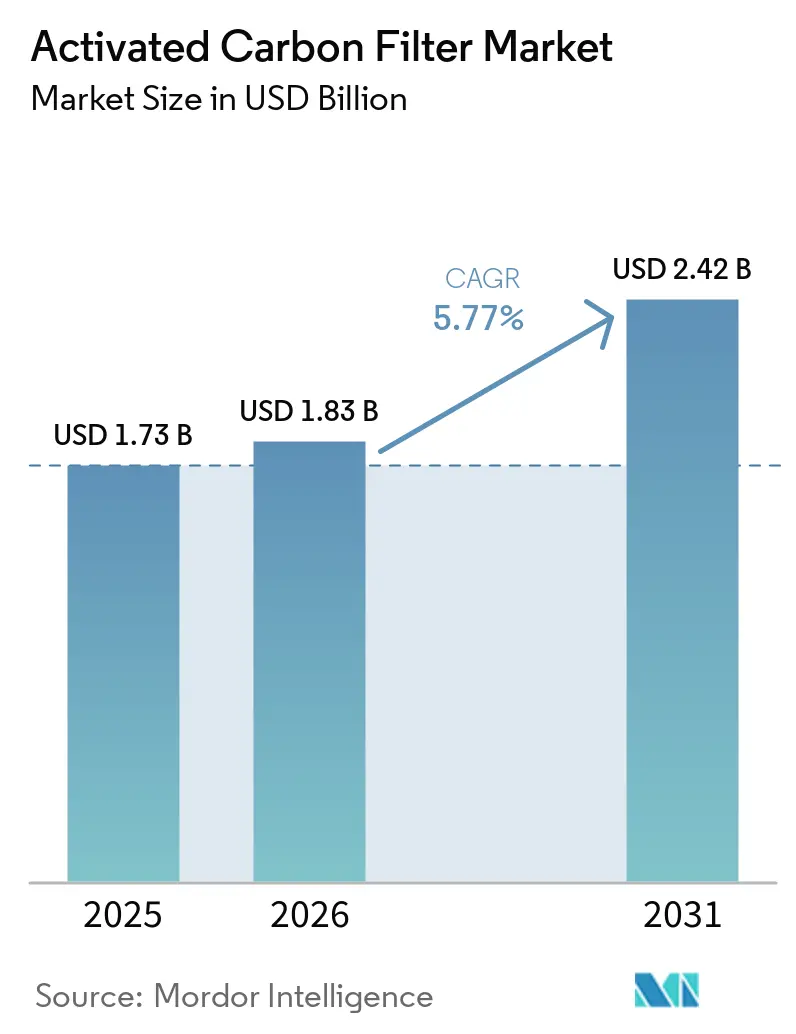
The Activated Carbon Filter Market size was valued at USD 1.73 billion in 2025 and is estimated to grow from USD 1.83 billion in 2026 to reach USD 2.42 billion by 2031, at a CAGR of 5.77% during the forecast period (2026-2031). The market is supported by drinking-water rules for per- and polyfluoroalkyl substances (PFAS), industrial wastewater compliance in Asia, and wider use of carbon media in commercial heating, ventilation, and air-conditioning systems. These demand sources serve different end uses, which helps limit exposure to a single purchasing cycle. Suppliers are placing greater emphasis on regeneration capacity and managed-service agreements because customers need carbon replacement, treatment equipment, and spent-media handling together. Energy use during activation and reactivation remains a cost and reporting concern, particularly where buyers examine direct and purchased-energy emissions. Liability for PFAS-contaminated spent carbon is also directing customers toward service arrangements that include regeneration and disposal responsibilities.
Key Report Takeaways
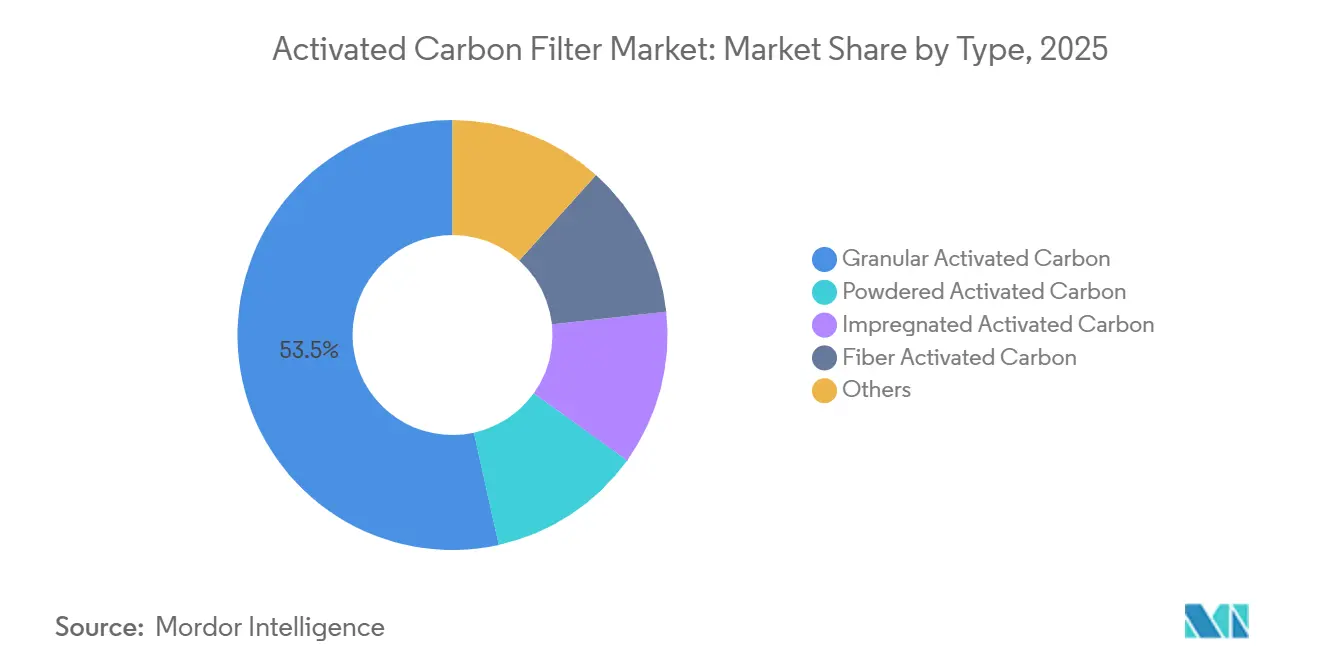
- By type, granular activated carbon held 53.45% of the activated carbon filter market share in 2025 and is projected to advance at a 6.14% CAGR through 2031.
- By raw material, coal held 43.13% of the activated carbon filter market share in 2025, while coconut shell is projected to advance at a 6.35% CAGR through 2031.
- By application, water treatment held 42.56% of the activated carbon filter market share in 2025, while industrial gas adsorption is projected to advance at a 6.77% CAGR through 2031.
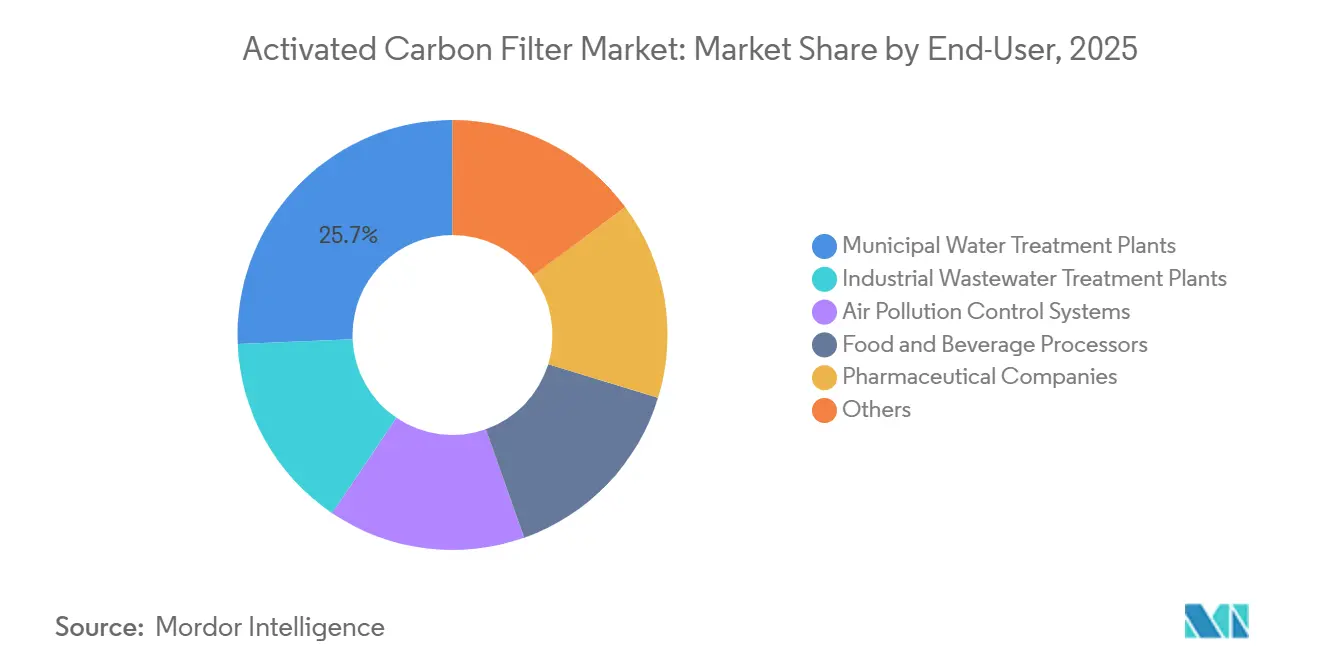
- By end-user, municipal water treatment plants held 25.67% of the activated carbon filter market share in 2025, while air pollution control systems are projected to advance at a 6.86% CAGR through 2031.
- By geography, Asia-Pacific held 38.45% of the activated carbon filter market share in 2025 and is projected to advance at a 6.52% CAGR through 2031.
Note: Market size and forecast figures in this report are generated using Mordor Intelligence’s proprietary estimation framework, updated with the latest available data and insights as of January 2026.
Global Activated Carbon Filter Market Trends and Insights
Drivers Impact Analysis*
| Driver | (~) % Impact on CAGR Forecast | Geographic Relevance | Impact Timeline |
|---|---|---|---|
| Tightening Drinking-Water Standards and PFAS Remediation | +1.8% | North America & EU, with early spillover to APAC | Short term (≤ 2 years) |
| Expansion of Industrial Wastewater Treatment | +1.4% | APAC core, spillover to MEA | Medium term (2-4 years) |
| Industrial VOC, Mercury and Hazardous-Emission Control | +1.1% | China & India core, North America | Medium term (2-4 years) |
| Indoor Air-Quality and HVAC Filtration Adoption | +0.8% | Global, early gains in North America and EU | Medium term (2-4 years) |
| Reactivation and Circular Carbon-Service Models | +0.6% | North America & EU | Long term (≥ 4 years) |
| Source: Mordor Intelligence | |||
Tightening Drinking-Water Standards and PFAS Remediation
The U.S. Environmental Protection Agency (EPA) finalized enforceable Maximum Contaminant Levels of 4 parts per trillion for perfluorooctanoic acid and perfluorooctane sulfonic acid in April 2024. Public water systems must comply by 2029[1]U.S. Environmental Protection Agency, “PFAS National Primary Drinking Water Regulation,” U.S. Environmental Protection Agency, epa.gov. The rule supports longer-term investment in granular activated carbon contactors and replacement services. In January 2025, Calgon Carbon Corporation and American Water finalized a 9-year exclusive agreement for granular activated carbon, equipment, and reactivation services at more than 50 sites in 10 states through 2033. Pretreatment choices matter because dissolved organic matter affects how quickly granular activated carbon is exhausted during PFAS removal. Kemira approved an investment in a Helsingborg, Sweden, reactivation plant intended to support the removal of micropollutants and PFAS in the Nordic region.
Expansion of Industrial Wastewater Treatment
Industrial wastewater treatment remains a major source of demand for the activated carbon filter market in the Asia-Pacific. China’s emissions objectives and industrial wastewater controls support tertiary treatment in chemical, petrochemical, and pharmaceutical operations. India has also tightened discharge requirements for textile and tanning clusters under amendments to its environmental framework. These requirements increase demand for polishing stages where activated carbon removes residual organic contaminants. Chinese suppliers serve domestic wastewater projects while also competing in export markets for commodity-grade material. Higher coconut shell costs have made pricing more difficult for Indian producers, while the Activated Carbon Manufacturers Association of India has sought greater transparency in the coconut shell and charcoal supply chain.
Industrial VOC, Mercury and Hazardous-Emission Control
Volatile organic compounds (VOCs), mercury, and hazardous-emission control support demand for specialized carbon media in industrial gas treatment. Coal-fired power plants and industrial combustion facilities require media that can capture pollutants from flue gas streams. Sulfur-impregnated and halogenated carbons are used where elemental mercury removal requires more than commodity-grade adsorption media. China and India are important demand centers because their industrial fleets are large and their emission controls are becoming more stringent. The activated carbon filter market also benefits from gas-treatment needs in liquefied natural gas processing and other gas purification applications.
Reactivation and Circular Carbon-Service Models
Reactivation capacity is becoming a stronger competitive factor in the activated carbon filter market. Thermal reactivation plants require permits, specialized equipment, and long construction periods, which can favor suppliers with established networks. Managed-service contracts allow the supplier to retain ownership of the carbon and handle replacement, regeneration, and disposal. This structure shifts purchasing away from one-time media procurement toward ongoing performance commitments. It also responds to customers’ concerns about the handling of PFAS-contaminated spent carbon. The REGENIOUS project is developing in-situ regeneration approaches intended to reduce the energy needed to regenerate spent granular activated carbon (GAC)[2]European Commission, “REGENIOUS, REthinking the ReGENeration of Spent Granular Activated Carbon,” CORDIS, cordis.europa.eu.
Restraints Impact Analysis*
| Restraint | (~) % Impact on CAGR Forecast | Geographic Relevance | Impact Timeline |
|---|---|---|---|
| Coconut Shell and Coal Feedstock Price Volatility | -1.2% | APAC core (India, Indonesia, Sri Lanka), Global spillover | Short term (≤ 2 years) |
| High Energy Intensity of Activation and Reactivation | -0.9% | Global | Long term (≥ 4 years) |
| Spent-Carbon Disposal and Contaminant Liability | -0.7% | North America & EU | Medium term (2-4 years) |
| Source: Mordor Intelligence | |||
Coconut Shell and Coal Feedstock Price Volatility
Coconut shell availability is a material cost issue for producers serving the activated carbon filter market. In June 2025, Jacobi Carbons Group announced a 15%-20% price increase for coconut-shell-based activated carbons, effective July 1, 2025. The company cited limited coconut availability across Asia and rising competition for shells from food, cosmetics, and battery-material applications. Coal-based material faces a separate exposure to trade conditions and imported supply. Calgon Carbon Corporation launched Operation Bedrock in June 2025 to provide tariff-free coal-based activated carbon sourced from U.S.-mined coal and processed through U.S. activation and reactivation infrastructure. Suppliers with diversified feedstock sourcing and regional production can better manage changes in input costs and delivery conditions.
High Energy Intensity of Activation and Reactivation
Activation and reactivation are energy-intensive processes that affect operating costs and customer procurement decisions. A 2025 life-cycle study reported that potassium hydroxide activation required 28.3 megajoules of energy per kilogram of activated carbon and generated 1.26 kilograms of carbon dioxide equivalent per kilogram. Pyrolysis was the principal energy stage in the activation pathways assessed by the study. Energy use becomes more significant where customers must report direct and purchased-energy emissions. The EU Corporate Sustainability Reporting Directive increases attention to emissions disclosures among covered businesses. Lower-energy regeneration methods could improve the position of circular service models, although deployment will depend on technical performance and operating economics.
*Our forecasts treat driver/restraint impacts as directional, not additive. The impact forecasts reflect baseline growth, mix effects, and variable interactions.
Segment Analysis
By Type: Granular Activated Carbon Anchors Revenue, While Specialty Grades Target Niche Performance
Granular activated carbon held a 53.45% of the activated carbon filter market share in 2025 and is projected to advance at a 6.14% CAGR through 2031. Its position in the activated carbon filter market reflects its use in fixed-bed contactors for municipal water treatment and PFAS removal. Utilities can integrate granular media into established treatment infrastructure and arrange replacement or reactivation on recurring cycles. This supports its use in larger water projects that require a reliable supply and documented treatment performance.
Powdered activated carbon serves short-contact-time applications, including emergency treatment responses and smaller water systems. Its capital-light deployment can be useful where building a permanent contactor is not practical. In the activated carbon filter market, impregnated activated carbon supports gas purification and pollutant-control applications that require tailored chemical properties. Fiber-activated carbon addresses cleanroom and solvent-recovery uses where low pressure drop and high surface area are important. Pelletized and extruded grades remain relevant in gas-phase adsorption systems where resistance to bed attrition is needed.



By Raw Material: Coal Leads by Revenue, Coconut Shell Leads by Growth
Coal held 43.13% of the activated carbon filter market share in 2025. Its position in the activated carbon filter market was supported by availability in China and the United States, as well as its role in commodity water treatment and flue-gas applications. Coal-based grades can provide a cost advantage where performance specifications do not require the pore structure of coconut shell material. Trade conditions and domestic supply programs can influence the availability of these grades in individual regions.
Coconut shell is projected to advance at a 6.35% CAGR through 2031. Its micropore structure supports applications that require the adsorption of PFAS and volatile organic compounds in the activated carbon filter market. A 2025 study examined the health benefits and trade-offs of granular activated carbon treatment for PFAS exposure, underscoring the importance of treatment performance and regeneration choices. Wood-based carbon has an incremental role in Europe, where circular-economy criteria can favor biogenic materials and reactivation. Petroleum coke-derived material remains suited to specialized gas purification and precious-metals recovery uses that require controlled ash chemistry.
By Application: Water Treatment Commands Share, Industrial Gas Adsorption Accelerates
Water treatment accounted for 42.56% of the activated carbon filter market size in 2025. Demand in the activated carbon filter market came from centralized drinking-water investment in Asia-Pacific and PFAS compliance programs in North America and Europe. Treatment systems use activated carbon to remove contaminants, improve taste and odor, and support regulated water quality outcomes. This application also supports long-duration supply and reactivation agreements for municipal customers.
Industrial gas adsorption is projected to advance at a 6.77% CAGR through 2031. Growth in the activated carbon filter market is associated with pollutant control at power and industrial facilities, gas processing, and emerging hydrogen purification activities. Air purification benefits from commercial heating, ventilation, and air-conditioning specifications and building development in Southeast Asia, the Middle East, and India. Food and beverage processing maintains demand for decolorization, taste and odor removal, and purification activities. These uses provide a broad customer base beyond municipal water treatment.
By End-User: Air Pollution Control Systems Gaining Ground Against an Established Municipal Water Treatment Plants Base
Municipal water treatment plants held 25.67% of the activated carbon filter market size in 2025. The segment reflects the scale of centralized water infrastructure and the extended duration of many granular activated carbon supply agreements in the activated carbon filter market. Municipal operators also need defined processes for spent-carbon handling and reactivation. These requirements favor suppliers that can combine media, equipment, logistics, and regeneration services.
Air pollution control systems are projected to advance at a 6.86% CAGR through 2031. The segment in the activated carbon filter market is supported by mercury and volatile organic compound controls across industrial facilities in China and India. Industrial wastewater treatment plants also create demand in chemical, petrochemical, textile, and related production clusters. Food and beverage processors and pharmaceutical companies form high-value customer groups where product qualification and compliance documentation are important. These end users can favor established suppliers with specialized products and reliable technical support.
Geography Analysis
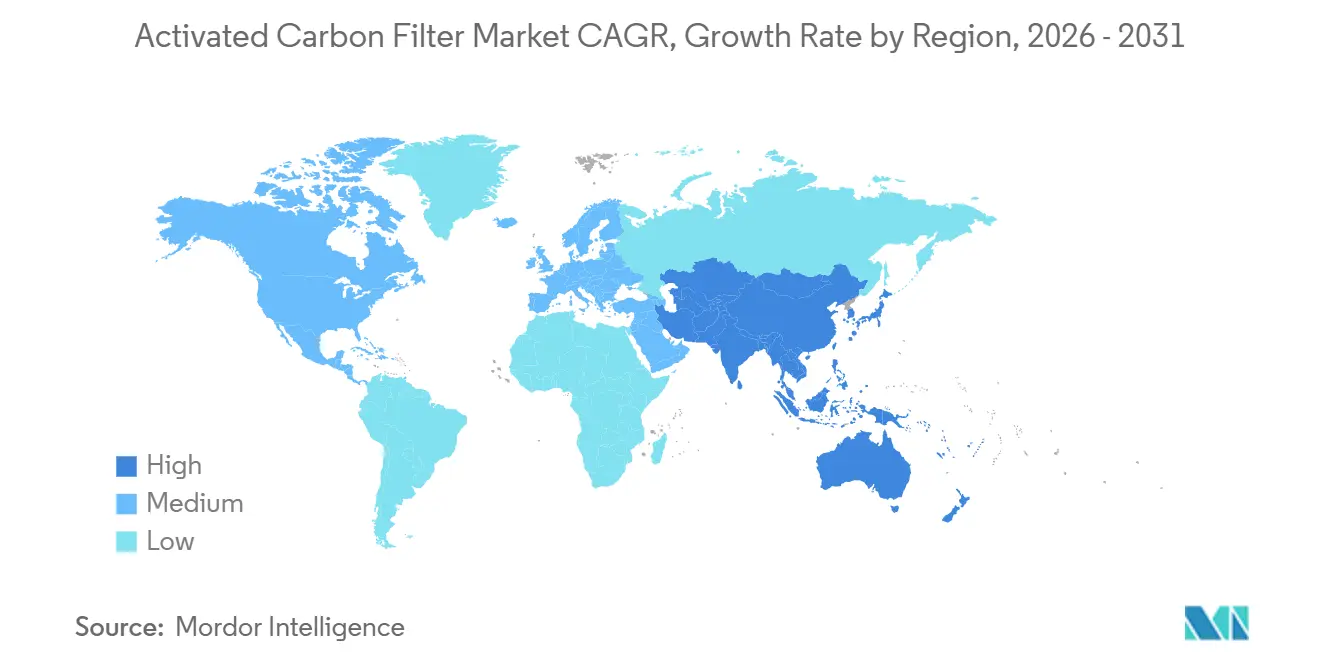
Asia-Pacific held 38.45% market share in 2025 and is projected to advance at a 6.52% CAGR through 2031. The activated carbon filter market in the region combines major production capacity with growing consumption in water treatment, industrial wastewater treatment, and air purification. China is an important producer of coal-based activated carbon and a major source of commodity-grade material for export markets. India is an important growth market because of wastewater controls and municipal water-quality goals. Higher coconut shell costs and competition from Chinese suppliers have pressured Indian producers.
Japan and South Korea support demand in the activated carbon filter market through pharmaceutical manufacturing and semiconductor clean-air requirements. KURARAY CO., LTD. and Osaka Gas Chemicals Co., Ltd. serve domestic high-purity applications that require products meeting relevant quality standards. Vietnam, Indonesia, and the Philippines are emerging demand centers as industrial wastewater rules and urban water infrastructure investment develop. North America is a mature region that is being reshaped by drinking-water compliance investment. The U.S. PFAS drinking-water rule has created a deadline-driven investment cycle for public water systems.
In February 2026, Calgon Carbon Corporation announced a nearly USD 100 million investment to expand drinking-water carbon reactivation capacity at its Columbus, Ohio, facility. The project is expected to begin operations in the first quarter of 2028. Europe has a regulatory demand base created by water and industrial emissions rules, with Germany supporting solvent recovery and PFAS remediation activity. Brazil supports South American demand through sugar decolorization, edible-oil refining, and bottled-water purification. In the Middle East and Africa, industrial diversification, desalination, power upgrades, and South African gold and platinum recovery support localized demand.

Competitive Landscape
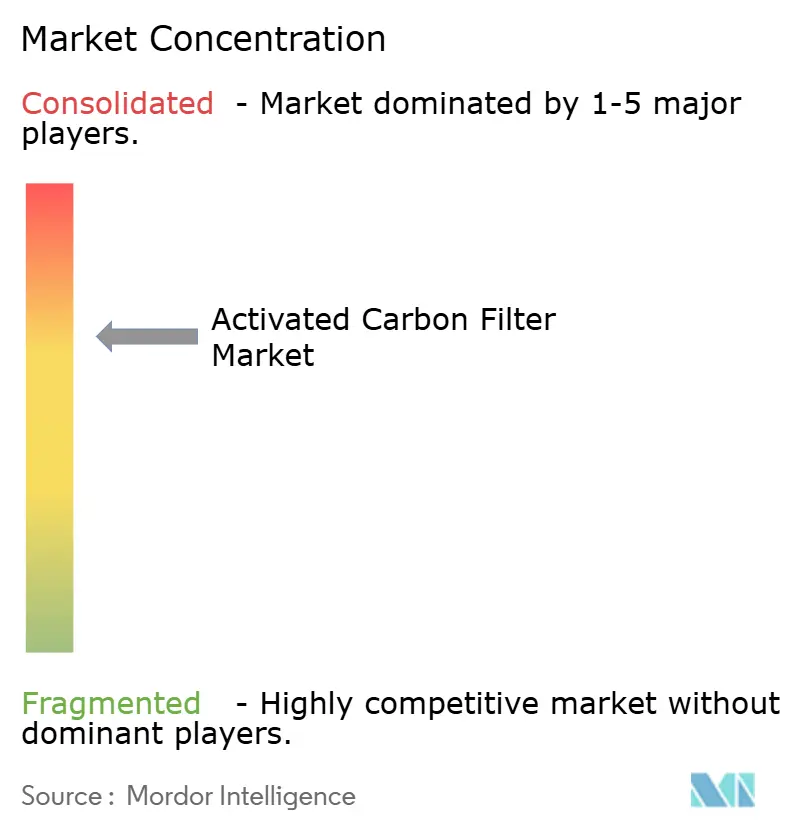
The activated carbon filter market is moderately concentrated, with the top five players including Kureha Corporation, Cabot Corporation, KURARAY CO., LTD., JACOBI CARBONS GROUP, and HAYCARB PLC. KURARAY CO., LTD., through Calgon Carbon Corporation, has a large granular activated carbon reactivation network in the United States, Europe, and Asia. Its network supports municipal contracts that require reliable replacement and spent-carbon handling. In October 2025, Calgon Carbon Corporation released results from a peer-reviewed study on PFAS removal and destruction through custom municipal reactivation. The scale and permitting requirements of reactivation capacity can make it difficult for new suppliers to duplicate established networks.
Jacobi Carbons Group has differentiated itself through its coconut-shell-based activated carbon portfolio and full-cycle service model in the activated carbon filter market. In November 2025, the company held a groundbreaking ceremony for a reactivation plant in Vierzon, France, described as the country’s first facility for reactivating spent activated carbon from industrial applications. Haycarb PLC is expanding its production footprint to diversify its coconut shell supply. In October 2025, Haycarb announced the establishment of Haycarb Philippines Corporation, its 7th manufacturing plant and 4th manufacturing country. The first phase is targeted at 6,000 metric tons per year, with commissioning planned for April 2027.
Product differentiation and circular service models are the main competitive approaches in the activated carbon filter market. Smaller utilities and industrial customers may provide an opening for modular regeneration technologies where large network contracts are not suitable. Cabot Corporation announced circular reinforcing carbon production capability at facilities in Indonesia and China in February 2026 under International Sustainability and Carbon Certification PLUS mass-balance certification. Sustainability documentation is becoming more relevant to premium supply agreements and customer qualification.
Activated Carbon Filter Industry Leaders
Kureha Corporation
Cabot Corporation
KURARAY CO., LTD.
JACOBI CARBONS GROUP
HAYCARB PLC
- *Disclaimer: Major Players sorted in no particular order

Recent Industry Developments
- June 2026: Calgon Carbon launched Filtrasorb Rx, a premium reactivated carbon designed for municipal drinking-water systems and supported by studies demonstrating more than 99.9% destruction removal efficiency. The product strengthens the use of reactivated carbon in drinking-water filtration while helping utilities manage treatment costs and PFAS-related requirements.
- March 2026: KURARAY CO., LTD. announced an approximately USD 100 million investment to expand reactivated carbon production capacity at its Columbus, Ohio, plant by 12,300 tons per year, with operations planned for 2028. The expansion is aimed at meeting growing demand for drinking-water treatment and PFAS removal, supporting the supply of activated carbon media used in filtration systems.


Global Activated Carbon Filter Market Report Scope
Activated carbon filters are filtration systems that use highly porous carbon media to adsorb and remove contaminants from fluid and gas streams. They support the treatment and purification of water, air, and industrial process streams by reducing unwanted compounds and impurities.
The Activated Carbon Filter Market is segmented by type, raw material, application, end-user, and geography. By type, the market is segmented into granular activated carbon, powdered activated carbon, impregnated activated carbon, fiber activated carbon, and others. By raw material, the market is segmented into coal, coconut shell, wood, petroleum coke, and others. By application, the market is segmented into water treatment, air purification, food and beverage processing, pharmaceutical, industrial gas adsorption, and others. By end-user, the market is segmented into municipal water treatment plants, industrial wastewater treatment plants, air pollution control systems, food and beverage processors, pharmaceutical companies, and others. The report also covers the market size and forecasts for activated carbon filters in 15 countries across major regions. For each segment, the market sizing and forecasts have been done on the basis of value (USD).
| Granular Activated Carbon |
| Powdered Activated Carbon |
| Impregnated Activated Carbon |
| Fiber Activated Carbon |
| Others |
| Coal |
| Coconut Shell |
| Wood |
| Petroleum Coke |
| Others |
| Water Treatment |
| Air Purification |
| Food and Beverage Processing |
| Pharmaceutical |
| Industrial Gas Adsorption |
| Others |
| Municipal Water Treatment Plants |
| Industrial Wastewater Treatment Plants |
| Air Pollution Control Systems |
| Food and Beverage Processors |
| Pharmaceutical Companies |
| Others |
| Asia-Pacific | China |
| India | |
| Japan | |
| South Korea | |
| ASEAN Countries | |
| Rest of Asia-Pacific | |
| North America | United States |
| Canada | |
| Mexico | |
| Europe | Germany |
| United Kingdom | |
| France | |
| Italy | |
| NORDIC Countries | |
| Rest of Europe | |
| South America | Brazil |
| Argentina | |
| Rest of South America | |
| Middle East and Africa | Saudi Arabia |
| South Africa | |
| Rest of Middle East and Africa |
| By Type | Granular Activated Carbon | |
| Powdered Activated Carbon | ||
| Impregnated Activated Carbon | ||
| Fiber Activated Carbon | ||
| Others | ||
| By Raw Material | Coal | |
| Coconut Shell | ||
| Wood | ||
| Petroleum Coke | ||
| Others | ||
| By Application | Water Treatment | |
| Air Purification | ||
| Food and Beverage Processing | ||
| Pharmaceutical | ||
| Industrial Gas Adsorption | ||
| Others | ||
| By End-User | Municipal Water Treatment Plants | |
| Industrial Wastewater Treatment Plants | ||
| Air Pollution Control Systems | ||
| Food and Beverage Processors | ||
| Pharmaceutical Companies | ||
| Others | ||
| By Geography | Asia-Pacific | China |
| India | ||
| Japan | ||
| South Korea | ||
| ASEAN Countries | ||
| Rest of Asia-Pacific | ||
| North America | United States | |
| Canada | ||
| Mexico | ||
| Europe | Germany | |
| United Kingdom | ||
| France | ||
| Italy | ||
| NORDIC Countries | ||
| Rest of Europe | ||
| South America | Brazil | |
| Argentina | ||
| Rest of South America | ||
| Middle East and Africa | Saudi Arabia | |
| South Africa | ||
| Rest of Middle East and Africa | ||


Key Questions Answered in the Report
What is the size of the activated carbon filter market?
The activated carbon filter market stands at USD 1.83 billion in 2026 and is projected to reach USD 2.42 billion by 2031.
What is driving demand for activated carbon filters?
PFAS drinking-water treatment, industrial wastewater compliance, emission control, and commercial air-filtration needs support demand.
Which type held the largest share in 2025?
Granular activated carbon held a 53.45% share in 2025, supported by established use in fixed-bed municipal drinking-water treatment systems.
Which raw material is projected to grow fastest through 2031?
Coconut shell is projected to advance at a 6.35% CAGR through 2031 because its micropore structure supports high-performance adsorption uses for regulated contaminant removal in drinking water applications.
Page last updated on:





