
Acetonitrile Market Size and Share
Market Overview
| Study Period | 2021 - 2031 |
|---|---|
| Market Size (2026) | USD 510.22 Million |
| Market Size (2031) | USD 670.32 Million |
| Growth Rate (2026 - 2031) | 5.61 % |
| Fastest Growing Market | Asia-Pacific |
| Largest Market | Asia-Pacific |
| Market Concentration | Medium |
Major Players *Disclaimer: Major Players sorted in no particular order Image © Mordor Intelligence. Reuse requires attribution under CC BY 4.0. | |
Acetonitrile Market Analysis by Mordor Intelligence
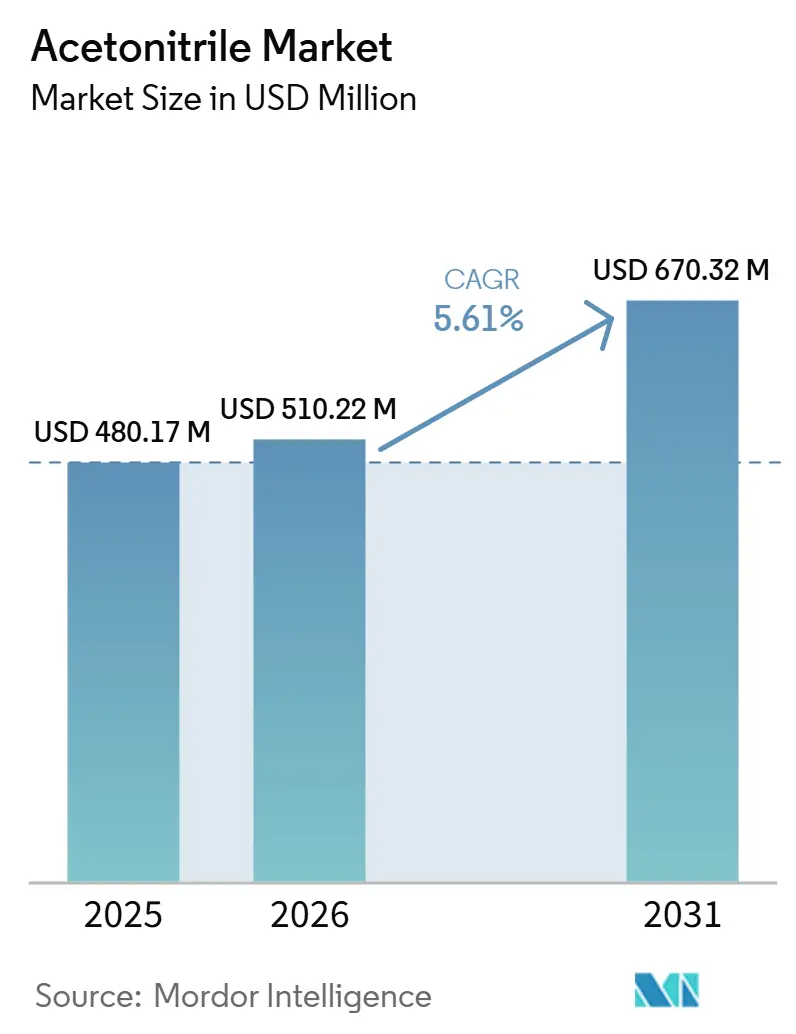
The Acetonitrile Market size is expected to increase from USD 480.17 million in 2025 to USD 510.22 million in 2026 and reach USD 670.32 million by 2031, at a CAGR of 5.61% over 2026-2031. Demand is supported by pharmaceutical manufacturing, analytical testing, chemical processing, and emerging battery applications. Supply remains tied to acrylonitrile production rather than to direct demand in the acetonitrile market. This link can cause shortages and price fluctuations when acrylonitrile operating rates decline. Producers with purification capacity, traceability, and reliable regional distribution are better positioned to serve regulated buyers. The acetonitrile market also faces a growing divide between customers seeking lower-carbon materials and those requiring extremely low levels of metallic impurities.
Key Report Takeaways
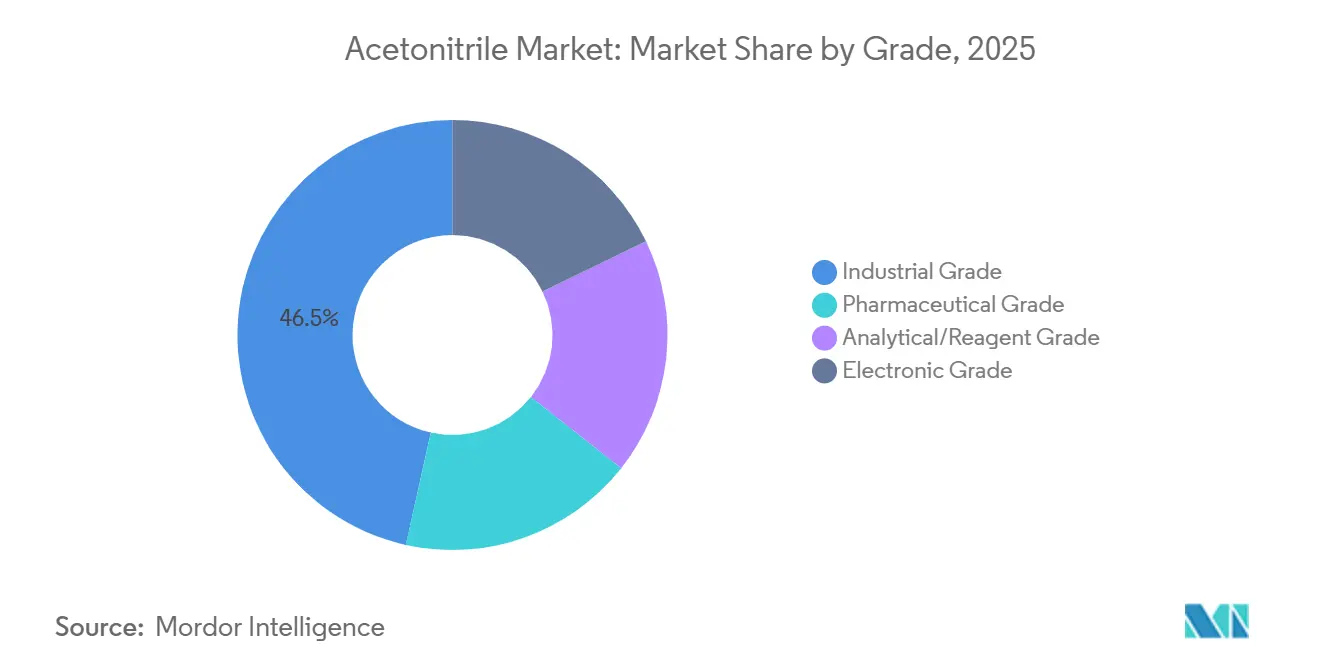
- By grade, industrial grade held 46.52% of the acetonitrile market share in 2025, while electronic grade is forecast to grow at a 6.47% CAGR through 2031.
- By purity level, high-purity material held 44.61% of the acetonitrile market share in 2025, while anhydrous material is forecast to expand at a 6.22% CAGR through 2031.
- By application, solvent accounted for 38.73% of the acetonitrile market size in 2025, while chromatography is projected to grow at a 6.76% CAGR through 2031.
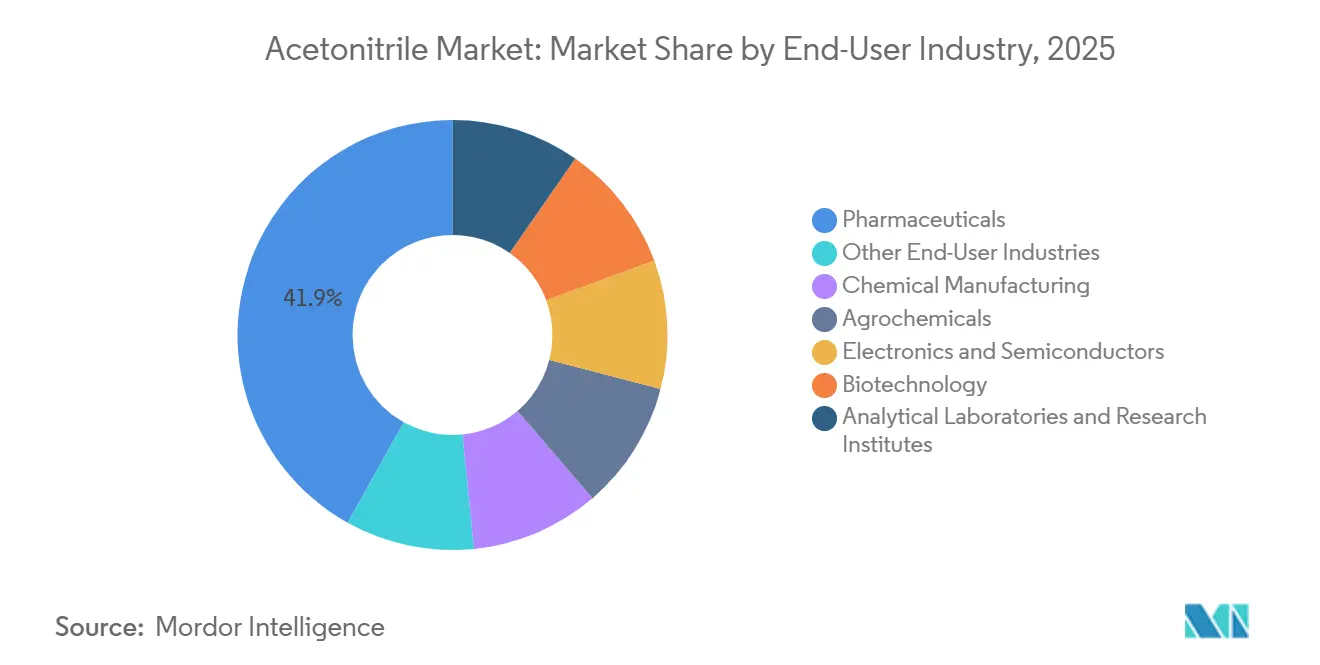
- By end-user industry, pharmaceuticals accounted for 41.91% of the acetonitrile market in 2025, while electronics and semiconductors are projected to grow at a 6.68% CAGR through 2031.
- By geography, Asia-Pacific accounted for 43.55% revenue share in 2025 and is expected to grow at a 6.04% CAGR through 2031.
Note: Market size and forecast figures in this report are generated using Mordor Intelligence’s proprietary estimation framework, updated with the latest available data and insights as of January 2026.
Global Acetonitrile Market Trends and Insights
Drivers Impact Analysis*
| Drivers | (~) % Impact on CAGR Forecast | Geographic Relevance | Impact Timeline |
|---|---|---|---|
| High-Purity Demand in Drug Manufacturing and Synthesis | +1.7% | Global, concentrated in North America, Europe, and India | Medium term (2-4 years) |
| Adoption in HPLC and Analytical Laboratories | +1.3% | Global | Short term (≤ 2 years) |
| Use in Agrochemical Production and Chemical Extraction | +0.7% | Asia-Pacific, North America | Medium term (2-4 years) |
| Demand from Electronics and Semiconductor Production | +0.9% | Asia-Pacific, with spillover to North America | Long term (≥ 4 years) |
| Rising Quality and Purity Requirements | +0.5% | North America and Europe | Short term (≤ 2 years) |
| Source: Mordor Intelligence | |||
Growing Demand for High-Purity Acetonitrile in Pharmaceutical Manufacturing and Drug Synthesis
Pharmaceutical manufacturing demand for acetonitrile is expanding beyond established high-performance liquid chromatography (HPLC) and active pharmaceutical ingredient applications. Solid-phase oligonucleotide synthesis, including work on glucagon-like peptide-1 (GLP-1) receptor agonists and antisense therapies, requires large volumes of high-purity solvent. Acetonitrile use per kilogram of output is higher in these workflows than in many conventional small-molecule processes. SK Pharmteco, Ionis Pharmaceuticals, and GEA have assessed industrial recovery and reuse methods for acetonitrile from oligonucleotide synthesis streams, indicating that supply availability has become a manufacturing concern for drug producers. Contract development and manufacturing organizations also require consistent grades, traceability, and complete current Good Manufacturing Practice (cGMP) documentation. FDA and European Medicines Agency requirements for solvent residues reinforce demand for pharmaceutical and HPLC grades that meet regulated specifications.
Increasing Adoption of Acetonitrile in HPLC and Analytical Laboratory Applications
The acetonitrile market benefits from its established role in HPLC and liquid chromatography-mass spectrometry (LC-MS) testing. Its ultraviolet transparency, low viscosity, and compatibility with water make it suitable as a mobile phase in pharmaceutical and bioanalytical methods. The shift toward ultra-high-performance liquid chromatography (UHPLC) increases solvent use per analysis cycle, as these instruments operate at higher pressure with smaller-particle columns. Regulated laboratories must use high-purity material that performs consistently across validated methods. This requirement limits spot purchasing and favors suppliers that have completed qualification processes. The growing number of pharmaceutical quality-control laboratories in India and South Korea is driving demand for analytical-grade acetonitrile.
Rising Use of Acetonitrile in Agrochemical Production and Chemical Extraction Processes
Acetonitrile supports agrochemical production as both a synthesis input and an extraction solvent. Its use is therefore broader than extraction alone, which reduces the effect of short-term changes in individual crop-protection product prices. The QuEChERS method uses buffered acetonitrile to extract pesticide residues from food samples[1]Association of Official Analytical Collaboration International, “AOAC Method 2007.01, Pesticide Residues in Foods by Acetonitrile Extraction and Partitioning With Magnesium Sulfate,” AOAC Official Methods, iaea.org.. A 2026 study found that acetonitrile improved multiclass pesticide recovery by altering the solid-liquid extraction interface. More frequent residue testing under food safety programs supports demand for extraction-grade material. Indian crop-protection manufacturers may also face different local sourcing conditions following the 2025 anti-dumping duties on certain imports.
Expanding Demand from the Electronics and Semiconductor Industries for High-Purity Solvents
Electronic-grade acetonitrile is used in wafer cleaning, photoresist stripping, LCD and thin-film transistor (TFT) production, and advanced packaging. Semiconductor processes below 10 nm require strict control of metallic contamination, as trace impurities can reduce device yield. Acetonitrile-based electrolytes have also demonstrated ionic conductivity above 15 mS/cm in fast-charging lithium-ion battery research. In November 2025, Asahi Kasei licensed its high-ionic-conductivity electrolyte technology to EAS Batteries GmbH for ultrahigh-power lithium-ion cells. The planned commercial deployment indicates how the acetonitrile market could gain demand beyond laboratory and pharmaceutical applications. Demand is concentrated in Taiwan, South Korea, China, and Japan, where semiconductor and battery manufacturing capacity is highest.
Restraints Impact Analysis*
| Restraints | (~) % Impact on CAGR Forecast | Geographic Relevance | Impact Timeline |
|---|---|---|---|
| Health, Safety, and Environmental Rules for Handling and Storage | -0.6% | European Union, North America, and global markets | Short term (≤ 2 years) |
| Supply Dependence on Acrylonitrile Production | -0.8% | Global | Medium term (2-4 years) |
| Limited Regional Availability of Ultra-High-Purity Material | -0.5% | Asia-Pacific, South America, the Middle-East, and Africa | Long term (≥ 4 years) |
| Source: Mordor Intelligence | |||
Stringent Health, Safety, and Environmental Regulations for Acetonitrile Handling and Storage
European Union rules classify acetonitrile as a Category 2 flammable liquid and identify acute oral, dermal, and inhalation hazards[2]European Chemicals Agency, “Acetonitrile, Substance Information,” European Chemicals Agency Registry, echa.europa.eu.. These requirements increase costs for storage, worker protection, handling equipment, and waste disposal. Smaller laboratories face higher costs when they lack access to centralized solvent recovery systems. The burden differs by region, as many North American and European pharmaceutical facilities already operate established recovery and compliance programs. New suppliers must provide chemical documentation and evidence of hazardous-substance compliance before qualification, which can lengthen lead times and increase reliance on approved suppliers.
Supply Constraints Due to Dependence on Acrylonitrile Production
More than 95% of global acetonitrile output is produced during the catalytic conversion of propylene to acrylonitrile. Supply can therefore decline even when demand in the acetonitrile market remains firm. Lower automotive output can reduce Acrylonitrile Butadiene Styrene (ABS) resin demand, acrylonitrile production, and the availability of co-products for laboratories. Asahi Kasei announced in May 2026 that it would close its 200,000-ton-per-year Mizushima acrylonitrile line by 2030 and shift output to Tongsuh Petrochemical in South Korea. The company announced the end of acetonitrile production at its Kawasaki site in May 2025. Limited availability of ultra-high-purity material in parts of Asia-Pacific, South America, the Middle-East, and Africa further increases the need for qualified inventory planning and regional distribution.
*Our forecasts treat driver/restraint impacts as directional, not additive. The impact forecasts reflect baseline growth, mix effects, and variable interactions.
Segment Analysis
By Grade: Industrial Volume Supports Demand While Electronic Grade Gains Ground
Industrial grade held 46.52% of the acetonitrile market share in 2025. It serves chemical synthesis, agrochemical extraction, and electrochemical processes where cost and reliable availability are important. This grade remains the foundation of the acetonitrile market, as many industrial applications do not require the lowest possible impurity levels. Its broad application base supports demand across chemical-processing regions. However, industrial-grade material competes directly with standard-grade supplies from Asian producers, which can constrain margins when buyers do not require specialized documentation. Industrial suppliers must therefore balance sales volume with investments that improve operational efficiency. This grade continues to account for a large share of physical demand in the acetonitrile market.
Electronic grade is forecast to grow at a 6.47% CAGR from 2026 to 2031. This grade addresses semiconductor applications that require metallic impurities below 1 ppb, a specification that standard industrial material cannot meet without dedicated purification and quality-control systems. MilliporeSigma lists electronic-grade acetonitrile at 99.999% trace-metals purity for battery applications. Certified quality records and application-specific assurance support higher realized prices for this material. Producers with electronic-grade capacity can serve a smaller but more demanding customer group. The acetonitrile market is thus separating into high-volume industrial supply and higher-value specialty supply, a distinction that affects capacity allocation, customer qualification, and pricing.



By Purity Level: High Purity Leads Value Demand While Anhydrous Material Rises
High-purity acetonitrile, with a purity of at least 99.9%, held 44.61% of the purity-level segment in 2025. It is widely used by pharmaceutical manufacturers and analytical laboratories that require dependable and repeatable performance. This leading position reflects the large contribution of regulated applications to the acetonitrile market. Standard and other purity levels remain important for extraction and industrial synthesis, where buyers are more price-sensitive and sub-ppm specifications are not always required. This creates a different competitive environment for suppliers serving standard-grade demand. High-purity material, therefore, remains central to revenue quality in the acetonitrile market.
Anhydrous acetonitrile is projected to grow at a 6.22% CAGR through 2031. Oligonucleotide drug synthesis requires tight control of water content, as moisture can reduce coupling efficiency and yield, making anhydrous material difficult to replace in these workflows. While standard-purity acetonitrile competes with alternative solvents in certain industrial uses, anhydrous acetonitrile has fewer practical substitutes in this therapeutic manufacturing process. Pharmaceutical customers also require compliance with residual solvent guidelines under ICH Q3C, which favors suppliers able to demonstrate purity, consistency, and documented handling. The acetonitrile market for anhydrous material is therefore tied to the expansion of advanced drug manufacturing, as well as to producers maintaining sufficient purification and logistics capacity.
By Application: Solvent Use Remains Largest While Chromatography Expands Faster
Solvent applications accounted for 38.73% of the acetonitrile market in 2025. Acetonitrile is used as a reaction medium, a process solvent, and a cleaning material in pharmaceutical and chemical operations. This breadth explains why solvent use remains the largest application category, with drug formulation, active ingredient processing, and chemical manufacturing all contributing to demand. The category provides a stable base for the acetonitrile market across multiple customer groups, and its growth is not dependent on a single analytical technique or product category. Supply disruptions can significantly affect solvent users, as substitutions may require process revalidation. Reliable supply is therefore as important to many solvent customers as price.
Chromatography is projected to grow at a 6.76% CAGR from 2026 to 2031. HPLC and LC-MS applications use acetonitrile in pharmaceutical quality control, clinical research, environmental testing, and food-safety laboratories. UHPLC systems, which use smaller-particle columns and higher pressure, can increase solvent volume per analytical cycle. Reagent and extraction applications continue to play a stable role in industrial testing and processing. Electrochemistry is also an emerging application for acetonitrile, including electrochemical synthesis, supercapacitors, and energy-storage research. Research on fast-charging lithium-ion batteries indicates that acetonitrile-based electrolytes can support new energy applications, providing the acetonitrile market with an additional source of demand beyond its established pharmaceutical and analytical base. The pace of commercial battery adoption will determine the extent to which this application contributes during the forecast period.
By End-User Industry: Pharmaceuticals Lead Consumption While Electronics Gains Momentum
Pharmaceuticals held 41.91% of the acetonitrile market share in 2025. The sector uses acetonitrile in HPLC quality control, active pharmaceutical ingredient synthesis, drug crystallization, and oligonucleotide manufacturing. These requirements make pharmaceutical demand relatively resilient, as validated production processes cannot readily be changed to use different solvents. The sector also requires traceability and documented compliance with quality standards, which favors high-purity, pharmaceutical-grade suppliers over unqualified commodity suppliers. Pharmaceutical production remains the largest end-user segment in the acetonitrile market, and purchasing decisions in this segment influence investments in recovery, storage, and regional service. The expansion of contract manufacturing increases the need for consistent material across multiple production sites.
Electronics and semiconductors are forecast to grow at a 6.68% CAGR through 2031. Semiconductor fabrication requires high-purity solvents for cleaning and process steps where contamination can affect yield. Acetonitrile electrolyte technology also provides a route to high-power, fast-charging batteries, as illustrated by Asahi Kasei's November 2025 license agreement with EAS Batteries for commercializing this technology. Chemical manufacturing and agrochemicals continue to support demand for industrial and standard grades, while biotechnology firms and analytical laboratories use smaller volumes but often require higher-grade material and reliable deliveries. Electronics demand is growing faster than its current share of total consumption, and producers focused solely on pharmaceutical accounts may overlook a customer group with distinct qualification requirements and purity needs.
Geography Analysis
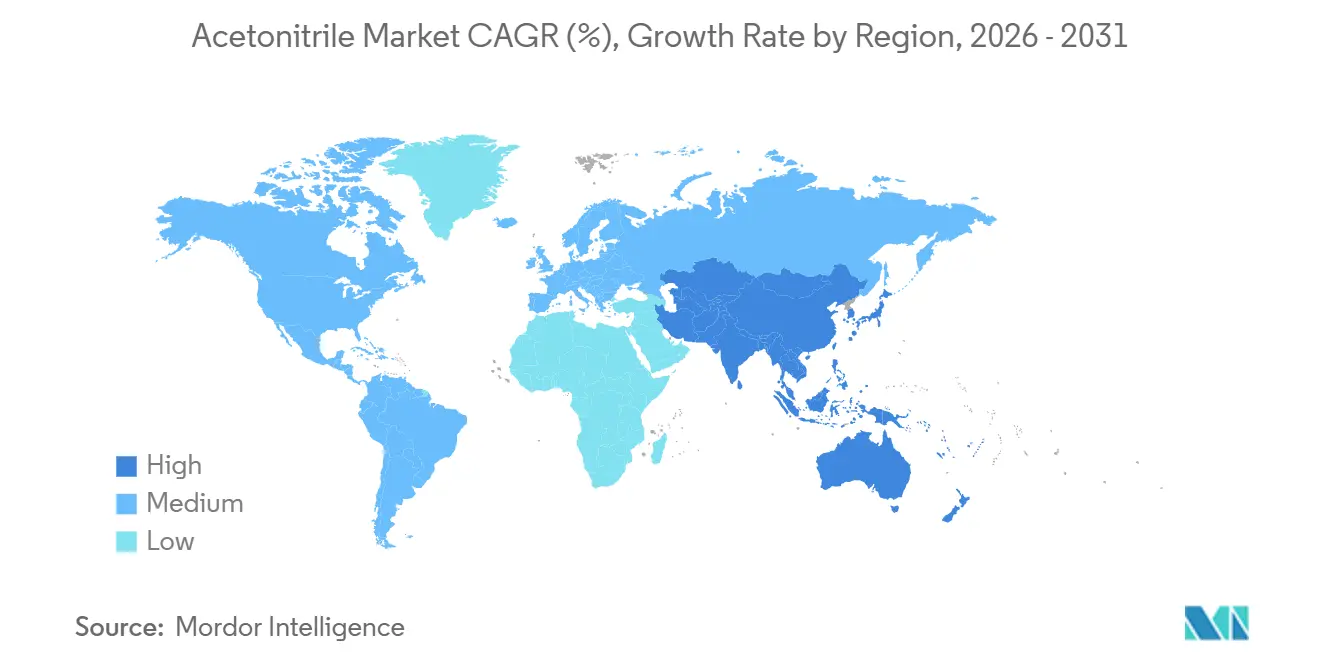
Asia-Pacific held 43.55% of the acetonitrile market share in 2025 and is forecast to grow at a 6.04% CAGR through 2031. China has significant upstream production capacity, while India, China, and South Korea support large pharmaceutical active ingredient manufacturing bases. Chinese producers influence commodity-grade pricing throughout the region. India is becoming a key demand center as pharmaceutical and active pharmaceutical ingredient (API) production expands. Japan and South Korea generate high-value demand through semiconductor fabrication and advanced battery manufacturing. Asahi Kasei's electrolyte technology licensing positions Japan as the origin of a new acetonitrile application. The regional market benefits from rising investment in biotechnology research and manufacturing. Supply qualification remains important because electronics and pharmaceutical customers require different grades and documentation.
North America is the second-largest regional market. The United States supports demand through pharmaceutical manufacturing, laboratory infrastructure, and local nitrile production. Ascend Performance Materials opened a high-purity acetonitrile recovery and purification facility at Chocolate Bayou in Alvin, Texas, on February 4, 2026. The site recovers co-produced material and refines it to pharmaceutical and analytical specifications. This development has improved regional supply resilience and reduced dependence on imported specialty-grade material. Europe remains a regulated premium market where REACH and Classification, Labeling and Packaging (CLP) obligations create a compliance threshold for suppliers. INEOS Nitriles is Europe's sole producer and serves a market that places strong value on qualified supply.
South America, the Middle-East, and Africa remain early-stage demand regions for the acetonitrile market. Brazil and Argentina support demand through generic drug and crop-protection manufacturing. South Africa's pharmaceutical and mining chemical sectors account for much of the regional demand. Saudi Arabia is expanding specialty chemical capacity and has pharmaceutical localization goals. Both regions rely substantially on imports for ultra-high-purity grades, creating an opening for suppliers that can provide distribution, documentation, technical support, and dependable inventory. Near-term demand is smaller but can become recurring as pharmaceutical and industrial sites reach operating scale. Reliance on imports lengthens lead times for laboratories and manufacturers requiring validated high-purity materials and increases the importance of local warehousing and technical support. Regional entry requires more than product availability, as buyers need quality records and support for safe handling. Generic drug production can raise demand for pharmaceutical and analytical grades over time, while crop-protection manufacturing supports a separate base of standard and extraction-grade demand. The supply gap is most visible for ultra-high-purity material used in laboratory and electronics applications.

Competitive Landscape
The acetonitrile market is moderately consolidated. Competition varies by grade, as industrial customers typically prioritize price and availability, while regulated customers prioritize documentation and lot consistency. In April 2024, INEOS Nitriles introduced INVIREO, a bio-based acetonitrile produced through an International Sustainability and Carbon Certification Plus (ISCC+)-certified mass-balance route. The company stated that the product can reduce carbon footprint by up to 90% compared with conventional production. This offering addresses pharmaceutical buyers seeking materials that support Scope 3 emissions programs, and adds sustainability documentation to the standard qualification requirements for high-purity solvent supply. The acetonitrile market rewards suppliers that can provide consistent quality across regions and retain customers through qualification cycles. Integrated producers are better positioned to manage the relationships among acrylonitrile operations, recovery systems, and purification assets, giving them greater flexibility when availability tightens or customers require grade changes. Suppliers without these assets may rely on short-term purchases that are less suitable for regulated applications. A bio-based, traceable supply can further influence supplier selection when buyers have carbon-reporting requirements.
Dedicated purification assets are a key competitive feature in specialty grades. Producers that depend on spot supply are less able to meet detailed impurity and traceability requirements. In November 2025, Asahi Kasei licensed its acetonitrile-containing electrolyte technology to EAS Batteries. This licensing agreement demonstrates how technology can create a new customer base without relying solely on additional solvent capacity. Ascend's 2026 Texas facility represents a separate strategy based on recovery and purification near acrylonitrile production. These developments address supply security, grade quality, and process efficiency. Competition in the acetonitrile market is therefore driven by both production capacity and application technology. Battery-related demand differs from laboratory use in that material volumes can increase with commercial cell production. Semiconductor customers also require impurity control that must be maintained across every lot. These requirements increase the value of dedicated purification, testing, and application support, and make it more difficult for suppliers of basic industrial grades to enter specialty accounts.
Distributors also compete by improving customer service and compliance support. Avantor expanded its Singapore distribution hub in 2025 and added GMP-aligned microbial and stability testing at its St. Louis site in April 2026, with a focus on lead times, testing, and service for biopharmaceutical customers. Recovery and recycling represent another area of competition, as they can reduce the volume of new solvent required in oligonucleotide production. Work by SK Pharmteco, Ionis Pharmaceuticals, and GEA demonstrates that recovery can function as both an operating service and a supply-management tool. Regional producers can compete in standard grades where local logistics and trade conditions are favorable. Specialty producers, however, remain better positioned where buyers require validated high-purity material. Pharmaceutical customers often require complete records covering manufacture, storage, testing, and distribution, creating a service requirement that extends beyond the supply of a chemical solvent. Recovery providers can address the same need by helping manufacturers manage spent solvent streams, reducing purchasing exposure while supporting continuity at drug-production sites. Regional suppliers can still gain business where local availability, trade conditions, and customer support outweigh the advantages of a global supplier network.
Acetonitrile Industry Leaders
INEOS
Asahi Kasei Corporation
Nova Molecular Technologies
Tedia Company, LLC.
TAEKWANG INDUSTRIAL CO., LTD.
- *Disclaimer: Major Players sorted in no particular order


Recent Industry Developments
- May 2026: Asahi Kasei announced the closure of its 200,000-ton-per-year acrylonitrile line at Mizushima, Japan, by approximately 2030. Output will shift to Tongsuh Petrochemical in South Korea, and polycarbonate diol production at Mizushima will also cease. This restructuring reduces a historically significant Japanese source of recoverable acetonitrile, requiring downstream customers to qualify alternative supply before the transition deadline.
- May 2025: Ascend Performance Materials commenced high-purity acrylonitrile production at its Chocolate Bayou plant in Alvin, Texas, following the installation and commissioning of new purification equipment. This preceded the startup of the acetonitrile facility and reflected Ascend's strategy to develop an integrated high-purity nitrile platform at the site, improving domestic US supply security for both chemicals.


Global Acetonitrile Market Report Scope
Acetonitrile is the simplest organic nitrile, primarily known as a colorless, volatile, and highly polar aprotic solvent. It is widely used in chemical synthesis, DNA/RNA synthesis, and serves as the industry standard for mobile phases in high-performance liquid chromatography (HPLC) due to its UV transparency, low viscosity, and ability to dissolve a wide range of compounds.
The acetonitrile market is segmented by grade, purity level, application, end-user industry, and geography. By grade, the market is segmented into industrial grade, electronic grade, pharmaceutical grade, and analytical/reagent grade. By purity level, the market is segmented into high purity (greater than or equal to 99.9%), anhydrous, standard purity, and other purity levels. By application, the market is segmented into solvent, reagent, extraction, chromatography, and electrochemistry. By end-user industry, the market is segmented into pharmaceuticals, chemical manufacturing, agrochemicals, electronics and semiconductors, biotechnology, analytical laboratories and research institutes, and other end-user industries. The report also covers market size and forecasts for acetonitrile across 16 countries in major regions. The market sizes and forecasts are provided in terms of value (USD).
| Industrial Grade |
| Electronic Grade |
| Pharmaceutical Grade |
| Analytical/Reagent Grade |
| High Purity (greater than or equal to 99.9%) |
| Anhydrous |
| Standard Purity |
| Other Purity Levels |
| Solvent |
| Reagent |
| Extraction |
| Chromatography |
| Electrochemistry |
| Pharmaceuticals |
| Chemical Manufacturing |
| Agrochemicals |
| Electronics and Semiconductors |
| Biotechnology |
| Analytical Laboratories and Research Institutes |
| Other End-User Industries |
| Asia-Pacific | China |
| India | |
| Japan | |
| South Korea | |
| Rest of Asia-Pacific | |
| North America | United States |
| Canada | |
| Mexico | |
| Europe | Germany |
| United Kingdom | |
| France | |
| Italy | |
| Russia | |
| Rest of Europe | |
| South America | Brazil |
| Argentina | |
| Rest of South America | |
| Middle-East and Africa | Saudi Arabia |
| South Africa | |
| Rest of Middle-East and Africa |
| By Grade | Industrial Grade | |
| Electronic Grade | ||
| Pharmaceutical Grade | ||
| Analytical/Reagent Grade | ||
| By Purity Level | High Purity (greater than or equal to 99.9%) | |
| Anhydrous | ||
| Standard Purity | ||
| Other Purity Levels | ||
| By Application | Solvent | |
| Reagent | ||
| Extraction | ||
| Chromatography | ||
| Electrochemistry | ||
| By End-User Industry | Pharmaceuticals | |
| Chemical Manufacturing | ||
| Agrochemicals | ||
| Electronics and Semiconductors | ||
| Biotechnology | ||
| Analytical Laboratories and Research Institutes | ||
| Other End-User Industries | ||
| By Geography | Asia-Pacific | China |
| India | ||
| Japan | ||
| South Korea | ||
| Rest of Asia-Pacific | ||
| North America | United States | |
| Canada | ||
| Mexico | ||
| Europe | Germany | |
| United Kingdom | ||
| France | ||
| Italy | ||
| Russia | ||
| Rest of Europe | ||
| South America | Brazil | |
| Argentina | ||
| Rest of South America | ||
| Middle-East and Africa | Saudi Arabia | |
| South Africa | ||
| Rest of Middle-East and Africa | ||


Key Questions Answered in the Report
What is current market size of Acetonitrile Market?
The Acetonitrile Market size is expected to increase from USD 480.17 million in 2025 to USD 510.22 million in 2026 and reach USD 670.32 million by 2031, at a CAGR of 5.61% over 2026-2031.
Which grade of acetonitrile held the largest share in 2025?
Industrial-grade LED with a 46.52% share in 2025 due to its use in chemical synthesis, agrochemical extraction, and electrochemical processes.
Why is anhydrous acetonitrile gaining demand?
Anhydrous material is required in oligonucleotide synthesis, as water can reduce coupling efficiency and yield.
Which application is growing fastest through 2031?
Chromatography is forecast to grow at a 6.76% CAGR as HPLC, LC-MS, and UHPLC use expands in regulated testing laboratories.
Page last updated on:





