
Zeolite Concrete Market Size and Share
Market Overview
| Study Period | 2021 - 2031 |
|---|---|
| Market Size (2026) | USD 470.63 Million |
| Market Size (2031) | USD 604.09 Million |
| Growth Rate (2026 - 2031) | 5.12 % |
| Fastest Growing Market | Asia-Pacific |
| Largest Market | Asia-Pacific |
| Market Concentration | Low |
Major Players *Disclaimer: Major Players sorted in no particular order Image © Mordor Intelligence. Reuse requires attribution under CC BY 4.0. | |
Zeolite Concrete Market Analysis by Mordor Intelligence
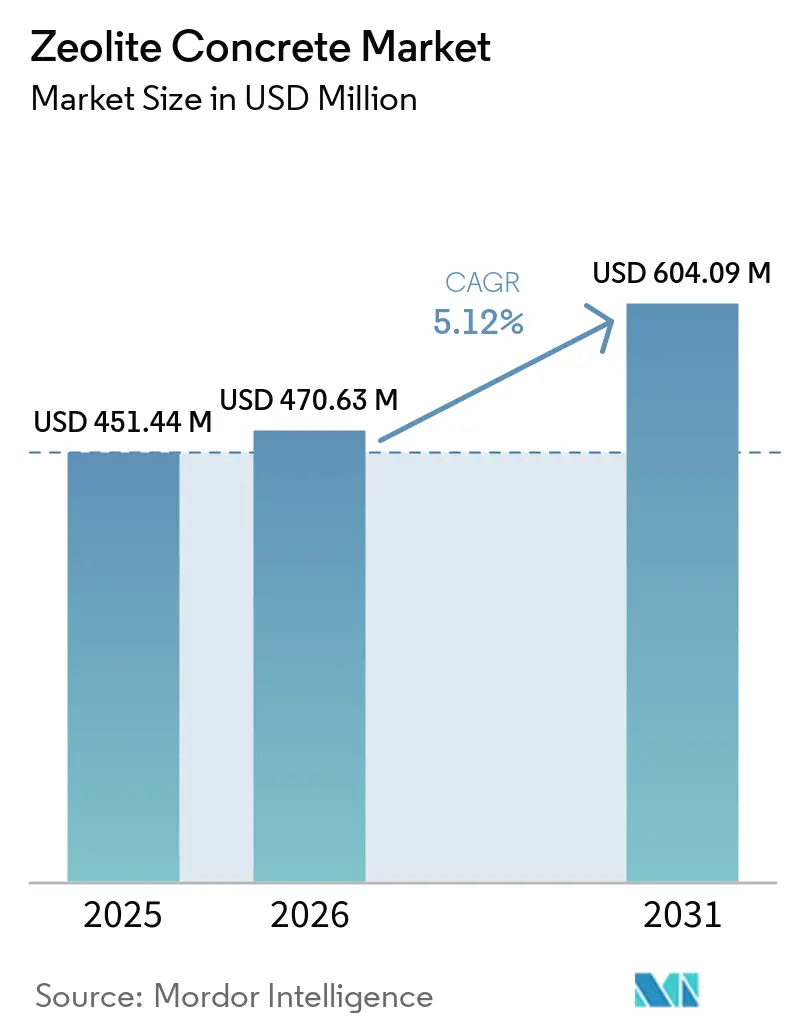
The Zeolite concrete market size was estimated at USD 451.44 million in 2025 and is estimated to grow from USD 470.63 million in 2026 to USD 604.09 million by 2031, at a CAGR of 5.12% during the forecast period (2026-2031). The zeolite concrete market is gaining relevance as cement producers and concrete buyers seek lower-clinker formulations with measurable performance. Natural zeolite can reduce cement content while improving pore structure, supporting carbon reduction and durability requirements in concrete specifications. ASTM C618 and EN 197-5 provide clearer guidance for qualifying natural pozzolans and lower-carbon blended cements. Declining availability of blast-furnace slag and fly ash is increasing interest in zeolite as an alternative supplementary cementitious material. Suppliers that provide verified reactivity data, environmental product declarations, and mix design support are better positioned to meet project specifications.
Key Report Takeaways
- By zeolite type, natural zeolite held 55.13% of the zeolite concrete market share in 2025, while synthetic zeolite is forecast to grow at a CAGR of 5.67% through 2031.
- By concrete type, ready-mix concrete held 44.06% of the zeolite concrete market share in 2025, while self-compacting concrete is forecast to grow at a CAGR of 5.79% through 2031.
- By application, structural concrete accounted for 38.22% of the zeolite concrete market size in 2025, while pavements and roads are forecast to grow at a CAGR of 6.06% through 2031.
- By end-user industry, building and construction accounted for 43.47% of the global zeolite concrete market in 2025, while water and wastewater is forecast to grow at a CAGR of 6.13% through 2031.
- By geography, Asia-Pacific held 41.34% of revenue in 2025 and is forecast to grow at a CAGR of 5.82% through 2031.
Note: Market size and forecast figures in this report are generated using Mordor Intelligence’s proprietary estimation framework, updated with the latest available data and insights as of January 2026.
Market Trends and Insights
Drivers Impact Analysis of Zeolite Concrete Market*
| Drivers | (~) % Impact on CAGR Forecast | Geographic Relevance | Impact Timeline |
|---|---|---|---|
| Low-Carbon Cement Substitution | +2.0% | Global, with early adoption gains in Europe, North America, and Australia | Medium term (2-4 years) |
| Infrastructure and Lightweight-Concrete Demand | +1.2% | Asia-Pacific core, including China, India, Indonesia, and Vietnam, with spillover to the Middle-East and Africa, and South America | Long term (≥ 4 years) |
| Durability Improvement in Aggressive Environments | +0.8% | Global, concentrated in marine economies across ASEAN, Nordic countries, and Gulf states | Medium term (2-4 years) |
| Internal Curing and Shrinkage Control | +0.4% | North America, Europe, and Japan, particularly high-performance concrete and Ultra-High-Performance Concrete (UHPC) applications | Short term (≤ 2 years) |
| Source-Specific Zeolite Reactivity and Mix Optimization | +0.3% | Turkey, Slovakia, the United States, New Zealand, and Australia | Medium term (2-4 years) |
| Local Availability of Natural Pozzolan Deposits | +0.2% | North America, Central Europe, the Middle-East and North Africa | Long term (≥ 4 years) |
| Source: Mordor Intelligence | |||
Low-Carbon Cement Substitution Driving the Core Value Proposition
The zeolite concrete market benefits from the broader shift toward pozzolanic supplementary cementitious materials. Clinoptilolite-rich natural zeolite can replace part of the cement binder while preserving mechanical and durability properties. A 2026 study found that 15% natural zeolite replacement achieved a 56-day compressive strength of 67.1 MPa, comparable with the ordinary Portland cement control. The same mix reduced the rapid chloride penetration charge to 1,719 coulombs and increased the electrical surface resistivity to 15.08 Ω·cm[1]. A 2024 study reported a carbon footprint of 659.72 kg CO₂/m³ for a 30% replacement with zeolite powder. These results support the use of zeolites in projects that require lower cement intensity and greater resistance to transport-related deterioration.
Infrastructure and Lightweight-Concrete Demand Anchoring Long-Run Volume Growth
The zeolite concrete market draws volume from transport, urban development, and other concrete-intensive construction programs. India's reinforced concrete requirements under Bureau of Indian Standards (BIS) IS 456 and China's lower-carbon procurement direction support the adoption of performance-tested supplementary cementitious material mixes. Zeolite-based lightweight concrete achieves densities from 500 kg/m³ to 1,500 kg/m³ and compressive strengths from 5 MPa to 30 MPa. Lower structural weight reduces loads on foundations and columns in high-rise construction, making the material relevant where designers need both weight reduction and adequate compressive performance. Demand remains most relevant in markets with long infrastructure pipelines and local access to suitable mineral deposits.
Durability Improvement in Aggressive Environments Expanding Marine and Industrial Segments
Zeolite concrete has a technical role in marine, hydraulic, and industrial projects exposed to chlorides and sulfates. A 2026 study using 15% natural zeolite and 10% ceramic waste powder increased 28-day compressive strength by 16.89% compared with the control mix. The blend recorded 425.7 coulombs during a 91-day rapid chloride penetration test, placing it in the very low permeability category of ASTM C1202. This result represented an 86.8% reduction from the ordinary Portland cement baseline. Research by Western Sydney University examined acid-resistant zeolite and calcium sulfoaluminate hybrid mortars for cathodic protection of reinforced concrete bridges in marine environments. Such performance supports use in structures where long service life is more important than initial material cost.
Internal Curing and Shrinkage Control Opening Ultra-High-Performance Concrete Markets
The zeolite concrete market also serves low water-to-binder ratio formulations used in ultra-high-performance concrete (UHPC) and high-performance concrete. In these mixes, autogenous shrinkage affects dimensional stability and long-term durability. Natural zeolite retains water within its pore structure and releases it during curing. Research at the University of Nottingham Ningbo China examined combinations of zeolites and superabsorbent polymers in UHPC and identified benefits in pore structure and dimensional stability. A Taiheiyo Cement research paper found that concrete with 15% natural zeolite had a creep coefficient 0.7 times that of a zeolite-free reference mix. Restrained shrinkage converged with the control at 364 days, supporting long-term durability claims.
Restraints Impact Analysis of Zeolite Concrete Market*
| Restraints | (~) % Impact on CAGR Forecast | Geographic Relevance | Impact Timeline |
|---|---|---|---|
| Natural Mineralogy and Purity Variability | -0.8% | Global, most acute for heterogeneous deposits in Turkey, Jordan, and Central America | Long term (≥ 4 years) |
| Reduced Workability and Higher Admixture Demand | -0.5% | Emerging markets with limited plasticizer infrastructure in Southeast Asia, South America, the Middle-East, and Africa | Short term (≤ 2 years) |
| Early-Age Strength and Slow Pozzolanic Reaction | -0.4% | Global, particularly fast-construction markets in China, the Gulf states, and the U.S. residential sector | Short term (≤ 2 years) |
| Source: Mordor Intelligence | |||
Natural Mineralogy and Purity Variability Constraining Specification Adoption
The zeolite concrete market faces a consistency challenge because natural deposits vary in their contents of clinoptilolite, heulandite, natrolite, and volcanic glass. These materials have different pozzolanic reactivity profiles, meaning mineral sources cannot be treated as interchangeable without testing. A cation exchange capacity threshold of 100 meq/100 g has been used in the Bear River Zeolite reserve report, but this measure does not capture all mix performance variation[2]. Experimental literature from 2026 also reported different rapid chloride penetration values for a single zeolite mix, demonstrating the sensitivity of performance testing to material and test conditions. Producers with independently verified product data can reduce this uncertainty for concrete specifiers. The requirement for reliable product qualification may favor established deposits and suppliers with technical support.
Reduced Workability and Higher Admixture Demand Raise the Total Cost of Adoption
Zeolite's internal porosity can increase water demand in fresh concrete, even though that porosity supports internal curing after placement. Higher replacement levels can alter slump behavior and require additional plasticizing admixture. A 2026 study reported a 12 cm slump at 25% zeolite replacement, a 140% increase over the ordinary Portland cement control, indicating a different rheological response that must be managed in mix design. Admixture use can add cost and require closer batching control. This barrier is more pronounced where plasticizer supply is limited or contractors depend on high-slump, pumpable concrete. It can limit use to projects able to support trial mixes, technical supervision, and adjusted logistics.
*Our forecasts treat driver/restraint impacts as directional, not additive. The impact forecasts reflect baseline growth, mix effects, and variable interactions.
Zeolite Concrete Market Segment Analysis
By Zeolite Type:
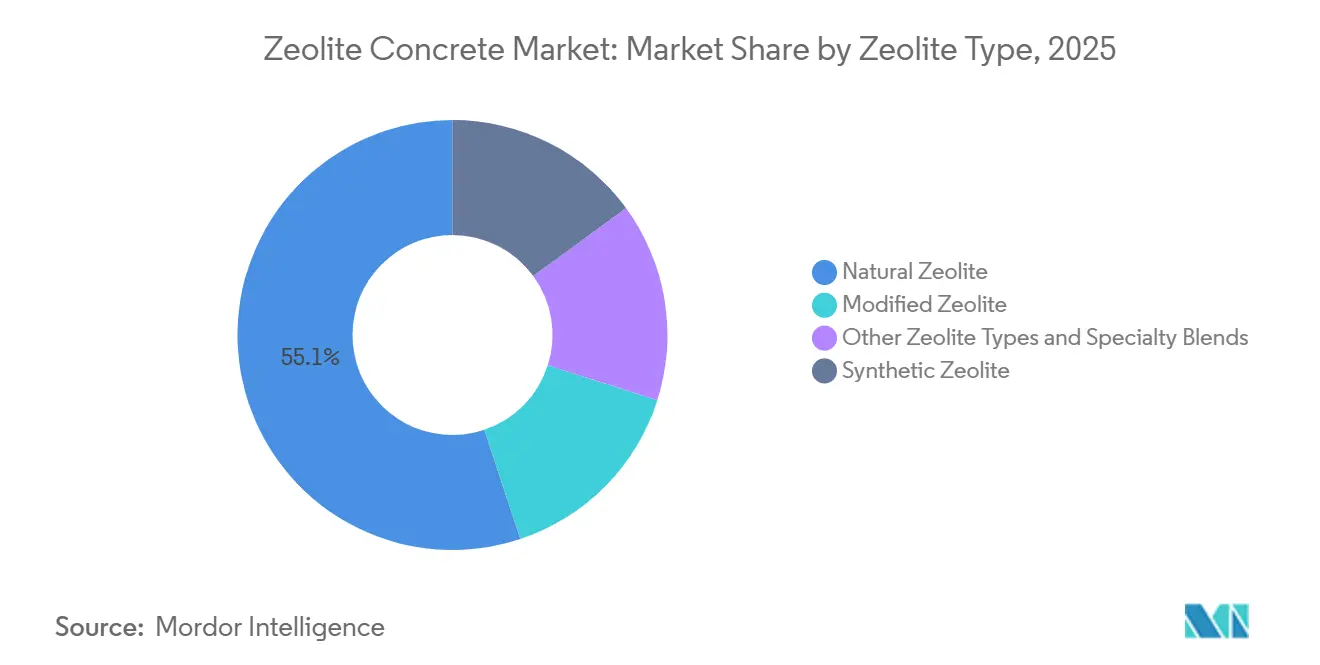
Natural Deposits Lead Demand While Synthetic Grades Serve Precision ApplicationsNatural zeolite held 55.13% of the global zeolite concrete market in 2025. Its position reflects lower cost and wide geographic availability. Natural zeolite mine production ranges from 3 to 4 million metric tons annually, with deposits in Turkey, Slovakia, Cuba, Japan, and the western United States. Clinoptilolite-rich deposits are commonly located near ready-mix concrete production regions, thereby reducing transport costs and simplifying local procurement. Natural grades are therefore suitable for large-scale concrete applications where dependable local material is available.
Synthetic zeolite is forecast to grow at a 5.67% CAGR through 2031. Synthetic grades benefit from applications requiring consistent mineralogy per contract specifications. High-performance concrete, precast panels, and self-compacting concrete are examples of such applications. Modified zeolite has a smaller role in UHPC and marine-protection formulations. Thermal or chemical activation can improve reactivity beyond that of untreated mineral. Cuban research found that thermal activation at 200°C for 2 hours increased the strength activity index with ordinary Portland cement by 13% at a 20% replacement level.

By Concrete Type:
Ready-Mix Leads While Self-Compacting Concrete Gains Premium DemandReady-mix concrete represented 44.06% of the global zeolite concrete market in 2025. It is the standard delivery format for commercial, residential, and infrastructure pours. Zeolite substitution can be implemented at the batching plant without major capital investment, thereby supporting adoption within established ready-mix supply chains. Precast concrete uses zeolite primarily for long-term durability and pore refinement, properties that are important for elements designed for extended service life.
Self-compacting concrete is projected to expand at a 5.79% CAGR through 2031. It is used in complex forms, densely reinforced sections, and acoustic wall panels. Urban residential construction and data-center construction can support demand for these applications. A 2024 study of self-compacting concrete with zeolite and graphene oxide found that a mix containing 10% zeolite and 0.02% graphene oxide improved compressive strength, flexural strength, and elastic modulus across curing ages. The study also reported a lower carbon footprint than conventional concrete. These performance requirements support a more specialized role compared to ready-mix applications.
By Application:
Structural Concrete Anchors Demand While Road Construction ExpandsStructural concrete accounted for 38.22% of the zeolite concrete market in 2025. This demand reflects the material's compatibility with reinforced and post-tensioned concrete designs. Zeolite mixes with 10% to 15% clinoptilolite replacement have shown compressive strength gains of up to 2.6% at 28 days, along with improved resistance to chloride and sulfate exposure. These properties are relevant to the durability of frames in buildings and infrastructure. Structural applications remain the largest end use because they combine the scale of demand with defined performance requirements.
Pavements and road construction are forecast to grow at a 6.06% CAGR through 2031, supported by the material's role in pavement-related formulations. Lower-temperature placement methods can reduce fuel use and bitumen oxidation. Marine and hydraulic structures form a smaller, high-value application area, where resistance to sulfate attack, chloride ingress, and sea-spray carbonation supports use in coastal structures and bridge-protection systems.
By End-User Industry:
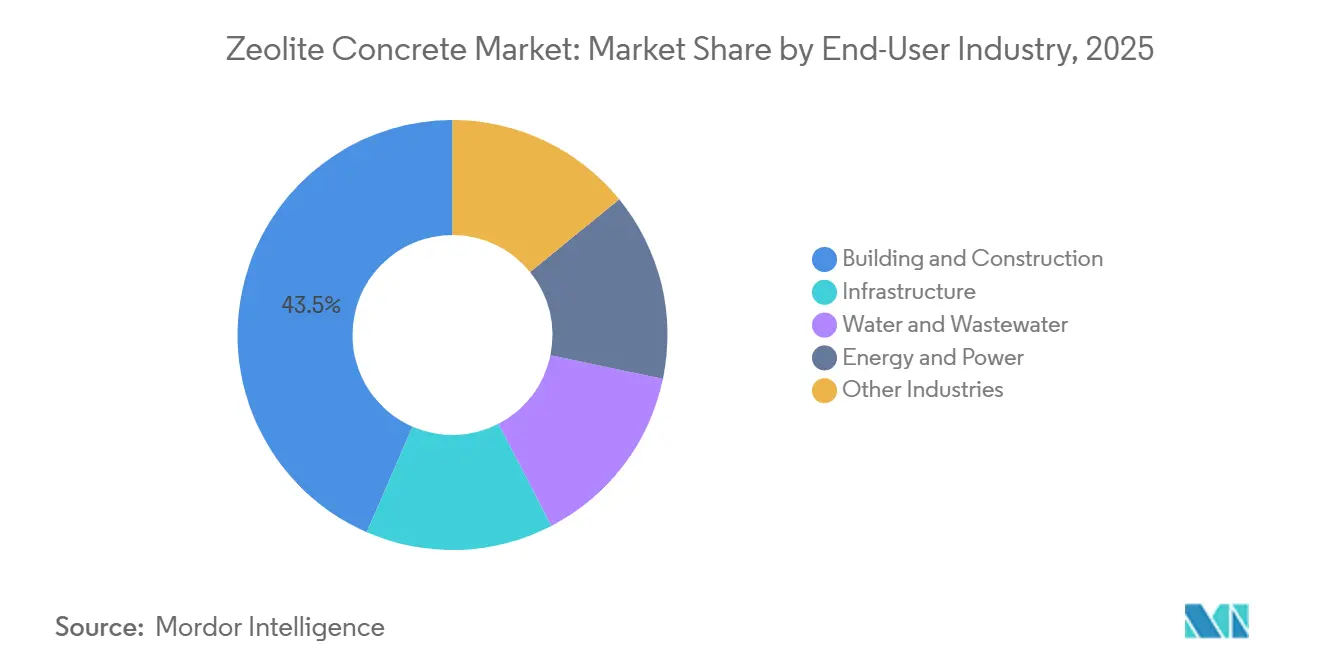
Building and Construction Leads While Water and Wastewater AccelerateBuilding and construction held 43.47% of the global zeolite concrete market in 2025. Residential high-rise projects, commercial complexes, and institutional buildings supported this demand, with Asia-Pacific and the Middle-East accounting for significant construction activity in the segment. Infrastructure is the second largest end-user category. Roads, bridges, airports, and rail projects benefit from long-term durability in chemically exposed conditions, giving the material a broad base beyond individual building projects.
Water and wastewater are forecast to grow at a 6.13% CAGR through 2031. A 2025 study found that zeolite-doped pervious concrete achieved 17.6% to 22.3% higher water-purification efficiency than ordinary pervious concrete. A University of Galway review found that zeolite-blended binders can reduce sulfuric acid and sulfate attack by refining the pore structure and limiting ettringite formation, which is relevant to sewers, pump stations, and treatment plants. Energy and power remain a smaller but technically demanding end-user category. Cooling towers, dam refurbishment, and waste-containment structures can also use zeolite's cesium-ion exchange capability.
Geography Analysis
APAC and Europe Zeolite Concrete Market
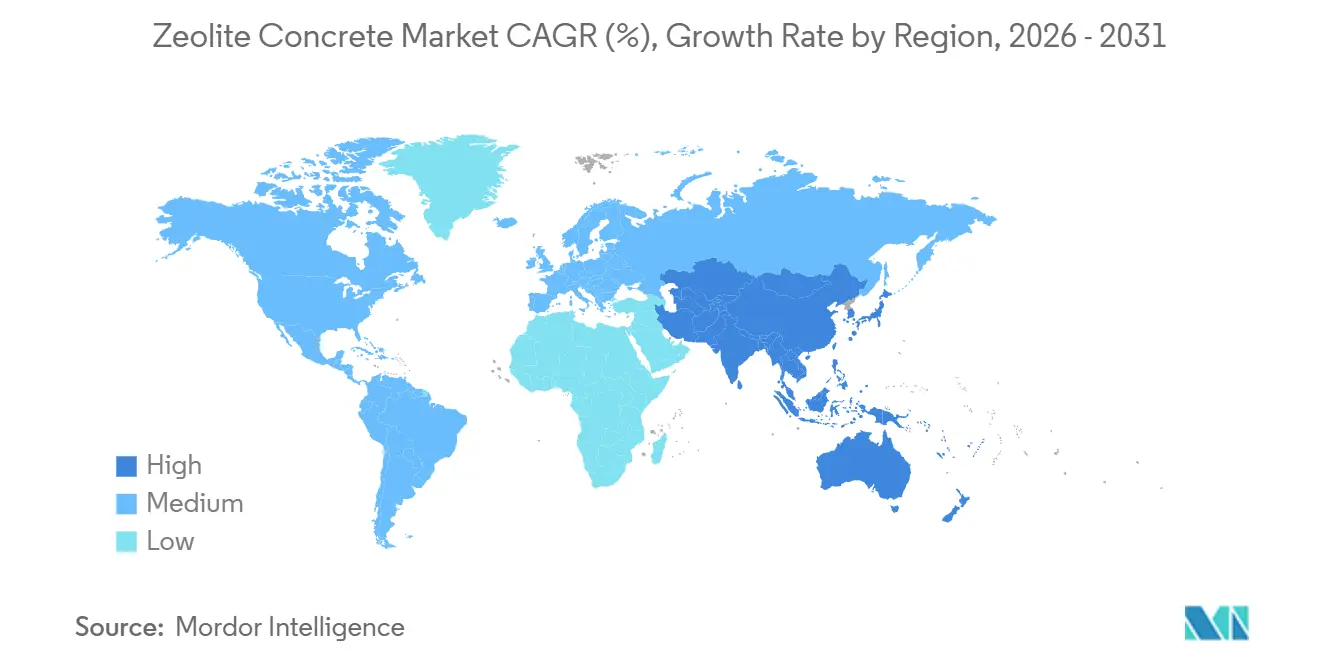
Asia-Pacific held 41.34% of the global zeolite concrete market in 2025 and is projected to grow at a 5.82% CAGR through 2031. China's concrete sector is under pressure to adopt lower-carbon procurement, increasing interest in blended materials and supporting the use of domestic clinoptilolite and imported zeolite from Turkey and Slovakia. India's construction activity supports demand for ready-mix and precast concrete that can use performance-tested supplementary cementitious materials. Japan is studying domestic pozzolanic alternatives as the availability of blast-furnace slag declines, with Taiheiyo Cement's 2025 and 2026 work on natural-zeolite shrinkage cracking reflecting this need.
North America and Europe Zeolite Concrete Market
North America and Europe are standards-intensive markets for zeolite concrete. In the United States, product-specific environmental declarations can support more formal specification of concrete-grade clinoptilolite. Canada is building local pozzolan supply capacity through the Ferguson Creek property near Kamloops, which Progressive Planet stated could supply material within an 800 km radius for at least 30 years. France's NF EN 206+A2/CN standard permits performance-based concrete formulation that can accommodate lower-carbon constituents. Slovakia has natural zeolite resources that can serve regional construction demand. Market participants in these regions compete on qualification data, logistics, and consistent product performance.
MEA and South America Zeolite Concrete Market
South America, the Middle-East, and Africa remain early-stage regions in the zeolite concrete market. The Andean volcanic arc contains clinoptilolite-rich tuffs in Chile, Peru, and Ecuador that can complement Brazil's construction demand. In Jordan, the WATAD quarry has a production capacity of over 2,000 tons per day and supplies zeolite and pozzolana materials for water treatment and hydraulic structures. Saudi Arabia and the United Arab Emirates offer demand from ports, desalination plants, and urban expansion programs, where sulfate-resistant concrete is particularly relevant. South Africa's construction and water utility sectors can also support near-term demand as regional mineral supply develops.
Competitive Landscape
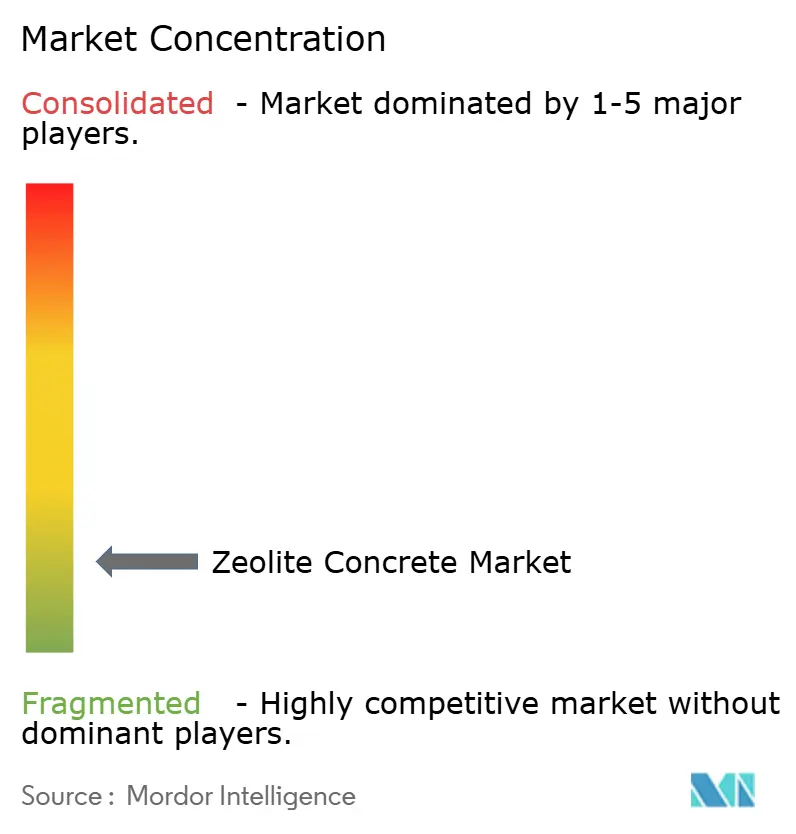
The zeolite concrete market is fragmented, as suppliers are primarily regional mining and mineral-processing companies, with no single company holding a dominant global position. Competition is moderate, given that local deposits, processing capability, and transport access vary across regions. Suppliers are pursuing vertical integration from mineral deposits to certified concrete-grade products, while also investing in logistics and technical documentation for concrete customers. This structure favors firms that can supply consistent materials and collaborate with mix designers.
Bear River Zeolite, a subsidiary of United States Antimony Corporation, completed a mineral reserve report in July 2025. The report quantified 5.127 million short tons with a cation exchange capacity of 146.2 meq/100 g, supporting a shift from commodity mineral sales toward specification-grade supply. Suppliers also use project-scale trials to validate material performance at batching plants, combining mineral products with field validation for concrete users.
Technical service is an important area of competition in the zeolite concrete market. Mix design support, site trials, and admixture guidance help customers manage natural-mineral variability and workability, and can reduce the time needed to qualify new supplementary cementitious materials. Research on artificial neural network models for zeolite concrete reported prediction errors below 15% for compressive, tensile, and flexural strengths, which could shorten qualification cycles for new formulations. ASTM C618 and EN 197-5 increase the value of verified reactivity and environmental data in public infrastructure tenders.
Zeolite Concrete Industry Leaders
-
ZEOCEM s.r.o.
-
KMI Zeolite Inc.
-
Bear River Zeolite Co.
-
St. Cloud Mining
-
Esen Zeolite
- *Disclaimer: Major Players sorted in no particular order
Zeolite Concrete Market Companies Covered in this Report
- Bear River Zeolite Co.
- BENTOMINE
- Blue Pacific Minerals Ltd
- Esen Zeolite
- Gordes Zeolite
- International Zeolite Corp.
- KMI Zeolite Inc.
- Rota Mining Corporation
- St. Cloud Mining
- Teague Mineral Products
- Trassingeneering
- ZeoCat
- ZEOCEM s.r.o.
- Zeolite Australia
- Zeotech Corporation
Recent Industry Developments in Zeolite Concrete Market
- August 2026: Zeotech signed a non-binding MoU with VINCI Construction, which undertakes approximately 75,000 projects annually, for concrete trials of AusPozz high-reactivity metakaolin. Independent testing confirmed that AusPozz can replace up to 40% of cement in optimized mixes, delivering improved compressive strength, reduced shrinkage, and alkali-silica reaction mitigation. The MoU runs until August 2027.
- January 2026: Zeolite Composites published its first two product-specific Environmental Product Declarations (EPDs) for clinoptilolite zeolite supplementary cementitious materials. The EPDs were verified under the Smart EPD program, including its Part B PCR for SCMs, providing the US concrete market with third-party-verified impact baselines for mix design and green building specifications.
Global Zeolite Concrete Market Report Scope
Zeolite concrete is an eco-friendly building material that uses natural microporous aluminosilicate minerals, either as a partial replacement for Portland cement or as a completely cement-free binder. It reduces carbon dioxide emissions, captures atmospheric carbon during curing, and improves structural strength and durability.
The zeolite concrete market is segmented by zeolite type, concrete type, application, end-user Industry, and geography. By zeolite type, the market is segmented into natural zeolite, synthetic zeolite, modified zeolite, and other zeolite types and specialty blends. By concrete type, the market is segmented into ready-mix concrete, precast concrete, self-compacting concrete, lightweight concrete, and other concrete types. By application, the market is segmented into structural concrete, pavements and road construction, marine and hydraulic structures, repair and rehabilitation, and other applications. By end-user industry, the market is segmented into building and construction, infrastructure, water and wastewater, energy and power, and other industries. The report also covers market size and forecasts for zeolite concrete across 15 countries in major regions. The market sizes and forecasts are provided in terms of value (USD).
Segmentation Overview
| Natural Zeolite |
| Synthetic Zeolite |
| Modified Zeolite |
| Other Zeolite Types and Specialty Blends |
| Ready-Mix Concrete |
| Precast Concrete |
| Self-Compacting Concrete |
| Lightweight Concrete |
| Other Concrete Types |
| Structural Concrete |
| Pavements and Road Construction |
| Marine and Hydraulic Structures |
| Repair and Rehabilitation |
| Other Applications |
| Building and Construction |
| Infrastructure |
| Water and Wastewater |
| Energy and Power |
| Other Industries |
| Asia-Pacific | China |
| India | |
| Japan | |
| South Korea | |
| ASEAN Countries | |
| Rest of Asia-Pacific | |
| North America | United States |
| Canada | |
| Mexico | |
| Europe | Germany |
| United Kingdom | |
| France | |
| Italy | |
| NORDIC Countries | |
| Rest of Europe | |
| South America | Brazil |
| Argentina | |
| Rest of South America | |
| Middle-East and Africa | Saudi Arabia |
| South Africa | |
| Rest of Middle-East and Africa |
| By Zeolite Type | Natural Zeolite | |
| Synthetic Zeolite | ||
| Modified Zeolite | ||
| Other Zeolite Types and Specialty Blends | ||
| By Concrete Type | Ready-Mix Concrete | |
| Precast Concrete | ||
| Self-Compacting Concrete | ||
| Lightweight Concrete | ||
| Other Concrete Types | ||
| By Application | Structural Concrete | |
| Pavements and Road Construction | ||
| Marine and Hydraulic Structures | ||
| Repair and Rehabilitation | ||
| Other Applications | ||
| By End-User Industry | Building and Construction | |
| Infrastructure | ||
| Water and Wastewater | ||
| Energy and Power | ||
| Other Industries | ||
| By Geography | Asia-Pacific | China |
| India | ||
| Japan | ||
| South Korea | ||
| ASEAN Countries | ||
| Rest of Asia-Pacific | ||
| North America | United States | |
| Canada | ||
| Mexico | ||
| Europe | Germany | |
| United Kingdom | ||
| France | ||
| Italy | ||
| NORDIC Countries | ||
| Rest of Europe | ||
| South America | Brazil | |
| Argentina | ||
| Rest of South America | ||
| Middle-East and Africa | Saudi Arabia | |
| South Africa | ||
| Rest of Middle-East and Africa | ||
Key Questions Answered in the Report
What is current market size of Zeolite Concrete Market?
The Zeolite concrete market size was estimated at USD 451.44 million in 2025 and is estimated to grow from USD 470.63 million in 2026 to USD 604.09 million by 2031, at a CAGR of 5.12% during the forecast period (2026-2031).
Which zeolite type has the largest share in concrete applications?
Natural zeolite led with a 55.13% share in 2025 due to its cost position, geographic availability, and suitability for high-volume concrete applications.
Which concrete format is growing fast for zeolite use?
Self-compacting concrete is projected to grow at a 5.79% CAGR through 2031, supported by demand for dense reinforcement and complex forms.
Which region leads zeolite concrete demand?
Asia-Pacific led with a 41.34% share in 2025 and had the fastest regional growth at a 5.82% CAGR through 2031.