
Zamak Material Market Size and Share
Market Overview
| Study Period | 2021 - 2031 |
|---|---|
| Market Size (2026) | USD 3.09 Billion |
| Market Size (2031) | USD 4.30 Billion |
| Growth Rate (2026 - 2031) | 6.83 % |
| Fastest Growing Market | Asia-Pacific |
| Largest Market | Asia-Pacific |
| Market Concentration | Low |
Major Players *Disclaimer: Major Players sorted in no particular order Image © Mordor Intelligence. Reuse requires attribution under CC BY 4.0. | |
Zamak Material Market Analysis by Mordor Intelligence
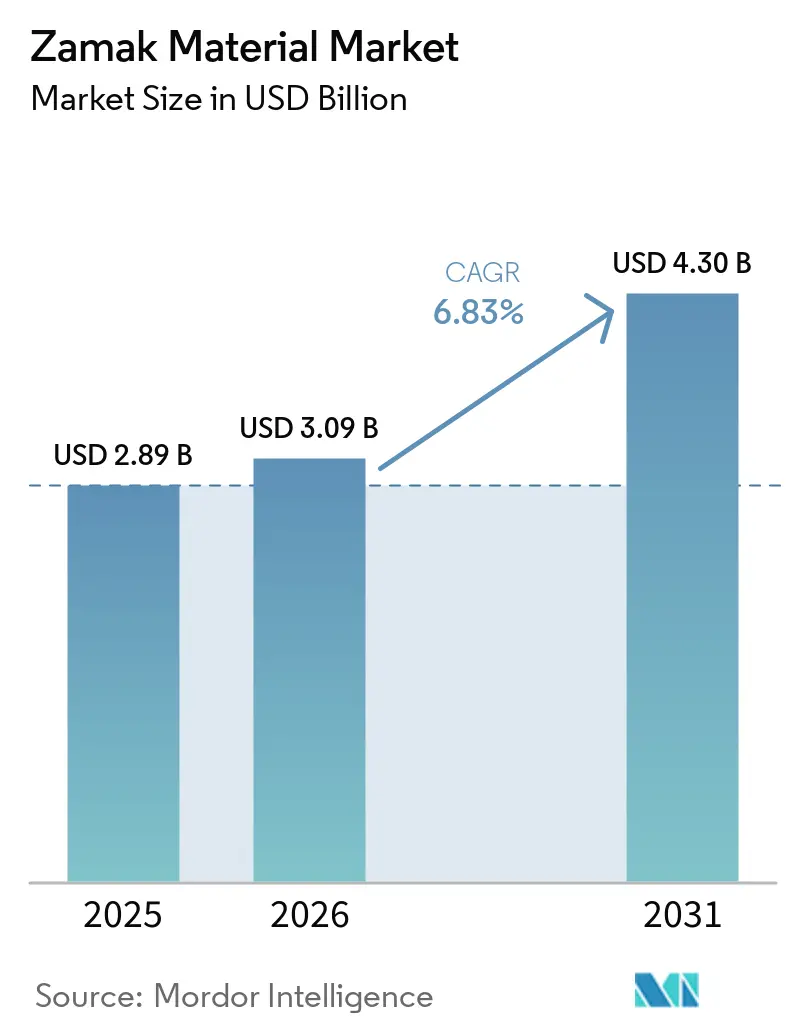
The Zamak Material Market size was valued at USD 2.89 billion in 2025 and is estimated to grow from USD 3.09 billion in 2026 to reach USD 4.30 billion by 2031, at a CAGR of 6.83% during the forecast period (2026-2031). The Zamak material market serves applications that require close dimensional control, complex shapes, and an acceptable surface for finishing. Electric vehicle (EV) platforms, fifth-generation mobile networks (5G), and more compact electronic devices support demand for small cast components. Zinc alloys can produce thin sections, provide electromagnetic interference (EMI) shielding, and support long tool life in suitable die-casting applications. The value chain links upstream alloy suppliers with precision die casters that compete on material quality, manufacturing control, and application engineering. Secondary zinc is becoming more relevant because verified life cycle assessment data helps original equipment manufacturers (OEMs) assess supply options against their Scope 3 emissions requirements.
Key Report Takeaways
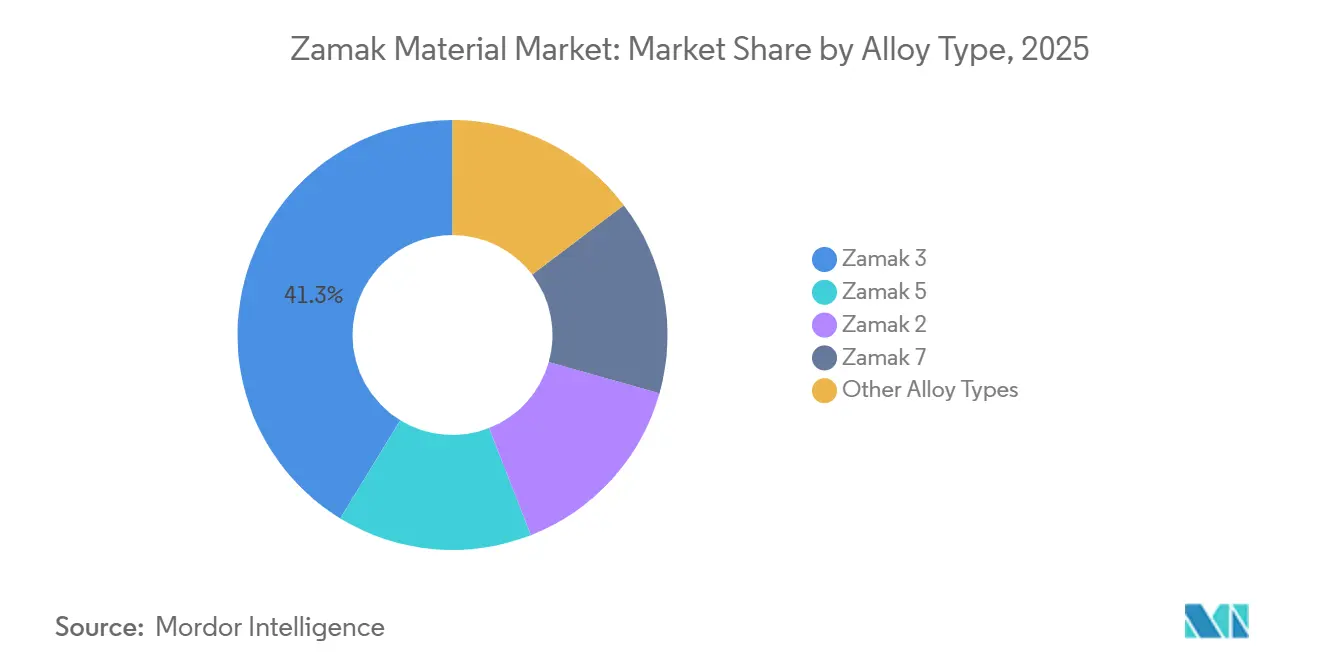
- By alloy type, Zamak 3 held 41.26% of the Zamak material market share in 2025, while Zamak 7 is projected to advance at a 7.78% CAGR through 2031.
- By manufacturing process, pressure die casting held 62.34% of the Zamak material market share in 2025 and is projected to advance at an 8.22% CAGR through 2031.
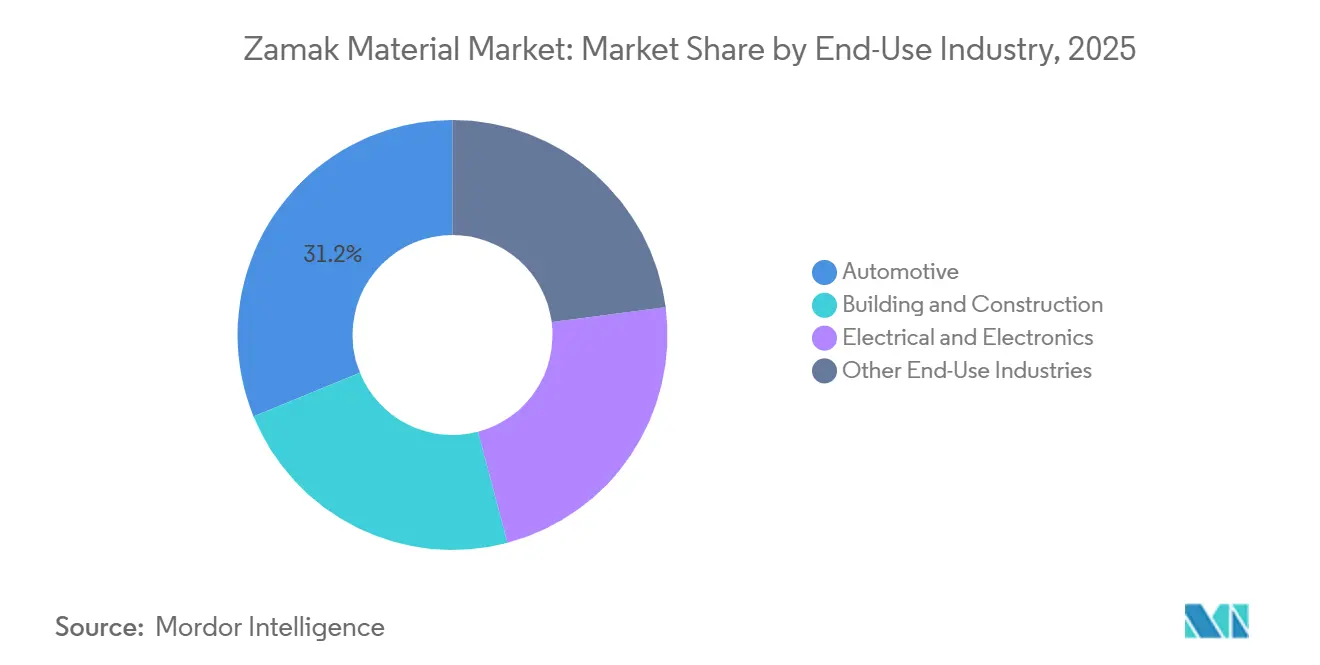
- By end-use industry, automotive held 31.18% of the Zamak material market share in 2025, while electrical and electronics is projected to advance at an 8.09% CAGR through 2031.
- By geography, Asia-Pacific held 43.34% of the Zamak material market share in 2025 and is projected to advance at a 7.85% CAGR through 2031.
Note: Market size and forecast figures in this report are generated using Mordor Intelligence’s proprietary estimation framework, updated with the latest available data and insights as of January 2026.
Market Trends and Insights
Drivers Impact Analysis of Zamak Material Market*
| Driver | (~) % Impact on CAGR Forecast | Geographic Relevance | Impact Timeline |
|---|---|---|---|
| Automotive and EV Component Lightweighting | +1.8% | Global; strongest in APAC, North America, and EU automotive corridors | Long term (≥ 4 years) |
| Electronics Miniaturization and EMI Shielding Demand | +1.5% | Global with APAC core; spillover to North America and Europe | Medium term (2–4 years) |
| Growth of Thin-Wall, High-Precision Die Casting | +1.2% | Global; APAC manufacturing hubs and EU precision casters | Medium term (2–4 years) |
| Recycled Zinc and Lower-Carbon Alloy Availability | +0.9% | Europe and North America; early adoption in India | Short term (≤ 2 years) |
| Nearshoring of Precision Component Supply Chains | +0.6% | North America, EU; secondary gains in Mexico and Southeast Asia | Short term (≤ 2 years) |
| Source: Mordor Intelligence | |||
Automotive and EV Component Lightweighting
Vehicle electrification increases the need for small components that combine dimensional stability, sealing performance, and accurate geometry. The Zamak material market benefits where EV battery connectors, advanced driver assistance system (ADAS) sensor housings, and control-unit enclosures need these characteristics. Zinc die casting can make thin-walled parts that are difficult to produce through aluminum cold-chamber casting. The International Zinc Association expects zinc alloy use in EV cable connections, engine parts, and sensor housings to increase during the next decade[1]. India and Southeast Asia are expected to record the strongest regional gains in zinc die-casting demand over that period. A higher number of ADAS sensors per vehicle also increases the need for compact housings with repeatable dimensions.
Electronics Miniaturization and EMI Shielding Demand
The Zamak material market is supported by electronics applications that need compact enclosures and shielding against EMI. Zinc alloys can provide shielding and form thin walls in one cast part, reducing the need for separate shielding layers in certain designs. This is relevant to equipment associated with 5G networks, connected devices, automotive electronics, and industrial controls. Electrical and electronics are projected to advance at an 8.09% CAGR through 2031, reflecting greater hardware demand and more electronics within end products. One-piece die-cast enclosures can reduce the number of assembly stages compared with designs that use separate shielding elements. The resulting manufacturing approach can improve consistency for OEMs that require compact, finished metal housings.
Growth of Thin-Wall, High-Precision Die Casting
Thin-wall capability remains an important basis of competition in the Zamak material market. The United States Department of Energy found that high-fluidity zinc die-casting alloys could produce castings with section thicknesses of 0.3 mm or less. The work also reported fluidity improvements of up to 40% compared with standard Zamak grades. Research by the Fraunhofer Institute for Structural Durability and System Reliability, LBF, showed that microstructural characterization can support fatigue-life prediction for thin-walled Zamak 5 components. Pressure die casting is projected to advance at an 8.22% CAGR through 2031 as producers invest in vacuum assistance, controlled injection, and in-process measurement. These measures help reduce defects and support net-shape production of small features.
Recycled Zinc and Lower-Carbon Alloy Availability
Recycled material availability gives the Zamak material market an additional basis for product selection. The International Zinc Association announced in December 2025 that life cycle assessment data for secondary Zamak were included in ecoinvent version 3.12. The availability of this data gives designers and procurement teams a documented basis to compare recycled alloy options. REAZN S.A. states that its recycled Zamak, made with 100% secondary raw materials, can reduce the carbon footprint by up to 97.5% against the cited primary-zinc benchmark. Procurement specifications can therefore place greater value on certified recycled content and verified life cycle assessment information. This increases the importance of traceability for alloy suppliers serving OEM sustainability programs.
Restraints Impact Analysis of Zamak Material Market*
| Restraint | (~) % Impact on CAGR Forecast | Geographic Relevance | Impact Timeline |
|---|---|---|---|
| Zinc Price and Primary-Metal Supply Volatility | -0.9% | Global; most acute in Europe and North America | Short term (≤ 2 years) |
| Substitution by Aluminum, Magnesium, and Engineering Plastics | -0.7% | Global | Long term (≥ 4 years) |
| Tightening Energy, Emissions, and Heavy-Metal Compliance Requirements | -0.4% | Europe, North America, widening to APAC | Medium term (2–4 years) |
| Source: Mordor Intelligence | |||
Zinc Price and Primary-Metal Supply Volatility
Zinc price movements can affect margins across the Zamak material market because zinc is the principal alloy input. The International Lead and Zinc Study Group reported a 33,000 metric ton refined-zinc market deficit in 2025. London Metal Exchange warehouse stocks declined by 77,000 metric tons to 739,000 metric tons at the end of 2025. The London Metal Exchange cash settlement price reached USD 3,351 per metric ton on December 2, 2025, after reaching a 2025 low of USD 2,521 per metric ton on April 17. Producers who buy zinc on spot terms or short-term contracts can face abrupt cost changes. Smaller die casters may have less ability to absorb those changes or pass them through to automotive and electronics customers.
Tightening Energy, Emissions, and Heavy-Metal Compliance Requirements
Energy, emissions, and heavy-metal rules increase compliance demands for producers and customers. The Restriction of Hazardous Substances Directive, Directive 2011/65/EU, regulates specified substances in electrical and electronic equipment. European Commission Delegated Directive (EU) 2025/2364, issued in September 2025, amended the directive's lead-exemption provisions[2]. The Registration, Evaluation, Authorisation and Restriction of Chemicals Regulation also requires supply-chain disclosure for substances of concern. These obligations increase the value of documented alloy composition and established qualification records. Larger integrated suppliers can generally manage reporting and technical documentation more efficiently than smaller casters.
*Our forecasts treat driver/restraint impacts as directional, not additive. The impact forecasts reflect baseline growth, mix effects, and variable interactions.
Zamak Material Market Segment Analysis
By Alloy Type:
Zamak 3 Anchors Revenue, While Zamak 7 Unlocks Thin-Wall GrowthZamak 3 held 41.26% of the Zamak material market in 2025, while Zamak 7 is projected to advance at a 7.78% CAGR through 2031. Zamak 3 remained widely used because it balanced mechanical performance, dimensional stability, castability, and finishing compatibility. The alloy has a tensile strength of 283 megapascals (MPa) and supports electroplating and powder-coating finishes. Its established use across automotive trim, electronics housings, and industrial hardware supports its position in North America. Zamak 7 is suited to thin-wall cosmetic and electronics applications where improved fluidity and surface polishability matter. Wearable housings, 5G antenna enclosures, and precision locks are examples of applications where those properties are relevant.
Zamak 5 supports precision trim and functional brackets that need greater strength from its copper content. The International Zinc Association reports a tensile strength of 331 MPa for Zamak 5. Zamak 2 is used in heavy-duty mechanical parts and gears where hardness and resistance to dimensional growth are important. Other alloy types include Zamak 8, zinc-aluminum 8 (ZA-8), and specialty grades for elevated-temperature or precision applications. The Zamak material industry is also differentiating alloy offerings through recycled-content documentation. The 2025 ecoinvent inclusion gives purchasers a recognized method to assess secondary Zamak life cycle information. This supports a market for certified recycled alloy alongside performance-oriented specialty grades.

By Manufacturing Process:
Pressure Die Casting Commands Both Scale and GrowthPressure die casting held 62.34% of the Zamak material market in 2025 and is projected to advance at an 8.22% CAGR through 2031. The process serves high-volume production where short cycle times and close tolerances are needed. Hot-chamber machines process Zamak at around 400 °C and are suited to zinc-based alloys. Pressure die casting remains central to the Zamak material market because it combines high output with repeatable geometry. Producers are investing in real-time injection monitoring, servo-controlled plunger velocity, vacuum assistance, and measurement feedback. These controls support lower rejection rates and more consistent thin-wall production.
Hot-chamber die casting remains relevant for small, complex parts made with zinc-specific gooseneck injection equipment. This equipment is not used for aluminum or magnesium in the same way. Multi-slide die casting uses perpendicular slides to create undercuts and cross-holes in a single net-shape operation. It supports connectors, microelectronics, and precision fasteners that would otherwise require secondary work. Other manufacturing processes include gravity casting and spin casting for decorative hardware, jewelry, and customized work. Digital process simulation and computed tomography are also supporting tooling decisions and internal quality assessment. The Zamak material industry uses these tools to reduce qualification risk before high-volume production begins.
By End-Use Industry:
Automotive Leads Market Share, While Electrical and Electronics is Reshaping Growth DynamicsAutomotive held 31.18% of the Zamak material market in 2025, while electrical and electronics is projected to advance at an 8.09% CAGR through 2031. Automotive demand includes door handles, seatbelt mechanisms, fuel-system components, EV battery connectors, and ADAS sensor housings. Zinc alloys are increasingly used in EV cable connections, engine parts, and sensor housings that require compact geometry and dimensional stability. Building and Construction also use Zamak in architectural door hardware, window fittings, and decorative fixtures. These applications value corrosion resistance and compatibility with decorative finishes. The Zamak material market continues to serve these established applications while adapting to new vehicle architectures.
Electrical and electronics use Zamak in consumer devices and industrial equipment. Consumer applications include smartphones, wearables, earphones, and laptops that need compact housings and EMI shielding. Industrial applications include 5G base-station enclosures, smart-grid terminal housings, and programmable logic controller mounting structures. The 2025 amendment to the Restriction of Hazardous Substances Directive is relevant to the lead-exemption requirements for electrical and electronic equipment. Other end-use industries include consumer goods and appliances, industrial equipment, healthcare, and aerospace and defense. These applications add demand for precision parts, finished surfaces, and controlled dimensions. Medical-device housings and minimally invasive instrument handles are among the specialized applications considered for zinc die casting.
Geography Analysis
APAC Zamak Material Market
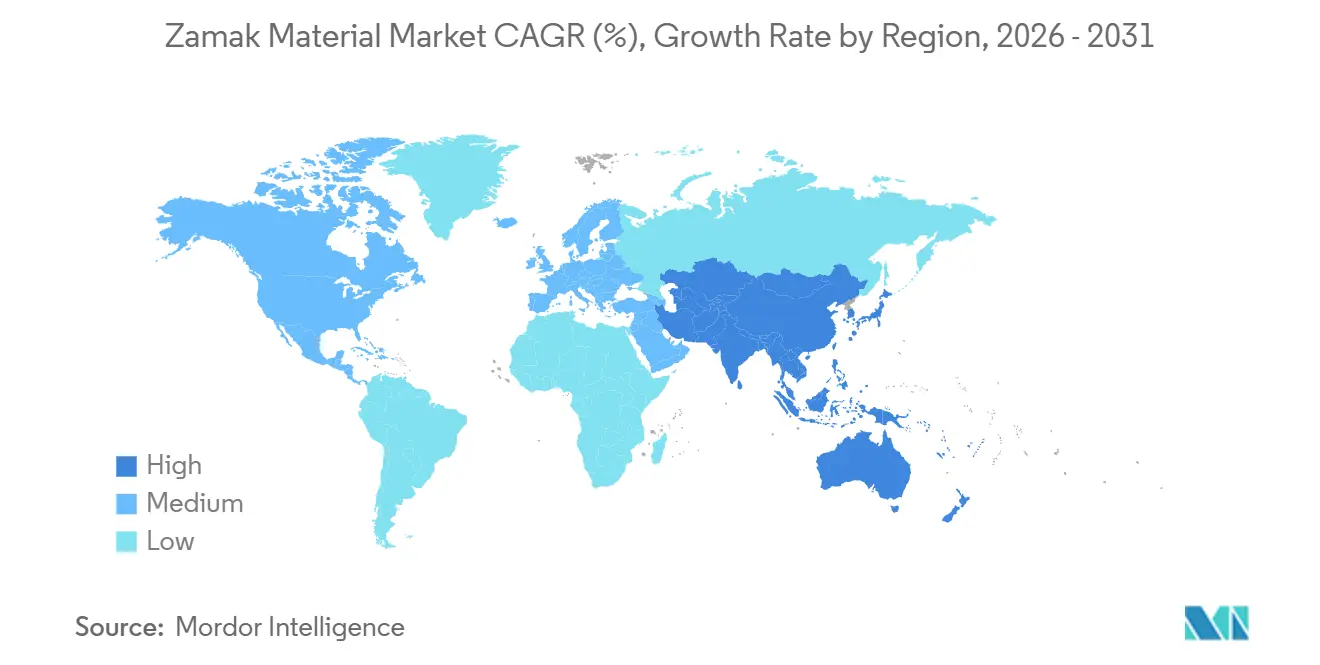
Asia-Pacific held 43.34% of the Zamak material market in 2025 and is projected to advance at a 7.85% CAGR through 2031. China has a large concentration of zinc die-casting capacity for domestic and export programs. India is expanding its position in zinc die casting and is becoming more relevant to diversified OEM sourcing. The International Zinc Association projects a 49% increase in zinc die-casting demand in India during the next decade. It expects China to contribute an additional 11% during the same period. Japan and South Korea remain important for precision automotive components. Asia-Pacific, therefore, combines scale, expanding capacity, and demand from automotive and electronics manufacturing.
North America and Europe Zamak Material Market
Automotive supply chains and the need for regional precision-casting capacity support North America. Europe has established zinc-alloy production and die-casting activity in Italy, Germany, and Belgium. Europe also has suppliers with recycled-content offerings and established sustainability documentation. The European Chemicals Agency maintained a candidate list of 250 Substances of Very High Concern as of June 2025. This regulatory setting increases the importance of alloy composition records and supply-chain disclosures. Hindustan Zinc approved a USD 1.39 billion metals complex in Rajasthan in June 2025. The project is intended to add 250,000 metric tons per annum of operational capacity and reduce import dependence. Supply security, energy costs, and compliance capability shape the Zamak material market in these regions.
South America and MEA Zamak Material Market
South America has demand led by Brazil's automotive production and by construction-linked hardware applications in Argentina. Many buyers in the region depend on imported Zamak alloy, which can increase exposure to zinc price movements. The International Lead and Zinc Study Group reported tight refined-zinc conditions during 2025. In the Middle-East and Africa, infrastructure development in Saudi Arabia and metals diversification in South Africa is expected to support future demand. Local fabrication capacity is still developing across parts of these regions. Upstream suppliers are considering distribution partnerships before local secondary-zinc capacity expands. The Zamak material market has an opening in these areas, but local capability could narrow it over time.
Competitive Landscape
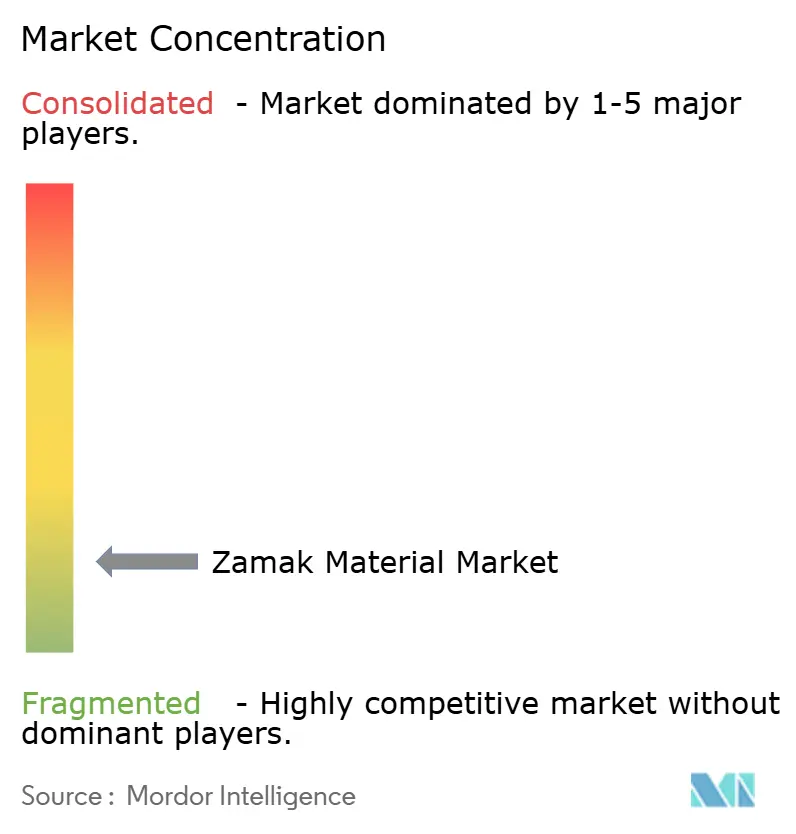
The Zamak material market is highly fragmented, with the top five players including GRILLO-Werke AG, Eastern Alloys Inc., Form Technologies, Belmont Metals, and Brillcast Manufacturing LLC. Upstream suppliers include Nyrstar, GRILLO-Werke AG, REAZN S.A., Hindustan Zinc, KOREAZINC, Eastern Alloys Inc., Belmont Metals, Chem Zinc Die Casting Alloys, and Ital Leghe S.r.l. Downstream precision component die casters include Form Technologies, Bruschi Srl, Brillcast Manufacturing LLC, Phoenix Industries Ltd., Radiant Metals & Alloys Pvt. Ltd., BN Industries, and Sidhi International. Upstream companies compete through alloy consistency, zinc sourcing, and documented environmental performance; REAZN S.A. used Euroguss 2026 to present recycled Zamak as a point of differentiation. This approach reflects rising customer interest in recycled-content material and traceable life cycle data.
Downstream casters compete through tolerance control, cycle time, rejection rates, automation, and application engineering. Form Technologies operated 32 facilities in 22 countries and received USD 304 million in new equity capital following its January 2025 acquisition by Ares Management. The funding was intended to support commercial strategy and geographic expansion. Bruschi Srl was committed to 100% certified green electricity for its 2024 and 2025 production, supporting its position in customer sustainability assessments. GRILLO-Werke AG began supplying a next-generation Zamak ingot portfolio through a long-term partnership with Glencore in January 2026.
Opportunities are concentrated in ultra-thin-wall precision castings for 5G and wearable applications and in recycled-content-certified alloy supply. Very few casters can reliably produce walls below 0.3 mm at production yield targets. Indian and Vietnam-based precision casters are increasing their role in export-oriented programs as die simulation, vacuum assistance, and real-time X-ray inspection become more accessible. Patent and technical work on high-fluidity alloy formulations and conformal-cooling inserts show that material and process development remain important.
Zamak Material Industry Leaders
-
GRILLO-Werke AG
-
Eastern Alloys Inc.
-
Form Technologies
-
Belmont Metals
-
Brillcast Manufacturing LLC
- *Disclaimer: Major Players sorted in no particular order
Zamak Material Market Companies Covered in this Report
- Belmont Metals
- BN Industries
- Brillcast Manufacturing LLC
- Bruschi Srl
- Chem Zinc Die Casting Alloys
- Eastern Alloys Inc.
- Form Technologies
- GRILLO-Werke AG
- Hindustan Zinc
- Ital Leghe S.r.l.
- KOREAZINC
- Nyrstar
- Phoenix Industries Ltd.
- Radiant Metals & Alloys Pvt. Ltd.
- REAZN S.A.
Recent Industry Developments in Zamak Material Market
- January 2026: REAZN S.A. highlighted recycling at EUROGUSS 2026 in Nuremberg, showcasing 80%–100% recycled-content Zamak as a solution for reducing upstream Scope 3 emissions in die-casting applications. This reflects increasing demand for sustainable Zamak material in automotive die casting, where OEMs are seeking lower-carbon alloy inputs and greater recycled content.
- January 2025: Hindustan Zinc Limited launched HZDA 3 and HZDA 5 at Bharat Mobility Global Expo 2025, providing domestically produced hot-chamber die-casting alloys with high dimensional stability and improved plating performance. The development supports greater use of locally produced Zamak alloys in automotive die-casting applications while reducing dependence on imported materials.
Global Zamak Material Market Report Scope
Zamak is a group of zinc-based alloys valued for their strength, dimensional stability, corrosion resistance, and ability to produce intricate components with smooth surfaces. These characteristics make Zamak suitable for precision casting and the production of durable components across a range of industrial and consumer applications.
The Zamak Material Market is segmented by alloy type, manufacturing process, end-use industry, and geography. By alloy type, the market is segmented into Zamak 3, Zamak 5, Zamak 2, Zamak 7, and other alloy types (Zamak 8/ZA-8 and specialty Zamak alloys). By manufacturing process, the market is segmented into hot-chamber die casting, pressure die casting, multi-slide die casting, and other manufacturing processes. By end-use industry, the market is segmented into automotive, building and construction, electrical and electronics, and other end-use industries (consumer goods and appliances, industrial equipment, healthcare, aerospace and defense). The report also covers the market size and forecasts for Zamak material in 15 countries across major regions. For each segment, the market sizing and forecasts have been done on the basis of value (USD).
Segmentation Overview
| Zamak 3 |
| Zamak 5 |
| Zamak 2 |
| Zamak 7 |
| Other Alloy Types (Zamak 8/ZA-8, Specialty Zamak Alloys) |
| Hot-Chamber Die Casting |
| Pressure Die Casting |
| Multi-Slide Die Casting |
| Other Manufacturing Processes |
| Automotive |
| Building and Construction |
| Electrical and Electronics |
| Other End-Use Industries (Consumer Goods and Appliances, Industrial Equipment, Healthcare, Aerospace and Defense) |
| Asia-Pacific | China |
| India | |
| Japan | |
| South Korea | |
| ASEAN Countries | |
| Rest of Asia-Pacific | |
| North America | United States |
| Canada | |
| Mexico | |
| Europe | Germany |
| United Kingdom | |
| France | |
| Italy | |
| NORDIC Countries | |
| Rest of Europe | |
| South America | Brazil |
| Argentina | |
| Rest of South America | |
| Middle-East and Africa | Saudi Arabia |
| South Africa | |
| Rest of Middle-East and Africa |
| By Alloy Type | Zamak 3 | |
| Zamak 5 | ||
| Zamak 2 | ||
| Zamak 7 | ||
| Other Alloy Types (Zamak 8/ZA-8, Specialty Zamak Alloys) | ||
| By Manufacturing Process | Hot-Chamber Die Casting | |
| Pressure Die Casting | ||
| Multi-Slide Die Casting | ||
| Other Manufacturing Processes | ||
| By End-Use Industry | Automotive | |
| Building and Construction | ||
| Electrical and Electronics | ||
| Other End-Use Industries (Consumer Goods and Appliances, Industrial Equipment, Healthcare, Aerospace and Defense) | ||
| By Geography | Asia-Pacific | China |
| India | ||
| Japan | ||
| South Korea | ||
| ASEAN Countries | ||
| Rest of Asia-Pacific | ||
| North America | United States | |
| Canada | ||
| Mexico | ||
| Europe | Germany | |
| United Kingdom | ||
| France | ||
| Italy | ||
| NORDIC Countries | ||
| Rest of Europe | ||
| South America | Brazil | |
| Argentina | ||
| Rest of South America | ||
| Middle-East and Africa | Saudi Arabia | |
| South Africa | ||
| Rest of Middle-East and Africa | ||
Key Questions Answered in the Report
What is the size of the Zamak material market?
The Zamak material market stands at USD 3.09 billion in 2026 and is projected to reach USD 4.30 billion by 2031.
What is driving demand for Zamak material?
Demand is supported by EV components, electronics miniaturization, 5G equipment, and the need for precision die-cast parts with EMI shielding.
Which alloy type held the largest share in 2025?
Zamak 3 held 41.26% of the Zamak material market in 2025, supported by its balance of castability, dimensional stability, and finishing compatibility.
Which manufacturing process is expected to grow fastest through 2031?
Pressure die casting is projected to advance at an 8.22% CAGR through 2031, supported by investment in process control and thin-wall production.