
Yogurt Powder Market Size and Share
Market Overview
| Study Period | 2021 - 2031 |
|---|---|
| Market Size (2026) | USD 800.11 Million |
| Market Size (2031) | USD 993.64 Million |
| Growth Rate (2026 - 2031) | 4.43 % |
| Fastest Growing Market | Asia-Pacific |
| Largest Market | Asia-Pacific |
| Market Concentration | Medium |
Major Players *Disclaimer: Major Players sorted in no particular order Image © Mordor Intelligence. Reuse requires attribution under CC BY 4.0. | |
Yogurt Powder Market Analysis by Mordor Intelligence
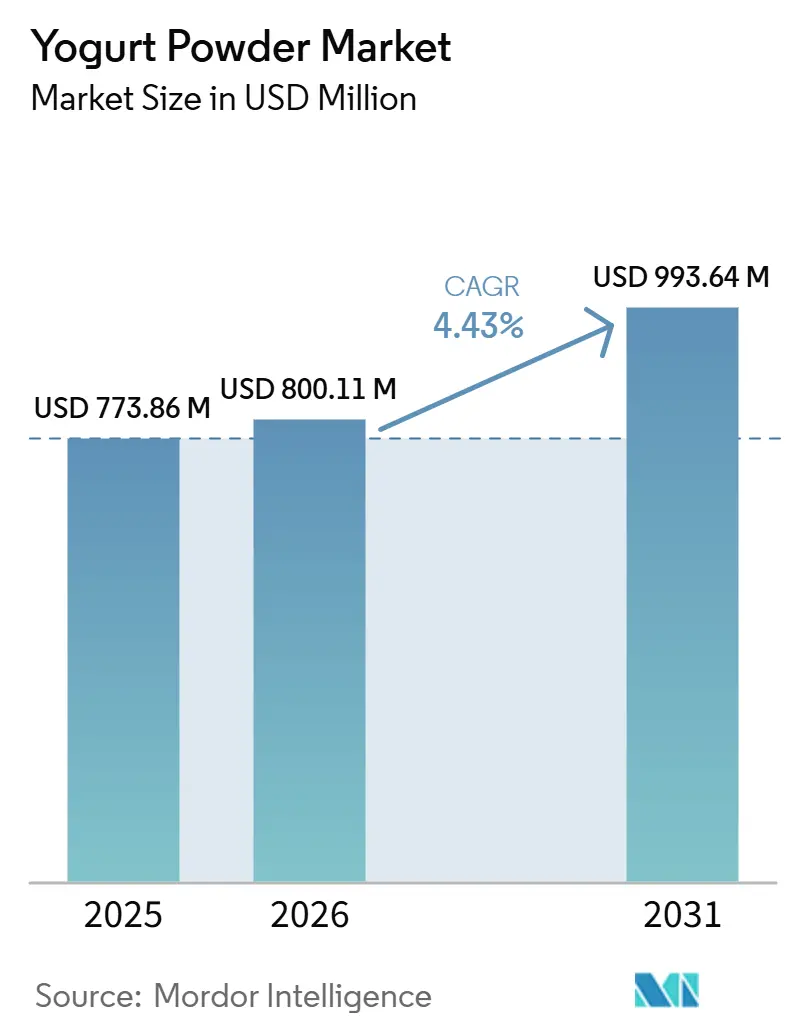
The yogurt powder market size is expected to grow from USD 773.86 million in 2025 to USD 800.11 million in 2026 and is forecast to reach USD 993.64 million by 2031 at 4.43% CAGR over 2026-2031. The yogurt powder market is supported by food manufacturers that need fermented dairy ingredients that can move through ambient supply chains. Powder formats reduce the refrigeration and spoilage exposure that accompanies liquid yogurt distribution. Global milk supply expanded by 2.5% in 2025, which increased pressure on commodity powder margins and encouraged suppliers to pursue higher-value specialty grades. The yogurt powder market also benefits from demand for ingredients that combine acidity, dairy flavor, and protein in a single formulation input. Producers are responding through capacity investment, improved drying methods, and products designed for specialty nutrition applications. Regulatory requirements for infant, geriatric, and probiotic products favor suppliers with traceable inputs and established compliance systems.
Key Report Takeaways
- By product type, whole yogurt powder held 47.78% share in 2025, while skimmed yogurt powder is forecast to expand at a 6.11% CAGR through 2031.
- By application, bakery and confectionery accounted for 29.54% share in 2025, while nutraceuticals and dietary supplements recorded the highest projected CAGR at 5.88% through 2031.
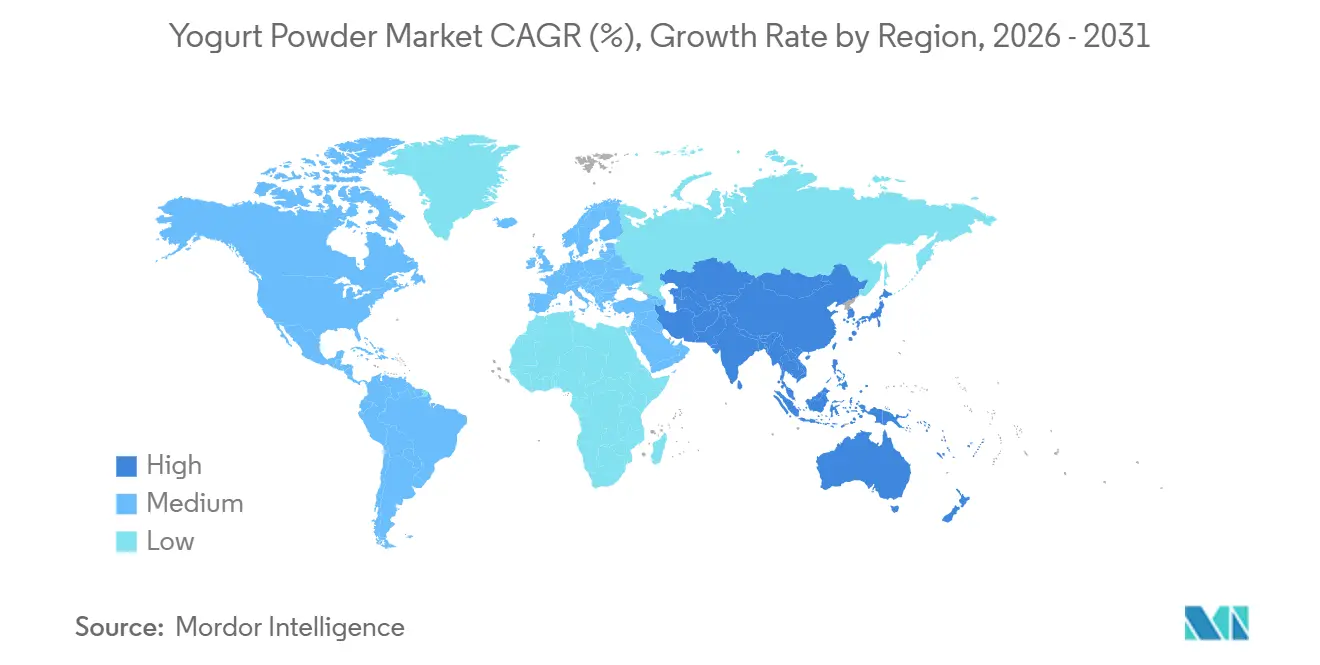
- By geography, Asia-Pacific held 32.64% share in 2025 and is projected to grow at a 5.77% CAGR through 2031.
Note: Market size and forecast figures in this report are generated using Mordor Intelligence’s proprietary estimation framework, updated with the latest available data and insights as of January 2026.
Market Trends and Insights
Drivers Impact Analysis of Yogurt Powder Market*
| Driver | (~) % Impact on CAGR Forecast | Geographic Relevance | Impact Timeline |
|---|---|---|---|
| Rising Demand for Shelf-Stable Dairy Products | +1.2% | Global, with concentrated impact in South and Southeast Asia, Middle East and Africa | Long term (≥ 4 years) |
| Growing Consumption of Functional and Nutrient-Dense Foods | +0.9% | North America, Europe, and Asia-Pacific urban centers | Medium term (2-4 years) |
| Increasing Use of Yogurt Powder in Food and Beverage Formulations | +0.7% | Global, particularly Asia-Pacific bakery and snack hubs | Short term (≤ 2 years) |
| Expansion of the Sports Nutrition and Protein Supplement Industry | +0.6% | North America, Europe, Asia-Pacific, and spillover to Middle East and Africa | Medium term (2-4 years) |
| Growth of the Bakery and Confectionery Industry | +0.5% | Global, with early gains in India, China, and Brazil | Short term (≤ 2 years) |
| Increasing Adoption of Yogurt Powder in Infant and Specialized Nutrition | +0.4% | China, Southeast Asia, and Middle East and Africa, with regulatory influence from SAMR and Codex Alimentarius | Long term (≥ 4 years) |
| Source: Mordor Intelligence | |||
Rising Demand for Shelf-Stable Dairy Products
Ambient dairy formats are gaining relevance in regions where operators face expensive or unreliable cold chain infrastructure. The OECD-FAO outlook projects global per capita fresh dairy consumption to grow by 1.9% annually over the next decade, primarily driven by rising incomes in South and Southeast Asia[1]Source: Organisation for Economic Co-operation and Development, “OECD‑FAO Agricultural Outlook 2026‑2035- Dairy and dairy products”, oecd.org. The yogurt powder market can serve these regions effectively because its 12-18 month ambient shelf life eliminates the need for refrigerated transport and storage, helping distributors reduce logistics complexity and product spoilage risks. This feature is particularly relevant across rural and semi-urban distribution corridors, where retailers and suppliers often have limited access to temperature-controlled storage. The OECD and FAO also report that international trade accounts for nearly 50% of global skim milk powder and whole milk powder production, highlighting the importance of shelf-stable dairy formats in cross-border supply[2]Source: Organisation for Economic Co-operation and Development, “OECD‑FAO Agricultural Outlook 2026‑2035- Dairy and dairy products”, oecd.org.
Growing Consumption of Functional and Nutrient-Dense Foods
Rising demand for health-oriented foods is driving greater interest in dairy ingredients with clearly defined nutritional functions. The yogurt powder market serves formulators developing products that require probiotic, prebiotic, protein, and fermented dairy attributes in a convenient powdered format. Danone’s acquisition of The Akkermansia Company reflected the industry’s shift toward strain-specific gut-health applications in dairy products. Yogurt powder delivers acidity, protein, and culture-related credentials from a fermented dairy base, which helps formulators reduce reliance on separate acidulants and plain milk powders. As a result, manufacturers use yogurt powder in clean-label products when they need multiple functional benefits from a single dairy input.
Expansion of the Sports Nutrition and Protein Supplement Industry
Sports nutrition has become a mainstream channel for protein-rich and functional food ingredients, as brands increasingly use these ingredients to formulate performance-focused products. The yogurt powder market supports applications such as protein bars, meal replacement blends, and recovery beverages, where manufacturers need dairy flavor, protein content, and convenient formulation properties. The draft identifies powder formats as the fastest-growing supplement delivery format in 2025, reflecting consumer preference for flexible, easy-to-mix nutrition solutions. Yogurt powder provides a tangy flavor profile that differentiates it from standard whey-based systems and helps brands expand flavor variety in sports nutrition products. Dairy nutrition platforms address consumer demand for protein, gut health, and immunity attributes by combining familiar dairy positioning with functional benefits. This broad application base continues to support interest in dairy-derived functional powders.
Increasing Adoption of Yogurt Powder in Infant and Specialized Nutrition
Infant and geriatric nutrition manufacturers require ingredients that meet strict compositional and traceability requirements. The yogurt powder market serves these applications by providing lactic acid, calcium, protein, and fermented dairy properties that support specialized nutrition formulations. Its lactic acid content supports products designed for sensitive stomachs and helps manufacturers address specific digestive tolerance needs. Aging populations in Europe, Japan, and South Korea are driving demand for easy-to-reconstitute, protein-dense foods that support daily nutrition needs. Codex Alimentarius standards and European Union regulations for foods for specific groups require suppliers to meet stringent safety, quality, and documentation requirements. These requirements favor producers that maintain auditable supply chains, consistent sourcing practices, and established quality systems.
Restraints Impact Analysis of Yogurt Powder Market*
| Restraint | (~) % Impact on CAGR Forecast | Geographic Relevance | Impact Timeline |
|---|---|---|---|
| High Energy Consumption During Spray-Drying and Processing | -0.9% | Global, most acute where energy costs are high in Europe and North America | Long term (≥ 4 years) |
| Loss of Probiotic Viability During Drying and Storage | -0.7% | Global, most pronounced in tropical and high-humidity markets | Medium term (2-4 years) |
| Higher Production Costs Compared with Conventional Dairy Powders | -0.5% | Global, particularly constraining in price-sensitive Asia-Pacific and Middle East and Africa markets | Medium term (2-4 years) |
| Sensitivity of Yogurt Powder to Moisture and Humidity | -0.3% | Asia-Pacific, Middle East and Africa, and South America | Short term (≤ 2 years) |
| Source: Mordor Intelligence | |||
High Energy Consumption During Spray-Drying and Processing
Spray drying accounts for 15-20% of the total processing cost of yogurt powder, making energy consumption a key operating factor for producers. As a result, energy price volatility can directly affect margins across the yogurt powder market. A 2024 pilot-scale study found that conventional spray drying consumed 1.2 kWh per liter of water removed, while electrostatic spray drying consumed 10.9 kWh/L and lyophilization consumed 16.9 kWh/L. The study also reported that conventional spray drying recovered 4.8 × 10⁷ CFU/kWh, compared to 4.6 × 10¹⁰ CFU/kWh for electrostatic spray drying. These results show that producers must balance energy efficiency, processing throughput, and probiotic recovery. This trade-off creates a cost challenge for producers that require both efficient throughput and strong probiotic survival.
Loss of Probiotic Viability During Drying and Storage
Manufacturers still face a key limitation in maintaining live culture counts above 10⁷ CFU/g during drying and storage for probiotic grades. A 2025 study reported that electrospraying preserved probiotic viability above this level for 60 days under refrigerated storage, indicating its potential to support stability in temperature-controlled supply chains. Lipid and alginate microencapsulation can extend viability and limit post-acidification during ambient storage, helping producers manage quality loss outside refrigerated conditions. However, these methods add 10-20% to production costs for probiotic grades. High humidity in Southeast Asia and West Africa can accelerate culture loss when moisture enters packaging, making moisture-barrier protection critical in these regions. The U.S. Food and Drug Administration’s planned 2026 focus on GRAS reform and new dietary ingredient guidance may require companies to provide further substantiation for probiotic claims.
*Our forecasts treat driver/restraint impacts as directional, not additive. The impact forecasts reflect baseline growth, mix effects, and variable interactions.
Yogurt Powder Market Segment Analysis
By Product Type:
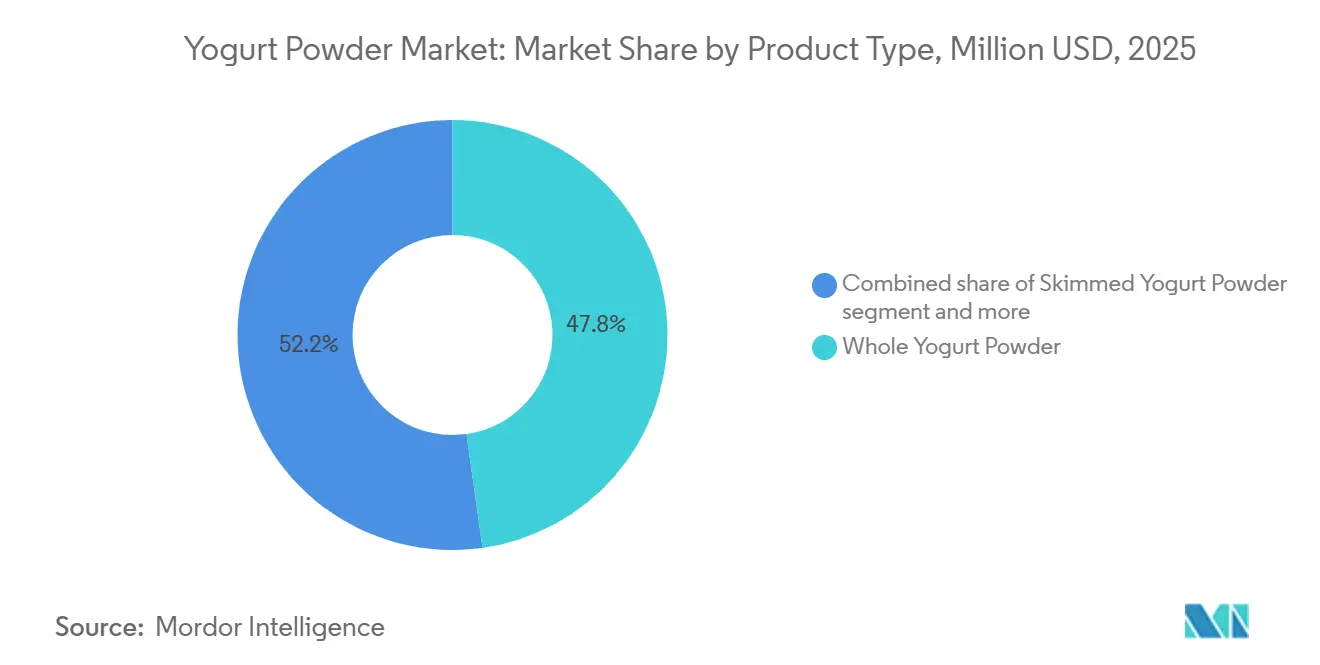
Skimmed Variants Capture Functional Reformulation DemandWhole yogurt powder held the largest share by product type, accounting for 47.78% of the yogurt powder market in 2025. The segment's dominance is primarily attributed to its superior nutritional profile, as it retains the natural fat content of yogurt, delivering a richer taste, creamier texture, and enhanced mouthfeel. Whole yogurt powder is extensively used across bakery, confectionery, dairy desserts, sauces, and ready-to-eat meal formulations where flavor and texture are key product attributes. Food manufacturers also prefer this variant because it offers excellent functionality, including improved emulsification, stability, and reconstitution properties in processed foods. The growing consumer demand for premium dairy products, clean-label ingredients, and high-protein formulations has further strengthened the adoption of whole yogurt powder.
Skimmed yogurt powder is projected to register the fastest growth, expanding at a CAGR of 6.11% through 2031. Rising consumer preference for low-fat, calorie-conscious, and protein-rich food products is driving the increasing demand for skimmed yogurt powder across global markets. The ingredient is gaining popularity in functional foods, nutritional beverages, sports nutrition, and dietary supplement applications due to its high protein content with reduced fat levels. Food manufacturers are increasingly incorporating skimmed yogurt powder into health-oriented product formulations to meet evolving consumer preferences for healthier dairy alternatives.



By Application:
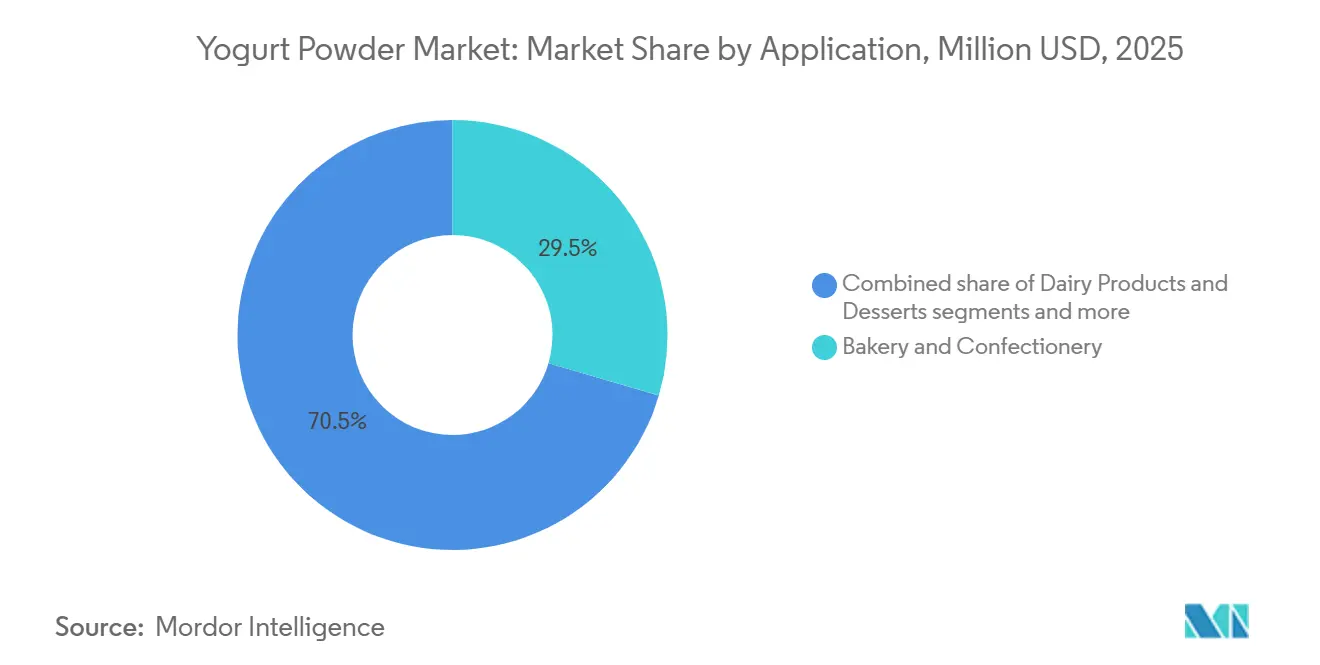
Bakery Dominates but Nutraceuticals Drive the Margin StoryBakery and Confectionery accounted for 29.54% of category demand in 2025. The application uses yogurt powder as an acidulant, a natural dairy flavor ingredient, and a partial protein source. Industrial bakeries also value its stability relative to liquid yogurt. The yogurt powder market is linked to dry ingredient procurement in large bakery and snack operations. Dairy products and desserts and beverages and smoothie mixes form the next large application group. These uses rely on reconstitution in markets with cold-chain limitations. Infant and Geriatric Nutrition remains smaller in volume but carries higher margins. Traceability and compositional certification requirements restrict the eligible supplier base. This raises the commercial importance of established quality systems in the yogurt powder industry.
Nutraceuticals and Dietary Supplements is expected to grow at a 5.88% CAGR through 2031. This application is supported by interest in probiotic, calcium, and protein ingredients from dairy sources. The yogurt powder market size for nutraceutical applications is growing as formulators seek natural-source positioning. Powder delivery formats can support stable supplement blends and meal replacement products. Yogurt powder can also reduce the need to add separate dairy flavor and acidulant inputs. The category faces tighter microbiological specifications than standard bakery applications. FDA GRAS clarification can affect how suppliers document probiotic-related claims.
Geography Analysis
APAC Yogurt Powder Market
Asia-Pacific held 32.64% of the yogurt powder market share in 2025 and is forecast to expand at a 5.77% CAGR through 2031. China, India, and Japan were identified as the region’s main consumption centers. China’s bakery, snack, and nutritional supplement sectors support demand for both whole and skimmed grades. India benefits from organized food manufacturing and persistent cold-chain gaps. These conditions make shelf-stable dairy formats practical for semi-urban distribution. Indonesia, Thailand, and Vietnam contribute further demand through expanding bakery chains and fortified convenience food sales. The OECD-FAO outlook expects per capita milk solids consumption in India to reach 33 kg by 2035[3]Source: Organisation for Economic Co-operation and Development, “OECD‑FAO Agricultural Outlook 2026‑2035- Dairy and dairy products”, oecd.org.
North America and Europe Yogurt Powder Market
North America and Europe generate higher per-unit revenue through premium product grades. In North America, demand centers on sports nutrition, functional foods, and clean-label bakery products. Organic and non-GMO certifications can support premium positioning in these applications. The FDA’s 2026 work on GRAS reform and new dietary ingredient guidance affects the substantiation of probiotic claims. Europe remains a mature region where traceability and regulatory compliance support specialty product values. European Union food-grade and organic frameworks shape the quality requirements for suppliers. Germany, France, the United Kingdom, the Netherlands, and Belgium are key European demand markets. The yogurt powder market in these regions relies on industrial bakery procurement and specialized nutrition applications.
South America and MEA Yogurt Powder Market
South America and Middle East and Africa are earlier-stage regions with distinct demand conditions. Brazil and Argentina provide regional demand anchors through food processing and dairy production capabilities. Colombia, Chile, and Peru are building demand through urbanization and retail expansion. Saudi Arabia and the United Arab Emirates are adding organized food manufacturing capacity that uses dry dairy ingredients. Halal certification can favor suppliers with established international compliance systems. Nigeria, Egypt, Morocco, and South Africa are developing domestic food processing capacity. Cold-chain limitations in these countries can strengthen demand for ambient dairy formats.

Competitive Landscape
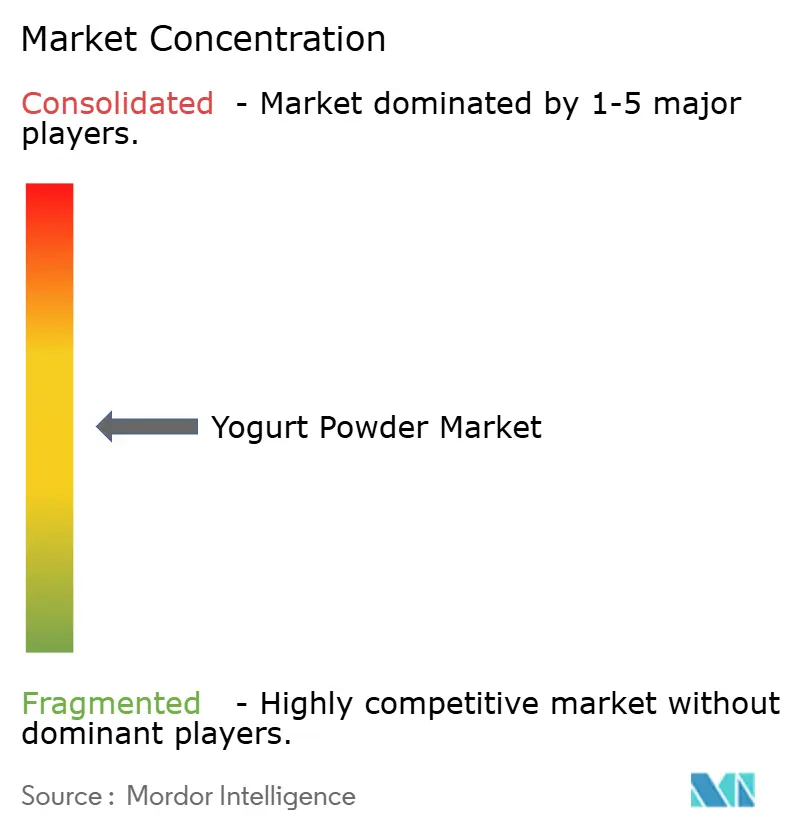
The yogurt powder market is fragmented. Large integrated dairy cooperatives, such as Glanbia, Ornua, and Arla, benefit from raw milk sourcing capabilities and broader processing networks. Mid-tier suppliers, including EPI Ingrédients, Prolactal GmbH, Schwarzwaldmilch GmbH, and Armor Protéines, compete through product specialization and application support. Commodity producers are investing in spray-drying capacity to reduce unit costs, while specialty suppliers are developing encapsulation and biotechnology capabilities for probiotic and functional products. This division reflects the differing requirements of high-volume customers and customers seeking high-specification products. No supplier in the yogurt powder market holds pricing authority across all product categories.
Glanbia completed the USD 300 million acquisition of Flavor Producers in April 2024. The transaction added natural flavor capabilities to its nutritional solutions platform and supported the company’s shift toward integrated ingredient systems rather than bulk ingredient supply. Kerry expanded industrial-scale lactase enzyme production at its Carrigaline biotechnology site in 2025, addressing demand for lactose-free and sugar-reduced dairy products. Arla Foods Ingredients began its reconstructing a spray-drying tower at its Arinco site in Videbæk in 2026. The DKK 300 million investment is designed to convert capacity from early-life nutrition production to specialty ingredient manufacturing. These moves indicate that suppliers are building broader technical platforms around dairy ingredients.
The strongest opportunities lie in nutraceuticals, infant nutrition, lactose-free products, and probiotic grades. Producers need validated culture counts, stable shelf life, and credible certification to serve these applications. All G and Savencia-owned Armor Protéines are expected to begin scaling bovine lactoferrin production in 2026 through a joint venture. This activity points to the growing use of precision fermentation for dairy bioactive ingredients. Real-time quality monitoring can help manage variation during spray drying. Application-focused formulation support can shorten development cycles with food manufacturers. ISO 22000 and FSSC 22000 are increasingly basic commercial requirements. Organic, non-GMO, halal, and kosher certifications can help suppliers differentiate themselves in specific regions and channels.
Yogurt Powder Industry Leaders
Glanbia plc
Kerry Group plc
Epi Ingrédients
Bluegrass Dairy & Food, Inc.
Prolactal GmbH
- *Disclaimer: Major Players sorted in no particular order
Yogurt Powder Market Companies Covered in this Report
- Glanbia plc
- Kerry Group plc
- Epi Ingrédients
- Batory Foods
- Bluegrass Dairy & Food, Inc.
- Prolactal GmbH
- CP Ingredients
- Ace International LLP
- EasiYo Products Limited
- ENKA SÜT A.Ş.
- Bempresa Ltd
- Schwarzwaldmilch GmbH
- Ballantyne Foods Pty Ltd
- Armor Proteines
- Almil AG
- Ornua Co-operative Limited
- Dr. Otto Suwelack Nachf. GmbH & Co. KG
- All American Foods, Inc.
- Lactoland Trockenmilchwerk GmbH
- BioGrowing Co., Ltd.

Recent Industry Developments in Yogurt Powder Market
- February 2026: Arla Foods announced a EUR 300 million investment in a new dairy plant at its existing Götene site. The plant is designed to process 1 billion kilograms of milk annually by 2030, nearly double the current volume. The project will add cheese and whey-derived ingredient capacity to the functional dairy ingredient supply chain. Its larger milk-processing base can support more consistent ingredient availability over time. The added capacity may also improve the use of milk streams across the company’s dairy operations.
- January 2025: Kerry Group plc completed the first phase of the sale of Kerry Dairy Ireland to Kerry Co-Operative Creameries, enabling the company to strengthen its strategic focus on its global Taste & Nutrition business. The company continues to invest in advanced dairy ingredients, including cultured dairy solutions that support yogurt powder applications.
- April 2024: Glanbia plc acquired Flavor Producers, a US-based developer of natural flavors, extracts, and ingredient solutions. The acquisition strengthens Glanbia's capabilities in clean-label product development and customized ingredient systems for food and beverage manufacturers.


Global Yogurt Powder Market Report Scope
Yogurt powder is a dehydrated dairy ingredient produced by removing the moisture from cultured yogurt using processes such as spray drying or freeze drying while preserving its characteristic flavor, nutritional value, and functional properties. The yogurt powder market is segmented by product type, application and geography. Based on product type, the market is segmented by whole yogurt powder, skimmed yogurt powder, semi-skimmed yogurt powder, lactose-free yogurt powder, probiotic yogurt powder and other product type. Based on application, the market is segmented into bakery and confectionery, dairy products and desserts, beverages and smoothie mixes, nutraceuticals and dietary supplements, infant and geriatric nutrition and other applications. By geography, the market is segmented into North America, Europe, Asia-Pacific, South America, and Middle-East and Africa. For each segment, the market sizing and forecasting have been done in value terms (USD million).
| Whole Yogurt Powder |
| Skimmed Yogurt Powder |
| Semi-Skimmed Yogurt Powder |
| Lactose-Free Yogurt Powder |
| Probiotic Yogurt Powder |
| Other Product Type |
| Bakery and Confectionery |
| Dairy Products and Desserts |
| Beverages and Smoothie Mixes |
| Nutraceuticals and Dietary Supplements |
| Infant and Geriatric Nutrition |
| Other Applications |
| North America | United States |
| Canada | |
| Mexico | |
| Rest of North America | |
| Europe | Germany |
| United Kingdom | |
| Italy | |
| France | |
| Spain | |
| Netherlands | |
| Poland | |
| Belgium | |
| Sweden | |
| Rest of Europe | |
| Asia-Pacific | China |
| India | |
| Japan | |
| Australia | |
| Indonesia | |
| South Korea | |
| Thailand | |
| Singapore | |
| Rest of Asia-Pacific | |
| South America | Brazil |
| Argentina | |
| Colombia | |
| Chile | |
| Peru | |
| Rest of South America | |
| Middle East and Africa | South Africa |
| Saudi Arabia | |
| United Arab Emirates | |
| Nigeria | |
| Egypt | |
| Morocco | |
| Turkey | |
| Rest of Middle East and Africa |
| By Product Type | Whole Yogurt Powder | |
| Skimmed Yogurt Powder | ||
| Semi-Skimmed Yogurt Powder | ||
| Lactose-Free Yogurt Powder | ||
| Probiotic Yogurt Powder | ||
| Other Product Type | ||
| By Application | Bakery and Confectionery | |
| Dairy Products and Desserts | ||
| Beverages and Smoothie Mixes | ||
| Nutraceuticals and Dietary Supplements | ||
| Infant and Geriatric Nutrition | ||
| Other Applications | ||
| By Geography | North America | United States |
| Canada | ||
| Mexico | ||
| Rest of North America | ||
| Europe | Germany | |
| United Kingdom | ||
| Italy | ||
| France | ||
| Spain | ||
| Netherlands | ||
| Poland | ||
| Belgium | ||
| Sweden | ||
| Rest of Europe | ||
| Asia-Pacific | China | |
| India | ||
| Japan | ||
| Australia | ||
| Indonesia | ||
| South Korea | ||
| Thailand | ||
| Singapore | ||
| Rest of Asia-Pacific | ||
| South America | Brazil | |
| Argentina | ||
| Colombia | ||
| Chile | ||
| Peru | ||
| Rest of South America | ||
| Middle East and Africa | South Africa | |
| Saudi Arabia | ||
| United Arab Emirates | ||
| Nigeria | ||
| Egypt | ||
| Morocco | ||
| Turkey | ||
| Rest of Middle East and Africa | ||


Key Questions Answered in the Report
What is the projected value of the yogurt powder market by 2031?
The yogurt powder market is forecast to reach USD 993.64 million by 2031, growing at a 4.43% CAGR from 2026.
Which yogurt powder product type is growing fastest?
Skimmed yogurt powder is the fastest-growing product type, with a projected 6.11% CAGR through 2031.
What application currently leads demand in the yogurt powder market?
Bakery and Confectionery led applications with a 29.54% share in 2025 because it uses yogurt powder for flavor, acidity, and protein.
Why are food manufacturers using yogurt powder?
The ingredient has a 12-18 month ambient shelf life and supports formulations that need dairy flavor, acidity, and protein without refrigeration.
Which region has the strongest growth outlook?
Asia-Pacific held 32.64% share in 2025 and is forecast to grow at a 5.77% CAGR through 2031.
Page last updated on:





