
Women's Luxury Footwear Market Size and Share
Market Overview
| Study Period | 2022 - 2032 |
|---|---|
| Market Size (2027) | USD 25.12 Billion |
| Market Size (2032) | USD 31.24 Billion |
| Growth Rate (2027 - 2032) | 4.46 % |
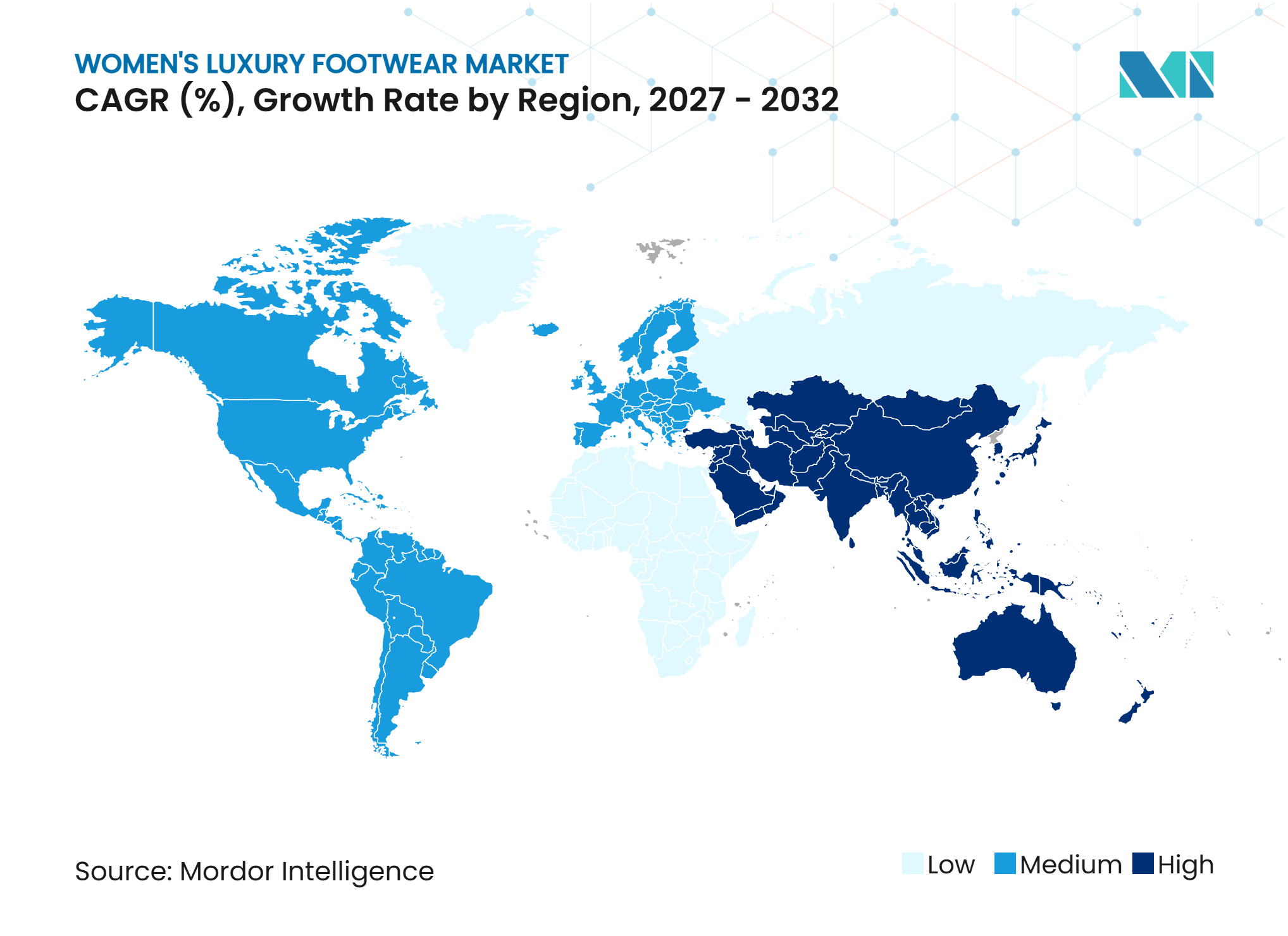
| Fastest Growing Market | Asia-Pacific |
| Largest Market | North America |
| Market Concentration | Low |
Major Players *Disclaimer: Major Players sorted in no particular order Image © Mordor Intelligence. Reuse requires attribution under CC BY 4.0. | |
Women's Luxury Footwear Market Analysis by Mordor Intelligence
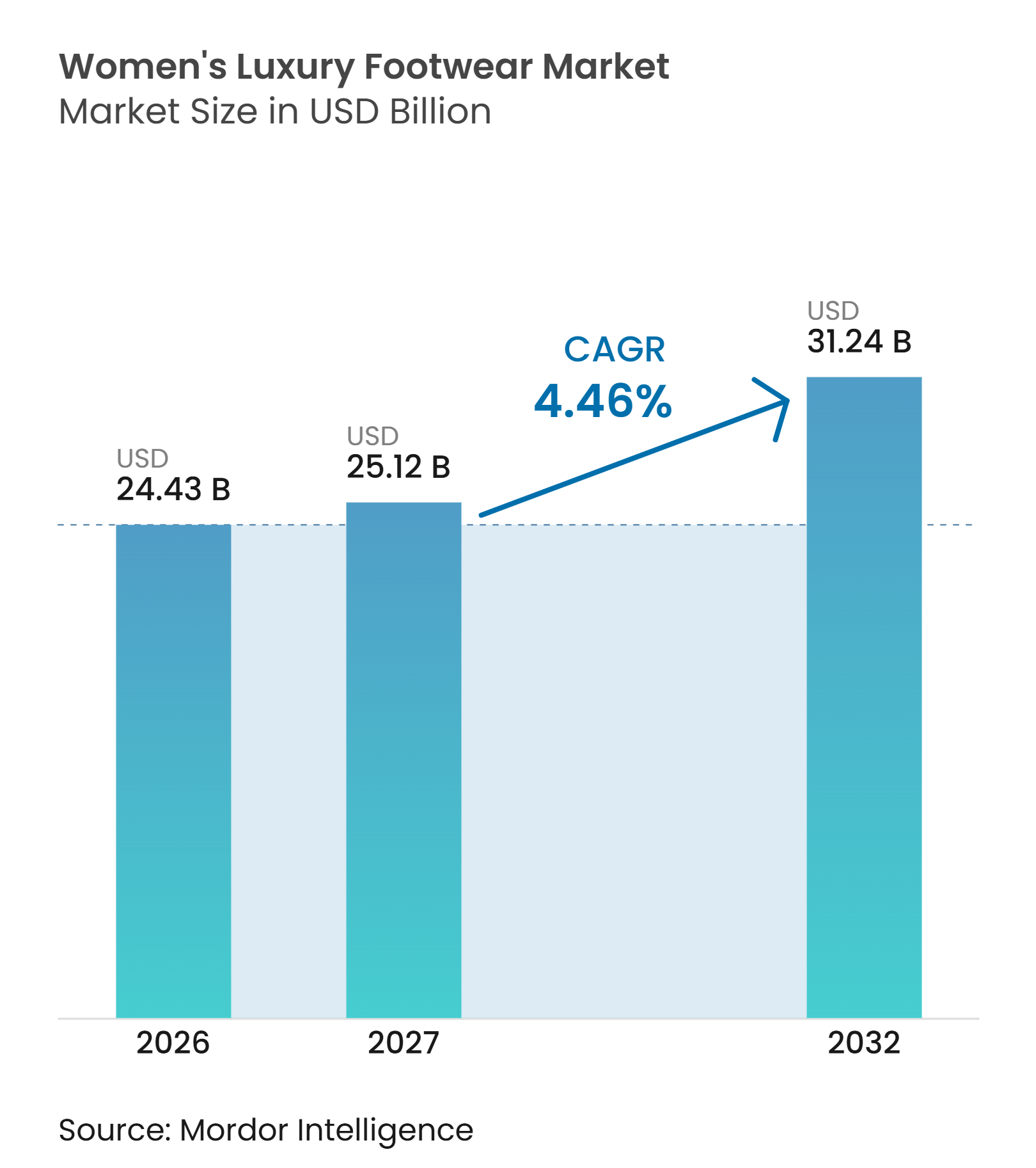
The women's luxury footwear market size is expected to grow from USD 24.43 billion in 2026 to USD 25.12 billion in 2027 and is forecast to reach USD 31.24 billion by 2032 at 4.46% CAGR over 2027-2032. The market is moving through a more selective purchasing period, with consumers placing greater weight on craftsmanship, fit, durability, and distinctive design. Premium brands are responding by protecting distribution, improving owned digital channels, and using stores as places for service rather than only transactions. Demand is also broadening across emerging luxury destinations, although brands must balance expansion with the exclusivity that supports premium pricing. The market faces pressure from price-sensitive buyers, counterfeit goods, and uncertainty in discretionary spending, while authentic provenance and tailored service remain important differentiators.
Key Report Takeaways
-
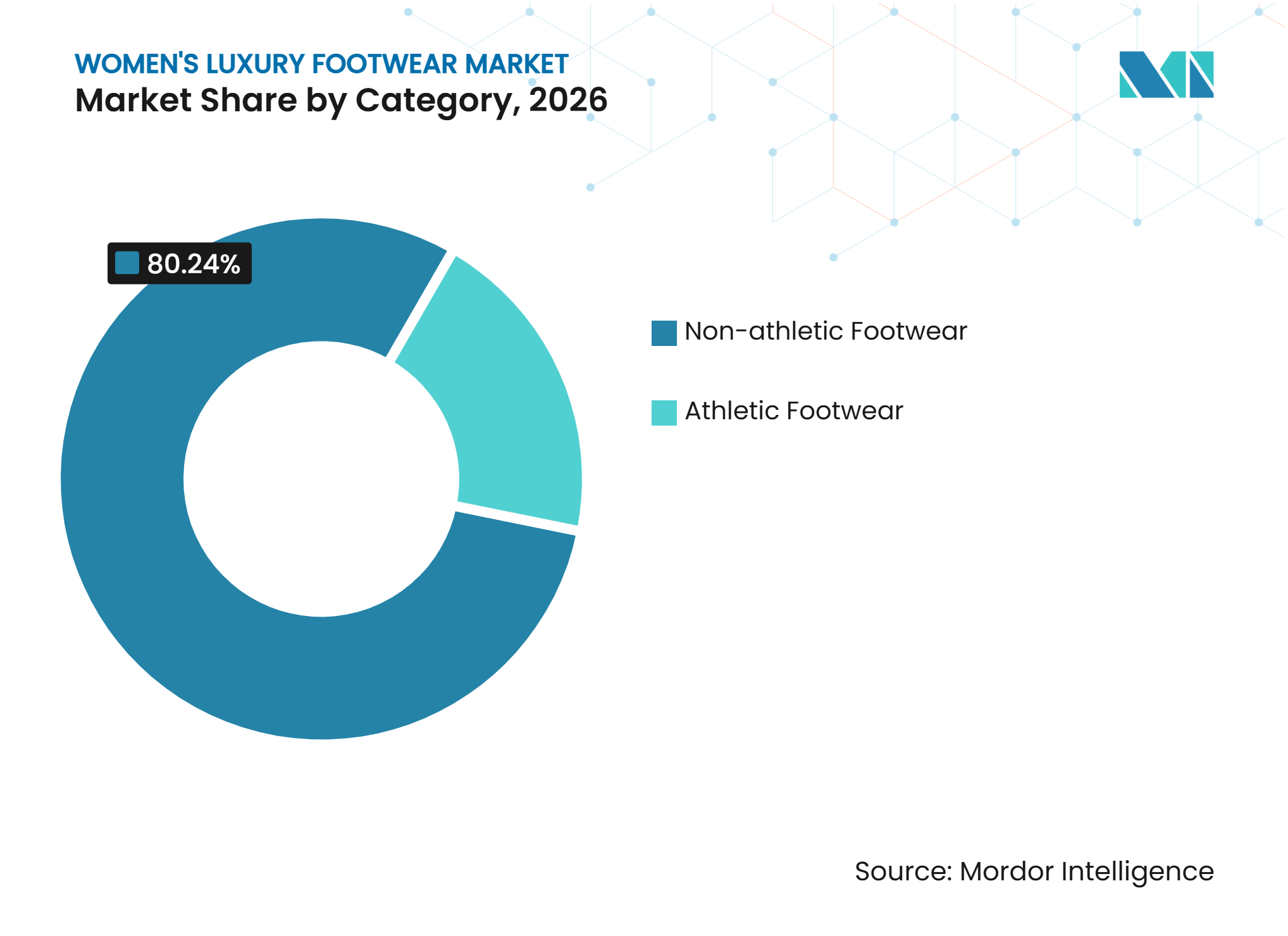
By category, non-athletic footwear held 80.24% of the women's luxury footwear market share in 2026, while athletic footwear is forecast to grow at a 5.34% CAGR through 2032.
-
By product type, shoes and boots accounted for 43.51% of the women's luxury footwear market share in 2026, while flats are forecast to grow at a 5.68% CAGR through 2032.
-
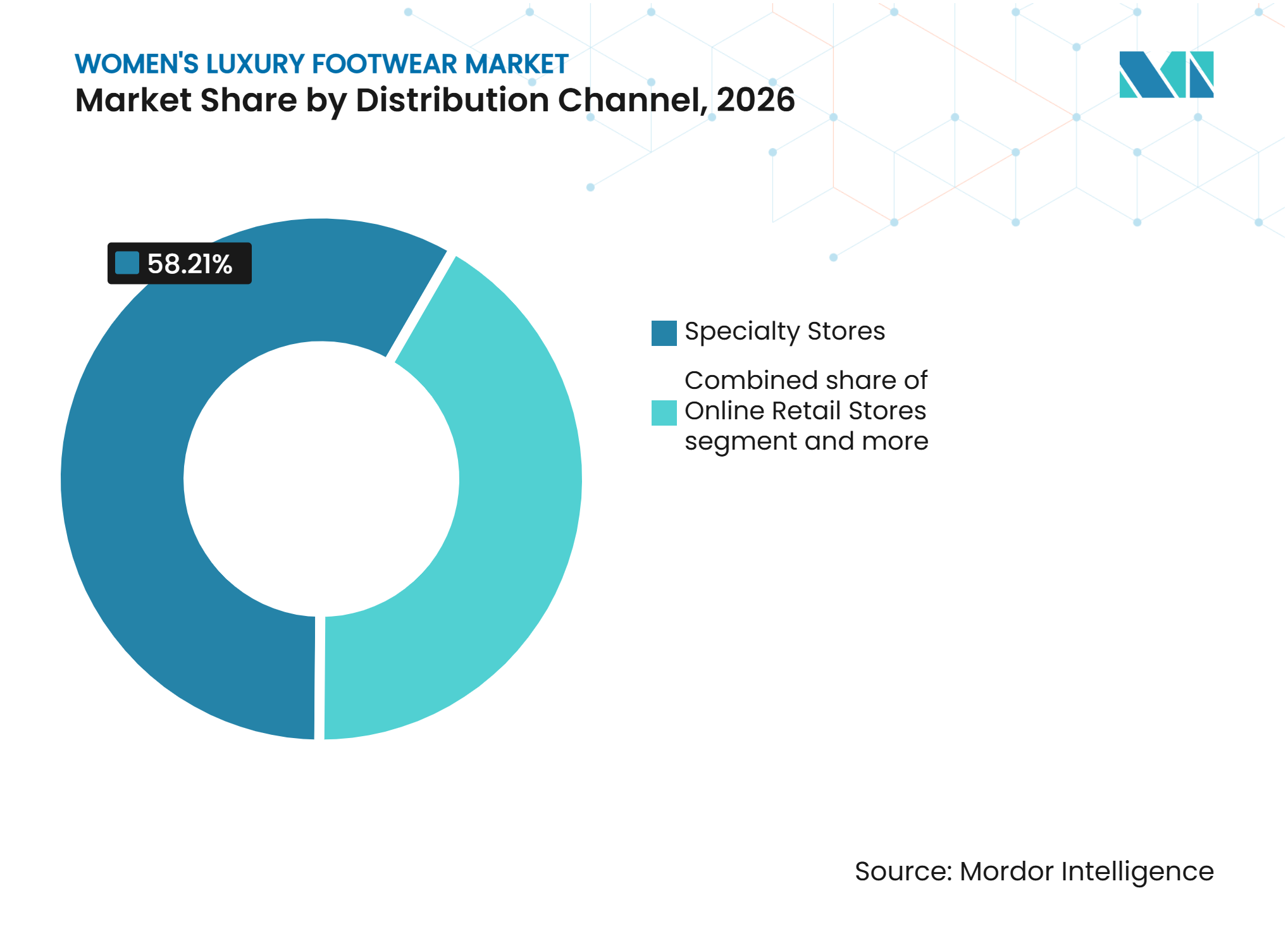
By distribution channel, specialty stores held 58.21% of the women's luxury footwear market share in 2026, while online retail stores are forecast to grow at a 6.01% CAGR through 2032.
-
By geography, North America accounted for 33.45% of the women's luxury footwear market share in 2026, while Asia-Pacific is forecast to grow at a 5.84% CAGR through 2032.
Note: Market numbers in this report are based on Mordor Intelligence's proprietary estimation framework, which combines nine months of actuals with Q4 projections for base year 2026.
Market Trends and Insights
Drivers Impact Analysis of Women's Luxury Footwear Market*
| Driver | (~) % Impact on CAGR Forecast | Geographic Relevance | Impact Timeline |
|---|---|---|---|
| Growing demand for premium and designer women's footwear | +1.4% | Global, strongest in North America and Europe | Medium term (2-4 years) |
| Increasing influence of celebrity endorsements and fashion influencers | +0.8% | Global, led by the United States with strong Asia-Pacific amplification | Short term (≤ 2 years) |
| Rising consumer preference for exclusive and personalized footwear designs | +0.6% | North America, Europe, and Asia-Pacific | Medium term (2-4 years) |
| Growing popularity of premium sneakers and luxury casual footwear | +0.5% | Global, with Asia-Pacific as a core area and spillover into the Middle East and Africa | Short term (≤ 2 years) |
| Increasing demand for sustainable and ethically sourced luxury footwear | +0.4% | Europe and North America | Long term (≥ 4 years) |
| Expansion of luxury fashion brands into emerging markets | +0.7% | Asia-Pacific, Middle East and Africa, and Latin America | Long term (≥ 4 years) |
| Source: Mordor Intelligence | |||
Growing Demand for Premium and Designer Women's Footwear
Premium footwear can remain accessible to customers who want entry into heritage brands but do not intend to buy higher-priced handbags or ready-to-wear. That positioning supports repeat purchases when consumers remain cautious about larger luxury purchases. Kering reported that new product introductions, especially shoes and women's ready-to-wear, supported sequential improvement at Yves Saint Laurent during 2025[1]. This supports a competitive approach centered on product renewal and visible quality rather than frequent price increases. Footwear also benefits when brands can explain materials, construction, and wearability in clear terms.
Increasing Influence of Celebrity Endorsements and Fashion Influencers
Celebrity appearances and creator partnerships can help footwear brands remain visible between product launches. Their value increases when a placement is repeated by independent fashion voices and reaches audiences outside the brand's own channels. This makes collaborations more useful when they link a product to a recognizable cultural moment rather than only a paid campaign. The Women's luxury footwear market benefits from this exposure because shoes are highly visible in editorial images, social content, and event coverage. Brands still need to connect attention to retail execution through product availability, sizing support, and customer service.
Rising Consumer Preference for Exclusive and Personalized Footwear Designs
Increasing consumer interest in individuality and product differentiation is encouraging demand for exclusive and personalized women's luxury footwear. Affluent consumers are increasingly seeking footwear that reflects their personal style through distinctive silhouettes, customized embellishments, premium materials, and limited-edition designs. According to EY's 2025 Luxury Client Index, personalization influenced the luxury fashion purchasing decisions of 30% of polled consumers, while exclusivity or scarcity was identified by 42% as an important purchase consideration[2]. This preference is encouraging luxury footwear brands to introduce made-to-order collections, customized design options, and limited-production styles. Brands such as Christian Louboutin, Gucci, and Louis Vuitton strengthen product differentiation through distinctive design elements, exclusive collections, and personalized customer experiences.
Increasing Demand for Sustainable and Ethically Sourced Luxury Footwear
Sustainability is becoming part of the product assessment for customers who expect a luxury purchase to retain value and remain credible over time. Material traceability, repairability, durable construction, and lower-waste production can reinforce the value narrative behind a premium shoe. The demand is strongest where customers already expect clear information on sourcing and manufacturing practices. It does not remove the need for design appeal because luxury buyers continue to judge comfort, finish, and brand identity alongside environmental claims. The Women's luxury footwear market can benefit when sustainability is incorporated into a proven product rather than presented as a separate and less desirable alternative. Brands also need evidence that can be explained clearly at the point of sale to avoid unsupported claims that may reduce customer trust.
Restraints Impact Analysis of Women's Luxury Footwear Market*
| Restraint | (~) % Impact on CAGR Forecast | Geographic Relevance | Impact Timeline |
|---|---|---|---|
| High prices limiting accessibility among price-sensitive consumers | -1.2% | Global, most acute in Asia-Pacific and North America | Short term (≤ 2 years) |
| Increasing availability of counterfeit luxury footwear products | -0.6% | Global, including China, India, North America, and Europe, Middle East and Africa | Medium term (2-4 years) |
| Economic uncertainties affecting discretionary consumer spending | -0.9% | Global, most acute in Europe and Asia-Pacific | Short term (≤ 2 years) |
| High production costs associated with premium materials and craftsmanship | -0.5% | Global, with production concentration in Italy and France | Long term (≥ 4 years) |
| Source: Mordor Intelligence | |||
High Prices Limiting Accessibility Among Price-Sensitive Consumers
Price sensitivity is placing pressure on the part of the category that depends on aspirational luxury customers. A buyer may delay a purchase when the difference between a premium shoe and an ultra-luxury product no longer seems justified by materials, fit, or service. This pressure is stronger in markets where imported footwear carries added cost exposure. It also makes discounting more damaging because it can weaken customer expectations about the brand's regular price. The Women's luxury footwear market must therefore rely on clearer product value, disciplined price architecture, and styles with lasting utility. Brands that serve the highest-end customer may be more insulated, but they still need to avoid product ranges that appear interchangeable.
Increasing Availability of Counterfeit Luxury Footwear Products
Counterfeiting damages brand equity because it creates uncertainty around authenticity in resale, online retail, and cross-border commerce. The Organisation for Economic Co-operation and Development identifies footwear among the leading product categories affected by counterfeit trade and notes that localized assembly can complicate customs enforcement[3]. The threat is becoming more difficult to manage when counterfeit products imitate labels, packaging, and digital authentication signals. Brands need stronger product-level provenance and practical checks for staff, customers, and resale partners. These investments may add operating costs, but they are important for defending the trust that supports luxury pricing. The market also needs clear communication so customers understand how to verify a purchase without relying on informal social media advice.
*Our forecasts treat driver/restraint impacts as directional, not additive. The impact forecasts reflect baseline growth, mix effects, and variable interactions.
Women's Luxury Footwear Market Segment Analysis
By Category:
Non-Athletic Footwear Provides the Core While Athletic Styles Extend UsageNon-athletic footwear dominated the women's luxury footwear market, accounting for 80.24% of the market share in 2026. The segment's leading position is supported by strong consumer preference for premium footwear designed for formal occasions, professional settings, and everyday fashion use. Luxury brands continue to focus on expanding their non-athletic footwear collections, including high-end heels, pumps, loafers, flats, boots, and designer sandals. These products benefit from established consumer demand for sophisticated designs, premium materials, craftsmanship, and brand recognition. Furthermore, the growing influence of fashion trends and designer collections encourages consumers to purchase luxury non-athletic footwear for both personal use and special occasions.
Athletic footwear is projected to register the fastest growth in the women's luxury footwear market, with a CAGR of 5.34% through 2032. Growth is supported by increasing consumer interest in luxury sneakers and performance-inspired footwear that combines comfort, functionality, and premium design. Luxury fashion brands are increasingly incorporating athletic-inspired silhouettes, innovative materials, and distinctive design elements into their footwear collections. The growing adoption of athleisure fashion is also encouraging women to incorporate premium athletic footwear into casual, travel, and everyday wardrobes.



By Product Type:
Shoes and Boots Retain Scale While Flats Gain RelevanceShoes and boots dominated the women's luxury footwear market, accounting for 43.51% of the market share in 2026. The segment's leading position is supported by consistent consumer demand for premium footwear suitable for formal, professional, and casual occasions. Luxury brands offer a wide range of products, including designer pumps, high heels, ankle boots, knee-high boots, and other fashion-oriented footwear. These products attract consumers through distinctive designs, premium materials, superior craftsmanship, and established brand positioning. Furthermore, the popularity of seasonal fashion collections and designer footwear trends encourages consumers to purchase premium shoes and boots for different occasions.
Flats are projected to register the fastest growth in the women's luxury footwear market, with a CAGR of 5.68% through 2032. Growth is supported by increasing consumer preference for comfortable and versatile footwear that can be incorporated into everyday wardrobes. Luxury brands are expanding their flat footwear collections through premium ballet flats, loafers, designer slip-ons, and embellished flat sandals. The growing demand for footwear that combines comfort with sophisticated styling is encouraging consumers to consider flats as alternatives to high heels and other formal footwear.
By Distribution Channel:
Specialty Stores Sustain Service While Online Retail Broadens AccessSpecialty stores dominated the women's luxury footwear market, accounting for 58.21% of the market share in 2026. The segment's leading position is supported by consumer preference for dedicated luxury retail environments that offer personalized shopping experiences and specialized product selections. These stores enable customers to physically examine footwear quality, assess material finishes, and evaluate fit and comfort before making premium purchases. Furthermore, personalized assistance, brand-specific product knowledge, and exclusive collections strengthen customer engagement and purchasing confidence.
Online retail stores are projected to register the fastest growth in the women's luxury footwear market, with a CAGR of 6.01% through 2032. Growth is supported by increasing consumer adoption of digital shopping platforms and the expanding online presence of luxury footwear brands. E-commerce channels provide access to wider product assortments, including exclusive collections, seasonal launches, and designs that may not be readily available through physical stores. Furthermore, improved digital shopping experiences through high-resolution product images, detailed size guides, virtual styling tools, and personalized recommendations are strengthening consumer confidence in online luxury purchases.

Geography Analysis
North America
North America dominated the women's luxury footwear market, accounting for 33.45% of the market share in 2026. The region's leading position is supported by high consumer purchasing power, strong demand for premium fashion products, and the established presence of international luxury footwear brands. The United States represents a major market, driven by consumer preference for designer footwear, premium sneakers, high-end boots, and occasion-specific luxury collections. Furthermore, the presence of established luxury retail destinations, department stores, specialty boutiques, and online shopping platforms supports product accessibility across the region. The growing influence of celebrity endorsements, fashion influencers, and designer collaborations also contributes to consumer interest in luxury footwear.
Asia-Pacific
Asia-Pacific is projected to register the fastest growth in the women's luxury footwear market, with a CAGR of 5.84% through 2032. Growth is supported by rising disposable incomes, an expanding affluent consumer base, and increasing interest in international luxury fashion brands across the region. China, Japan, South Korea, and India represent important markets, supported by growing demand for premium fashion products and designer footwear. The increasing influence of social media, celebrity endorsements, and fashion influencers is also encouraging younger consumers to explore luxury footwear collections. Furthermore, the expansion of luxury retail outlets, international brand boutiques, and e-commerce platforms is improving access to premium footwear across major urban markets.
Europe, South America, and Middle East and Africa
Europe represents an established market for women's luxury footwear, supported by the presence of prominent luxury fashion houses, strong fashion heritage, and established premium retail infrastructure. Countries such as Italy, France, Germany, and the United Kingdom benefit from domestic luxury brand presence, international tourist spending, and consumer demand for designer footwear. South America is supported by growing interest in premium fashion products, particularly in Brazil and Argentina, where affluent consumers contribute to demand for international luxury brands. The Middle East and Africa market benefits from luxury-oriented consumer spending in countries such as the United Arab Emirates and Saudi Arabia, supported by premium shopping destinations, international tourism, and the expansion of luxury retail outlets.
Competitive Landscape
Market Concentration
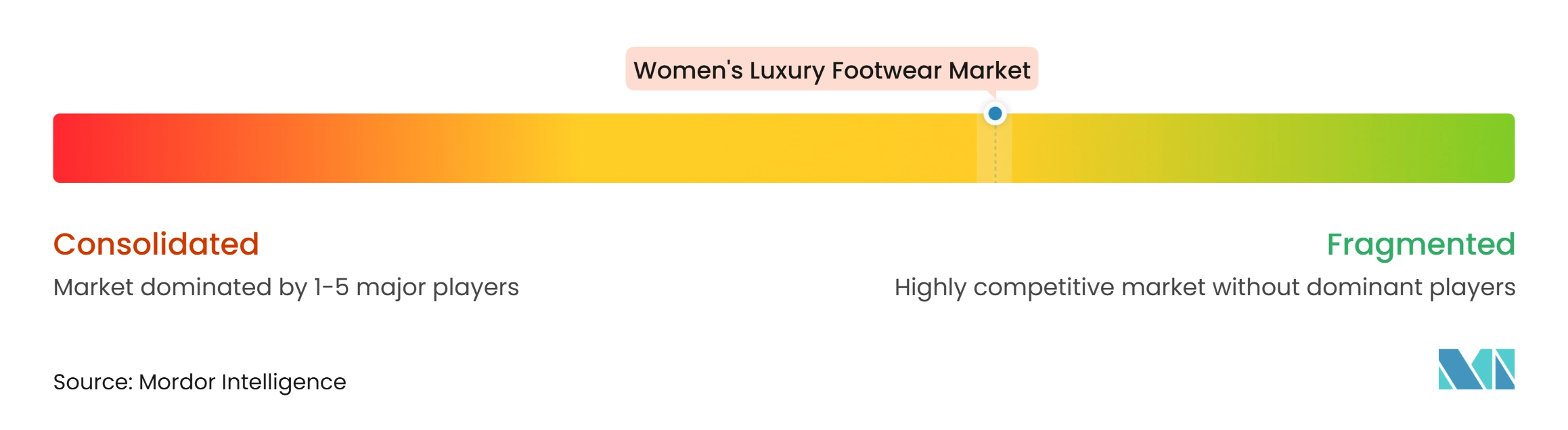
The women's luxury footwear market is fragmented, with prominent players competing through brand positioning, product innovation, design differentiation, and global retail presence. LVMH Moët Hennessy Louis Vuitton SE maintains a strong competitive position through its extensive luxury brand portfolio, including Louis Vuitton, Christian Dior, and other fashion houses offering premium footwear collections. Kering SA strengthens its market presence through luxury brands such as Gucci, Saint Laurent, and Bottega Veneta, targeting consumers through distinctive designs and premium craftsmanship. Both companies leverage established brand recognition, exclusive collections, and international distribution networks to attract affluent consumers.
Prada S.p.A. competes through contemporary luxury designs, premium materials, and the integration of fashion-forward styling across its footwear portfolio. The company focuses on expanding its luxury footwear offerings through products that combine distinctive aesthetics, craftsmanship, and functional design. Chanel Limited maintains its competitive position through timeless designs, brand exclusivity, and premium footwear collections that appeal to consumers seeking sophisticated fashion products. Its footwear portfolio benefits from the brand's established positioning in the global luxury fashion industry and strong customer loyalty.
Hermès International S.A. maintains a differentiated position in the women's luxury footwear market through its emphasis on craftsmanship, premium materials, exclusivity, and heritage-led product development. The company offers luxury footwear collections that complement its broader positioning in the high-end fashion and accessories market. Its focus on product quality, distinctive designs, and controlled distribution supports its premium brand positioning. Competition among these prominent players is primarily based on brand reputation, product design, craftsmanship, pricing, exclusivity, and distribution reach.
Women's Luxury Footwear Industry Leaders
-
LVMH Moët Hennessy Louis Vuitton SE
-
Kering SA
-
Prada S.p.A.
-
Chanel Limited
-
Hermès International S.A.
- *Disclaimer: Major Players sorted in no particular order
Women's Luxury Footwear Market Companies Covered in this Report
- LVMH Moët Hennessy Louis Vuitton SE
- Kering SA
- Prada S.p.A.
- Chanel Limited
- Hermès International S.A.
- Burberry Group plc
- Capri Holdings Limited
- Tapestry, Inc.
- Salvatore Ferragamo S.p.A.
- TOD'S S.p.A.
- Christian Louboutin SAS
- Manolo Blahnik International Limited
- Golden Goose S.p.A.
- Giuseppe Zanotti S.p.A.
- Zintala S.r.l. (Aquazzura)
- Jimmy Choo Limited
- Giorgio Armani S.p.A.
- Brunello Cucinelli S.p.A.
- Aeffe S.p.A.
- Caleres, Inc.
Recent Industry Developments in Women's Luxury Footwear Market
- August 2026: Fashion label Khy collaborated with Italian luxury footwear designer Gia Borghini to introduce its first footwear collection. The collection features three styles, including leather thong sandals, architectural wedge sandals, and sculptural strappy heels. The footwear was handmade in Italy and developed around contemporary, versatile styling.
- July 2026: Indian luxury footwear brand Crimzon opened its fifth standalone boutique at Ambawatta One in Mehrauli, New Delhi. The store marked the brand's first dedicated footwear outlet in the luxury bridal and couture shopping destination. The expansion strengthened its offline retail presence across Delhi and Mumbai, with an additional boutique planned in Gurugram. The expansion strengthened its offline retail presence across Delhi and Mumbai, with an additional boutique planned in Gurugram.
- June 2026: Manolo Blahnik collaborated with fashion designer Emilia Wickstead to introduce a 12-style footwear capsule collection exclusively through Net-a-Porter and Emilia Wickstead's retail channels. The collection combines Manolo Blahnik's footwear craftsmanship with Wickstead's feminine and refined design approach.
- April 2026: Luxury footwear brand Tiannia Barnes launched its handcrafted Italian footwear collection on Nordstrom.com as part of the retailer's curated emerging designer assortment. The launch expanded the brand's distribution beyond its direct-to-consumer channels and increased its access to luxury footwear shoppers in the United States. The collection features architectural heels, contemporary silhouettes, and premium Italian-sourced materials.
Global Women's Luxury Footwear Market Report Scope
Luxury footwear is manufactured using premium quality materials and provides greater durability, uniqueness, and comfort. Luxury products are controlled by limited availability. The women's luxury footwear market is segmented by category, product type, distribution channel, and geography. By category, the market is segmented into athletic footwear and non-athletic footwear. By product type, the market is divided into shoes and boots, heels and pumps, flats and other product types. By distribution channel, the market is segmented into specialty stores, online retail stores and other distribution channels. By geography, the market is segmented by North America, Europe, Asia-Pacific, South America, the Middle East and Africa. For each segment, market sizing and forecasts have been done based on the value in USD billion.
Segmentation Overview
| Athletic Footwear |
| Non-Athletic Footwear |
| Shoes and Boots |
| Heels and Pumps |
| Flats |
| Other Product Types |
| Specialty Stores |
| Online Retail Stores |
| Other Distribution Channels |
| North America | United States |
| Canada | |
| Mexico | |
| Rest of North America | |
| Europe | United Kingdom |
| Germany | |
| France | |
| Italy | |
| Spain | |
| Netherlands | |
| Poland | |
| Belgium | |
| Sweden | |
| Rest of Europe | |
| Asia-Pacific | China |
| Japan | |
| India | |
| Australia | |
| Indonesia | |
| South Korea | |
| Thailand | |
| Singapore | |
| Rest of Asia-Pacific | |
| South America | Brazil |
| Argentina | |
| Colombia | |
| Chile | |
| Peru | |
| Rest of South America | |
| Middle East and Africa | South Africa |
| Saudi Arabia | |
| United Arab Emirates | |
| Nigeria | |
| Egypt | |
| Morocco | |
| Turkey | |
| Rest of Middle East and Africa |
| By Category | Athletic Footwear | |
| Non-Athletic Footwear | ||
| By Product Type | Shoes and Boots | |
| Heels and Pumps | ||
| Flats | ||
| Other Product Types | ||
| By Distribution Channel | Specialty Stores | |
| Online Retail Stores | ||
| Other Distribution Channels | ||
| By Geography | North America | United States |
| Canada | ||
| Mexico | ||
| Rest of North America | ||
| Europe | United Kingdom | |
| Germany | ||
| France | ||
| Italy | ||
| Spain | ||
| Netherlands | ||
| Poland | ||
| Belgium | ||
| Sweden | ||
| Rest of Europe | ||
| Asia-Pacific | China | |
| Japan | ||
| India | ||
| Australia | ||
| Indonesia | ||
| South Korea | ||
| Thailand | ||
| Singapore | ||
| Rest of Asia-Pacific | ||
| South America | Brazil | |
| Argentina | ||
| Colombia | ||
| Chile | ||
| Peru | ||
| Rest of South America | ||
| Middle East and Africa | South Africa | |
| Saudi Arabia | ||
| United Arab Emirates | ||
| Nigeria | ||
| Egypt | ||
| Morocco | ||
| Turkey | ||
| Rest of Middle East and Africa | ||
Key Questions Answered in the Report
What is the 2032 outlook for women's luxury footwear?
The market is forecast to reach USD 31.24 billion by 2032, expanding at a CAGR of 4.46% from 2027.
Which category leads women's luxury footwear sales?
Non-athletic footwear leads with an 80.24% share in 2026, supported by demand for heels, boots, loafers, and other occasion-led designs.
Which women's luxury footwear product type is growing fastest?
Flats are forecast to grow at a 5.68% CAGR through 2032 as buyers favor comfort, versatility, and heritage-led styling.
Why are specialty stores important for luxury shoes?
Specialty stores held 58.21% share in 2026 because they support fitting, material assessment, styling advice, and clienteling.