
Whey Permeate Market Size and Share
Market Overview
| Study Period | 2022 - 2032 |
|---|---|
| Market Size (2027) | USD 0.99 Billion |
| Market Size (2032) | USD 1.32 Billion |
| Growth Rate (2027 - 2032) | 5.80 % |
| Fastest Growing Market | Asia-Pacific |
| Largest Market | North America |
| Market Concentration | Medium |
Major Players *Disclaimer: Major Players sorted in no particular order Image © Mordor Intelligence. Reuse requires attribution under CC BY 4.0. | |
Whey Permeate Market Analysis by Mordor Intelligence
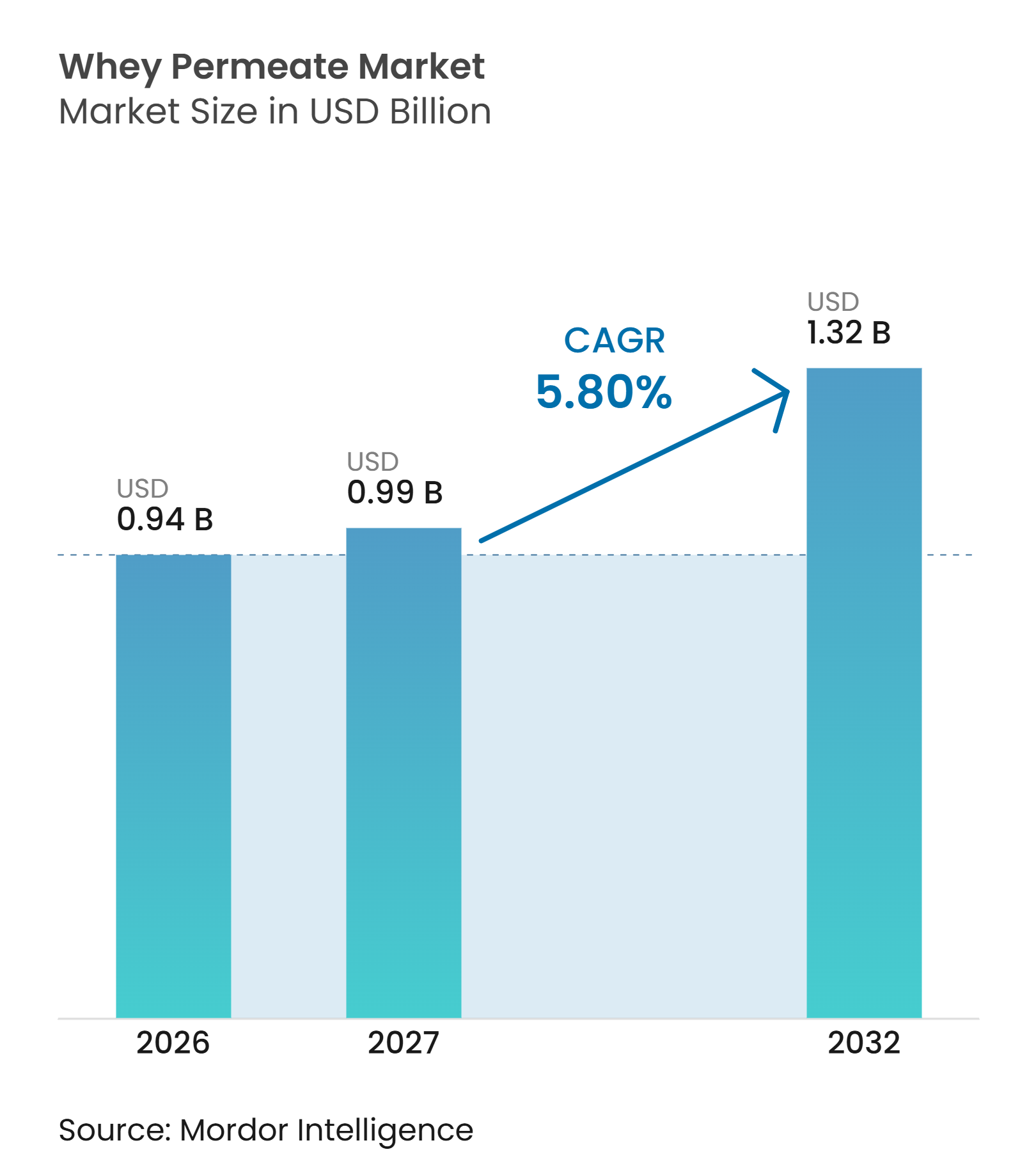
The whey permeate market size was valued at USD 0.94 billion in 2026 and is estimated to grow from USD 0.99 billion in 2027 to reach USD 1.32 billion by 2032, at a CAGR of 5.80% during the forecast period (2027-2032). The whey permeate market benefits from a supply model in which producers generate permeate during whey protein concentrate and whey protein isolate production. Higher-value protein production also provides major processors with a financial incentive to improve permeate recovery and direct it toward food-grade applications. Demand is expanding beyond conventional food and feed applications into fermentation. However, new processing capacity may pressure commodity-grade returns if end-use demand fails to keep pace.
Key Report Takeaways
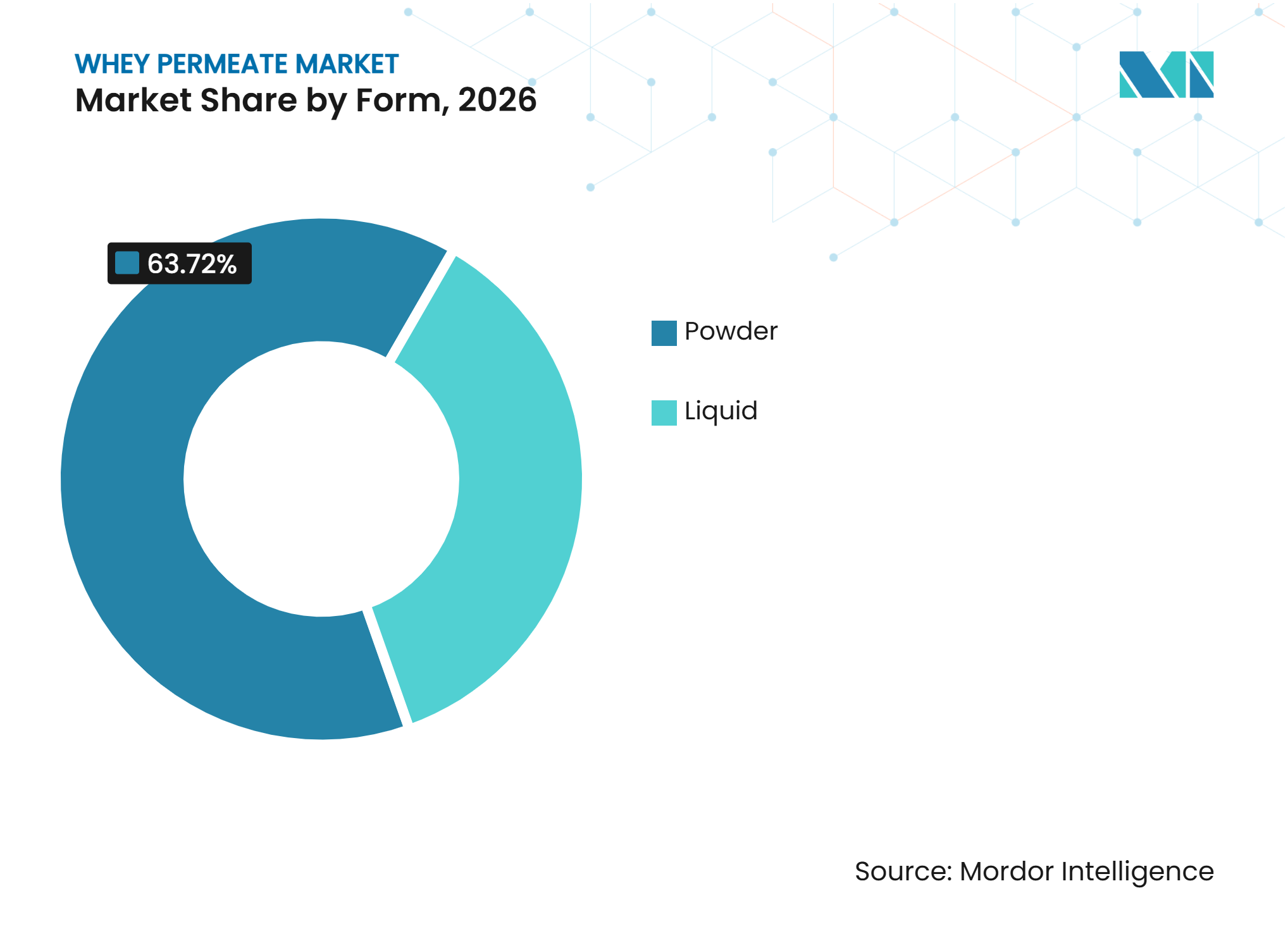
- By form, powder dominated the whey permeate market with a share of 63.72% in 2026, while liquid is anticipated to register the fastest CAGR of 7.02% during 2027-2032.
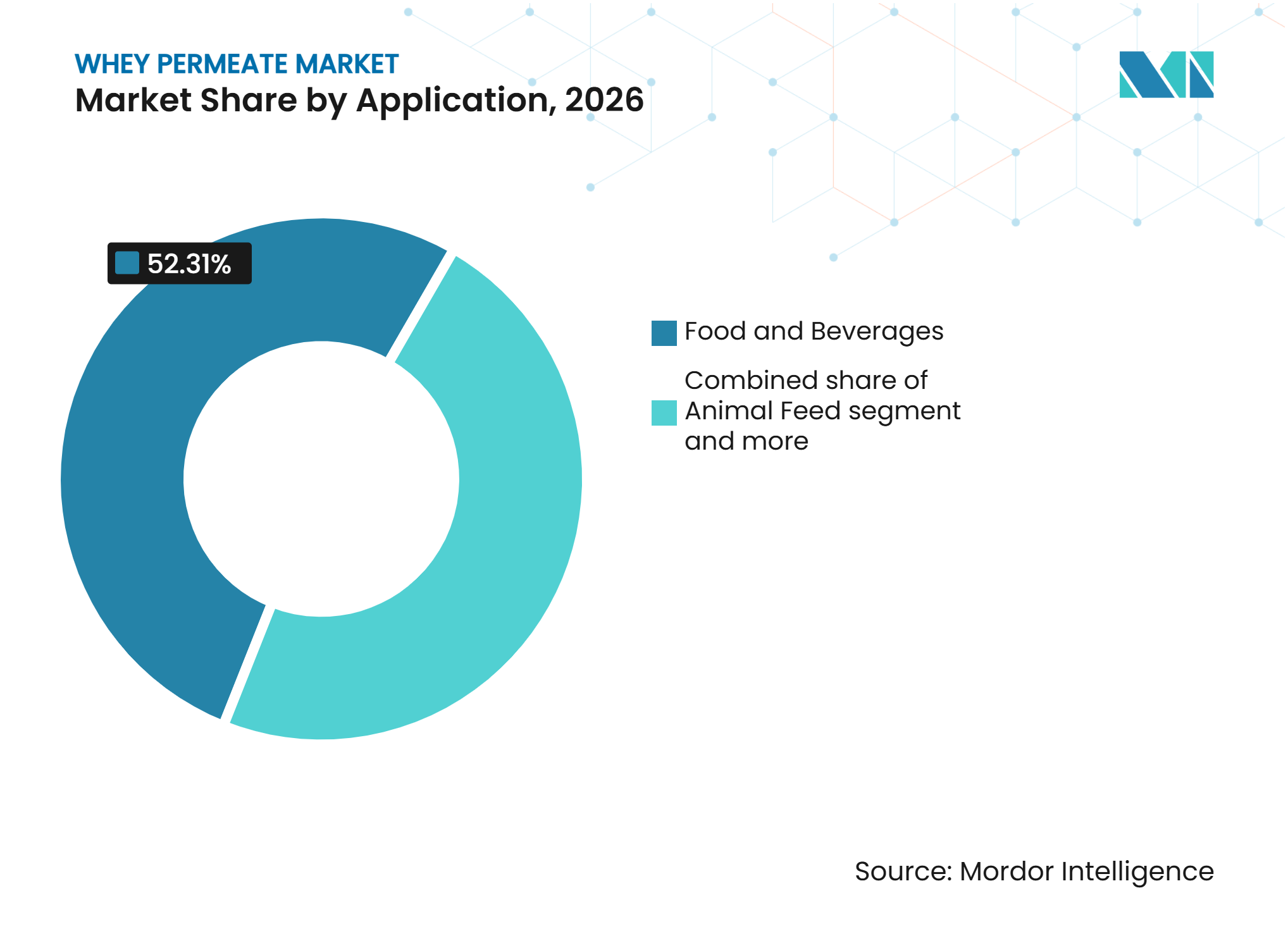
- By application, food and beverages led the market with a share of 52.31% in 2026, while animal feed is anticipated to register the fastest CAGR of 7.32% during 2027-2032.
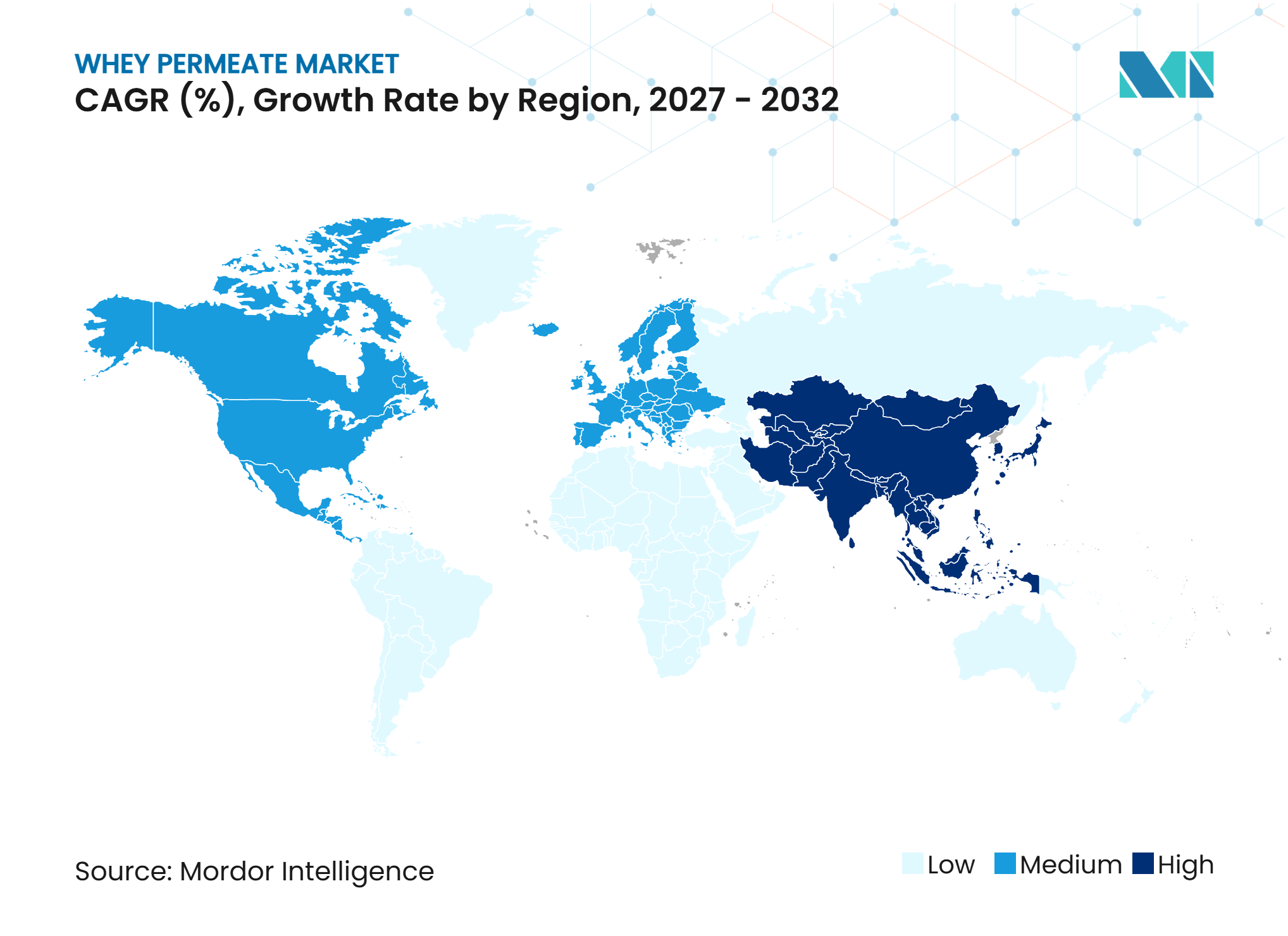
- By geography, North America dominated the whey permeate market with a share of 36.42% in 2026, while Asia-Pacific is projected to register the fastest CAGR of 7.68% during 2027-2032.
Note: Market numbers in this report are based on Mordor Intelligence's proprietary estimation framework, which combines nine months of actuals with Q4 projections for base year 2026.
Market Trends and Insights
Drivers Impact Analysis of Whey Permeate Market*
| Driver | (~) % Impact on CAGR Forecast | Geographic Relevance | Impact Timeline |
|---|---|---|---|
| Rising demand for cost-effective dairy ingredients | +1.5% | Global, with core gains in North America and Europe | Short term (≤ 2 years) |
| Expanding applications in bakery and confectionery products | +1.1% | North America, Europe, Asia-Pacific | Medium term (2-4 years) |
| Increasing utilization of whey permeate in animal feed | +1.2% | North America and Asia-Pacific | Short term (≤ 2 years) |
| Growing demand for sodium reduction in processed foods | +0.9% | North America and Europe | Medium term (2-4 years) |
| Rising production of whey protein concentrates and isolates | +0.8% | Global, with supply gains in North America and the Netherlands | Short term (≤ 2 years) |
| Expanding applications in fermentation and industrial biotechnology | +0.5% | Europe, with emerging gains in North America | Long term (≥ 4 years) |
| Source: Mordor Intelligence | |||
Rising Demand for Cost-Effective Dairy Ingredients
Food and beverage manufacturers increasingly use cost-effective dairy ingredients to optimize production costs while maintaining product quality, nutritional composition, and functional performance. Whey permeate provides an economical source of lactose and minerals for food formulations, including bakery products, confectionery, dairy products, and processed foods. As a co-product of whey protein concentration, it also enables dairy processors to recover additional value from existing milk-processing streams. In January 2025, the United States Department of Agriculture (USDA), through its Agricultural Marketing Service (AMS), reported increased whey permeate availability for animal feed, driven by higher whey protein concentration manufacturing volumes[1]. This trend indicates greater availability of dairy-derived ingredients from established processing operations and supports the use of whey permeate in cost-sensitive food and feed applications.
Expanding Applications in Bakery and Confectionery Products
Bakery and confectionery manufacturers increasingly use whey permeate as a multifunctional dairy ingredient to enhance product quality, flavor, and formulation efficiency. Its high lactose content promotes Maillard browning during baking, resulting in desirable crust color and caramelized flavor. Its moisture-retention properties also help maintain crumb softness in baked products. In confectionery applications, whey permeate enhances flavor, replaces sugar, and improves texture in chocolates, coatings, caramels, and fillings. In September 2025, the American Dairy Products Institute (ADPI) published its Lactose and Permeate Application Guide, which notes that manufacturers can add whey and milk permeates at 3-8% to bakery formulations to enhance browning and flavor, while 5-10% can provide humectant properties[2]. These applications demonstrate the formulation flexibility of dairy permeates and create opportunities for whey permeate suppliers to expand their presence in commercial bakery and confectionery applications.
Increasing Utilization of Whey Permeate in Animal Feed
The animal nutrition industry is an important application area for whey permeate, driven by its lactose content, mineral composition, and suitability for livestock feed formulations. Feed manufacturers use whey permeate in swine feed, calf milk replacers, and other animal nutrition products as an alternative source of carbohydrates and dairy-derived nutrients. Its lactose content provides an accessible energy source, while its mineral composition enhances the nutritional profile of feed formulations. Whey permeate also provides formulation flexibility in livestock nutrition, particularly for young animal diets, where lactose-rich ingredients are valued for their nutritional benefits. These characteristics strengthen the commercial relevance of whey permeate in the animal feed industry.
Growing Demand for Sodium Reduction in Processed Foods
Food manufacturers are increasingly prioritizing sodium reduction in processed foods to address public health concerns, meet evolving consumer preferences, and comply with nutritional guidelines. Whey permeate can be used in soups, sauces, seasonings, bakery products, and prepared foods, creating opportunities for manufacturers to develop cost-effective, sodium-optimized formulations, depending on the ingredient’s sodium content. In May 2026, the World Health Organization (WHO) reported that global average sodium consumption was approximately 4,278 mg per person per day, more than twice its recommended daily limit of 2,000 mg[3]. The organization also identifies food reformulation as an important strategy for reducing dietary sodium intake. This sustained focus on sodium reduction is expected to create opportunities for whey permeate manufacturers to develop tailored ingredient solutions that support lower-sodium food formulations while maintaining desirable taste and functionality.
Restraints Impact Analysis of Whey Permeate Market*
| Restraint | (~) % Impact on CAGR Forecast | Geographic Relevance | Impact Timeline |
|---|---|---|---|
| High processing, drying, and storage costs | -0.7% | Global, most acute in emerging markets without scale infrastructure | Short term (≤ 2 years) |
| Limited shelf life of liquid whey permeate | -0.4% | North America and Europe | Short term (≤ 2 years) |
| Competition from alternative dairy and carbohydrate ingredients | -0.5% | Global | Medium term (2-4 years) |
| Quality standardization and regulatory compliance challenges | -0.3% | Emerging markets, Middle East and Africa, and South America | Medium term (2-4 years) |
| Source: Mordor Intelligence | |||
High Processing, Drying, and Storage Costs
Whey permeate production involves multiple processing stages, including filtration, concentration, evaporation, crystallization, and drying, all of which require specialized equipment and substantial energy. Converting liquid whey permeate into powder is particularly cost-intensive, as spray drying requires significant thermal energy to remove moisture and achieve the desired product stability. Moreover, the high lactose content of whey permeate complicates crystallization and drying processes, requiring controlled conditions to maintain powder quality and solubility. These technical requirements increase manufacturing costs and create additional operational challenges for dairy processors. Consequently, high processing, drying, and storage costs can reduce the price competitiveness of whey permeate and constrain production expansion, particularly for smaller manufacturers.
Limited Shelf Life of Liquid Whey Permeate
Liquid whey permeate poses storage and transportation challenges due to its high moisture content and susceptibility to microbial deterioration. Unlike powdered whey permeate, liquid whey permeate requires controlled temperatures, hygienic handling, and appropriate preservation measures to maintain product quality. Extended storage periods, transportation delays, and inadequate refrigeration can compromise its microbiological stability, flavor, and suitability for food and animal feed applications. Refrigerated storage and transportation also increase logistics costs, particularly when manufacturers supply customers located far from dairy processing plants. Manufacturers may need to invest in preservation, concentration, and processing technologies to extend product usability. These constraints limit distribution flexibility, increase supply chain complexity, and encourage manufacturers to favor powdered whey permeate for applications that require longer storage periods.
*Our forecasts treat driver/restraint impacts as directional, not additive. The impact forecasts reflect baseline growth, mix effects, and variable interactions.
Whey Permeate Market Segment Analysis
By Form:
Powder Maintains Broad Distribution While Liquid Serves Local UsesPowder accounted for 63.72% of the whey permeate market in 2026. Its 24-month shelf life and suitability for dry blending support its use across food and feed supply chains. The Codex standard for dairy permeate powders provides a common reference for composition and labeling in international trade, enabling multinational buyers to compare product specifications across suppliers. Powder also provides a practical option for exporters serving customers unable to receive liquid material. Food manufacturers further reinforce the segment’s role by requiring predictable storage, dosing, and batch consistency.
Liquid is projected to grow at a CAGR of 7.02% from 2027 to 2032, outpacing the overall whey permeate market, as nearby feed and fermentation users can avoid drying and reconstitution. Its primary use case involves short supply chains between cheese or protein plants and customers with appropriate storage infrastructure. This route may offer a higher-value option for certain liquid streams. However, the format requires consistent handling, temperature control, and prompt use. Liquid suppliers must also manage variations resulting from whey sources and processing conditions. Consequently, liquid segment growth will likely remain concentrated in local clusters rather than broadly distributed through trade.


By Application:
Food and Beverages Retain Scale While Animal Feed Grows FasterFood and beverages accounted for 52.31% of the whey permeate market size in 2026. This application group includes bakery, confectionery, dairy foods, beverages, snack products, and dry mixes. In these applications, whey permeate provides dairy solids, sweetness, minerals, and browning performance. Demand for food-grade whey permeate depends on reliable specification control, as formulation performance varies across products. This segment enables processors to capture greater value than through basic disposal or undifferentiated feed applications. It also encourages suppliers to provide technical support, sample development, and application-specific grades.
Animal feed is forecast to grow at a CAGR of 7.32% through 2032, making it the fastest-growing application segment in the whey permeate market. Lactose-rich permeate is suitable for young-animal diets and selected rations when feed formulators can manage product consistency and delivery. Nutraceutical and sports nutrition applications remain smaller but may use hydrolyzed or modified permeate ingredients. Fermentation and related industrial applications could expand the application mix if they demonstrate commercial scalability.


Geography Analysis
North America
North America is projected to account for a 36.42% regional share in 2026. The region’s position will reflect the substantial United States whey protein processing base and the associated volume of co-produced permeate. Processors are expected to prioritize higher-value food and functional applications while maintaining feed channels for large liquid volumes. Regulatory and customer requirements for transparent composition data will keep specification control central to product development. Established dairy ingredient manufacturers, advanced processing infrastructure, and well-developed distribution networks will further support the region's market position.
Asia-Pacific
Asia-Pacific is forecast to grow at a CAGR of 7.68% from 2027 to 2032. Growth in regional demand is supported by the expansion of food manufacturing, rising animal production, and increasing interest in tailored dairy ingredient solutions. In September 2025, FrieslandCampina Ingredients expanded its Singapore Application Centre to support product development for regional customers across several nutrition categories. China remains a key destination for dairy ingredients, while producers in Southeast Asia present opportunities in bakery products, beverage mixes, and animal feed. Local formulation capabilities can reduce barriers to using permeate in products tailored to regional tastes. Companies that combine reliable supply with technical services are better positioned to capture this demand.
Europe, South America, and Middle East and Africa
Europe has substantial whey processing capacity and an established base of bakery, confectionery, and animal nutrition end users. In South America, Arla Foods Ingredients’ Porteña expansion became operational in 2026 and doubled the facility’s whey permeate powder capacity. The project increased local conversion of permeate into dry, food-grade ingredients. In the Middle East and Africa, demand remains smaller based on the available data, with usage linked to packaged food production and imported dairy ingredients. Across these regions, whey permeate powder offers an advantage where long transport distances and limited storage infrastructure make liquid supply challenging. Further investments in dairy processing capabilities and ingredient distribution networks are expected to improve regional availability and support broader commercial adoption.
Competitive Landscape
Market Concentration
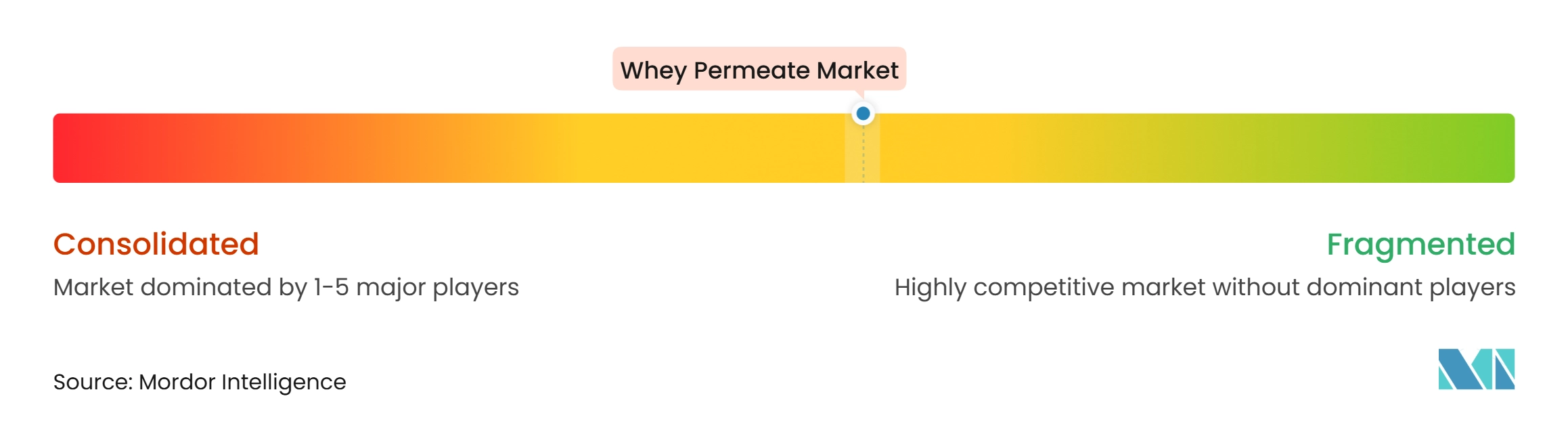
The whey permeate market is moderately fragmented. Large dairy cooperatives benefit from captive supply, as their cheese and whey protein operations generate permeate volumes. Arla Foods Ingredients and Royal FrieslandCampina have invested in higher-value protein assets, increasing the need to recover value from co-product streams. As a result, the whey permeate market favors companies that can integrate protein processing, powder production, quality systems, and application support. This model enables large suppliers to serve food-grade customers while maintaining feed and energy applications for residual streams.
FrieslandCampina Ingredients completed the expansion of its Borculo facility in March 2026, which doubled its whey protein isolate and milk fat globule membrane capacity. These investments reflect a focus on protein-led capacity expansion while increasing the importance of effectively managing permeate streams. Food-grade permeate suppliers must demonstrate consistent composition, functional performance, and appropriate documentation. These requirements create barriers for smaller companies that lack specialized drying assets or technical sales capabilities.
Regional and independent producers can compete through customer proximity, flexible blending capabilities, and application support. Idaho Milk Products opened a USD 200 million ice cream and powder blending facility in Jerome, Idaho, in May 2026 to expand its custom dairy formulation capabilities. Such investments can help suppliers serve customers requiring tailored blends rather than bulk ingredients. Fermentation also offers a strategic pathway for companies seeking alternatives to drying or low-value liquid disposal. Competitive outcomes will depend on processors' ability to align available co-product volumes with stable demand across food, feed, and bioprocessing channels.
Whey Permeate Industry Leaders
-
Groupe Lactalis S.A.
-
Agropur Ingredients
-
Numidia BV
-
Royal FrieslandCampina N.V.
-
Vilvi Group
- *Disclaimer: Major Players sorted in no particular order
Whey Permeate Market Companies Covered in this Report
- Groupe Lactalis S.A.
- Arla Foods Ingredients Group P/S
- Agropur Ingredients
- Numidia BV
- Spomlek Dairy Cooperative
- Mahaan Milk Foods Ltd.
- Royal FrieslandCampina N.V.
- Vilvi Group
- Actus Nutrition
- Idaho Milk Products
- Enka Süt
- Proliant Dairy Ingredients
- Euroserum
- Arion Dairy Products B.V.
- Shreem Nutritions LLP
- Volac International Limited
- MILEI GmbH
- Polmlek Group
- Industria Casearia Silvio Belladelli S.P.A.
- Sooro Renner
Recent Industry Developments in Whey Permeate Market
- March 2026: FrieslandCampina Ingredients completed the expansion of its Borculo facility, doubling its capacity for whey protein isolate and milk fat globule membrane ingredients. The facility commenced commercial operations in March 2026, expanding the company’s supply of high-specification dairy protein ingredients. The expansion supports global customers across nutrition categories that require consistent specifications, traceability, and application performance.
- April 2025: ForFarmers partnered with Arla Foods Ingredients to expand the availability of liquid dairy co-products for beef and dairy farmers across Wales and Southern England. Through this partnership, ForFarmers introduced a regular supply of liquid whey permeate, complementing its existing liquid co-product portfolio and expanding its distribution reach across the United Kingdom.
- April 2025: MNEXT announced Project WheyNot, a collaborative research initiative with LOOOP and Water Future to explore higher-value applications for whey permeate. The project evaluates electrodialysis technology to remove minerals from whey permeate and develop a purified, dairy-derived feedstock for the chemical industry.
Global Whey Permeate Market Report Scope
Whey permeate is a dairy ingredient obtained during whey protein separation through membrane filtration, primarily containing lactose, minerals, and small amounts of residual protein.
The whey permeate market is segmented by form, application, and geography. By form, the market is segmented into powder and liquid. By application, the market is segmented into animal feed, food and beverages (bakery and confectionery, dairy products, beverages, snacks, bars and dry mixes, and other food and beverages), nutraceuticals and sports nutrition, and other applications. Based on geography, the market is classified into North America, Europe, South America, Asia-Pacific, and the Middle East and Africa. The market forecasts are provided in terms of value (USD).
Segmentation Overview
| Powder |
| Liquid |
| Animal Feed | |
| Food and Beverages | Bakery and Confectionery |
| Dairy Products | |
| Beverages | |
| Snacks, Bars and Dry Mixes | |
| Other Food and Beverages | |
| Nutraceuticals and Sports Nutrition | |
| Other Applications |
| North America | United States |
| Canada | |
| Mexico | |
| Rest of North America | |
| Europe | Germany |
| United Kingdom | |
| Italy | |
| France | |
| Spain | |
| Netherlands | |
| Rest of Europe | |
| Asia-Pacific | China |
| India | |
| Japan | |
| Rest of Asia-Pacific | |
| South America | Brazil |
| Rest of South America | |
| Middle East and Africa | South Africa |
| Egypt | |
| Rest of Middle East and Africa |
| By Form | Powder | |
| Liquid | ||
| By Application | Animal Feed | |
| Food and Beverages | Bakery and Confectionery | |
| Dairy Products | ||
| Beverages | ||
| Snacks, Bars and Dry Mixes | ||
| Other Food and Beverages | ||
| Nutraceuticals and Sports Nutrition | ||
| Other Applications | ||
| By Geography | North America | United States |
| Canada | ||
| Mexico | ||
| Rest of North America | ||
| Europe | Germany | |
| United Kingdom | ||
| Italy | ||
| France | ||
| Spain | ||
| Netherlands | ||
| Rest of Europe | ||
| Asia-Pacific | China | |
| India | ||
| Japan | ||
| Rest of Asia-Pacific | ||
| South America | Brazil | |
| Rest of South America | ||
| Middle East and Africa | South Africa | |
| Egypt | ||
| Rest of Middle East and Africa | ||
Key Questions Answered in the Report
What is the current size and future growth outlook of the whey permeate market?
The whey permeate market was valued at USD 0.94 billion in 2026 and is estimated to reach USD 0.99 billion in 2027. The market is projected to grow to USD 1.32 billion by 2032, registering a CAGR of 5.80% during 2027-2032.
Which form segment held the largest share of the whey permeate market in 2026?
The powder segment held the largest market share in 2026, accounting for 63.72% of the market.
Which application segment dominated the whey permeate market in 2026?
The food and beverages segment dominated the market in 2026, capturing 52.31% of the total market share.
Which region accounted for the largest share of the whey permeate market in 2026?
North America held the largest regional market share in 2026, accounting for 36.42% of the market.
Which region is expected to grow at the fastest rate during 2027-2032?
The Asia-Pacific region is forecast to register the highest growth rate, expanding at a CAGR of 7.68% during the forecast period.