
Water Pumps Market Size and Share
Market Overview
| Study Period | 2022 - 2032 |
|---|---|
| Market Size (2027) | USD 70.21 Billion |
| Market Size (2032) | USD 89.21 Billion |
| Growth Rate (2027 - 2032) | 4.89 % |
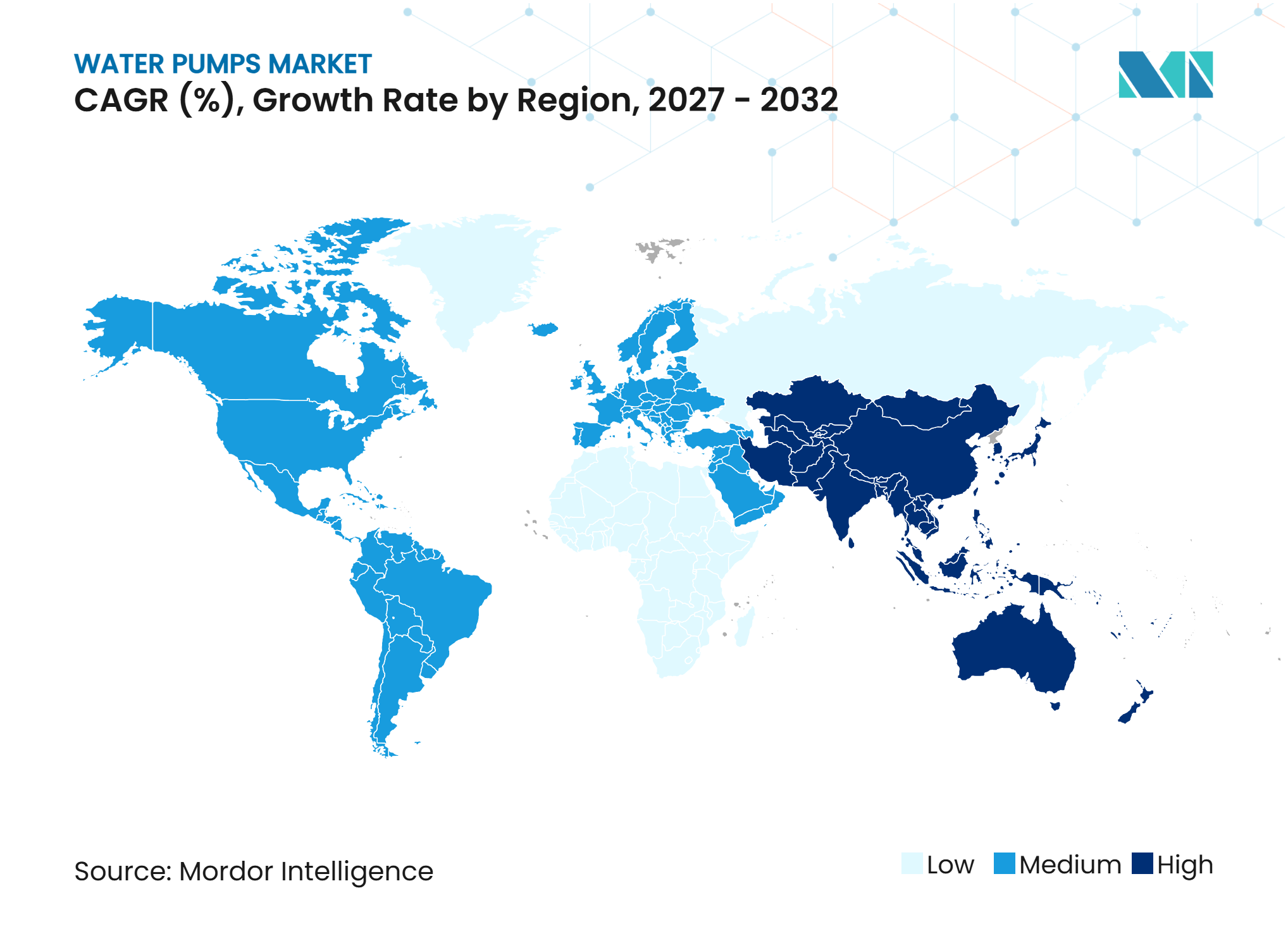
| Fastest Growing Market | Asia-Pacific |
| Largest Market | Asia-Pacific |
| Market Concentration | Low |
Major Players *Disclaimer: Major Players sorted in no particular order Image © Mordor Intelligence. Reuse requires attribution under CC BY 4.0. | |
Water Pumps Market Analysis by Mordor Intelligence
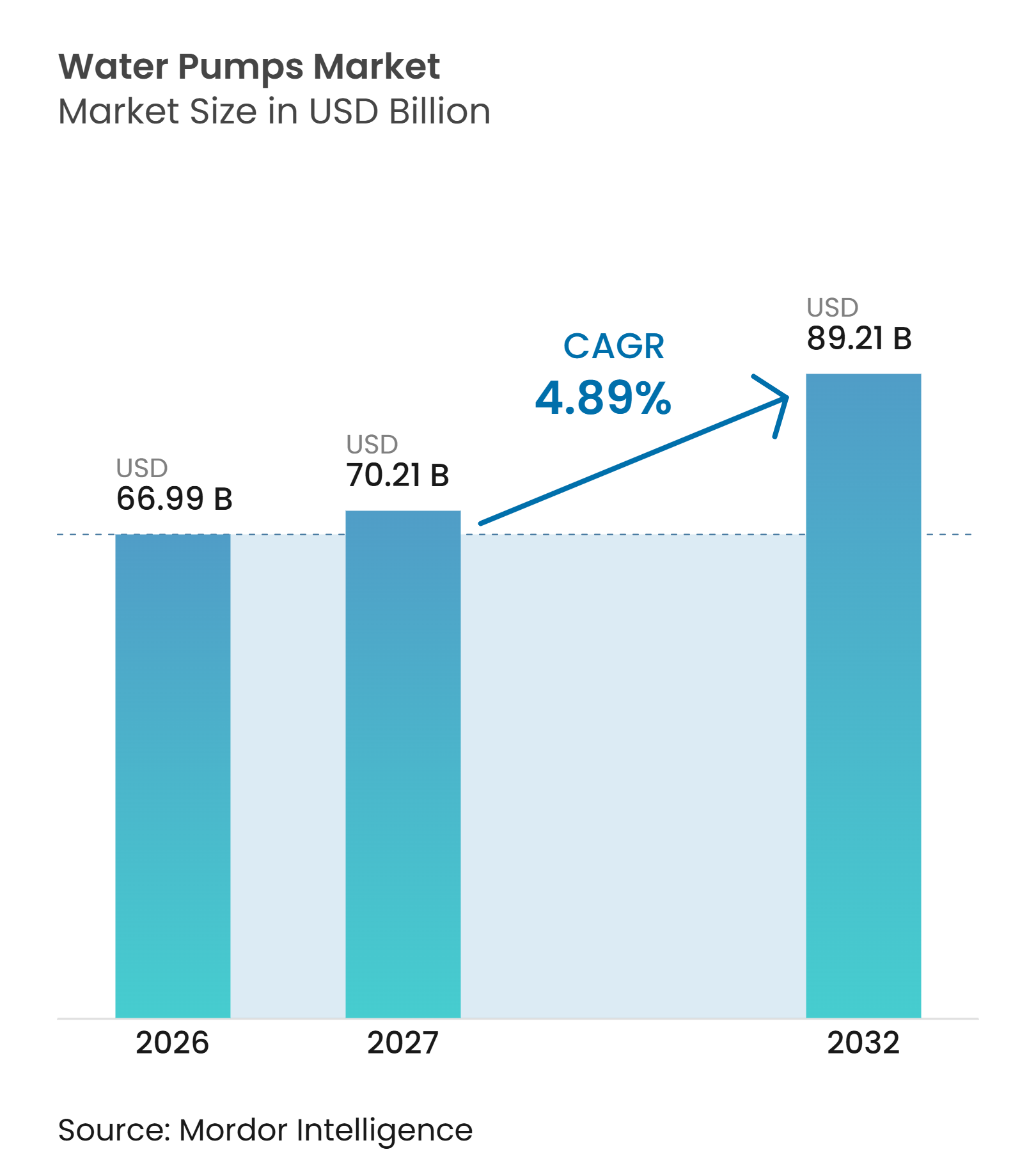
The global water pumps market size is projected to expand from USD 66.99 billion in 2026 and USD 70.21 billion in 2027 to USD 89.21 billion by 2032, registering a CAGR of 4.89% between 2027 and 2032. The global water pumps market is supported by replacement needs in municipal systems, rising irrigation demand, and new treatment and distribution capacity in urban areas. Utilities are moving beyond like-for-like pump replacement because energy use, maintenance records, and water losses now influence procurement decisions. The global water pumps market also benefits when regulations require more treatment stages or stronger operating performance, since these changes raise demand for pumps, drives, and monitoring equipment. Manufacturers with efficient motors, variable-speed control, and digital monitoring capabilities are better placed to address these requirements. Price sensitivity, volatile component costs, and limited municipal capital budgets remain important constraints, especially where buyers focus on initial purchase prices rather than long-term operating costs.
Key Report Takeaways
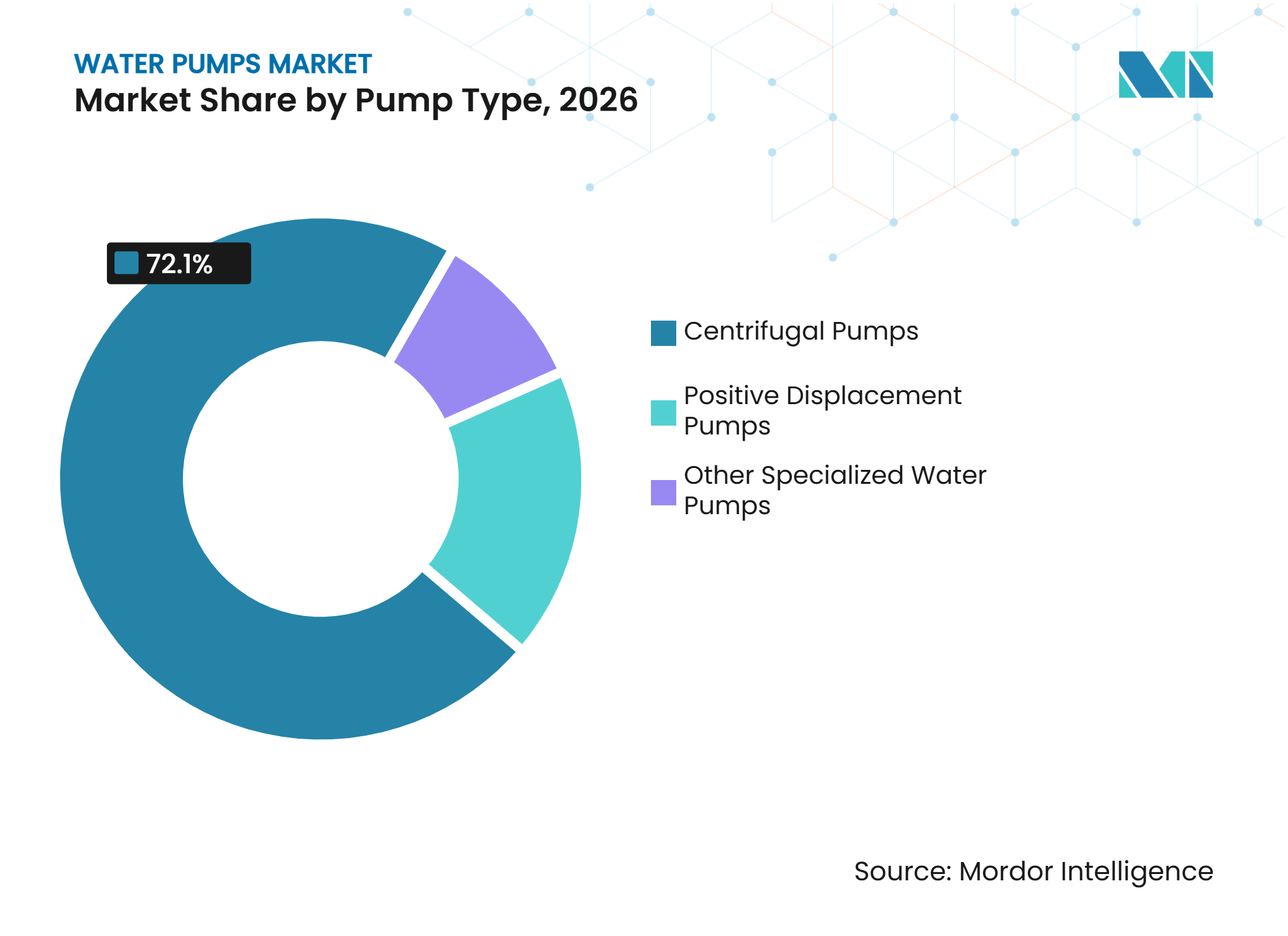
- By pump type, centrifugal pumps held 72.1% of global water pumps market share in 2026, while positive displacement pumps are forecast to grow at a 5.5% CAGR through 2032.
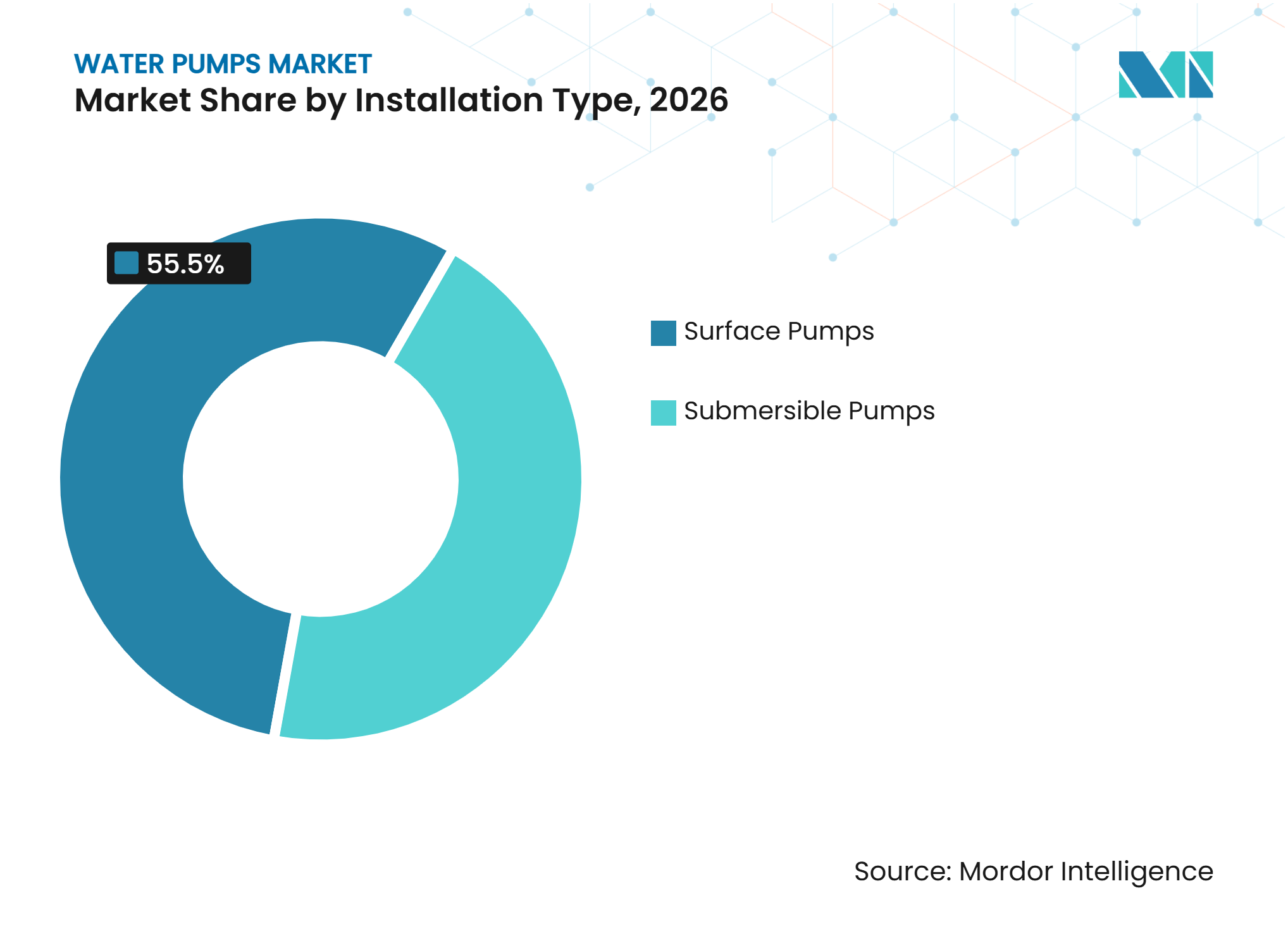
- By installation type, surface pumps held 55.7% of global water pumps market share in 2026, while submersible pumps are forecast to grow at a 6.3% CAGR through 2032.
- By end-use industry, municipal water and wastewater accounted for 27.3% of the global water pumps market size in 2026 and are forecast to grow at a 5.8% CAGR through 2032.
- By geography, Asia-Pacific held 44.9% of global revenue in 2026 and is forecast to grow at a 5.4% CAGR through 2032.
Note: Market numbers in this report are based on Mordor Intelligence's proprietary estimation framework, which combines nine months of actuals with Q4 projections for base year 2026.
Market Trends and Insights
Drivers Impact Analysis of Water Pumps Market*
| Driver | (~) % Impact on CAGR Forecast | Geographic Relevance | Impact Timeline |
|---|---|---|---|
| Aging Municipal Water and Wastewater Infrastructure | +1.2% | Global, with early gains in North America and Western Europe | Long term (≥ 4 years) |
| Water Scarcity, Irrigation Expansion and Groundwater Extraction | +0.9% | Asia-Pacific core, with spillover to Middle East and Africa and South America | Medium term (2-4 years) |
| Stricter Wastewater Discharge, Reuse and Water Quality Requirements | +0.8% | Europe, North America, East Asia | Long term (≥ 4 years) |
| Industrialization and Urban Infrastructure Investment | +0.7% | Asia-Pacific core, with spillover to Middle East and Africa | Medium term (2-4 years) |
| Solar-Powered Pumping for Off-Grid Water Supply | +0.5% | India, Sub-Saharan Africa, Southeast Asia | Short term (≤ 2 years) |
| Pump-System Digitalization and Leakage Reduction | +0.6% | Global, led by North America and Europe | Medium term (2-4 years) |
| Source: Mordor Intelligence | |||
Aging Municipal Water and Wastewater Infrastructure
Many water distribution and wastewater collection networks in North America and Western Europe were installed between the 1950s and 1970s. Their age places many pump stations beyond their intended operating life and creates replacement demand that utilities cannot delay indefinitely. The U.S. Clean Water State Revolving Fund provided USD 12.8 billion in low-interest assistance for 2,025 clean-water infrastructure projects in state fiscal year 2025, with an average interest rate of 1.7%.[1] This funding structure can make energy-saving upgrades easier to finance because utilities can spread capital costs over longer repayment periods. In the global water pumps market, municipal buyers are increasingly specifying a pump, drive, and monitoring package instead of replacing only the failed unit. That approach favors suppliers that can document lower energy use and maintenance needs over an asset’s operating life.
Water Scarcity, Irrigation Expansion and Groundwater Extraction
Irrigation expansion in water-stressed economies creates continuing demand for surface and submersible equipment. India’s Pradhan Mantri Kisan Urja Suraksha Evam Utthan Mahabhiyan (PM-KUSUM) program had sanctioned 807,000 solar pumps under Component B and 2.543 million pump solarization installations under Component C, and the scheme was extended through March 2026.[2] As groundwater levels decline, farmers and municipalities need deeper wells and longer submersible pump strings. This can raise equipment requirements even when the number of irrigation sites does not increase at the same pace. The global water pumps market therefore has exposure to a shift toward higher-specification submersible systems in aquifer-dependent regions. Demand is especially relevant across South Asia, North Africa, and areas where surface-water availability is under pressure.
Stricter Wastewater Discharge, Reuse, and Water Quality Requirements
The revised Urban Wastewater Treatment Directive entered into force in January 2025 and establishes staged requirements for more advanced treatment across the European Union.[3] Large treatment plants will need tertiary treatment, while subsequent requirements will extend further treatment obligations to defined facilities. These additional treatment steps require more pumping capacity for nutrient removal, filtration, recirculation, and reuse processes. The directive also sets an energy-neutrality objective for urban wastewater treatment plants by 2045.[4] The global water pumps market benefits when operators replace isolated equipment with integrated systems that can help manage both treatment performance and electricity use. Compliance requirements can also make operational data more important in supplier selection.
Industrialization and Urban Infrastructure Investment
Industrial growth and urban expansion increase demand for water transfer, pressure boosting, wastewater handling, and building-services equipment. China’s updated centrifugal pump efficiency standard, GB 19762-2025, was published in February 2025 and takes effect in March 2026. China also issued JB/T 14812-2025 for intelligent constant-pressure water supply pump systems, which became effective in November 2025. Together, these measures support higher standards for equipment used in urban supply and industrial settings. The global water pumps market gains from new construction, but the larger opportunity is often the upgrade of installed systems to meet energy and control requirements. Southeast Asian industrial sites and expanding municipal networks add to this demand base.
Restraints Impact Analysis of Water Pumps Market*
| Restraint | (~) % Impact on CAGR Forecast | Geographic Relevance | Impact Timeline |
|---|---|---|---|
| High Upfront Cost of Energy-Efficient and Smart Pumping Systems | -0.5% | Global, most acute in price-sensitive Asia-Pacific and South America markets | Long term (≥ 4 years) |
| Raw-Material, Mechanical-Seal and Motor-Component Cost Volatility | -0.3% | Global | Short term (≤ 2 years) |
| Fragmented SCADA, VFD, and Cybersecurity Architectures | -0.2% | North America, Europe | Medium term (2-4 years) |
| Low-Cost Like-for-Like Replacements Delaying Efficiency Upgrades | -0.4% | Global, most pronounced in developing markets | Long term (≥ 4 years) |
| Source: Mordor Intelligence | |||
High Upfront Cost of Energy-Efficient and Smart Pumping Systems
Smart systems with variable-frequency drives, connected controls, and high-efficiency motors can cost 30% to 60% more than conventional units. For utilities with annual capital budgets, that premium may prevent adoption even where lifecycle savings are favorable. The revised IEC 60034-30-1:2025 standard introduced the IE5 efficiency class for single-speed AC motors from 0.12 kW to 1,000 kW. The revised standard raises the performance benchmark, but the shift from widely installed IE2 and IE3 equipment requires significant capital investment. The global water pumps market faces slower conversion where buyers cannot access concessionary finance or evaluate energy savings over the full operating life of the asset. Procurement rules that prioritize initial price can reinforce this barrier.
Raw-Material, Mechanical-Seal, and Motor-Component Cost Volatility
Manufacturers rely on cast iron, stainless steel, copper, elastomers, and specialized sealing materials. Changes in the price or availability of these inputs can pressure gross margins and complicate project quotations. KSB stated that currency effects reduced 2025 order intake by EUR 84.3 million compared with the previous year. Mechanical seals are also a common cause of unplanned pump downtime, and their materials may be sourced from a limited supplier base. These conditions create greater pressure for manufacturers that have limited purchasing scale or cannot pass costs on to customers. The global water pumps market may therefore concentrate more profit among suppliers with broader sourcing networks, established aftermarket operations, or vertically integrated component capabilities.
*Our forecasts treat driver/restraint impacts as directional, not additive. The impact forecasts reflect baseline growth, mix effects, and variable interactions.
Water Pumps Market Segment Analysis
By Pump Type:
Centrifugal Pumps Maintain Scale While Positive Displacement Pumps Add Specialized DemandCentrifugal pumps held 72.1% of global revenue in 2026. Their broad use across municipal water transfer, irrigation, industrial processes, and building services makes them the standard equipment type in many installations. They can address a wide range of pressure and flow requirements, from low-head agricultural applications to booster stations. China’s GB 19762-2025 sets updated minimum energy-efficiency values and grades for centrifugal pumps. This change is likely to raise the energy-performance floor in China and increase replacement demand for less efficient units. Centrifugal equipment will remain tied to replacement cycles as well as new infrastructure projects.
Positive displacement pumps are forecast to grow at 5.5% CAGR through 2032. They are used for precision-flow duties, chemical handling, food processing, and high-viscosity fluids where centrifugal designs are less suitable. Their growth reflects expansion in specialized industrial applications rather than a direct substitution for centrifugal pumps. Mining, chemicals, and petrochemicals require equipment with stronger material compatibility and sealing performance. Flowserve launched the INNOMAG TB-MAG Dual Drive pump in March 2025 for hazardous chemical and petrochemical fluid handling, with true secondary containment in a sealless magnetic-drive configuration. Other specialized pumps retain demand in residential groundwater, mining, and geothermal applications, although advanced centrifugal submersible products can serve some of these duties.



By Installation Type:
Surface Pumps Remain Broadly Used While Submersible Pumps Gain MomentumSurface pumps held 55.7% of global revenue in 2026. Their accessible design supports routine maintenance in irrigation, building water supply, heating and cooling systems, and industrial processes. Commercial and industrial buildings commonly use surface-mounted multistage and in-line pumps for pressurization and water circulation. Grundfos launched the NKE long-coupled end-suction pump and the TPE3 in-line pump for India’s commercial building-services segment in 2025. The products incorporate International Efficiency class 5 (IE5) motor technology, integrated sensing, and controls that help improve energy management. These capabilities support higher realized value in surface-pump applications where building owners seek operating-cost savings.
Submersible pumps are forecast to grow at a 6.3% CAGR through 2032. Demand is supported by deeper wells, solar-powered irrigation, construction dewatering, mining, and municipal water access projects. Franklin Electric reported Water Systems revenue of USD 1.3 billion in 2025, a 6% increase, while its large dewatering equipment sales grew 7%. Revenue from developing markets outside the United States and Canada increased 10% in that business. PM-KUSUM Component B requires qualifying products to meet India’s applicable solar pumping specifications, which gives manufacturers a defined technical baseline. These factors place submersible equipment at the center of the global water pumps market growth in water-stressed and off-grid locations.

By End-Use Industry:
Municipal Water and Wastewater Combines Current Scale and Faster GrowthMunicipal water and wastewater accounted for 27.3% of the global water pumps market size in 2026 and are forecast to grow at a 5.8% CAGR through 2032. This combination reflects capacity expansion as well as recurring replacement needs. The EU Urban Wastewater Treatment Directive requires phased upgrades to treatment facilities, including tertiary treatment for defined large plants beginning in 2033. New treatment stages add demand for transfer, recirculation, filtration, and sludge-handling equipment. KSB reported 12.5% growth in its Water Market within the Pumps Division in 2025. These requirements support demand for higher-efficiency packages rather than only basic replacements.
Agriculture and irrigation remain a major source of unit demand because food production depends on water availability and reliable pumping. Residential and commercial buildings maintain demand through construction, pressurization, heating and cooling, and hot-water systems. Oil and gas, power generation, mining, chemicals, and petrochemicals rely on custom-engineered pumps that can command higher prices and generate aftermarket work. Flowserve’s magnetic-drive product introduction illustrates how process-safety needs influence equipment selection in chemical facilities. Food and beverage, construction, and other industries add a diverse set of application requirements. Across these end uses, the global water pumps industry rewards companies with broad hydraulic portfolios and service capabilities.
Geography Analysis
Asia-Pacific Leads Both Revenue and Forecast Growth
Asia-Pacific held 44.9% of global revenue in 2026 and is forecast to grow at a 5.4% CAGR through 2032. China combines urban infrastructure renewal with industrial upgrading, while India combines urban water investment with rural irrigation and solar-pump deployment. GB 19762-2025 and JB/T 14812-2025 strengthen the role of efficiency and intelligent control in Chinese pump procurement. India’s PM-KUSUM program, together with industrial and urban utility investment in Southeast Asia, supports the global water pumps market across both rural and city-based applications.
Europe and North America Focus on Upgrade Cycles
Europe’s place in global revenue is shaped by replacement-led procurement rather than solely new construction. The EU Urban Wastewater Treatment Directive requires major facilities to meet phased tertiary treatment obligations and sets further advanced-treatment requirements. These rules add equipment needs that many existing plants do not currently have. Germany’s water-supply standards and industrial base support demand for efficient, high-specification equipment, while KSB and WILO benefit from long experience with European requirements. In North America, USD 12.8 billion of Clean Water State Revolving Fund (CWSRF) assistancein fiscal year 2025 and the Bipartisan Infrastructure Law’s USD 50 billion water commitment support the global water pumps market through a longer planning horizon for municipal investment.
Middle East, Africa, and South America Add Distinct Demand Sources
Water-pump demand in Middle East and Africa is shaped by a two-part demand profile. Gulf Cooperation Council countries require high-specification equipment for desalination, reuse, and large water projects, while Sub-Saharan Africa and North Africa need solar-powered submersible systems for rural water access. Morocco and Egypt benefit from agricultural modernization and municipal water investment supported by development financing. South America depends on agricultural and municipal demand in Brazil, together with mining-related demand in Chile and Argentina. Franklin Electric reported USD 204.7 million of 2025 Water Systems revenue from Latin America, showing how these regions expand the global water pumps market.
Competitive Landscape
Market Concentration
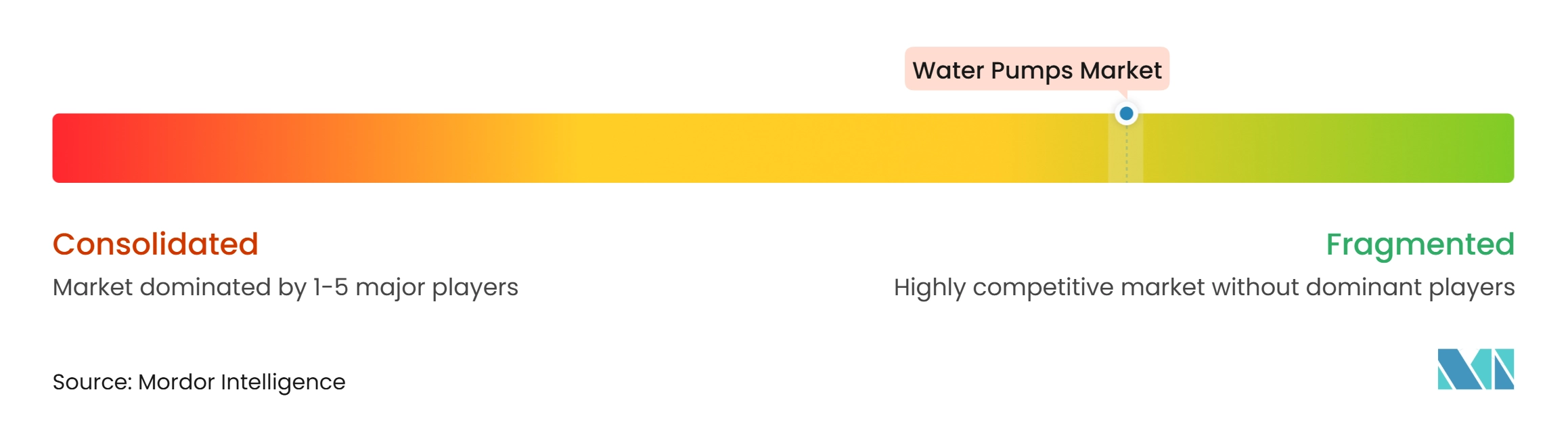
The global water pumps market is fragmented among technology-focused suppliers, while regional manufacturers compete on price in domestic and developing markets. Grundfos reported USD 5.21 billion (EUR 4.7 billion) in 2025 sales. KSB reported USD 3.37 billion (EUR 3.035 billion) in 2025 revenue, and Xylem reported USD 2.6 billion in 2025 Water Infrastructure revenue. These companies set benchmarks in water treatment, municipal infrastructure, and connected system management. Their scale supports investment in motors, drives, digital tools, and service networks.
Leading suppliers are combining high-efficiency motors, digital platforms, and localized production to meet customer requirements and manage supply-chain exposure. Sulzer’s Flow division signed a 5-year framework agreement with Veolia in 2025 covering pumps, mixers, and turbocompressors. WILO’s Stratos GIGA2.0-B uses IE5 motor technology and Multi-Flow Adaptation controls, reflecting a move toward products that compete on lifecycle energy performance. Grundfos was the first company to receive China Quality Certification Center energy-conservation certification for clean-water centrifugal pump units under the updated national standard in March 2025.
New competitive positions are forming in solar pumping, retrofit monitoring, and specialized cooling and process applications. Shakti Pumps raised USD 30.87 million (INR 2.9 billion) through a Qualified Institutional Placement in 2025 to support a 2.2 GW domestic-content-requirement solar cell manufacturing plant. This investment can reduce the company’s exposure to component-supply volatility in solar pumping. Smaller municipal operators present an opportunity for suppliers that can offer simpler digital retrofits rather than custom-engineered systems. The global water pumps market also has room for specialized solutions for data-center liquid cooling, desalination, and hazardous process fluids.
Water Pumps Industry Leaders
-
Grundfos Holding A/S
-
Xylem Inc.
-
KSB SE & Co. KGaA
-
Flowserve Corporation
-
Wilo SE
- *Disclaimer: Major Players sorted in no particular order
Water Pumps Market Companies Covered in this Report
- C.R.I. Pumps Private Limited
- Caprari S.p.A.
- DAB Pumps S.p.A.
- Ebara Corporation
- Flowserve Corporation
- Franklin Electric Co., Inc.
- Grundfos Holding A/S
- ITT Inc.
- Kirloskar Brothers Limited
- KSB SE & Co. KGaA
- Pentair plc
- Ruhrpumpen Group
- Shakti Pumps (India) Limited
- Shimge Pump Industry Group Co., Ltd.
- Sulzer Ltd.
- Torishima Pump Mfg. Co., Ltd.
- Tsurumi Manufacturing Co., Ltd.
- Weir Group PLC
- Wilo SE
- Xylem Inc.
Recent Industry Developments in Water Pumps Market
- June 2026: Grundfos expanded its production facility in Brookshire, Texas, strengthening US manufacturing capacity for water and wastewater pump systems under the Ignite'27 strategy. The expansion supports growing demand in the North American municipal and commercial building segments.
- April 2026: China's GB 3215-2025, the revised national standard for centrifugal pumps in petroleum, petrochemical, and natural gas industry applications, became effective. It reshaped procurement specifications and set higher performance requirements for the oil and gas pump segment.
- March 2026: Sulzer launched its Water Treatment Center of Excellence, consolidating brands including Nordic Water, FRC, IPEC, JWC Screens, Owatec, and Probig under a unified end-to-end offering. This reduced customer procurement complexity for municipal water treatment operators.
- September 2025: Sulzer signed a 5-year framework agreement with Veolia, one of the world's largest environmental services and water utility operators, covering pumps, mixers, and turbo-compressors. This established Sulzer as a preferred supplier across Veolia's global operations.
Global Water Pumps Market Report Scope
A water pump is a mechanical or electromechanical device that moves water from one location to another by increasing its pressure and overcoming gravity.
The water pump market is segmented into pump type, installation type, end-use industry, and geography. By pump type, the market is segmented into centrifugal pumps, positive displacement pumps, and other specialized water pumps. By installation type, the market is divided into submersible pumps and surface pumps. By end-use industry, the market is segmented into municipal water and wastewater, agriculture and irrigation, residential, commercial buildings, oil and gas, power generation, chemicals and petrochemicals, food and beverage, mining, construction, and other industries. The report also covers the market size and forecasts for the global water pumps market across 26 countries in key regions. For each segment, the market sizing and forecasts have been provided on the basis of value (USD).
Segmentation Overview
| Centrifugal Pumps |
| Positive Displacement Pumps |
| Other Specialized Water Pumps |
| Submersible Pumps |
| Surface Pumps |
| Municipal Water and Wastewater |
| Agriculture and Irrigation |
| Residential |
| Commercial Buildings |
| Oil and Gas |
| Power Generation |
| Chemicals and Petrochemicals |
| Food and Beverage |
| Mining |
| Construction |
| Other Industries |
| North America | United States |
| Canada | |
| Mexico | |
| Europe | Germany |
| France | |
| Italy | |
| Spain | |
| United Kingdom | |
| Poland | |
| Russia | |
| Rest of Europe | |
| Asia-Pacific | China |
| India | |
| Japan | |
| South Korea | |
| Australia | |
| Indonesia | |
| Vietnam | |
| Thailand | |
| Rest of Asia-Pacific | |
| South America | Brazil |
| Argentina | |
| Chile | |
| Rest of South America | |
| Middle East and Africa | Saudi Arabia |
| United Arab Emirates | |
| Egypt | |
| South Africa | |
| Morocco | |
| Rest of Middle East and Africa |
| By Pump Type | Centrifugal Pumps | |
| Positive Displacement Pumps | ||
| Other Specialized Water Pumps | ||
| By Installation Type | Submersible Pumps | |
| Surface Pumps | ||
| By End-Use Industry | Municipal Water and Wastewater | |
| Agriculture and Irrigation | ||
| Residential | ||
| Commercial Buildings | ||
| Oil and Gas | ||
| Power Generation | ||
| Chemicals and Petrochemicals | ||
| Food and Beverage | ||
| Mining | ||
| Construction | ||
| Other Industries | ||
| By Geography | North America | United States |
| Canada | ||
| Mexico | ||
| Europe | Germany | |
| France | ||
| Italy | ||
| Spain | ||
| United Kingdom | ||
| Poland | ||
| Russia | ||
| Rest of Europe | ||
| Asia-Pacific | China | |
| India | ||
| Japan | ||
| South Korea | ||
| Australia | ||
| Indonesia | ||
| Vietnam | ||
| Thailand | ||
| Rest of Asia-Pacific | ||
| South America | Brazil | |
| Argentina | ||
| Chile | ||
| Rest of South America | ||
| Middle East and Africa | Saudi Arabia | |
| United Arab Emirates | ||
| Egypt | ||
| South Africa | ||
| Morocco | ||
| Rest of Middle East and Africa | ||
Key Questions Answered in the Report
What is the projected value of global water pumps by 2032?
The global water pumps market is forecast to reach USD 89.12 billion by 2032, growing at a 4.89% CAGR from 2027 to 2032.
Which pump type holds the largest share of global demand?
Centrifugal pumps held 72.1% of revenue in 2026 because they serve municipal, irrigation, industrial, and building applications.
Why are submersible pumps growing faster than other installation types?
Submersible pumps are projected to grow at a 6.3% CAGR through 2032, supported by deeper wells, solar irrigation, dewatering, mining, and rural water access projects.
Which end-use segment is expanding fastest for water pumps?
Municipal water and wastewater is projected to grow at a 5.8% CAGR through 2032 after accounting for 27.3% of revenue in 2026.
Why is Asia-Pacific important for water pump suppliers?
Asia-Pacific held 44.9% of revenue in 2026 and is projected to grow at a 5.4% CAGR through 2032, driven by infrastructure upgrades, irrigation, and efficiency standards.
How do wastewater rules affect pump purchasing?
European wastewater rules require phased treatment upgrades and energy-neutrality planning, increasing demand for efficient pumps, drives, and monitoring systems.