
Water Electrolyzer Stack Materials and Components Market Size and Share
Market Overview
| Study Period | 2021 - 2031 |
|---|---|
| Market Size (2026) | USD 0.65 Billion |
| Market Size (2031) | USD 2.03 Billion |
| Growth Rate (2026 - 2031) | 25.64 % |
| Fastest Growing Market | Asia-Pacific |
| Largest Market | Asia-Pacific |
| Market Concentration | Medium |
Major Players *Disclaimer: Major Players sorted in no particular order Image © Mordor Intelligence. Reuse requires attribution under CC BY 4.0. | |
Water Electrolyzer Stack Materials and Components Market Analysis by Mordor Intelligence
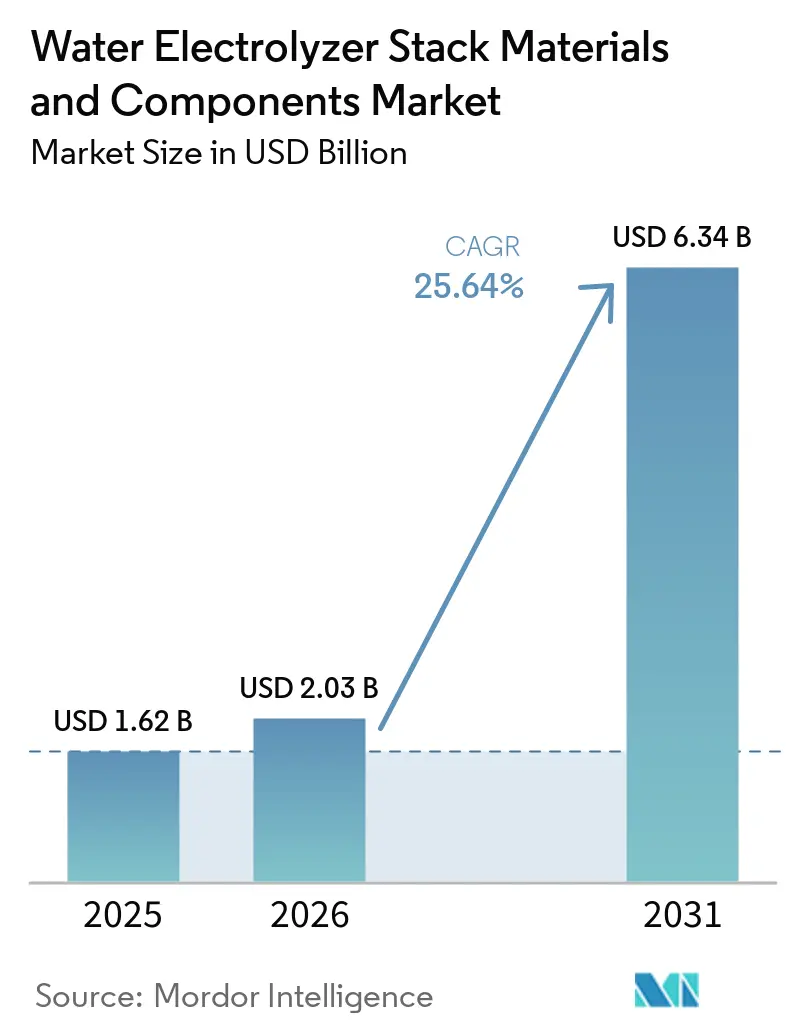
The Water Electrolyzer Stack Materials And Components Market size was valued at USD 0.52 billion in 2025 and is estimated to grow from USD 0.65 billion in 2026 to reach USD 2.03 billion by 2031, at a CAGR of 25.64% during the forecast period (2026-2031). Industrial decarbonization requirements, larger electrolyzer projects, and serial manufacturing are driving demand for stack materials and components. Global installed water electrolysis capacity reached 2 GW in 2024 and grew by 1 GW by mid-2025, driving higher demand for membranes, electrodes, plates, and related materials. China holds 65% of installed capacity and nearly 60% of manufacturing capacity, setting a cost benchmark and creating supply chain pressure for producers elsewhere. The water electrolyzer stack materials and components market is also shaped by European, Japanese, and Chinese suppliers moving toward modular platforms and larger factories. Local content requirements and clean hydrogen incentives support the supply of compliant non-Chinese components. Iridium and platinum availability, project cancellations, financing gaps, and uncertainty around hydrogen offtake prices continue to limit near-term order visibility in the water electrolyzer stack materials and components market.
Key Report Takeaways
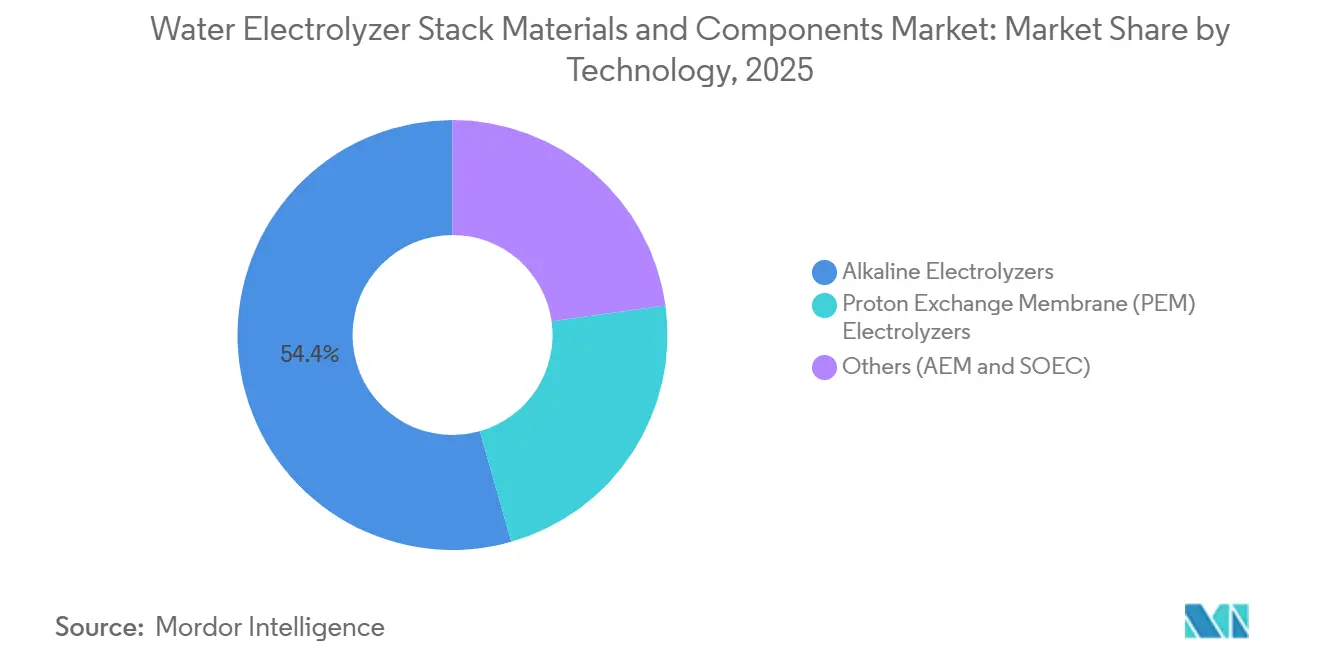
- By technology, alkaline electrolyzers held 54.40% of the market share in 2025, while Proton Exchange Membrane (PEM) electrolyzers recorded the highest projected CAGR at 28.52% through 2031.
- By component type, membranes and separators accounted for 32.71% of the market share in 2025, while catalyst layers and electrodes are projected to grow at a CAGR of 29.66% through 2031.
- By material type, nickel, stainless steel, and titanium held 40.36% of the market share in 2025, while platinum group metals are forecast to expand at a CAGR of 28.34% through 2031.
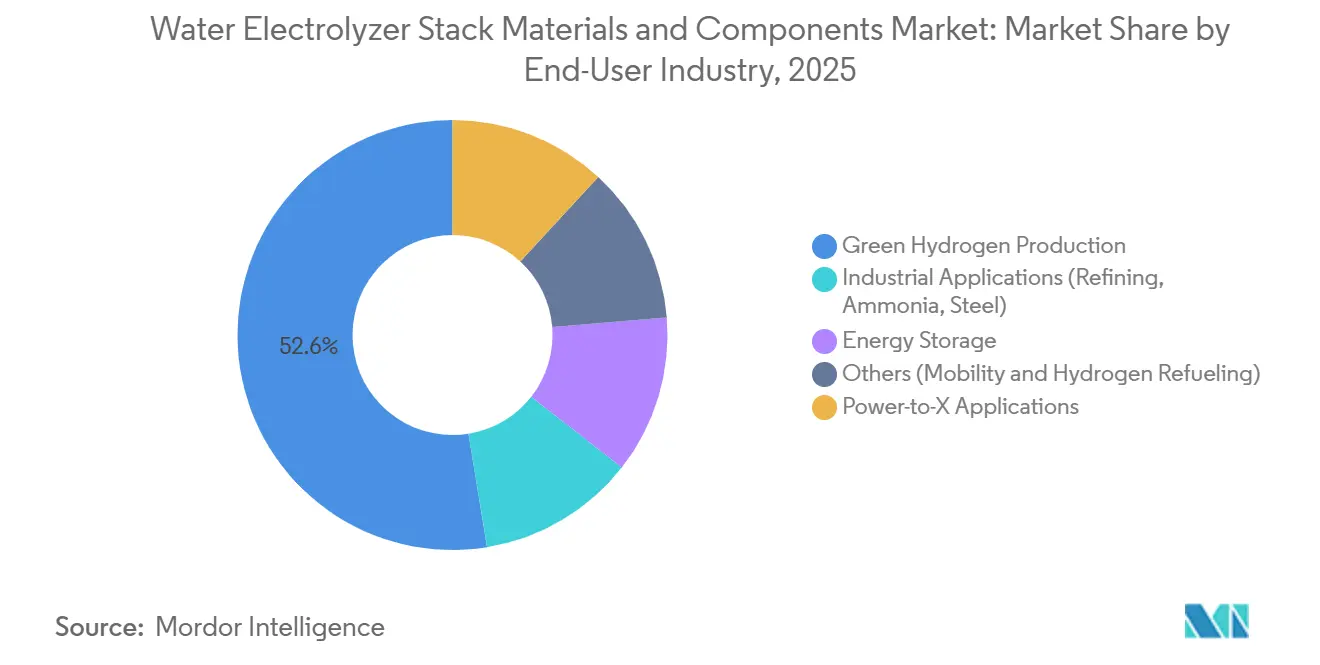
- By end-user industry, green hydrogen production accounted for 52.57% of the Water electrolyzer stack materials and components market size in 2025, while Power-to-X applications are advancing at a CAGR of 28.67% through 2031.
- By geography, Asia-Pacific held 37.46% of the Water electrolyzer stack materials and components market share in 2025 and is forecast to grow at a CAGR of 29.05% through 2031.
Note: Market size and forecast figures in this report are generated using Mordor Intelligence’s proprietary estimation framework, updated with the latest available data and insights as of January 2026.
Global Water Electrolyzer Stack Materials and Components Market Trends and Insights
Drivers Impact Analysis*
| Drivers | (~) % Impact on CAGR Forecast | Geographic Relevance | Impact Timeline |
|---|---|---|---|
| Industrial Decarbonization of Ammonia, Refining, and Steel | +3.50% | Global, with early gains in Germany, South Korea, India, and the GCC | Medium term (2-4 years) |
| Gigawatt-Scale Electrolyzer Deployment | +4.20% | China leading, spillover to Asia-Pacific, Europe, and the Middle-East | Short term (≤ 2 years) |
| Renewable Power Integration and Energy Storage | +3.00% | Europe, Asia-Pacific, and Australia | Medium term (2-4 years) |
| Falling Catalyst Loadings and Component Cost Curves | +4.80% | Global research and development, with commercialization in Japan, Germany, and China | Long term (≥ 4 years) |
| Regional Manufacturing Localization Incentives | +2.80% | Europe, North America, and India | Medium term (2-4 years) |
| Stack Standardization and Modular Manufacturing | +3.20% | Global, led by European and Chinese original equipment manufacturers | Medium term (2-4 years) |
| Source: Mordor Intelligence | |||
Industrial Decarbonization of Ammonia, Refining, and Steel
Decarbonization pressure in the ammonia, refining, and steel industries is creating sustained demand for large-format electrolyzer stack materials. These sectors consume hydrogen at volumes that exceed those of mobility and distributed energy applications. In January 2026, Repsol announced a second 100 MW alkaline electrolyzer at its Petronor refinery in Spain, supported by EUR 292 million (~USD 336.39 million) in investment and planned for commissioning in 2029. The project is intended to produce up to 15,000 tons of renewable hydrogen per year. Such refinery projects require a reliable supply of membranes, electrodes, and other stack materials in the water electrolyzer stack materials and components market.
In March 2026, thyssenkrupp nucera received a contract to supply 15 standardized 20 MW alkaline units for Moeve's 300 MW Onuba project in Spain. The order illustrates how larger industrial plants are creating forward procurement requirements for component suppliers in the water electrolyzer stack materials and components market. Direct-reduced steel production requires high capacity-factor operation, which places particular demands on the durability of separators and electrodes. Suppliers that can validate long operating lifetimes may be better positioned for projects with sustained operating loads.
Gigawatt-Scale Electrolyzer Deployment
The shift from sub-megawatt demonstrations to 50-MW and 200-MW plants is changing supplier requirements across stack-component categories. In May 2026, Nel ASA launched its next-generation pressurized alkaline platform, targeting a turnkey cost below USD 1,450/kW for a 25 MW plant. The company supported the platform with a EUR 135 million (~USD 155.52 million) EU Innovation Fund grant covering 60% of eligible industrialization costs. Nel also reached a final investment decision in December 2025 to scale Herøya production to 4 GW per year. These investments reflect the growing importance of standardized manufacturing in the water electrolyzer stack materials and components market.
Chinese original equipment manufacturers are increasing both unit size and factory capacity. LONGi Hydrogen has 5.0 GW of annual manufacturing capacity. By the end of 2024, Shuangliang presented a 5,000 Nm³/h alkaline electrolyzer with energy consumption of 4.532 kWh/Nm³ H₂. Larger plants in the water electrolyzer stack materials and components market favor suppliers that can provide membrane and bipolar plate material in continuous, large-area formats. This requirement raises qualification barriers and can concentrate long-term supply agreements among technically approved producers.
Renewable Power Integration and Energy Storage
Coupling electrolyzers with renewable power creates material stresses that differ from those of steady baseload operation. Dynamic load cycling can accelerate membrane degradation through wet-dry cycling and increase mechanical fatigue in porous transport layers. These conditions increase demand for reinforced perfluorosulfonic acid (PFSA) membranes and titanium-felt porous transport layers with more controlled pore structures. This distinction is expanding application-specific demand within the water electrolyzer stack materials and components market.
Air Liquide began construction of its 200 MW ELYgator electrolyzer in Rotterdam in 2025. The company is investing more than EUR 500 million (~USD 576.02 million) and expects the facility to produce up to 23,000 tons of renewable hydrogen per year under a TotalEnergies offtake agreement. Electricity represents more than 64% of the levelized hydrogen cost across electrolyzer technologies. Material improvements in the water electrolyzer stack materials and components market that raise efficiency can therefore reduce hydrogen production costs, increasing the value of components that maintain performance under variable renewable generation.
Falling Catalyst Loadings and Component Cost Curves
Reducing iridium loadings in proton exchange membrane (PEM) anodes is a central technical priority for the water electrolyzer stack materials and components market. Commercial PEM systems have used iridium loadings of 1 mg/cm² to 2 mg/cm², while the U.S. Department of Energy target is below 0.5 mg/cm² by 2026. Lower loadings reduce exposure to a constrained precious-metal supply and can improve the economics of membrane electrode assemblies. This work also supports alternatives that employ non-precious metals in anion-exchange membrane (AEM) systems.
A study published in Nature Communications in 2026 reported that a dual-interface titanium dioxide stabilization approach sustained 3.0 A/cm² for 2,600 hours at 0.4 mg/cm² with near-zero voltage degradation[1]. Research on resource requirements found that net-zero scenarios require an 89% to 97% reduction in iridium use per installed capacity unit by 2050. China's domestic perfluorosulfonic acid (PFSA) membrane localization increased from 18% in 2020 to 52% in 2025. This trend is increasing pricing pressure on established ionomer suppliers and demonstrates that component cost reductions depend on both manufacturing learning and laboratory results.
Restraints Impact Analysis*
| Restraints | (~) % Impact on CAGR Forecast | Geographic Relevance | Impact Timeline |
|---|---|---|---|
| Iridium, Platinum, Titanium, and PFSA Supply Constraints | -2.50% | Global PEM market, with the highest exposure in Europe and North America | Long term (≥ 4 years) |
| High Cost of Green Hydrogen Versus Fossil-Based Hydrogen | -3.20% | North America, the Middle-East, and regions with low natural gas prices | Medium term (2-4 years) |
| Project Cancellations, Financing Gaps, and Slow Offtake Conversion | -2.80% | Global, with high exposure in Australia, the United States, the United Kingdom, and emerging markets | Short term (≤ 2 years) |
| Qualification Risk for New Membranes, Coatings, and Catalyst Chemistries | -1.50% | Global research and development pipeline, particularly Anion Exchange Membrane (AEM) and Solid Oxide Electrolysis Cell (SOEC) suppliers | Medium term (2-4 years) |
| Source: Mordor Intelligence | |||
Iridium, Platinum, Titanium, and Perfluorosulfonic Acid (PFSA) Supply Constraints
The gap between iridium supply and projected Proton Exchange Membrane (PEM) demand remains a major constraint on scaling PEM components. Iridium is produced as a by-product of platinum mining, which limits the ability to increase supply quickly. A 2026 study estimates annual global iridium production at 7-10 tons and indicates that PEM water electrolysis could require up to 30% of annual global iridium production under net-zero scenarios[2]. Supply shortfalls could arise by 2028 if deployment expands without further reductions in loading.
Titanium bipolar plates and platinum-coated porous transport layers face related cost pressure. At scale, machining costs for titanium components remain four to five times higher than those for graphite or stainless steel alternatives. PFSA membrane suppliers also face uncertainty due to ongoing European Per- and Polyfluoroalkyl Substances (PFAS) restriction efforts. New membranes, coatings, and catalyst chemistries in the Water Electrolyzer Stack Materials and Components Market require long validation periods before industrial use. This qualification risk can delay adoption, even when laboratory results indicate lower material use or improved performance.
High Cost of Green Hydrogen Versus Fossil-Based Hydrogen
The cost gap between green hydrogen and fossil-based hydrogen continues to limit final investment decisions. The cost of debt for green hydrogen projects is reported as more than three times that of mature renewable energy projects. Higher financing costs limit the number of projects that can secure bankable offtake arrangements, which affects demand forecasts across the Water Electrolyzer Stack Materials and Components Market.
The International Energy Agency (IEA) has reported that the global 2030 hydrogen production pipeline has declined to 37 million tons per annum (Mtpa), down from 49 Mtpa the previous year, with delays in electrolysis projects accounting for more than 80% of that reduction. Topsoe paused its USD 400 million electrolyzer factory project in Virginia due to weak demand and uncertainty around the Section 45V policy. Project cancellations and slow offtake conversion can reduce component orders before manufacturing capacity is fully utilized. Chinese renewable hydrogen may approach competitiveness by the end of the decade, but current cost pressure weighs more heavily on suppliers that depend on export-oriented projects.
*Our forecasts treat driver/restraint impacts as directional, not additive. The impact forecasts reflect baseline growth, mix effects, and variable interactions.
Segment Analysis
By Technology: Alkaline Scale and PEM Flexibility Define Complementary Demand Profiles
Alkaline electrolyzers held 54.40% of the water electrolyzer stack materials and components market share in 2025. Their position rests on an established supply chain for nickel, stainless steel, and titanium, along with accumulated experience in 100 MW-scale deployments in China and Europe. Lower material costs support alkaline systems where operating conditions permit, keeping this technology central to large industrial hydrogen projects.
PEM electrolyzers are projected to be the fastest-growing technology segment at a 28.52% CAGR from 2026 to 2031. Renewable-coupled and distributed applications favor PEM systems for their operating pressure, gas purity, and dynamic response. AEM and SOEC technologies continue to receive research and development investment. Enapter introduced its AEM Stack 250 in 2026 for hybrid plants above 100 MW, and Topsoe opened an SOEC manufacturing facility in Herning, Denmark, in March 2026. U.S. Department of Energy targets for reduced iridium loading and membrane thickness define a key performance and cost boundary for PEM component suppliers.

By Component Type: Catalyst Innovation Reshapes the Stack Cost Hierarchy
Membranes and separators held 32.71% of the market share in 2025, serving PEM, alkaline, and AEM architectures. PEM systems use PFSA membranes, alkaline systems use zirconia-composite diaphragms, and AEM systems rely on polymer membranes with anion-exchange functionality.
Catalyst layers and electrodes are forecast to be the fastest-growing component category, with a 29.66% CAGR through 2031, supported by lower iridium loadings and non-precious bifunctional catalysts for AEM stacks. Bipolar plates account for 53% of the PEM stack cost. A 2026 Langmuir study reported 3D-printed stainless-steel porous transport layers with chromium-interlayer platinum coatings that achieved a 50-fold increase in surface area and a 96% reduction in corrosion rate. A 2025 Nano-Micro Letters study described triple-layer porous transport layers with high porosity for improved oxygen transport. Gaskets and seals continue to attract patent activity, as high-temperature SOEC systems and PFAS-free AEM systems require specialized materials
By Material Type: PGM Scarcity Drives the Fastest-Growing but Supply-Constrained Segment
Nickel, stainless steel, and titanium led the material category, accounting for 40.36% of the water electrolyzer stack materials and components market in 2025, reflecting the large installed base of alkaline technology. These metals remain important in electrodes, structural parts, and coating systems. A 2026 Nature Communications paper reported a nanoporous zirconia-polybenzimidazole (PBI) composite membrane that achieved 13.1 A/cm² at 2.0 V and stable operation for 7,000 hours, supporting continued development of alkaline separator materials.
Platinum group metals are projected to be the fastest-growing material category at a 28.34% CAGR between 2026 and 2031, driven by expanding PEM deployment even as iridium and platinum use per installed kilowatt declines. Polymer materials remain important in PFSA PEM membranes and AEM ionomers. China's domestic PFSA localization rose from 18% in 2020 to 52% in 2025. Graphite and carbon composites are used in PEM cathode bipolar plates and AEM gas-diffusion layers, while ceramic materials remain concentrated in SOEC electrolytes and electrode systems.
By End-User Industry: Green Hydrogen Production Anchors Demand While Power-to-X Opens Premium Channels
Green hydrogen production held 52.57% of the market share in 2025, supported by large projects in China, the Middle-East, and Northern Europe. The NEOM project in Saudi Arabia reached commercial operation as a green hydrogen facility, producing 220,000 tons of green ammonia annually for export to Asia. Projects at this scale require dedicated procurement capacity from suppliers of membranes, electrodes, and bipolar plates.
Power-to-X applications are forecast to grow at a 28.67% CAGR through 2031. Denmark's Kassø e-methanol plant produced its first output in March 2025, providing a commercial example of an integrated electrolysis-synthesis chain. Demand for aviation and maritime e-fuels supports these projects. Refining, ammonia, and steel applications favor alkaline materials with proven operating lifetimes. The mobility segment is supported by containerized systems, including Asahi Kasei's Aqualyzer C3 installation at a commercial hydrogen refueling station in Finland, scheduled for March 2026. These applications broaden the material performance requirements served by the water electrolyzer stack materials and components market.
Geography Analysis
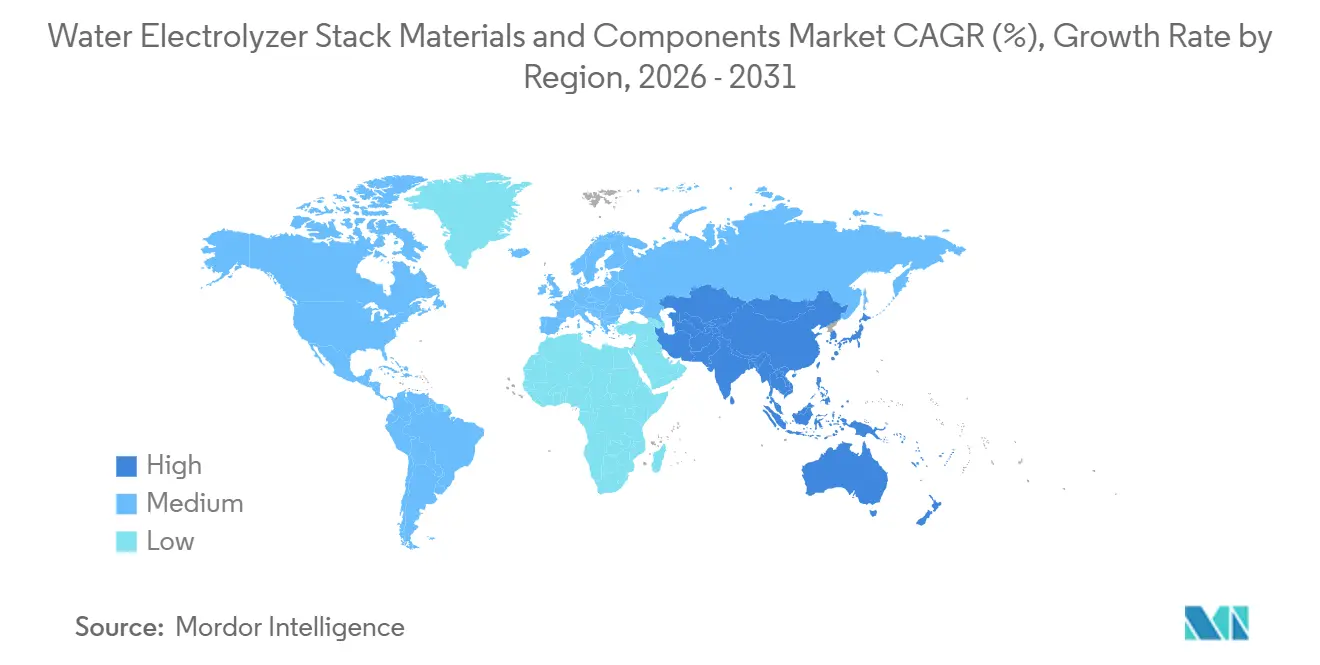
Asia-Pacific held 37.46% of the water electrolyzer stack materials and components market share in 2025 and is projected to record the fastest regional CAGR of 29.05% through 2031. China's manufacturing scale, India's localization plans, and South Korea's hydrogen commitments are supporting regional demand. China's installed capacity and manufacturing footprint provide a cost advantage in alkaline stack production. LONGi Hydrogen has 5.0 GW of annual manufacturing capacity. India is also becoming an important localization market for water electrolyzer stack materials and components.
Thyssenkrupp Nucera and BHEL signed a Strategic Collaboration Agreement in July 2026 to localize the fabrication of alkaline water electrolyzer modules in India. Japan and South Korea contribute membrane chemistry and precision electrode coating capabilities. Australia is a demand center for green iron and ammonia projects. Progressive Green Solutions selected Thyssenkrupp Nucera as a preferred supplier for a 1.4 GW electrolyzer project in Australia in August 2025. This activity supports regional demand for large alkaline stack components in the water electrolyzer stack materials and components market.
Europe held the second-largest regional position in the water electrolyzer stack materials and components market. Germany, Spain, and the Netherlands are key deployment centers supported by the EU Hydrogen Bank. The European Commission's hydrogen auction process supports renewable hydrogen projects through the Innovation Fund. John Cockerill assembled its first 5 MW alkaline stack in France in July 2026. Sunfire's pressurized systems exceeded 85,000 cumulative operating hours at European industrial sites in 2025. North America faces uncertainty around Section 45V, while South America and the Middle-East have opportunities tied to favorable renewable resources and ammonia production. The NEOM project's 2.2 GW electrolyzer capacity and 4.0 GW of co-located renewables illustrate the scale of Gulf supplier qualification requirements.
Competitive Landscape
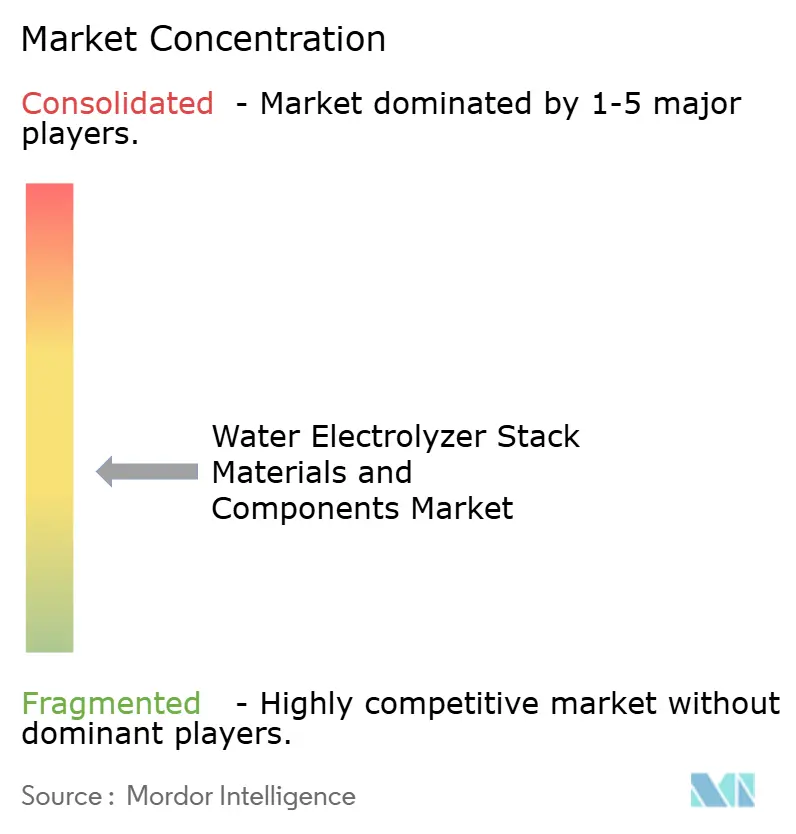
The water electrolyzer stack materials and components market is moderately fragmented. Nel ASA, thyssenkrupp Nucera, Siemens Energy, LONGi, and Plug Power hold stack supply positions. Materials supply remains dispersed among membrane specialists, platinum-group-metal catalyst suppliers, titanium fabricators, and polymer compounders. This structure makes technical qualification important at each layer of the supply chain and creates different competitive conditions for equipment manufacturers and specialized material producers.
Siemens Energy is moving toward automated serial production of PEM electrolyzers with a 1 GW annual target. Nel launched its next-generation pressurized alkaline platform in May 2026 as part of its move toward lower-cost standardized equipment. Thyssenkrupp Nucera's collaboration with BHEL is a strategic move to establish access to local manufacturing in India. John Cockerill's first French stack from the former McPhy facility demonstrates the use of acquired manufacturing assets to build local production capability. These developments indicate that production scale and regional access are both central to competition in this market.
The intermediate materials tier presents openings for producers of electrode coatings, sintered porous transport layers, and catalyst-coated membrane substrates at gigawatt-relevant scale. Long validation timelines and technical qualification requirements limit entry into these positions. Enapter's AEM Stack 250 and SOEC suppliers represent distinct competitive groups, as their component requirements differ from those of alkaline and PEM systems. Patent activity for bipolar plate coatings, porous transport layer designs, and reduced-iridium catalysts has increased since 2024. Intellectual property therefore plays an important role alongside manufacturing scale in this market.
Water Electrolyzer Stack Materials and Components Industry Leaders
-
thyssenkrupp nucera AG & Co. KGaA
-
Nel ASA
-
Siemens Energy
-
Plug Power Inc.
-
ITM Power plc
- *Disclaimer: Major Players sorted in no particular order
Recent Industry Developments
- July 2026: Thyssenkrupp Nucera and BHEL signed a Strategic Collaboration Agreement for phased localization of alkaline water electrolyzer module fabrication in India, targeting joint participation in tenders under India's National Green Hydrogen Mission and establishing a manufacturing presence in one of the high-growth electrolyzer demand markets globally.
- July 2026: John Cockerill Hydrogen unveiled its first 5 MW pressurized alkaline electrolyzer stack assembled at the former McPhy facility in Belfort, France. The 30-ton polymer-cell unit was unveiled alongside the launch of 40 MW production for a Dutch green hydrogen project, marking the first output from its 2025 McPhy acquisition.
Global Water Electrolyzer Stack Materials and Components Market Report Scope
Water electrolyzer stack materials and components include bipolar plates, membranes or separators, and electrocatalytic electrodes. These parts work together inside an electrolyzer stack to split water into hydrogen and oxygen using electricity.
The water electrolyzer stack materials and components market is segmented by technology, component type, material type, end-user industry, and geography. By technology, the market is segmented into proton exchange membrane (PEM) electrolyzers, alkaline electrolyzers, and others (AEM and SOEC). By component type, the market is segmented into membranes and separators, catalyst layers and electrodes, bipolar plates, porous transport layers (PTL)/gas diffusion layers (GDL), and others (gaskets, seals, end plates, MEAs). By material type, the market is segmented into platinum group metals (PGMs), nickel, stainless steel and titanium, polymer materials (PFSA, hydrocarbon, AEM), graphite and carbon composites, and others (ceramics and emerging materials). By end-user industry, the market is segmented into green hydrogen production, power-to-x applications, industrial applications (refining, ammonia, steel), energy storage, and others (mobility and hydrogen refueling). The report also covers market size and forecasts for water electrolyzer stack materials and components across 15 countries in major regions. The market sizes and forecasts are provided in terms of value (USD).
| Proton Exchange Membrane (PEM) Electrolyzers |
| Alkaline Electrolyzers |
| Others (AEM and SOEC) |
| Membranes and Separators |
| Catalyst Layers and Electrodes |
| Bipolar Plates |
| Porous Transport Layers (PTL)/Gas Diffusion Layers (GDL) |
| Others (Gaskets, Seals, End Plates, MEAs) |
| Platinum Group Metals (PGMs) |
| Nickel, Stainless Steel and Titanium |
| Polymer Materials (PFSA, Hydrocarbon, AEM) |
| Graphite and Carbon Composites |
| Others (Ceramics and Emerging Materials) |
| Green Hydrogen Production |
| Power-to-X Applications |
| Industrial Applications (Refining, Ammonia, Steel) |
| Energy Storage |
| Others (Mobility and Hydrogen Refueling) |
| Asia-Pacific | China |
| India | |
| Japan | |
| South Korea | |
| Rest of Asia-Pacific | |
| North America | United States |
| Canada | |
| Mexico | |
| Europe | Germany |
| United Kingdom | |
| France | |
| Italy | |
| Rest of Europe | |
| South America | Brazil |
| Argentina | |
| Rest of South America | |
| Middle-East and Africa | Saudi Arabia |
| South Africa | |
| Rest of Middle-East and Africa |
| By Technology | Proton Exchange Membrane (PEM) Electrolyzers | |
| Alkaline Electrolyzers | ||
| Others (AEM and SOEC) | ||
| By Component Type | Membranes and Separators | |
| Catalyst Layers and Electrodes | ||
| Bipolar Plates | ||
| Porous Transport Layers (PTL)/Gas Diffusion Layers (GDL) | ||
| Others (Gaskets, Seals, End Plates, MEAs) | ||
| By Material Type | Platinum Group Metals (PGMs) | |
| Nickel, Stainless Steel and Titanium | ||
| Polymer Materials (PFSA, Hydrocarbon, AEM) | ||
| Graphite and Carbon Composites | ||
| Others (Ceramics and Emerging Materials) | ||
| By End-User Industry | Green Hydrogen Production | |
| Power-to-X Applications | ||
| Industrial Applications (Refining, Ammonia, Steel) | ||
| Energy Storage | ||
| Others (Mobility and Hydrogen Refueling) | ||
| By Geography | Asia-Pacific | China |
| India | ||
| Japan | ||
| South Korea | ||
| Rest of Asia-Pacific | ||
| North America | United States | |
| Canada | ||
| Mexico | ||
| Europe | Germany | |
| United Kingdom | ||
| France | ||
| Italy | ||
| Rest of Europe | ||
| South America | Brazil | |
| Argentina | ||
| Rest of South America | ||
| Middle-East and Africa | Saudi Arabia | |
| South Africa | ||
| Rest of Middle-East and Africa | ||
Key Questions Answered in the Report
What is current market size of Water Electrolyzer Stack Materials And Components Market?
The Water Electrolyzer Stack Materials And Components Market size was valued at USD 0.52 billion in 2025 and is estimated to grow from USD 0.65 billion in 2026 to reach USD 2.03 billion by 2031, at a CAGR of 25.64% during the forecast period (2026-2031).
Which electrolyzer technology held the largest share in 2025?
Alkaline electrolyzers led with a 54.40% share in 2025 due to established supply chains and lower material costs.
Which component category is growing the fastest?
Catalyst layers and electrodes are projected to grow at a CAGR of 29.66% through 2031 as producers reduce iridium use and develop Anion Exchange Membrane (AEM) catalysts.
Which region is expected to grow the fastest?
Asia-Pacific is projected to grow at a CAGR of 29.05% through 2031, supported by China’s manufacturing base and regional localization efforts.