
Waste Pre-processing For Alternate Fuel and Raw Materials (AFR) Market Size and Share
Market Overview
| Study Period | 2021 - 2031 |
|---|---|
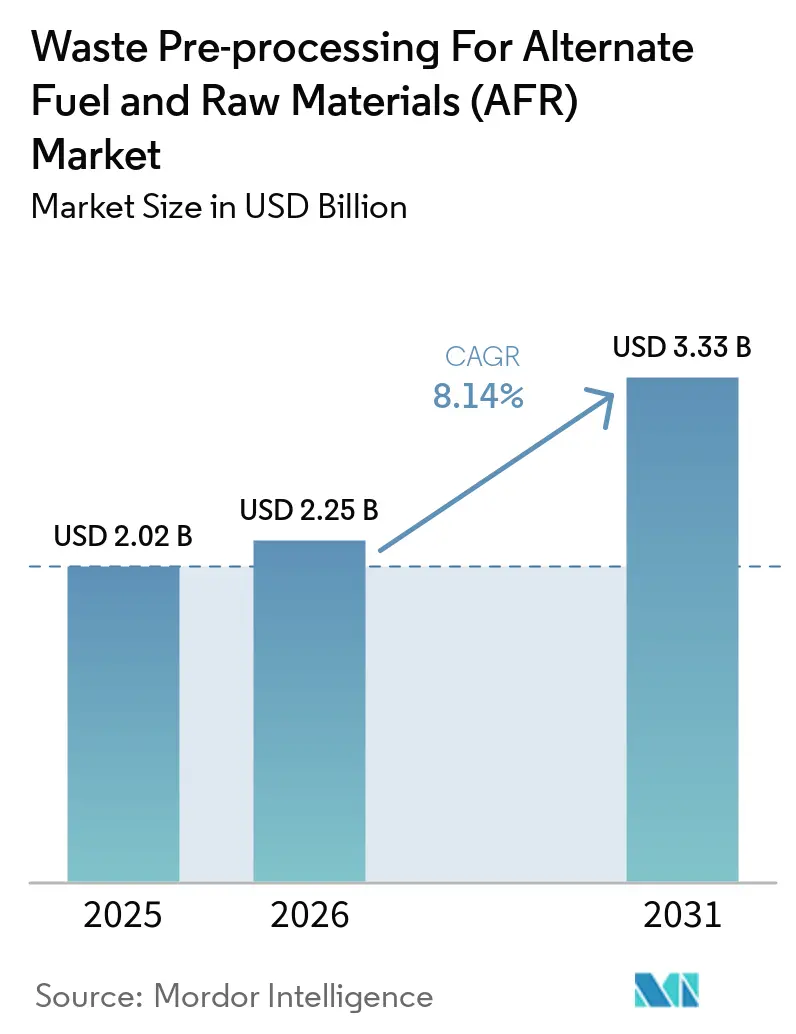
| Market Size (2026) | USD 2.25 Billion |
| Market Size (2031) | USD 3.33 Billion |
| Growth Rate (2026 - 2031) | 8.14 % |
| Fastest Growing Market | Asia-Pacific |
| Largest Market | Europe |
| Market Concentration | Medium |
Major Players *Disclaimer: Major Players sorted in no particular order Image © Mordor Intelligence. Reuse requires attribution under CC BY 4.0. | |
Waste Pre-processing For Alternate Fuel and Raw Materials (AFR) Market Analysis by Mordor Intelligence
The Waste Pre-processing For Alternate Fuel And Raw Materials Market size is expected to increase from USD 2.02 billion in 2025 to USD 2.25 billion in 2026 and reach USD 3.33 billion by 2031, at a CAGR of 8.14% over 2026-2031. The waste pre-processing for the alternative fuels and raw materials market is moving toward structured fuel supply as cement producers seek dependable substitutes for fossil fuels. European cement plants met 58% of thermal energy demand with alternative fuels, and Cembureau reports a 60% target for 2030 without identified technical barriers[1]. This need favors suppliers that can control moisture, calorific value, contaminants, traceability, and dependable deliveries across the waste pre-processing for the alternative fuels and raw materials market. This operating requirement links equipment investment directly with customer retention in the waste pre-processing for the alternative fuels and raw materials market. Advanced sorting is becoming more important because it can turn mixed waste into a more consistent secondary fuel stream. Integrated collection, processing, quality control, and long-term offtake arrangements therefore shape competition in the waste pre-processing for alternative fuels and raw materials market.
Key Report Takeaways
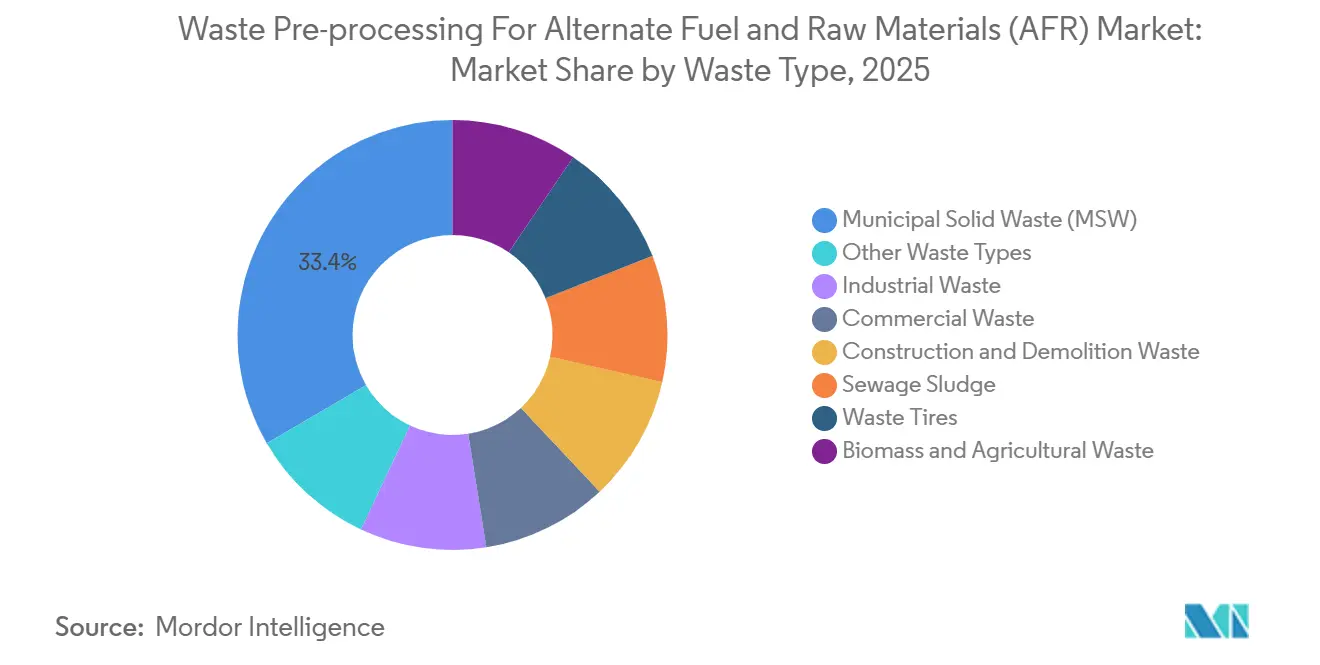
- By waste type, municipal solid waste held 33.4% of the waste pre-processing for the alternative fuels and raw materials market share in 2025, while biomass and agricultural waste are forecast to grow at a 9.3% CAGR through 2031.
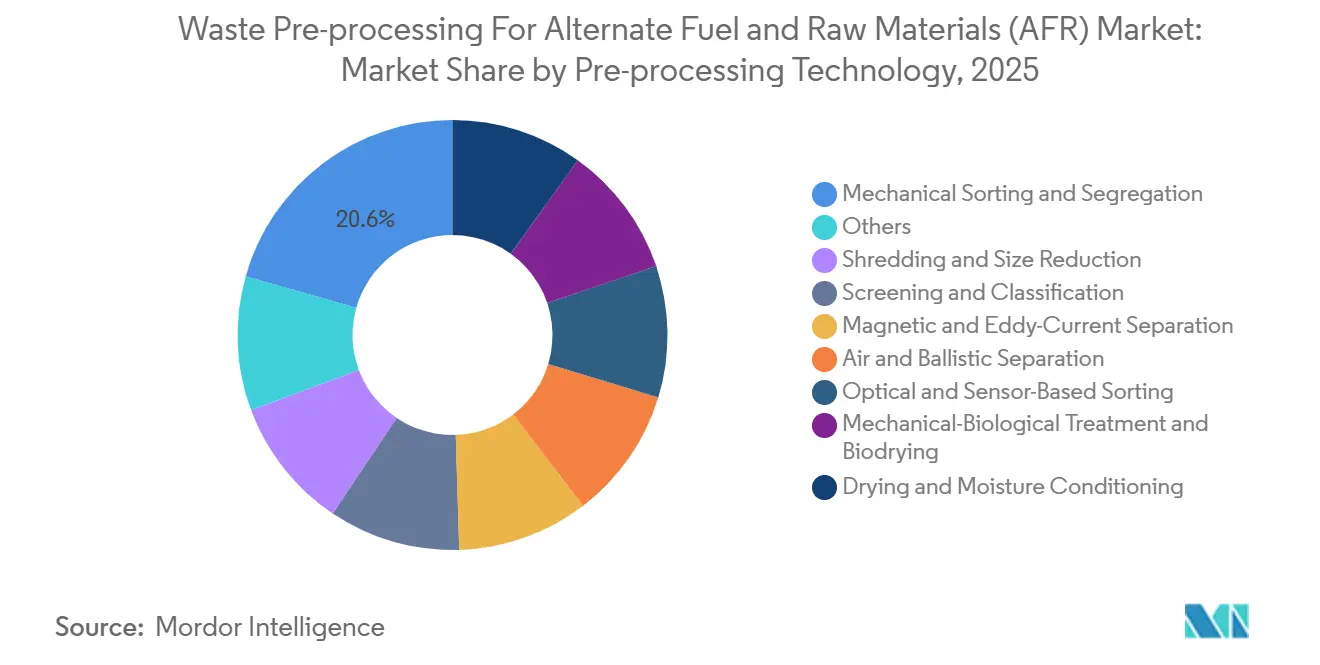
- By pre-processing technology, mechanical sorting and segregation accounted for 20.6% of the waste pre-processing for the alternative fuels and raw materials market size in 2025, while optical and sensor-based sorting is projected to grow at a 10.2% CAGR through 2031.
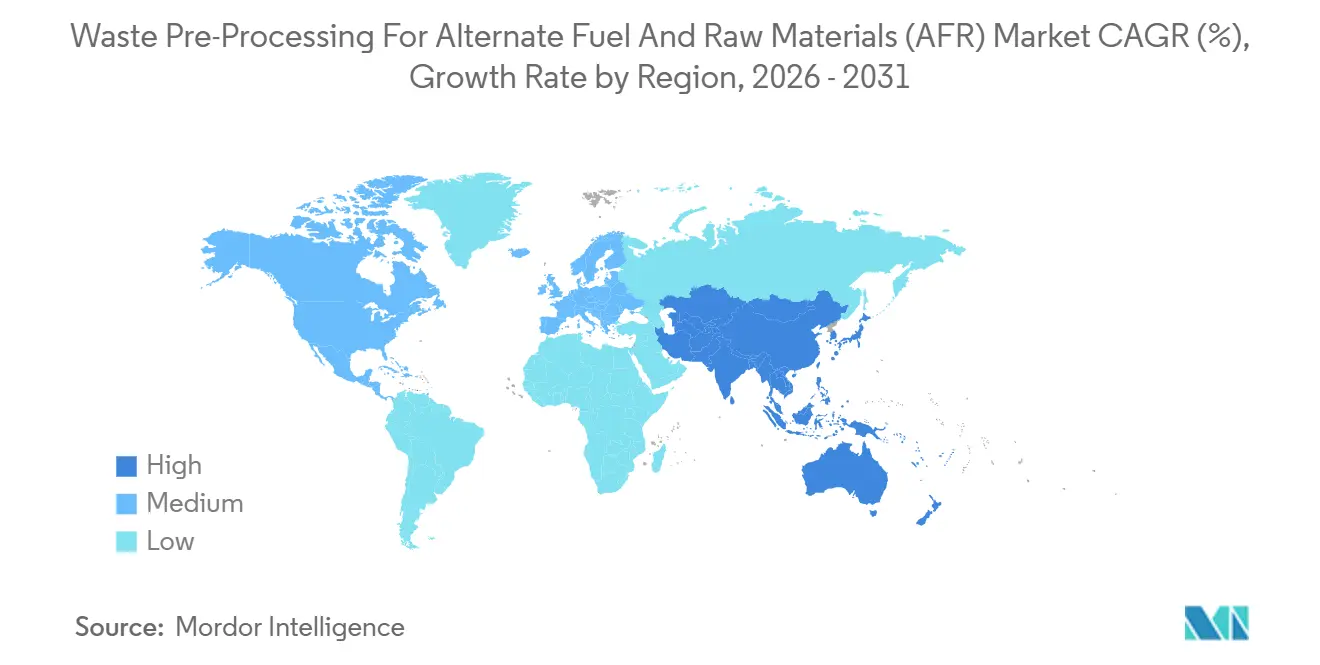
- By geography, Europe accounted for 37.4% of the waste pre-processing for alternative fuels and raw materials market share in 2025, while Asia-Pacific is forecast to grow at a 9.5% CAGR through 2031.
Note: Market size and forecast figures in this report are generated using Mordor Intelligence’s proprietary estimation framework, updated with the latest available data and insights as of January 2026.
Market Trends and Insights
Drivers Impact Analysis of Waste Pre-processing For Alternate Fuel and Raw Materials (AFR) Market*
| Driver | (~) % Impact on CAGR Forecast | Geographic Relevance | Impact Timeline |
|---|---|---|---|
| Fossil-Fuel Substitution and Cement Decarbonization | +2.80% | Global, led by EU, expanding to APAC and South America | Medium term (2-4 years) |
| Landfill Diversion and Circular-Economy Mandates | +2.10% | EU core, spill-over to North America and APAC | Short term (≤ 2 years) |
| Demand for Consistent High-Calorific Fuels | +0.80% | Global, concentrated in established cement hubs | Medium term (2-4 years) |
| Expansion of Waste-to-Energy and CHP Capacity | +1.10% | APAC and North America with spill-over to MEA | Medium to long term (2-5 years) |
| AI-Enabled Sorting and Digital Fuel Traceability | +0.90% | Europe and North America, expanding to APAC | Short to medium term (1-4 years) |
| Integration of Alternative Raw Materials With Fuel Pre-Processing | +0.60% | Global, highest initial uptake in EU and South America | Long term (≥ 4 years) |
| Source: Mordor Intelligence | |||
Fossil-Fuel Substitution and Cement Decarbonization
Fuel combustion accounted for 30% of cement production emissions, making fuel replacement a direct operating priority for cement plants[2]. The waste pre-processing for alternative fuels and raw materials market benefits when plants require engineered fuels instead of irregular waste deliveries. The GCCA states that fuel quality requirements now address calorific value, alkali content, chloride limits, and moisture control[3]. Heidelberg Materials set a target above 50% for alternative fuel use and plans for more than 30% of its clinker plants to achieve at least 45% AFR use. These targets create demand for suppliers that can provide high-calorific solid recovered fuel at consistent specifications. Investment in feeding and dosing equipment also supports multi-year arrangements rather than one-time waste transactions.
Landfill Diversion and Circular-Economy Mandates
Europe’s landfill rules are directing more residual material toward recovery and co-processing routes. The Waste Framework Directive supports prevention, reuse, recycling, recovery, and disposal in that order. The waste pre-processing for alternative fuels and raw materials market gains access to larger local volumes when landfilling becomes more restricted. Regulation 2026/1703 restricts exports of mixed municipal waste for recovery, which reduces overseas outlets for residual waste. France also updated requirements related to solid recovered fuel production during 2025. These rules encourage facilities that can turn difficult municipal and industrial streams into compliant fuels. Higher costs for competing disposal routes can improve the economics of processing lower-calorific sludge and construction residues. This increases the range of materials that can enter the waste pre-processing for alternative fuels and raw materials market when technical controls are in place.
Demand for Consistent High-Calorific Fuels and Energy Recovery Capacity
Cement plants need consistent particle size and heat value to sustain stable kiln operation. This requirement makes sorting, shredding, drying, and conditioning important parts of the waste pre-processing for alternative fuels and raw materials market, particularly where cement plants buy fuel under long-term quality commitments. New waste-to-energy and combined heat and power capacity expands the number of potential users for prepared fuel. Indonesia selected 8 consortia for waste-to-energy projects across 20 cities during July 2026. JFE Engineering invested JPY 750 million in 2 Andhra Pradesh waste-to-energy special-purpose vehicles, signaling new formal processing investment in India. More end users can reduce dependence on one cement buyer, although they also compete for high-calorific residual material.
AI-Enabled Sorting, Traceability, and Alternative Raw Materials Integration
AI-enabled sorting allows facilities to make narrower quality grades from mixed waste. Multi-sensor systems combine near-infrared imaging, color cameras, 3D recognition, and AI classification to separate complex streams. TOMRA introduced its GAINnext platform during 2026 and reported 98%+ purity for its UBC aluminum application. The waste pre-processing for alternative fuels and raw materials market also gains from traceability because cement buyers need defensible fuel composition records for supply contracts, regulatory review, and internal environmental procurement procedures. ISO Technical Committee 300’s proposed recycling index for SRF co-processing may formalize composition measures used in procurement and audit processes. Combining alternative raw materials with fuel processing can further raise the value captured from sorted residual streams.
Restraints Impact Analysis of Waste Pre-processing For Alternate Fuel and Raw Materials (AFR) Market*
| Restraint | (~) % Impact on CAGR Forecast | Geographic Relevance | Impact Timeline |
|---|---|---|---|
| Feedstock Variability and Kiln-Stability Risk | -1.20% | Global, highest impact in APAC and North America | Short to medium term (1-4 years) |
| High Pre-Processing Capital and Logistics Costs | -0.80% | Emerging markets in APAC, South America, MEA | Medium term (2-4 years) |
| Competition for High-Calorific Residual Waste | -0.60% | EU, UK, and mature North American markets | Short term (≤ 2 years) |
| Fragmented Permitting and Cross-Border Waste Rules | -0.50% | EU cross-border flows, APAC intra-regional, MEA | Long term (≥ 4 years) |
| Source: Mordor Intelligence | |||
Feedstock Variability and Kiln-Stability Risk
Variable moisture, calorific value, and ash composition can prevent residual waste from meeting main-burner fuel requirements. Research on kiln burner technology identifies moisture below 10% as necessary for stable main-burner combustion. High-moisture fuel can destabilize the calciner and cause uneven clinker burning. This makes drying and moisture conditioning necessary for many municipal solid waste and agricultural residue streams. Operators without biodrying or thermal drying equipment are less able to compete for premium fuel contracts in the waste pre-processing for alternative fuels and raw materials market. The need for tighter quality control can narrow margins when incoming materials change in composition.
High Pre-Processing Capital, Logistics, and Compliance Costs
Purpose-built processing plants require sizable investment before they can generate stable fuel volumes. PreZero invested more than EUR 42 million in its Barcelona facility, which can process 190,000 tonnes of industrial waste per year. Biomass also requires more handling because it is bulky and has lower energy density. Transport rules add documentation needs for certain chlorine-bearing streams, particularly within Europe. U.S. regulatory treatment of some cement operations can add permitting complexity and has contributed to a 35-percentage-point gap with European alternative fuel adoption. Smaller operators face a greater burden from the capital, logistics, and compliance costs required to meet buyer specifications.
*Our forecasts treat driver/restraint impacts as directional, not additive. The impact forecasts reflect baseline growth, mix effects, and variable interactions.
Waste Pre-processing For Alternate Fuel and Raw Materials (AFR) Market Segment Analysis
By Waste Type:
Municipal Solid Waste Leads While Biomass ExpandsMunicipal solid waste held 33.4% of the waste pre-processing for alternative fuels and raw materials market share in 2025. Its large volume and proximity to urban collection systems support the location of processing facilities near municipal waste flows. Industrial and commercial waste remains a useful input because its composition is often more uniform and less contaminated. That uniformity can reduce the processing steps needed to produce higher-calorific solid recovered fuel. Construction and demolition wood is emerging as a pellet feedstock for cement kilns. The Construction and Demolition Recycling Association worked with the American Cement Association and the EPA during 2025 and 2026 on non-hazardous secondary material classification for clean cellulosic biomass. Waste tires retain a heat value near that of coal after shredding and steel separation. Sewage sludge requires biodrying to reach an energy density suitable for co-firing. These inputs provide stable demand but have lower projected growth than biomass residues.
The waste pre-processing for alternative fuels and raw materials market size for biomass and agricultural waste is projected to grow at a 9.3% CAGR through 2031. Agricultural residues can broaden the feedstock base for cement producers in Asia-Pacific and Latin America. A 2025 study found that biomass and agricultural fuels could provide up to 70% of coal’s energy content and showed low HCl and dioxin emissions under the tested conditions. Holcim Mexico commissioned a biomass facility in Colima during August 2026. The facility dries 220 tonnes per day of sugar bagasse with recovered kiln heat before grinding it for co-firing. China’s T/CIECCPA 129-2026 standard sets requirements for calorific value, moisture, ash composition, and particle size for biomass fuels used in cement kilns. Such requirements favor facilities that can manage seasonal variation in agricultural inputs. They also shift biomass supply toward engineered fuel specifications rather than untreated residue delivery.

By Pre-processing Technology:
Mechanical Sorting Provides the Base for Advanced SortingMechanical sorting and segregation accounted for 20.6% of the waste pre-processing for alternative fuels and raw materials market size in 2025. It separates inert, recyclable, and organic fractions before shredding, drying, and sensor-based refinement. Shredding and size reduction form the next essential layer because fuel must meet particle-size limits for conveying and combustion. Particle sizes below 80 mm support more consistent handling and kiln feeding. Mechanical biological treatment and biodrying can reduce the energy needed for later moisture conditioning. Magnetic and eddy-current separation protect downstream equipment by removing metals. Air and ballistic separation help improve material purity before optical sorting. Drying and moisture conditioning are increasingly important as cement producers impose stricter fuel specifications. Each of these steps supports consistent quality but adds processing complexity and operating cost. Their combined role explains why integrated processing lines are central to the waste pre-processing for alternative fuels and raw materials market.
Optical and sensor-based sorting is forecast to grow at a 10.2% CAGR through 2031. The technology serves facilities that need a more precise output from variable mixed waste streams. A 2026 review describes sensor fusion that combines near-infrared hyperspectral imaging, color cameras, 3D recognition, and AI classification. STEINERT reported that its sensor-fusion AI enabled food-grade PET-tray sorting at Cirrec without replacing hardware[4]. Software updates can therefore help facilities adapt to new material targets. European best-available-technique requirements are also encouraging upgrades of older mechanical and shredding lines. Advanced sorting supports a higher-quality fuel stream but does not eliminate the need for mechanical preparation. The strongest technology stacks combine mechanical separation, moisture control, and sensor-based quality refinement.
Geography Analysis
Europe Waste Pre-processing for Alternate Fuel and Raw Materials (AFR) Market
Europe accounted for 37.4% of the waste pre-processing for alternative fuels and raw materials market share in 2025. The region has established rules and commercial arrangements for waste co-processing. Regulation 2026/1703 restricts mixed municipal waste exports for recovery and redirects residual material to domestic outlets. Austria, Belgium, and Germany have some of the highest cement substitution rates. Poland, Spain, and Italy remain below Europe’s 58% average alternative fuel rate, leaving room for new processing capacity. Paprec and Vicat opened the EUR 15.4 million ALTèreNATIVE plant in France during July 2026. The facility illustrates the regional supply-chain model that links processing capacity with a local cement offtaker.
APAC Waste Pre-processing for Alternate Fuel and Raw Materials (AFR) Market
Asia-Pacific is projected to grow at a 9.5% CAGR through 2031. The waste pre-processing for alternative fuels and raw materials market is supported by increasing waste volumes and cement capacity across China, India, Indonesia, and Vietnam, although supply quality still depends on local collection and segregation systems. KHD commissioned a second Pyrorotor system at Conch Group’s Baoshan plant during December 2025. The installation processes shredded biomass and municipal solid waste at 18 tonnes per hour under high-moisture conditions. Indonesia’s program for waste-to-energy projects can expand the formal infrastructure needed for prepared fuels. India generates 150,000 tonnes of municipal solid waste each day, but segregation gaps and variable feedstock quality limit near-term cement use. The region’s opportunity depends on improving collection, sorting, and quality control before material reaches cement plants.
South America and MEA Waste Pre-processing for Alternate Fuel and Raw Materials (AFR) Market
South America and the Middle East and Africa are smaller regions with meaningful potential. Geocycle planned USD 125 million of Latin American investment through 2030, supported by 14 facilities that processed nearly 1 million tonnes of waste during 2025. This model combines cement operations and waste processing within one supply chain. Saudi Arabia and the UAE support policy frameworks for waste as an alternative fuel through the Cement and Concrete Breakthrough initiative. Morocco also offers potential as cement production and municipal solid waste volumes grow. Research found that locally sourced agricultural waste ashes could reduce the carbon footprint of African cement by up to 40%. This can link fuel preparation with alternative raw material use in future projects.
Competitive Landscape
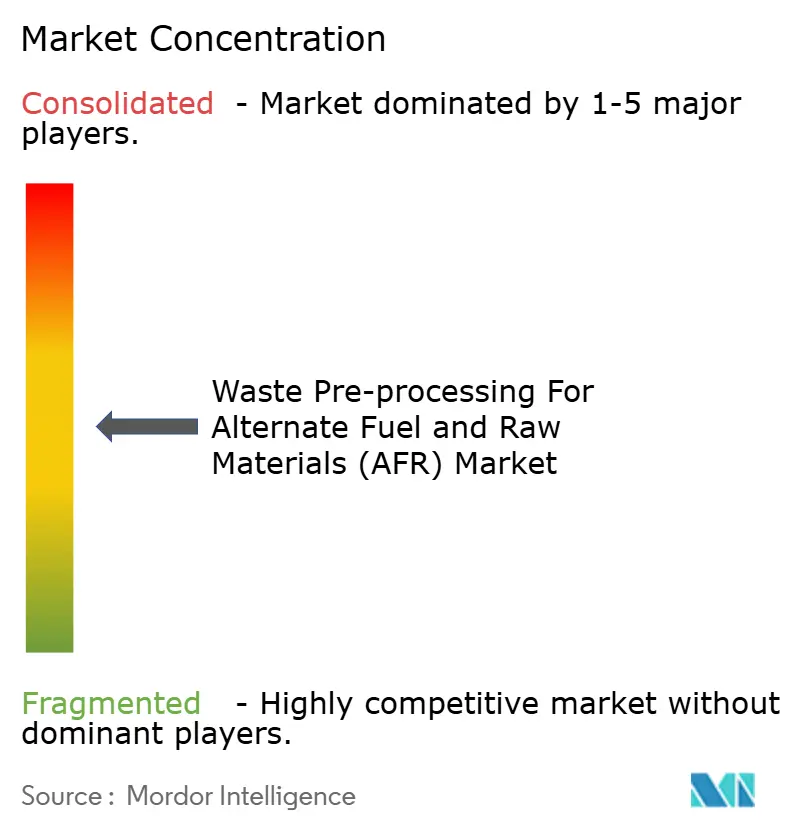
The waste pre-processing for the alternative fuels and raw materials market is moderately consolidated. Operators with collection networks, certified fuel data, and cement offtake contracts have a stronger position. Veolia, SUEZ, REMONDIS, PreZero, and Geocycle operate major solid recovered fuel supply chains in Europe. PreZero increased deliveries of solid recovered fuel to CEMEX from its new Barcelona facility during July 2026. Heidelberg Materials issued a EUR 600 million green bond during January 2026, with proceeds designated for plant modernization that includes alternative fuel infrastructure. These developments support arrangements where processors and cement producers share the infrastructure needed for higher substitution rates.
Fuel traders also have an important role because logistics and quality documentation affect the value of each delivery. Geminor handled 2.1 million tonnes of RDF and SRF annually and was the United Kingdom’s largest RDF exporter during 2024. Its shift toward domestic quality-certified contracts shows how trade activity can move closer to processing and fuel assurance. Biffa acquired Renewi’s United Kingdom municipal operations for GBP 125 million during 2025. The transaction combined waste collection, treatment, and residual fuel supply within one company. Such consolidation also appeared in Germany and the Netherlands. It can give operators stronger control over feedstock, treatment capacity, and delivery routes. Companies that lack verified composition data may find it harder to qualify for long-term cement supply contracts.
Technology companies influence the competitive structure by shaping the quality and economics of prepared fuel. TOMRA and STEINERT are offering AI-based sorting systems that add software capabilities to established equipment sales. TOMRA’s GAINnext platform links real-time stream composition data with physical sorting actions. STEINERT demonstrated that adaptable models can handle new material targets without a hardware replacement. This can reduce the time needed to change sorting strategies when waste composition changes. Premium fuel suppliers remain dependent on these technologies but must also manage drying, storage, and logistics. Their advantage comes from the ability to deliver a specification that a kiln can use safely and consistently.
Waste Pre-processing For Alternate Fuel and Raw Materials (AFR) Industry Leaders
-
Geocycle (Deutschland) GmbH
-
Veolia Environnement SA
-
SUEZ S.A.
-
REMONDIS SE & Co. KG
-
Indaver NV
- *Disclaimer: Major Players sorted in no particular order
Waste Pre-processing For Alternate Fuel and Raw Materials (AFR) Market Companies Covered in this Report
- Andusia Holdings Limited
- Beauparc Utilities Holdings Limited
- Biffa plc
- CEMEX, S.A.B. de C.V.
- EEW Energy from Waste GmbH
- Enva Group Limited
- FCC Environment (UK) Limited
- Geminor AS
- Geocycle (Deutschland) GmbH
- Heidelberg Materials AG
- Holcim Ltd.
- Indaver NV
- Paprec Group S.A.S. (Paprec)
- PreZero International GmbH
- Ragn-Sells AB
- REMONDIS SE & Co. KG
- Renewi plc (Renewi)
- SUEZ S.A.
- Veolia Environnement SA
- Vicat SA
Recent Industry Developments in Waste Pre-processing For Alternate Fuel and Raw Materials (AFR) Market
- July 2026: Paprec and Vicat inaugurated the EUR 15.4 million ALTèreNATIVE SRF plant in Martigues, France's largest of its type, with 50,000 tonnes per year of SRF capacity, avoiding 48,000 tonnes of CO₂ annually and supplying Vicat's Grave de Peille cement plant through a regional short-circuit supply chain.
- July 2026: PreZero Portugal completed the acquisition of TRATRIS, a waste treatment company in Tondela, strengthening SRF production capacity in central Portugal's industrial cluster and expanding PreZero's geographic footprint in the Iberian market.
- May 2026: TOMRA Recycling unveiled the GAINnext™ AI-native sorting platform and a 51% stake in PolyPerception at IFAT 2026 Munich, introducing deep-learning applications for PET trays (>95% purity) and UBC aluminum (98%+ purity at 33× manual throughput), advancing the quality ceiling for sensor-based pre-processing.
- January 2026: Heidelberg Materials placed a EUR 600 million, 10-year green bond (ISIN XS3270897575), designating proceeds to plant modernization, including alternative fuel infrastructure, the company's largest single green finance instrument to date.
Global Waste Pre-processing For Alternate Fuel and Raw Materials (AFR) Market Report Scope
Waste pre-processing for Alternate Fuel and Raw Materials (AFR) refers to the collection, sorting, segregation, size reduction, drying, blending, and conditioning of waste materials to convert them into a consistent, safe, and suitable fuel or raw material feedstock for industrial processes, particularly cement manufacturing. The process removes unsuitable materials and contaminants while adjusting properties such as calorific value, moisture content, particle size, chemical composition, and homogeneity. The resulting processed waste, commonly referred to as RDF (Refuse-Derived Fuel), SRF (Solid Recovered Fuel), or prepared AFR, can replace conventional fossil fuels such as coal and petcoke, while mineral-rich waste streams can substitute for conventional raw materials in cement production.
The Waste Pre-processing for AFR Market is segmented by waste type, pre-processing technology, and geography. By waste type, the market is segmented into municipal solid waste (MSW), industrial waste, commercial waste, construction & demolition (C&D) waste, sewage sludge, waste tires, biomass & agricultural waste, and other waste types. By pre-processing technology, the market is segmented into mechanical sorting, shredding, screening, magnetic separation, air & ballistic separation, optical sorting, mechanical biological treatment (MBT), drying, and other technologies. The report also covers the market size and forecasts for the global Waste Pre-processing for AFR Market across 26 countries in key regions. For each segment, the market sizing and forecasts have been provided on the basis of value (USD).
Segmentation Overview
| Municipal Solid Waste (MSW) |
| Industrial Waste |
| Commercial Waste |
| Construction and Demolition Waste |
| Sewage Sludge |
| Waste Tires |
| Biomass and Agricultural Waste |
| Other Waste Types |
| Mechanical Sorting and Segregation |
| Shredding and Size Reduction |
| Screening and Classification |
| Magnetic and Eddy-Current Separation |
| Air and Ballistic Separation |
| Optical and Sensor-Based Sorting |
| Mechanical-Biological Treatment and Biodrying |
| Drying and Moisture Conditioning |
| Others |
| North America | United States |
| Canada | |
| Mexico | |
| Europe | Germany |
| France | |
| Italy | |
| Spain | |
| United Kingdom | |
| Poland | |
| Russia | |
| Rest of Europe | |
| Asia-Pacific | China |
| India | |
| Japan | |
| South Korea | |
| Australia | |
| Indonesia | |
| Vietnam | |
| Thailand | |
| Rest of Asia-Pacific | |
| South America | Brazil |
| Argentina | |
| Chile | |
| Rest of South America | |
| Middle East and Africa | Saudi Arabia |
| United Arab Emirates | |
| Egypt | |
| South Africa | |
| Morocco | |
| Rest of Middle East and Africa |
| By Waste Type | Municipal Solid Waste (MSW) | |
| Industrial Waste | ||
| Commercial Waste | ||
| Construction and Demolition Waste | ||
| Sewage Sludge | ||
| Waste Tires | ||
| Biomass and Agricultural Waste | ||
| Other Waste Types | ||
| By Pre-processing Technology | Mechanical Sorting and Segregation | |
| Shredding and Size Reduction | ||
| Screening and Classification | ||
| Magnetic and Eddy-Current Separation | ||
| Air and Ballistic Separation | ||
| Optical and Sensor-Based Sorting | ||
| Mechanical-Biological Treatment and Biodrying | ||
| Drying and Moisture Conditioning | ||
| Others | ||
| By Geography | North America | United States |
| Canada | ||
| Mexico | ||
| Europe | Germany | |
| France | ||
| Italy | ||
| Spain | ||
| United Kingdom | ||
| Poland | ||
| Russia | ||
| Rest of Europe | ||
| Asia-Pacific | China | |
| India | ||
| Japan | ||
| South Korea | ||
| Australia | ||
| Indonesia | ||
| Vietnam | ||
| Thailand | ||
| Rest of Asia-Pacific | ||
| South America | Brazil | |
| Argentina | ||
| Chile | ||
| Rest of South America | ||
| Middle East and Africa | Saudi Arabia | |
| United Arab Emirates | ||
| Egypt | ||
| South Africa | ||
| Morocco | ||
| Rest of Middle East and Africa | ||
Key Questions Answered in the Report
How large is the waste pre-processing for alternative fuels and raw materials market?
The sector is valued at USD 2.25 billion in 2026 and is forecast to reach USD 3.33 billion by 2031 at an 8.14% CAGR.
What is driving demand for waste pre-processing for alternative fuels and raw materials?
Cement producers need consistent substitutes for fossil fuels, while landfill diversion rules increase the flow of residual materials to recovery routes.
Which waste type is growing fastest for alternative fuel production?
Biomass and agricultural waste is projected to grow at a 9.3% CAGR through 2031, supported by its availability in agricultural regions.
Which processing technology is growing fastest?
Optical and sensor-based sorting is projected to expand at a 10.2% CAGR through 2031 because it can improve quality control for mixed waste streams.
Which region has the strongest growth outlook?
Asia-Pacific is forecast to grow at a 9.5% CAGR through 2031 as waste volumes, cement capacity, and formal treatment infrastructure expand.
What limits wider use of prepared alternative fuels in cement kilns?
Feedstock variability, high capital requirements, logistics costs, and compliance needs can limit investment and reliable fuel supply.