
Voice-Enabled Password Reset Market Size and Share
Market Overview
| Study Period | 2021 - 2032 |
|---|---|
| Market Size (2027) | USD 0.48 Billion |
| Market Size (2032) | USD 1.05 Billion |
| Growth Rate (2027 - 2032) | 16.81 % |
| Fastest Growing Market | Asia-Pacific |
| Largest Market | North America |
| Market Concentration | Medium |
Major Players *Disclaimer: Major Players sorted in no particular order Image © Mordor Intelligence. Reuse requires attribution under CC BY 4.0. | |
Voice-Enabled Password Reset Market Analysis by Mordor Intelligence
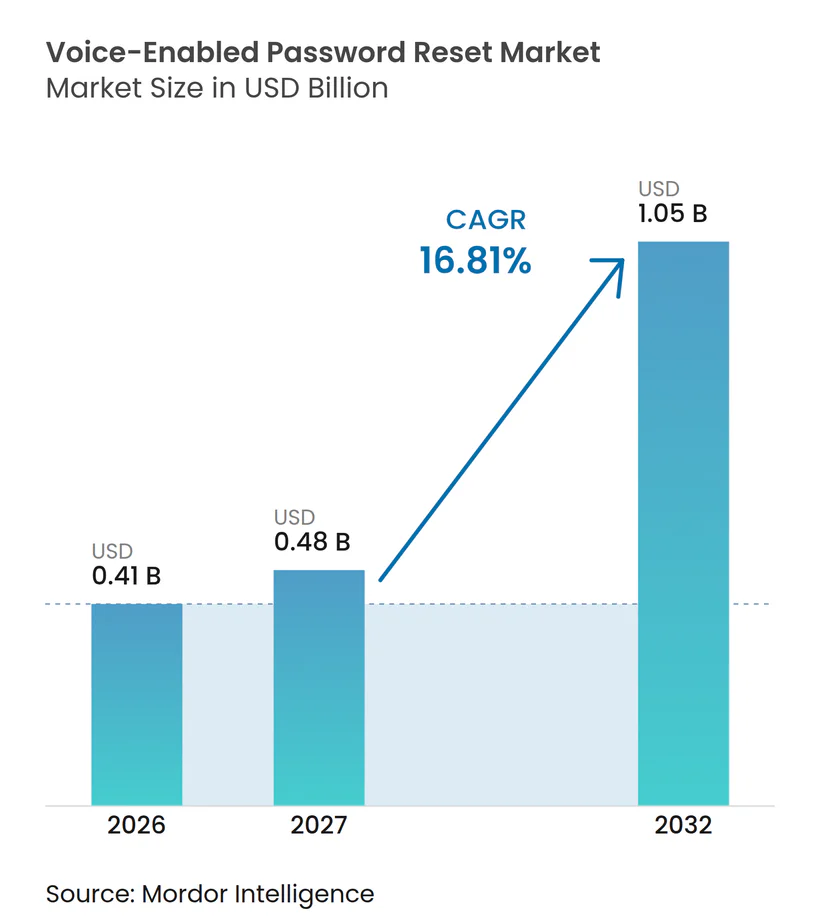
The Voice-Enabled Password Reset Market size was valued at USD 0.41 billion in 2026 and is estimated to grow from USD 0.48 billion in 2027 to reach USD 1.05 billion by 2032, at a CAGR of 16.81% during the forecast period (2027-2032). The voice-enabled password reset market is moving away from knowledge-based checks as organizations use biometric verification in IVR systems, mobile applications, and conversational interfaces. Zero-trust programs, account takeover risk, and stronger identity rules are supporting adoption, while the withdrawal of Amazon Connect Voice ID and Microsoft Azure AI Speaker Recognition is creating replacement demand. Providers are responding with passive authentication, liveness detection, fraud scoring, and links to existing contact center platforms. The voice-enabled password reset market also faces a practical limit because voice comparison must work with another factor under NIST guidance, and privacy requirements can extend legal and technical review cycles.
Key Report Takeaways
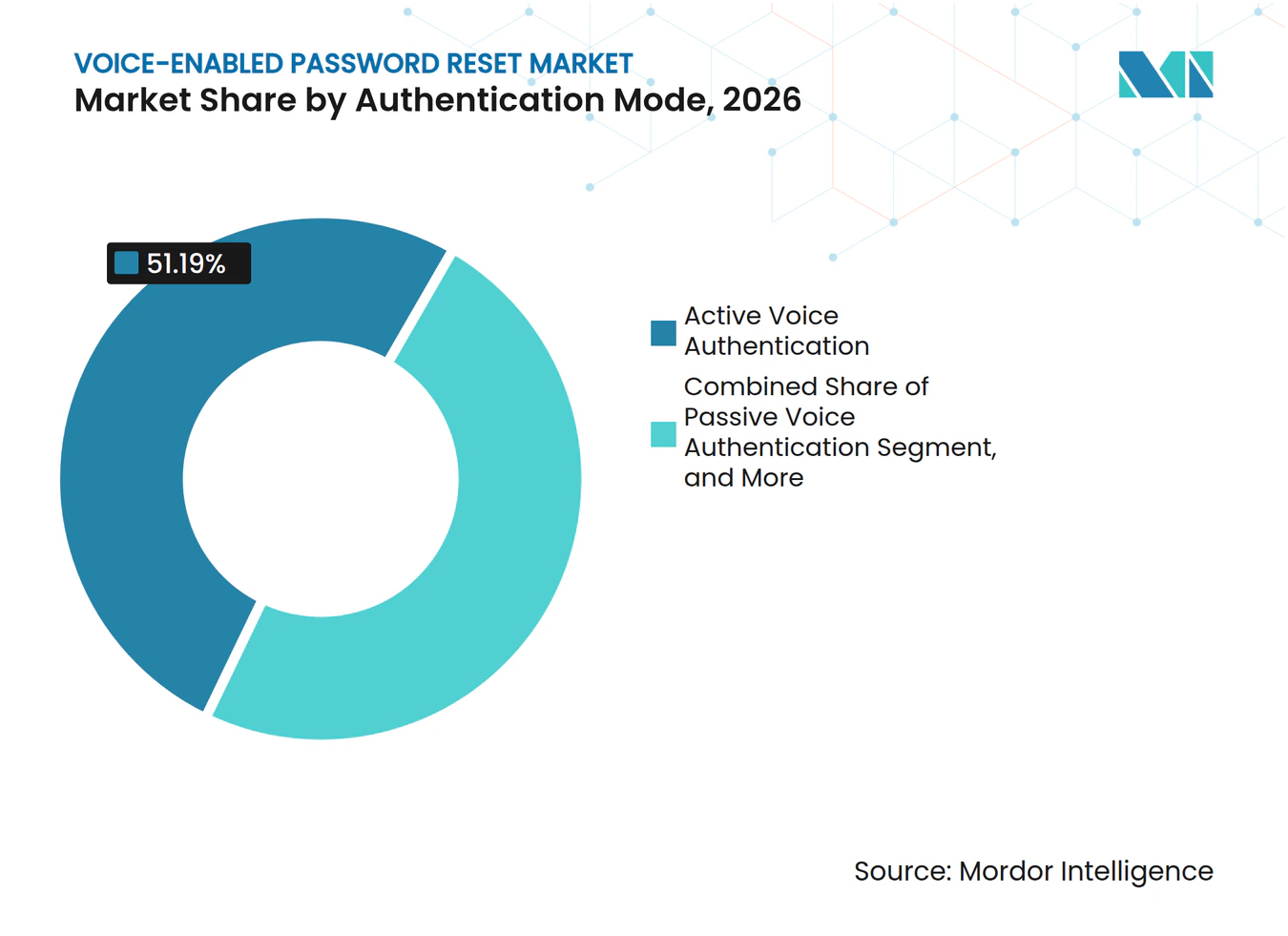
- By authentication mode, active voice authentication held 51.91% of voice-enabled password reset market share in 2026, while passive voice authentication is projected to expand at a 17.63% CAGR through 2032.
- By access channel, IVR and contact centers accounted for 56.32% of revenue in 2026, while mobile applications are projected to expand at a 17.48% CAGR through 2032.
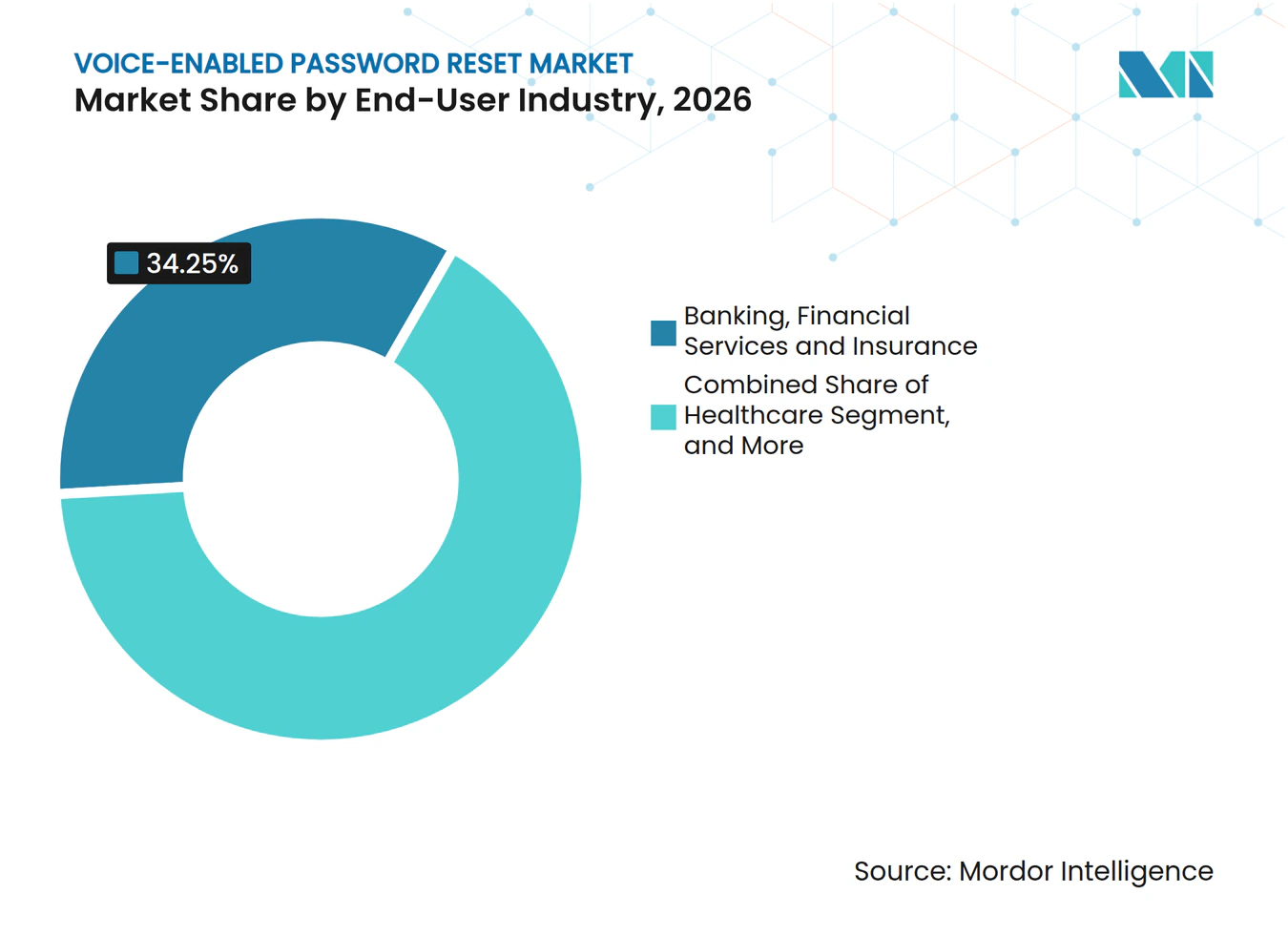
- By end-user industry, BFSI held 34.25% of revenue in 2026, while healthcare is projected to expand at a 17.75% CAGR through 2032.
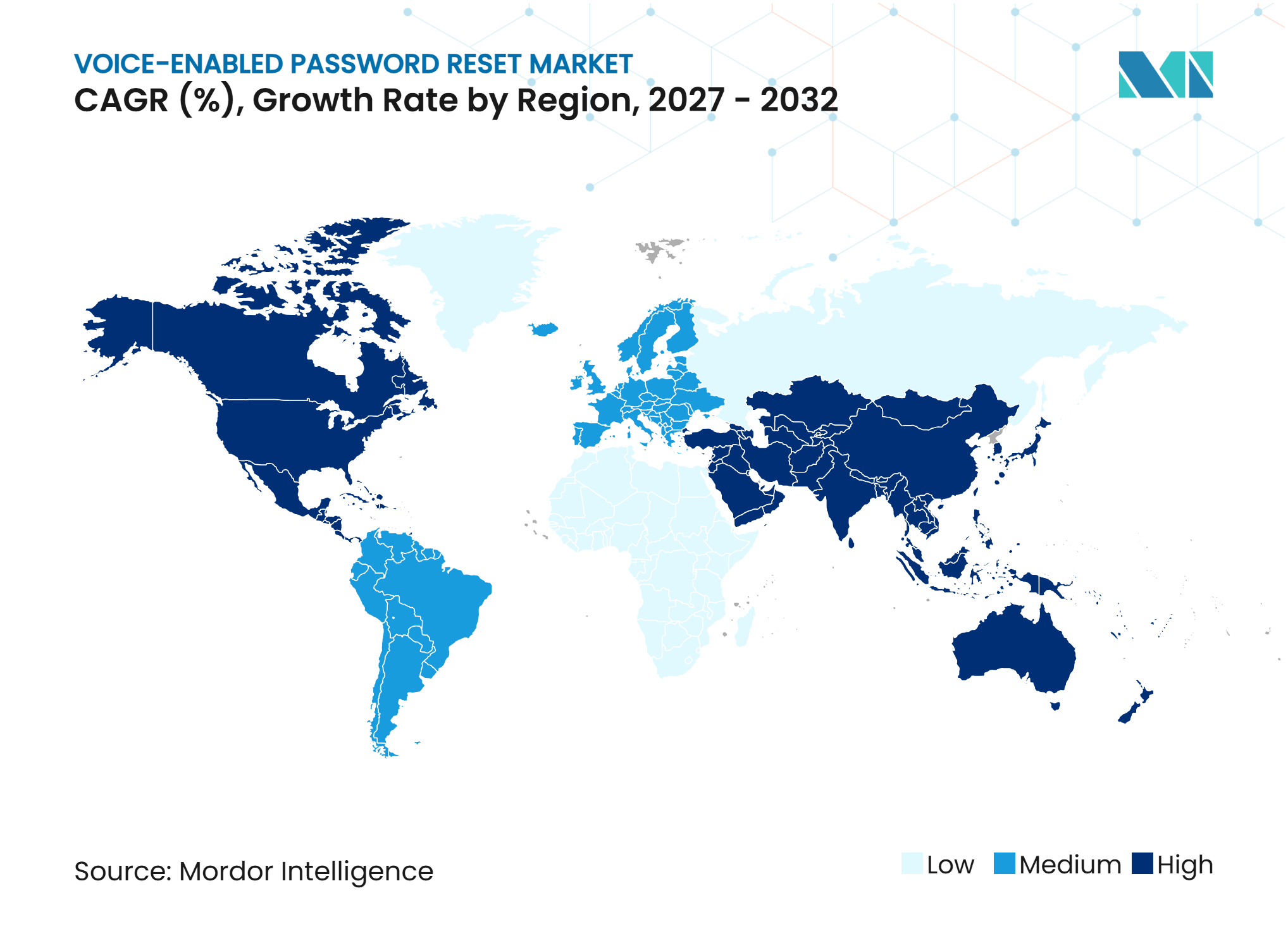
- By geography, North America held 41.87% of revenue in 2026, while Asia-Pacific is projected to expand at a 17.69% CAGR through 2032.
Note: Market numbers in this report are based on Mordor Intelligence's proprietary estimation framework, which combines nine months of actuals with Q4 projections for base year 2026.
Market Trends and Insights
Drivers Impact Analysis of Voice-Enabled Password Reset Market*
| Driver | (~) % Impact on CAGR Forecast | Geographic Relevance | Impact Timeline |
|---|---|---|---|
| Passwordless Authentication in Zero-Trust Programs | +2.3% | Global, led by North America and Europe | Short term (≤ 2 years) |
| Account-Takeover and Social-Engineering Risk | +2.1% | North America and Europe core, extending to Asia-Pacific | Short term (≤ 2 years) |
| Contact Center Automation and Help Desk Cost Reduction | +1.9% | North America and Europe, expanding to Asia-Pacific and the Middle East and Africa | Short term (≤ 2 years) |
| Strong Customer Authentication Requirements | +1.6% | Europe core, North America, extending to Asia-Pacific and the Middle East | Medium term (2-4 years) |
| Deepfake-Resistant Voice Liveness | +1.4% | Global, led by North America | Medium term (2-4 years) |
| Hands-Free Recovery in Mobile-First Settings | +1.0% | Asia-Pacific, Africa, and South America | Medium term (2-4 years) |
| Source: Mordor Intelligence | |||
Passwordless Authentication Adoption in Zero-Trust Programs
Zero-trust programs require organizations to confirm identity at each access point, which exposes the weakness of password-based recovery. The voice-enabled password reset market benefits when a stolen password cannot by itself restore access to an account. Microsoft Entra ID began making passkeys the default sign-in experience from September 2026, pushing organizations to reconsider SMS and password fallback paths for users who cannot rely on hardware tokens. Voice verification can support phone-based users, including people who may find device prompts difficult to use. NIST SP 800-63B-4, issued in August 2025, provides federal authentication guidance that enterprises often use as a technical reference. This makes multimodal recovery design more important than a standalone voice check.
Rising Account-Takeover and Social-Engineering Risk
Account takeover and social engineering are making contact centers a more visible security point. Sift reported a 122% year-over-year increase in fintech and finance attack rates in Q3 2025, reaching 1.2% of inbound interactions. Pindrop found that 39.2% of detected fraud calls in its analysis were account takeover attempts involving credential resets, address changes, or card replacements. Static questions are less effective in these cases because criminals can obtain personal information before calling. The voice-enabled password reset market therefore gains relevance as digital login controls leave telephony as a potential alternate entry point. Financial institutions also need documented verification controls for voice interactions, which supports procurement of tools that cover both fraud and identity assurance.
Contact Center Automation and Help Desk Cost Reduction
Password resets are recurring self-service requests, so faster verification can reduce time spent on routine calls. Pindrop reported that Michigan State University Federal Credit Union reduced per-call authentication time by 45 seconds within 90 days and was tracking USD 561,600 in annualized savings from reduced agent time. These results matter because routine recovery calls can be resolved in IVR rather than moved to human agents. Conversational AI deployments also need a reliable identity layer before they handle sensitive recovery requests. The voice-enabled password reset market can therefore benefit when automation projects move from routing calls to completing secure account actions.
Regulatory Pressure for Strong Customer Authentication
European rules require payment providers to apply strong customer authentication using 2 of 3 factor types, knowledge, possession, and inherence, for relevant electronic payment activity. Voice biometrics can serve as the inherence element when it is paired with a possession factor, such as a registered mobile device. This gives telephony users an alternative to a PIN entry process while preserving a second factor. The EU AI Act adds requirements for biometric speaker recognition systems, including stronger documentation and oversight. Organizations that must satisfy both payment and AI requirements may prefer one provider that supports compliant authentication and auditable biometric controls. The voice-enabled password reset market has an opportunity where these related compliance needs are handled through the same deployment.
Restraints Impact Analysis of Voice-Enabled Password Reset Market*
| Restraint | (~) % Impact on CAGR Forecast | Geographic Relevance | Impact Timeline |
|---|---|---|---|
| Voiceprint Privacy and Data-Residency Requirements | -2.0% | Europe, North America, and Asia-Pacific | Medium term (2-4 years) |
| Spoofing, Replay, Synthetic Speech, and Deepfake Risk | -1.8% | Global, with strong focus on North America and Europe | Short term (≤ 2 years) |
| Multilingual Bias and Accent-Dependent Performance | -1.6% | Asia-Pacific, Africa, South America, and the Middle East | Long term (≥ 4 years) |
| Enrollment Friction and Voice Variability | -1.2% | Global, with greater impact in Asia-Pacific and Africa | Medium term (2-4 years) |
| Source: Mordor Intelligence | |||
Voiceprint Privacy and Data-Residency Requirements
A voiceprint used to identify a person is biometric data, and privacy rules can place strict conditions on its collection and use. The UK Information Commissioner’s Office notes that biometric recognition can involve special-category personal data and requires a lawful basis and an appropriate condition for processing. Organizations may need clear consent, retention schedules, deletion processes, and separate audit records. Multi-jurisdiction deployments can also require different data-residency settings and consent journeys. These requirements make procurement slower because legal, security, and operational teams must agree on the implementation. Providers that offer clear enrollment controls and regional data options can reduce this friction in the voice-enabled password reset market.
Spoofing, Replay, Synthetic Speech, and Deepfake Attack Risk
Synthetic speech increases the risk that a voice sample can be copied or replayed during a reset request. The Federal Trade Commission has described efforts to evaluate audio deepfake and voice-clone detection, highlighting the need for liveness testing in this area. Veridas stated that its ECHO product passed iBeta Quality Assurance Level-1 testing under ISO/IEC 30107-3 in June 2025 with a 100% spoof-block rate. Attack methods continue to change, so organizations need ongoing testing and model updates. Smaller deployments may find it harder to maintain the data and specialist capability needed for robust liveness controls. These requirements can slow buying decisions in the voice-enabled password reset market.
*Our forecasts treat driver/restraint impacts as directional, not additive. The impact forecasts reflect baseline growth, mix effects, and variable interactions.
Voice-Enabled Password Reset Market Segment Analysis
By Authentication Mode:
Passive Verification Gains Ground Alongside Active SystemsActive voice authentication accounted for 51.91% of voice-enabled password reset market share in 2026, reflecting the installed base of passphrase enrollment systems in contact centers. The method gives callers a clear moment to record a passphrase and provide consent. That process can make it easier to document consent requirements under privacy frameworks. Active systems also provide a direct record for organizations that must demonstrate authentication controls during reviews. Multimodal voice and second-factor configurations remain the smallest revenue segment, but they are strategically important.
Passive voice authentication is projected to expand at a 17.63% CAGR from 2027 to 2032. It verifies a caller during natural conversation instead of asking for a passphrase. The approach can authenticate a caller during the first 10 to 15 seconds of a conversation, which suits AI-supported IVR routing. Passive enrollment can reduce drop-off because it builds a voiceprint through normal interactions. It also expands the amount of biometric information processed during each call, which increases the scope of privacy and data management work for the voice-enabled password reset industry.



By Access Channel:
IVR Scale Supports Mobile AdoptionIVR and contact centers represented 56.32% of revenue in 2026, giving the voice-enabled password reset market its largest access-channel base. Large enterprise telephony systems process high volumes of calls where agent time creates a clear operating cost. Password recovery is a common help desk request, so automation has an immediate use case in this channel. Chatbots and conversational interfaces remain earlier in adoption, but their use is increasing as voice capabilities are added to AI tools. Pindrop introduced BotStopper in September 2026 to identify AI voice agents and automated callers in real time, supported by a registry of more than 5,000 identified AI voices.
Mobile applications are projected to expand at a 17.48% CAGR from 2027 to 2032. The shift reflects self-service recovery in mobile banking and healthcare portals. It also aligns with smartphone adoption in India, Southeast Asia, and Sub-Saharan Africa, where mobile devices are a primary access point. Mobile workflows need identity checks that can operate without moving users into a separate contact center process. Mobile deployments require smaller liveness models that run on consumer devices, driving investment in on-device processing without weakening anti-spoofing controls.
By End-User Industry:
Healthcare Challenges BFSI’s Established LeadBFSI held 34.25% of revenue in 2026, making it the largest end-user category in the voice-enabled password reset market. Banks and insurers manage a large volume of sensitive phone interactions, and account takeover carries financial and reputational consequences. Sift reported that fintech and finance attacks rose 122% year over year in Q3 2025 to 1.2% of inbound interactions. IT and telecom is the second-largest end-user segment, with telecom operators using voice verification in subscriber identity management and enterprise IT teams using it for help desk authentication. These operating needs keep financial services central to the voice-enabled password reset industry.
Healthcare is projected to expand at a 17.75% CAGR from 2027 to 2032. Remote care creates a need to confirm patient identity without requiring a physical card or a remembered password. Cambridge Cognition launched a GDPR- and HIPAA-compliant speaker identification solution in August 2025, reporting accuracy above 97% for clinical trial participant verification. Retail and e-commerce, as well as manufacturing, remain smaller use cases. Manufacturing has a practical hands-free recovery opportunity for workers who cannot easily use a keyboard or touchscreen on the production floor.

Geography Analysis
The Americas Voice-Enabled Password Reset Market
North America held 41.87% of revenue in 2026, supported by a dense contact center base, early biometric procurement cycles, and an established group of voice biometric providers. NIST SP 800-63B-4 provides a federal reference point for technical authentication decisions, while state biometric privacy rules add review requirements for employers and service providers. The exit of Amazon Connect Voice ID and Microsoft Azure AI Speaker Recognition created replacement decisions for many contact center users. Pindrop positioned its Amazon Connect integration as a migration path after the service change. South America is at an earlier adoption stage, with financial services and retail banking providing a starting point as smartphone use, payment digitization, and identity verification rules develop.
Europe and Middle East Voice-Enabled Password Reset Market
Europe is the second-largest regional market for the voice-enabled password reset market, where GDPR treatment of voiceprints and the EU AI Act’s high-risk classification for speaker recognition place compliance at the center of vendor selection. Payment providers must also meet strong customer authentication standards for relevant transactions, which encourages investment in biometric inherence factors paired with a second factor for telephone channels. The Middle East is also advancing through digital identity programs and banking deployments. Riyad Bank offers voice access and commands through its retail banking platform, showing a practical regional use case. These deployments indicate that app-based voice security and enterprise telephony can develop together.
Asia-Pacific, Middle East, and Africa Voice-Enabled Password Reset Market
Asia-Pacific is projected to expand at a 17.69% CAGR from 2027 to 2032. Moreover, India has the fastest growth rate reported for the voice-enabled password reset market. Aadhaar provides a digital identity foundation, while the Unified Payments Interface supports high volumes of account activity, and India’s 22 scheduled languages make voice useful for people who do not prefer text-heavy recovery steps. Africa remains a greenfield opportunity, where national biometric programs in South Africa and Nigeria, mobile-first banking, and low-bandwidth voice authentication services can support adoption. The voice-enabled password reset market can serve these mobile-led settings when voice verification operates reliably with limited bandwidth.
Competitive Landscape
Market Concentration
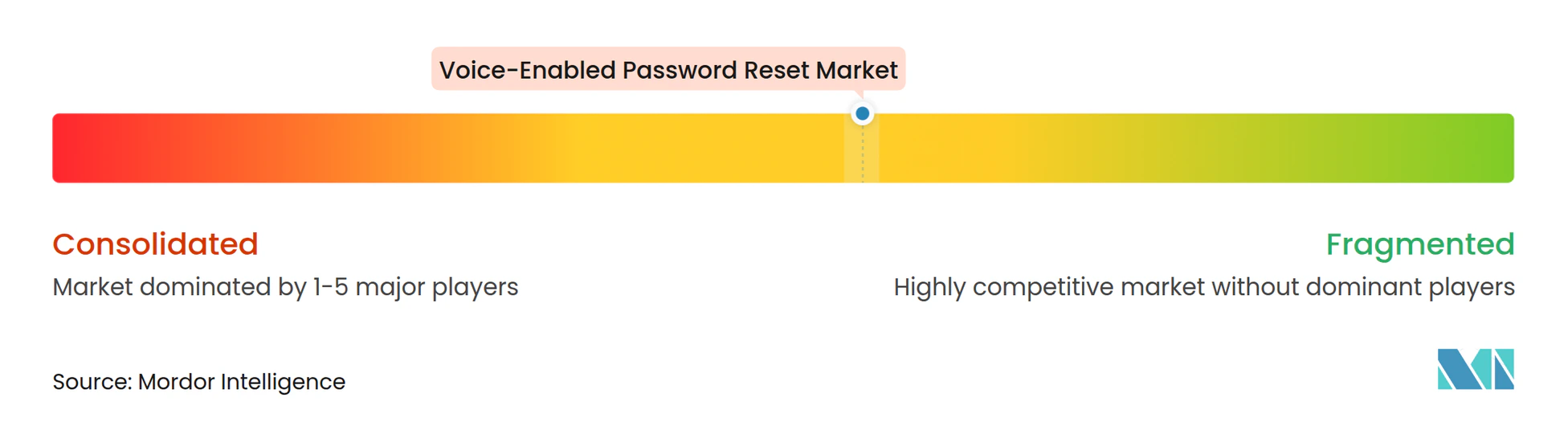
The voice-enabled password reset market has a moderate level of concentration, with Pindrop Security holding a leading position in North America and serving 14 of the top 20 U.S. banks through a platform that combines passive authentication, deepfake detection, and fraud risk scoring. Amazon Connect Voice ID reached end of support in May 2026, and Microsoft Azure AI Speaker Recognition was retired in September 2025, creating a gap for specialist providers. Pindrop presented an Amazon Connect migration option in June 2025, while ValidSoft cited the exits of Nuance and Amazon Connect Voice ID when it formed an alliance with Reality Defender in August 2025. These moves shifted more attention toward providers that can support migrations as well as authentication. Anti-spoofing performance is becoming a central comparison point in provider selection.
Veridas reported that its ECHO product passed iBeta Quality Assurance Level-1 spoof testing under ISO/IEC 30107-3 in June 2025, with a 100% spoof-block rate that gives buyers a documented benchmark for liveness capabilities. Reality Defender received U.S. Patent 12462813B1 for a data-driven audio deepfake detection system in November 2025, showing continued technical investment in this area. Phonexia released Voice Inspector 6 in September 2026 with dedicated deepfake detection capabilities. Illuma also secured investment from existing clients in October 2026 to advance deepfake detection and adaptive multi-factor authentication. These moves show why voice verification and liveness defense are increasingly sold together in the voice-enabled password reset market.
Regional specialists are serving community banks, credit unions, and organizations that need practical integrations without large internal implementation teams. The clearest white space is among enterprises with 50 to 500 contact center seats, as well as healthcare, government, and retail organizations in Asia-Pacific where voice authentication use remains limited. Illuma integrated Reality Defender’s synthetic audio detection into IllumaSHIELD in March 2026, while Pindrop expanded its NICE CXone integration in February 2026 to support passive authentication and deepfake detection across AI-agent and human-agent interactions. Vendors that combine straightforward deployment with privacy controls and tested liveness capabilities are better positioned to serve this group.
Voice-Enabled Password Reset Industry Leaders
-
Nuance Communications, Inc.
-
Pindrop Security, Inc.
-
Veridas Digital Authentication Solutions, S.L.
-
Auraya Systems Pty Ltd
-
Aculab plc
- *Disclaimer: Major Players sorted in no particular order
Voice-Enabled Password Reset Market Companies Covered in this Report
- Nuance Communications, Inc.
- Pindrop Security, Inc.
- Veridas Digital Authentication Solutions, S.L.
- Auraya Systems Pty Ltd
- Aculab plc
- Phonexia s.r.o.
- VoicePIN.com Sp. z o.o.
- Uniphore Technologies Inc.
- SESTEK SES VE ILETISIM TEKNOLOJILERI A.S
- ID R&D, Inc.
- LumenVox, LLC
- Speech Technology Center, LLC
- ValidSoft UK Limited
- OneVault (Pty) Ltd
- Voice Biometrics Group, Inc.
- VoiceIt Technologies, Inc.
- Sensory, Inc.
- Reality Defender, Inc.
- Illuma Labs, Inc.
- CreaLog GmbH
Recent Industry Developments in Voice-Enabled Password Reset Market
- October 2026: Illuma secured an undisclosed investment from Financial Plus Credit Union, Dort Financial Credit Union, and CUSO One Washington Financial to advance deepfake detection, adaptive multi-factor authentication, and platform integrations. The deal, led by existing Illuma clients, reflects the community-banking segment's shift toward client-funded voice security infrastructure as ATO threats intensify.
- September 2026: Pindrop launched BotStopper technology, a standalone product detecting AI voice agents and automated callers in real time, backed by an AI Voice Consortium registry of more than 5,000 identified AI voices. A Fortune 500 healthcare deployment using the platform reduced bot activity by 94.3% in under 4 months after identifying more than 30,000 bot calls in less than a year.
- September 2026: Phonexia released Voice Inspector 6, upgrading its forensic voice biometrics platform with dedicated deepfake detection capabilities, extending the product's relevance from law enforcement forensic analysis into enterprise voice security applications.
- August 2026: Microsoft Dynamics 365 Contact Center made voice biometric authentication generally available, offering native voice enrollment with optional one-time passcode and knowledge-based challenge as a multi-factor authentication strategy for contact centers. The release provides out-of-the-box compliant voice reset capabilities without requiring a separate third-party biometric integration.
Global Voice-Enabled Password Reset Market Report Scope
The Voice-Enabled Password Reset Market refers to the industry focused on solutions and services that enable users to reset, recover, or verify account credentials through voice-based authentication technologies, including active and passive voice biometrics, speaker recognition, voiceprint matching, and AI-powered conversational interfaces.
The Voice-Enabled Password Reset Market Report is Segmented by Authentication Mode (Active Voice Authentication, Passive Voice Authentication, and Multimodal Voice and Second Factor), by Access Channel (IVR and Contact Center, Mobile Application, Web Portal, and Chatbot and Conversational Interface), by End-User Industry (Banking, Financial Services and Insurance, IT and Telecom, Healthcare, Government and Public Sector, Retail and E-Commerce, Manufacturing, and Other End-User Industries), and by Geography [North America (United States, Canada, and Mexico), South America (Brazil, Argentina, and Rest of South America), Europe (United Kingdom, Germany, France, Italy, Spain, and Rest of Europe), Asia-Pacific (China, India, Japan, South Korea, Australia and New Zealand, and Rest of Asia-Pacific), Middle East (United Arab Emirates, Saudi Arabia, Turkey, and Rest of Middle East), and Africa (South Africa, Nigeria, and Rest of Africa)]. The Market Forecasts are Provided in Terms of Value (USD).
Segmentation Overview
| Active Voice Authentication |
| Passive Voice Authentication |
| Multimodal Voice and Second Factor |
| IVR and Contact Center |
| Mobile Application |
| Web Portal |
| Chatbot and Conversational Interface |
| Banking, Financial Services and Insurance |
| IT and Telecom |
| Healthcare |
| Government and Public Sector |
| Retail and E-Commerce |
| Manufacturing |
| Other End-User Industries |
| North America | United States |
| Canada | |
| Mexico | |
| South America | Brazil |
| Argentina | |
| Rest of South America | |
| Europe | United Kingdom |
| Germany | |
| France | |
| Italy | |
| Spain | |
| Rest of Europe | |
| Asia-Pacific | China |
| India | |
| Japan | |
| South Korea | |
| Australia and New Zealand | |
| Rest of Asia-Pacific | |
| Middle East | United Arab Emirates |
| Saudi Arabia | |
| Turkey | |
| Rest of Middle East | |
| Africa | South Africa |
| Nigeria | |
| Rest of Africa |
| By Authentication Mode | Active Voice Authentication | |
| Passive Voice Authentication | ||
| Multimodal Voice and Second Factor | ||
| By Access Channel | IVR and Contact Center | |
| Mobile Application | ||
| Web Portal | ||
| Chatbot and Conversational Interface | ||
| By End-User Industry | Banking, Financial Services and Insurance | |
| IT and Telecom | ||
| Healthcare | ||
| Government and Public Sector | ||
| Retail and E-Commerce | ||
| Manufacturing | ||
| Other End-User Industries | ||
| By Geography | North America | United States |
| Canada | ||
| Mexico | ||
| South America | Brazil | |
| Argentina | ||
| Rest of South America | ||
| Europe | United Kingdom | |
| Germany | ||
| France | ||
| Italy | ||
| Spain | ||
| Rest of Europe | ||
| Asia-Pacific | China | |
| India | ||
| Japan | ||
| South Korea | ||
| Australia and New Zealand | ||
| Rest of Asia-Pacific | ||
| Middle East | United Arab Emirates | |
| Saudi Arabia | ||
| Turkey | ||
| Rest of Middle East | ||
| Africa | South Africa | |
| Nigeria | ||
| Rest of Africa | ||
Key Questions Answered in the Report
What is the projected size of the voice-enabled password reset market?
It is projected to reach USD 1.05 billion by 2032, from USD 0.48 billion in 2027, at a 16.81% CAGR.
Which authentication mode leads voice-enabled password reset deployments?
Active voice authentication leads with 51.91% of revenue in 2026, supported by its established use in passphrase-based contact center systems.
Why are contact centers adopting voice-based password reset tools?
IVR and contact centers held 56.32% of revenue in 2026 because automated identity verification can reduce routine agent work and address phone-based fraud risk.
Which end-user sector is expanding fastest for voice authentication?
Healthcare is projected to expand at a 17.75% CAGR through 2032 as telehealth and patient identity needs increase.
How do deepfakes affect voice-enabled password resets?
Deepfakes increase the need for liveness detection, anti-spoofing tests, and voice verification that is paired with another authentication factor.
Which geography has the fastest projected adoption?
Asia-Pacific is projected to expand at a 17.69% CAGR through 2032.