
Vietnam Roofing Market Size and Share
Market Overview
| Study Period | 2021 - 2032 |
|---|---|
| Forecast Data Period | 2027 - 2032 |
| Base Year Market Size (2026) | USD 1.91 Billion |
| Market Size (2027) | USD 2.03 Billion |
| Market Size (2032) | USD 2.77 Billion |
| Growth Rate (2027 - 2032) | 6.41 % |
| Market Concentration | Medium |
Major Players *Disclaimer: Major Players sorted in no particular order Image © Mordor Intelligence. Reuse requires attribution under CC BY 4.0. | |
Vietnam Roofing Market Analysis by Mordor Intelligence
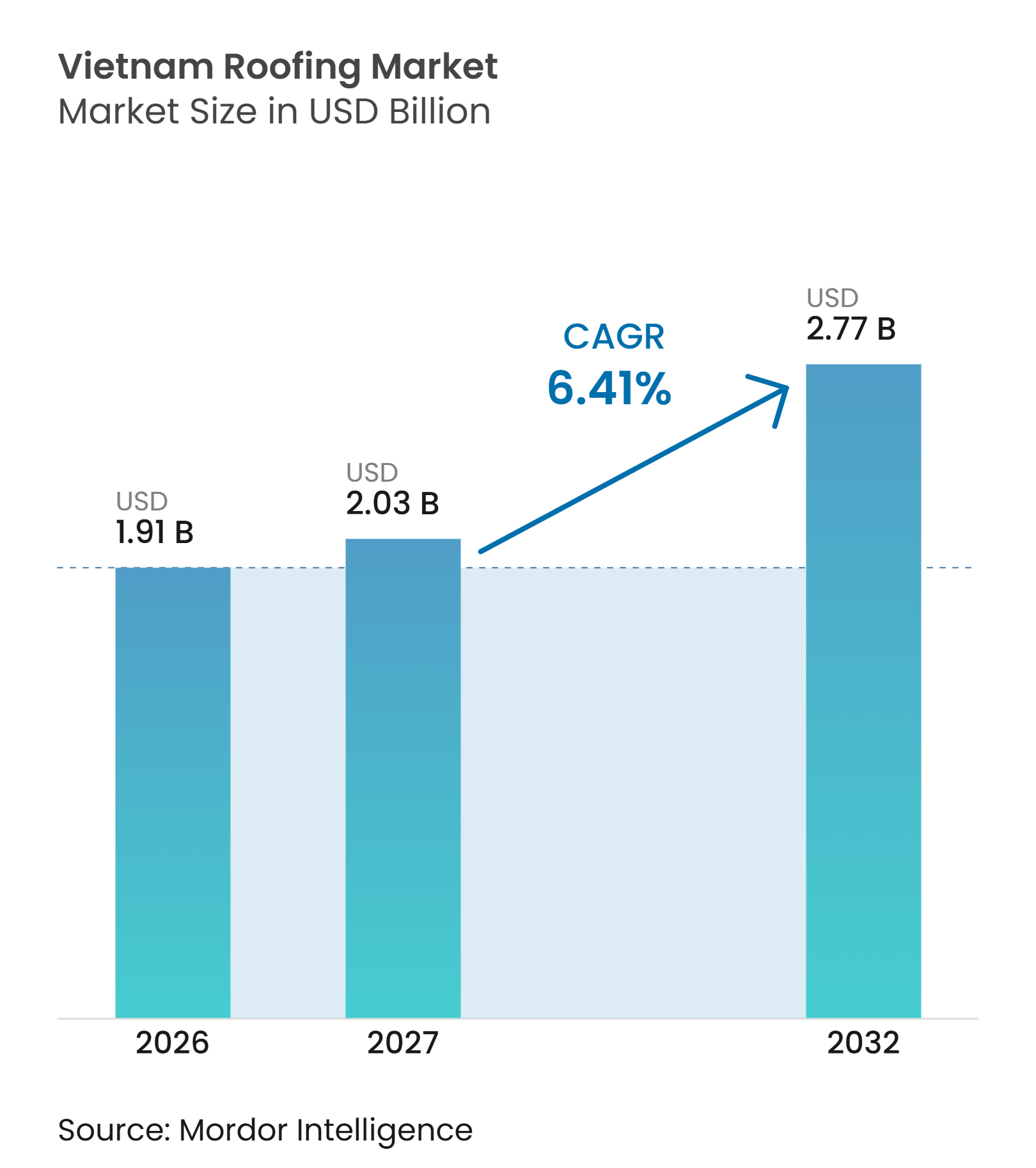
The Vietnam Roofing Market size was valued at USD 1.91 billion in 2026 and is estimated to grow from USD 2.03 billion in 2027 to reach USD 2.77 billion by 2032, at a CAGR of 6.41% during the forecast period (2027-2032).
Public social housing programs, industrial construction, and rising expectations for energy-efficient buildings support the Vietnam roofing market. Resolution No. 07/NQ-CP assigns a 2026 target of 158,723 social housing units and a 2026 to 2030 target of 973,471 units, which sustains demand for residential roof systems. Rooftop solar policy is also changing material selection because supporting structures must carry photovoltaic equipment without undermining waterproofing or service life. The Vietnam roofing industry therefore offers opportunities for suppliers of coated metal, insulated panels, and high-performance membranes that meet higher thermal and structural requirements. QCVN 04-3:2026/BXD will require flat roofs on buildings with at least 2,500 m² of floor area to achieve a total thermal resistance of R₀ ≥ 1.00 m²·K/W from February 2027.
Key Report Takeaways
- By material type, metal roofing held 42.7% of the Vietnam roofing market share in 2026, while single-ply membranes are forecast to grow at a 7.21% CAGR through 2032.
- By construction type, new construction accounted for 65.9% of the Vietnam roofing market size in 2026, while reroofing and replacement are projected to expand at a 6.91% CAGR through 2032.
- By application, residential roofing held 48.1% of the Vietnam roofing market share in 2026, while commercial roofing is forecast to advance at a 7.02% CAGR through 2032.
- By city, Ho Chi Minh City held 33.5% of the Vietnam roofing market size in 2026, while Da Nang is projected to grow at a 7.40% CAGR through 2032.
Note: Market numbers in this report are based on Mordor Intelligence's proprietary estimation framework, which combines nine months of actuals with Q4 projections for base year 2026.
Market Trends and Insights
Drivers Impact Analysis of Vietnam Roofing Market*
| Drivers | (~) % Impact on CAGR Forecast | Geographic Relevance | Impact Timeline |
|---|---|---|---|
| Government-Led Social Housing Development | +1.6% | National, with early gains in Ho Chi Minh City, Hanoi, Hai Phong, and industrial corridor provinces | Short term (≤ 2 years) |
| Industrial Park and Foreign-Invested Manufacturing Expansion | +1.4% | Southern and Northern industrial clusters, with spillover to Central Vietnam | Medium term (2-4 years) |
| Aging Roof Renovation and Replacement | +1.0% | National, with concentration in established peri-urban areas of Ho Chi Minh City and Hanoi | Medium term (2-4 years) |
| Rooftop Solar Adoption | +0.8% | National, including Ho Chi Minh City, Hanoi, Da Nang, Binh Duong, and industrial parks | Medium term (2-4 years) |
| Agricultural Processing and Livestock Infrastructure Growth | +0.6% | Mekong Delta, Central Highlands, and northern rural provinces | Long term (≥ 4 years) |
| Energy-Efficient Building Requirements | +0.5% | National urban commercial and institutional buildings with at least 2,500 m² of floor area | Long term (≥ 4 years) |
| Source: Mordor Intelligence | |||
Government-Led Social Housing Programs Activate Residential Roofing Pipelines
Vietnam’s social and rental housing programmes are creating a substantial project pipeline for the roofing market. Under Resolution No. 303/NQ-CP, issued in September 2026, the government set a target of 899,857 social and rental housing units for 2026–2030, including 97,271 units in 2026[1]. At the Government’s November 4, 2026 press briefing, the Ministry of Construction reported that 293 projects, comprising 363,065 units, were under development. A further 128 projects had been newly launched during 2026, representing 183,293 units, including 140,492 social housing units and 42,801 rental units. This construction activity supports demand for affordable and durable roofing products, including coated metal sheets, roof tiles, and waterproofing systems. Suppliers with broad distribution networks, competitive pricing, and reliable installation support may be better positioned to serve developers and contractors as these projects progress.
Industrial Park Expansion Creates Demand for Metal and Insulated Roofing
Industrial construction remains an important source of demand for the Vietnam roofing industry. Vietnam has more than 620 industrial parks operating across 61 provinces in 2026. Large factories, warehouses, and ready-built facilities often require lightweight roof systems with weather resistance and thermal performance. These conditions support the use of coated metal sheets and insulated panels across industrial corridors. Integrated procurement favors vendors that can provide compatible roofing, structural, and technical support services.
Rooftop Solar Adoption Raises Roof Performance Requirements
Rooftop solar is becoming a practical demand driver for the Vietnam roofing market because it changes how roofs are assessed. Directive No. 10/CT-TTg directs the expansion of self-produced and self-consumed rooftop solar power[2]. Vietnam had 134,410 rooftop solar systems with installed capacity exceeding 11,450 MWp by August 2026. Solar projects require roofs with adequate load capacity, corrosion protection, and mounting arrangements that maintain waterproofing. This requirement can bring reroofing decisions forward where existing roofs have insufficient remaining service life. The shift directs demand toward reinforced metal roofing and membrane systems that can meet operational and durability needs.
Energy-Efficient Building Rules Support Insulated Roof Systems
Energy performance requirements are creating a clearer technical basis for premium roof specifications. QCVN 04-3:2026/BXD sets a minimum total thermal resistance of R₀ ≥ 1.00 m²·K/W for qualifying flat roofs from February 2027[3]. The requirement applies to buildings with at least 2,500 m² of total floor area. Commercial and institutional projects will need to consider insulation, reflective surfaces, and roof assembly design together. This supports demand for insulated panels and reflective membrane products in the Vietnam roofing industry. It also gives suppliers an opportunity to compete on documented thermal performance rather than price alone.
Restraints Impact Analysis of Vietnam Roofing Market*
| Restraints | (~) % Impact on CAGR Forecast | Geographic Relevance | Impact Timeline |
|---|---|---|---|
| Steel, Aluminum, and Other Input Price Volatility | -0.8% | National, with stronger pressure on small and mid-tier domestic producers | Medium term (2-4 years) |
| Residential Buyer Price Sensitivity | -0.6% | National, especially Tier 2 and Tier 3 cities and rural provinces | Medium term (2-4 years) |
| Domestic Producer Price Competition | -0.5% | National, especially coated metal sheet and plain corrugated sheet categories | Medium term (2-4 years) |
| Typhoon and Extreme Weather Exposure | -0.3% | Central and Northern Vietnam, including coastal provinces from Quang Ninh to Binh Dinh | Long-term (≥ 4 years) |
| Source: Mordor Intelligence | |||
Input Price Volatility Compresses Manufacturer Margins
Steel and aluminum price movements remain a material restraint for the Vietnam roofing market. Construction steel prices exceeded VND 15.6 million (approximately USD 608) per tonne after at least 3 price increases during the first 5 months of 2026. Vietnam News reported that higher energy costs contributed to rising prices for construction materials. Higher input costs can narrow supplier margins or raise delivered prices for contractors and households. Larger producers may manage this pressure better through scale, purchasing arrangements, and wider product portfolios. Smaller regional producers can face a more direct impact when they lack comparable cost buffers.
Price Sensitivity Limits Premium Product Adoption
Residential price sensitivity can slow the adoption of premium roofing systems. The Ministry of Construction has identified an imbalance between higher-end commercial housing supply and unmet affordable housing demand. Individual homeowners often prioritize initial cost when selecting roofing materials. This preference supports basic coated metal products in entry- and mid-priced residential projects. Rising costs for steel, cement, and other materials can reduce the budget available for thermal upgrades or advanced membranes. Suppliers must therefore balance performance improvements with product designs that remain affordable to the mass residential customer base.
*Our forecasts treat driver/restraint impacts as directional, not additive. The impact forecasts reflect baseline growth, mix effects, and variable interactions.
Vietnam Roofing Market Segment Analysis
By Material Type:
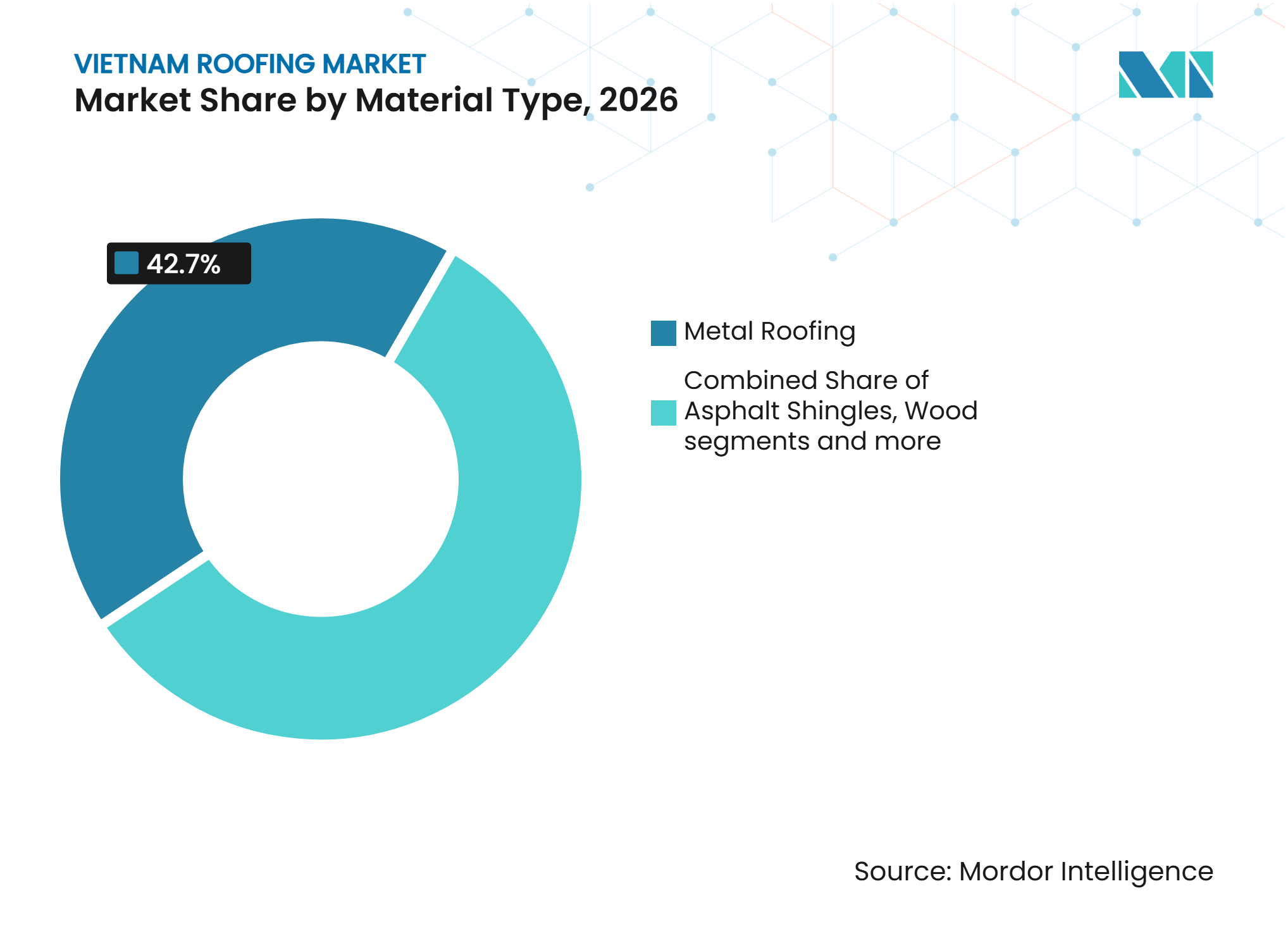
Metal Roofing Leads While Single-Ply Membranes Gain in Premium ProjectsMetal roofing accounted for 42.7% of roofing demand in 2026. It is used across industrial warehouses, factories, peri-urban housing, and social housing developments because it balances cost, installation speed, and durability. The social housing pipeline strengthens the need for roof products that can be supplied consistently at scale. Industrial parks reinforce demand for coated sheets because large-span buildings need lightweight weather-resistant roof systems. Metal systems are also becoming more relevant for solar installations where load capacity and corrosion resistance are important. The material’s broad applicability keeps it central to the Vietnam roofing industry.
Single-ply membranes are forecast to record a 7.21% CAGR through 2032, the fastest rate among material categories. Their growth is linked to commercial, logistics, data center, and higher-specification industrial projects with flat roof designs. These applications require reliable waterproofing and thermal control over larger roof areas. QCVN 04-3:2026/BXD supports this shift by setting thermal requirements for qualifying flat roofs. Asphalt shingles remain limited to villas and boutique hospitality projects, while clay and concrete tiles retain a role in traditional construction. Bituminous membranes continue to serve existing flat-roof waterproofing needs, but single-ply systems gain attention where seam reliability and reflective properties are required.



By Construction Type:
New Construction Leads, While Reroofing and Replacement Builds MomentumNew construction accounted for 65.9% of the Vietnam roofing market size in 2026. Active social housing projects, industrial facilities, commercial buildings, and development in secondary cities support the segment. The Ministry of Construction reported 293 social housing projects under construction in 2026. This pipeline gives manufacturers visibility on demand for metal sheets, tile alternatives, and insulation products. Industrial construction adds another reliable source of new roof area, particularly in manufacturing and logistics facilities. New construction will remain the primary volume base for the Vietnam roofing market during the forecast period.
Reroofing and replacement are forecast to grow at a 6.91% CAGR through 2032. Aging roofs in established urban and peri-urban areas require replacement as service life declines. Solar adoption can accelerate this decision where existing roofs cannot carry a photovoltaic system for its intended operating life. Directive No. 10/CT-TTg supports wider deployment of self-produced and self-consumed solar systems. Thermal requirements from 2027 may also encourage upgrades to existing flat commercial and institutional roofs. The replacement cycle creates recurring demand that is less dependent on entirely new project starts.
By Application:
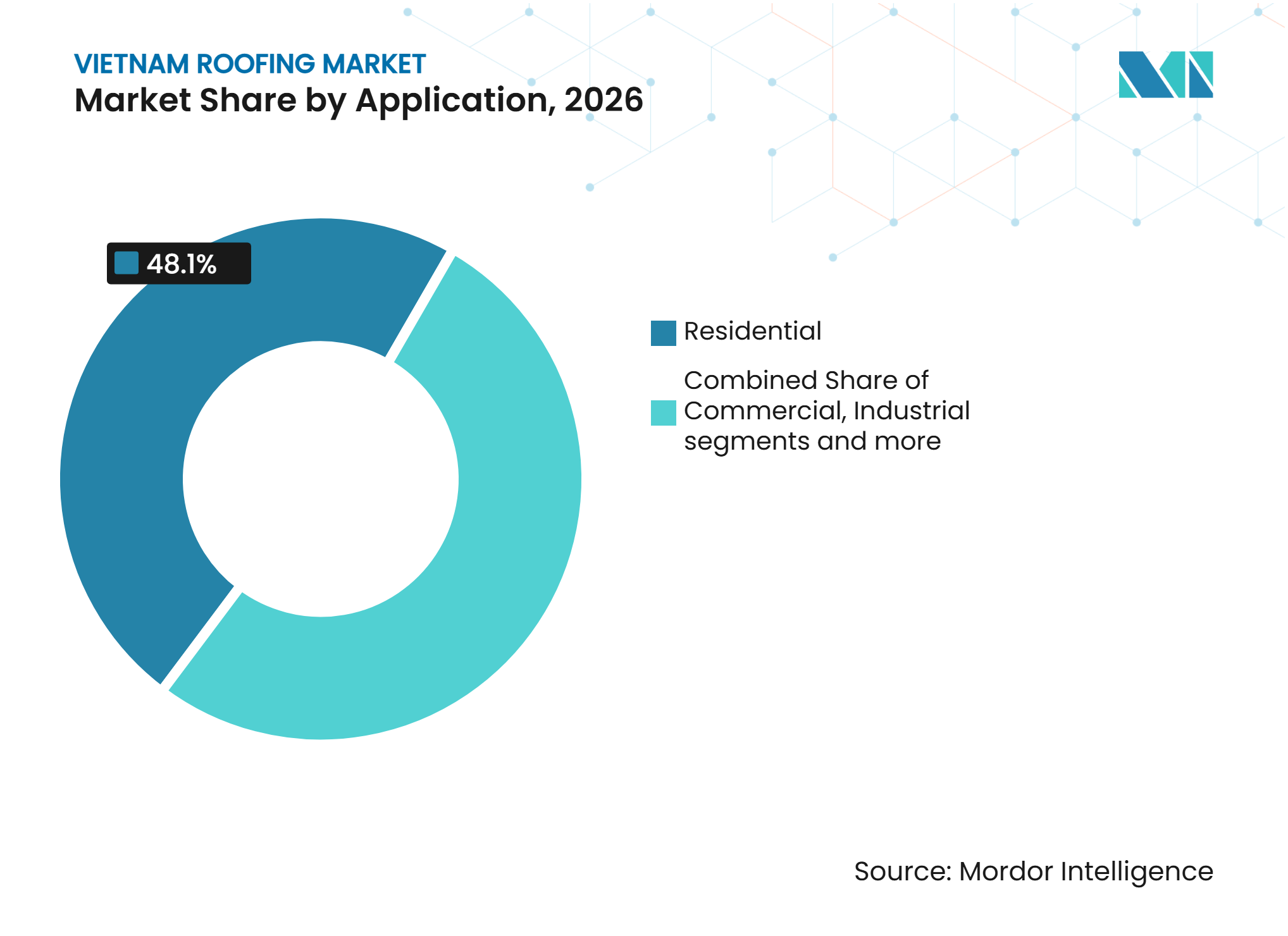
Residential Roofing Dominates the Market, While Commercial Projects Drive GrowthResidential roofing accounted for 48.1% of roofing demand in 2026. Government social housing targets and ongoing private housing construction support the segment’s scale. Resolution No. 07/NQ-CP assigns housing delivery targets across localities through 2030. Residential purchasers remain highly cost-conscious, so basic coated metal products remain important in the segment. At the same time, solar compatibility and weather resistance can increase interest in reinforced products. Suppliers that combine accessible pricing with reliable local installation can address the largest application base.
Commercial roofing is forecast to expand at a 7.02% CAGR through 2032. Retail, logistics, warehousing, hospitality, and office projects require roofing that supports longer service life, energy performance, and visual standards. The technical requirements are particularly clear in larger flat-roof buildings that fall within QCVN 04-3:2026/BXD. Industrial facilities also contribute to non-residential demand through their preference for metal and insulated systems. Institutional roofs are likely to require upgrades as public offices add rooftop solar systems under the national policy direction. The application mix is moving toward products that can meet both functional and regulatory requirements.

Geography Analysis
Ho Chi Minh City
Ho Chi Minh City accounted for 33.5% of national roofing demand in 2026. The city combines a large urban housing base with a dense concentration of commercial and industrial activity. Rooftop solar installations are an important local influence because the city had 6,241 self-generating systems with 472 MWp of capacity in September 2026. This installed base increases the importance of roof load capacity, corrosion protection, and compatible mounting arrangements. Hoa Sen Group has committed to supply materials for 20,000 social housing units for workers in Ho Chi Minh City from 2026 to 2030. The combination of housing delivery, solar deployment, and commercial construction supports broad demand for metal roofing and premium roof assemblies. Suppliers can differentiate through systems that support solar equipment without compromising long-term weather protection.
Da Nang
Da Nang is forecast to expand at a 7.4% CAGR through 2032. The city’s construction output reached VND 58,500 billion during the first 9 months of 2026, reflecting activity in residential buildings and specialized construction. Industrial development adds to the project pipeline, including planned investment in industrial park infrastructure. These projects create demand for large-span metal roofing, insulated panels, and waterproofing systems. The region’s coastal exposure gives wind resistance and durable installation greater importance. This combination makes roof design quality as important as product selection for the Vietnam roofing market. Companies able to support engineered installation can address commercial and industrial customers with stronger technical requirements.
Quang Ninh and Da Nang
Quang Ninh and Da Nang represent important construction demand centers in northern and central Vietnam, supported by industrial development, infrastructure expansion, and urban housing projects. Quang Ninh's industrial parks, manufacturing facilities, and logistics infrastructure support demand for roofing and building system components. In Da Nang, urban development, commercial construction, and infrastructure projects create opportunities for durable building materials and installation systems. Both locations also face climate-related challenges, particularly typhoon exposure, heavy rainfall, and strong winds, increasing the need for wind-resistant roofing, secure fastening systems, and corrosion-resistant components. ReliefWeb reported widespread roof damage in Quang Ninh Province following Typhoon No. 1 in July 2026, highlighting the importance of resilient roofing solutions in exposed coastal areas.
Competitive Landscape
Market Concentration
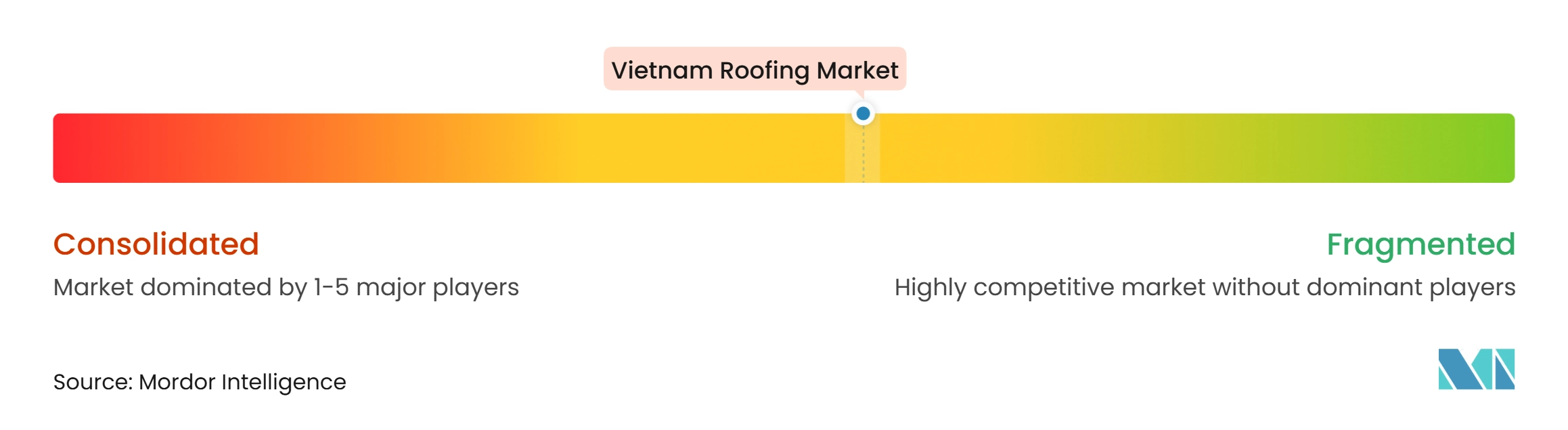
The Vietnam roofing market has intense price competition in standard corrugated and coated metal sheet products. Hoa Sen Group, NS BlueScope Vietnam, Ton Dong A Corporation, and Nam Kim Steel are prominent suppliers in the domestic coated metal category. Their scale, distribution reach, and investment capacity can support wider product availability. The competitive focus is gradually shifting from basic sheets toward integrated systems that combine roofing with structural framing, wall products, insulation, and technical support.
Technical certification can provide an additional competitive route in higher-value projects. NS BlueScope Vietnam received ResponsibleSteel site certification, which supports its position with customers that evaluate responsible steel production. Saint-Gobain completed the acquisition of Phu My Innovative Materials in 2026, expanding its local building-materials footprint. The transaction strengthens the company’s ability to serve customers seeking coordinated building-envelope solutions. TotalEnergies ENEOS commissioned a nearly 28 MWp rooftop solar project at Samsung Electronics’ Ho Chi Minh City Consumer Electronics Complex, demonstrating the growing connection between industrial roofs and on-site power generation.
Domestic manufacturers are also increasing their capacity for higher-specification products. Lilama 18 reported that Nam Kim Group contracted for equipment installation at the Nam Kim Phu My Roofing Steel Plant in September 2026. Ton Dong A began construction of Factory 4 at Phu My Specialized Industrial Park in June 2026 through its Dong A Phu My subsidiary. Panel Viet began building its fifth national factory in Hung Yen in May 2026 to produce insulated panels. These investments indicate stronger competition in coated steel and insulated roofing solutions.
Vietnam Roofing Industry Leaders
-
Hoa Sen Group
-
NS BlueScope Vietnam
-
Ton Dong A Corporation
-
Nam Kim Steel Joint Stock Company
-
Viglacera Corporation - JSC
- *Disclaimer: Major Players sorted in no particular order
Vietnam Roofing Market Companies Covered in this Report
- Hoa Sen Group
- NS BlueScope Vietnam
- Ton Dong A Corporation
- Nam Kim Steel Joint Stock Company
- Viglacera Corporation - JSC
- Ton Phu My
- PRIME Group
- Dong Tam Group
- Siam Cement Group
- Sika Vietnam
- Saint-Gobain Vietnam
- SOPREMA
- Kingspan Group
- Carlisle Construction Materials
- Panel Viet
- Owens Corning
- DuPont
- BASF
- Viet Dung Aluminum Joint Stock Company
- Hoa Phat Group
Recent Industry Developments in Vietnam Roofing Market
- July 2026: TotalEnergies ENEOS commissioned a nearly 28 MWp rooftop solar photovoltaic system at the Samsung Electronics Ho Chi Minh City Consumer Electronics Complex under a 20-year power purchase agreement.
- June 2026: Ton Dong A Corporation broke ground on Factory 4 at Phu My Specialized Industrial Park through its Dong A Phu My subsidiary.
- May 2026: Panel Viet broke ground on its fifth national factory in Hung Yen Industrial Park No. 3 to make insulated panels.
Vietnam Roofing Market Report Scope
Segmentation Overview
| Asphalt Shingles |
| Clay and Concrete Tiles |
| Metal Roofing |
| Bituminous / Modified Bitumen Membranes |
| Single-Ply Membranes (TPO, EPDM, and PVC) |
| Wood |
| Other Materials |
| New Construction |
| Reroofing and Replacement |
| Residential |
| Commercial |
| Industrial |
| Institutional |
| Other Applications |
| Ho Chi Minh City |
| Hanoi |
| Quang Ninh |
| Da Nang |
| By Material Type | Asphalt Shingles |
| Clay and Concrete Tiles | |
| Metal Roofing | |
| Bituminous / Modified Bitumen Membranes | |
| Single-Ply Membranes (TPO, EPDM, and PVC) | |
| Wood | |
| Other Materials | |
| By Construction Type | New Construction |
| Reroofing and Replacement | |
| By Application | Residential |
| Commercial | |
| Industrial | |
| Institutional | |
| Other Applications | |
| By City | Ho Chi Minh City |
| Hanoi | |
| Quang Ninh | |
| Da Nang |
Key Questions Answered in the Report
What is the value of the Vietnam roofing market?
The Vietnam roofing market is valued at USD 1.91 billion in 2026 and is forecast to reach USD 2.77 billion by 2032, with a 6.41% CAGR during 2027 to 2032.
Which material leads roofing demand in Vietnam?
Metal roofing leads with a 42.7% share in 2026 because it is widely used in housing, factories, warehouses, and other large-span buildings.
Which roofing category is expected to grow fastest in Vietnam?
Single-ply membranes are forecast to grow at a 7.21% CAGR through 2032 as commercial and industrial projects require higher waterproofing and thermal performance.
How does rooftop solar affect roof product demand in Vietnam?
Rooftop solar increases demand for roofs with sufficient load capacity, corrosion protection, and mounting arrangements that preserve waterproofing.
What is driving residential roof demand in Vietnam?
The government’s social housing targets and private housing activity support residential demand, with the residential application holding a 48.1% share in 2026.
Why are insulated roof systems becoming more important?
QCVN 04-3:2026/BXD will require qualifying flat roofs to achieve a minimum thermal resistance from February 2027, supporting insulation and reflective products.