
Vietnam Bonsai Market Size and Share
Market Overview
| Study Period | 2021 - 2031 |
|---|---|
| Forecast Data Period | 2026 - 2031 |
| Base Year Market Size (2025) | USD 26.01 Million |
| Market Size (2026) | USD 28.40 Million |
| Market Size (2031) | USD 43.70 Million |
| Growth Rate (2026 - 2031) | 9.00 % |
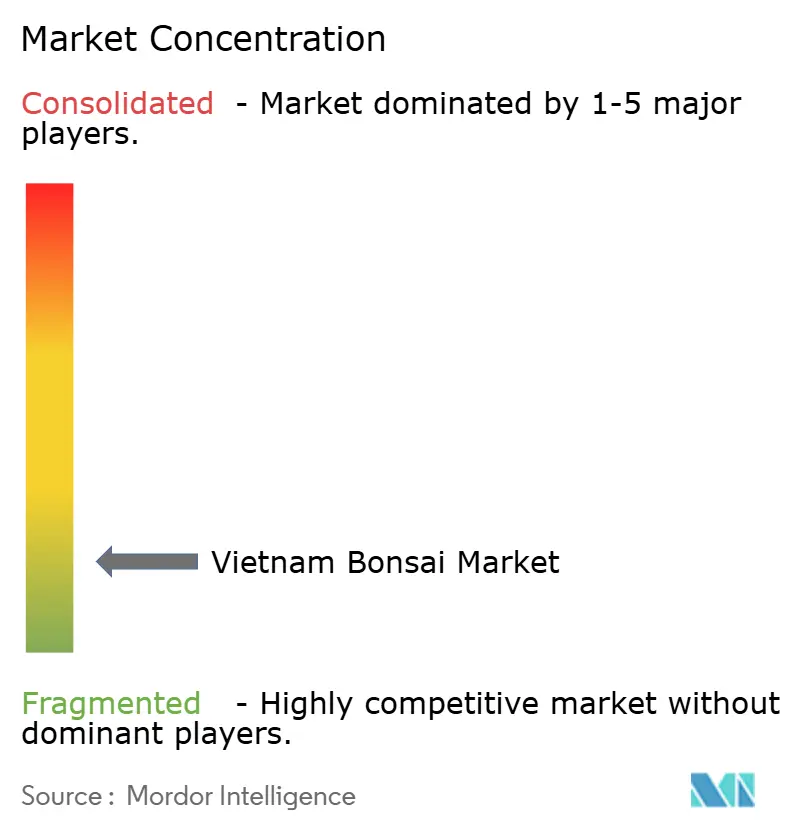
| Market Concentration | Low |
Major Players *Disclaimer: Major Players sorted in no particular order Image © Mordor Intelligence. Reuse requires attribution under CC BY 4.0. | |
Vietnam Bonsai Market Analysis by Mordor Intelligence
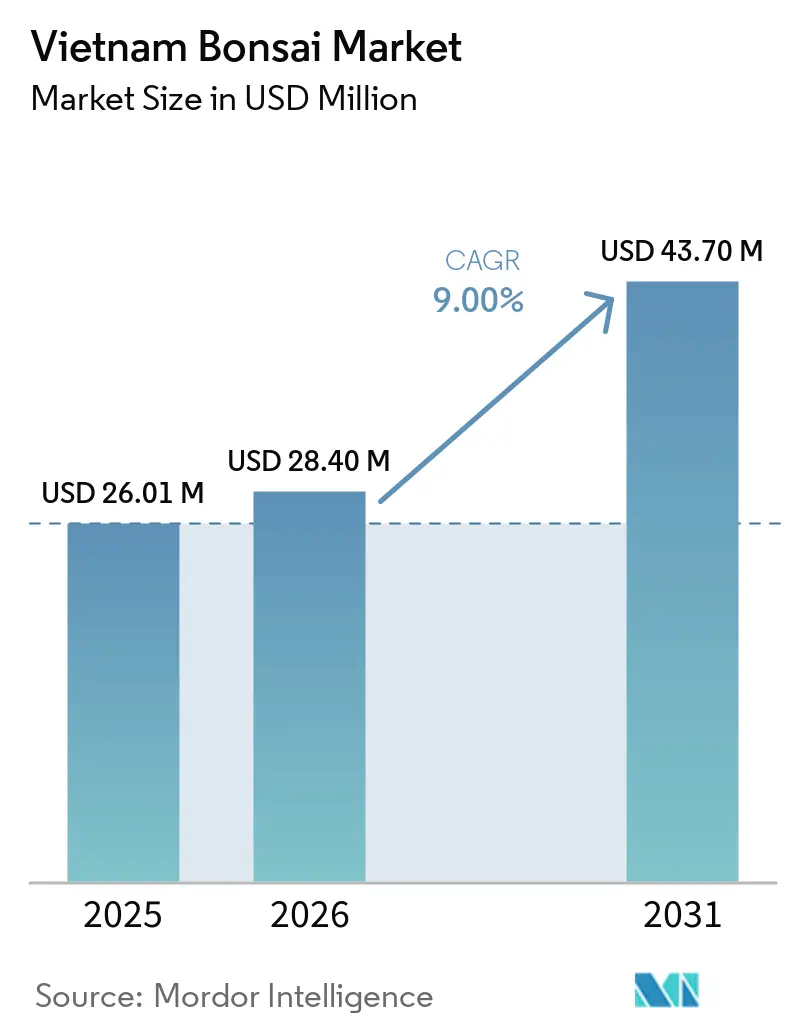
The Vietnam bonsai market size was valued at USD 26.01 million in 2025 and is estimated to grow from USD 28.40 million in 2026 to reach USD 43.70 million by 2031, at a CAGR of 9.00% during the forecast period (2026-2031). The broader floriculture and ornamental plant sector exceeded USD 100 million in export turnover in 2025, while annual production value exceeded VND 45 trillion (USD 1.8 billion) in 2024[1]. Rising urban density, recurring Tet gifting, and wider use of social commerce are shifting demand from seasonal purchases to year-round buying. Production is becoming more organized in established craft villages, where sellers are adding traceability, branded presentation, and care services to their offerings. The market also has the potential to benefit from export readiness and tourism-related sales, although the availability of trained artisans, plant health documentation, and climate exposure will continue to shape outcomes through 2031.
Key Report Takeaways
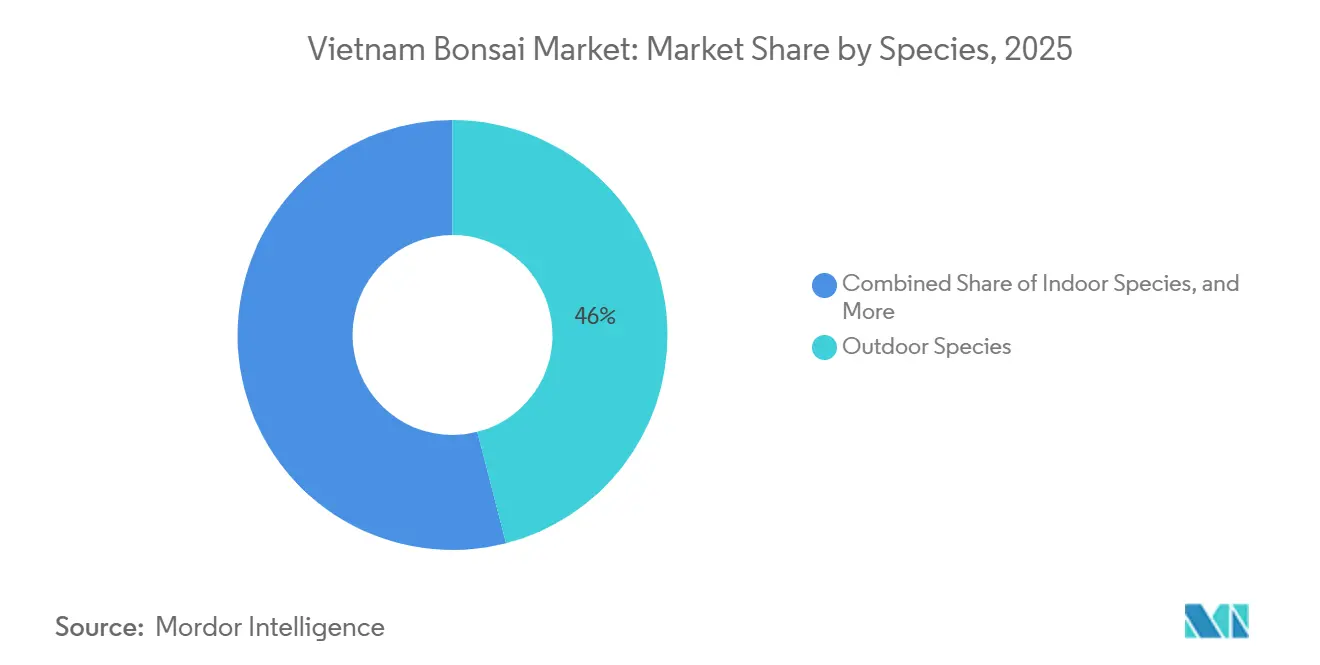
- By species, outdoor species accounted for 46% of the Vietnam bonsai market share in 2025, while indoor species are forecast to grow at a CAGR of 10.3% from 2026 to 2031.
- By distribution channel, offline channels accounted for 61% of the Vietnam bonsai market size in 2025, while online channels are forecast to grow at a CAGR of 14.2% from 2026 to 2031.
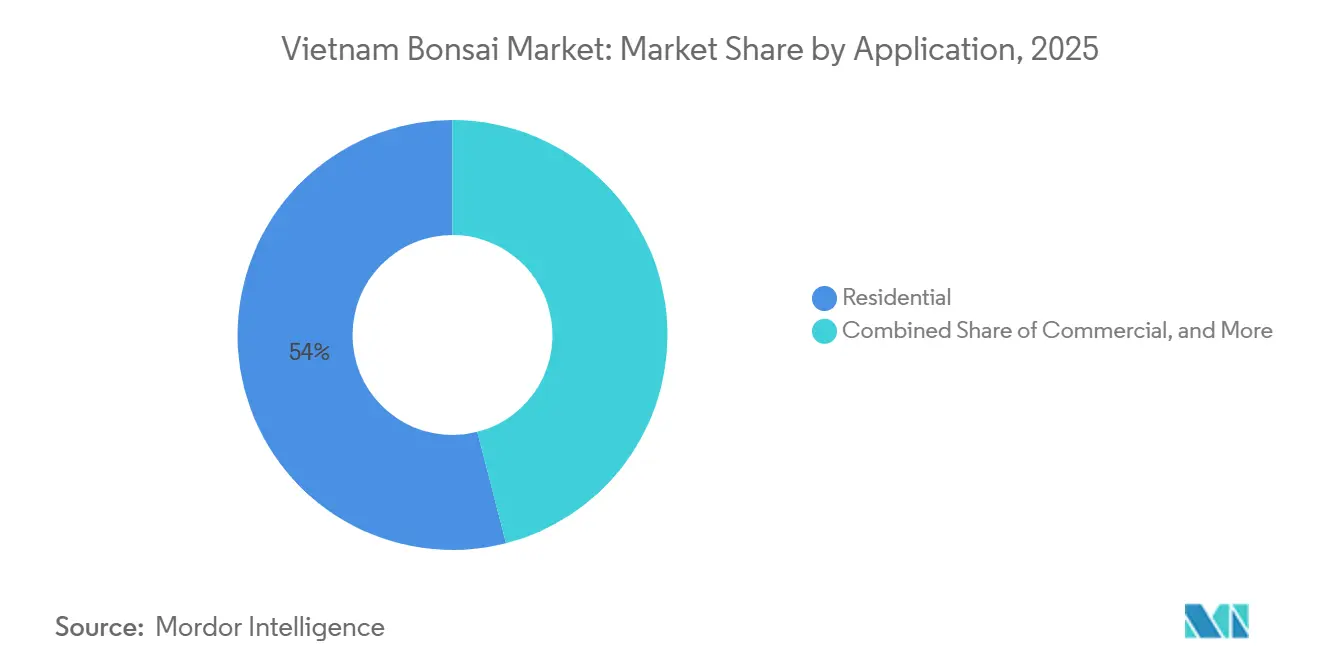
- By application, residential accounted for 54% of the market share in 2025, while commercial is forecast to grow at a CAGR of 9.6% from 2026 to 2031.
Note: Market size and forecast figures in this report are generated using Mordor Intelligence’s proprietary estimation framework, updated with the latest available data and insights as of January 2026.
Market Trends and Insights
Drivers Impact Analysis of Vietnam Bonsai Market*
| Driver | (~) % Impact on CAGR Forecast | Geographic Relevance | Impact Timeline |
|---|---|---|---|
| Urban Space Constraints and Compact Living Decor | +1.4% | Vietnam-wide, strongest in Hanoi, Ho Chi Minh City, and Da Nang | Medium term (2-4 years) |
| Tet-Season Cultural Gifting and Display | +1.6% | Southern Vietnam and Northern Vietnam, including Dong Thap, Ben Tre, and Hanoi | Short term (≤ 2 years) |
| Social-Commerce Discovery and Livestream Selling | +2% | Vietnam-wide, linking craft villages with urban buyers | Short term (≤ 2 years) |
| Export-Oriented Climate-Tolerant Seedling Production | +0.8% | Dong Thap and Ben Tre, with export links to Japan, South Korea, and the United States | Long term (≥ 4 years) |
| Craft Village Professionalization and Premiumization | +1.5% | Sa Dec, Cho Lach, Nam Dinh, and emerging central artisan hubs | Medium term (2-4 years) |
| Bonsai Tourism, Exhibitions, and Learning Experiences | +0.6% | Sa Dec, Da Lat, Hanoi, and Hue | Long term (≥ 4 years) |
| Source: Mordor Intelligence | |||
Urban Space Constraints and Compact Living Decor
Vietnam’s urban population reached 38.6 million people, or 38.2% of the population, in the 2024 midterm census[2]. Urban population growth was 3.06% annually from 2019 to 2024, compared with 2.02% in the preceding 5-year period. Vietnam's urban population is projected to reach 50% of the total population by 2045, supporting the continued relevance of compact living to the Vietnam bonsai market. Rising urbanization is expanding the relevance of space-efficient decorative plants for apartment residents and households with limited outdoor areas. Bonsai can be used on balconies, terraces, interiors, and smaller outdoor spaces, supporting its suitability for compact urban environments. Demand for smaller bonsai varieties and tabletop formats can therefore benefit from the shift toward more space-constrained housing. Online sales and delivery services can further improve access to bonsai for urban households that cannot easily visit production areas.
Tet-Season Cultural Gifting and Display
Tet remains an important purchase period for flowering and ornamental plants, including bonsai, in Vietnam. Cho Lach District supplies 12 million ornamental products annually for the Tet season, including bonsai-shaped animals, miniature landscapes, and mai vàng trees. This seasonal concentration of demand supports growers that prepare mature and flowering trees in advance and offer them in gift-ready formats. The Vietnam bonsai market can benefit from combining mature trees, seasonal presentation, delivery, and related services in a single offering. Gift-oriented packaging and convenient delivery can further support purchases among households seeking bonsai for Tet celebrations, home decoration, and gifting. As Tet continues to combine cultural gifting, festive decoration, and seasonal plant purchases, the holiday is likely to remain an important demand driver for the Vietnam bonsai market.
Social-Commerce Discovery and Livestream Selling
Social commerce expanded in Vietnam through 2025 as TikTok Shop and Shopee Live brought short video discovery and livestream checkout into regular retail activity. This format works well for bonsai because growers can show styling, wiring, trunk structure, and plant condition in real time. Livestreaming allows growers in production clusters such as Sa Dec and Cho Lach to demonstrate plant characteristics and styling techniques to buyers in other parts of Vietnam without requiring an in-person visit. Social selling brings craft-village prices closer to urban buyers and reduces the role of some intermediaries, although it can pressure wholesale margins. Online sellers still need safe shipment practices and clear information on live-plant movement requirements to translate digital discovery into reliable fulfillment. As social platforms increasingly combine product discovery, live demonstrations, and direct purchasing, their growing role in retail can expand the reach of Vietnamese bonsai growers and support the development of online sales channels in the Vietnam bonsai market.
Export-Oriented Climate-Tolerant Seedling Production
Vietnam’s flower export turnover surpassed USD 100 million in 2025, while the country’s total area dedicated to flowers and ornamental plants reached nearly 45,000 hectares. The Ministry of Agriculture and Environment has outlined measures to develop the sector through 2030, including specialized cultivation zones, improved production standards, traceability, and export promotion. This expanding horticultural base provides a broader production and export ecosystem that can support the development of Vietnam’s bonsai exports, although bonsai remains a smaller category within ornamental plants. Growers in Dong Thap and Ben Tre cultivate tropical species such as Ficus benjamina, mai vàng, and si that can support future bonsai export opportunities. Export preparation requires compliance with destination-specific phytosanitary requirements, including restrictions on soil and growing media in some markets. As Vietnam strengthens its flower and ornamental plant production and export capabilities, bonsai growers can leverage this broader horticultural ecosystem to reach overseas buyers and expand the market beyond domestic demand.
Restraints Impact Analysis of Vietnam Bonsai Market*
| Restraint | (~) % Impact on CAGR Forecast | Geographic Relevance | Impact Timeline |
|---|---|---|---|
| Advanced Training and Skilled Artisan Scarcity | -0.9% | Vietnam-wide, especially outside Sa Dec, Cho Lach, and Hanoi clusters | Medium term (2-4 years) |
| Unclear Export Pathways for Living Bonsai | -0.6% | Dong Thap and Ben Tre, with corridors to Japan, South Korea, the United States, and the European Union | Long term (≥ 4 years) |
| Long Biological Production Cycles and Working Capital Lock-In | -1% | Dong Thap, Ben Tre, Nam Dinh, Da Lat, and other production clusters | Medium term (2-4 years) |
| Climate, Pest, and Water-Stress Exposure | -0.7% | Mekong Delta, Central Coast, and Da Lat highlands | Short term (≤ 2 years) |
| Source: Mordor Intelligence | |||
Advanced Training and Skilled-Artisan Scarcity
High-quality bonsai work requires skills in pruning, copper wiring, deadwood carving, and repotting that take time to develop. Cho Lach had 700 provincial-level certified artisans among its 6,000 households engaged in cultivation. This limits the number of growers able to produce trees with detailed styling and premium positioning. The Ministry of Agriculture and Environment has targeted 130 to 150 officially recognized craft villages by 2030. However, the availability of trained artisans outside established craft clusters remains limited, particularly for specialized styling and long-term tree maintenance. The resulting shortage of skilled labor can undermine the consistency and quality of bonsai production, increase the time and cost required to develop premium trees, and constrain smaller growers' ability to meet higher-value demand. This may limit the expansion of premium bonsai offerings and act as a restraint on the growth of the Vietnam bonsai market.
Unclear Export Pathways for Living Bonsai
Vietnam updated phytosanitary certificate formats as of July 2025 under the Plant Production and Protection Department identity and ISPM 12 requirements. The revised format provides a clearer administrative basis for ornamental plant exports but does not eliminate the practical difficulty of preparing living bonsai to meet destination-country requirements. Trees with root systems may require bare-root preparation or approved sterile media where soil is prohibited, and many craft-village nurseries may not yet have the facilities or processes to apply these requirements consistently. Japan applies rigorous post-entry quarantine procedures for ornamental plant imports from Vietnam[3]. These requirements can increase preparation time, handling costs, and compliance burdens for small bonsai producers seeking to access overseas markets. As export procedures and quarantine requirements vary across destination markets, limited technical knowledge and compliance capabilities can restrict the number of Vietnamese growers able to export living bonsai. This can limit international market access and reduce the contribution of exports to the growth of the Vietnam bonsai market.
*Our forecasts treat driver/restraint impacts as directional, not additive. The impact forecasts reflect baseline growth, mix effects, and variable interactions.
Vietnam Bonsai Market Segment Analysis
By Species:
Outdoor Species Dominate, While Indoor Species Grow FastestOutdoor species accounted for 46% of the share in 2025, making them the largest species segment. Vietnam’s tropical climate supports Ficus, mai vàng, and tamarind varieties that are familiar to buyers and relevant to Tet gifting. The Vietnam National University of Agriculture noted in 2025 that outdoor flowering varieties continued to support domestic consumption, especially in Southern and Northern Vietnam. Outdoor trees are also suited to traditional gardens and open residential settings, and their role in holiday displays supports recurring household demand.
Needle tree and deciduous tree species serve smaller but distinct collector groups in Hanoi and Da Lat. Indoor species is forecast to grow at a 10.3% CAGR from 2026 to 2031, the fastest rate within species. Compact ficus, schefflera, and succulent bonsai are suited to apartments and are commonly offered through online delivery. Demand from urban buyers with limited outdoor space supports the growth of indoor bonsai species in Vietnam.

By Distribution Channel:
Offline Channels Lead, While Online Channels Grow FastestOffline accounted for 61% of the share in 2025, making it the largest distribution channel. Many buyers still prefer to inspect the root structure, trunk taper, and overall condition before purchasing a bonsai. Craft-village markets, garden centers, and specialist retailers remain important for high-value trees. Sa Dec’s more than 4,000 producing households and Cho Lach’s nursery network provide supply depth for physical outlets. In-person purchase also makes it easier for customers to discuss care requirements.
Online is forecast to grow at a 14.2% CAGR from 2026 to 2031, the highest rate across the distribution channel segments. Vietnam’s e-commerce transaction value reached USD 13.8 billion in 2024, rising 40% from the previous year. TikTok Shop and Shopee Live support a visual selling format that suits bonsai, allowing sellers to reach buyers in provincial cities where specialist retailers are less accessible. Nationwide delivery expands geographic reach but requires careful packaging and clearer documentation for the movement of live plants.
By Application:
Residential Demand Leads, While Commercial Applications Grow FastestResidential accounted for 54% of the Vietnam bonsai market in 2025, making it the largest application segment. Household Tet gifts, apartment balconies, and traditional garden displays create the core of residential demand. Well-styled trees with documented origins can hold special value in Vietnamese gift-giving, with consumers placing greater importance on tree condition, seller reputation, and delivery when purchasing a gift. Institutional gifts, art fairs, and cultural event installations contribute smaller demand streams.
Commercial is forecast to grow at a 9.6% CAGR from 2026 to 2031. Hotels, co-working spaces, and restaurants are using bonsai in interiors and public spaces. This application favors suppliers that can install trees and provide scheduled maintenance. Leasing, maintenance subscriptions, and replacement guarantees can create recurring revenue streams. Công Ty TNHH Cảnh Quan SeaGarden and Công Ty TNHH Dịch Vụ Cảnh Quan Non Bộ Sơn Thủy are identified as companies with landscaping capabilities that can support commercial contracts.
Geography Analysis
Southern Vietnam held the largest share of the Vietnam bonsai market in 2025, driven by major production clusters and retail and commercial demand from Ho Chi Minh City. Sa Dec cultivated more than 2,000 varieties across 946 hectares and generated VND 3,300 billion (USD 135 million) in ornamental plant production value during 2024. This accounted for 79% of Dong Thap’s agricultural production value. Cho Lach had 6,000 households engaged in cultivation, producing 12 million ornamental products annually for Tet. The Sa Dec Bonsai Museum and the second Sa Dec Flower Festival in December 2025 further supported the region’s visitor profile.
Northern Vietnam includes Hanoi and craft provinces such as Nam Dinh and Bắc Ninh. With 8.7 million residents, Hanoi is the largest urban buyer base outside Ho Chi Minh City. Apartment growth in expanding districts supports demand for compact indoor and outdoor bonsai. The government's target of 130 to 150 recognized floriculture craft villages by 2030 is expected to support northern production clusters. Commercial demand in Hanoi is linked with co-working spaces and corporate headquarters.
Central Vietnam represents an emerging growth area from a smaller market base. Da Lat’s highland climate supports needle-leaf and deciduous bonsai, including pine and other conifer forms that are less viable elsewhere in Vietnam. Quê Garden Bonsai and Coffee in Da Lat represents a local combination of tourism, plant retail, and workshops. Da Nang’s hospitality expansion is also generating commercial demand from hotels.
Competitive Landscape
The Vietnam bonsai market is fragmented, with many small growers. Công Ty Cổ Phần Bonsai Việt Nam, known as Bonsai Huỳnh Gia, and Khu Du Lịch Hoa Kiểng Sa Dec are notable for their product range and local presence. Vườn Bonsai Tinh Mộc is recognized for multi-city activity and structured training. Competition is shaped by tree quality, styling reputation, product range, and delivery reliability. Sellers are also using social commerce and livestreams to reach buyers directly.
Khu Du Lịch Hoa Kiểng Sa Dec received a formal operating license in March 2025 for the Sa Dec Bonsai Museum, which combines exhibition, preservation, training, and tourism services. This extends the company's activities beyond plant sales to include visitor and learning services. Cho Lach is moving toward traceability, branding, and digital transformation in its ornamental value chain. Operators that can provide verified origin, standardized documentation, and ongoing care can differentiate themselves from basic plant suppliers. Compliance with plant health requirements may also benefit growers seeking export readiness.
Công Ty TNHH Dịch Vụ Vinaxanh and Công Ty TNHH Dịch Vụ Cảnh Quan Non Bộ Sơn Thủy are operators that may serve commercial contracts. As suppliers expand beyond basic bonsai sales into training, visitor experiences, landscaping, maintenance, and digital selling, these additional services can support differentiation and strengthen competitive positioning in the Vietnam bonsai market.
Vietnam Bonsai Industry Leaders
-
Công Ty Cổ Phần Bonsai Việt Nam (Bonsai Huỳnh Gia)
-
Vườn Bonsai Tinh Mộc
-
Công Ty TNHH Thương Mại Và Dịch Vụ Tiện Ích Xanh (Vườn Cây Việt)
-
Quê Garden Bonsai and Coffee
-
Thanh Tâm Bonsai
- *Disclaimer: Major Players sorted in no particular order
Vietnam Bonsai Market Companies Covered in this Report
- Công Ty Cổ Phần Bonsai Việt Nam (Bonsai Huỳnh Gia)
- Vườn Bonsai Tinh Mộc
- Công Ty TNHH Thương Mại Và Dịch Vụ Tiện Ích Xanh (Vườn Cây Việt)
- Vườn Mai Bonsai Tuấn Ngọc
- Quê Garden Bonsai and Coffee
- Vườn Bonsai Bùi Việt
- Bonsai Mini
- Công Ty Cổ Phần Rose Park Việt Nam (Hoa Cây Cảnh Thăng Long)
- HTH Garden
- Thanh Tâm Bonsai
- Hộ Kinh Doanh Bonsai Chú Thòòng
- Công Ty TNHH TM Vườn Ươm Cây Tốt
- Bonsai Ba Miền
- Cây Cảnh An Nhiên
Recent Industry Developments in Vietnam Bonsai Market
- July 2025: Vietnam’s Plant Production and Protection Department introduced updated phytosanitary certificate formats in accordance with ISPM 12, effective July 1, 2025, for plant export and re-export shipments, including ornamental plants such as bonsai. The updated certificates provide the revised documentation framework for Vietnamese growers and exporters shipping bonsai and other ornamental plants to international markets.
- March 2025: Khu Du Lịch Hoa Kiểng Sa Đéc received a formal operating license from the Dong Thap Provincial People’s Committee for the Sa Dec Bonsai Museum. The museum combines bonsai collection, preservation, exhibition, training, and tourism activities, expanding the role of bonsai beyond plant sales and creating an additional platform for bonsai education and visitor engagement in Sa Dec.
- January 2025: Ben Tre Province hosted the first Cho Lach Flower and Ornamental Plant Festival, introducing dedicated e-commerce and livestream trade-promotion zones along with hands-on bonsai workshops. The festival also featured a 15-kilometer ornamental flower route recognized by the Vietnam Record Organization as the longest community-created ornamental flower route in Vietnam, bringing greater visibility to Cho Lach’s ornamental plant and bonsai industry.
Vietnam Bonsai Market Report Scope
Our study defines the Vietnam bonsai market as the annual value of miniature, living woody plants intentionally trained to mimic mature trees, along with the pots, soils, and pruning inputs sold with them. Values represent consumer-level spending through specialty nurseries and general retail channels in Vietnam and are expressed in USD.
The Vietnam Bonsai Market Report is Segmented by Species (Indoor, Outdoor, Needle Tree, and Deciduous Tree Species), by Distribution Channel (Online and Offline), and by Application (Residential, Commercial, and Others). The Market Forecasts are Provided in Terms of Value (USD).
Segmentation Overview
| Indoor Species |
| Outdoor Species |
| Needle Tree Species |
| Deciduous Tree Species |
| Online |
| Offline |
| Residential |
| Commercial |
| Others (institutional gifts, art fairs) |
| By Species | Indoor Species |
| Outdoor Species | |
| Needle Tree Species | |
| Deciduous Tree Species | |
| By Distribution Channel | Online |
| Offline | |
| By Application | Residential |
| Commercial | |
| Others (institutional gifts, art fairs) |
Key Questions Answered in the Report
What is the forecast value for the Vietnam bonsai market?
The Vietnam bonsai market is forecast to grow from USD 28.40 million in 2026 to USD 43.70 million by 2031, at a CAGR of 9.00% from 2026 to 2031.
Which species segment is forecast to grow fastest in Vietnam?
Indoor species are forecast to grow at a CAGR of 10.3% from 2026 to 2031, supported by their suitability for apartments, compact living spaces, and indoor decoration.
Which distribution channel is forecast to grow fastest for bonsai in Vietnam?
Online channels are forecast to grow at a CAGR of 14.2% from 2026 to 2031, supported by social commerce, livestream selling, and improved access to bonsai beyond local production areas.
What is driving commercial demand for bonsai in Vietnam?
Commercial demand includes hotels, restaurants, co-working spaces, and other businesses that use bonsai for interior and landscape decoration. These customers can also require installation, maintenance, and replacement services.
What limits bonsai exports from Vietnam?
Bonsai exporters must meet destination-country phytosanitary requirements, which can include specific requirements for root systems, growing media, and plant health documentation. These requirements can increase preparation and compliance requirements for growers seeking to export living bonsai.