
Video Transcoding For OTT Market Size and Share
Market Overview
| Study Period | 2020 - 2031 |
|---|---|
| Market Size (2026) | USD 1.21 Billion |
| Market Size (2031) | USD 2.08 Billion |
| Growth Rate (2026 - 2031) | 11.39 % |
| Fastest Growing Market | Asia-Pacific |
| Largest Market | North America |
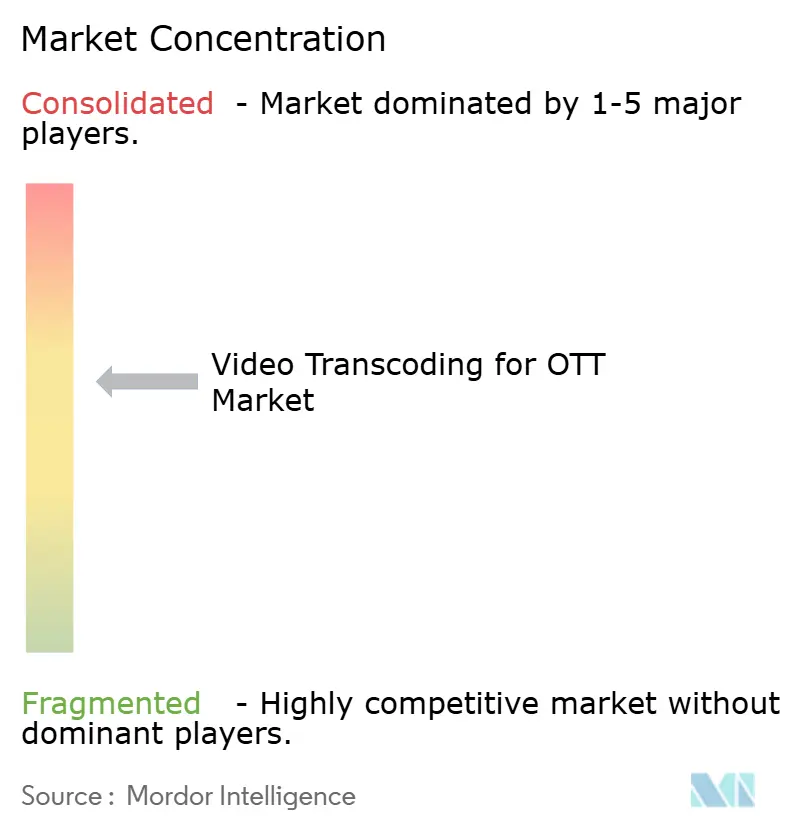
| Market Concentration | Medium |
Major Players *Disclaimer: Major Players sorted in no particular order Image © Mordor Intelligence. Reuse requires attribution under CC BY 4.0. | |
Video Transcoding For OTT Market Analysis by Mordor Intelligence
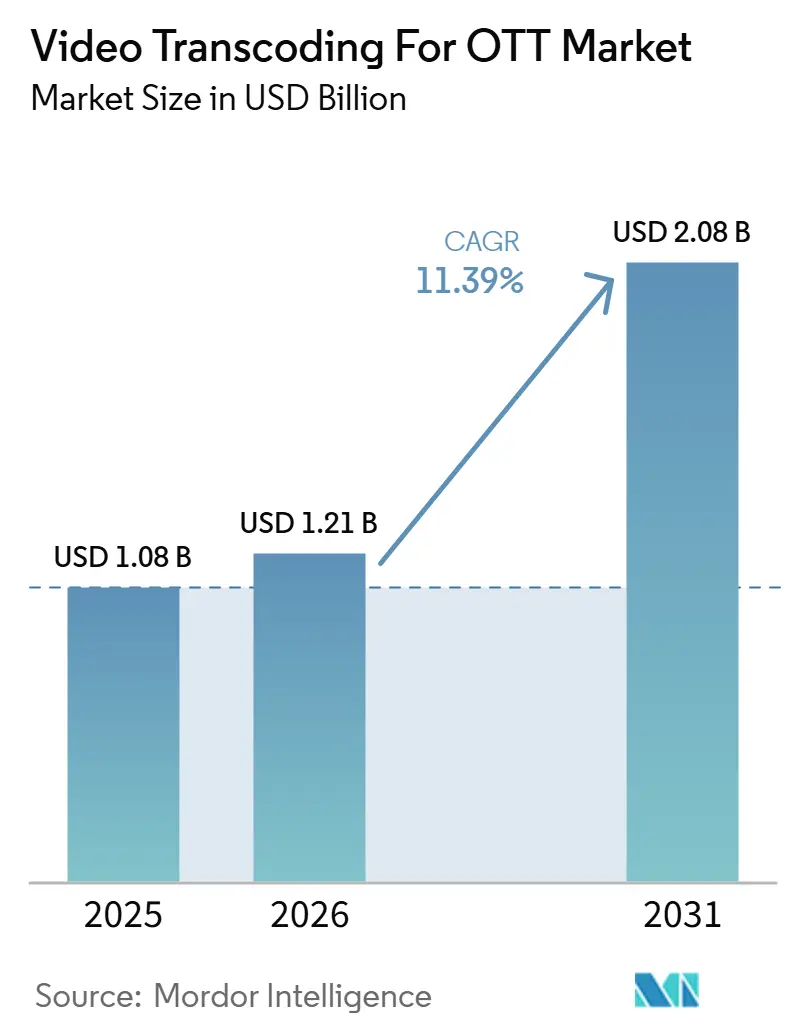
The OTT video transcoding market size is projected to expand from USD 1.08 billion in 2025 and USD 1.21 billion in 2026 to USD 2.08 billion by 2031, registering a CAGR of 11.39% between 2026 and 2031. Rising subscription volumes are increasing the number of device profiles, resolutions, and delivery protocols that platforms must support. This makes encoding capacity and per-title compute cost central operating considerations for streaming services. Live sports, FAST channels, and interactive programming are also moving operators toward real-time, elastic processing that can handle event-driven peaks. Vendors are responding with cloud-native platforms, codec support, hardware acceleration, and workflow tools that reduce operational friction. The video transcoding for the OTT market, therefore, offers providers the opportunity to combine reliable quality, low latency, and flexible deployment without adding unnecessary complexity.
Key Report Takeaways
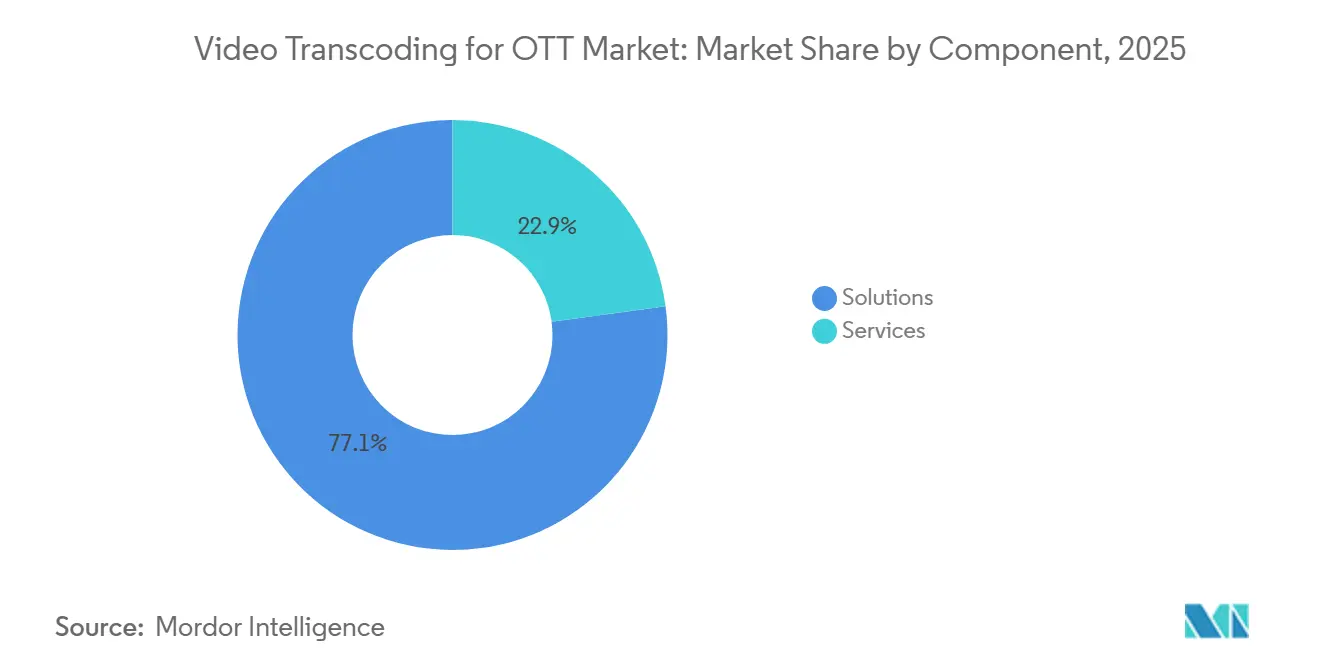
- By component, solutions accounted for 77.13% of OTT video transcoding revenue in 2025, while services are projected to expand at a CAGR of 11.91% through 2031.
- By processing type, file-based and video-on-demand transcoding accounted for 53.28% of video transcoding in the over-the-top (OTT) market in 2025, while live and linear real-time transcoding is projected to expand at a CAGR of 11.88% through 2031.
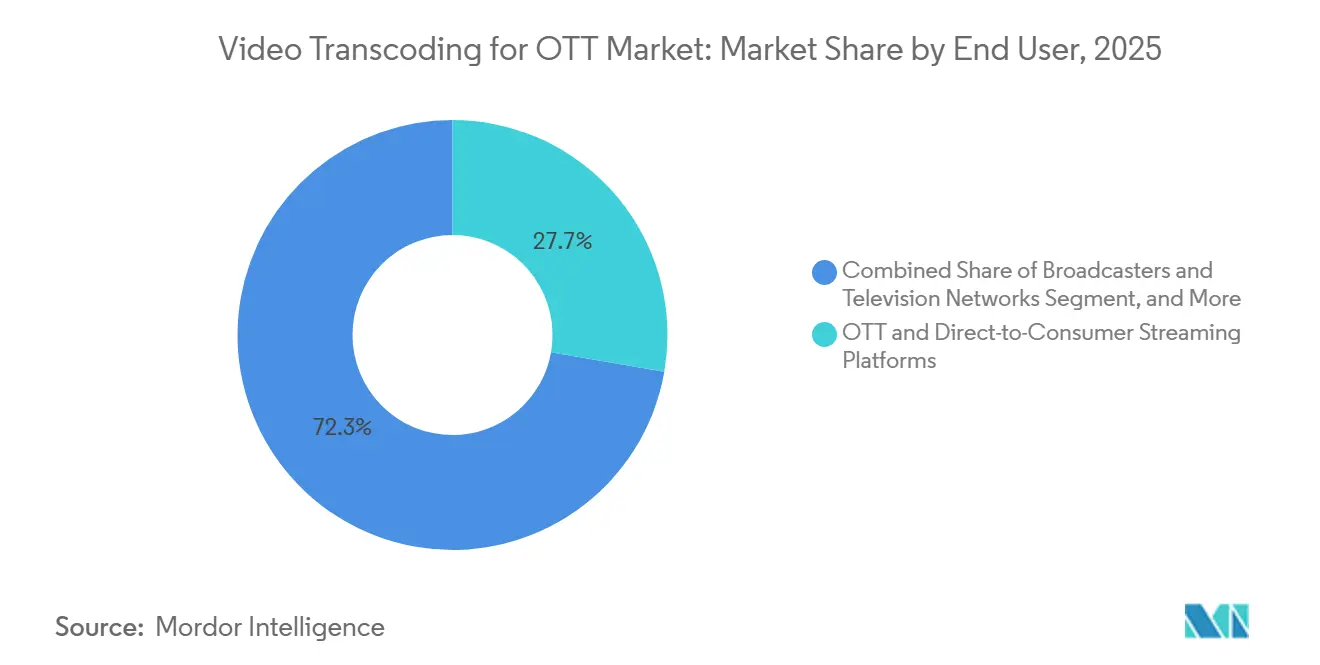
- By end user, OTT and direct-to-consumer streaming platforms held 27.74% of revenue in 2025, while social video and user-generated content platforms are projected to expand at a CAGR of 12.01% through 2031.
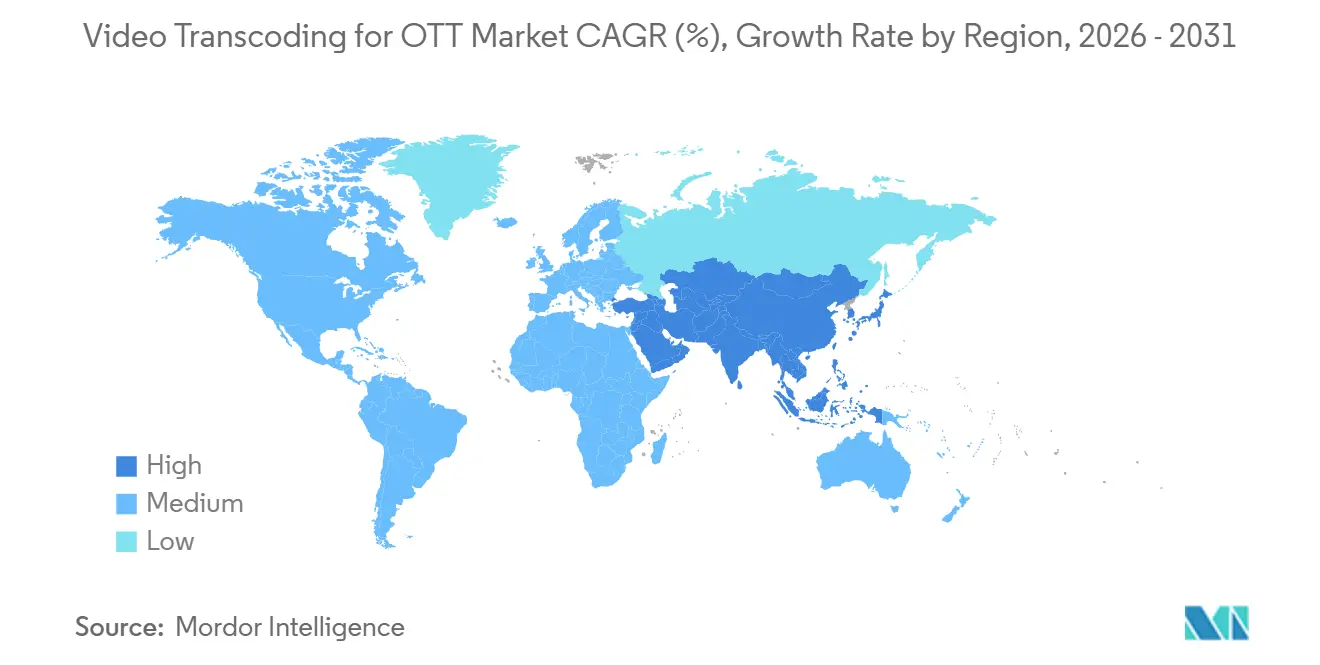
- By geography, North America held 44.37% of revenue in 2025, while Asia-Pacific is projected to expand at a CAGR of 11.93% through 2031.
Note: Market size and forecast figures in this report are generated using Mordor Intelligence’s proprietary estimation framework, updated with the latest available data and insights as of January 2026.
Market Trends and Insights
Drivers Impact Analysis of Video Transcoding For OTT Market*
| Driver | (~) % Impact on CAGR Forecast | Geographic Relevance | Impact Timeline |
|---|---|---|---|
| OTT and Multiscreen Video Consumption Expansion | +3.2% | Global | Short term (≤ 2 years) |
| Live Sports, FAST Channels, and Interactive Streaming Growth | +2.3% | Global, with early acceleration in North America and Europe | Short term (≤ 2 years) |
| Cloud Migration and Elastic Media Processing Demand | +1.8% | North America and Europe, with spillover to Asia-Pacific | Medium term (2-4 years) |
| 4K, 8K, HDR, and Immersive Video Format Adoption | +1.4% | North America and Asia-Pacific core, with spillover to Europe | Medium term (2-4 years) |
| Codec Portfolio Diversification Across AV1, HEVC, and VVC | +0.9% | Global | Short term (≤ 2 years) |
| Edge-Based Transcoding for Low-Latency and Localized Delivery | +0.7% | Asia-Pacific and North America, with early gains in India, South Korea, and Southeast Asia | Medium term (2-4 years) |
| Source: Mordor Intelligence | |||
OTT and Multiscreen Video Consumption Expansion
The OTT video transcoding supports viewing across smart TVs, mobile phones, tablets, and connected devices. Each device group has different codec support, resolution limits, and bitrate needs. Platforms must therefore maintain broader encoding ladders rather than simply process more files. In video transcoding for the OTT market, connected TV use in mature streaming markets is also shifting delivery toward 4K, increasing the work required for each title. This effect does not disappear as markets mature because new viewing devices continue to create compatibility requirements. The change increases demand for video transcoding in the OTT market, enabling platforms to manage multiple renditions without requiring operators to rebuild their workflows for every device category.
Live Sports, FAST Channels, and Interactive Streaming Growth
Live sports and FAST channels create demanding workloads because operators cannot rely on pre-processed assets or batch scheduling. Sports programming on major streaming platforms increased 52% year over year in early 2026, while dedicated sports FAST channels had grown 105% between mid-2024 and February 2025.[1]Amagi, “Amagi Releases June 2026 AIRTIME Report: FAST Viewing Hours Grow 55% YoY as Metadata Friction Escalates,” Amagi, amagi.com Capacity must be available for peak concurrent events, rather than average traffic, which favors elastic infrastructure. Smaller leagues can now pursue FAST distribution, which was previously less accessible under traditional broadcast economics. Amagi reported that FAST viewing hours grew 55% year over year, and ad impressions increased 53% across nearly 6,500 channel deliveries in June 2026. Video transcoding for the over-the-top (OTT) market benefits from the need for parallel, real-time renditions for multiple viewers and devices.
Cloud Migration and Elastic Media Processing Demand
Cloud processing turns encoding from a fixed infrastructure commitment into a cost that can move with workload demand. This makes broadcast-grade processing more accessible to mid-sized platforms that do not want to maintain large on-premises systems. For the video transcoding for the OTT market, that cost model expands the range of providers that can use advanced processing. AWS retired Amazon Elastic Transcoder in November 2025 and consolidated its media-transcoding offering around AWS Elemental MediaConvert. AWS Elemental MediaConvert introduced a video probe API in February 2026 that reads header metadata without processing the full file. Telestream introduced its UP cloud-native solution in March 2026 and expanded Oracle Cloud Infrastructure support for Vantage Cloud workflows in April 2026. Hybrid models remain useful for operators that keep on-premises resources for routine video-on-demand work and use cloud capacity during live events.
4K, 8K, HDR, and Immersive Video Format Adoption
Higher-resolution and high-dynamic-range delivery are raising the quality requirements placed on video encoding. HDR requires efficient codecs such as HEVC or AV1 when operators need to conserve bandwidth. Netflix stated that AV1 supported 30% of its streams and had been extended to HDR delivery, giving it feature parity with HEVC for 4K HDR workflows. In India, 8K-capable display prices fell below INR 150,000 (USD 1,800) in 2025, while average fixed broadband speeds exceeded 100 Mbps. These conditions improve the commercial basis for higher-resolution streaming and increase the need for efficient bitrate management. Video transcoding for the OTT market is consequently benefiting from tools that support multiple high-quality formats without overwhelming infrastructure budgets.
Restraints Impact Analysis of Video Transcoding For OTT Market*
| Restraint | (~) % Impact on CAGR Forecast | Geographic Relevance | Impact Timeline |
|---|---|---|---|
| High Compute, Storage, and Energy Requirements | -2.4% | Global, most acute in North America and Europe | Short term (≤ 2 years) |
| Legacy Workflow Integration and Format Compatibility Complexity | -1.2% | North America and Europe, with early challenges in South America and Middle East | Medium term (2-4 years) |
| Codec Patent Royalty Stacking and Licensing Uncertainty | -0.7% | Global | Medium term (2-4 years) |
| Multi-Codec Duplication and Cache Inefficiency | -0.4% | Global | Long term (≥ 4 years) |
| Source: Mordor Intelligence | |||
High Compute, Storage, and Energy Requirements
Multi-format and multi-codec delivery increases compute, storage, and power requirements faster than infrastructure costs can fall. NETINT found that 72% of surveyed video professionals used GPU-based HEVC encoding, and 39% identified power consumption as a critical deployment challenge. The company reported that its Quadra T1U video processing unit used 17 watts while supporting up to 32 parallel 1080p 30fps streams across H.264, HEVC, and AV1. Data center power constraints in North America and Europe can limit capacity expansion even when video demand remains strong. This encourages platforms to assess purpose-built video processing units and other hardware that improve encoding efficiency. NETINT also found that 49% of respondents planned to evaluate video processing units in 2026, compared with 53.6% who planned to evaluate GPUs.
Legacy Workflow Integration and Format Compatibility Complexity
Broadcasters and pay-TV providers moving toward OTT delivery often continue to operate older SDI-based production systems, proprietary media asset management platforms, and fixed-function encoders. These environments do not always support modern container formats or adaptive bitrate packaging without extensive integration work. Operators commonly need to run legacy and modern systems in parallel during a multiyear transition. Zixi and Comcast Technology Solutions announced an integration in July 2026 that provides US linear broadcasters with a path from C-band distribution to IP-based content distribution.[2]Comcast Technology Solutions, “Zixi and Comcast Technology Solutions Partner to Provide Unified Video Supply Chain Distribution for Linear Broadcasters,” Comcast Technology Solutions, comcasttechnologysolutions.com CMAF, HLS, DASH, Microsoft Smooth Streaming, digital rights management systems, and captioning standards expand the test combinations needed for cross-platform delivery. The OTT video transcoding market has room for managed services that reduce this burden by providing simpler interfaces and workflow support.
*Our forecasts treat driver/restraint impacts as directional, not additive. The impact forecasts reflect baseline growth, mix effects, and variable interactions.
Video Transcoding For OTT Market Segment Analysis
By Component:
Software Platforms Hold the Largest PositionSolutions accounted for 77.13% of revenue in 2025, giving software-based platforms the largest component position. In the video transcoding for the OTT market, these platforms have shifted attention away from dedicated hardware appliances and toward cloud-deployable software that can add format support without a physical replacement cycle. The software-led video transcoding for the OTT market reflected the appeal of codec-agnostic software that can run across GPU clusters, video processing units, and standard CPU resources. This separation of encoding logic from underlying compute hardware gives operators more choice when managing workload costs. It also allows a platform to adjust its infrastructure by use case instead of tying every job to the same appliance. Larger providers can apply this flexibility across established libraries, while smaller services can adopt it without making a broad hardware investment.
Bitmovin signed MUBI as a cloud video-on-demand encoding client through AWS Marketplace in May 2026. MUBI replaced its legacy on-premises stack with a managed service supporting AVC, HEVC, AV1, UHD, and three-pass encoding. This case provides a clear example of why managed platforms are relevant for OTT video transcoding, services that need multiple codecs but do not want to maintain specialist engineering teams. Services are projected to expand at a CAGR of 11.91% through 2031. Live-event operations are particularly suited to managed delivery because parallel events can create operational peaks that an internal team struggles to manage. Providers that combine infrastructure support with monitoring and workflow expertise can address this need. The video transcoding for the OTT market is therefore moving toward a mix of software platforms and managed operational support.


By Processing Type:
Video-on-Demand Remains the Revenue BaseFile-based and video-on-demand transcoding held 53.28% of revenue in 2025. Its lead reflects the large libraries held by subscription video services and the need to re-encode catalogs as codecs and device profiles change. The OTT market video transcoding for this processing type is supported by work that can be scheduled and optimized around catalog priorities. Video-on-demand jobs can be processed in batches and scaled as the library grows. This gives operators greater control over timing and cost than live workflows. It also helps services keep older titles accessible across legacy devices while adding support for newer display formats.
Live and linear real-time transcoding is projected to expand at a CAGR of 11.88% through 2031. In the video transcoding for the over-the-top (OTT) market, live sports, news, and interactive programming can attract and retain subscribers in ways that catalog depth alone may not achieve. Kaltura delivered live TV streaming for broadcasters and telecom providers during the 2026 FIFA World Cup across 6 production environments in Europe, Asia, and the Middle East. The company supported 40 million registered devices and re-architected the service into independent microservices to handle authentication and encoding spikes. These requirements show why real-time processing needs different operational planning from file-based work. Operators are increasingly seeking unified tools that can manage both scheduled asset processing and live event encoding. Such tools can reduce the need for separate vendor stacks as streaming services support both catalog and live programming.
By End User:
OTT Platforms Lead While User-Generated Video Expands FastestOTT and direct-to-consumer streaming platforms held 27.74% of revenue in 2025. Their position is tied to growing content libraries and repeated re-encoding as device support and codec standards change. The video transcoding for OTT market share for this user group also reflects its unusually wide set of encoding needs. Operators may keep H.264 for older devices, use HEVC for 4K HDR, and deploy AV1 to improve bandwidth efficiency for connected TV delivery. Each content title may therefore require several renditions for different screens and network conditions. This keeps encoding work active even after a title has already entered a streaming catalog.
Social video and user-generated content platforms are projected to expand at a CAGR of 12.01% through 2031. In the video transcoding for the OTT market, creator-uploaded video needs rapid processing for moderation, publishing, and delivery across multiple short-form formats. Broadcasters and television networks with OTT services make up the second-largest user cohort and are facing next-generation broadcast upgrades alongside their direct streaming plans. Harmonic enhanced its XOS Advanced Media Processor in March 2026 to support C-band-to-Ku-band migration and ATSC 3.0 deployment for US broadcasters. Pay-TV and telecom operators, studios, content owners, digital publishers, and sports rights holders add further diversity to the workload. Their needs differ by content type, delivery model, and timing, which supports demand for specialized platform features.

Geography Analysis
North America Video Transcoding for OTT Market
North America held 44.37% of revenue in 2025, making it the largest regional contributor. The regional position in the video transcoding for the OTT market is supported by major streaming platforms, hyperscale data centers, and early cloud-native media infrastructure. AWS Elemental, Azure Media Services, and Google Cloud Transcoder have substantial capacity in the region, giving operators access to established media-processing services. Broadcasters moving from C-band satellite distribution to IP workflows create another source of demand for hybrid broadcast-to-streaming processing. The shift brings distribution and encoding decisions together as operators modernize their delivery systems.
APAC Video Transcoding for OTT Market
Asia-Pacific is projected to expand at a CAGR of 11.93% through 2031. Video transcoding for the OTT market is developing in India, Indonesia, South Korea, and Southeast Asia as connected television use and local streaming catalogs grow. The region’s mobile-first viewing patterns and varied network conditions make efficient delivery particularly important. Local-language catalogs also widen the number of content and distribution profiles platforms must manage. Tencent Cloud and Rockstreamer announced a partnership in July 2026 to provide cloud, AI, content delivery network, and enterprise OTT solutions in Bangladesh and other emerging Asian markets.[3]Tencent Cloud, “Tencent Cloud and Rockstreamer Bring Over the Top Infrastructure and Sports Streaming to Bangladesh,” Tencent Cloud, tencentcloud.com
EMEA and South America Video Transcoding for OTT Market
Europe ranked third in 2025. Next-generation broadcast changes, OTT development, and stronger expectations around data sovereignty shape the video transcoding for the over-the-top (OTT) market in the region. Qvest, ATEME, and Scaleway announced a 2026 partnership to develop production-ready OTT platforms built entirely on European technology. South America is gaining support from Brazil’s DTV+ transition, and Harmonic updated its XOS Advanced Media Processor in March 2026 to support that migration. The Middle East and Africa remain smaller in absolute value but are developing through mobile-first streaming and sports rights investment. Vertical video and low-bandwidth delivery needs are shaping the encoding configurations used in African markets.

Competitive Landscape
Video transcoding for the OTT market is moderately concentrated, with hyperscale cloud providers holding broad infrastructure advantages, while specialist vendors compete on codec depth, latency, and integration. AWS Elemental serves large platform accounts through its integration with a broader media services environment. Harmonic maintains broadcast-to-cloud capabilities through VOS360 and launched an AI Orchestration Service in April 2026. The service brings real-time translation, automated sports highlight generation, and ad-break detection into live video workflows.[4]Harmonic, “Harmonic Introduces Breakthrough AI Orchestration Service for Live Video Workflows,” Harmonic, harmonicinc.com This type of offering helps broadcasters consolidate multiple functions into a single, controlled workflow. It also shows that vendors are competing on process integration as well as basic encoding performance.
ATEME entered a multi-year agreement with Netflix to deploy its TITAN Live transcoder in March 2026. The selection considered VMAF quality metrics and subjective visual-artifact assessments. The agreement indicates that measurable video quality can influence procurement alongside existing vendor relationships. Bitmovin, ATEME, and NETINT offer alternatives that emphasize codec coverage, workflow flexibility, or hardware acceleration. NETINT reported that 70% of surveyed video professionals planned to expand their AI- and machine-learning-based encoding capabilities in 2026. Content-aware encoding ladders and per-scene quality prediction are becoming important differentiators. These capabilities can help operators manage quality and compute use across varied content types.
Low-latency edge delivery remains an open area for live sports betting and interactive streaming, where central processing may not meet sub-3-second glass-to-glass requirements. Vendors that can place processing closer to audiences may be more relevant for these use cases. European broadcasters also consider regional compute capacity due to EU AI Act transparency obligations and General Data Protection Regulation data-sovereignty requirements. This can favor European-headquartered vendors that can provide in-region processing. The video transcoding for the OTT industry includes large cloud providers and specialized technology companies with distinct strengths. Competition is based on deployment choice, quality, codec support, power efficiency, and the ability to fit existing media workflows. No combined share of leading companies was provided, so the available evidence supports a moderate concentration description without a numerical concentration score.
Video Transcoding For OTT Industry Leaders
Amazon Web Services, Inc.
Harmonic Inc.
Telestream, LLC
Brightcove Inc.
Bitmovin GmbH
- *Disclaimer: Major Players sorted in no particular order
Video Transcoding For OTT Market Companies Covered in this Report
- Amazon Web Services, Inc.
- Harmonic Inc.
- Telestream, LLC
- Brightcove Inc.
- Bitmovin GmbH
- Akamai Technologies, Inc.
- Haivision Systems Inc.
- Synamedia Limited
- MediaKind Global Limited
- Imagine Communications Corp.
- Google LLC
- Tencent Holdings Limited
- Huawei Technologies Co., Ltd.
- Qencode, Inc.
- Kaltura, Inc.
- Wowza Media Systems, LLC
- ATEME S.A.
- Avid Technology, Inc.
- NETINT Technologies Inc.
- Vimeo, Inc.

Recent Industry Developments in Video Transcoding For OTT Market
- July 2026: Kaltura delivered live TV streaming throughout the 2026 FIFA World Cup, supporting approximately 40 million registered devices across six production environments in Europe, Asia, and the Middle East. The deployment required re-architecture to independent microservices to manage simultaneous authentication and encoding spikes at kickoff.
- July 2026: Wowza launched the Video Intelligence Framework in collaboration with NVIDIA, enabling AI inference to run directly inside Wowza Streaming Engine without a separate pipeline. The solution ships with NVIDIA’s Synthetic Video Detector and RF-DETR object detection for real-time clip generation and alert triggering within live workflows.
- July 2026: Tencent Cloud and Rockstreamer Private Limited announced a strategic partnership to deliver cloud, AI, CDN, and enterprise OTT solutions across Bangladesh and emerging markets in Asia, expanding Tencent Cloud’s OTT infrastructure footprint into frontier streaming markets.
- July 2026: Zixi and Comcast Technology Solutions announced an integration combining Comcast Media360 with the Zixi Software Platform, delivering C-band to IP-based content distribution migration paths for US linear broadcasters.


Global Video Transcoding For OTT Market Report Scope
The Video Transcoding for OTT Market comprises software solutions, cloud-based platforms, hardware-accelerated systems, and associated services that enable the conversion, optimization, and processing of digital video content into multiple formats, codecs, resolutions, bitrates, and streaming protocols for efficient delivery over over-the-top (OTT) streaming platforms. These technologies ensure seamless playback across diverse internet-connected devices, operating systems, network conditions, and content distribution environments while maintaining video quality, reducing bandwidth consumption, and enhancing viewer experience.
The Video Transcoding for OTT Market Report is Segmented by Component (Solutions, and Services), Processing Type (File-Based and Video-on-Demand Transcoding, and Live and Linear Real-Time Transcoding), End User (OTT and Direct-to-Consumer Streaming Platforms, Broadcasters and Television Networks, Pay-TV and Telecom Operators with OTT/IP Video Services, Studios, Content Owners, and Digital Publishers, Sports Rights Holders and Live-Event Streaming Providers, and Social Video and User-Generated Content Platforms), and Geography (North America, South America, Europe, Asia-Pacific, Middle East, and Africa). The Market Forecasts are Provided in Terms of Value (USD).
| Solutions | Software-Based Transcoding Platforms |
| Hardware Transcoding Appliances | |
| Services |
| File-Based and Video-on-Demand Transcoding |
| Live and Linear Real-Time Transcoding |
| OTT and Direct-to-Consumer Streaming Platforms |
| Broadcasters and Television Networks |
| Pay-TV and Telecom Operators with OTT/IP Video Services |
| Studios, Content Owners, and Digital Publishers |
| Sports Rights Holders and Live-Event Streaming Providers |
| Social Video and User-Generated Content Platforms |
| North America | United States |
| Canada | |
| Mexico | |
| South America | Brazil |
| Argentina | |
| Rest of South America | |
| Europe | Germany |
| United Kingdom | |
| France | |
| Italy | |
| Spain | |
| Russia | |
| Rest of Europe | |
| Asia-Pacific | China |
| India | |
| Japan | |
| South Korea | |
| Southeast Asia | |
| Australia and New Zealand | |
| Rest of Asia-Pacific | |
| Middle East | United Arab Emirates |
| Saudi Arabia | |
| Turkey | |
| Israel | |
| Rest of Middle East | |
| Africa | South Africa |
| Nigeria | |
| Egypt | |
| Rest of Africa |
| By Component | Solutions | Software-Based Transcoding Platforms |
| Hardware Transcoding Appliances | ||
| Services | ||
| By Processing Type | File-Based and Video-on-Demand Transcoding | |
| Live and Linear Real-Time Transcoding | ||
| By End User | OTT and Direct-to-Consumer Streaming Platforms | |
| Broadcasters and Television Networks | ||
| Pay-TV and Telecom Operators with OTT/IP Video Services | ||
| Studios, Content Owners, and Digital Publishers | ||
| Sports Rights Holders and Live-Event Streaming Providers | ||
| Social Video and User-Generated Content Platforms | ||
| By Geography | North America | United States |
| Canada | ||
| Mexico | ||
| South America | Brazil | |
| Argentina | ||
| Rest of South America | ||
| Europe | Germany | |
| United Kingdom | ||
| France | ||
| Italy | ||
| Spain | ||
| Russia | ||
| Rest of Europe | ||
| Asia-Pacific | China | |
| India | ||
| Japan | ||
| South Korea | ||
| Southeast Asia | ||
| Australia and New Zealand | ||
| Rest of Asia-Pacific | ||
| Middle East | United Arab Emirates | |
| Saudi Arabia | ||
| Turkey | ||
| Israel | ||
| Rest of Middle East | ||
| Africa | South Africa | |
| Nigeria | ||
| Egypt | ||
| Rest of Africa | ||


Key Questions Answered in the Report
What is the size of the video transcoding for OTT market?
The video transcoding for OTT market was USD 1.21 billion in 2026 and is projected to reach USD 2.08 billion by 2031 at a CAGR of 11.39%. The forecast reflects continued demand for several video formats, screen types, and delivery profiles.
What is driving demand for OTT video transcoding?
Multiscreen viewing, live sports, FAST channels, cloud migration, and higher-resolution delivery are increasing the need for flexible encoding capacity. Each of these needs can create a larger number of renditions for a single content title.
Which component leads video transcoding for OTT?
Solutions led with 77.13% of revenue in 2025, reflecting the shift toward cloud-deployable software platforms. These tools can support changing codec requirements without a dedicated hardware replacement cycle.
Which processing type is growing fastest?
Live and linear real-time transcoding is projected to expand at a CAGR of 11.88% through 2031 as platforms increase live sports, news, and interactive programming. These workflows require capacity that can handle simultaneous event peaks.
Which end users create the most demand?
OTT and direct-to-consumer streaming platforms held 27.74% of revenue in 2025, while social video and user-generated content platforms are projected to grow fastest at 12.01% CAGR. Broadcasters, telecom operators, studios, and sports rights holders also create distinct processing needs.
Which region is expanding fastest?
Asia-Pacific is projected to grow at a CAGR of 11.93% through 2031, supported by streaming growth in India, Indonesia, South Korea, and Southeast Asia. Mobile viewing patterns, local-language catalogs, and varied network conditions add to delivery requirements.
Page last updated on:





