
Vertical Lettuce Farming Market Size and Share
Market Overview
| Study Period | 2022 - 2032 |
|---|---|
| Market Size (2027) | USD 5.59 Billion |
| Market Size (2032) | USD 10.76 Billion |
| Growth Rate (2027 - 2032) | 14.00 % |
| Fastest Growing Market | Asia-Pacific |
| Largest Market | North America |
| Market Concentration | Low |
Major Players *Disclaimer: Major Players sorted in no particular order Image © Mordor Intelligence. Reuse requires attribution under CC BY 4.0. | |
Vertical Lettuce Farming Market Analysis by Mordor Intelligence
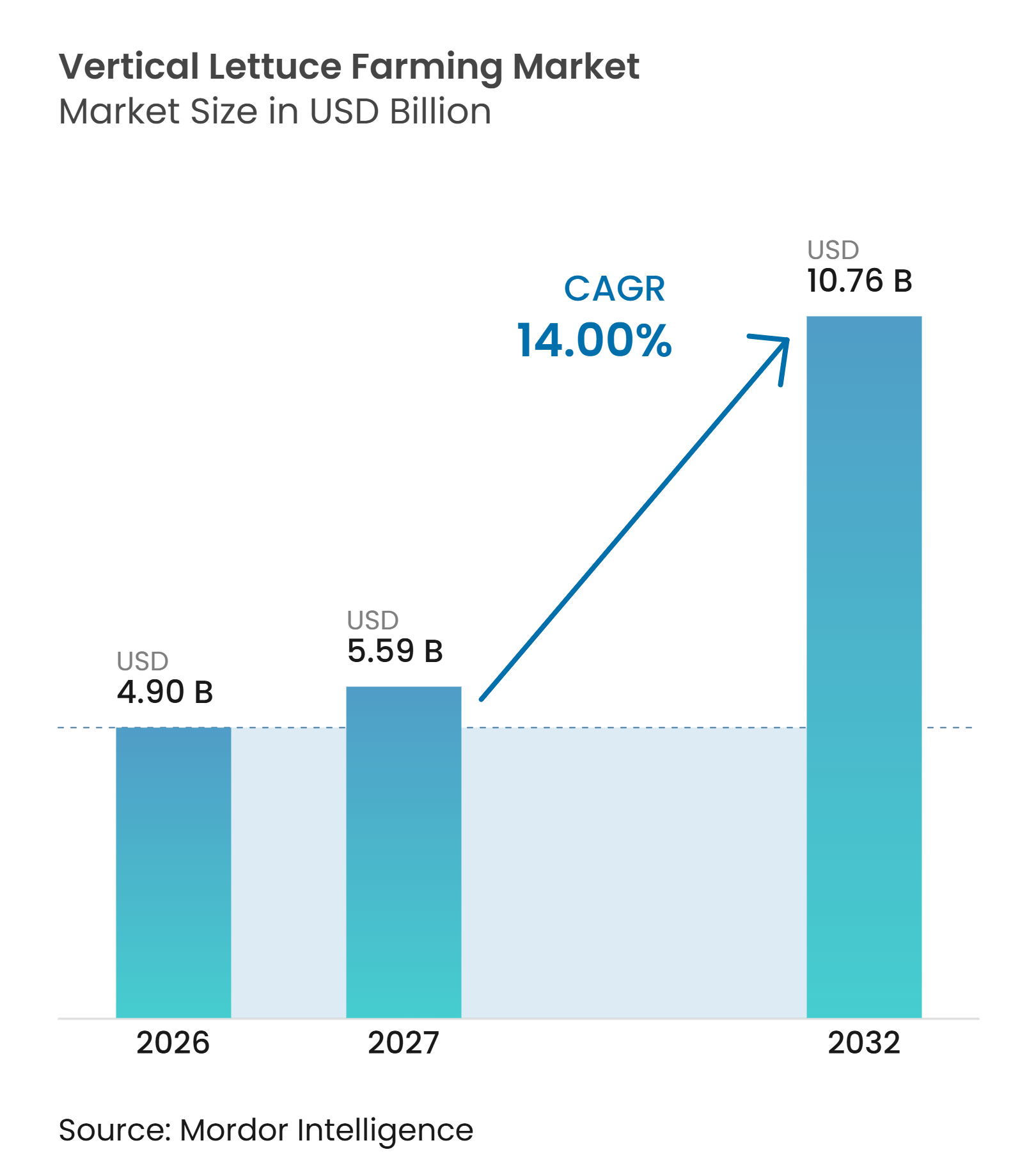
The vertical lettuce farming market size was valued at USD 4.90 billion in 2026 and is forecast to grow from USD 5.59 billion in 2027 to USD 10.76 billion by 2032, at a CAGR of 14% during the forecast period (2027-2032). The market is transitioning from smaller demonstration sites toward retail-supported networks that use consistent growing methods and predictable output per square foot. Controlled-environment production is becoming a supply tool for grocery chains that require reliable volumes, rather than a novel technology investment. Operators that remained active after the market correction have generally combined proprietary growing methods with long-term retail contracts and lower-cost power arrangements. Electricity costs, access to financing, and food safety controls remain decisive factors for profitability. Government food-security programs in the Middle East and Southeast Asia can provide demand support when private capital conditions deteriorate.
Key Report Takeaways
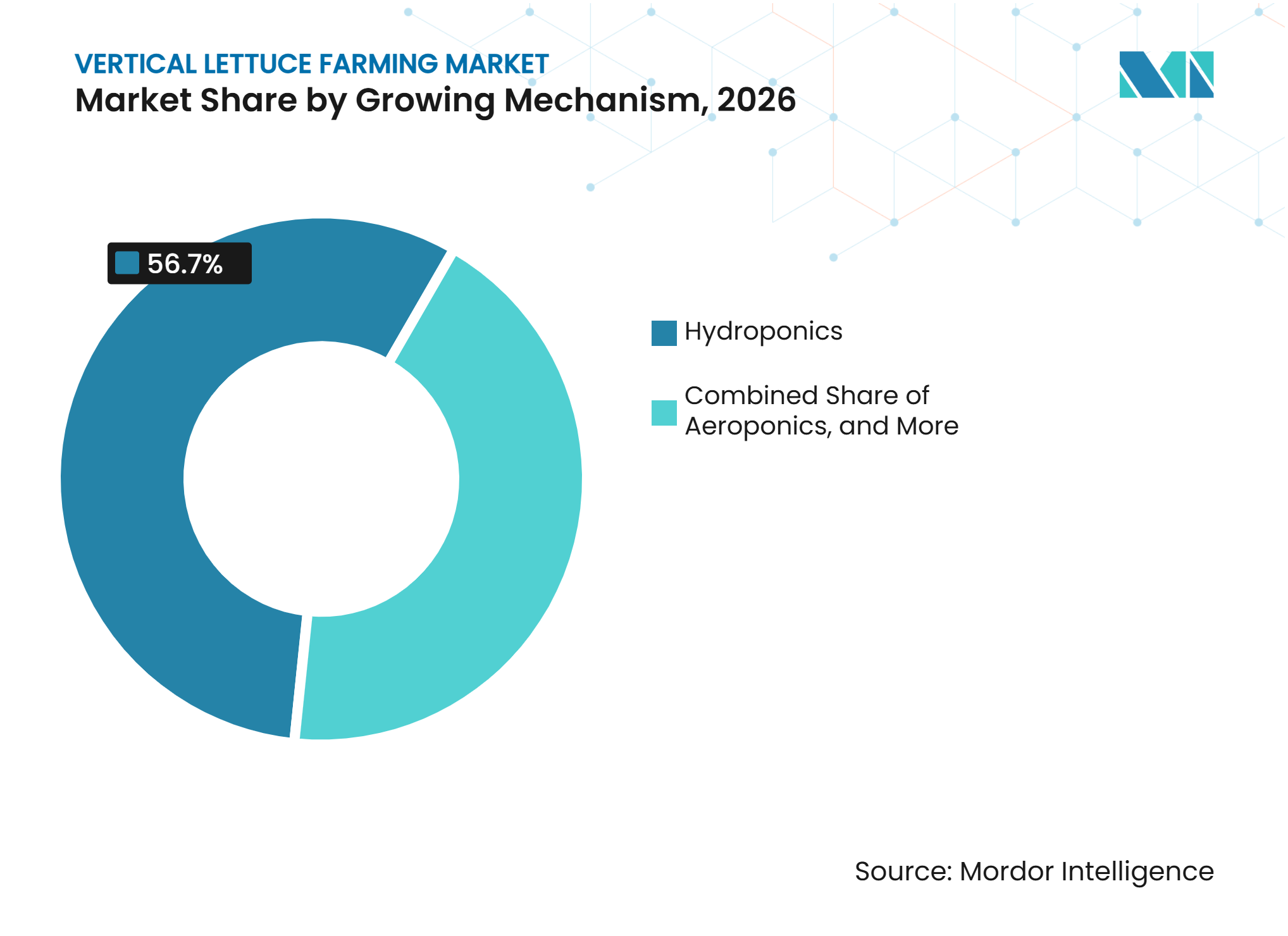
- By growing mechanism, hydroponics accounted for 56.7% of the vertical lettuce farming market share in 2026, while aeroponics is forecast to grow at a 13.1% CAGR from 2027 to 2032.
- By facility structure, building-based vertical farms accounted for 72.4% of the vertical lettuce farming market size in 2026, while shipping-container vertical farms are forecast to grow at a 13.8% CAGR from 2027 to 2032.
- By lettuce variety, butterhead lettuce accounted for 35% of the market share in 2026, while loose-leaf lettuce is forecast to grow at a 14.5% CAGR from 2027 to 2032.
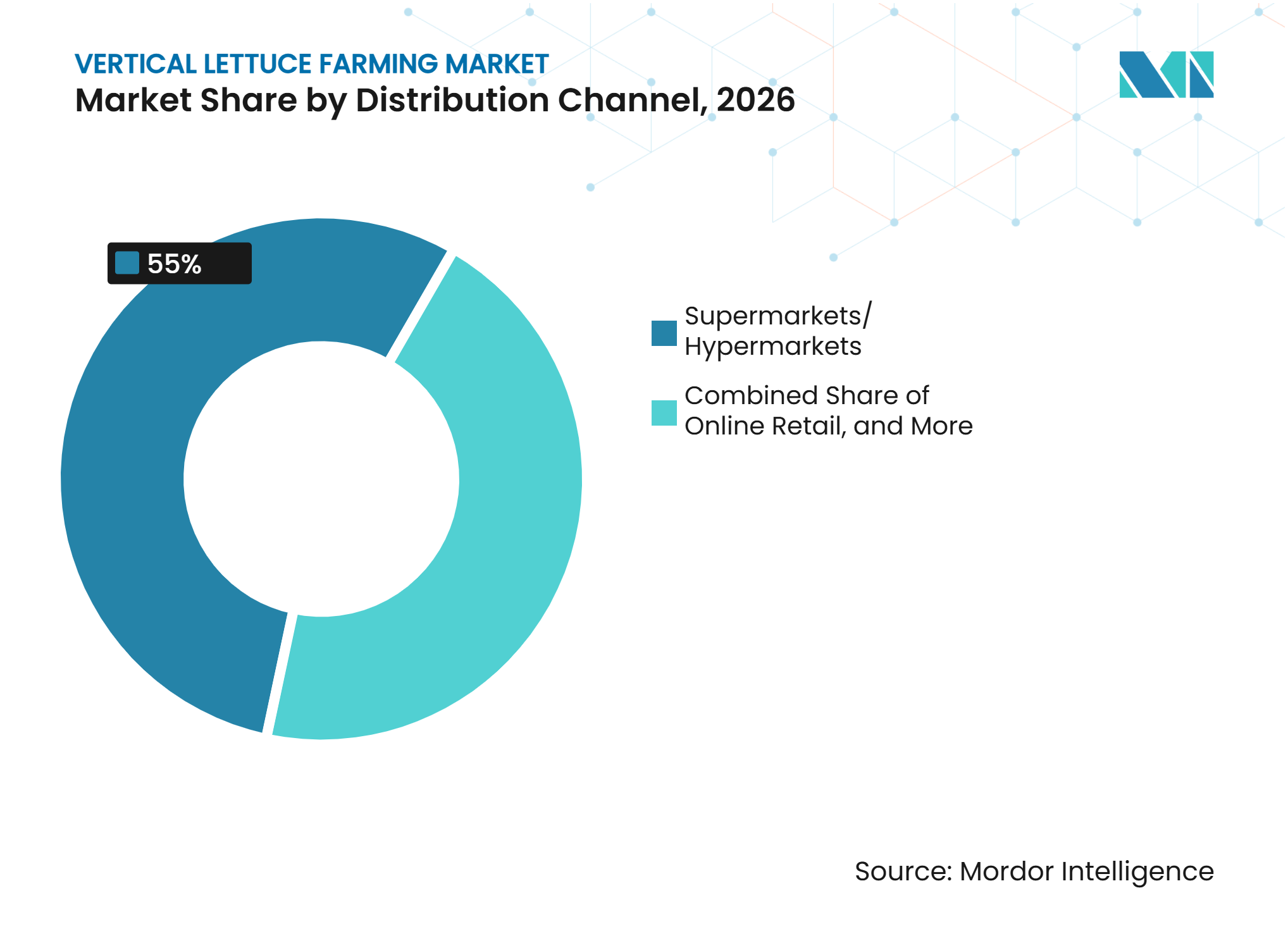
- By distribution channel, supermarkets/hypermarkets accounted for 55% of the market share in 2026, while online retail is forecast to grow at a 15.5% CAGR from 2027 to 2032.
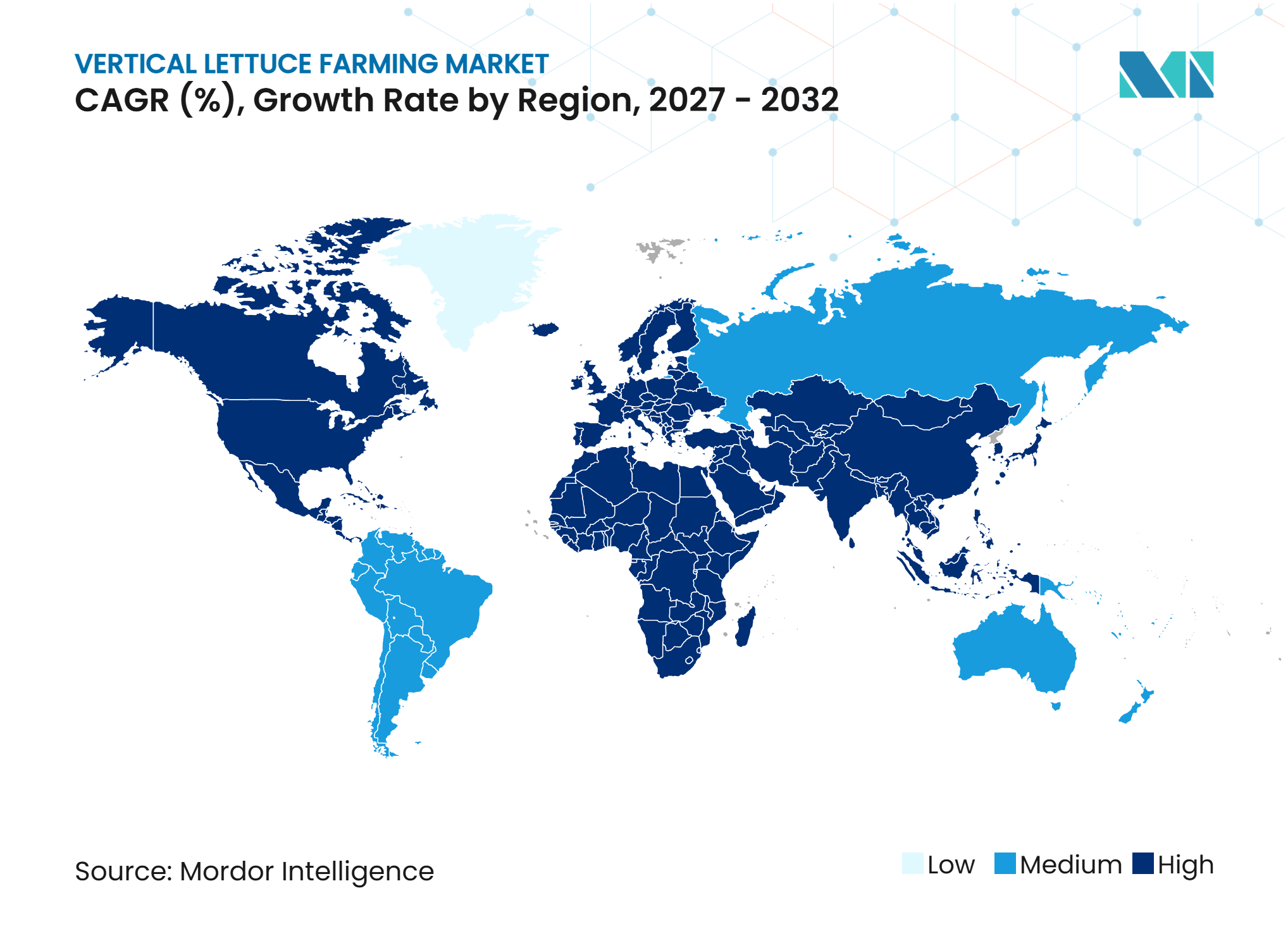
- By geography, North America accounted for 41.8% of the market share in 2026, while Asia-Pacific is forecast to grow at a 13.5% CAGR from 2027 to 2032.
Note: Market numbers in this report are based on Mordor Intelligence's proprietary estimation framework, which combines nine months of actuals with Q4 projections for base year 2026.
Market Trends and Insights
Drivers Impact Analysis of Vertical Lettuce Farming Market*
| Driver | (~) % Impact on CAGR Forecast | Geographic Relevance | Impact Timeline |
|---|---|---|---|
| Demand for Locally Grown, Pesticide-Free Lettuce | +2.2% | Global, strongest in North America, Europe, and Asia-Pacific | Medium term (2-4 years) |
| Improving Energy Efficiency Through LED Lighting and Automation | +2.5% | Global, particularly the United States, Netherlands, China, Japan, and South Korea | Long term (≥ 4 years) |
| Demand for Year-Round Lettuce Production Amid Climate Volatility | +2% | Global, highest impact in the United Arab Emirates, Saudi Arabia, United Kingdom, and Japan | Long term (≥ 4 years) |
| Government Support for Food Security and Controlled-Environment Agriculture | +1.8% | Asia-Pacific and Middle East core, with spillover to North America and Europe | Medium term (2-4 years) |
| Retail Preference for Consistent, Traceable Supply | +1.5% | North America and Europe | Medium term (2-4 years) |
| Integration With Renewable Energy and Waste Heat Sources | +1.2% | United States, United Kingdom, Netherlands, and Australia | Long term (≥ 4 years) |
| Source: Mordor Intelligence | |||
Demand for Locally Grown, Pesticide-Free Lettuce
Demand for locally grown, pesticide-free lettuce is gaining traction as retailers and consumers place greater emphasis on food safety, freshness, and supply chain transparency. Food safety advisories involving field-grown leafy greens have heightened scrutiny of production practices and sourcing standards among supermarket buyers. Retailers in markets such as the United States, Canada, Japan, and Singapore increasingly emphasize traceability records when evaluating fresh produce suppliers. Vertical farming operators can support these requirements through controlled production environments and systematic monitoring of growing conditions. In January 2025, the United States Department of Agriculture (USDA) announced USD 14.4 million in grants and technical assistance for urban agriculture and innovative production, including indoor and soilless farming initiatives[1]. These developments support the adoption of controlled-environment lettuce production by strengthening traceability, improving supply consistency, and expanding opportunities for vertical farms to serve retail buyers.
Improving Energy Efficiency Through LED Lighting and Automation
Advances in LED lighting and automated environmental controls are improving the operating economics of indoor lettuce production by reducing energy consumption and optimizing growing conditions. A 2025 review published in Sustainability reported that replacing high-pressure sodium lamps with LED systems reduced lighting energy use by 30% to 50% in commercial-scale applications, generating annual savings of USD 35,700 per installation and payback periods of 2 to 3 years[2]. A 2025 study published in Frontiers in Sustainable Food Systems found that intelligent environmental controls can adjust light intensity and photoperiod based on electricity price information, helping optimize energy use in indoor farming[3]. California's proposed 2025 Title 24 update also included a minimum photosynthetic photon efficacy standard of 2.3 µmol/J for indoor sole-source lighting, reinforcing the importance of efficient lighting technologies. As energy efficiency and automation become increasingly important to operating performance, farms with advanced lighting and control systems may gain a cost advantage over less efficient facilities, supporting wider adoption of these technologies in the vertical lettuce farming market.
Demand for Year-Round Lettuce Production Amid Climate Volatility
Heat events, water restrictions, and changing crop-protection requirements can disrupt outdoor lettuce production, increasing the value of a reliable, year-round supply for retail buyers. Vertical farms can reduce exposure to seasonal weather conditions by maintaining controlled growing environments, helping stabilize production schedules and product availability. In April 2025, the United Kingdom announced GBP 45.6 million in funding across three innovation funds to support agricultural technologies to strengthen food security and improve farm productivity. In the Middle East and Singapore, indoor farms can serve as food-security assets where outdoor production is limited. Retailers can also reduce single-location supply risk by sourcing from standardized facilities across multiple locations. This creates an advantage for vertical lettuce farming market participants that can replicate their farm designs across regions.
Government Support for Food Security and Controlled-Environment Agriculture
Government funding programs and food-security initiatives are supporting controlled-environment agriculture in markets facing constraints related to land availability, water resources, and climate conditions. Alberta's Growing Greenhouses Program provides funding of up to CAD 4 million per applicant for eligible greenhouse construction and productivity improvements during the 2025–2028 program period. The European Commission's 2025 Horizon Europe program also supports research and innovation in sustainable food production systems, including relevant controlled-environment agriculture initiatives. In South Korea, a K-Vertical Farm globalization program launched in 2025 allocated KRW 6.15 billion to support seven projects focused on international expansion and vertical farming models. Such initiatives can help eligible operators offset development costs, support technology adoption, and reduce reliance on commercial financing during expansion. Continued policy support for controlled-environment agriculture can improve investment conditions and encourage the development of vertical lettuce farming capacity in markets prioritizing food security.
Restraints Impact Analysis of Vertical Lettuce Farming Market*
| Restraint | (~) % Impact on CAGR Forecast | Geographic Relevance | Impact Timeline |
|---|---|---|---|
| High Electricity Consumption and Capital Intensity | -2.5% | Global, most acute in Germany, United Kingdom, Japan, Australia, and United States | Long term (≥ 4 years) |
| Financing Constraints and Risk Assessment in Vertical Farming | -1.5% | Global, strongest in United States, United Kingdom, Japan, and Singapore | Medium term (2-4 years) |
| Limited Economic Viability Across Lettuce Cultivars and Price Segments | -2% | North America and Europe core, with spillover to Australia and Canada | Medium term (2-4 years) |
| Pathogen-Control Complexity in Closed-Loop Production | -1% | Global, particularly United States, Canada, United Kingdom, Netherlands, and Japan | Medium term (2-4 years) |
| Source: Mordor Intelligence | |||
High Electricity Consumption and Capital Intensity
Electricity consumption remains a major operating expense for vertical lettuce farms that rely on artificial lighting and controlled indoor environments. Energy costs can account for 30% to 50% of the cost of goods sold in sole-source-lit indoor facilities, depending on the production system and local electricity prices. Building-based vertical farms can also require substantial upfront investment, with estimated construction costs of USD 100 to USD 300 per square foot, placing financial pressure on new and smaller operators. High fixed costs and fluctuations in industrial electricity prices can further complicate project financing and reduce the predictability of operating margins. Compliance with applicable energy-efficiency standards may require additional investment in equipment, increasing the financial burden on some facilities. These energy and capital requirements can lengthen payback periods, constrain expansion plans, and limit market entry for operators with restricted access to financing.
Financing Constraints and Risk Assessment in Vertical Farming
Financial institutions may apply stricter lending criteria to vertical farming projects due to high capital requirements, uncertain profitability, and the operational challenges of indoor agriculture. Lenders may require established retail contracts, multiyear operating records, and detailed unit-cost information before approving construction financing, creating barriers for operators without proven commercial performance. Insurance assessments can also be affected by operational risks associated with recirculating nutrient systems, including the potential for pathogen contamination and system failures. A 2025 study published in Food Control examined the persistence and distribution of Salmonella and Listeria during recirculating hydroponic lettuce cultivation, highlighting food safety risks associated with recirculating water systems. These financing and operational requirements tend to favor established companies with reliable customers and demonstrated performance, while making it more difficult for new entrants to secure funding and scale operations in the vertical lettuce farming market.
*Our forecasts treat driver/restraint impacts as directional, not additive. The impact forecasts reflect baseline growth, mix effects, and variable interactions.
Vertical Lettuce Farming Market Segment Analysis
By Growing Mechanism:
Hydroponics Leads, While Aeroponics Records the Fastest GrowthHydroponics accounted for 56.7% of the Vertical lettuce farming market share in 2026. Its leading position reflects the use of established nutrient film technique and deep-water culture methods that suit lettuce's short growing cycle and shallow root structure. These systems can provide predictable output per square foot when growers use consistent cultivar and nutrient-management practices. A 2025 study published in the Journal of Plant Nutrition reported that the nutrient film technique achieved the highest fresh leaf weight among the systems evaluated, at 96.73 grams. Hydroponics remains the main choice for high-volume commercial lettuce production.
Aeroponics is forecast to grow at a 13.1% CAGR from 2027 to 2032, making it the fastest-growing mechanism. The approach can support yield advantages for selected premium butterhead and romaine cultivars. AeroFarms raised equity in August 2025 to support its Danville, Virginia, facility and pre-construction work for a second commercial farm. Aquaponics remains smaller because it adds the operating complexity of managing fish and vegetables together. The vertical lettuce farming industry is likely to retain hydroponics for high-volume supply while using aeroponics for selected premium varieties.



By Facility Structure:
Building-Based Vertical Farms Lead, While Shipping-Container Farms Grow FastestBuilding-based vertical farms accounted for 72.4% of the market share in 2026. Permanent facilities can support energy management, staffing efficiency, and production capacity for large retail contracts. Their scale can also justify dedicated lighting, airflow, and handling systems designed for lettuce. GoodLeaf closed CAD 52 million (USD 37 million) in equity financing during November 2025 to expand its Alberta and Quebec facilities and establish an Agricultural Centre of Excellence in Ontario. Building farms will remain the core platform for high-volume production in the Vertical lettuce farming market.
Shipping-container vertical farms are forecast to grow at a 13.8% CAGR from 2027 to 2032. Their modular format can help producers enter locations where land ownership, zoning rules, or infrastructure constraints prevent the construction of larger buildings. Remote islands, military logistics sites, and dry inland areas can benefit from this form of deployment. Modular farms sit between container and building models, offering some customization and lower capital requirements than permanent sites. The vertical lettuce farming market can use containers to widen access while buildings retain their role in large retail supply programs.
By Lettuce Variety:
Butterhead Lettuce Leads, While Loose-Leaf Lettuce Records the Fastest GrowthButterhead lettuce accounted for 35% of the market share in 2026. Its compact shape, uniform color, and mild flavor make it well-suited to nutrient film technique lanes and premium retail packaging. The variety can also support a differentiated shelf position in packaged lettuce displays. Its architecture is compatible with indoor production systems that rely on dense and repeatable crop layouts. Butterhead products support the premium positioning of many commercial operators in the vertical lettuce farming market.
Loose-leaf lettuce is forecast to grow at a 14.5% CAGR from 2027 to 2032. Growth is linked to demand for mixed salad bags that combine several lettuce types. Vertical farms can meet this need through harvest-day flexibility that field production does not always provide. Romaine remains the second-largest variety because quick-service restaurants and prepared-salad manufacturers value its firmness during processing. Specialty and heirloom types give the vertical lettuce farming industry an additional route into direct-to-consumer channels seeking flavor and product differentiation.
By Distribution Channel:
Supermarkets/Hypermarkets Lead, While Online Retail Grows FastestSupermarkets/hypermarkets accounted for 55% of the market share in 2026. Their regular purchasing programs give producers the volume and demand visibility needed to support major facility investments. Retail contracts can also make it easier for producers to secure financing and plan labor. Major chains offer an established route for premium indoor lettuce to reach consumers at scale. This channel remains central to the vertical lettuce farming market because it connects high-output farms with broad consumer demand.
Online retail is forecast to grow at a 15.5% CAGR from 2027 to 2032. Direct subscription models can reduce intermediary margins and allow growers to control product handling through the cold chain. These channels also provide customer data that can guide variety and packaging choices. Specialty stores can support higher unit prices, but their limited volume makes them less important for large farms. The vertical lettuce farming market can use online channels to develop closer customer relationships without replacing the scale of mainstream retail.

Geography Analysis
North America held 41.8% of the Vertical lettuce farming market share in 2026. The region has supermarket networks capable of absorbing premium indoor lettuce at scale. Consumers respond to labels indicating that products are locally grown and pesticide-free. Canada has added capacity through GoodLeaf's CAD 52 million (USD 37 million) November 2025 financing for farms in Alberta and Quebec. North America benefits from a developed retail channel, but project funding still depends on durable unit economics.
Europe is shaped by the Farm to Fork framework and its goal to reduce synthetic pesticide use by 50% by 2030. The United Kingdom and the Netherlands are the region's most developed commercial markets. The Netherlands has a specialized horticultural equipment base that supports the development of container and hydroponic systems. The United Kingdom's GBP 45.6 million (USD 57.9 million) 2025 investment reinforces the role of controlled environments in food resilience policy. Germany, France, Italy, Spain, and Russia offer further demand potential.
Asia-Pacific is forecast to grow at a 13.5% CAGR from 2027 to 2032, the fastest regional rate in the Vertical lettuce farming market. Food-security mandates, urban density, and limited arable land support this growth. South Korea's KRW 6.15 billion (USD 4.4 million) program funds seven vertical farm projects with export-oriented and building-integrated models. The Middle East has strong demand conditions because local field agriculture is limited and food-security policies remain active.
Competitive Landscape
Market Concentration
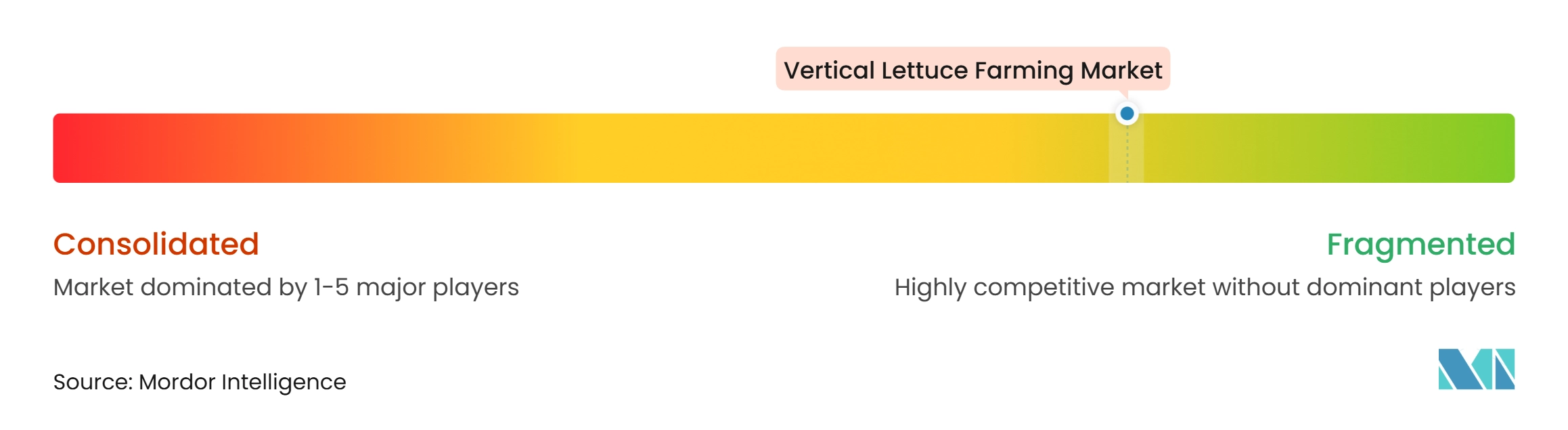
The Vertical Lettuce Farming Market was fragmented in 2026. Regional growers, technology providers, and farm-as-a-service businesses contribute to a diverse, competitive landscape. Competition depends on energy cost per kilogram, consistent product quality, and long-term retail supply agreements. Gotham Greens has adopted a logistics-focused approach by locating facilities near population centers, reducing transportation distances and improving delivery responsiveness.
Intelligent Growth Solutions offers its Growth Towers and Total Controlled Environment Agriculture platform to third-party operators. This approach separates technology revenue from direct farming risk and supports expansion across multiple markets. iFarm uses Growtune crop-steering software and nutrient film technique hardware for producers that do not want to develop proprietary systems. GoodLeaf has strengthened its operating platform through its Agricultural Centre of Excellence in Guelph, Ontario, funded as part of its November 2025 expansion financing. AeroFarms raised equity in August 2025 for its existing facility and a planned second commercial site.
Consolidation has increased as operators seek distressed assets that can expand capacity without long construction delays. Food safety requirements also underscore the importance of documented sanitation processes and established management systems. The FDA Produce Safety Rule and European food law requirements make traceability a practical necessity for sustained retail access. The market's fragmented structure reflects the presence of diverse regional producers and specialized technology providers, as well as companies pursuing expansion through operational investments and technology-led partnerships.
Vertical Lettuce Farming Industry Leaders
-
Gotham Greens Holdings LLC
-
80 Acres Farms Inc.
-
GoodLeaf Community Farms Limited
-
GrowUp Farms Limited
-
UP Vertical Farms
- *Disclaimer: Major Players sorted in no particular order
Vertical Lettuce Farming Market Companies Covered in this Report
- 80 Acres Farms Inc.
- Gotham Greens Holdings LLC
- GoodLeaf Community Farms Limited
- GrowUp Farms Limited
- Urban Crop Solutions BV
- Intelligent Growth Solutions Limited
- OnePointOne
- Vertical Future Ltd.
- iFarm Project
- UP Vertical Farms
- Kilometro Verde
- Badia Farms
- UNS Farms (Speedex Group)
- Sustenir Agriculture
- Sky Greens Pte. Ltd.
Recent Industry Developments in Vertical Lettuce Farming Market
- January 2026: Elevate Farms Inc. acquired Fieldless Farms Inc., a Canadian controlled-environment agriculture operator producing leafy greens in Ontario. The acquisition supports Elevate Farms’ expansion strategy, with projects in development across the United States, Switzerland, and the United Arab Emirates.
- November 2025: GoodLeaf Farms completed a CAD 52 million equity financing round to double production capacity at its Alberta and Quebec vertical farms in 2026 and establish a research and development center in Ontario. The funding was backed by Farm Credit Canada, Power Sustainable Lios, and McCain Foods Limited.
- August 2025: 80 Acres Farms Inc. and Soli Organic announced a strategic merger to combine their indoor farming operations, targeting USD 200 million in first-year revenue and distribution across more than 17,000 retail locations in the United States.
Global Vertical Lettuce Farming Market Report Scope
Vertical lettuce farming refers to the cultivation of lettuce in vertically stacked layers within controlled environments, using soilless growing methods and systems that optimize space, water, and nutrient use for year-round production.
The Vertical Lettuce Farming Market is Segmented by Growing Mechanism (Hydroponics, Aeroponics, and Aquaponics), by Facility Structure (Building-Based Vertical Farms, Shipping-Container Vertical Farms, Modular Vertical Farms, and Other Facility Structures), by Lettuce Variety (Romaine Lettuce, Butterhead Lettuce, Loose-Leaf Lettuce, Crisphead Lettuce, and Other Lettuce Varieties), by Distribution Channel (Supermarkets/Hypermarkets, Specialty Stores, Online Retail, and Others), and by Geography (North America, South America, Europe, Asia-Pacific, Middle East, and Africa). The Forecasts are Provided in Terms of Value (USD).
Segmentation Overview
| Hydroponics |
| Aeroponics |
| Aquaponics |
| Building-Based Vertical Farms |
| Shipping-Container Vertical Farms |
| Modular Vertical Farms |
| Other Facility Structures |
| Romaine Lettuce |
| Butterhead Lettuce |
| Loose-Leaf Lettuce |
| Crisphead Lettuce |
| Other Lettuce Varieties |
| Supermarkets/Hypermarkets |
| Specialty Stores |
| Online Retail |
| Others |
| North America | United States |
| Canada | |
| Mexico | |
| Rest of North America | |
| South America | Brazil |
| Argentina | |
| Chile | |
| Rest of South America | |
| Europe | Germany |
| United Kingdom | |
| France | |
| Netherlands | |
| Spain | |
| Italy | |
| Russia | |
| Rest of Europe | |
| Asia-Pacific | China |
| Japan | |
| India | |
| Singapore | |
| South Korea | |
| Australia | |
| New Zealand | |
| Rest of Asia-Pacific | |
| Middle East | United Arab Emirates |
| Saudi Arabia | |
| Israel | |
| Turkey | |
| Rest of Middle East | |
| Africa | South Africa |
| Kenya | |
| Egypt | |
| Rest of Africa |
| By Growing Mechanism | Hydroponics | |
| Aeroponics | ||
| Aquaponics | ||
| By Facility Structure | Building-Based Vertical Farms | |
| Shipping-Container Vertical Farms | ||
| Modular Vertical Farms | ||
| Other Facility Structures | ||
| By Lettuce Variety | Romaine Lettuce | |
| Butterhead Lettuce | ||
| Loose-Leaf Lettuce | ||
| Crisphead Lettuce | ||
| Other Lettuce Varieties | ||
| By Distribution Channel | Supermarkets/Hypermarkets | |
| Specialty Stores | ||
| Online Retail | ||
| Others | ||
| By Geography | North America | United States |
| Canada | ||
| Mexico | ||
| Rest of North America | ||
| South America | Brazil | |
| Argentina | ||
| Chile | ||
| Rest of South America | ||
| Europe | Germany | |
| United Kingdom | ||
| France | ||
| Netherlands | ||
| Spain | ||
| Italy | ||
| Russia | ||
| Rest of Europe | ||
| Asia-Pacific | China | |
| Japan | ||
| India | ||
| Singapore | ||
| South Korea | ||
| Australia | ||
| New Zealand | ||
| Rest of Asia-Pacific | ||
| Middle East | United Arab Emirates | |
| Saudi Arabia | ||
| Israel | ||
| Turkey | ||
| Rest of Middle East | ||
| Africa | South Africa | |
| Kenya | ||
| Egypt | ||
| Rest of Africa | ||
Key Questions Answered in the Report
What is the forecast size of the vertical lettuce farming market by 2032?
The vertical lettuce farming market is forecast to reach USD 10.76 billion by 2032, growing from USD 5.59 billion in 2027 at a CAGR of 14% from 2027 to 2032.
Which growing method accounts for the largest market share?
Hydroponics accounted for 56.7% of the vertical lettuce farming market share in 2026, supported by short growing cycles and predictable output.
Which facility format is growing fastest?
Shipping-container vertical farms are forecast to grow at a 13.8% CAGR from 2027 to 2032.
Which lettuce type accounts for the largest market share?
Butterhead lettuce accounted for 35% of the vertical lettuce farming market share in 2026, supported by its suitability for premium retail packaging and indoor cultivation.
Which region is forecast to grow fastest in the vertical lettuce farming market?
Asia-Pacific is forecast to grow at a 13.5% CAGR from 2027 to 2032, supported by food-security policies, limited arable land, and urban density.