
Venture Debt Market Size and Share
Market Overview
| Study Period | 2021 - 2032 |
|---|---|
| Market Size (2027) | USD 72.5 Billion |
| Market Size (2032) | USD 102.40 Billion |
| Growth Rate (2027 - 2032) | 7.20 % |
| Fastest Growing Market | Asia-Pacific |
| Largest Market | North America |
| Market Concentration | Low |
Major Players *Disclaimer: Major Players sorted in no particular order Image © Mordor Intelligence. Reuse requires attribution under CC BY 4.0. | |
Venture Debt Market Analysis by Mordor Intelligence
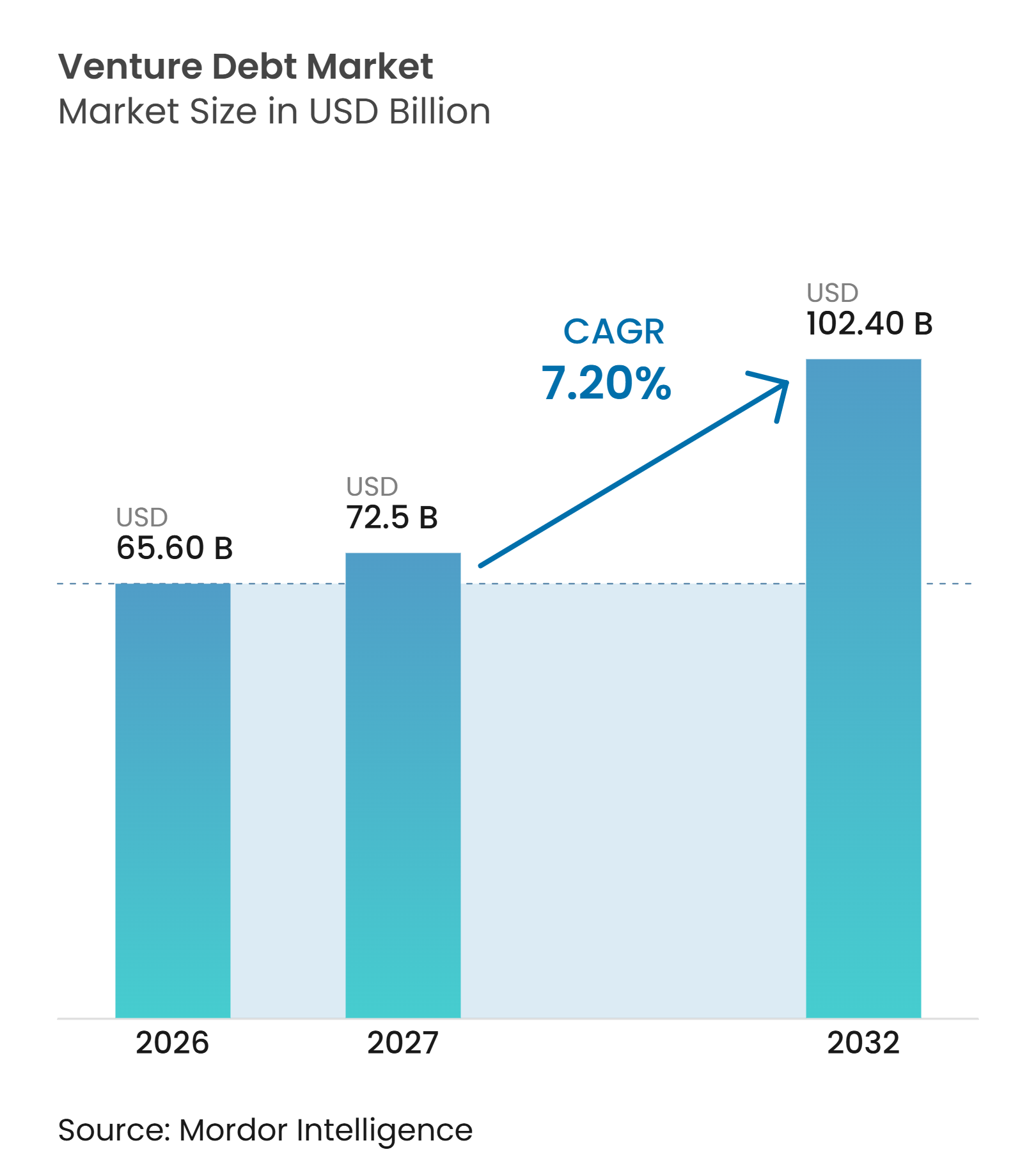
The Venture Debt Market size is expected to increase from USD 65.60 billion in 2026 to USD 72.5 billion in 2027 and reach USD 102.40 billion by 2032, growing at a CAGR of 7.20% over 2027-2032.
Tighter equity availability and longer private-company holding periods are increasing the role of debt in growth-stage financing. Borrowers are using venture debt to preserve ownership while extending cash runway between operating milestones. Lenders are responding with more specialized structures, although pricing and access vary by borrower quality and stage. Bank supervision is directing regulated lenders toward stronger credits, which is widening the role of specialty finance providers for borrowers with higher risk profiles. The venture debt market therefore combines broader institutional capacity with a more defined separation between lower-risk and higher-risk credits.
Key Report Takeaways
- By product type, term loans captured 67.1% of the venture debt market share in 2026, while venture leasing and equipment financing are projected to grow at a 9.2% CAGR through 2032.
- By lender type, banks and specialist banking institutions held 34.7% of the venture debt market share in 2026, while diversified private credit funds and asset managers are projected to grow at a 9.8% CAGR through 2032.
- By company stage, late-stage and pre-IPO companies captured 46.8% of the venture debt industry share in 2026, while early-stage companies are projected to grow at an 8.6% CAGR through 2032.
- By application and use of proceeds, cash runway extension and interim financing captured 32.3% of the venture debt market share in 2026, while capital expenditure and product development are projected to grow at an 8.3% CAGR through 2032.
- By industry vertical, software and enterprise technology captured 37.6% of the venture debt market share in 2026, while hardware, semiconductors, and deep tech are projected to grow at a 9.0% CAGR through 2032.
- By geography, North America captured 61.5% of the venture debt industry share in 2026, while Asia-Pacific is projected to grow at a 10.2% CAGR through 2032.
Note: Market numbers in this report are based on Mordor Intelligence's proprietary estimation framework, which combines nine months of actuals with Q4 projections for base year 2026.
Market Trends and Insights
Drivers Impact Analysis of Venture Debt Market*
| Driver | (~) % Impact on CAGR Forecast | Geographic Relevance | Impact Timeline |
|---|---|---|---|
| Demand for Non-Dilutive Capital and Longer Cash Runway | +2.1% | Global | Short term (≤ 2 years) |
| Growth Financing After Equity Rounds | +1.7% | North America and Europe | Short term (≤ 2 years) |
| Expansion of Specialist Lenders and Institutional Capital | +1.4% | North America, Europe, and Asia-Pacific | Medium term (2-4 years) |
| Longer Commercialization Timelines and Delayed Liquidity Events | +0.9% | Global | Medium term (2-4 years) |
| Financing Needs of AI and Life Sciences Startups | +1.6% | North America, Asia-Pacific, and Europe | Medium term (2-4 years) |
| Venture Debt Availability in Emerging Startup Ecosystems | +0.8% | Asia-Pacific, Middle East and Africa, and South America | Long term (≥ 4 years) |
| Source: Mordor Intelligence | |||
Demand for Non-Dilutive Capital to Extend Cash Runway
Founders are using debt when the ownership cost of raising equity at lower valuations exceeds the cost of interest and warrant coverage. This behavior is particularly relevant for companies that want to defer a down round while retaining time to meet operating goals. SaaS companies received more than USD 28 billion in venture debt for the second consecutive year, while follow-on financing exceeded USD 12.3 billion across 156 deals[1]. Stable cash burn is becoming more important for access, with 78% of closed growth-stage debt deals in the first half of 2026 involving companies with at least 6 quarters of stable or improving cash burn. This pattern supports continued demand in the venture debt market because debt provides time without requiring an immediate valuation reset. It also means that lenders can focus more closely on operating discipline, liquidity planning, and the borrower’s ability to reach the next defined milestone.
Rising Financing Needs of Capital-Intensive Startups, Including AI and Life Sciences
AI infrastructure and life sciences companies both require large investments before revenue can fully support their operating needs. GPU fleets, chip purchases, and clinical development programs can be financed with structures that are less dilutive than repeated equity issuance. PIMCO reported that AI capital expenditure is set to absorb 94% of hyperscaler operating cash flow in 2026 and 2027, which underscores the scale of financing needs among infrastructure builders[2]. The venture debt market benefits when lenders can use equipment and contracted revenue as support for senior secured facilities. Life sciences borrowers also need flexible capital because product approval timelines can remain long and uncertain. The financing need is greatest when the company must maintain development work before clinical, regulatory, or commercial milestones can support a larger equity event.
Growth Financing Needs of Venture-Backed Companies Following Equity Rounds
Venture-backed companies increasingly use venture debt alongside equity financing to extend cash runway, finance expansion, and achieve operating milestones without immediate shareholder dilution. Venture debt is generally used as complementary financing following equity rounds, although facility sizes vary according to company stage, revenue visibility, investor backing, and cash flow. United States venture capital investment reached USD 515.8 billion through Q3 2026, approximately 44% above the previous full-year record set in 2021, reflecting continued demand for growth capital[3]. Venture debt issuance reached USD 64.7 billion across 280 loans during the first half of 2026, although the figure included a USD 20 billion SpaceX debt refinancing, highlighting the increasing concentration of lending among large, established borrowers. Meanwhile, only 18 companies went public during Q3 2026, while 992 active unicorns held a combined valuation of USD 5.7 trillion, indicating that liquidity constraints persist despite stronger investment activity. These conditions sustain demand for non-dilutive financing among eligible venture-backed businesses seeking to bridge funding requirements between equity rounds, expansion milestones, and eventual liquidity events.
Expansion of Specialist Venture Lending Providers and Institutional Capital
The lender base is broadening as private credit funds, business development companies, and asset managers increase their participation. Silicon Valley Bank, a division of First Citizens Bank, announced a USD 2.5 billion lending relationship with Pinegrove Venture Partners in March 2025, restoring substantial deployment capacity for technology and life sciences borrowers[4]. Larger institutional pools can support longer-tenor facilities than many specialist lenders have historically offered. The venture debt market is also becoming more segmented because lenders differ in their underwriting tolerance, cost of capital, and sector expertise. This expansion can improve access for well-qualified borrowers while maintaining discipline for companies with limited repayment capacity. It also gives borrowers a broader choice between relationship banks, specialist providers, and larger institutional platforms when arranging a facility.
Restraints Impact Analysis of Venture Debt Market*
| Restraint | (~) % Impact on CAGR Forecast | Geographic Relevance | Impact Timeline |
|---|---|---|---|
| High All-In Borrowing Costs Against Repayment Capacity | -0.6% | Global | Short term (≤ 2 years) |
| Default Risk From Cash Burn, Limited Collateral, and Unproven Cash Flows | -0.5% | Global | Short term (≤ 2 years) |
| Dependence on Future Equity Funding for Repayment and Refinancing | -0.4% | Global | Medium term (2-4 years) |
| Limited Refinancing and Cross-Border Credit Enforcement Challenges | -0.3% | Cross-border markets, Middle East and Africa, and Asia-Pacific | Long term (≥ 4 years) |
| Source: Mordor Intelligence | |||
High All-In Borrowing Costs Relative to Borrower Repayment Capacity
Venture debt facilities commonly carry floating rates, origination fees, end-of-term payments, and warrant coverage. Bank-provided facilities typically price at SOFR plus 550 to 700 basis points, while specialty finance can price higher. These terms can raise the all-in cost of capital to 15% to 20% for borrowers with weaker credit profiles. The OCC states that declining unrestricted cash is not a sustainable primary repayment source, which requires bank lenders to match credit protections to a borrower’s stage and cash burn profile. Higher costs can reduce the benefit of debt for companies with negative free cash flow and uncertain fundraising schedules. Borrowers must therefore weigh the runway gained from a facility against the cash commitments and credit protections required over the life of the loan.
Elevated Default Risk From Cash Burn, Limited Collateral, and Unproven Cash Flows
Venture borrowers often lack stable free cash flow, mature collateral pools, and predictable refinancing options. The OCC identifies undeveloped products, declining liquid assets, and uncertainty about ongoing viability as important risks in venture lending. These conditions can require tighter covenants, cash sweeps, and closer monitoring by lenders. Horizon Technology Finance reported a net realized loss of USD 55.1 million for full-year 2025, demonstrating the recurring effect of credit losses on lender economics. Export licensing requirements for certain GPU collateral can also extend foreclosure timelines and reduce the practical value of collateral in a default. These constraints make it important for lenders to distinguish between the stated asset value and the value that could be recovered under a stressed sale process.
*Our forecasts treat driver/restraint impacts as directional, not additive. The impact forecasts reflect baseline growth, mix effects, and variable interactions.
Venture Debt Market Segment Analysis
By Product Type:
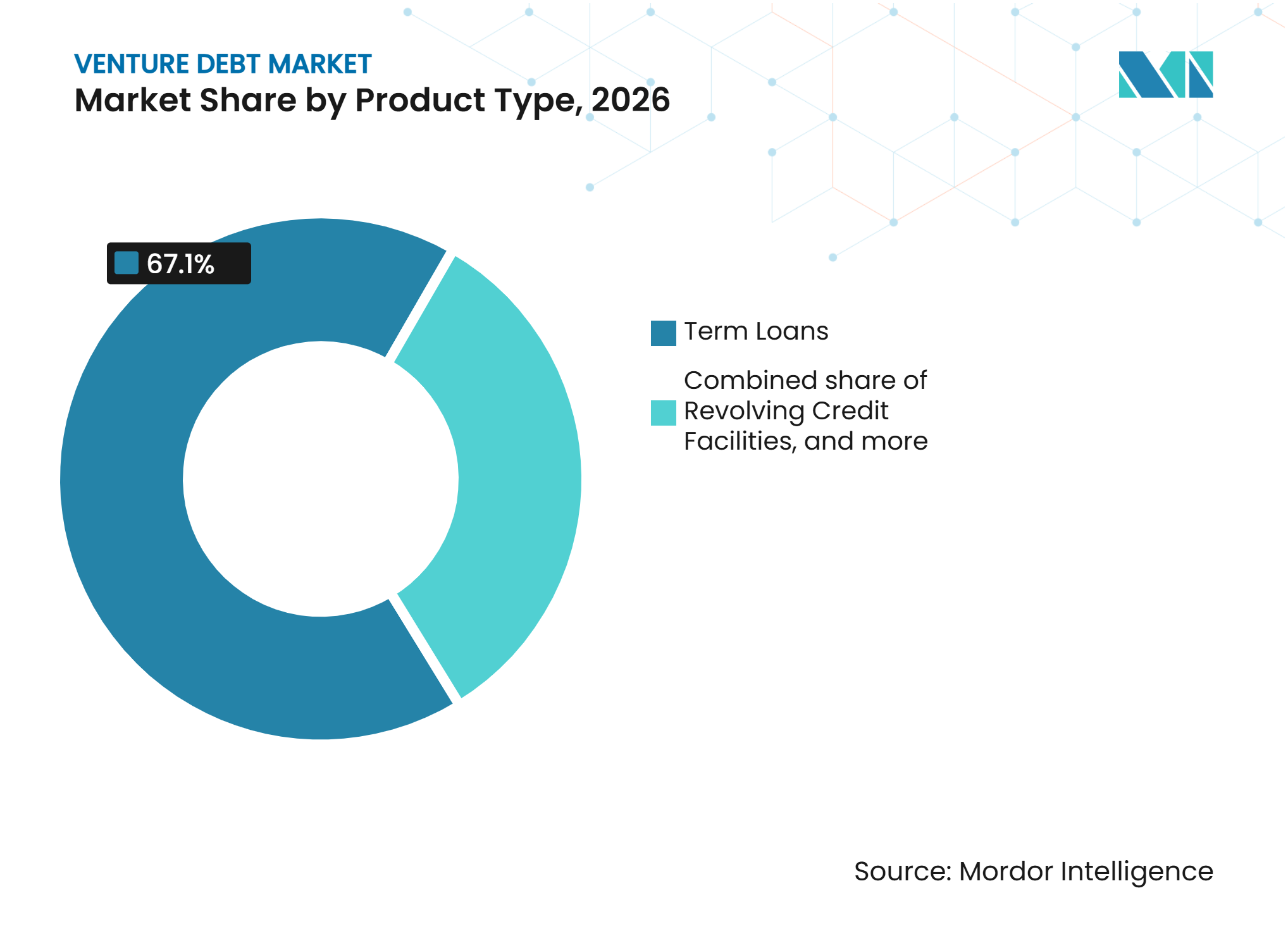
Term Loans Anchor Supply While Equipment Finance ExpandsTerm loans accounted for 67.1% of the venture debt market size in 2026, reflecting lender preference for first-lien structures with scheduled repayment. Bank supervisory guidance favors credit structures that offer clear repayment protection and active monitoring. Horizon Technology Finance reported portfolio yield targets of 14% to 16% in its 2025 filing, reflecting the return expectations associated with structured lending. Revolving credit facilities remain relevant for software and fintech companies with more regular working-capital cycles. Other specialized structures serve borrowers whose revenue and collateral profiles do not fit conventional term financing.
Venture leasing and equipment financing are projected to expand at a 9.2% CAGR from 2027 to 2032. This growth reflects demand for financing tied to GPU fleets and semiconductor equipment that can function as identifiable hard assets. Equipment-backed structures can reduce reliance on enterprise valuation alone when lenders assess repayment capacity. Export control requirements can influence the resale and recovery process for certain GPU equipment, requiring lenders to consider compliance before assigning collateral values. This part of the venture debt market can therefore serve capital-intensive borrowers that have physical assets but limited operating cash flow.


By Lender Type:
Institutions Replace Bank Incumbents While Specialist Funds Retain DepthBanks and specialist banking institutions held a 34.7% share of the venture debt market size in 2026. Their position reflects relationship lending, balance-sheet pricing, and links to cash-management services. First Citizens Bank’s Silicon Valley Bank division established a USD 2.5 billion lending relationship with Pinegrove Venture Partners in 2025, showing continued institutional capacity in this channel. Bank participation remains more focused on borrowers with stronger liquidity and identifiable repayment paths because of supervisory expectations. This approach leaves space for non-bank lenders in transactions that need more flexible underwriting.
Diversified private credit funds and asset managers are projected to expand at a 9.8% CAGR through 2032. These lenders can support larger and longer-duration facilities because they draw on broader pools of institutional capital. BlackRock disclosed its acquisition of Kreos Capital in its 2024 annual filing, adding an established venture lending capability to a larger asset-management platform. Public and development finance institutions are also supporting newer ecosystems, including the International Finance Corporation’s USD 25 million commitment to Trifecta Venture Debt Fund IV. Dedicated business development companies continue to be important for borrowers that value sector knowledge and tailored structures.
By Company Stage:
Late-Stage Companies Lead While Early-Stage Borrowing BroadensLate-stage and pre-IPO companies held a 46.8% share of the venture debt market in 2026. These borrowers can support larger facilities, often ranging from USD 50 million to USD 500 million, because they have more developed operating histories and institutional investor backing. The segment also includes companies preparing for delayed public offerings or acquisitions. Larger facilities can increase lender concentration within a small number of well-capitalized platforms. The venture debt industry therefore remains closely tied to the financing needs of companies that have progressed beyond initial product validation.
Early-stage companies are forecast to grow at an 8.6% CAGR from 2027 to 2032. Post-seed companies use debt to delay dilution before reaching Series A milestones. In India, Stride Ventures, Trifecta Capital, and Alteria Capital deployed more than INR 2,100 crore (USD 252 million) across more than 130 deals in the first half of 2025, with more participation from pre-Series A companies. Early-stage underwriting requires careful assessment because the borrower may have limited revenue and few hard assets. Lenders that combine sector expertise with active monitoring are better positioned to evaluate these credits.
By Application and Use of Proceeds:
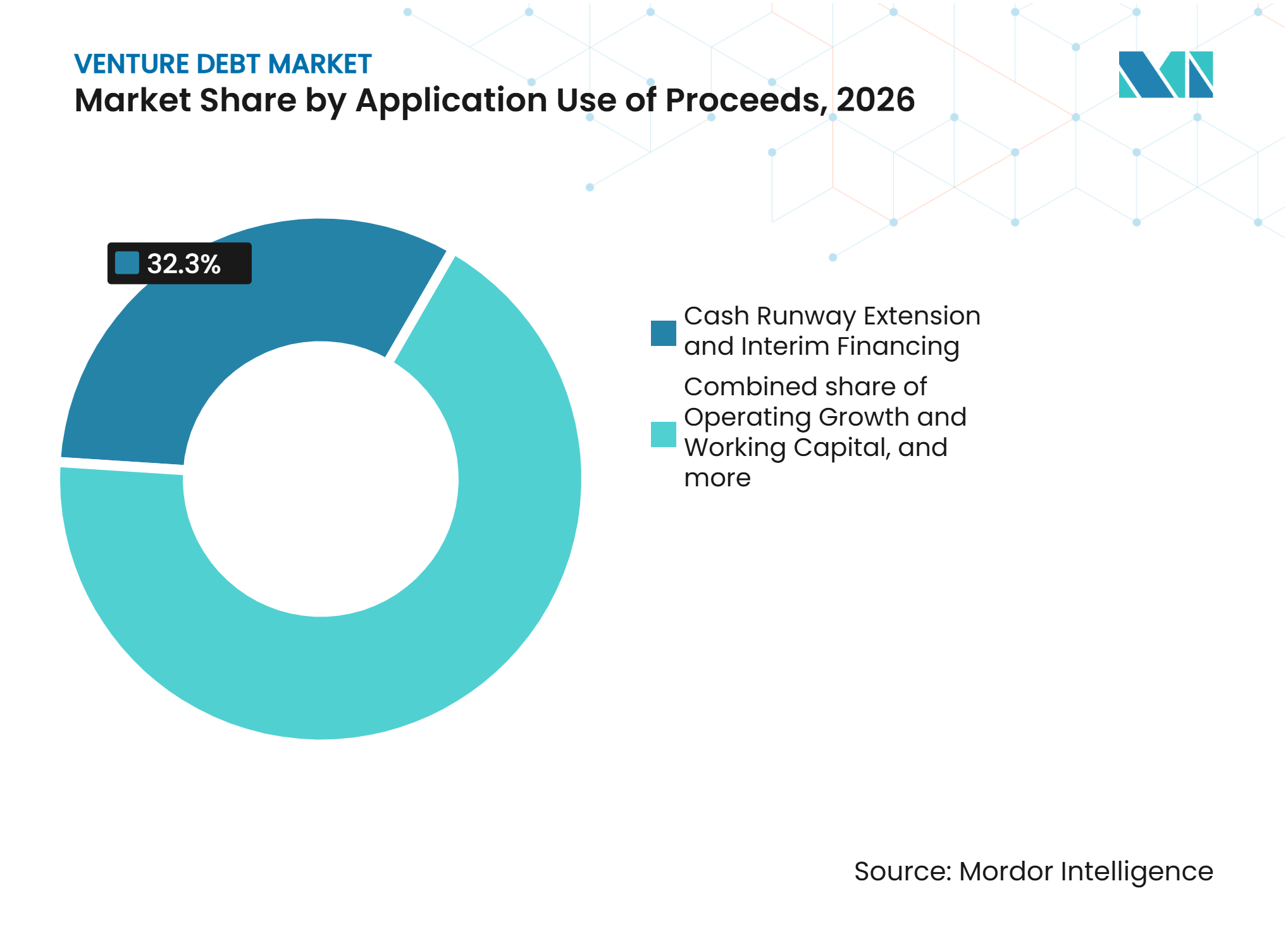
Runway Extension Leads While CapEx Financing RisesCash runway extension and interim financing held a 32.3% share of the venture debt market in 2026. Founders use these facilities to defer an equity round until the company reaches a higher-value operating milestone. Facilities based on committed cash flow are priced 175 basis points tighter than those based on expected equity events, showing that lenders place a premium on proven repayment capacity. Acquisition financing is another growing use, as shown by Runway Growth Capital’s USD 40 million senior secured loan to Autobooks in May 2025. These uses can sit within one facility when growth plans require both operating funding and strategic expansion.
Capital expenditure and product development are forecast to expand at an 8.3% CAGR from 2027 to 2032. AI infrastructure, semiconductor procurement, and clinical development require large upfront spending that is often suited to senior secured debt. Equipment financing can align repayment periods more closely with the useful life of the funded assets. Working-capital facilities are also relevant for consumer platforms in India, where they accounted for a 32% share in 2025. Refinancing and recapitalization will remain necessary as earlier facilities mature and borrowers reassess their capital structure.

By Industry Vertical:
Software Leads While Hardware and Deep Tech Gain MomentumSoftware and enterprise technology held a 37.6% share in 2026. SaaS businesses can offer lenders recurring revenue and retention measures that help demonstrate repayment capacity. This supports structured lending where the borrower has a defined customer base and measurable cash conversion. Fintech businesses also use debt for working capital, while climate technology and mobility companies increasingly use equipment-backed structures. The venture debt market has become more selective within software as lenders differentiate between mature recurring revenue profiles and unproven growth models.
Hardware, semiconductors, and deep tech are forecast to grow at a 9.0% CAGR through 2032. The segment benefits from structures supported by GPU and equipment collateral. These assets may provide lenders with a more direct security interest than a valuation-based financing approach. Healthcare, biotechnology, and life sciences form another growing borrower base because companies often need funding through long product-development cycles. Consumer and digital platform businesses remain smaller users and generally apply facilities to inventory or working-capital needs.
Geography Analysis
North America: Largest Market With Institutional Depth
North America held a 61.5% global share in 2026. The United States has the largest concentration of venture-backed companies, specialist lenders, business development companies, and private credit funds. Hercules Capital reported USD 3.92 billion in new commitments during 2025 and USD 5.7 billion in total assets under management. Trinity Capital reported USD 2.1 billion in new commitments in 2025, showing continued lending capacity among major platforms. Silicon Valley Bank’s USD 2.5 billion relationship with Pinegrove Venture Partners also shows that institutional-scale lending capacity has been rebuilt. OCC oversight is an important regulatory influence because it places greater attention on repayment sources, liquidity, and credit protections.
Asia-Pacific: Fastest-Growing Region With Lower Penetration
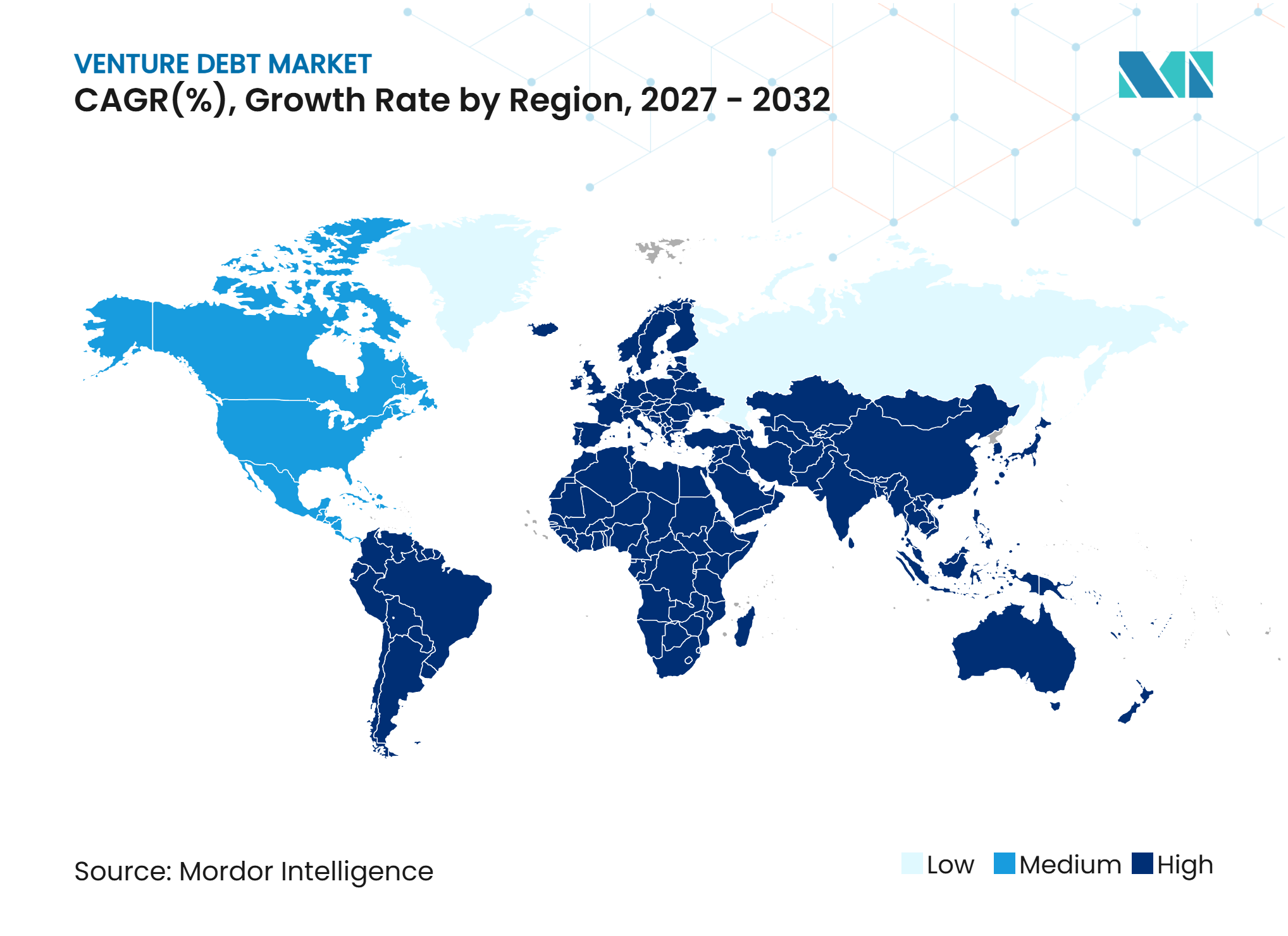
Asia-Pacific is projected to grow at a 10.2% CAGR from 2027 to 2032. Venture debt penetration remains below United States levels, giving lenders room to expand as startup ecosystems and local credit capabilities mature. India’s venture debt activity reached USD 1.3 billion in 2025, equal to a 9% share of venture capital deployment, compared with 20% to 30% in the United States and Europe. The International Finance Corporation’s USD 25 million commitment to Trifecta Venture Debt Fund IV supports further availability of non-dilutive capital in India and Southeast Asia. Singapore is emerging as a regional structuring hub, while Australia, Japan, South Korea, and Malaysia have growing lender activity. Local currency products and clearer security enforcement can strengthen the venture debt market by reducing cross-border repayment and recovery risk.
Europe, South America, and the Middle East and Africa: Complementary Expansion Paths
Europe is the second-largest regional venture debt market, with the United Kingdom representing an important center for activity. France, Germany, and the Nordic countries are also active lending markets for technology and life sciences companies. BlackRock’s venture lending platform has added a larger institutional base following its acquisition of Kreos Capital. South America remains an emerging lending environment led by Brazil and Mexico, where local credit knowledge can be important for underwriting. The Middle East and Africa have early-stage activity, including a USD 200 million Gulf Cooperation Council debt fund launched by Stride Ventures with support from Saudi Arabia’s Public Investment Fund. The mixed regional opportunity depends on stronger local lender networks, legal clarity, and financing structures that limit foreign-currency exposure.
Competitive Landscape
Market Concentration
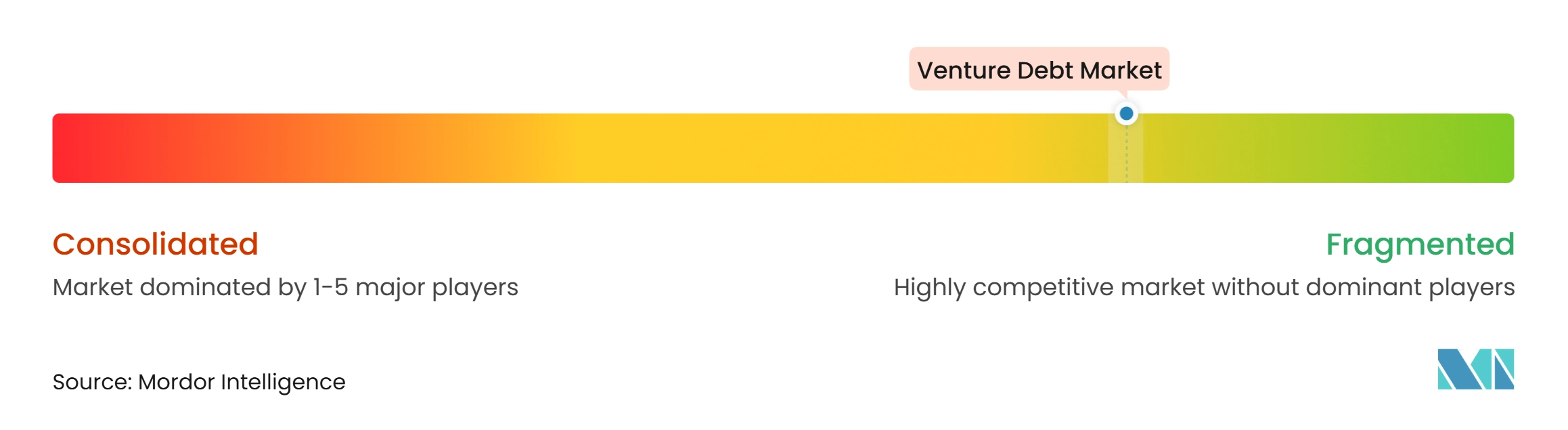
The venture debt market is fragmented, with more than 250 active lenders operating in the United States and approximately 30 in Europe. Competition is spread across business development companies, specialist banks, private credit funds, and institutional lenders, each serving different borrower segments and financing requirements. Established lenders compete through balance-sheet capacity, underwriting experience, and sector specialization, while smaller providers differentiate themselves through flexible financing structures and local market knowledge. Hercules Capital's USD 3.92 billion in commitments during 2025 demonstrates the lending capacity of established providers.
Strategic acquisitions and partnerships are strengthening individual lenders' capabilities and geographic reach. BlackRock's acquisition of Kreos Capital expanded its presence in European venture debt and growth financing. In 2026, Runway Growth Finance completed its acquisition of SWK Holdings, expanding its healthcare and life sciences lending capabilities. Trinity Capital and Capital Southwest also established an equally owned joint venture in March 2026, with each committing USD 50 million in equity to expand lending opportunities. These developments strengthen individual competitors but do not fundamentally alter the market's fragmented structure.
Smaller financing facilities, particularly those below USD 5 million, remain an opportunity for specialist lenders serving early-stage companies that may not meet larger institutions' lending requirements. Local-currency financing in emerging markets also offers opportunities to reduce foreign-exchange exposure for borrowers. Additionally, automated credit assessment tools that monitor cash burn, recurring revenue, and covenant compliance can improve underwriting efficiency and portfolio management. Regulatory expectations for stronger underwriting and ongoing credit monitoring, reinforced by the Office of the Comptroller of the Currency's guidance, further increase the importance of disciplined risk assessment.
Venture Debt Industry Leaders
-
Hercules Capital, Inc.
-
Trinity Capital Inc.
-
HSBC Innovation Banking
-
TriplePoint Venture Growth BDC Corp.
-
First Citizens Innovation Banking
- *Disclaimer: Major Players sorted in no particular order
Venture Debt Market Companies Covered in this Report
- Hercules Capital
- First Citizens Innovation Banking (formerly Silicon Valley Bank)
- Trinity Capital
- HSBC Innovation Banking
- TriplePoint Venture Growth BDC Corp.
- Horizon Technology Finance
- Runway Growth Finance
- Western Technology Investment
- Oxford Finance LLC
- Espresso Capital
- Kreos Capital
- Claret Capital Partners
- Bootstrap Europe
- Columbia Lake Partners
- Viola Credit
- InnoVen Capital
- Stride Ventures
- Alteria Capital
- Trifecta Capital
- Atempo Growth
Recent Industry Developments in Venture Debt Market
- October 2026: Trinity Capital originated USD 880 million in Q3 new commitments, bringing 2026 year-to-date to USD 2.0 billion, including USD 159 million in equipment financings reflecting demand for hardware and infrastructure-backed lending structures.
- September 2026: DEG proposed an additional USD 10 million loan to JC Growth Credit Fund 1 LP, January Capital, Singapore, supplementing an earlier USD 20 million loan, to support venture debt to growth-stage technology companies in Southeast Asia.
- March 2026: CoreWeave closed a USD 8.5 billion GPU-secured facility backed by a Meta Platforms contract worth at least USD 19 billion. A subsequent USD 3.1 billion GPU loan drew USD 19 billion in investor orders in April 2026.
- March 2026: Trinity Capital and Capital Southwest Corporation formed an equally owned joint venture targeting first-out senior secured debt in the lower middle market, with each committing USD 50 million in equity.
Global Venture Debt Market Report Scope
Segmentation Overview
| Term Loans |
| Revolving Credit Facilities |
| Venture Leasing and Equipment Financing |
| Other Specialized Structures |
| Banks and Specialist Banking Institutions |
| Dedicated Venture Debt Funds and BDCs |
| Diversified Private Credit Funds and Asset Managers |
| Public and Development Finance Institutions |
| Other Non-Bank Specialty Finance Companies |
| Early Stage |
| Expansion Stage |
| Late Stage and Pre-IPO |
| Cash Runway Extension and Interim Financing |
| Operating Growth and Working Capital |
| Capital Expenditure and Product Development |
| Acquisitions and Strategic Expansion |
| Debt Refinancing and Recapitalization |
| Other / Mixed / Unspecified |
| Software and Enterprise Technology |
| Healthcare, Biotechnology and Life Sciences |
| Fintech and Financial Services Technology |
| Climate Tech, Energy and Clean Technology |
| Hardware, Semiconductors and Deep Tech |
| Consumer, Commerce and Digital Platforms |
| Mobility, Transportation and Logistics |
| Other Industries |
| North America | United States |
| Canada | |
| Mexico | |
| South America | Brazil |
| Argentina | |
| Rest of South America | |
| Europe | United Kingdom |
| Germany | |
| France | |
| Italy | |
| Spain | |
| Rest of Europe | |
| Asia-Pacific | China |
| Japan | |
| India | |
| South Korea | |
| Australia | |
| Indonesia | |
| Thailand | |
| Malaysia | |
| Singapore | |
| Vietnam | |
| Rest of Asia-Pacific | |
| Middle East and Africa | Saudi Arabia |
| United Arab Emirates | |
| Turkey | |
| South Africa | |
| Egypt | |
| Rest of Middle East and Africa |
| By Product Type | Term Loans | |
| Revolving Credit Facilities | ||
| Venture Leasing and Equipment Financing | ||
| Other Specialized Structures | ||
| By Lender Type | Banks and Specialist Banking Institutions | |
| Dedicated Venture Debt Funds and BDCs | ||
| Diversified Private Credit Funds and Asset Managers | ||
| Public and Development Finance Institutions | ||
| Other Non-Bank Specialty Finance Companies | ||
| By Company Stage | Early Stage | |
| Expansion Stage | ||
| Late Stage and Pre-IPO | ||
| By Application and Use of Proceeds | Cash Runway Extension and Interim Financing | |
| Operating Growth and Working Capital | ||
| Capital Expenditure and Product Development | ||
| Acquisitions and Strategic Expansion | ||
| Debt Refinancing and Recapitalization | ||
| Other / Mixed / Unspecified | ||
| By Industry Vertical | Software and Enterprise Technology | |
| Healthcare, Biotechnology and Life Sciences | ||
| Fintech and Financial Services Technology | ||
| Climate Tech, Energy and Clean Technology | ||
| Hardware, Semiconductors and Deep Tech | ||
| Consumer, Commerce and Digital Platforms | ||
| Mobility, Transportation and Logistics | ||
| Other Industries | ||
| By Geography | North America | United States |
| Canada | ||
| Mexico | ||
| South America | Brazil | |
| Argentina | ||
| Rest of South America | ||
| Europe | United Kingdom | |
| Germany | ||
| France | ||
| Italy | ||
| Spain | ||
| Rest of Europe | ||
| Asia-Pacific | China | |
| Japan | ||
| India | ||
| South Korea | ||
| Australia | ||
| Indonesia | ||
| Thailand | ||
| Malaysia | ||
| Singapore | ||
| Vietnam | ||
| Rest of Asia-Pacific | ||
| Middle East and Africa | Saudi Arabia | |
| United Arab Emirates | ||
| Turkey | ||
| South Africa | ||
| Egypt | ||
| Rest of Middle East and Africa | ||
Key Questions Answered in the Report
What is the projected value of the venture debt market by 2032?
The venture debt market is projected to reach USD 102.4 billion by 2032, growing at a 7.2% CAGR from 2027.
Which product type has the largest share in venture debt?
Term loans lead with 67.1% share in 2026 because lenders favor structured first-lien facilities with clear repayment schedules.
Why do startups use venture debt?
Startups use venture debt to extend cash runway, finance capital needs, and reduce immediate equity dilution.
Which borrower stage is growing fastest?
Early-stage companies are forecast to grow at an 8.6% CAGR through 2032 as post-seed founders seek capital before Series A milestones.
Which region is expanding fastest for venture debt?
Asia-Pacific is forecast to expand at a 10.2% CAGR through 2032, supported by lower current penetration and developing lender networks.
What are the main risks for venture debt borrowers?
High all-in borrowing costs, cash burn, uncertain cash flow, dependence on future equity, and refinancing constraints are key risks.