
Vanilla Extract Market Size and Share
Market Overview
| Study Period | 2021 - 2031 |
|---|---|
| Market Size (2026) | USD 2.17 Billion |
| Market Size (2031) | USD 2.82 Billion |
| Growth Rate (2026 - 2031) | 5.39 % |
| Fastest Growing Market | Asia-Pacific |
| Largest Market | North America |
| Market Concentration | Low |
Major Players
*Disclaimer: Major Players sorted in no particular order Image © Mordor Intelligence. Reuse requires attribution under CC BY 4.0. |
|
Vanilla Extract Market Analysis by Mordor Intelligence
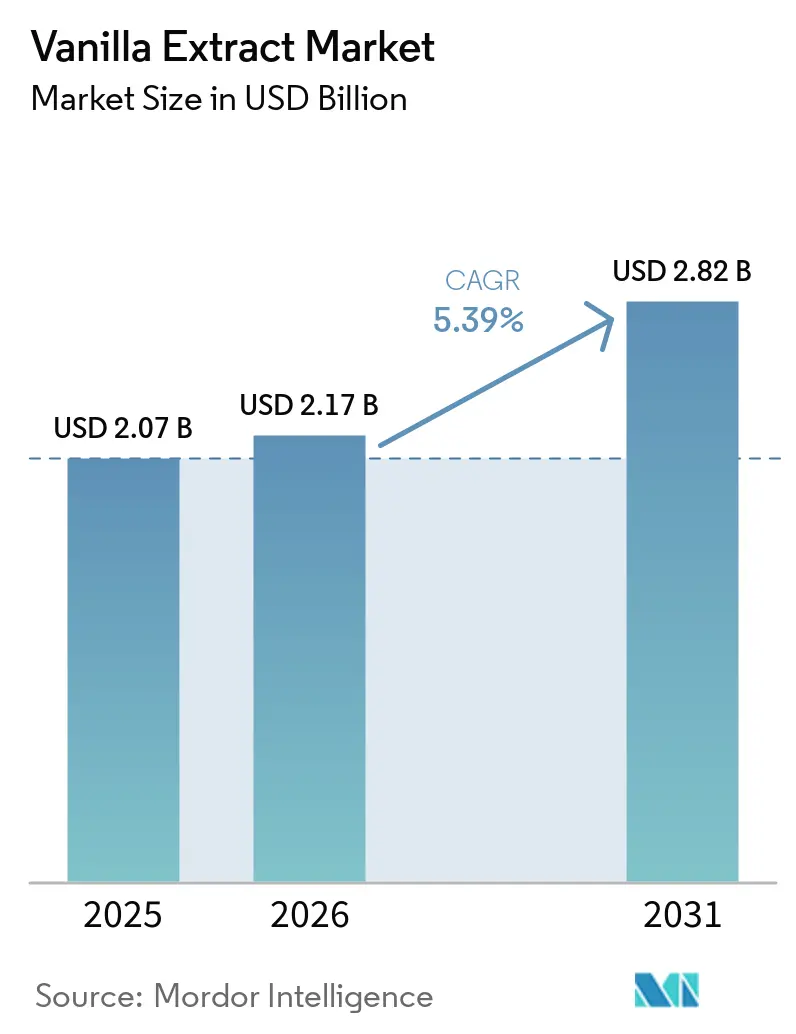
The vanilla extract market size was valued at USD 2.07 billion in 2025 to USD 2.17 billion in 2026, and is forecast to reach USD 2.82 billion by 2031 at a 5.39% CAGR over 2026-2031. Lower vanilla bean prices have improved the cost position of natural extract and expanded its use in food formulations that previously relied on synthetic vanillin. According to an article published in the Electronic Code of Federal Regulations in July 2026, labeling rules in the United States and Europe continue to distinguish natural vanilla flavoring from synthetic alternatives, supporting demand for bean-derived ingredients in products carrying natural claims[1]Source: Electronic Code of Federal Regulations, " Foods; labeling of spices, flavorings, colorings and chemical preservatives," ecfr.gov. Supply remains exposed to Madagascar’s climate conditions and recurring price cycles, making origin diversification and long-term procurement important competitive priorities. The vanilla extract market also faces emerging competition from fermentation-derived vanillin, although companies continue to differentiate natural extracts through flavor complexity, sourcing, and certification.
Key Report Takeaways
- By form, liquid led the vanilla extract market with a share of 67.83% in 2025, while powder is anticipated to register the fastest CAGR of 6.83% during 2026-2031.
- By end use, food processing retained a 67.67% share in 2025, whereas retail is forecast to expand at a 6.43% CAGR through 2031.
- By geography, North America led the vanilla extract market in 2025 with a 37.85% share, while Asia-Pacific is projected to advance at a 6.57% CAGR through 2031.
Note: Market size and forecast figures in this report are generated using Mordor Intelligence’s proprietary estimation framework, updated with the latest available data and insights as of January 2026.
Global Vanilla Extract Market Trends and Insights
Drivers Impact Analysis*
| Driver | (~) % Impact on CAGR Forecast | Geographic Relevance | Impact Timeline |
|---|---|---|---|
| Rising consumer preference for natural and clean label ingredients | +1.4% | Global | Long term (≥ 4 years) |
| Rapid growth of organic and sustainable food products | +1.1% | North America and European Union | Medium term (2-4 years) |
| Expanding application of vanilla extract across food and beverage manufacturing | +1.0% | Global | Medium term (2-4 years) |
| Growth in premium and artisanal food consumption globally | +0.7% | North America, European Union, and Asia-Pacific | Long term (≥ 4 years) |
| Single-origin, organic, and alcohol-free product innovation | +0.5% | North America and European Union | Long term (≥ 4 years) |
| E-commerce and specialty retail expansion | +0.4% | North America, European Union, and Asia-Pacific | Medium term (2-4 years) |
| Source: Mordor Intelligence | |||
Rising Consumer Preference for Natural and Clean Label Ingredients
Regulations in the United States and Europe clearly distinguish natural vanilla flavoring from petrochemical-derived synthetic vanillin. Synergy Flavors’ 2025 report stated that 89% of surveyed consumers were willing to pay more for products labeled as containing pure vanilla extract. According to Archer-Daniels-Midland Company, natural extract contains more than 300 flavor compounds and can enhance sweetness perception, reduce astringency in plant proteins, and improve mouthfeel in lower-fat and lower-sugar formulations. As food manufacturers increasingly reformulate products to meet clean-label and premium positioning requirements, demand for authentic vanilla extract continues to strengthen across multiple food categories. These functional benefits link the vanilla extract market to reformulation activity in dairy alternatives, protein products, and foods designed to deliver more intense flavor in smaller portions.
Rapid Growth of Organic and Sustainable Food Products
Certified sourcing is gaining importance in the vanilla extract market, particularly among food brands serving premium retail channels. Givaudan’s SOMAVA joint venture in Madagascar supplies selected Rainforest Alliance Certified vanilla for extraction in the Netherlands. In June 2025, Givaudan’s SOMAVA joint venture in Madagascar supplied selected Rainforest Alliance Certified vanilla for extraction in the Netherlands. The company stated that its associated community programs reached more than 10,000 people in Madagascar and enabled customers to use the Rainforest Alliance seal on product packaging. Organic certification, sustainability programs, and traceability documentation influence access to premium customers and brand positioning. In the vanilla extract market, suppliers without these credentials may face a competitive disadvantage, even when their extract quality meets buyer specifications.
Expanding Application of Vanilla Extract Across Food and Beverage Manufacturing
The vanilla extract market is expanding beyond traditional bakery and dairy applications. Food manufacturers use vanilla extract to reduce plant-based off-notes, improve sweetness balance, and deliver a fuller taste in lower-fat and lower-sugar products. According to Flavorsum, vanilla launches in United States food products increased by 14% in the 52 weeks ended March 2026, three times the rate of total category innovation. The increasing diversification of vanilla extract across functional, plant-based, and health-oriented food categories is further strengthening its role as a versatile natural flavor ingredient. Ready-to-drink protein beverages, oat milk, wellness bars, and gut-health products are creating additional demand channels for the vanilla extract market. This broader application base supports market growth, as manufacturers increasingly choose vanilla extract for both flavor delivery and formulation performance.
Growth In Premium and Artisanal Food Consumption Globally
The vanilla extract market is witnessing rising demand for single-origin products, as provenance and supply chain transparency increasingly influence purchasing decisions. Premium bakery products, handcrafted chocolates, gourmet ice creams, specialty beverages, and fine desserts use natural vanilla extract to deliver authentic flavor and strengthen product differentiation. Ready-to-drink protein beverages, oat milk, wellness bars, and gut-health products are creating additional demand channels for the vanilla extract market. Rising disposable incomes, evolving consumer preferences, and consumers’ willingness to pay a premium for high-quality foods are encouraging manufacturers to incorporate pure vanilla extract into their formulations, supporting market growth.
Restraints Impact Analysis*
| Restraint | (~) % Impact on CAGR Forecast | Geographic Relevance | Impact Timeline |
|---|---|---|---|
| Limited vanilla bean supply due to climate-dependent cultivation | -0.8% | Global, with Madagascar at the core and spillover to Indonesia and Uganda | Long term (≥ 4 years) |
| High price volatility of natural vanilla beans and extracts | -0.6% | Global | Medium term (2-4 years) |
| Low-cost synthetic vanilla alternatives | -0.5% | Global, particularly price-sensitive Asia-Pacific and Middle East and Africa | Short term (≤ 2 years) |
| Disruptions across vanilla-producing regions | -0.4% | Global, with Madagascar concentrated | Short term (≤ 2 years) |
| Source: Mordor Intelligence | |||
Limited Vanilla Bean Supply Due to Climate-Dependent Cultivation
Madagascar remains the key supplier of global vanilla beans, leaving the vanilla extract market exposed to conditions in a single producing country. A March 2025 Public Library of Science Climate study surveyed 479 small-scale farmers in Madagascar’s Sava region and found worsening temperature and rainfall conditions. Fewer than 20% of the surveyed farmers had changed their agricultural practices in response[2]Source: PHYS ORG, " In the heart of vanilla country," phys.org. The current supply surplus does not eliminate the market’s underlying exposure to cyclones or poor rainfall during a harvest season. A severe disruption in Sava can quickly shift the supply position from surplus to shortage, as seen after Cyclone Enawo. As a result, extract producers and food manufacturers are increasingly prioritizing multi-origin procurement from Indonesia, Uganda, and Papua New Guinea.
High Price Volatility of Natural Vanilla Beans and Extracts
The vanilla extract market remains vulnerable to fluctuations in natural vanilla bean availability, as production is concentrated in a few tropical regions highly susceptible to climatic events and supply disruptions. In 2024, Cyclone Gamane affected major vanilla-growing areas in Madagascar, prompting industry participants to emphasize diversified sourcing to reduce supply risks. Additionally, a 2024 Public Library of Science ONE study highlighted that successive crises, including cyclones and market instability, increased the vulnerability of vanilla farming communities and affected the long-term resilience of the supply chain[3]Source: PLOS ORG, " Compounding impacts of COVID-19," journals.plos.org. These recurring disruptions create uncertainty for vanilla extract manufacturers, making raw material procurement and production planning more challenging.
*Our forecasts treat driver/restraint impacts as directional, not additive. The impact forecasts reflect baseline growth, mix effects, and variable interactions.
Segment Analysis
By Form: Powder Formats Gaining Ground in High-Temperature Applications
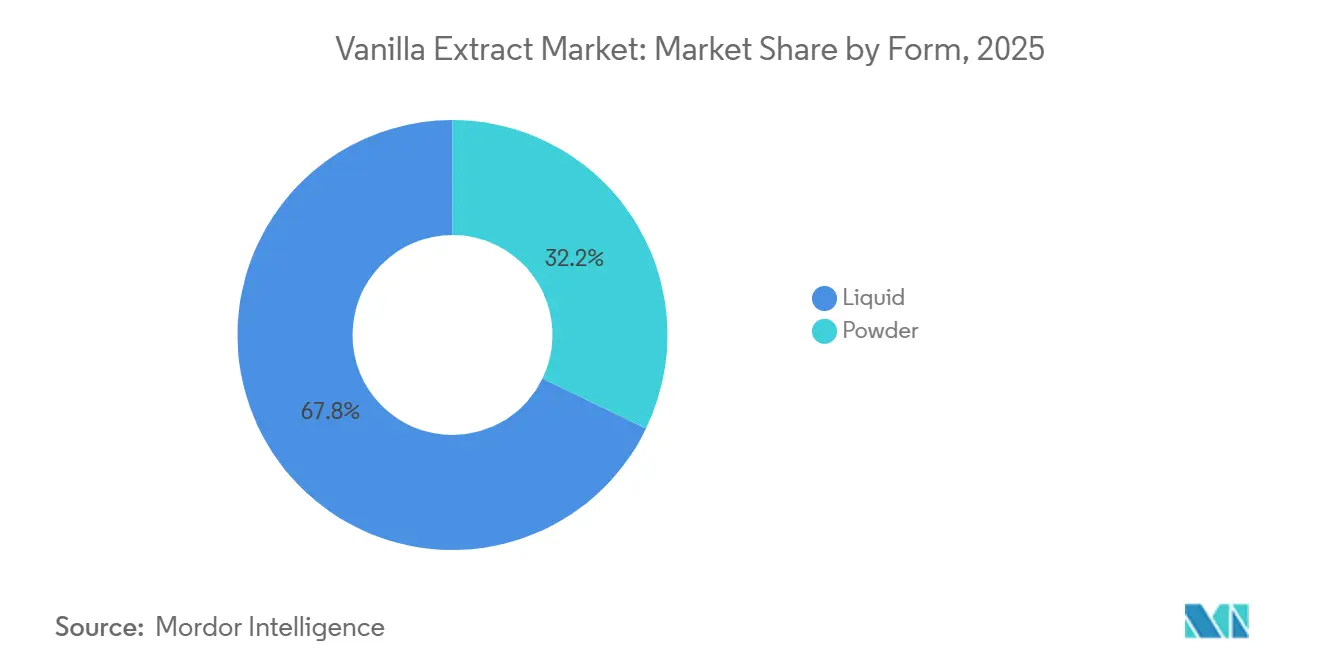
Liquid extract holds 67.83% of the vanilla extract market share in 2025, while powder extract is forecast to grow at a CAGR of 6.83% from 2026 to 2031. Powder growth is linked to stronger aromatic retention during baking, a key advantage for large producers of biscuits, brownies, pastries, and other high-heat baked products. Encapsulated powder supports natural vanilla extract claims while improving flavor consistency in industrial production. Liquid extract remains widely used because its water-and-alcohol base disperses easily across mixing, homogenization, and filling lines, eliminating the reconstitution step required for powder formats. Alcohol-free liquid products are gaining traction among halal-certified manufacturers and health-oriented brands in Southeast Asia and the Middle East.
The vanilla extract market size for powder is supported by its suitability for high-temperature food production. Flavorchem stated that its process repurposes 100% of spent vanilla beans into secondary culinary-grade ingredients, which may reduce the cost gap between liquid and powder formats. Producers are increasingly offering the same single-origin vanilla in liquid and powder forms to meet diverse manufacturing requirements. The American Society of Baking describes vanilla as the most widely used flavor in baked goods globally, supporting a stable demand base for liquid extract in 2025.


By End Use: Food Processing Anchors Volume While Retail Redefines Margin
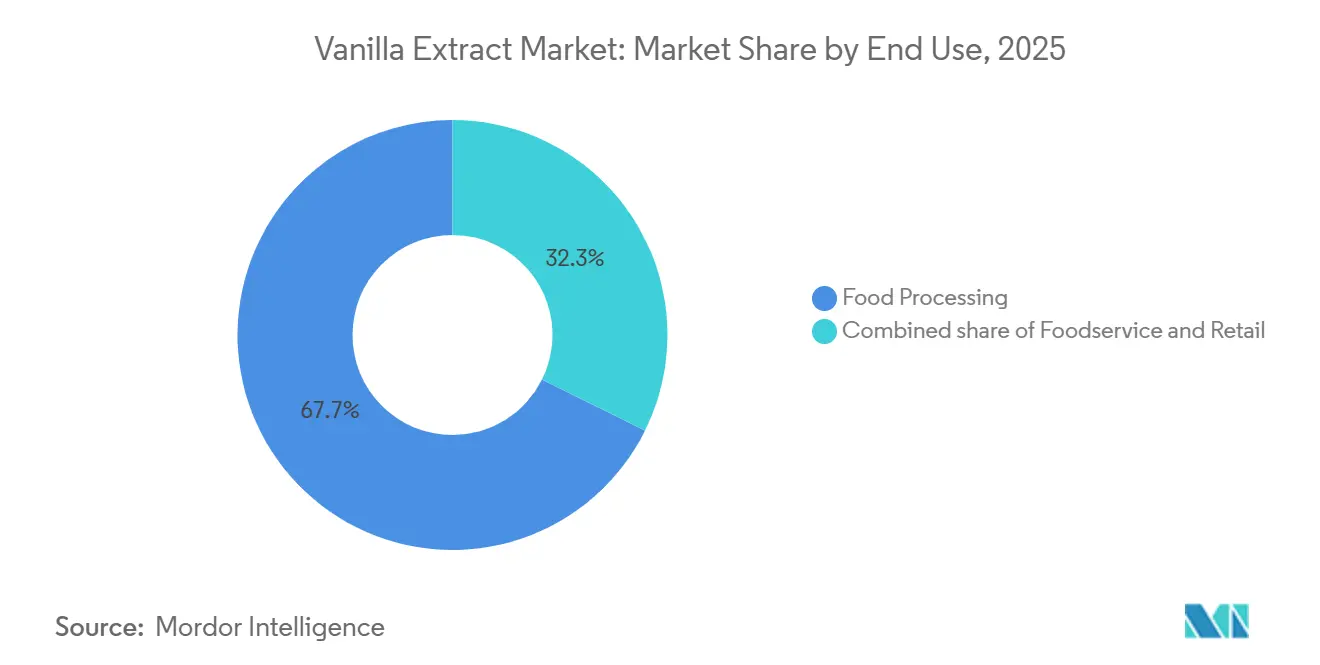
Food processing holds 67.67% of the vanilla extract market share in 2025. Bakery and confectionery represent the largest use within food processing, as vanilla remains a core flavor in cakes, cookies, biscuits, pastries, and chocolate products. Dairy and frozen-dessert producers also use vanilla extract as they shift from synthetic vanillin to natural ingredients. Ready-to-drink coffee, oat milk, and protein shakes represent emerging application areas, where vanilla can enhance flavor and help moderate undesirable notes from plant proteins. Foodservice contributes additional demand through premium quick-service chains, hotel pastry operations, and artisanal cafes. Although its scale remains below that of industrial food processing, foodservice supports higher-value applications that rely on pure vanilla extract.
Retail is the fastest-growing end-use channel, with a forecast CAGR of 6.43% through 2031. Single-serve packets, multi-fold extracts, origin-specific bean pastes, and organic-certified products are expanding retail options for home bakers. These formats address portion control and convenience for health-conscious consumers. As a result, the vanilla extract industry can support industrial volumes through supply agreements while pursuing higher returns through branded retail and e-commerce products. Retail growth also gives extract producers a direct channel to communicate origin, certification, and format differences to consumers.

Geography Analysis
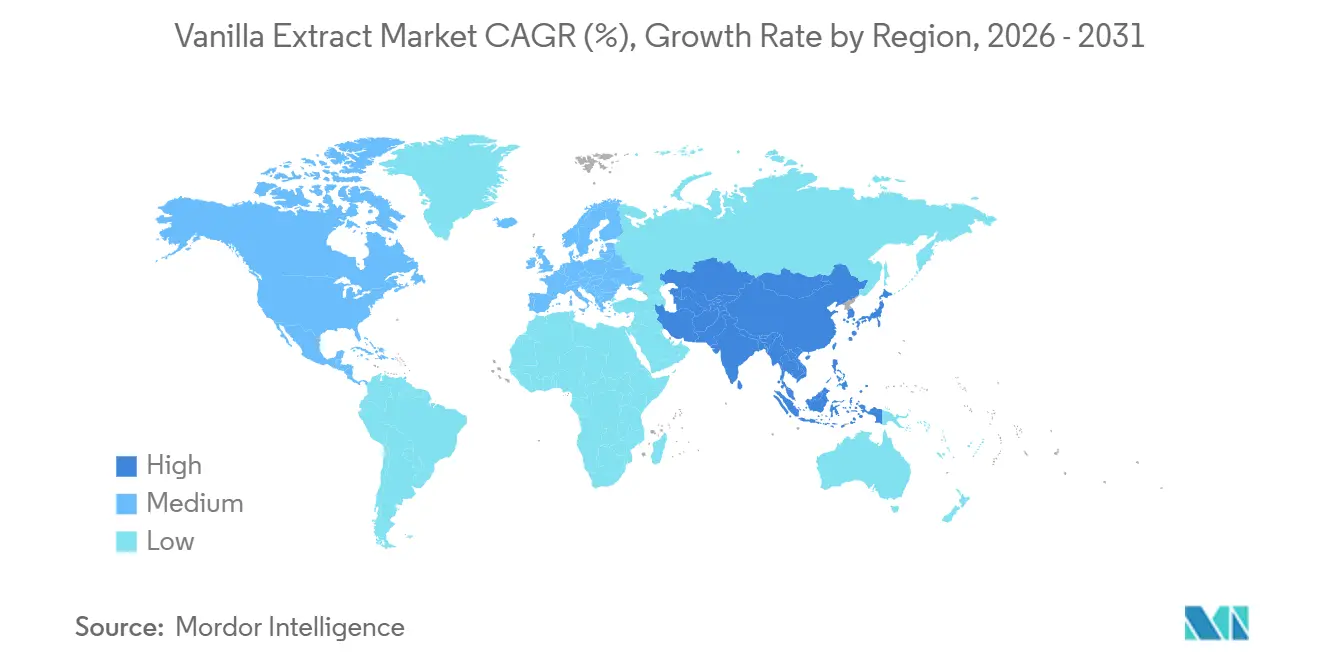
North America accounted for 37.85% of global revenue in 2025. The region benefits from strong home baking trends, well-developed premium food retail, and the presence of major flavor houses and specialist extract brands. The United States Food and Drug Administration regulations establish a Standard of Identity for pure vanilla extract under 21 CFR 169. This standard defines labeled pure extract products and limits substitution by imitation products in those applications. Canada and Mexico further support regional demand. Mexico is the botanical origin of Vanilla planifolia, and Nielsen-Massey has promoted Mexican vanilla bean paste as an origin-specific option.
In the vanilla extract market, Asia-Pacific is projected to register the highest regional CAGR, at 6.57%, from 2026 to 2031. China and India remain the key growth engines, supported by the expansion of bakery, dairy, confectionery, and premium retail formats. Japan’s premium ice cream and confectionery categories support demand for natural vanilla. South Korea’s cafe culture and bakery chains also contribute to extract imports. Indonesia plays a dual role as a vanilla producer and a growing domestic consumer of artisan and industrial vanilla products. Southeast Asian food formats are also incorporating vanilla into coconut desserts, rice flour confectionery, and tropical beverages, broadening demand beyond Western-style food categories.
Demand from premium confectionery, artisanal bakery, and fine fragrance applications in Germany, France, and the Netherlands supports Europe’s vanilla extract market size. The regulatory definition helps sustain demand for genuine extract in natural-labeled products. Givaudan’s Rainforest Alliance Certified vanilla extracts provide European customers with a documented certified supply option. South America remains at an earlier development stage, with Brazil and Colombia offering longer-term potential driven by artisan food demand and native vanilla diversity. The Middle East and Africa remain relevant markets for alcohol-free extracts, halal-compliant product lines, and regional food manufacturing.

Competitive Landscape
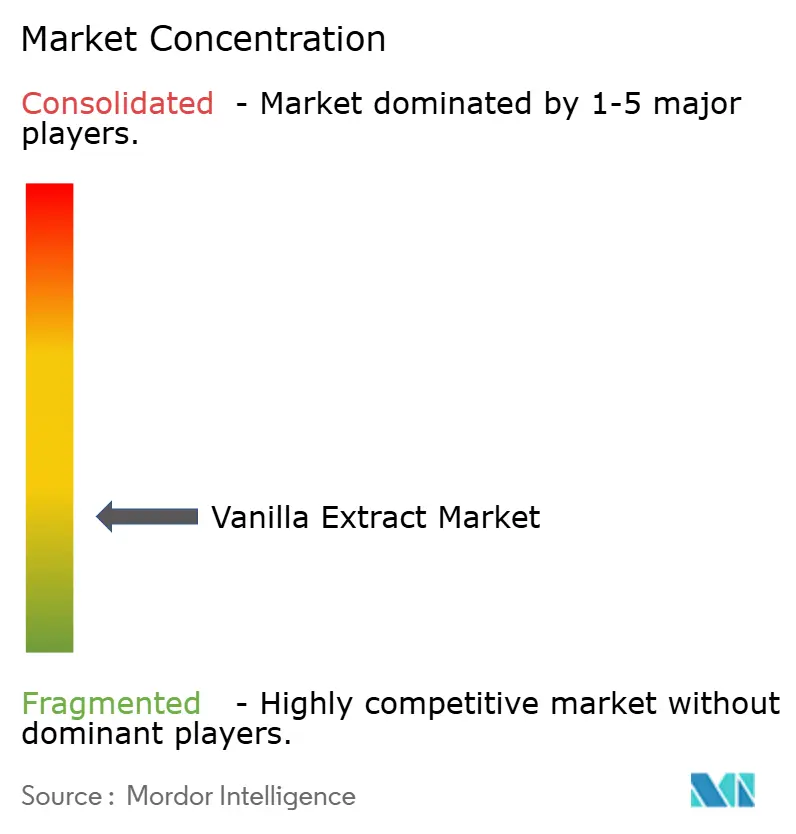
The vanilla extract market is fragmented, with multinational flavor houses competing with specialist extract producers and smaller direct-to-consumer brands. Symrise, Givaudan, International Flavors & Fragrances (IFF), and Kerry Group offer broad formulation and sourcing capabilities. Rodelle, Prova, and Flavorchem compete through origin-specific products and processing innovation. In May 2026, IFF opened a 650-square-meter Vanilla Innovation Center in Toamasina, Madagascar. The site includes extraction equipment, molecular profiling capabilities, an application laboratory, and the RE-MASTER VANILLA training program. This investment is expected to position product development and supply chain capabilities closer to the raw material base.
In February 2026, IFF also achieved Fair Trade and Fair for Life certifications across several vanilla flavor and extraction sites. These credentials are expected to support customer procurement requirements in Europe and North America. Symrise presented its SymVision platform for flavor trend forecasting during World Vanilla Day activities in April 2026. Flavorchem launched its Art of Vanilla portfolio in June 2025 and describes a zero-waste extraction process that repurposes all spent vanilla beans. These developments indicate that sourcing, certification, product development, and circular processing remain key competitive factors in the vanilla extract market.
Within the vanilla extract market, smaller companies such as Heilala and VanillaPura address premium demand through single-origin positioning and regenerative sourcing claims. Alcohol-free extracts remain an opportunity for halal-certified and health-positioned foods in Southeast Asia and the Middle East. Functional products that combine vanilla with plant proteins, probiotics, or adaptogens represent another area of product development. Multi-origin supply from Madagascar, Indonesia, Uganda, and Papua New Guinea can reduce exposure to a single production area. Fermentation-derived vanillin may increase competitive pressure, especially where buyers prioritize consistency and availability over bean-derived flavor complexity.
Vanilla Extract Industry Leaders
-
International Flavors & Fragrances
-
McCormick & Company, Inc.
-
Kerry Group plc.
-
Rodelle Inc.
-
Givaudan SA
- *Disclaimer: Major Players sorted in no particular order

Recent Industry Developments
- May 2026: IFF opened a 650-square-meter Vanilla Innovation Center in Toamasina, Madagascar, co-locating lab analysis, extraction, molecular profiling, flavor creation, and an application development laboratory at the source. The facility includes The Bloomery greenhouse for varietal research and the RE-MASTER VANILLA training program for customers and local teams. The center strengthens supply resilience, shortens formulation development cycles, and embeds IFF's vanilla network closer to the raw material base.
- June 2025: Flavorchem unveiled “The Art of Vanilla,” a comprehensive premium vanilla portfolio built on zero-waste extraction technology that repurposes 100% of spent vanilla beans, with more than 50% converted into culinary-grade powder. The platform offers comprehensive regulatory support for global compliance, positioning Flavorchem as a full-lifecycle vanilla solutions provider for brands that require end-to-end sustainability documentation.
- June 2025: Givaudan introduced Rainforest Alliance Certified vanilla extracts for the European market, sourcing them through its SOMAVA joint venture with Henri Fraise Fils et Cie in Madagascar. The certification allows customers to display the Rainforest Alliance frog seal on final packaging. Community programs covering more than 10,000 Madagascan villagers support the initiative, integrating supply chain ethics into Givaudan’s European extract offering.


Global Vanilla Extract Market Report Scope
Vanilla extract is a flavoring ingredient produced by extracting aromatic compounds from cured vanilla beans using a solvent, typically a mixture of alcohol and water. It is primarily used to impart a distinct vanilla aroma and flavor to food and beverage products.
The vanilla extract market is segmented by form, end use, and geography. By form, the market is segmented into liquid and powder. By end use, the market is segmented into food processing (bakery and confectionery, dairy and frozen desserts, beverages, and others), foodservice, and retail. Based on geography, the market is classified into North America, Europe, South America, Asia-Pacific, and the Middle East and Africa. The market forecasts are provided in terms of value (USD).
| Liquid |
| Powder |
| Food Processing | Bakery and Confectionery |
| Dairy and Frozen Desserts | |
| Beverages | |
| Others | |
| Foodservice | |
| Retail |
| North America | United States |
| Canada | |
| Mexico | |
| Rest of North America | |
| Europe | Germany |
| United Kingdom | |
| Italy | |
| France | |
| Spain | |
| Netherlands | |
| Poland | |
| Belgium | |
| Sweden | |
| Rest of Europe | |
| Asia-Pacific | China |
| India | |
| Japan | |
| Australia | |
| Indonesia | |
| South Korea | |
| Thailand | |
| Singapore | |
| Rest of Asia-Pacific | |
| South America | Brazil |
| Argentina | |
| Colombia | |
| Chile | |
| Peru | |
| Rest of South America | |
| Middle East and Africa | South Africa |
| Saudi Arabia | |
| United Arab Emirates | |
| Nigeria | |
| Egypt | |
| Morocco | |
| Turkey | |
| Rest of Middle East and Africa |
| By Form | Liquid | |
| Powder | ||
| By End Use | Food Processing | Bakery and Confectionery |
| Dairy and Frozen Desserts | ||
| Beverages | ||
| Others | ||
| Foodservice | ||
| Retail | ||
| By Geography | North America | United States |
| Canada | ||
| Mexico | ||
| Rest of North America | ||
| Europe | Germany | |
| United Kingdom | ||
| Italy | ||
| France | ||
| Spain | ||
| Netherlands | ||
| Poland | ||
| Belgium | ||
| Sweden | ||
| Rest of Europe | ||
| Asia-Pacific | China | |
| India | ||
| Japan | ||
| Australia | ||
| Indonesia | ||
| South Korea | ||
| Thailand | ||
| Singapore | ||
| Rest of Asia-Pacific | ||
| South America | Brazil | |
| Argentina | ||
| Colombia | ||
| Chile | ||
| Peru | ||
| Rest of South America | ||
| Middle East and Africa | South Africa | |
| Saudi Arabia | ||
| United Arab Emirates | ||
| Nigeria | ||
| Egypt | ||
| Morocco | ||
| Turkey | ||
| Rest of Middle East and Africa | ||


Key Questions Answered in the Report
What is the size and growth outlook of the vanilla extract market?
The vanilla extract market was valued at USD 2.07 billion in 2025 and is projected to grow from USD 2.17 billion in 2026 to USD 2.82 billion by 2031, registering a CAGR of 5.39% during 2026-2031.
Which form segment held the largest share of the vanilla extract market in 2025?
The liquid vanilla extract segment held the largest market share in 2025, accounting for 67.83% of the market.
Which end-use segment dominated the vanilla extract market in 2025?
The food processing segment dominated the market with a 67.67% share in 2025.
Which region accounted for the largest share of the vanilla extract market in 2025?
North America was the leading regional market, holding 37.85% of the market share in 2025.
Which region is projected to be the fastest-growing vanilla extract market during 2026-2031?
The Asia-Pacific region is expected to be the fastest-growing market, recording a CAGR of 6.57% during the forecast period.
Page last updated on:


 Your data is secure and never sold or shared.



