
Uzbekistan Table Grapes Market Size and Share
Uzbekistan Table Grapes Market Analysis by Mordor Intelligence
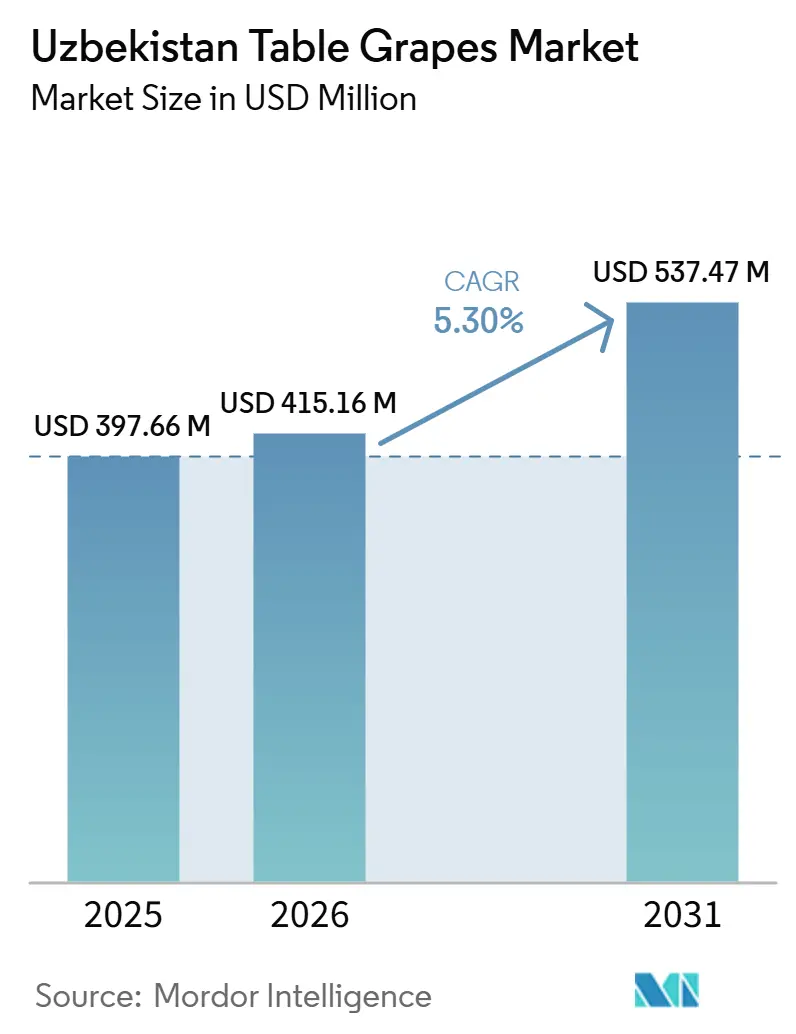
The Uzbekistan Table Grapes Market size is projected to expand from USD 397.66 million in 2025 and USD 415.16 million in 2026 to USD 537.47 million by 2031, registering a CAGR of 5.30% between 2026 to 2031. The market is benefiting from investments in post-harvest infrastructure, including cold storage, pre-cooling, and controlled-atmosphere facilities that help preserve fruit quality, reduce post-harvest losses, and extend market availability. Export-oriented production continues to shape market development, with producers strengthening quality standards, grading, packaging, and logistics to meet international buyer requirements. Market participants are also gradually expanding cultivation of premium seedless varieties in response to changing consumer preferences and stronger demand from export destinations, while improving product differentiation and export competitiveness. Government-backed irrigation modernization and infrastructure development are further enhancing vineyard productivity, water-use efficiency, and fruit quality across key grape-growing regions. These investments, combined with improved cultivation practices and export-focused value chain development, are projected to support sustainable growth and strengthen Uzbekistan's position as a major supplier of fresh table grapes in regional and international markets.
Key Report Takeaways
- According to the National Statistics Committee of the Republic of Uzbekistan, Samarkand was the country's largest grape-producing region in 2025, harvesting 696,952 metric tons, or approximately 35% of Uzbekistan's total grape output of 1.98 million metric tons. Bukhara (241,389 metric tons) and Fergana (229,063 metric tons) followed, underscoring Samarkand's dominant role in the country's table grape industry and export supply.
Note: Market size and forecast figures in this report are generated using Mordor Intelligence’s proprietary estimation framework, updated with the latest available data and insights as of January 2026.
Uzbekistan Table Grapes Market Trends and Insights
Drivers Impact Analysis*
| Driver | (~) % Impact on CAGR Forecast | Geographic Relevance | Impact Timeline |
|---|---|---|---|
| Export demand from Russia and neighboring markets | +2.3% | National, with concentration in Samarkand, Fergana, and Bukhara export corridors | Short term (≤ 2 years) |
| Expansion of cold storage and pre-cooling capacity | +1.6% | National, with early gains in Fergana Valley and Samarkand | Medium term (2-4 years) |
| Irrigation modernization in vineyard belts | +1.2% | National, with priority in Kashkadarya, Namangan, Surkhandarya, and Bukhara | Long term (≥ 4 years) |
| Premiumization of seedless and high-brix table grapes | +0.9% | National, with stronger activity in Fergana and Ohangaron | Medium term (2-4 years) |
| Export grade traceability and certification readiness | +0.7% | National, with spillover to Japan, South Korea, the Gulf, and the European Union destination markets | Medium term (2-4 years) |
| Off-season supply advantage from early and late harvest windows | +0.5% | National, led by Surkhandarya for early harvest and the Fergana to Samarkand corridor for later harvest | Short term (≤ 2 years) |
| Source: Mordor Intelligence | |||
Export Demand from Russia and Neighboring Markets
Growing demand from Russia and neighboring CIS countries is encouraging Uzbek producers to expand commercial table grape production and prioritize export-quality fruit, thereby driving the Uzbekistan table grapes market. According to the World Integrated Trade Solution (WITS), Russia imported USD 152.6 million worth of fresh grapes from Uzbekistan in 2024, which is major supplier and reinforcing its position as the country's largest export destination[1].Source: World Integrated Trade Solution (WITS), World Bank, “Uzbekistan Fresh Grapes Exports by Country, 2024,” wits.worldbank.org. Sustained regional demand encourages growers to adopt higher-quality varieties, strengthen export-oriented cultivation practices, and improve supply reliability, supporting higher production volumes and long-term investment across the table grape value chain.
Expansion of Cold Storage and Pre-Cooling Capacity
Expansion of cold storage and pre-cooling capacity is strengthening post-harvest management by reducing spoilage, preserving fruit quality, and extending the marketing season, thereby supporting the Uzbekistan table grapes market. According to the Fergana Regional Administration (2025), the construction of a USD 50 million agro-logistics complex in the Kuva district will include 30,000 metric tons of cold storage and a 20,000 metric tons annual fruit and vegetable processing facility[2]Source: UzDaily.uz, “Construction Begins on Uzbek-Russian Agro-Logistics Center in Kuva,” uzdaily.uz.. Enhanced post-harvest infrastructure enables growers to maintain export-grade quality, optimize inventory management, access distant markets, and improve overall supply chain efficiency, which drives the table grape market in Uzbekistan.
Irrigation Modernization in Vineyard Belts
Irrigation modernization is improving water-use efficiency, vineyard productivity, and fruit quality in key grape-growing regions, supporting the Uzbekistan table grapes market. According to the President of the Republic of Uzbekistan (2025), the national water management program for 2025–2028 includes the reconstruction of 2,551 km of irrigation canals, modernization of pumping stations, and expansion of water-saving irrigation technologies across the country[3]Source: President of the Republic of Uzbekistan, “Measures on Further Improving Water Resource Management and Irrigation Infrastructure,” president.uz.. Improved irrigation infrastructure enables more reliable water delivery during critical growing stages, helping producers maintain berry size, sugar content, and crop consistency, while strengthening the long-term competitiveness of Uzbekistan's export-oriented table grape industry.
Premiumization of Seedless and High-Brix Table Grapes
The Uzbekistan table grapes market is shifting toward seedless varieties that meet international retail and export standards. According to the Government of Uzbekistan (2026), intensive vineyard development includes 309 hectares of Avatar seedless grapes in Akhangaran, 550 hectares in Bulungur, and 60 hectares in Kuva, supporting the country's strategy to expand high-value grape production. The adoption of premium seedless cultivars, combined with improved cultivation practices and export-oriented marketing, is enabling producers to improve fruit quality, access higher-value international markets, and strengthen export competitiveness across the table grape value chain.
Restraints Impact Analysis*
| Restraint | (~) % Impact on CAGR Forecast | Geographic Relevance | Impact Timeline |
|---|---|---|---|
| Water stress and climate volatility | -1.5% | National, with higher exposure in Kashkadarya, Surkhandarya, and Karakalpakstan | Long term (≥ 4 years) |
| Labor scarcity during peak harvest | -1.0% | National, with concentration in Fergana Valley and Samarkand during the August to October harvest window | Short term (≤ 2 years) |
| Residue compliance and phytosanitary friction | -0.8% | National, with highest risk among export-facing enterprises supplying Russia and Kazakhstan | Short term (≤ 2 years) |
| Post-harvest losses in smallholder supply chains | -0.6% | National, with greatest pressure outside Samarkand and Fergana where cold storage density is lower | Medium term (2-4 years) |
| Source: Mordor Intelligence | |||
Water Stress and Climate Volatility
Water stress and climate variability continue to restrain the Uzbekistan table grapes market by increasing production risks and reducing yield consistency in irrigated vineyards. According to the World Bank (2025), 2.4 million hectares of Uzbekistan's agricultural land depend on pump-based irrigation systems, reflecting the sector's high dependence on reliable water infrastructure. Rising temperatures, changing precipitation patterns, and increasing irrigation demand are placing additional pressure on vineyard operations, particularly during critical fruit development stages. These challenges can affect berry size, fruit quality, and harvest stability, limiting productivity and constraining the long-term growth potential of Uzbekistan's export-oriented table grape industry.
Residue Compliance and Phytosanitary Friction
Residue compliance and phytosanitary requirements continue to restrain the Uzbekistan table grapes market by increasing export costs, inspection requirements, and shipment delays. According to UzDaily (2026), Uzbekistan received more than 700 notifications from importing countries regarding agricultural products that failed to meet food safety requirements. This prompted the introduction of the Green, Yellow, and Red export corridor system, with mandatory laboratory testing for products classified under higher-risk categories. These stricter compliance measures increase operational complexity for exporters, particularly smaller producers, while raising the risk of shipment rejections and limiting competitiveness in premium international markets.
*Our forecasts treat driver/restraint impacts as directional, not additive. The impact forecasts reflect baseline growth, mix effects, and variable interactions.
Geography Analysis
Samarkand is the primary grape-producing region in Uzbekistan, supported by extensive vineyard cultivation, favorable agroclimatic conditions, and an established production ecosystem that serves both domestic consumption and exports. Fergana complements national production through intensive horticultural practices and proximity to major logistics corridors serving neighboring export markets. Bukhara supports supply flexibility by contributing to both fresh consumption and processing activities, while Navoi and Surkhandarya continue expanding irrigated vineyards under irrigation modernization programs. Together, these regions provide diversified production across different harvest periods, helping maintain stable grape availability and improving supply chain resilience throughout the marketing season.
Export geography remains concentrated around neighboring Commonwealth of Independent States countries due to their proximity, road transport networks, and established commercial relationships with Uzbek exporters. Russia represents the largest demand for fresh grapes, while Kazakhstan, Kyrgyzstan, and Belarus contribute to regional trade through consistent import requirements and lower logistics costs. This regional trade structure supports rapid delivery of fresh produce and reduces post-harvest losses during transportation. Expanding exports into Asian premium markets are encouraging greater investment in cold-chain infrastructure, grading, packaging, and international quality certification.
Geographic diversification is gradually improving export resilience by reducing reliance on traditional regional buyers and expanding access to premium international markets. According to UzDaily (2025), Uzbekistan completed its first commercial shipment of fresh table grapes to Japan under a USD 1 million export contract, demonstrating the country's ability to meet stringent phytosanitary, traceability, and quality requirements. This development supports broader market diversification efforts and encourages exporters to invest in post-harvest handling, cold-chain logistics, and internationally recognized certification systems that improve competitiveness in higher-value export destinations.
Competitive Landscape
The competitive environment remains highly diverse, with production distributed across numerous growers, cooperatives, exporters, and horticultural enterprises rather than a few dominant market participants. Competition is increasingly shifting beyond vineyard ownership toward integrated capabilities such as grading, pre-cooling, packaging, cold-chain logistics, and export documentation. Companies investing in traceability systems, internationally recognized food safety standards, and efficient post-harvest infrastructure are strengthening their position in premium export markets. This environment favors exporters capable of consistently supplying high-quality grapes while meeting increasingly stringent phytosanitary and customer requirements across international destinations.
Competitive differentiation is increasingly driven by investments in modern production technologies, seedless grape varieties, export-oriented cultivation, and integrated logistics rather than expansion of vineyard acreage alone. Collaboration between private companies and government institutions is accelerating technology transfer, varietal improvement, and access to premium international markets. Exporters are also strengthening laboratory testing, cold storage, and quality management systems to comply with evolving international food safety regulations. These investments improve operational efficiency and product consistency, enabling suppliers to compete more effectively in higher-value export markets.
Exporters' ability to meet international quality requirements, strengthen supply chain capabilities, and expand market access beyond traditional destinations is also shaping competitive positioning. According to the President of the Republic of Uzbekistan (2025), food exports increased by 37% to USD 3 billion, while the number of export destinations expanded by 18 countries to reach 83 markets. This broader international presence encourages grape exporters to invest in quality assurance, post-harvest infrastructure, and export compliance. As competition shifts toward premium markets, companies with stronger operational capabilities and reliable international buyer relationships are better positioned for long-term growth.
Recent Industry Developments
- May 2026: Uzbekistan announced a program to establish 168,000 hectares of industrial orchards and vineyards by 2028, supported by USD 2 billion in investment, preferential loans, and subsidies. The program aims to expand export-oriented fruit and vegetable production, including table grapes, and modernize commercial vineyards.
- March 2025: Uzbekistan introduced the Green, Yellow, and Red export corridor system to strengthen phytosanitary compliance and improve the quality and traceability of exported fruit and vegetable products, including table grapes.
- October 2024: Uzbekistan's Agency for Plant Protection and Quarantine partnered with South Korea's TMS Global Group to introduce new table grape varieties and advanced vineyard cultivation technologies. The partnership supports export-oriented grape production and improved phytosanitary compliance for international markets.


Uzbekistan Table Grapes Market Report Scope
Table grapes are grapes grown specifically for fresh fruit consumption, distinct from grapes cultivated for wine, juice, jelly, jam, or raisin production.
The Uzbekistan Table Grapes Market Report Includes Production Analysis (Volume, Area Harvested, and Yield), Consumption Analysis (Value and Volume), Import Analysis (Value and Volume), Export Analysis (Value and Volume), Wholesale Price Trend Analysis and Forecast, Regulatory Framework, Logistics and Infrastructure, and Seasonality Analysis. The Market Forecasts are Provided in Terms of Value (USD) and Volume (Metric Tons).
| Production Volume |
| Area Harvested and Yield |
| Import Market Analysis | Import Value and Volume |
| Key Supplying Markets | |
| Export Market Analysis | Export Value and Volume |
| Key Destinations Markets |
| Production Analysis | Production Volume | |
| Area Harvested and Yield | ||
| Trade Analysis (Value and Volume) | Import Market Analysis | Import Value and Volume |
| Key Supplying Markets | ||
| Export Market Analysis | Export Value and Volume | |
| Key Destinations Markets | ||


Key Questions Answered in the Report
What is the current value of the Uzbekistan table grapes sector in 2026?
The Uzbekistan table grapes market size is at USD 415.16 million in 2026.
Which region leads grape production in Uzbekistan?
Samarkand led national production in 2025 with 696,952 metric tons, equal to 35% of total output, ahead of Bukhara and Fergana.
What is the biggest operational challenge for exporters?
Phytosanitary and residue compliance is the most immediate issue because shipment restrictions, testing requirements, and corridor-based risk controls can directly interrupt exports.
How important is cold storage for grape profitability in Uzbekistan?
It is critical because shelf life rises from 10 days without refrigeration to 200 days with refrigerated storage, allowing growers to avoid forced sales during harvest peaks.
Page last updated on:





