
Utility Truck Market Size and Share
Market Overview
| Study Period | 2020 - 2032 |
|---|---|
| Market Size (2027) | USD 40.34 Billion |
| Market Size (2032) | USD 50.22 Billion |
| Growth Rate (2027 - 2032) | 4.48 % |
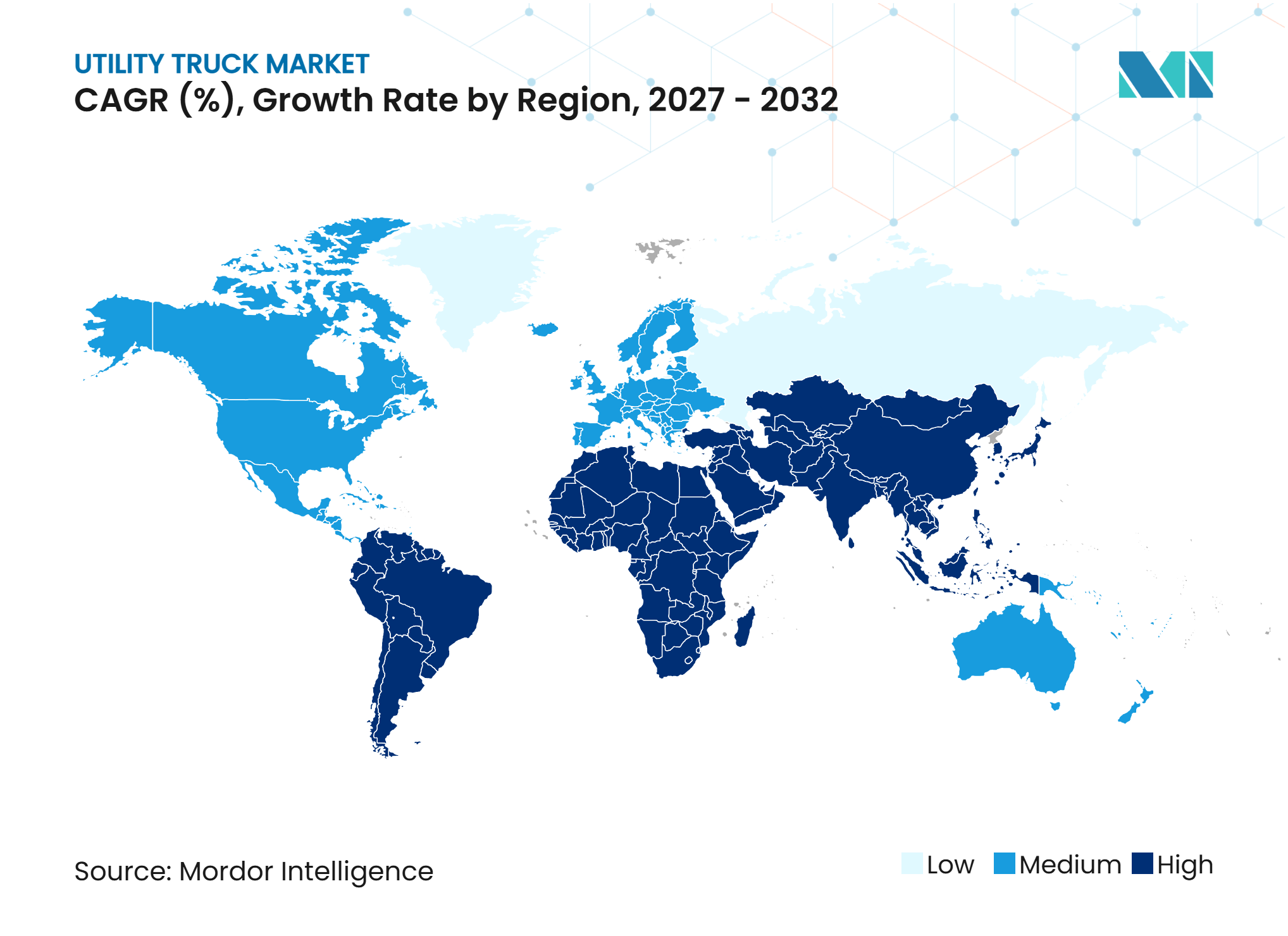
| Fastest Growing Market | Asia-Pacific |
| Largest Market | North America |
| Market Concentration | Medium |
Major Players *Disclaimer: Major Players sorted in no particular order Image © Mordor Intelligence. Reuse requires attribution under CC BY 4.0. | |
Utility Truck Market Analysis by Mordor Intelligence
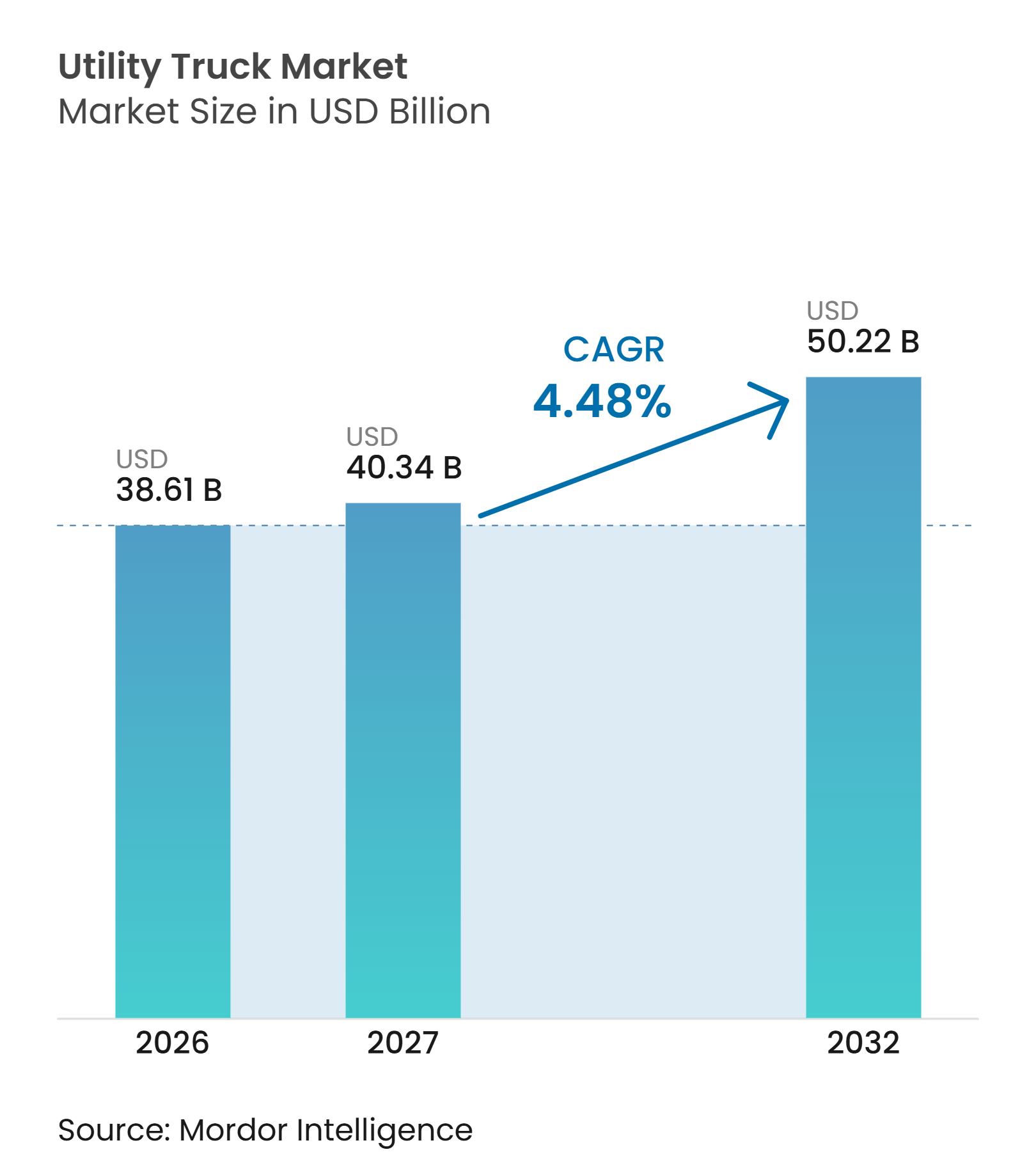
The Utility Truck Market size was valued at USD 38.61 billion in 2026 and is estimated at USD 40.34 billion in 2027, and it is projected to reach USD 50.22 billion by 2032, registering a CAGR of 4.48% between 2027 and 2032. Grid modernization, broadband construction, and municipal replacement programs are creating sustained equipment demand across the utility truck market. Power distribution work and fiber deployment increasingly draw on the same aerial and service fleets, which supports broader use of each vehicle across contract types. Storm hardening is also changing procurement from routine replacement toward readiness programs that require specialized equipment to be available before outages occur. Manufacturers are responding through domestic capacity additions, platform redesigns, and electric power take-off systems that address jobsite noise, idling, and safety requirements.
Key Report Takeaways
-
By truck type, bucket and aerial trucks held 26.27% of the utility truck market share in 2026 and are projected to grow at a 4.91% CAGR through 2032.
-
By weight class, Class 6–8 heavy trucks held 55.73% of the utility truck market share in 2026, while Class 3–5 medium trucks are forecast to grow at a 4.71% CAGR through 2032.
-
By propulsion, diesel held 68.27% of the utility truck market share in 2026, while electric and hybrid trucks are forecast to grow at a 10.61% CAGR through 2032.
-
By end user, electric and telecom utilities held 34.18% of the utility truck market share in 2026 and are projected to grow at a 4.89% CAGR through 2032.
-
By geography, North America held 46.27% of the utility truck market share in 2026, while Asia-Pacific is forecast to grow at a 5.65% CAGR through 2032.
Note: Market numbers in this report are based on Mordor Intelligence's proprietary estimation framework, which combines nine months of actuals with Q4 projections for base year 2026.
Market Trends and Insights
Drivers Impact Analysis of Utility Truck Market*
| Driver | (~) % Impact on CAGR Forecast | Geographic Relevance | Impact Timeline |
|---|---|---|---|
| Grid Modernization and Broadband Expansion | +1.3% | North America, Europe, Asia-Pacific | Medium term (2-4 years) |
| Utility and Municipal Fleet Replacement Cycles | +0.9% | North America, Europe | Short term (≤ 2 years) |
| Storm Hardening and Outage-Response Fleet Requirements | +0.7% | North America, South America | Short term (≤ 2 years) |
| Electrification and ePTO Adoption | +0.5% | North America, Europe, Asia-Pacific | Medium term (2-4 years) |
| Modular Utility Bodies | +0.3% | Global | Long term (≥ 4 years) |
| Battery-Powered Aerial Equipment | +0.3% | Europe, North America, Asia-Pacific | Medium term (2-4 years) |
| Source: Mordor Intelligence | |||
Grid Modernization and Broadband Expansion
Electricity demand from data centers, industrial electrification, grid resiliency work, and broadband expansion is supporting an extended utility equipment cycle. FMI identified power transmission and distribution investment, federal resiliency spending, and broadband activity as overlapping demand signals in 2025[1]. These programs support purchases of bucket trucks and digger derricks by power utilities and fiber-installation contractors. The utility truck market benefits when these work programs run in parallel because fleets can assign compatible equipment across related maintenance activities. Shared procurement frameworks can reduce duplicate equipment needs because one vehicle can support power, telecom, and broadband maintenance work. Elliott Equipment expanded its Omaha production facility in October 2025, increased its workforce by 20%, and added robotic welding and CNC manufacturing capacity in response to grid and 5G demand. Water and wastewater infrastructure funding adds demand for service bodies and sewer vacuum configurations, extending the addressable work base for the utility truck market.
Utility and Municipal Fleet Replacement Cycles
Aging utility and municipal fleets are entering replacement windows at the same time, creating near-term order activity. Fleet managers must balance replacement needs with the number of vehicles that can be used each day effectively. Fleet rightsizing can moderate unit demand while increasing the value assigned to each truck. A Utilimarc analysis of a 68-unit utility fleet found that reducing the fleet to 58 vehicles could save USD 540,000 in acquisition costs and USD 35,000 in annual operating costs. This approach can make the utility truck market more dependent on specifications, uptime, and vehicle versatility than on simple fleet counts. Advanced Clean Truck requirements are encouraging some operators to source earlier model-year equipment before compliance costs increase. This timing effect can pull purchases forward even when fleets remain focused on disciplined capital planning.
Storm Hardening and Outage-Response Fleet Requirements
Utilities are treating storm response as a standing fleet capability rather than a purely reactive function. Risk assessments and outage records are being used to stage aerial equipment near areas with elevated exposure. Equipment must be ready to travel, elevate crews, carry materials, and operate within coordinated restoration plans after severe weather. ISUZU delivered 142 specialized bucket trucks to Oncor Electric Delivery in Texas under parallel contracts exceeding USD 110 million. The company reported that the equipment supported restoration of 34,000 customer outages within 4 hours during a June 2025 derecho event[2]. Storm purchases can include dual-fuel capability, emergency lighting, and telematics connected to utility command systems. These requirements can raise the value of each order in the utility truck market without changing the basic replacement need. Airgain also supplied a 5G vehicle gateway to a Midwestern electric utility to improve field connectivity and grid resilience.
Electrification and ePTO Adoption
Electric power take-off equipment provides engine-off work capability while allowing fleets to retain a conventional or hybrid chassis. It can reduce engine idling when a crew needs power for the aerial device or body equipment at a worksite. Duke Energy adopted Viatec SmartPTO across its new aerial truck fleet after a 3-month pilot, citing immediate fuel savings and lower engine-idling noise. Environmental Defense Fund recorded 9,139 announced medium- and heavy-duty electric vehicle deployments in 2025, with 61% of announcing fleets entering the category for the first time. Terex Utilities paired its Optima HR55 aerial device with the Mack MD7 Electric chassis in February 2025. Terex stated that the configuration provides 1.5 times the range of comparable Class 6 and 7 electric bucket trucks and twice the rear-axle payload capacity. Modular bodies and battery-powered aerial equipment extend this approach by allowing more tasks to be served from a common vehicle platform and by enabling quieter work in urban locations. This operating flexibility supports the utility truck market, where local work rules and fleet duty cycles make conventional idling less desirable.
Restraints Impact Analysis of Utility Truck Market*
| Restraint | (~) % Impact on CAGR Forecast | Geographic Relevance | Impact Timeline |
|---|---|---|---|
| High Acquisition Costs and Financing Requirements | -0.9% | North America, Europe, Asia-Pacific | Short term (≤ 2 years) |
| Specialized Certification and Regulatory Approval Complexity | -0.5% | North America, Europe | Medium term (2-4 years) |
| Payload and Range Trade-Offs in Electrified Upfits | -0.7% | North America, Europe | Medium term (2-4 years) |
| Fragmented Upfitter Integration and Extended Delivery Lead Times | -0.4% | Global | Short term (≤ 2 years) |
| Source: Mordor Intelligence | |||
High Acquisition Costs and Financing Requirements
Fully specified utility trucks can cost USD 200,000 to USD 300,000 per vehicle, depending on the aerial device and chassis. This requirement places pressure on municipal and cooperative buyers that operate within multiyear capital budgets. Financing costs add to the burden and can favor longer vehicle holding periods. Evolectric stated that its Gen3 CircularEV Kit can reduce initial conversion costs by as much as 45% compared with purchasing a new electric truck. The stated incentive support of up to USD 103,500 per vehicle through California programs is not available to many fleet operators. Specialized equipment lead times of 36 to 42 months further complicate the timing and financing of fleet plans.
Payload and Range Trade-Offs in Electrified Upfits
Battery weight reduces the payload available for tools, bodies, and equipment, while cold weather can reduce operating range. Utility fleets also require 4x4 capability, towing capacity, and adequate space for worksite tools. Bronto Skylift and Designwerk presented a fully electric truck with a 56-meter aerial work platform at Bauma 2025. The purpose-built vehicle uses a 500 kWh battery and was designed to cover a full working day. This demonstrates technical progress, but it also shows the need for dedicated platforms rather than simple freight-truck conversions. EPA low-NOx requirements and state-level clean-truck rules add compliance questions for operators working across different jurisdictions.
*Our forecasts treat driver/restraint impacts as directional, not additive. The impact forecasts reflect baseline growth, mix effects, and variable interactions.
Utility Truck Market Segment Analysis
By Truck Type:
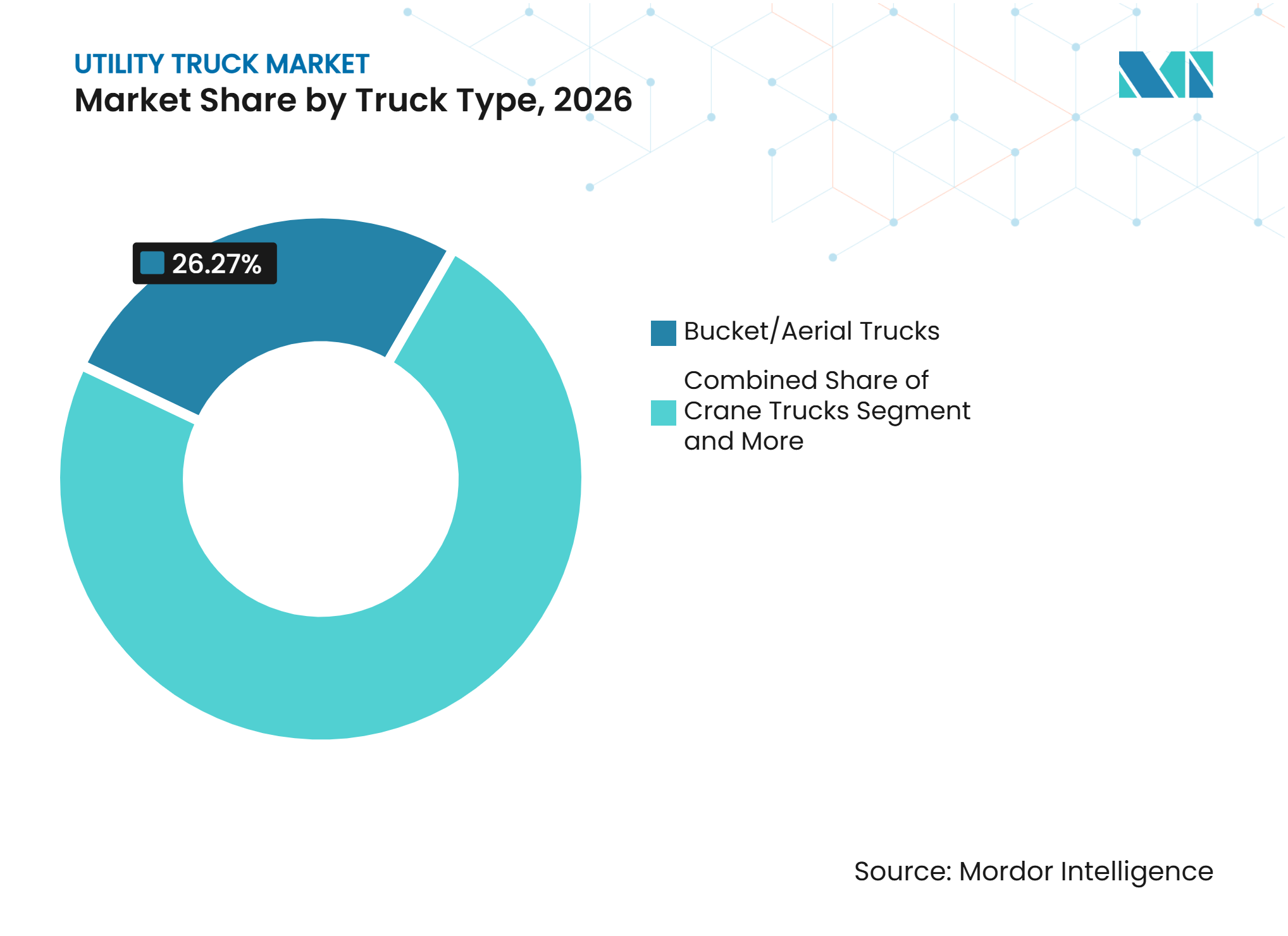
Bucket and Aerial Configurations Lead DemandBucket and aerial trucks held 26.27% of the utility truck market share in 2026 and are forecast to record a 4.91% CAGR through 2032. Their position reflects demand for safe energized-line work across power distribution and telecom construction, and it supports the utility truck market wherever field crews require elevated access and insulated equipment. Terex introduced its TRX Series at the 2025 Utility Expo with working heights from 46 to 60 feet and payloads of up to 6,000 pounds on Class 5 and 6 chassis. The design broadens the potential operator pool by supporting non-CDL configurations for certain utility uses.
Altec introduced the DX60E distribution digger derrick and its EZ-Egress insulating platform at the 2025 Utility Expo. The company described EZ-Egress as a patented platform design with a door that allows workers to exit the platform, supporting jobsite safety needs under OSHA 1910.269. Digger derricks, crane trucks, dump and stake trucks, sewer and vacuum trucks, and service bodies serve distinct customer tasks. Municipal infrastructure spending and utility capital programs support demand across these configurations. Modular lifting systems can allow one chassis to support material handling and personnel-lifting work, increasing the functional value of specialized trucks.



By Weight Class:
Heavy Trucks Anchor Demand While Medium Trucks ExpandClass 6–8 heavy trucks accounted for 55.73% of the utility truck market size in 2026. Full-size aerial devices, digger derricks, and crane bodies require the payload capacity offered by these chassis. Their role is therefore well established in utility-grade work where equipment cannot be moved to a lighter platform without affecting use. Heavy platforms also support remote field operations that carry tools, equipment, and crew requirements on the same vehicle.
Class 3–5 medium trucks are forecast to expand at a 4.71% CAGR through 2032. Lighter aerial platforms suit urban telecom and municipal work where access, maneuverability, and parking constraints are important. Reading Truck introduced the RHD-46 and RHD-67 heavy-duty service bodies in March 2026 for Class 4–7 chassis. The products use reinforced torsion-box construction, 50-inch floor widths, and structural tow hitches rated to 30,000 lb. The development shows how body suppliers are designing around the operating requirements of separate weight classes rather than applying one architecture to every chassis, which gives the utility truck market a broader set of configurations for distinct local operating conditions and customer fleet requirements in different operating territories worldwide today.
By Propulsion:
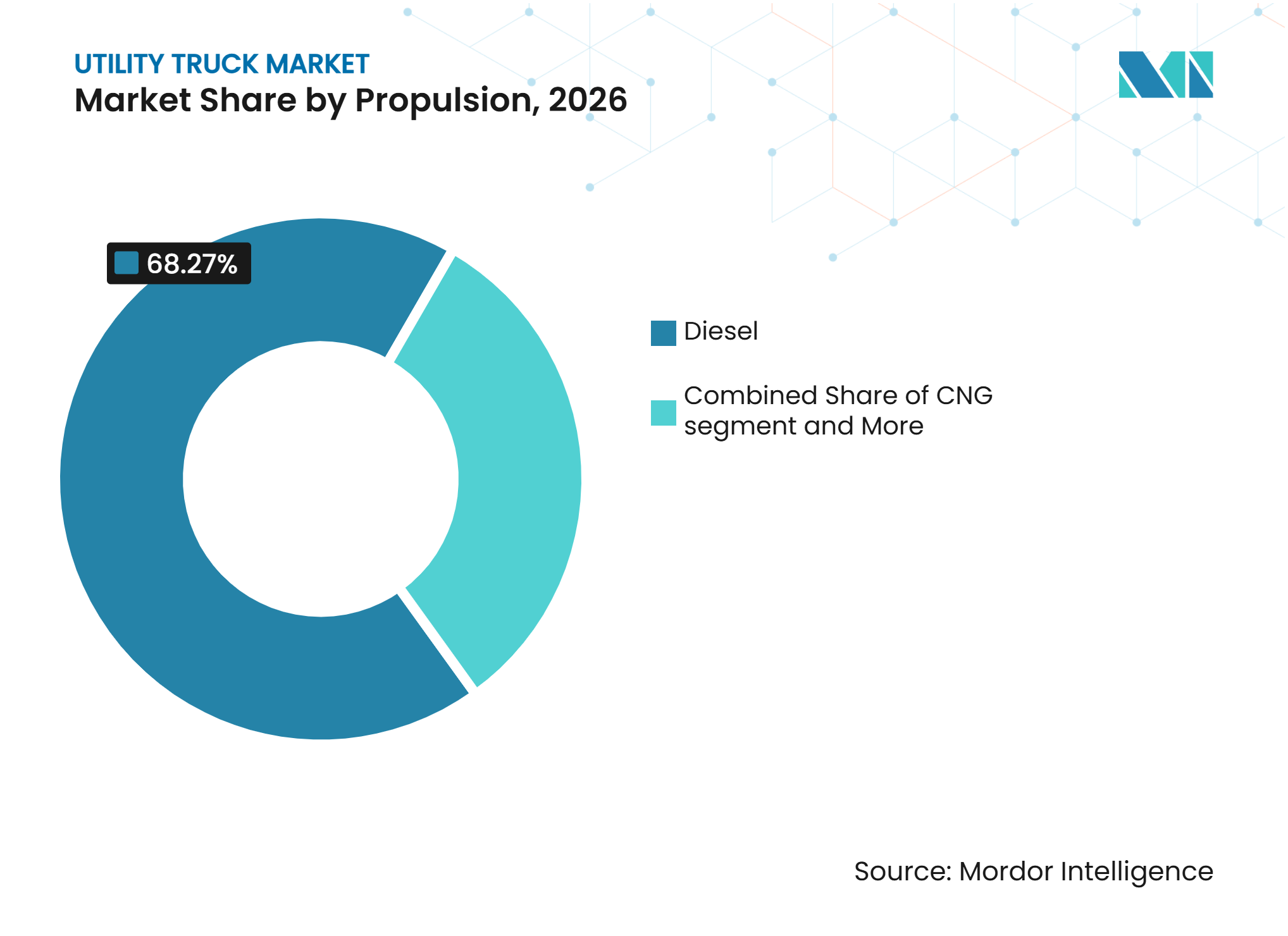
Diesel Retains Its Position While Electric and Hybrid Trucks ExpandDiesel held 68.27% of the utility truck market share in 2026 because remote field work depends on energy density, operating range, and established refueling networks. Diesel vehicles remain relevant for service territories with limited charging access and demanding summer load conditions. Gasoline and CNG configurations continue to serve some municipal and regional applications where suitable fuel infrastructure already exists. Their role is more limited where emissions rules and electric operating economics favor new alternatives.
Electric and hybrid trucks are forecast to grow at a 10.61% CAGR through 2032, the fastest rate among propulsion types. ePTO systems, zero-emission requirements, and quiet operating conditions support their use in appropriate duty cycles. A Cox Automotive survey reported that 87% of U.S. fleets expected to add electric vehicles within 5 years, while fleets that had already adopted electric vehicles reported a 90% likelihood of adding more in the next buying cycle. The utility truck industry is therefore balancing continued diesel demand with a faster shift toward electric systems in urban and lower-idle applications.

By End User:
Electric and Telecom Utilities Set the Demand BaseElectric and telecom utilities represented 34.18% of the utility truck market size in 2026 and are projected to grow at a 4.89% CAGR through 2032. Grid modernization and 5G network expansion rely on multiyear programs, giving fleet managers a reason to plan equipment purchases over several years. Framework contracts can provide manufacturers with better visibility than individual replacement purchases. Water and gas utilities also maintain demand for service and mechanic bodies used in underground infrastructure work.
Municipalities add demand for sewer and vacuum trucks, dump trucks, cranes, and aerial vehicles that support public works activities. Knapheide documented how the City of Red Wing uses specialized service bodies across varied public works tasks. Compartment design, liftgates, and body layouts remain major specifications for these buyers. Construction and oil and gas customers have more variable purchasing patterns because their equipment demand follows project activity and commodity conditions. This leaves utilities and municipalities as the steadier base of the utility truck industry.
Geography Analysis
North America
North America held 46.27% of the utility truck market share in 2026. Grid hardening, broadband deployment, and municipal public works funding support multiyear fleet programs across the region. Elliott Equipment expanded its Omaha workforce by 20% in October 2025 and invested in robotic welding and CNC manufacturing, linking the decision to grid modernization and 5G broadband demand. EPA low-NOx rules and state clean-truck programs are influencing the timing of replacement purchases. Mexico adds demand through its 2025 to 2030 grid plan, while ISUZU announced a USD 55 million contract for 150 specialized bucket trucks across 12 Mexican states. The contract supports a stated goal of reducing service interruptions by 30% and extending rural electrification coverage to 98%.
Asia-Pacific
Asia-Pacific is forecast to grow at a 5.65% CAGR through 2032. China’s zero-emission medium- and heavy-duty vehicle sales grew 115% year over year in the first half of 2025, and utility vehicles accounted for 20% of the zero-emission total. The reported zero-emission share in utility applications was 9.0%, which indicates a rapidly changing technology base for the utility truck market. India supports a separate demand base through infrastructure work and commercial vehicle activity. Heavy commercial vehicle registrations in India rose 28.95% year over year in October 2026, while goods-carrier registrations rose 21.4% during January through October 2026. These conditions support demand for utility equipment alongside broader transport and infrastructure investment.
Europe, South America, and Middle East and Africa
Europe’s emissions requirements and low-emission-zone restrictions support demand for hybrid and electric aerial equipment in urban settings. PALFINGER presented its TEC range at Bauma 2025 with electric-drive readiness and battery options for engine-off aerial work. These products can also serve hospitals and other noise-sensitive sites that are difficult for diesel equipment to access. South America is supported by power distribution, telecom expansion, municipal programs, and mining-related activity in countries including Brazil, Argentina, Colombia, and Chile. The Middle East and Africa draw demand from Saudi infrastructure programs, UAE smart-city work, municipal modernization in South Africa and Egypt, and long-term rural electrification needs in Sub-Saharan Africa.
Competitive Landscape
Market Concentration

The utility truck market is moderately concentrated around aerial-device specialists, crane manufacturers, body manufacturers, upfitters, and rental operators. Altec, Terex, PALFINGER, and Tadano compete through product capability, operating compliance, service, and capacity. Terex developed the TRX Series to provide aerial capability on Class 5 and 6 configurations, addressing CDL-driver availability for distribution work. ANSI/SIA A92.2 requirements for aerial devices and FMCSA requirements for commercial vehicles make certification and compliance important competitive considerations. These requirements favor manufacturers that can validate products, maintain service networks, and support fleet buyers through approvals.
Altec announced a USD 9.7 million expansion at its Mount Airy, North Carolina, site in February 2026, with 100 jobs expected by the fourth quarter of 2026. The project includes a maintenance facility and infrastructure improvements that expand capacity for aerial devices and digger derricks. PALFINGER rolled out CONNECTED as a Standard across a broad product range in early 2025, positioning digital telematics as a standard feature instead of an optional service. The company also announced a Global Development Center in Pune with L&T Technology Services to support future regional production. These moves show that companies are competing through capacity, connected-service capability, and local development support.
Purpose-built electric platforms, ePTO retrofits, modular body systems, and digital service contracts remain active product areas in the utility truck market. Fleet purchasers can weigh these options against the requirements of their service territory, crew tasks, and compliance obligations. Viatec’s adoption by Duke Energy shows that a component supplier can enter a large fleet account without supplying the full truck. Knapheide’s April 2026 America’s Work Truck campaign and Reading Truck’s new RHD service-body series show the emphasis that body suppliers place on configurability and product recognition. Competition is therefore shaped by the ability to match vehicle architecture to specific crew tasks and operating conditions.
Utility Truck Industry Leaders
-
Altec, Inc.
-
Terex Corporation
-
Time Manufacturing Company
-
PALFINGER AG
-
Reading Truck Group
- *Disclaimer: Major Players sorted in no particular order
Utility Truck Market Companies Covered in this Report
- Altec, Inc.
- Terex Corporation
- Time Manufacturing Company
- Dur-A-Lift, Inc.
- Reading Truck Group
- Knapheide Manufacturing Company
- Stellar Industries, Inc.
- Dover Corporation
- Elliott Equipment Company
- Dakota Bodies, Inc.
- Royal Truck Body, Inc.
- PALFINGER AG
- Manitex International, Inc.
- Bronto Skylift Oy Ab
- Socage S.r.l.
- Aichi Corporation
- Tadano Ltd.
- Cargotec Corporation
- Danco Products
- Venco Venturo Industries LLC
- Viatec, Inc.
Recent Industry Developments in Utility Truck Market
- March 2026: Reading Truck introduced the Combo Body and the RHD-46 and RHD-67 heavy-duty service bodies at the 2026 Work Truck Show. The RHD series was designed for Class 4–7 applications.
- February 2026: Altec Industries announced a USD 9.7 million expansion of its Mount Airy, North Carolina, production facility. The company expects the project to create 100 jobs by the fourth quarter of 2026.
- November 2025: Terex Corporation and REV Group agreed to merge in a stock-and-cash transaction expected to close in the first half of 2026, while Terex said it would begin a process to exit its aerials segment, including a potential sale or spin-off, reshaping the competitive field for utility aerial equipment.
- February 2025: Terex Utilities and Mack Trucks unveiled a fully electric bucket truck pairing the Terex Optima HR55 aerial device with the Mack MD7 Electric chassis. The aerial device runs on its own power source, allowing crews to work a full day without drawing down the chassis battery.
Global Utility Truck Market Report Scope
Segmentation Overview
| Service/Mechanic Body Trucks |
| Bucket/Aerial Trucks |
| Digger Derricks |
| Dump and Stake Trucks |
| Crane Trucks |
| Sewer and Vacuum Trucks |
| Other Truck Types |
| Class 3-5 |
| Class 6-8 |
| Diesel |
| Gasoline |
| Electric and Hybrid |
| CNG |
| Electric and Telecom Utilities |
| Water and Gas Utilities |
| Municipalities |
| Construction |
| Oil and Gas |
| Other End Users, Including Rental |
| North America | United States |
| Canada | |
| Mexico | |
| Europe | Germany |
| United Kingdom | |
| France | |
| Italy | |
| Spain | |
| Russia | |
| Rest of Europe | |
| Asia-Pacific | China |
| India | |
| Japan | |
| South Korea | |
| Australia | |
| Rest of Asia-Pacific | |
| South America | Brazil |
| Argentina | |
| Chile | |
| Colombia | |
| Rest of South America | |
| Middle East and Africa | Turkey |
| Saudi Arabia | |
| United Arab Emirates | |
| South Africa | |
| Egypt | |
| Rest of Middle East | |
| Rest of Africa |
| By Truck Type | Service/Mechanic Body Trucks | |
| Bucket/Aerial Trucks | ||
| Digger Derricks | ||
| Dump and Stake Trucks | ||
| Crane Trucks | ||
| Sewer and Vacuum Trucks | ||
| Other Truck Types | ||
| By Weight Class | Class 3-5 | |
| Class 6-8 | ||
| By Propulsion | Diesel | |
| Gasoline | ||
| Electric and Hybrid | ||
| CNG | ||
| By End User | Electric and Telecom Utilities | |
| Water and Gas Utilities | ||
| Municipalities | ||
| Construction | ||
| Oil and Gas | ||
| Other End Users, Including Rental | ||
| By Geography | North America | United States |
| Canada | ||
| Mexico | ||
| Europe | Germany | |
| United Kingdom | ||
| France | ||
| Italy | ||
| Spain | ||
| Russia | ||
| Rest of Europe | ||
| Asia-Pacific | China | |
| India | ||
| Japan | ||
| South Korea | ||
| Australia | ||
| Rest of Asia-Pacific | ||
| South America | Brazil | |
| Argentina | ||
| Chile | ||
| Colombia | ||
| Rest of South America | ||
| Middle East and Africa | Turkey | |
| Saudi Arabia | ||
| United Arab Emirates | ||
| South Africa | ||
| Egypt | ||
| Rest of Middle East | ||
| Rest of Africa | ||
Key Questions Answered in the Report
What is the projected value of the utility truck market by 2032?
The utility truck market is projected to reach USD 50.22 billion by 2032, growing at a 4.48% CAGR from 2027.
Which truck type has the largest share?
Bucket and aerial trucks held the largest truck-type share at 26.27% in 2026 and are forecast to grow at a 4.91% CAGR.
Why are electric and hybrid utility trucks growing quickly?
Electric and hybrid trucks are forecast to grow at a 10.61% CAGR because ePTO systems, emissions requirements, and low-idle operations support their adoption.
Which region is growing fastest through 2032?
Asia-Pacific is forecast to grow at a 5.65% CAGR through 2032, supported by electrification and infrastructure activity.