
United States Sports Betting Market Size and Share
Market Overview
| Study Period | 2022 - 2032 |
|---|---|
| Forecast Data Period | 2027 - 2032 |
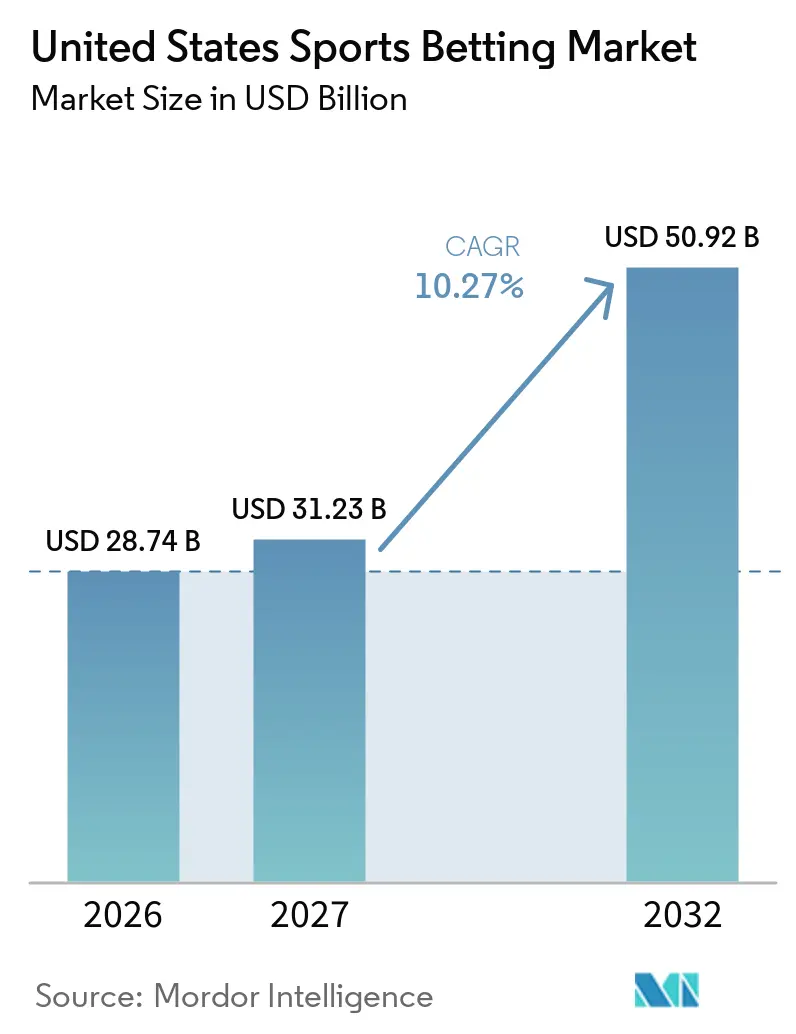
| Base Year Market Size (2026) | USD 28.74 Billion |
| Market Size (2027) | USD 31.23 Billion |
| Market Size (2032) | USD 50.92 Billion |
| Growth Rate (2027 - 2032) | 10.27 % |
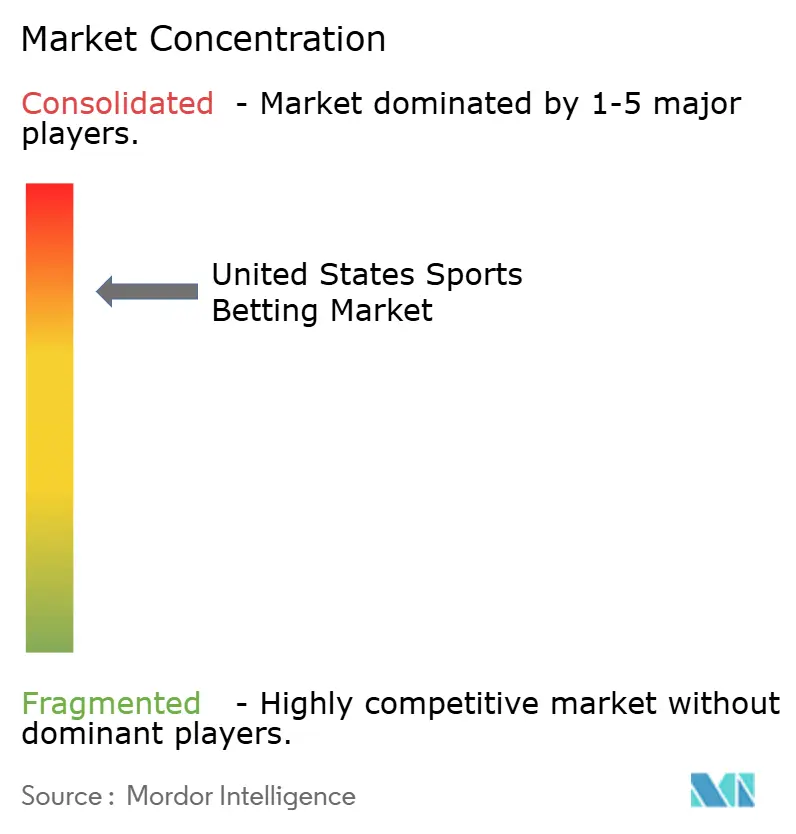
| Market Concentration | High |
Major Players *Disclaimer: Major Players sorted in no particular order Image © Mordor Intelligence. Reuse requires attribution under CC BY 4.0. | |
United States Sports Betting Market Analysis by Mordor Intelligence
The United States sports betting market size is expected to grow from USD 28.74 billion in 2026 to USD 31.23 billion in 2027 and is forecast to reach USD 50.92 billion by 2032 at 10.27% CAGR over 2027-2032. The United States sports betting market is moving from the early expansion of legal access toward a period defined by product depth, tax policy, and stronger operating discipline. Mobile wagering remains central to the United States sports betting market because it makes live markets, account management, and promotional offers readily available to customers. The next phase depends on how operators manage the higher compliance burden in mature states while maintaining product quality and customer retention. Potential legalization in large states, together with the growth of prediction products, could change the geographic balance of the United States sports betting market during the forecast period.
Key Report Takeaways
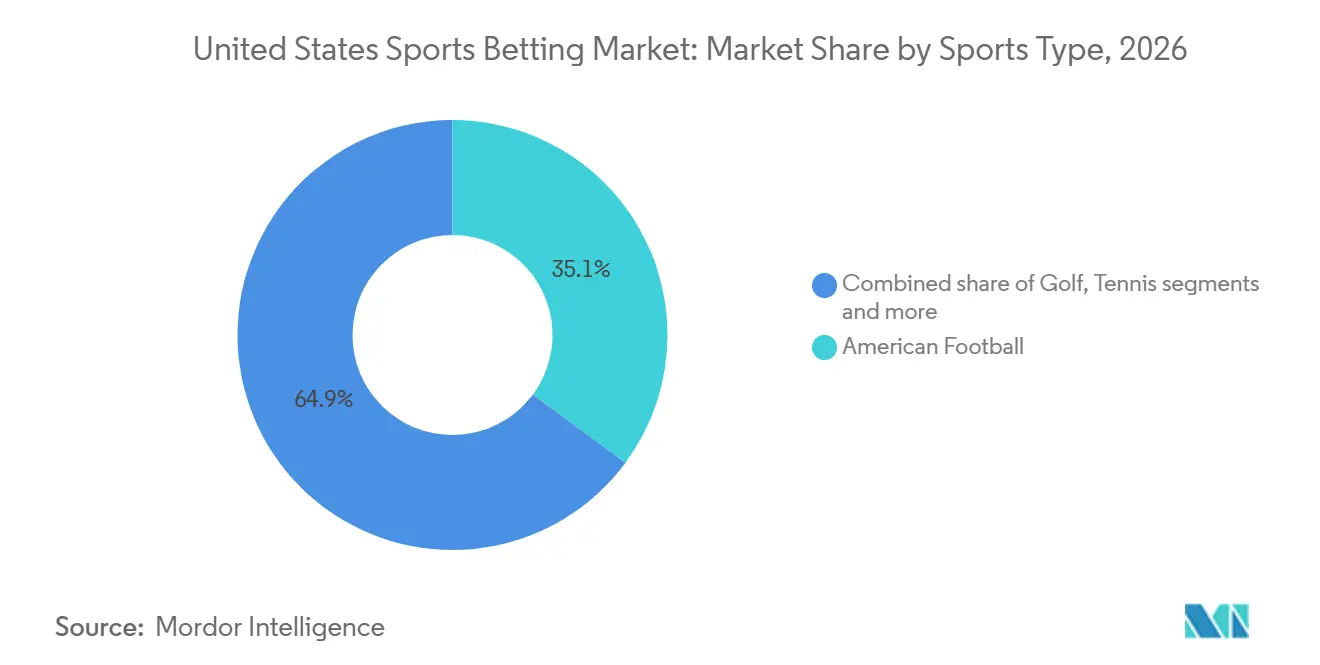
- By sports type, American football held 35.12% of the United States sports betting market in 2026, while Tennis is forecast to expand at an 11.91% CAGR through 2032.
- By betting platform, online betting held 65.88% of the United States sports betting market in 2026 and is forecast to expand at a 12.14% CAGR through 2032.
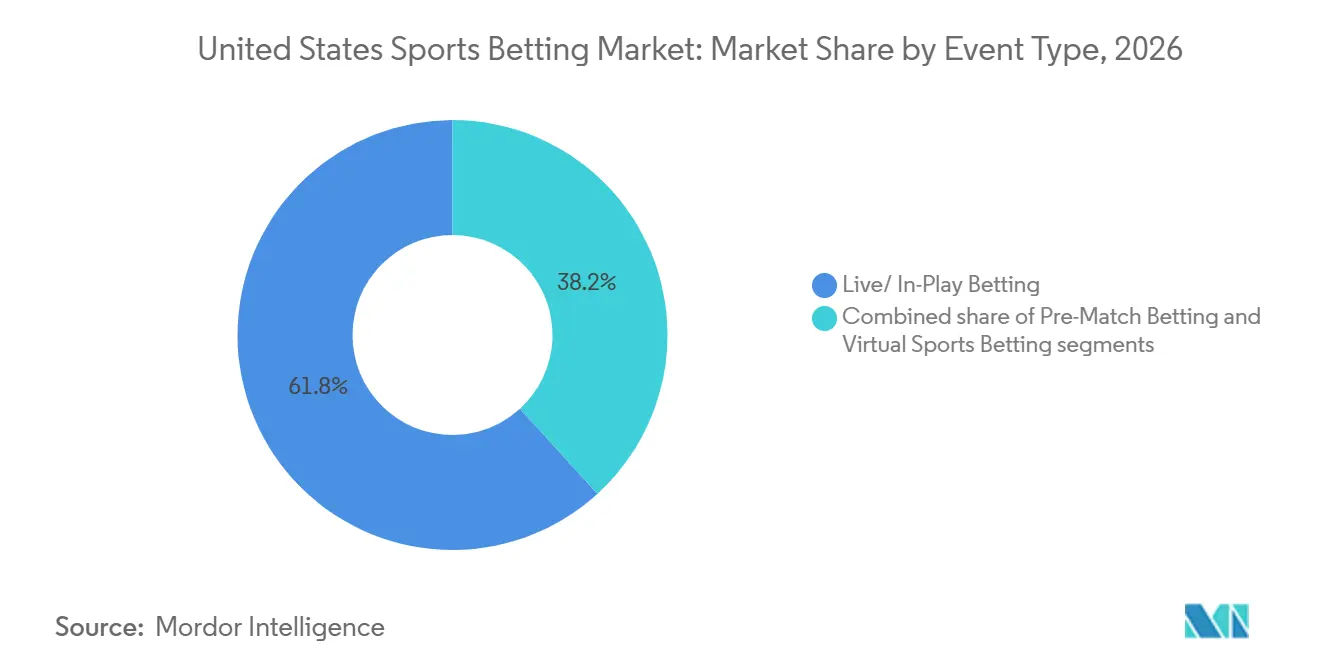
- By event type, live/in-play betting held 61.78% of the United States sports betting market in 2026, while virtual sports betting is forecast to expand at a 12.01% CAGR through 2032.
Note: Market numbers in this report are based on Mordor Intelligence's proprietary estimation framework, which combines nine months of actuals with Q4 projections for base year 2026.
United States Sports Betting Market Trends and Insights
Drivers Impact Analysis*
| Driver | (~) % Impact on CAGR Forecast | Geographic Relevance | Impact Timeline |
|---|---|---|---|
| Expansion of legal sports betting across U.S. states | +2.8% | National, with concentrated near-term gains in Mississippi, Missouri, and Minnesota; long-term in California, Texas, and Georgia | Long term (≥ 4 years) |
| Rapid growth of online and mobile sports betting platforms | +2.2% | National; strongest in high-volume states: New York, Illinois, New Jersey | Short term (≤ 2 years) |
| Rising popularity of in-play and live sports betting | +1.8% | National; deepest impact in states with high smartphone adoption | Medium term (2–4 years) |
| Strong popularity of major U.S. professional sports leagues | +1.2% | National, with NFL-driven peaks in Q3–Q4 calendar periods | Short term (≤ 2 years) |
| Integration of real-time data and advanced betting technology | +1.0% | National; fastest adoption in high-volume states | Medium term (2–4 years) |
| Growing sports sponsorships, partnerships, and promotional activities | +0.8% | National; spill-over effect into newly launching states | Short term (≤ 2 years) |
| Source: Mordor Intelligence | |||
Expansion of Legal Sports Betting Across U.S. States
The expansion of regulated sports betting across the United States is supporting market growth by increasing consumer access to licensed wagering platforms and generating additional tax revenue for state and local governments. According to the American Gaming Association, commercial sports betting revenue reached USD 16.89 billion in 2025, representing a 22.6% increase year over year[1]. The report highlights the growing economic contribution of regulated gaming, strengthening the incentive for states to assess legal sports betting frameworks and associated fiscal benefits. Furthermore, states such as California and Texas remain significant potential expansion markets, as online sports betting is not yet broadly legalized in these populous states. The continued adoption of state-level legalization, licensing, and regulatory frameworks could expand the addressable customer base, encourage migration from unregulated operators to licensed sportsbooks, and create additional growth opportunities for established sports betting companies.
Growth of Online and Mobile Sports Betting Platforms and Sponsorships
Online products support the United States sports betting market by making wagering available throughout the sports calendar rather than only at retail locations. In New Jersey, online sportsbooks represented 96.8% of total handle in March 2026, demonstrating the depth of mobile adoption in a mature regulated state[2]. Operators use loyalty programs, same-game parlays, cash-out tools, and app-based payments to make digital accounts more useful after initial registration. Partnerships with leagues, broadcasters, teams, and ticketing businesses extend the visibility of these products and connect betting offers with sports viewing and live events. The market benefits when these partnerships are supported by clear advertising practices and permitted within state rules. The same commercial relationships can improve retention, although they also increase the need for operators to show that promotions are responsible and transparent.
Rising Popularity of In-Play Betting and Real-Time Data Technology
Live betting has become a central part of the United States sports betting market because users can place wagers while games are in progress. DraftKings said that in-play volume increased 16% year over year in Q2 2025 after its acquisition of Simplebet, which expanded the availability of micro-betting products[3]. The product depends on rapid, reliable data, since odds that reach a customer too late create pricing and integrity risks. Genius Sports said that its BetVision product reduced broadcast-to-mobile latency to 4-8 seconds from a more typical 45-second delay. Official data rights, event feeds, and personalized presentation tools therefore have a direct effect on the range of markets that a sportsbook can offer. In the United States sports betting market, operators with scale can better absorb the cost of data and technology than small operators can.
Strong Popularity of Major U.S. Professional Sports Leagues
The widespread fan base of professional sports leagues, including the National Football League (NFL), National Basketball Association (NBA), Major League Baseball (MLB), and National Hockey League (NHL), supports the expansion of the United States sports betting market. Regular-season fixtures, playoffs, championship games, and rivalry matchups generate sustained fan engagement and betting opportunities throughout the year. The growing integration of live odds, mobile betting applications, and real-time statistics enables consumers to place wagers while following sporting events. In addition, fantasy sports participation, sports media coverage, and league-led digital engagement encourage fans to explore betting-related activities. The continued popularity of major leagues therefore provides sports betting operators with a large and recurring audience, supporting wagering activity around high-profile games and tournaments.
Restraints Impact Analysis*
| Restraint | (~) % Impact on CAGR Forecast | Geographic Relevance | Impact Timeline |
|---|---|---|---|
| Growing concerns over problem gambling and financial losses | -1.5% | National; heightened regulatory scrutiny in New York, Illinois, Maryland, and Louisiana | Medium term (2–4 years) |
| Risks of match-fixing and threats to sporting integrity | -0.8% | National; concentrated in prop-betting states with granular micro-markets | Medium term (2–4 years) |
| Rising cybersecurity risks and data privacy challenges | -0.6% | National | Short term (≤ 2 years) |
| Intensifying competition and escalating customer acquisition costs | -0.9% | National; most acute in mature, saturated states | Short term (≤ 2 years) |
| Source: Mordor Intelligence | |||
Growing Concerns Over Problem Gambling and Financial Losses
The rising incidence of problem gambling and concerns over financial losses pose a significant restraint on the United States sports betting market. The easy accessibility of mobile betting platforms, continuous live-wagering opportunities, and incentives to recover previous losses can encourage excessive betting and increase the risk of gambling-related financial distress. According to a 2026 Urban Institute survey, 12% of sports bettors reported saving less money because of sports betting, while online bettors were more likely to report financial difficulties than those betting exclusively in person. These concerns have intensified scrutiny from regulators, healthcare professionals, and consumer protection organizations, potentially prompting stricter advertising rules, responsible gambling requirements, and limits on promotional practices.
Risks of Match-fixing and Threats to Sporting Integrity
The threat of match-fixing and manipulation of sporting events poses a significant restraint on the United States sports betting market by undermining consumer confidence in the fairness and credibility of competitions. The expansion of betting opportunities, particularly live wagering and player-specific proposition bets, increases the potential for athletes, coaches, or officials to exploit inside information or manipulate specific game events for financial gain. The FBI identifies game manipulation, bribery, and illegal betting operations as key threats to sporting integrity. In October 2025, the NCAA reported investigations into potential sports betting violations involving approximately 30 current or former men's basketball student-athletes. Such incidents can trigger stricter betting restrictions, enhanced monitoring requirements, and increased compliance costs for operators.
*Our forecasts treat driver/restraint impacts as directional, not additive. The impact forecasts reflect baseline growth, mix effects, and variable interactions.
Segment Analysis
By Sports Type: American Football Leads While Tennis Gains From Live Betting
American football held the largest share of the United States sports betting market, accounting for 35.12% in 2026. The segment's dominance is supported by the sport's strong domestic fan base, extensive media coverage, and established professional and collegiate competitions. The National Football League (NFL) serves as a major driver of betting activity, particularly during the regular season and playoffs. High-profile events, including the Super Bowl, attract substantial wagering interest due to their widespread viewership and extensive betting markets. The availability of diverse betting options, including match winners, point spreads, totals, and player performance props, further strengthens engagement among bettors.
Tennis is projected to be the fastest-growing sports type in the United States sports betting market, registering a CAGR of 11.91% through 2032. The segment's growth is supported by year-round tournament coverage and a regular schedule of professional competitions across the ATP and WTA tours. Major tournaments, including the US Open, Wimbledon, the French Open, and the Australian Open, generate heightened betting interest among sports enthusiasts. The availability of live and in-play betting allows bettors to wager on individual sets, games, points, and match outcomes, increasing opportunities for engagement throughout a match.

By Betting Platform: Online Betting Defines the Main Customer Channel
Online betting accounted for the largest share of the United States sports betting market, representing 65.88% in 2026. The segment's dominance is driven by the widespread adoption of smartphones, improved internet connectivity, and the growing availability of mobile sportsbook applications. The legalization and expansion of sports betting across multiple states have further supported the adoption of digital betting platforms. Online sportsbooks provide convenient access to a wide range of sporting events, betting markets, and wagering options through centralized digital interfaces. Features such as live betting, real-time odds updates, personalized promotions, and cash-out options enhance user engagement and encourage repeat wagering.
Online betting is projected to expand at a CAGR of 12.14% through 2032, making it a key growth segment in the United States sports betting market. Continued legalization across additional states, subject to legislative and regulatory developments, is expected to create opportunities for sportsbook operators to expand their customer bases. The increasing preference for mobile-first entertainment and digital payment solutions is also supporting the transition from traditional wagering channels to online platforms. Furthermore, the integration of live and in-play betting enables consumers to place wagers during sporting events, creating more frequent betting opportunities.
By Event Type: Live Betting Has Changed Revenue Mix and Virtual Sports Add Continuity
Live/in-play betting accounted for the largest share of the United States sports betting market, representing 61.78% in 2026. The segment's dominance is driven by bettors' growing preference for placing wagers while sporting events are in progress. Real-time betting opportunities allow users to respond to changing match conditions, team performance, player statistics, and scoring developments. The availability of dynamic odds and diverse wagering options, including the next scoring play, player performance, and match outcomes, further enhances engagement. The expansion of mobile sportsbook applications and improvements in live data delivery have made in-play betting more accessible to consumers.
Virtual sports betting is projected to register a CAGR of 12.01% through 2032, making it an emerging growth segment in the United States sports betting market. The segment benefits from digitally simulated sporting events that provide betting opportunities without depending on the timing or availability of live competitions. Virtual sports can offer frequent event cycles, enabling operators to maintain betting activity between major sporting fixtures and during periods with limited live sports coverage. Advances in graphics, simulation technology, and automated event generation are helping improve the user experience and make virtual sports more engaging.
Geography Analysis
The United States sports betting market exhibits a geographically diverse landscape, shaped by state-level legalization, regulatory frameworks, consumer preferences, and sports popularity. The market's development varies considerably across states, as individual jurisdictions determine the legality, licensing requirements, taxation, and permitted channels for sports wagering. States that have legalized online sports betting provide operators with opportunities to reach a wider customer base through mobile applications and digital platforms. Established professional sports leagues, including the National Football League (NFL), National Basketball Association (NBA), Major League Baseball (MLB), and National Hockey League (NHL), contribute to betting demand across multiple regions.
New York, New Jersey, and Pennsylvania represent important markets within the United States sports betting industry, supported by large consumer populations, established sports cultures, and regulated wagering frameworks. New York benefits from its substantial population and strong demand for mobile betting, while New Jersey has developed a prominent position through its early adoption of regulated online sports wagering. Pennsylvania also contributes significantly through its combination of retail sportsbooks and digital betting platforms. Meanwhile, states such as Illinois, Ohio, and Michigan have expanded the market through legalized sports betting and the participation of established sportsbook operators.
The geographic expansion of the United States sports betting market increasingly depends on regulatory developments in states where online wagering remains restricted or unavailable. States considering legalization may represent potential growth opportunities, although the timing and scope of market entry depend on legislative approval, regulatory implementation, and licensing arrangements. Regional differences in sports preferences also influence betting activity, with American football, basketball, baseball, and other professional and collegiate competitions attracting varying levels of engagement. In addition, the expansion of mobile platforms and partnerships between sportsbook operators, sports organizations, and media companies is strengthening the reach of licensed betting services in regulated jurisdictions.
Competitive Landscape
The United States sports betting market is characterized by a consolidated market structure, with a limited number of major operators accounting for a significant proportion of market activity. Key players include DraftKings Inc., Flutter Entertainment plc, MGM Resorts International, and bet365 Limited, which compete through established sportsbook brands, digital platforms, customer acquisition strategies, and extensive betting offerings. The competitive landscape is shaped by state-level licensing requirements, regulatory compliance costs, technology investments, and the ability to establish strong brand recognition. Leading operators leverage their financial resources, marketing capabilities, and customer databases to strengthen their market positions.
DraftKings Inc. and Flutter Entertainment plc maintain strong competitive positions through their digital sportsbook operations and diversified wagering products. DraftKings focuses on its sportsbook platform, customer engagement capabilities, and integration with its broader digital gaming ecosystem to attract and retain users in eligible US states. Flutter Entertainment participates through FanDuel, one of the prominent sportsbook brands in the US market, supported by its established technology infrastructure, brand recognition, and customer reach. Meanwhile, MGM Resorts International leverages its established casino and hospitality presence alongside its BetMGM digital sports betting and online gaming operations. Its combination of land-based gaming assets, loyalty programs, and digital offerings supports cross-channel customer engagement.
bet365 Limited further contributes to competition through its international sportsbook expertise, digital platform capabilities, and broad selection of sporting events and betting markets. The company competes with established US operators by emphasizing its online betting experience, live wagering features, and extensive event coverage. Across the market, competition increasingly centers on customer retention, product differentiation, operational efficiency, and the development of engaging mobile-first experiences rather than customer acquisition alone. Major operators also pursue partnerships, technology enhancements, and targeted marketing initiatives to strengthen their positions in individual states.
United States Sports Betting Industry Leaders
-
DraftKings Inc.
-
Flutter Entertainment plc
-
MGM Resorts International
-
bet365 Group Limited
-
Caesars Entertainment, Inc.
- *Disclaimer: Major Players sorted in no particular order
Recent Industry Developments
- August 2026: The National Football League (NFL) signed multi-year sports betting partnership agreements with DraftKings, FanDuel, and Fanatics Betting and Gaming, enabling the operators to use official NFL branding, promote online and retail betting, and activate campaigns around major events such as the Super Bowl and NFL Draft. The agreements also provide access to official play-by-play statistics and Next Gen Stats through Genius Sports, supporting enhanced live betting and digital fan engagement.
- July 2026: Hard Rock Bet entered a three-year sponsorship agreement with the Miami Marlins, naming the company the team's official sportsbook for the 2026–2028 seasons. The partnership includes live odds integrations during Marlins.TV broadcasts, fan promotions, and on-site activations at loanDepot park, including bonus-bet offers linked to grand slams. The agreement strengthens Hard Rock Bet's brand visibility and customer engagement through professional sports partnerships in Florida.
- September 2025: FanDuel partnered with Amazon to become the exclusive odds provider and an official partner for NBA and WNBA coverage on Prime Video. The multi-year partnership introduces opt-in features such as real-time bet tracking and Odds View, which displays live betting odds, lines, and probabilities during broadcasts. Viewers can link their Prime Video profiles to their FanDuel accounts to track active NBA bets, although bets cannot be placed directly through Prime Video.
United States Sports Betting Market Report Scope
Sports betting is the activity of predicting sports results and placing a wager on the outcome. The United States sports betting market is segmented based on the sport type, betting platform, event type and geography. By the sport type, the market is segmented into American football, basketball, baseball, tennis, golf, horse racing and other sports. By betting platforn, the market is segmented into online and offline. By event type, the market is segmented into pre-match betting, live/ in-play betting, and virtual sports betting. The market sizing has been done in value terms in USD for all the above-mentioned segments.
| American Football |
| Basketball |
| Baseball |
| Tennis |
| Golf |
| Horse Racing |
| Other Sports |
| Online |
| Offline |
| Pre-Match Betting |
| Live/ In-Play Betting |
| Virtual Sports Betting |
| By Sports Type | American Football |
| Basketball | |
| Baseball | |
| Tennis | |
| Golf | |
| Horse Racing | |
| Other Sports | |
| By Betting Platform | Online |
| Offline | |
| By Event Type | Pre-Match Betting |
| Live/ In-Play Betting | |
| Virtual Sports Betting |
Key Questions Answered in the Report
What is the projected value of U.S. sports betting by 2032?
The United States sports betting market is projected to reach USD 50.92 billion by 2032, from USD 31.23 billion in 2027, at a 10.27% CAGR.
Which sport has the largest share of U.S. wagering revenue?
American Football leads with a 35.12% share in 2026. Its weekly NFL schedule concentrates wagering interest.
Which sports type is growing fastest through 2032?
Tennis is forecast to grow at an 11.91% CAGR, supported by frequent in-play betting opportunities and its year-round calendar.
Why is online betting growing faster than retail sportsbooks?
Online Betting held 65.88% in 2026 and is forecast to grow at a 12.14% CAGR because mobile apps provide immediate access to live markets, payments, account services, and responsible-gambling controls.
What are the main risks facing operators?
Problem gambling, sporting integrity concerns, cybersecurity needs, and customer acquisition costs can raise compliance costs and restrict promotional activity.