
United States Social Publishing and Gifting Market Size and Share
Market Overview
| Study Period | 2020 - 2031 |
|---|---|
| Forecast Data Period | 2026 - 2031 |
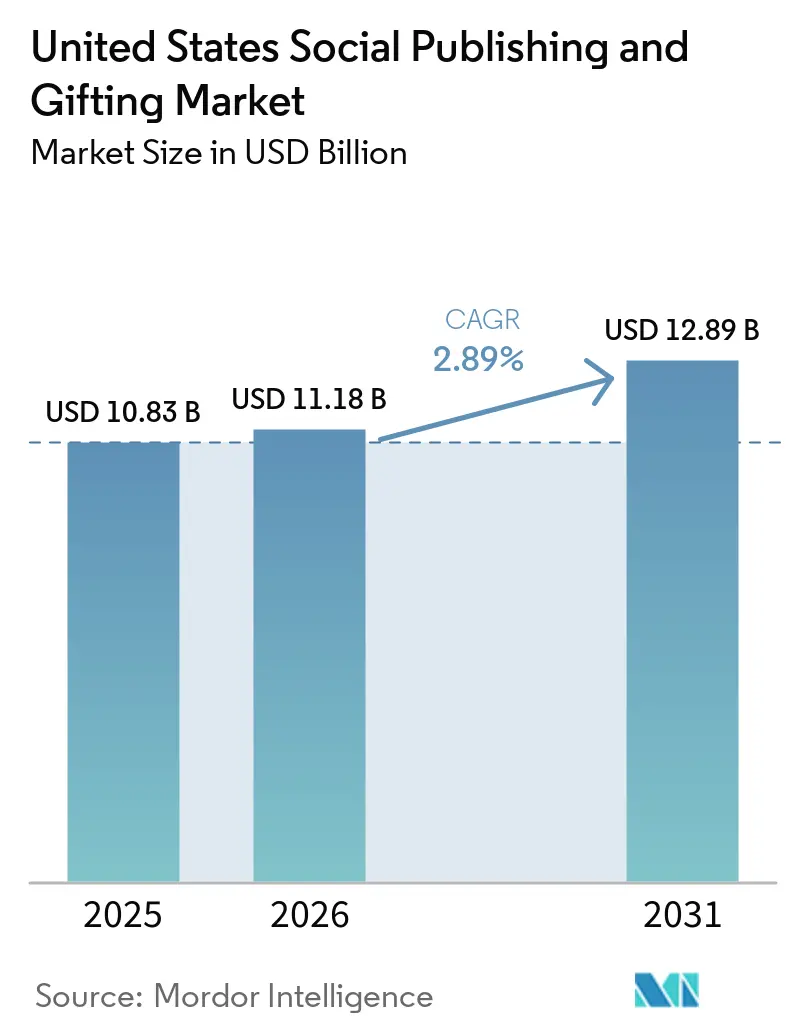
| Base Year Market Size (2025) | USD 10.83 Billion |
| Market Size (2026) | USD 11.18 Billion |
| Market Size (2031) | USD 12.89 Billion |
| Growth Rate (2026 - 2031) | 2.89 % |
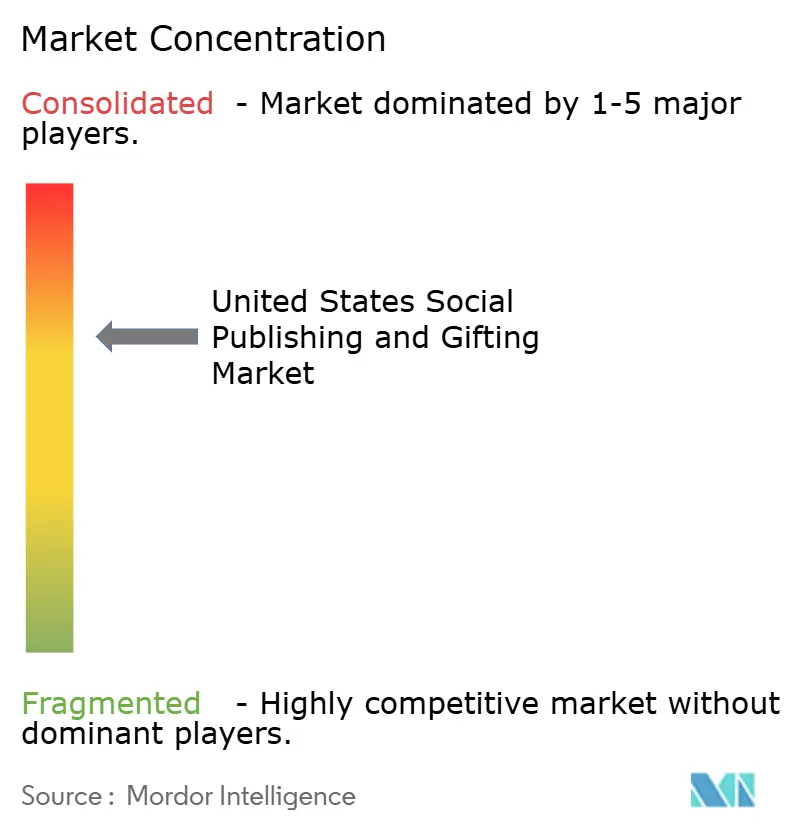
| Market Concentration | Medium |
Major Players *Disclaimer: Major Players sorted in no particular order Image © Mordor Intelligence. Reuse requires attribution under CC BY 4.0. | |
United States Social Publishing and Gifting Market Analysis by Mordor Intelligence
The United States social publishing and gifting market size is projected to expand from USD 10.83 billion in 2025 to USD 11.18 billion in 2026, and to USD 12.89 billion by 2031, registering a CAGR of 2.89% between 2026 and 2031. The United States social publishing and gifting market continues to be supported by recurring purchases tied to birthdays, holidays, and everyday occasions. Physical cards, planners, notebooks, calendars, and gift packaging remain relevant because consumers use them to mark personal relationships and important moments. Premium materials, personalization, and product design are shifting spending toward higher-value formats. Digital ordering is improving access to customized products, while physical retail remains important for browsing and impulse purchases. Competition remains concentrated in greeting cards, but adjacent categories offer space for specialist brands with distinctive designs, product selection, and direct customer relationships across multiple recurring consumer occasions.
Key Report Takeaways
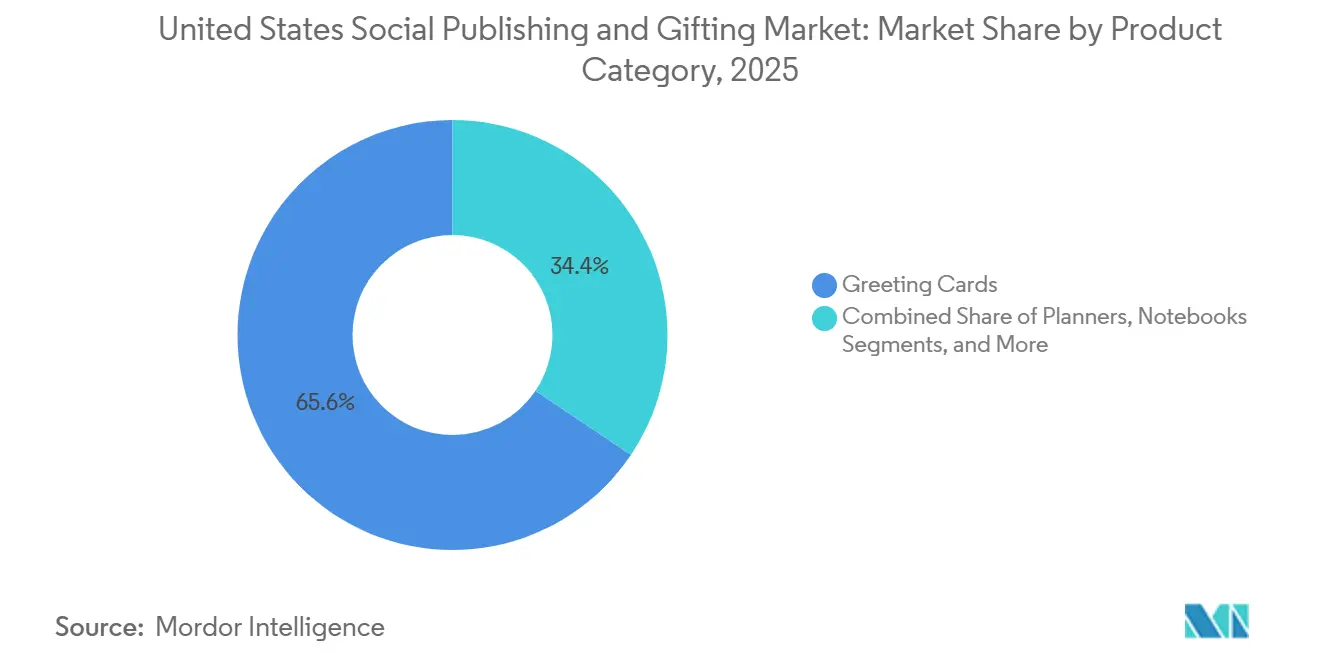
- By product category, Greeting Cards held 65.58% of the United States social publishing and gifting market share in 2025, while Planners are projected to expand at a 3.41% CAGR through 2031.
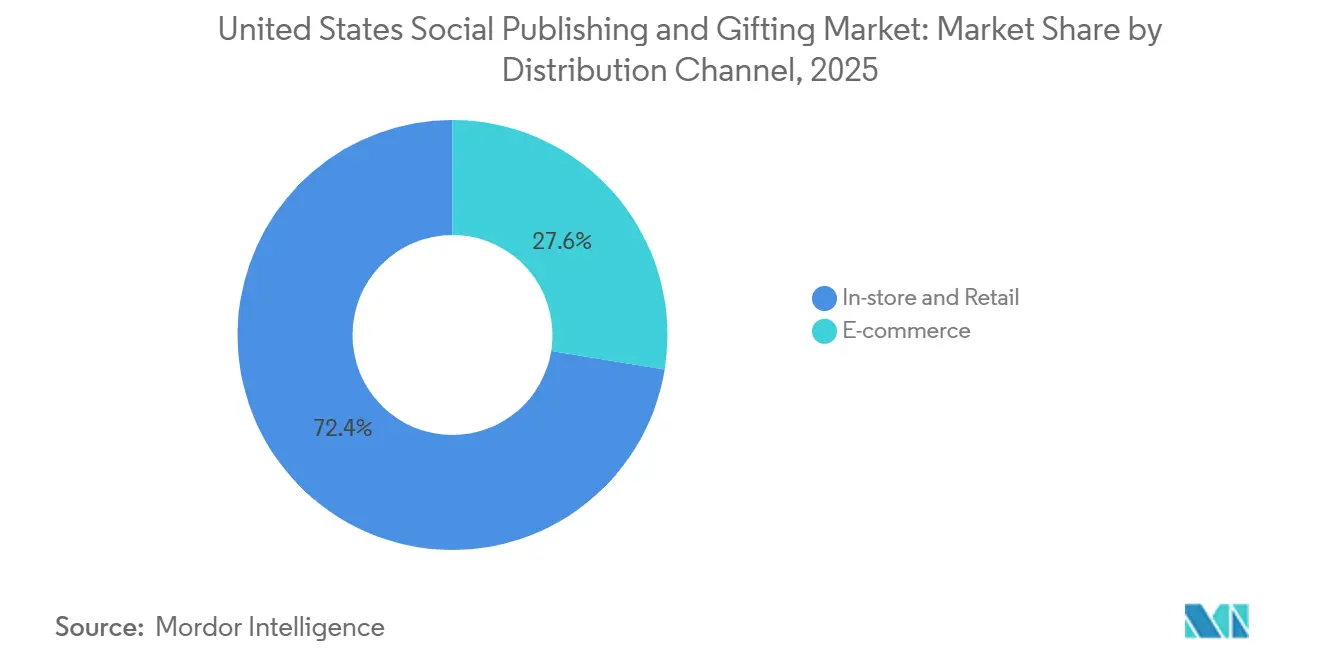
- By distribution channel, In-Store and Retail held 72.43% of the United States social publishing and gifting market share in 2025, while E-commerce is projected to expand at a 3.62% CAGR through 2031.
Note: Market size and forecast figures in this report are generated using Mordor Intelligence’s proprietary estimation framework, updated with the latest available data and insights as of January 2026.
United States Social Publishing and Gifting Market Trends and Insights
Drivers Impact Analysis*
| Driver | (~) % Impact on CAGR Forecast | Geographic Relevance | Impact Timeline |
|---|---|---|---|
| Seasonal and Occasion-Based Gifting | +1.0% | National, with peak density in the South and Midwest | Short term (≤ 2 years) |
| Demand for Personalized and Premium Products | +0.7% | National, highest concentration in Northeast and West | Medium term (2-4 years) |
| Consumer Preference for Physical and Tangible Products | +0.5% | National, skewing toward suburban and rural households | Medium term (2-4 years) |
| Growth of E-Commerce and Omnichannel Retail | +0.3% | National, accelerating in urban and suburban metro areas | Short term (≤ 2 years) |
| Expansion of Lifestyle and Design-Led Stationery Products | +0.2% | Urban centers, millennial and Gen Z consumer segments | Long term (≥ 4 years) |
| Growth of Independent, Identity-Led, and Occasion-Specific Card Makers | +0.1% | National, especially Northeast and West Coast independent retail | Long term (≥ 4 years) |
| Source: Mordor Intelligence | |||
Seasonal and Occasion-Based Gifting
Seasonal and occasion-based purchases provide a recurring source of demand for the United States social publishing and gifting market. Consumers bought 6.5 billion greeting cards annually, and Christmas accounted for 1.5 billion of those purchases, while Mother's Day ranked as the second-largest occasion.[1]Greeting Card Association, “Industry Statistics and Consumer Research,” Greeting Card Association, greetingcard.org Consumers also purchase cards for Galentine's Day, Diwali, sobriety milestones, recovery anniversaries, and diagnosis-related occasions. The wider range of occasions is linked to younger consumers sending cards outside traditional calendar events. Planners, gift packaging, and seasonal notebooks follow related cycles around back-to-school, the holiday period, and New Year. This longer calendar spreads demand across more of the year and reduces reliance on a small number of seasonal peaks.
Demand for Personalized and Premium Products
Personalization is becoming a standard expectation in the United States social publishing and gifting market. Birthday cards represented 60% of all everyday individual greeting cards sold in the United States, and many include photo printing, name embossing, or customizable messages. Erin Condren introduced its 2026-2027 LifePlanner collection with multiple interior layouts, a Stoney Clover Lane collaboration, upgraded 80-pound paper, and vegan leather cover options.[2]Erin Condren, “The 2026-2027 LifePlanner Collection,” Erin Condren, erincondren.com Premium paper, foil accents, and lay-flat binding enable higher-priced planner formats. Foil, laser cutting, embossing, and raised UV coatings also help card makers distinguish products that may otherwise appear similar. Brands that invest in materials and design can reduce exposure to price competition from private-label alternatives, especially when customers treat a product as part of a personal gesture.
Consumer Preference for Physical and Tangible Products
Consumer interest in tangible products remains an important support for the United States social publishing and gifting market. The Greeting Card Association reported that 9 in 10 U.S. households bought greeting cards annually, and these households purchased an average of 30 cards each year. This pattern shows that physical cards still have a role even when consumers use messaging and social platforms daily. Selecting a card, writing a message, and giving a wrapped item creates an experience that digital communication does not fully replace. Gift packaging extends this experience by making the presentation part of the occasion. Products with personalized messages, distinctive designs, and better materials are less likely to compete only on price, supporting a premium segment based on emotional value and physical presentation.
Growth of E-Commerce and Omnichannel Retail
E-commerce is expanding the ways consumers find and order products in the United States social publishing and gifting market. U.S. retail e-commerce sales reached USD 340.2 billion in the second quarter of 2026 and accounted for 17.1% of total retail sales, increasing 12.2% from the same quarter in 2025.[3]U.S. Census Bureau, “Quarterly Retail E-Commerce Sales, Second Quarter 2026,” U.S. Census Bureau, census.gov Print-on-demand services allow customers to create personalized cards, notebooks, and gift packaging with short fulfillment times. Online tools are useful for planned occasions because customers can customize an item before ordering it. Retailers with both stores and digital ordering can support customers who browse in one channel and complete the purchase in another. The United States social publishing and gifting market benefits when loyalty programs, product availability, and customer data are coordinated across those channels.
Restraints Impact Analysis*
| Restraint | (~) % Impact on CAGR Forecast | Geographic Relevance | Impact Timeline |
|---|---|---|---|
| Digital Alternatives and Changing Communication Preferences | -0.6% | National, skewing toward urban and Gen Z demographics | Medium term (2-4 years) |
| Paper and Raw Material Cost Volatility | -0.3% | National, with upstream exposure in Northeast and Southeast mills | Short term (≤ 2 years) |
| Seasonal Demand Concentration | -0.2% | National | Short term (≤ 2 years) |
| Changing Consumer Spending Patterns | -0.1% | National, higher sensitivity in middle-income households | Medium term (2-4 years) |
| Source: Mordor Intelligence | |||
Digital Alternatives and Changing Communication Preferences
Digital alternatives remain a restraint for lower-priced and less personal purchases in the United States social publishing and gifting market. Messaging services, social platforms, and electronic card subscriptions give consumers quick ways to recognize an occasion. Boxed holiday cards have declined as personalized and photo-based cards have taken a larger role in seasonal sending. American Greetings launched a Sebastian Maniscalco celebrity SmashUp ecard in August 2026 through its websites and mobile applications, with membership tiers from USD 6.99 to USD 39.99. The launch shows that established card companies are using digital products to serve occasions that might otherwise move to free communication tools. The main exposure remains commodity purchases because premium physical cards and meaningful occasions retain stronger reasons for personalization and presentation.
Paper and Raw Material Cost Volatility
Paper cost movements can place pressure on margins across the United States social publishing and gifting market. The Producer Price Index for writing and printing papers increased from 265.688 in March 2026 to 273.249 in July 2026. Higher prices for specialty paper can affect greeting cards, planners, notebooks, and premium packaging more directly than simpler paper products. Producers may have to absorb some costs or raise prices in channels where price sensitivity is high. Specialty coated papers and high-grade printing papers have fewer sourcing alternatives than standard grades. This constraint can favor companies with established procurement relationships and more flexibility in their product mix, while making premium pricing and efficient production more important for margins.
*Our forecasts treat driver/restraint impacts as directional, not additive. The impact forecasts reflect baseline growth, mix effects, and variable interactions.
Segment Analysis
By Product Category: Greeting Cards Sustain Structural Dominance
Greeting Cards held 65.58% of revenue by product category in 2025. The category benefits from purchases for birthdays, holidays, and everyday occasions across age groups. Birthday cards accounted for 60% of everyday individual cards sold in the United States. Friends received 1 in 3 everyday cards, making them the most frequent recipients. Cards for recovery milestones, pregnancy loss, gender transition, and culturally specific celebrations broaden the range of occasions addressed by the category. These more specific products encourage publishers to develop messages and designs for needs that are not fully served by traditional card assortments. Premium details such as foil, embossing, and specialty coatings support higher-value card purchases. The established volume base gives Greeting Cards a leading role in the United States social publishing and gifting market, even as the mix of occasions changes.
Planners are projected to expand at a 3.41% CAGR from 2026 to 2031, making them the fastest-growing product category. The category serves consumers who see analog planning as part of organization, wellness journaling, and personal style. Premium layouts, stronger paper, durable covers, and customization options support its appeal. Notebooks also serve stationery buyers who value design and use these products as lifestyle items. Recycled paper content and FSC certification can influence purchase decisions among customers seeking documented material standards. Calendars have a more mature role, but premium wall-art and artist-designed formats can be bought as decorative items. Gift Packaging Products support coordinated purchases of bags, wrapping paper, tissue, ribbons, and enclosure cards. Other Product Categories include stationery accessories, gift tags, wax seals, and enclosure items that complete an occasion-specific gift set.



By Distribution Channel: In-Store Retail Anchors the Purchase Experience
In-Store and Retail accounted for 72.43% of revenue by distribution channel in 2025. Physical stores allow customers to read card messages, assess paper quality, and evaluate visual details before purchase. These steps matter when the item represents a personal relationship or a specific occasion. Store visits also support impulse purchases made during broader shopping trips. A card or gift packaging item can be selected after a customer sees it rather than before the trip begins. Hallmark's January 2026 Semi-Annual Sale offered buy-one-get-one-50%-off on cards priced USD 2.99 and above. The promotion showed how in-store and digital offers can be used after the holiday period to encourage repeat purchases. Curated assortments, loyalty programs, and artist events also help stores direct customers toward premium purchases.
E-commerce is projected to expand at a 3.62% CAGR from 2026 to 2031, the fastest rate among distribution channels. The channel is suited to personalized orders because customers can choose design details and messages before production. Shorter production and delivery cycles reduce the convenience advantage that stores once held for planned purchases. Minted introduced an AI-based customization tool in April 2026 that allows customers to create design elements within artist-created invitation templates. Shutterfly also entered a multiyear agreement for 35 HP Indigo 120K presses in March 2026. This capacity supports personalized print production at a larger scale during both peak and nonpeak periods. The United States social publishing and gifting market is likely to retain a mixed channel structure because customization benefits online ordering while browsing and immediate selection remain important in stores.
Geography Analysis
The United States social publishing and gifting market is domestic in scope, but purchasing patterns vary across regions. The South is the highest-volume region by consumer base, supported by large multigenerational households, holiday traditions, and broad mass-market retail coverage. Hallmark and Dollar General launched the Simply for You by Hallmark Holiday 2026 Collection during September 2026, with more than 30 holiday-themed items. The collection provides a value-oriented route to shoppers in Southern and rural areas. The Midwest also supports steady card and gift purchases through a longstanding culture of handwritten occasion acknowledgment. Hallmark's headquarters in Kansas City, Missouri, reflects the region's historic association with the greeting card category. The South and Midwest remain important for products tied to established holidays and regular family occasions.
The Northeast supports a higher concentration of independent card makers, premium stationery stores, and design-focused gift shops. Consumers in the New York metropolitan area, Massachusetts, and the Mid-Atlantic corridor can place more value on artistic design, cultural relevance, and message specificity. The 3,500 independent card makers active nationally serve customers for whom design quality can matter more than established brand recognition. This regional setting supports occasion-specific and artist-designed products with higher price points. Retailers in the Northeast can use specialized assortments to distinguish themselves from mass-market outlets. Regional retail formats shape where premium and independent offerings are most visible.
The West Coast, especially California, acts as a center for digital-to-physical product development. Shutterfly and Minted are headquartered in the region, and consumers in San Francisco and Los Angeles have supported early use of personalized digital workflows. Minted's customization approach combines customer input with artwork developed by independent artists. This model is relevant for shoppers who want individualized products without starting from a blank design. Mountain and Plains states represent a smaller but stable demand base. Their seasonal purchasing patterns are closely aligned with national occasions, and mass-market retail has a strong role in product access. The United States social publishing and gifting market therefore has distinct regional strengths, with volume-oriented demand in the South and Midwest, premium retail in the Northeast, and product innovation on the West Coast.
Competitive Landscape
The United States social publishing and gifting market has a concentrated greeting card segment and a more fragmented set of adjacent categories. Hallmark Cards, Inc. and American Greetings Corporation together accounted for 80% of greeting card revenues. This scale gives the two companies substantial influence over retail placement, product ranges, and the annual occasion calendar. The remaining portion of the category includes 3,500 independent makers with specialized designs and messages. Competition in planners includes mass-market ACCO Brands and At-A-Glance products as well as premium lines from Erin Condren and Moleskine S.p.A. Gift packaging, notebooks, and related stationery have a wider group of regional and specialty producers. Design quality, materials, and direct customer relationships are central ways these companies compete.
Leading companies are using licensing, entertainment, and physical experiences to extend their brands. Hallmark announced a holiday pop-up at Disney Springs in August 2026, with greeting cards, Keepsake Ornaments, and film-related merchandise. The activation combines content, retail products, and an in-person customer experience. Hallmark also announced Hallmark Stars Live in March 2026, a multicity event presented by Michaels. Minted, Rifle Paper Co., and Passion Planner, Inc. compete through design-led assortments, direct-to-consumer distribution, and online communities. These approaches allow smaller and specialist brands to reach customers without depending only on traditional retail shelf space.
Technology is becoming more important for companies that sell customized print products. Minted's April 2026 tool lets customers add personalized elements while maintaining artist-created template structures. Shutterfly's agreement for 35 HP Indigo 120K presses expands automated personalized-print capacity. These investments can improve speed and consistency for customers ordering personalized products close to an occasion. FSC certification and recyclable packaging standards can also matter in procurement decisions, particularly among specialty and premium grocery retailers with sustainability commitments. The United States social publishing and gifting industry combines high concentration in greeting cards with a fragmented competitive environment in its other product areas. Companies that can connect customization, production capacity, and clear product positioning have more ways to serve digital-native customers who order gifts at short notice.
United States Social Publishing and Gifting Industry Leaders
Hallmark Cards, Inc.
American Greetings Corporation
Shutterfly, LLC
Vistaprint
Minted, Inc.
- *Disclaimer: Major Players sorted in no particular order

Recent Industry Developments
- September 2026: Dollar General and Hallmark Cards, Inc. launched the exclusive "Simply for You by Hallmark" Holiday 2026 Collection at Dollar General stores nationwide, beginning the week of September 20, 2026. The collection spans more than 30 holiday-themed items, including festive decor, entertaining essentials, and thoughtful gifts. It extends Hallmark's brand presence into value retail and broadens affordable holiday gifting access across price-sensitive consumer segments. The launch places a seasonal branded assortment within a retailer that has broad reach in smaller cities, rural communities, and value-oriented shopping locations.
- August 2026: Hallmark Cards, Inc. announced a limited-time holiday pop-up store at Disney Springs, Walt Disney World Resort, Florida, scheduled to open in early October 2026. The activation is tied to the Hallmark Channel original film "Holiday Ever After: A Disney World Wish Come True" and features greeting cards, Keepsake Ornaments, and film-inspired merchandise. It marks Hallmark's first in-park retail activation at a Disney property. The company used the location to connect entertainment content, collectible products, and a physical shopping visit during the holiday season.
- August 2026: American Greetings Corporation launched a customizable celebrity SmashUp ecard featuring comedian Sebastian Maniscalco. It is available through americangreetings.com, bluemountain.com, and corresponding iOS and Android apps. Membership tiers range from USD 6.99 to USD 39.99. The product uses a recognizable personality and customization features to support subscription-based digital gifting.
- July 2026: Shutterfly, LLC and Scodix expanded their strategic partnership through Shutterfly's investment in 4 new Scodix Ultra 2500 SHD digital embellishment presses. The investment included an expected 5-year consumables and service agreement. The new presses, installed ahead of the 2026 peak production season, expand capacity for premium digital foil, varnish, and dimensional embellishment across personalized greeting cards and stationery. The equipment adds production capacity for finishes that support premium product positioning.


United States Social Publishing and Gifting Market Report Scope
The United States Social Publishing and Gifting Market refers to the ecosystem of digital platforms, applications, and services that enable users to create, personalize, publish, share, and monetize social content, and facilitate the exchange of virtual and physical gifts within online communities.
The United States Social Publishing and Gifting Market Report is Segmented by Product Category (Greeting Cards, Planners, Notebooks, Calendars, Gift Packaging Products, and Other Product Categories) and Distribution Channel (E-commerce and In-Store and Retail). The Market Forecasts are Provided in Terms of Value (USD).
| Greeting Cards |
| Planners |
| Notebooks |
| Calendars |
| Gift Packaging Products |
| Other Product Categories |
| E-commerce |
| In-store and Retail |
| By Product Category | Greeting Cards |
| Planners | |
| Notebooks | |
| Calendars | |
| Gift Packaging Products | |
| Other Product Categories | |
| By Distribution Channel | E-commerce |
| In-store and Retail |


Key Questions Answered in the Report
What is the United States social publishing and gifting market size?
The United States social publishing and gifting market size is USD 11.18 billion in 2026 and is projected to reach USD 12.89 billion by 2031, registering a CAGR of 2.89% during the forecast period.
Which product category leads social publishing and gifting sales in the United States?
Greeting Cards led product categories with a 65.58% revenue share in 2025, driven by strong consumer demand for birthdays, holidays, celebrations, and everyday occasions.
Which sales channel is expanding fastest for social publishing and gifting products?
E-commerce is projected to expand at a CAGR of 3.62% through 2031, supported by personalized product ordering, broader product accessibility, and improved print-on-demand fulfillment capabilities.
Why do physical greeting cards remain relevant in the United States?
Physical greeting cards remain relevant because consumers continue to value tangible and personal expressions of sentiment, with 9 in 10 U.S. households purchasing greeting cards annually.
What factors support premium planner and stationery demand?
Demand for premium planners and stationery is supported by personalization features, higher-quality paper materials, durable covers, decorative formats, and increasing consumer preference for design-focused products.
Who are the leading companies in the United States social publishing and gifting market?
Hallmark Cards, Inc. and American Greetings Corporation together accounted for approximately 80% of greeting card revenues, while adjacent product segments are served by a mix of established and niche specialty brands.
Page last updated on:





