
United States Social Commerce Market Size and Share
Market Overview
| Study Period | 2020 - 2031 |
|---|---|
| Forecast Data Period | 2026 - 2031 |
| Base Year Market Size (2025) | USD 0.37 Trillion |
| Market Size (2026) | USD 0.45 Trillion |
| Market Size (2031) | USD 1.04 Trillion |
| Growth Rate (2026 - 2031) | 18.24 % |
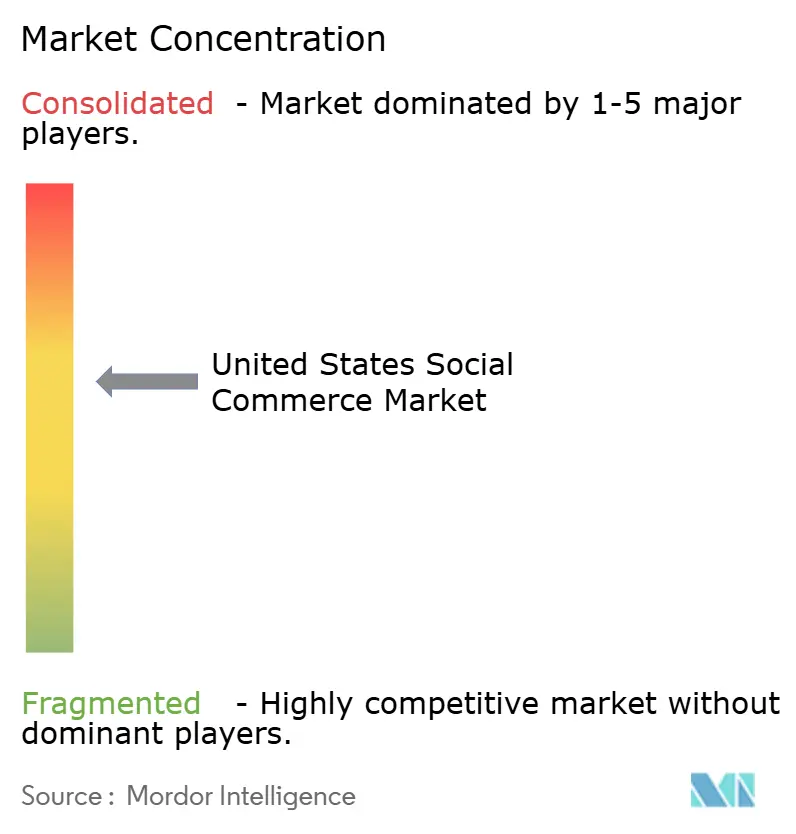
| Market Concentration | Medium |
Major Players *Disclaimer: Major Players sorted in no particular order Image © Mordor Intelligence. Reuse requires attribution under CC BY 4.0. | |
United States Social Commerce Market Analysis by Mordor Intelligence
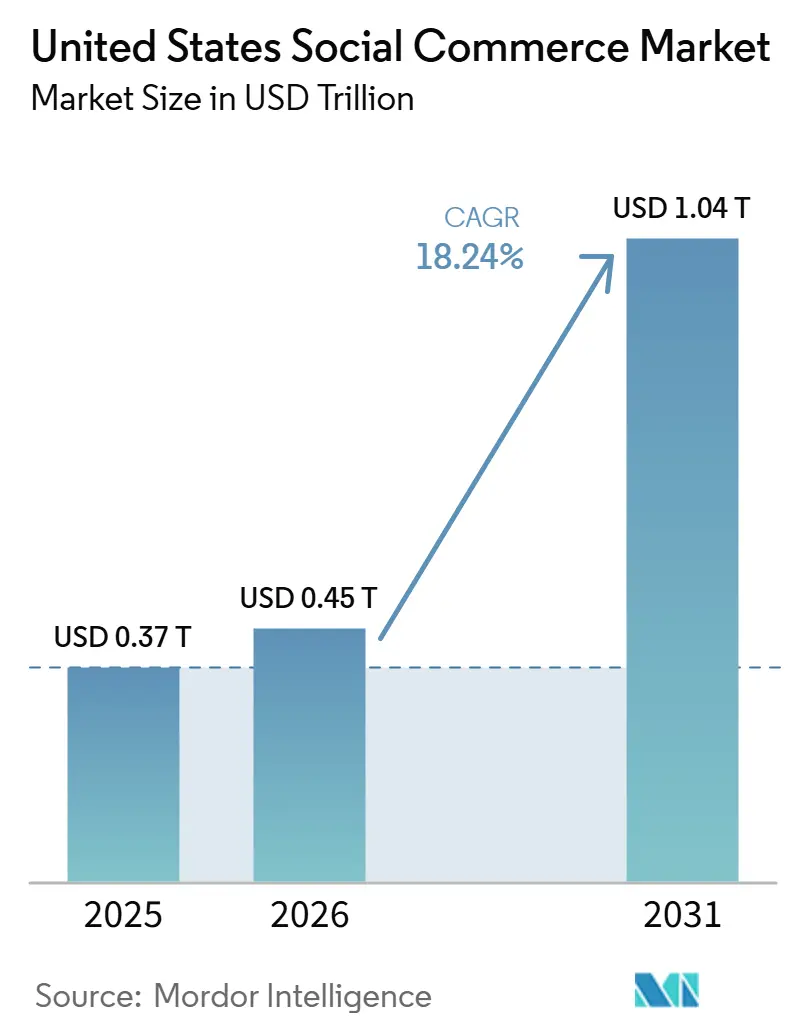
The United States social commerce market size was valued at USD 0.37 trillion in 2025 and estimated to grow from USD 0.45 trillion in 2026 to reach USD 1.04 trillion by 2031, at a CAGR of 18.24% during the forecast period (2026-2031). Creator-led discovery, native checkout, and shoppable video are bringing product discovery and transaction completion into the same customer journey, giving merchants more opportunities to turn product interest into an order without asking the buyer to leave a familiar social service. The United States social commerce market is also moving beyond low-cost impulse purchases as home products, supplements, food, and higher-value beauty items gain traction, which makes product information, creator credibility, and reliable delivery more important to purchase confidence. Platforms are competing through creator relationships, conversion performance, and catalog connections rather than through isolated features, because useful tools have limited value when merchants cannot connect them to their existing inventory and customer operations. Brands must also decide which platform combinations serve their target consumers, how to maintain consistent product listings, how to handle returns and service requests, and how to balance creator-led activity with direct storefront management. Fraud exposure, disclosure requirements, and uncertainty around platform operations are prompting brands to spread budgets across several channels and to place greater weight on trusted content, clear product claims, and measurable outcomes. This shift creates opportunities for merchants that can manage compliance, measure conversion, deliver reliable fulfillment, and respond consistently to customers within the United States social commerce market.
Key Report Takeaways
- By product type, apparel held 30.27% of the United States social commerce market share in 2025, while personal and beauty care is projected to expand at an 18.74% CAGR through 2031.
- By device, smartphones held 79.46% of the United States social commerce market share in 2025 and are projected to expand at an 18.93% CAGR through 2031.
- By sales channel, video commerce accounted for 37.18% of the United States social commerce market size in 2025, while social reselling is projected to expand at a 20.22% CAGR through 2031.
Note: Market size and forecast figures in this report are generated using Mordor Intelligence’s proprietary estimation framework, updated with the latest available data and insights as of January 2026.
United States Social Commerce Market Trends and Insights
Drivers Impact Analysis*
| Driver | (~) % Impact on CAGR Forecast | Geographic Relevance | Impact Timeline |
|---|---|---|---|
| Creator-Led Product Discovery and Affiliate Conversion | +4.8% | National, concentrated in California, New York, and Texas creator clusters | Short term (≤ 2 years) |
| Native In-Platform Checkout and Wallet Integration | +3.9% | National, with the highest conversion uplift in smartphone-dominant Sun Belt metros and Northeast cities | Short term (≤ 2 years) |
| Video-First Shopping and Livestream Demonstrations | +3.2% | National, with early leadership in Sun Belt and Pacific Coast markets | Medium term (2-4 years) |
| Expansion Into Planned-Purchase Categories | +2.1% | National, with strongest uptake in high-income Northeast and Pacific Coast markets | Medium term (2-4 years) |
| Creator Storefront Portability Across Platforms | +1.5% | National, with spillover into secondary markets as creator tools become more accessible | Long term (≥ 4 years) |
| AI-Assisted Product Matching and Shoppable Content Generation | +2.0% | National, with early adoption in beauty, apparel, and home products | Medium term (2-4 years) |
| Source: Mordor Intelligence | |||
Creator-Led Product Discovery and Affiliate Conversion
Creator affiliate programs are becoming a central sales channel for beauty and apparel brands in the United States social commerce market. LTK reported that creator recommendations remain important to Gen Z purchase decisions, reflecting the role of trusted personalities in product selection.[1]A live product demonstration can build awareness, clarify product use, and enable a purchase within the same content session. Brands, therefore, need a broad group of credible mid-tier creators, rather than reliance on a small number of exclusive partners. This approach can also reduce the operational risk of depending on one individual for a large share of campaign performance.
Native In-Platform Checkout and Wallet Integration
Native checkout is reducing the distance between social content and completed orders in the United States social commerce market. Shopify extended Shop Pay installment financing to TikTok Shop checkouts in May 2026, adding a payment option for creator storefront transactions.[2] Meta also announced product-discovery tools and checkout-related partnerships during 2026. These integrations favor merchants with established storefronts, product data, and payment systems. Smaller sellers can still participate, but setup requirements can postpone their first profitable sales.
Video-First Shopping and Livestream Demonstrations
Livestream demonstrations give the United States social commerce market a format that combines product explanation, interaction, and immediate checkout. TikTok Shop reported extensive live-shopping activity during its 2025 Black Friday and Cyber Monday period, indicating that brands can use scheduled events to reach large audiences. Live content can also reach consumers who do not already follow a brand when a platform recommends the session. This makes live commerce useful for customer acquisition as well as repeat purchasing. The format is expanding beyond youth-oriented fashion into collectibles, beauty, and other categories where demonstration improves product understanding.
Expansion Into Planned-Purchase Categories
The United States social commerce market is extending into purchases that require more research, comparison, or confidence than low-priced impulse items. Higher-value health and beauty orders show that consumers can consolidate larger transactions within social channels when the content answers product questions. Product expansion also creates room for home goods, supplements, food, and niche collector categories. These products require accurate descriptions, credible reviews, and dependable fulfillment. Regulatory scrutiny of supplement claims makes established compliance processes especially important for brands in that category.
Restraints Impact Analysis*
| Restraint | (~) % Impact on CAGR Forecast | Geographic Relevance | Impact Timeline |
|---|---|---|---|
| Consumer Concerns About Payment Security and Product Quality | -2.8% | National, with elevated exposure in high-fraud urban metros | Short term (≤ 2 years) |
| Disclosure, Review Integrity, and Product-Claim Compliance Costs | -2.2% | National, with the highest burden for large creator programs in California and New York | Short term (≤ 2 years) |
| Platform Policy and Operating-Structure Volatility | -1.8% | National, with a disproportionate impact on TikTok-heavy revenue models | Medium term (2-4 years) |
| Attribution Loss From Walled-Garden Data and Identity Changes | -1.3% | National, with the largest operational impact on multi-platform operators in competitive verticals | Medium term (2-4 years) |
| Source: Mordor Intelligence | |||
Consumer Concerns About Payment Security and Product Quality
Consumer trust remains a major constraint on the United States social commerce market. The Federal Trade Commission reported substantial consumer losses from scams that began on social media, and it identified shopping scams as the most frequently reported category. The agency stated that a significant share of social-media fraud victims reported ordering products that did not arrive or were counterfeit. Visa also identified AI-enabled social engineering as a growing payment threat in its latest report. VISA Fraud can reduce conversion for legitimate merchants, particularly smaller creators without a widely recognized brand name.
Disclosure, Review Integrity, and Product-Claim Compliance Costs
Compliance obligations can increase the cost of creator programs in the United States social commerce market. The FTC states that creators must clearly disclose material relationships with brands, including affiliate commissions. The agency also provides specific guidance on conspicuous disclosures in social media posts. The Fake Reviews and Testimonials Rule, effective October 21, 2024, prohibits certain deceptive review practices and can impose civil penalties for knowing violations.[3] Large brands can absorb monitoring and legal costs more easily than smaller entrants. This gap can affect access to leading creators and slow the expansion of less-resourced merchants.
*Our forecasts treat driver/restraint impacts as directional, not additive. The impact forecasts reflect baseline growth, mix effects, and variable interactions.
Segment Analysis
By Product Type: Apparel Leads, While Beauty Sets The Faster Pace
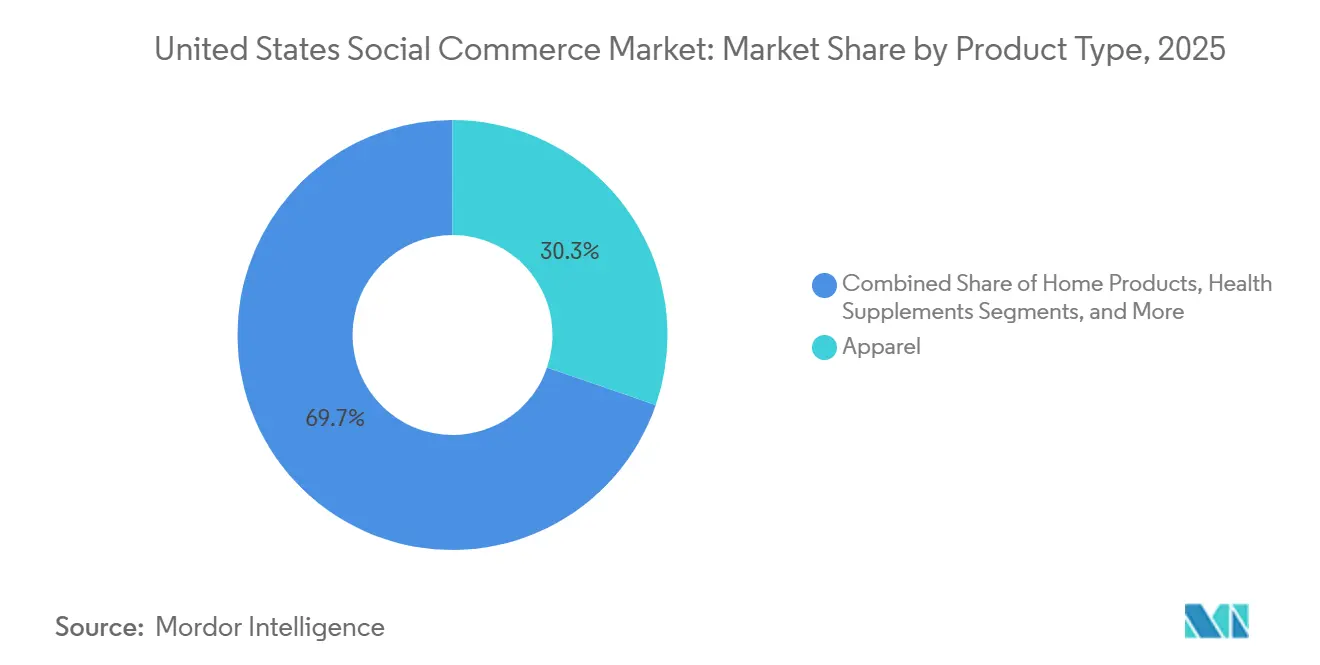
Apparel held 30.27% share in 2025. Fashion fits discovery-led feeds because creators can show products in use, offer styling context, compare looks, and link directly to purchase options within the content experience. Personal and beauty care is projected to expand at an 18.74% CAGR from 2026 to 2031. Beauty content can combine a visual demonstration with routine advice, which can support first purchases and repeat buying when consumers want to see results, learn product application, and assess suitability.
Accessories and home products are gaining relevance as creator content moves into lifestyle recommendations, room design, seasonal shopping, and gift selection. Health supplements can benefit from comparison reviews and routine videos that help consumers assess products, although claims need careful oversight. The FDA requires that product claims remain truthful and not misleading, which favors sellers with reliable review and approval processes. Food and beverages remain at an earlier stage than apparel and beauty, although live discovery can help shoppers find new products and understand how they fit into daily use. Across these categories, more planned purchases are being completed within social platforms instead of on separate retail sites, increasing the importance of product information and dependable order handling.

By Device: Smartphones Define The Mobile-Native Purchase Journey
Smartphones accounted for 79.46% of the United States social commerce market size in 2025 and are projected to expand at an 18.93% CAGR through 2031. The result reflects the role of mobile feeds, short videos, messaging, wallet-based payments, and creator links in the purchase process. Laptops and desktops remain useful for higher-value purchases and business-to-business workflows where buyers prefer larger screens, detailed comparison, or more extensive product information. Merchants must make product pages, creator links, and checkout flows work smoothly on smartphones because the customer can move directly from a video or post to payment. A slow or complicated mobile experience can cause customers to leave before completing payment and can make paid or creator-driven traffic less productive.
Apple’s App Tracking Transparency framework limits some data sharing between apps and advertising systems, making cross-platform measurement more difficult for merchants that depend on several paid and unpaid channels. Shopify’s Shop Pay integration with TikTok Shop can give Shopify merchants a more consistent checkout experience across participating sales surfaces. Better mobile connectivity can also improve the quality of livestream viewing in secondary cities, reducing interruptions that can weaken the live purchase experience. This could widen the audience for real-time selling formats over the forecast period as video can be viewed more reliably outside the largest metropolitan areas. The United States social commerce industry will therefore remain closely tied to mobile design, payment speed, video reliability, and the ability to connect campaign activity with verified orders.
By Sales Channel: Video Commerce Leads, While Social Reselling Gains Momentum
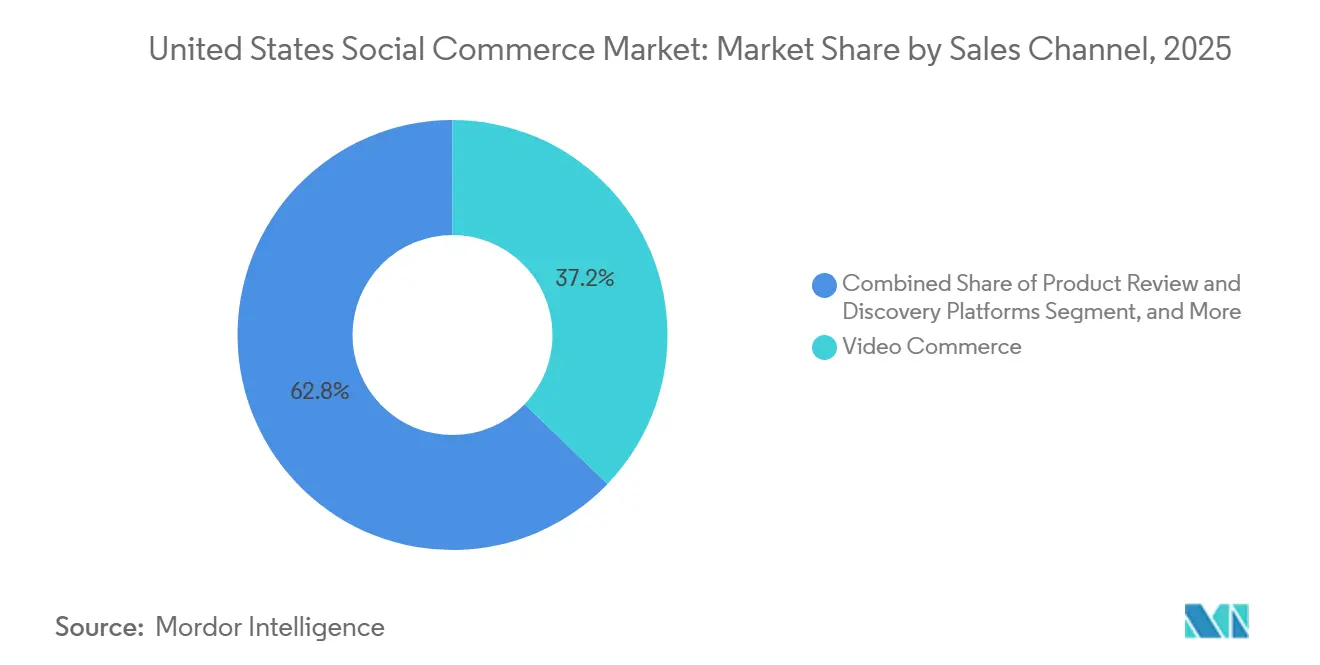
Video commerce held 37.18% share of the US social commerce market in 2025. Demonstrations, live questions, and product links make video an effective format for explaining goods before purchase, particularly when customers need to see product use or compare alternatives. Social-network-led commerce also benefits from peer endorsement and existing social relationships. These relationships can add a layer of trust that standard paid advertising does not always provide, especially when recommendations come from a familiar creator or community member. Consumers can use social discussion to research products before completing purchases on platform storefronts, which means content can support several stages of the purchase process.
Social reselling is projected to expand at a 20.22% CAGR from 2026 to 2031. Demand is supported by younger consumers’ interest in pre-owned goods, value-focused purchasing, and improved authentication tools that can increase confidence in peer-to-peer and marketplace transactions. eBay announced an agreement to acquire Depop for USD 1.2 billion in February 2026, reinforcing the strategic importance of mobile-first resale. eBay said Depop generated nearly USD 1 billion in annual gross merchandise sales during 2025 and that 90% of its 7 million active buyers were under age 34. Resale platforms can benefit when consumers seek lower-priced alternatives while still wanting discovery, community interaction, and a marketplace that can help validate products.
Geography Analysis
California supported a major share of creator-content supply for the United States social commerce market in 2026, led by Los Angeles-based creator networks. The concentration of creators and brands in the state can support ongoing experimentation with affiliate programs, livestream selling, and shoppable content. The Pacific Coast corridor links Seattle’s technology and retail capabilities with Los Angeles’s creator base, creating a connection between platform development, merchant operations, and creative production. This corridor can serve as an early testing ground for new social shopping formats before national expansion, especially when merchants need to test content, checkout, and fulfillment together.
Sun Belt states, including Texas, Florida, North Carolina, and Tennessee, are important demand centers for the United States social commerce market. Migration into these states can concentrate younger households that use mobile commerce and social platforms frequently, which supports new customer acquisition through social content. South Florida’s bilingual digital environment can support beauty, food, and home-product discovery through Spanish- and English-language content. Texas logistics networks around Dallas-Fort Worth and Austin can reduce fulfillment delays for impulse-oriented categories, where customers expect the speed associated with a digital purchase. Reliable local fulfillment is particularly important when purchases follow a time-sensitive live session and when buyers need assurance that products will arrive as described.
The Northeast remains a major consumption cluster for higher-value social purchases, with New York and Boston supporting fashion, luxury, and design-oriented demand. New York’s household incomes, fashion-industry concentration, and engagement with trend cycles make it receptive to Pinterest’s shoppable categories and Instagram Shopping’s luxury content. The Midwest is an emerging region where live-commerce adoption remains behind coastal markets, leaving room for further participation as formats become more familiar. Whatnot’s broader focus on collectibles, sports memorabilia, and craft goods can appeal to buyers in this region because these categories benefit from enthusiastic communities and product demonstrations. Local creator recruitment, stronger delivery operations, and category-specific programming can widen the commercial opportunity in underpenetrated locations through 2031.
Competitive Landscape
The United States social commerce market is moderately concentrated at the platform level and fragmented among specialist marketplaces and creator-service providers. Meta, TikTok, and YouTube have broad consumer reach, while specialist platforms compete through focused communities, resale activity, and more specific selling formats. Meta launched a unified Commerce Hub in June 2026 that integrated Facebook Shops, Instagram Shopping, and WhatsApp Business catalogs into a single merchant interface. This type of integration can make it easier for merchants to manage product information across Meta properties, reduce duplicate catalog work, and keep listings consistent when they use more than one Meta service.
Pinterest is developing product-discovery tools that can appeal to brands with higher-value home and lifestyle catalogs, where consumers often need more visual context before buying. LTK launched LTK AI in February 2026 to surface product recommendations from verified creator content to its consumer audience. This approach positions creator curation as a distinct alternative to algorithm-only recommendations and gives users a way to begin with creators they already trust. eBay’s planned acquisition of Depop provides another example of strategic investment in socially oriented resale and a younger buyer base. Amazon, Meta, and specialist platforms are all seeking better ways to connect creator content with attributable commerce outcomes, while merchants seek clearer evidence of which content produces completed orders.
Competitive advantage in the United States social commerce market depends on the depth of creator relationships, checkout conversion, product catalog quality, and measurement capability. No single platform can rely on a lasting feature lead because checkout, affiliate, and product-matching tools can be replicated by competitors with enough merchant demand and technical resources. Platform-policy uncertainty can lead brands to distribute budgets across Pinterest, YouTube Shopping, TikTok Shop, and resale platforms rather than concentrate activity in one service. Mid-market merchants with annual revenue between USD 1 million and USD 50 million can face particular difficulty because enterprise tools are costly and multi-platform compliance takes time. Their teams must coordinate product feeds, creator agreements, disclosures, payment operations, customer service, returns, inventory availability, and reporting across different interfaces. The United States social commerce industry remains open to focused providers that can make creator selling, compliance, fulfillment coordination, catalog maintenance, and measurement easier for these merchants.
United States Social Commerce Industry Leaders
-
Meta Platforms, Inc.
-
TikTok Inc.
-
Alphabet Inc.
-
Pinterest, Inc.
-
Walmart Inc.
- *Disclaimer: Major Players sorted in no particular order
Recent Industry Developments
- June 2026: Meta launched its unified Commerce Hub, integrating Facebook Shops, Instagram Shopping, and WhatsApp Business catalogs into a single merchant interface. Beta testing reported a 76% reduction in multi-platform management time, and full rollout was scheduled across all Meta Business accounts by August 2026.
- March 2026: Pinterest added Amazon Storefront support, enabling creators to link their Amazon Influencer storefronts to Pinterest accounts and tag products in Pins with affiliate links.
- March 2026: Reddit expanded its Shopify integration globally for all advertisers, enabling product catalog syncing into Reddit Dynamic Product Ads. The platform reported a 40% year-over-year increase in high-intent shopping conversations and noted that 84% of on-platform shoppers report greater purchase confidence.
- February 2026: eBay announced a definitive agreement to acquire Depop from Etsy for USD 1.2 billion in cash. Depop reported nearly USD 1 billion in annual gross merchandise sales in 2025, including nearly 60% year-over-year U.S. gross merchandise value growth, 7 million active buyers, 90% of whom were under age 34, and more than 3 million active sellers.
United States Social Commerce Market Report Scope
The United States Social Commerce Market refers to the buying and selling of products directly through social media platforms and social-network-driven commerce experiences in the U.S. It includes shoppable posts, live shopping, creator-led storefronts, in-app checkout, and social selling across platforms such as TikTok, Instagram, Facebook, and YouTube.
The United States Social Commerce Market Report is Segmented by Product Type (Apparel, Personal and Beauty Care, Accessories, Home Products, Health Supplements, and Food and Beverages), Device (Laptops and Desktops, and Smartphones), and Sales Channel (Video Commerce, Social Network-Led Commerce, Social Reselling, Group Buying, and Product Review Platforms). The Market Forecasts are Provided in Terms of Value (USD).
| Apparel |
| Personal and Beauty Care |
| Accessories |
| Home Products |
| Health Supplements |
| Food and Beverages |
| Other Product Types |
| Laptops and Desktops |
| Smartphones |
| Video Commerce |
| Social Network-Led Commerce |
| Social Reselling |
| Group Buying / Team Purchase |
| Product Review and Discovery Platforms |
| By Product Type | Apparel |
| Personal and Beauty Care | |
| Accessories | |
| Home Products | |
| Health Supplements | |
| Food and Beverages | |
| Other Product Types | |
| By Device | Laptops and Desktops |
| Smartphones | |
| By Sales Channel | Video Commerce |
| Social Network-Led Commerce | |
| Social Reselling | |
| Group Buying / Team Purchase | |
| Product Review and Discovery Platforms |
Key Questions Answered in the Report
What is the size of the United States social commerce market?
The market is estimated at USD 0.45 trillion in 2026 and is forecast to reach USD 1.04 trillion by 2031 at an 18.24% CAGR. The United States social commerce market is supported by discovery, content, payment, and fulfillment functions that increasingly operate within connected platform experiences. Its outlook reflects the increasing ability of creators and merchants to show products, answer questions, direct buyers to checkout, and keep the buying process within the social environment instead of sending consumers to a separate shopping site.
Which product category leads social commerce sales in the United States?
Apparel led with 30.27% share in 2025, while personal and beauty care is projected to expand at an 18.74% CAGR through 2031. In the United States social commerce market, creators can show apparel and beauty products in use, which gives buyers practical context before choosing an item. This visual format can help consumers understand fit, styling, application, and routine use, while also helping brands present products in a way that can encourage repeat engagement and purchase consideration.
Which device is most important for social shopping in the United States?
Smartphones held 79.46% share in 2025 and are projected to expand at an 18.93% CAGR through 2031. The United States social commerce market depends on mobile product pages, checkout flows, video viewing, and payment methods that allow customers to act immediately after seeing content. Merchants that cannot provide a clear, fast mobile experience risk losing traffic generated by creators, live sessions, social posts, and paid promotions before the customer has completed an order.
Which sales channel is expected to expand the fastest through 2031?
Social reselling is projected to expand at a 20.22% CAGR, supported by demand for pre-owned goods and improved authentication. The United States social commerce market can benefit when resale platforms combine community discovery, value-focused purchasing, and measures that help buyers evaluate product authenticity. These features can be particularly relevant for younger users who want access to unique items, seek lower prices, and expect resale services to provide an enjoyable social experience as well as a secure transaction.
What are the main risks for social commerce sellers?
Fraud, payment security concerns, undisclosed endorsements, fake reviews, and difficult cross-platform measurement can raise costs and reduce consumer trust. Sellers in the United States social commerce market need clear disclosures, accurate product information, review controls, and effective customer support to reduce these risks. They also need internal processes that can review creator relationships, product claims, and customer complaints before small issues create broader reputational or compliance problems across several social platforms.
How are leading platforms competing in U.S. social shopping?
Platforms are strengthening creator tools, catalog connections, product discovery, and payment experiences, while merchants increasingly use several channels to manage platform risk. In the United States social commerce market, this makes dependable checkout, merchant support, and clear conversion reporting as important as audience reach. Platforms must also help merchants maintain accurate product data, coordinate creator activity, respond to buyers, and understand whether a completed order can be linked to the content or promotion that influenced it. This requires merchant interfaces that reduce repetitive work, support timely catalog changes, and make it easier for a seller to use platform tools without losing control of its customer experience or operating processes.