
United States Scaffolding Rental Market Size and Share
Market Overview
| Study Period | 2021 - 2032 |
|---|---|
| Forecast Data Period | 2027 - 2032 |
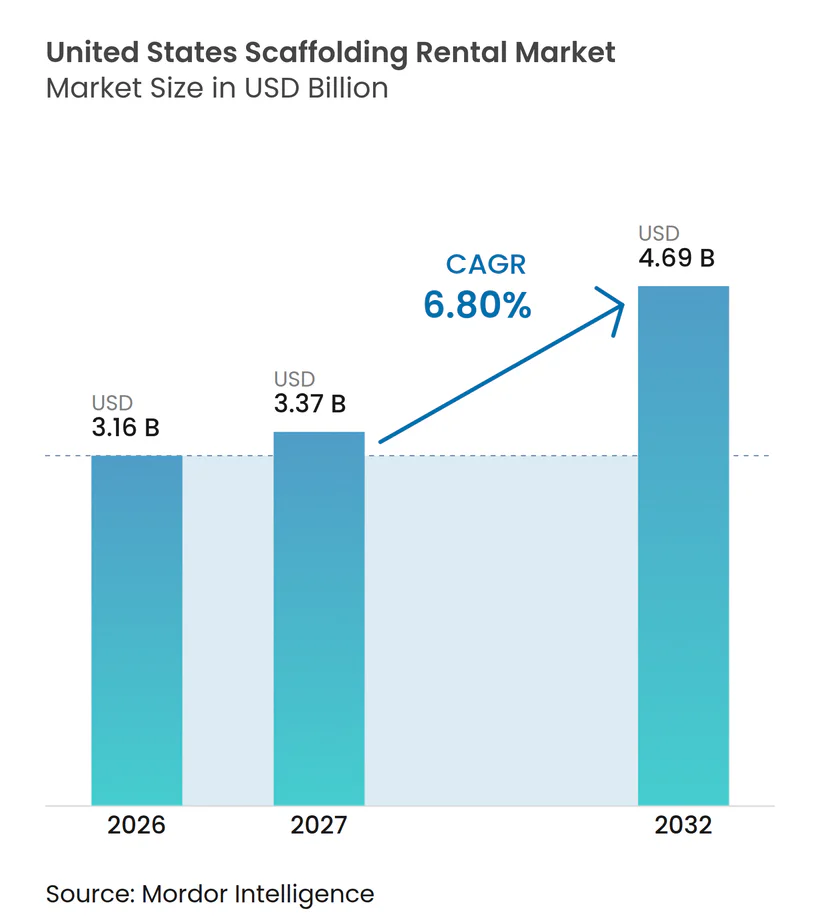
| Base Year Market Size (2026) | USD 3.16 Billion |
| Market Size (2027) | USD 3.37 Billion |
| Market Size (2032) | USD 4.69 Billion |
| Growth Rate (2027 - 2032) | 6.80 % |
| Market Concentration | Medium |
Major Players *Disclaimer: Major Players sorted in no particular order Image © Mordor Intelligence. Reuse requires attribution under CC BY 4.0. | |
United States Scaffolding Rental Market Analysis by Mordor Intelligence
The United States Scaffolding Rental Market size is expected to grow from USD 3.16 billion in 2026 to USD 3.37 billion in 2027 and is forecast to reach USD 4.69 billion by 2032 at 6.80% CAGR over 2027-2032.
Public bridge, highway, and transit rehabilitation gives rental providers a long project pipeline, while new data center, semiconductor, and battery facilities create demand for multi-trade access systems. The United States Department of Transportation has authorized USD 27.5 billion for the Bridge Formula Program and USD 15.8 billion in Bridge Investment Program grants, supporting projects where scaffold access is needed below decks and beside active traffic lanes. Rental also helps contractors avoid storing, inspecting, and replacing idle equipment, which supports demand for certified fleets. Competition increasingly depends on reliable inspections, documented compliance, and planning tools that reduce site delays. Labor shortages and weak new commercial starts may slow some projects, but infrastructure and industrial maintenance work provide a more stable base for the United States scaffolding rental market.
Key Report Takeaways
- By type, supported scaffold held 47.00% of the United States scaffolding rental market share in 2026, while suspended scaffold is forecast to grow at a 7.40% CAGR through 2032.
- By system, frame and H-frame held 31.00% of the United States scaffolding rental market share in 2026, while modular and ringlock systems are forecast to grow at a 7.80% CAGR through 2032.
- By material type, steel held 56.00% of the United States scaffolding rental market in 2026, while aluminum is forecast to grow at a 7.90% CAGR through 2032.
- By sector, commercial held 40.00% of the United States scaffolding rental market in 2026, while infrastructure is forecast to grow at a 7.60% CAGR through 2032.
- By state, the Rest of the United States held 52.00% of the United States scaffolding rental market in 2026, while Texas is forecast to grow at a 7.60% CAGR through 2032.
Note: Market numbers in this report are based on Mordor Intelligence's proprietary estimation framework, which combines nine months of actuals with Q4 projections for base year 2026.
Market Trends and Insights
Drivers Impact Analysis of United States Scaffolding Rental Market*
| Drivers | (~) % Impact on CAGR Forecast | Geographic Relevance | Impact Timeline |
|---|---|---|---|
| IIJA-Funded Bridge, Highway, and Transit Rehabilitation | +1.5% | National, with concentrated gains in Texas, Illinois, and New York | Long term (≥ 4 years) |
| Data Center, Semiconductor, and Battery Plant Construction | +1.2% | National, led by Texas and California | Medium term (2-4 years) |
| Refinery, Petrochemical, and LNG Turnarounds on the Gulf Coast | +0.9% | Texas and Louisiana primarily | Medium term (2-4 years) |
| Contractor Preference for Rental Over Fleet Ownership | +0.8% | National | Short term (≤ 2 years) |
| OSHA 1926 Subpart L Compliance Favoring Inspected Rental Fleets | +0.6% | National | Medium term (2-4 years) |
| Facade Inspection Ordinances Driving Urban Access Demand | +0.4% | Major urban centers, principally New York City and California metros | Long term (≥ 4 years) |
| Source: Mordor Intelligence | |||
IIJA-Funded Bridge, Highway, and Transit Rehabilitation
The Infrastructure Investment and Jobs Act, known as the IIJA, provides a long-term source of work for the United States scaffolding rental market. Congressional Research Service analysis describes a substantial bridge rehabilitation need and higher funding through the IIJA period[1]. Many bridge repairs require crews to work under decks, over water, or beside moving traffic, where ground-supported scaffold provides a safer and more practical work platform than aerial equipment. Federal Highway Administration requirements also favor contractors that can show equipment records and safety documentation. These conditions support recurring rental demand throughout the life of public works programs.
Data Center, Semiconductor, and Battery Plant Construction
Technology manufacturing projects are creating a different access requirement from conventional office construction. Large facilities need controlled installation, sequenced access for multiple trades, and enclosed work areas, which can favor specialist scaffold packages. SpaceX and Tesla announced an initial USD 16.8 billion investment in the Terafab semiconductor complex in Grimes County, Texas, in August 2026. Semiconductor plants also need periodic maintenance, equipment replacement, and cleanroom changes after construction ends. This can convert a project-based rental relationship into repeat service work. The result is a broader customer base for the United States scaffolding rental market in technology-heavy regions.
Refinery, Petrochemical, and Liquefied Natural Gas Turnarounds on the Gulf Coast
Scheduled maintenance shutdowns at Gulf Coast plants create concentrated and time-sensitive demand for scaffold services. The American Institute of Chemical Engineers reported more than USD 480 million in chemical plant maintenance spending in the first quarter of 2026, including USD 130 million connected with ethylene units at Port Arthur, Sweeny, and Clinton[2]. During a turnaround, equipment must be accessed quickly so an operator can limit lost production time. Rental companies that can mobilize material, labor, and inspection support quickly are therefore well placed in this work. Maintenance may continue even when commodity markets weaken because unplanned outages add operational and safety risk. This makes the Gulf Coast a useful counterweight to more cyclical construction demand.
Contractor Preference for Rental Over Fleet Ownership
Many contractors choose rental equipment because it reduces the capital tied up in a fleet. Rental can help users match equipment costs to the duration and requirements of individual projects. For scaffold users, rental can remove the need for storage yards, routine component checks, and replacement allowances for aging equipment. This is especially useful when project workloads are short or uncertain. PERI USA identifies the expected project pipeline as a major factor in the rent-or-own decision[3]. The preference helps providers maintain demand across a wider range of contractor sizes.
Restraints Impact Analysis of United States Scaffolding Rental Market*
| Restraints | (~) % Impact on CAGR Forecast | Geographic Relevance | Impact Timeline |
|---|---|---|---|
| Skilled Erection Labor Shortages | -0.9% | National, most acute in Texas, the Southeast, and urban corridors | Long term (≥ 4 years) |
| Commercial Real Estate and Interest-Rate Cycle Volatility | -0.7% | National, concentrated in high-cost hubs including New York and California. | Medium term (2-4 years) |
| Substitution by Aerial Work Platforms and Mast Climbers | -0.6% | National, most visible in commercial facade and fit-out applications | Long term (≥ 4 years) |
| Freight, Storage, and Yard Costs | -0.5% | National | Short term (≤ 2 years) |
| Source: Mordor Intelligence | |||
Skilled Erection Labor Shortages
A shortage of qualified workers can limit how quickly rental providers install and remove scaffold systems. Scaffold erection requires skilled craft labor and competent-person oversight under OSHA requirements, so providers cannot easily replace trained crews with unqualified workers. Wage pressure and slower mobilization can raise project costs for customers. The issue is especially difficult in areas where infrastructure and industrial work compete for the same trades. Training and crew retention will remain important for providers that want to protect service levels.
Commercial Real Estate and Interest-Rate Cycle Volatility
Commercial work represented 40.00% of the United States scaffolding rental market in 2026, leaving suppliers exposed to changes in office and mixed-use project starts. Higher financing costs can delay speculative construction, especially in higher-cost coastal areas. Renovation and facade maintenance can soften the impact, but they may not replace the volume from major new developments. Industrial and infrastructure customers can also take available fleet capacity first when activity improves. Operators with a narrow commercial customer base may therefore recover later than more diversified providers.
*Our forecasts treat driver/restraint impacts as directional, not additive. The impact forecasts reflect baseline growth, mix effects, and variable interactions.
United States Scaffolding Rental Market Segment Analysis
By Type:
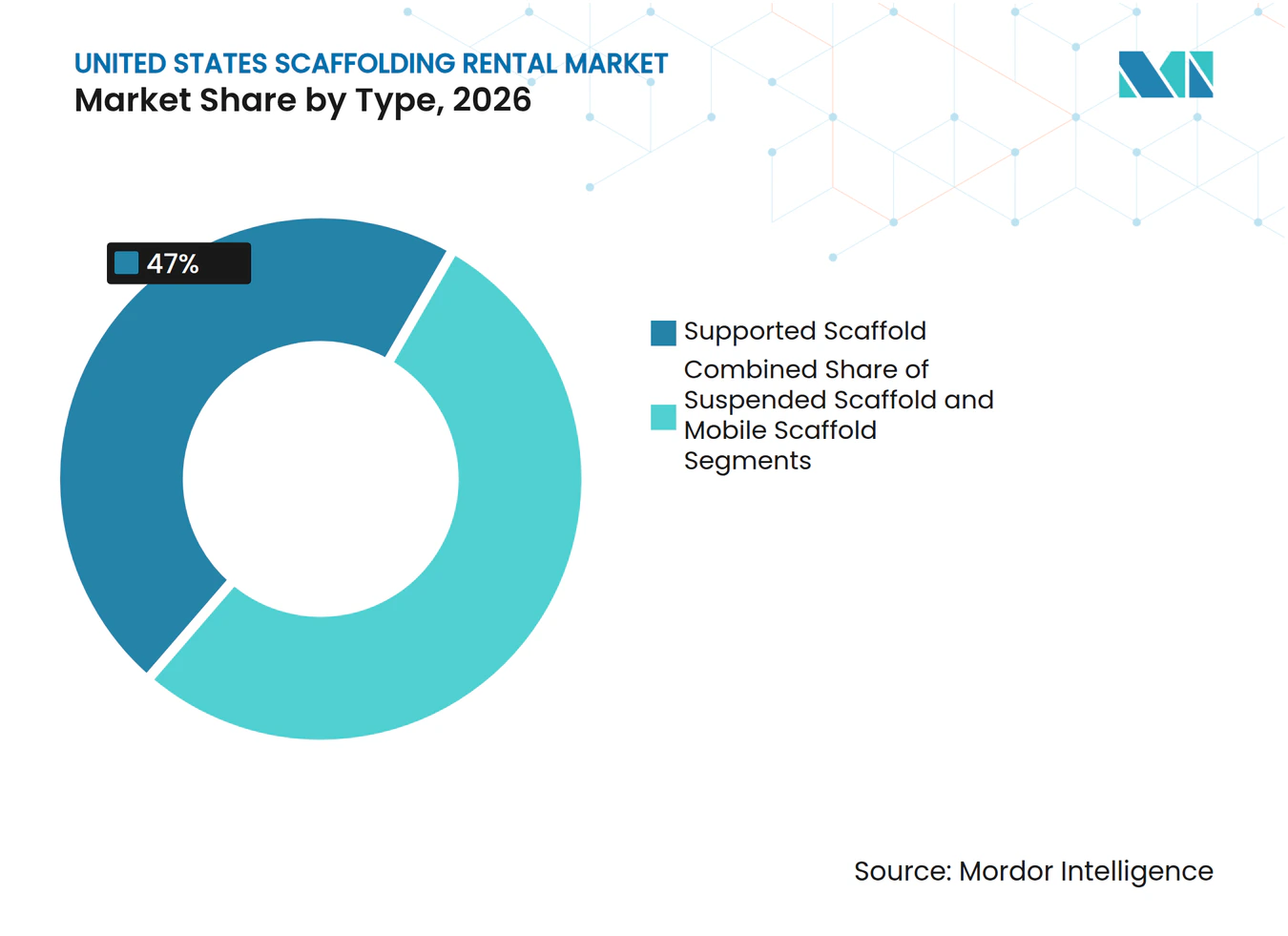
Supported Scaffold Remains the Core Access SystemSupported scaffold accounted for 47.00% of the United States scaffolding rental market in 2026. Its leading position reflects broad use on bridge rehabilitation, multi-story construction, and industrial maintenance sites where ground-based support is practical. Wide platforms can serve several trades at once and remain in place over longer work periods. This helps contractors manage tasks such as concrete repair, coating, mechanical work, and cladding installation. The system can also be configured around equipment and work zones without requiring repeated repositioning. That continuity is valuable when work must proceed in a planned sequence. Federal bridge rehabilitation programs reinforce demand because under-deck repairs often need stable access around traffic lanes or waterways. Supported systems also suit large sites that have enough ground area for towers and material staging.
Suspended scaffold is forecast to grow at a 7.40% CAGR through 2032. It is increasingly used for facade work on high-rise buildings where a tower from the ground would be inefficient or intrusive. Its configuration allows work teams to reach exterior areas without occupying a large footprint at street level. It can also be adjusted as repairs move across a building elevation. New York City’s revised facade program is expected to increase the urgency of repair work by reducing the time allowed for sidewalk sheds. The United States scaffolding rental market size for these urban jobs benefits when suppliers can provide hoists, fall protection, and documented inspections together. Mobile scaffold remains useful for short interior tasks, but it is less suited to the heavy and repeated access needs that support or suspended systems address. Providers that combine engineering support with reliable field service can capture higher-value urban projects.
Urban work also requires close coordination with building occupants and public areas. Suppliers may need to arrange deliveries around restricted access periods and keep equipment within a limited street footprint. Clear documentation helps the building owner show that the access system is being managed safely. This service requirement can favor providers with strong field supervision and local experience. It gives suspended scaffold a larger role in dense renovation programs.
Supported and suspended systems are often used for different parts of the same renovation program. A contractor may use a supported platform where there is room at ground level, then select suspended equipment for upper facade areas. This makes equipment planning a practical part of the rental discussion. Providers that understand the work sequence can help customers avoid unnecessary changes during the project. The range of type options also allows the United States scaffolding rental market to serve both major public works and dense urban repairs.



By System:
Frame and H-Frame Systems Lead in Familiar ApplicationsFrame and H-frame systems held 31.00% of the United States scaffolding rental market in 2026. Contractors know how to erect these systems, and the components can be practical for conventional building work. Their relative simplicity is useful when qualified erection labor is scarce. These systems also support high fleet utilization because the same equipment can move across a broad set of basic applications. Standard parts can be picked, delivered, and returned with less planning than highly specialized configurations. This supports fast response on routine construction and renovation work. Providers can maintain demand by keeping common components available near active construction corridors. This approach is particularly relevant for customers focused on cost and quick installation.
Modular and ringlock systems are forecast to grow at a 7.80% CAGR through 2032. Their flexible connections can fit complex industrial layouts, including pipe racks, vessels, and irregular equipment shapes. The United States scaffolding rental market size for engineered access solutions can rise when semiconductor, petrochemical, and energy projects require layouts that basic frame systems cannot provide efficiently. These systems allow providers to respond to changing elevations and restricted work areas with fewer compromises in platform design. They also support detailed planning before material reaches the site. Specialist suppliers can use design support to reduce unnecessary material and make work platforms safer. These systems may command higher rental rates, but they also require technical knowledge and disciplined inventory management. The difference between standard frames and engineered systems gives specialized operators a way to compete beyond price.
The system choice can affect both the speed of installation and the amount of material required on site. On irregular structures, a planned modular layout can reduce the need for improvised adjustments after crews arrive. This can be valuable when an industrial site has strict shutdown deadlines or limited room for staging. Providers with trained designers and field supervisors are better able to manage this work. These capabilities make technical support part of the rental offer, not an optional extra.
By Material Type:
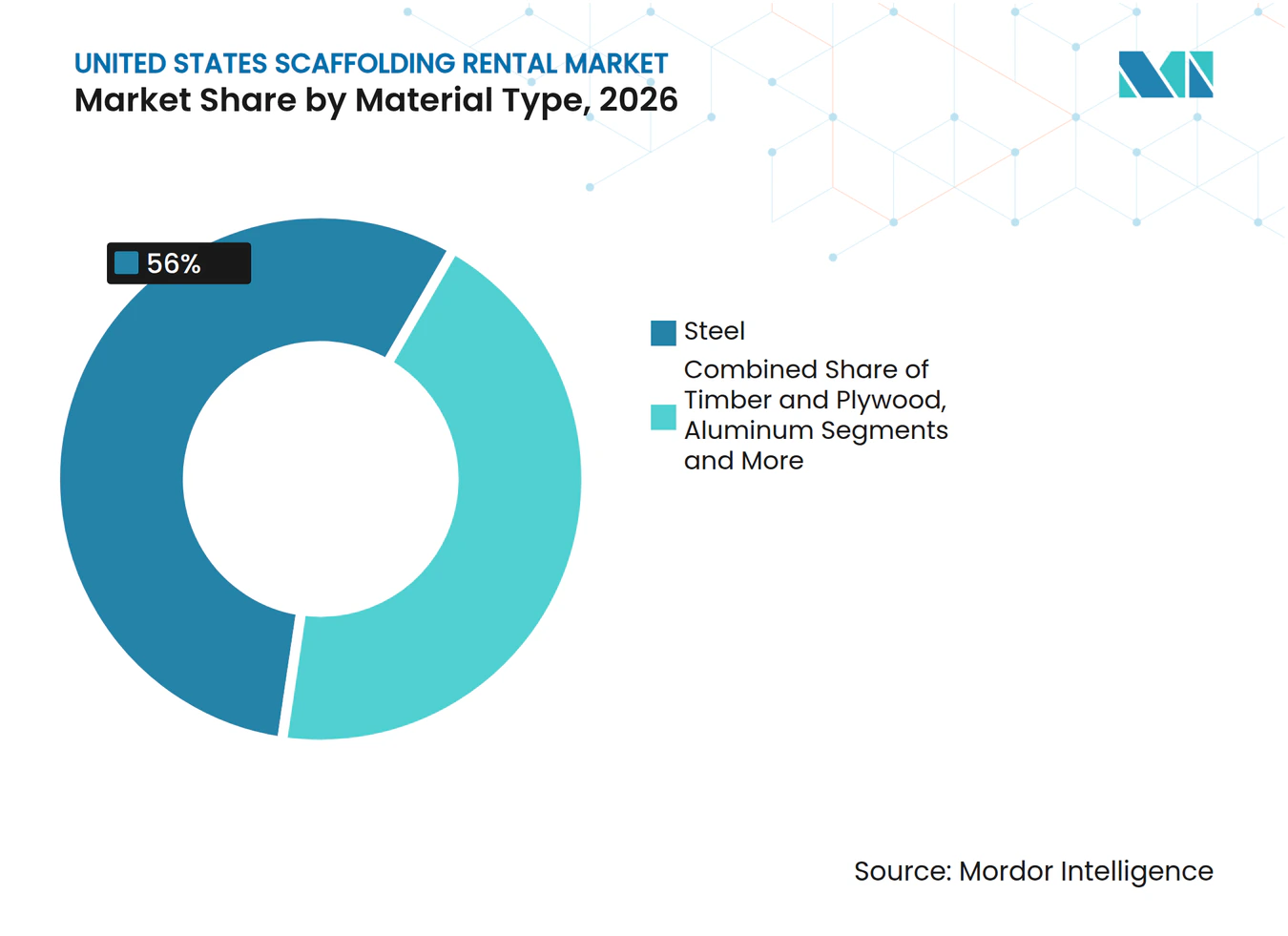
Steel Holds the Largest Installed Rental BaseSteel held 56.00% of the United States scaffolding rental market in 2026. It remains common on large infrastructure and industrial projects because it combines strength, durability, and an established supply base. Galvanized steel components can withstand repeated outdoor use and are suitable for heavy-duty work platforms. The material also supports long rental cycles at refineries, bridges, and major construction sites. Its familiar performance characteristics help contractors plan for demanding loads and extended exposure to outdoor conditions. Standardized steel equipment can also be used across several project types. Rental companies can repair and reissue standard steel components across a broad customer base. This keeps steel central to the fleet mix for the United States scaffolding rental market.
Aluminum is forecast to grow at a 7.90% CAGR through 2032. Its lower weight can be useful for suspended platforms, mobile systems, and sites with floor-loading limits. Lighter components may also reduce manual handling during frequent repositioning. This can support efficiency where access must be moved several times during a job. It can be particularly relevant for exterior work where lifting capacity or building loads are constrained. Timber, plywood, plastic, and fiberglass remain relevant for specific restoration and refinery settings. Material choice will continue to depend on load requirements, site conditions, and the access method selected.
Material selection also affects transport, installation, and retrieval planning. A lower-weight system can be useful when crews must move components through occupied areas or lift them to higher elevations. Steel remains the more practical choice where strength and repeated heavy use are the main requirements. Suppliers must therefore maintain fleets that suit several access methods rather than assume one material can serve every job. This balance supports customer choice across the United States scaffolding rental market.

By Sector:
Commercial Work Provides the Largest Revenue BaseCommercial work held 40.00% of the United States scaffolding rental market in 2026. Building renovations, mixed-use projects, envelope repairs, and mechanical servicing sustain demand from this sector. Existing buildings need periodic exterior access even when the flow of new construction weakens. This creates opportunities for rental firms that serve property managers and renovation contractors as well as new-build customers. Renovation work can involve many smaller sites, which makes dependable local delivery important. Suppliers can also support customers by coordinating access with ongoing building use. The sector remains sensitive to interest rates and financing conditions, which can delay larger development decisions. A balanced customer portfolio can reduce the effect of these delays.
Infrastructure is forecast to grow at a 7.60% CAGR through 2032. Bridge, highway, and transit work is supported by federal funding programs that offer a more visible project pipeline than many private developments. These contracts can be larger and may keep rental fleets in service for extended periods. They also require careful scheduling because crews often work near traffic, waterways, or active public facilities. Industrial and logistics facilities add maintenance demand from their growing installed base, while residential work supports exterior cladding projects. The United States scaffolding rental market can benefit when providers allocate specialized equipment to public works and maintain standard fleets for commercial customers. This mix helps manage variation in project timing across end users.
Infrastructure customers often value consistent availability more than the lowest equipment rate. Delays can affect a wider construction schedule and may create traffic or public-safety concerns. Rental companies can respond by planning material deliveries around work phases and retaining inspection records for the full rental period. This service model can deepen relationships with contractors working on recurring public projects. It also supports the position of infrastructure as a faster-growing end-use segment.
Geography Analysis
Texas
Texas is forecast to expand at a 7.60% CAGR from 2027 to 2032. Gulf Coast maintenance and large technology facilities create two different but complementary sources of scaffold demand. Chemical plant maintenance spending exceeded USD 480 million in the first quarter of 2026, demonstrating the scale of scheduled work in the region. The planned Terafab complex in Grimes County adds a large construction project that will need staged access during installation and later maintenance. This mix allows rental suppliers to serve planned shutdowns as well as longer construction programs. It also increases the value of local engineering support, rapid delivery, and documented inspection services. Suppliers with local crews, engineered systems, and strong safety records can serve both sectors. This combination makes Texas less dependent on a single type of project.
California, New York, Florida, and Illinois
California, New York, Florida, and Illinois show how rules and sector mix can shape local demand. California’s occupational safety requirements under the California Occupational Safety and Health Administration, known as Cal/OSHA, can favor suppliers that maintain documented inspections and trained crews. In New York, the Facade Inspection and Safety Program requires regular building facade reviews, while changes to sidewalk-shed rules add pressure to complete repairs promptly. These compliance factors can make equipment records and capable field supervision part of the customer selection process. Florida supports access work through commercial and multi-family construction, while Illinois benefits from construction activity and industrial maintenance around the Chicago corridor. The different state patterns give suppliers a reason to vary their fleet mix and service model by location. These markets reward providers that understand local permits, labor availability, and equipment needs. Their different demand drivers can help diversify the United States scaffolding rental market beyond Texas and the distributed rest-of-country segment.
Rest of the United States
The Rest of the United States held 52.00% of the United States scaffolding rental market in 2026. Its position reflects a broad mix of bridge rehabilitation, industrial maintenance, utility work, and commercial activity across the Southeast, Midwest, and Mountain West. Federal Highway Administration funding creates a continuing project pipeline in every state, helping rental firms plan fleet deployment beyond single-city construction cycles. This broad program structure reduces the risk that a pause in one local construction category will leave equipment without work. It also allows providers to transfer standard inventory among nearby states when a major repair program starts. Chemical plants, paper mills, power facilities, and manufacturing sites create repeat maintenance needs in the corridor from Louisiana through Georgia. Providers that place inventory near these industrial centers can shorten mobilization time. Demand is therefore spread across many smaller project markets rather than concentrated in one major metro area.
Competitive Landscape
Market Concentration
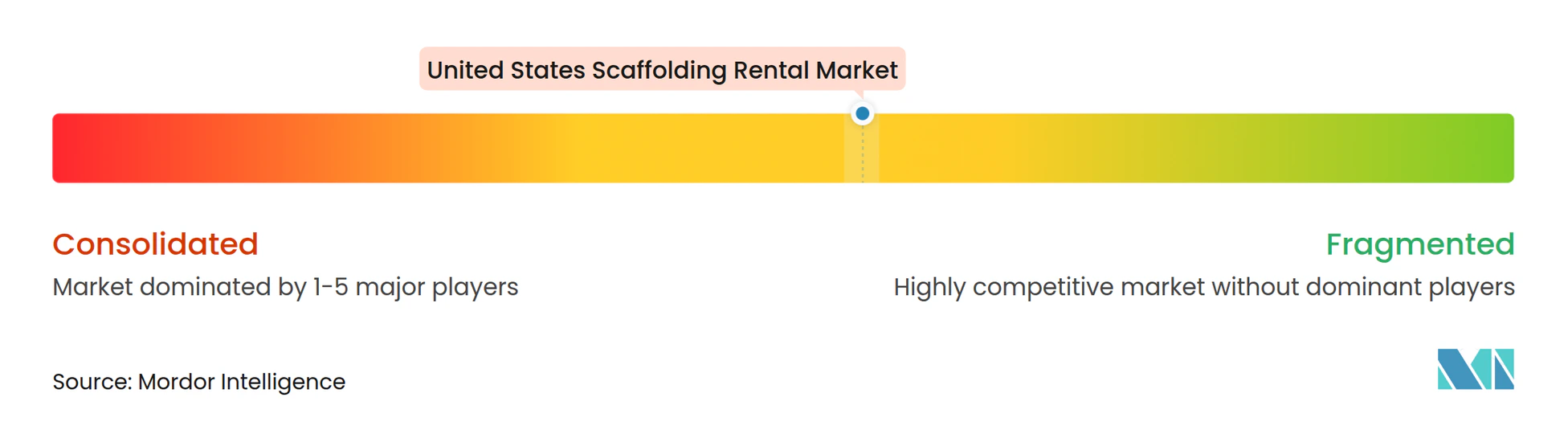
The United States scaffolding rental market is moderately concentrated. BrandSafway, Altrad Group’s United States operations, and specialist system suppliers compete with a large base of regional contractors. Larger providers can bundle access, insulation, maintenance, engineering, and safety support for industrial customers. Altrad’s Americas operations support the company’s ability to provide a broad industrial service package. Regional providers remain competitive when they offer faster local response or specialist knowledge for mid-sized maintenance sites.
Digital planning and compliance support are becoming important ways to differentiate. Bilfinger’s Client Portal 2.0 provides inventory visualization, risk alerts, and cost information for access work, and the company reported average cost reductions of 30% in early deployments. Building information modeling, or BIM, can help contractors coordinate access plans with other trades before a project begins. OSHA compliance also favors providers that can give customers clear inspection and access records. These services can matter as much as equipment availability on complex projects.
The United States scaffolding rental market concentration score is 4 out of 10 because the available draft identifies a large regional contractor base but provides no combined share showing that leading firms control a high proportion of revenue. Competition remains active in standard frame equipment, while engineered systems and bundled industrial services offer more defensible positions. Bilfinger completed its acquisition of Teknokon effective April 1, 2026, expanding its industrial service footprint. Providers that combine local execution with engineering, inspection, and digital documentation are better positioned to retain customers.
United States Scaffolding Rental Industry Leaders
-
PERI SE
-
Sunbelt Rentals, Inc.
-
United Rentals, Inc.
-
BrandSafway
-
The Brock Group
- *Disclaimer: Major Players sorted in no particular order
United States Scaffolding Rental Market Companies Covered in this Report
- BrandSafway
- Sunbelt Rentals, Inc.
- United Rentals, Inc.
- The Brock Group
- Atlantic Pacific Equipment, LLC
- Associated Scaffolding Company, Inc.
- Apache Industrial Services, Inc.
- Excel Modular Scaffold
- United Scaffolding, Inc.
- Universal Builders Supply Inc.
- American Scaffolding
- Southwest Scaffolding and Supply Co.
- Waco Scaffolding and Equipment Co.
- Petrin, LLC
- BETCO Scaffolds
- Brewer Equipment Co.
- Classic Industrial Services, Inc.
- Contractors Access Equipment, Inc.
- Layher, Inc.
- PERI USA
Recent Industry Developments in United States Scaffolding Rental Market
- August 2026: SpaceX and Tesla announced an initial USD 16.8 billion investment for the Terafab semiconductor complex in Grimes County, Texas. The 100-million-square-foot vertically integrated chip manufacturing facility is expected to create scaffolding access demand during construction and later maintenance.
- April 2026: Bilfinger completed the acquisition of Teknokon, effective April 1, 2026, expanding its industrial services and scaffolding footprint.
- April 2026: Layher North America delivered a 133-foot temporary public access stair and walkway system at the University of California San Francisco campus, meeting public-access code compliance on sloping terrain in an active construction zone, per the company's official LinkedIn disclosure.
United States Scaffolding Rental Market Report Scope
Segmentation Overview
| Supported Scaffold |
| Suspended Scaffold |
| Mobile Scaffold |
| Tube and Coupler |
| Cuplock |
| Modular and Ringlock |
| Frame and H-Frame |
| Timber and Plywood |
| Steel |
| Aluminum |
| Plastic and Fiberglass |
| Others |
| Residential |
| Commercial |
| Industrial and Logistics |
| Infrastructure |
| Texas |
| California |
| Florida |
| New York |
| Illinois |
| Rest of US |
| By Type | Supported Scaffold |
| Suspended Scaffold | |
| Mobile Scaffold | |
| By System | Tube and Coupler |
| Cuplock | |
| Modular and Ringlock | |
| Frame and H-Frame | |
| By Material Type | Timber and Plywood |
| Steel | |
| Aluminum | |
| Plastic and Fiberglass | |
| Others | |
| By Sector | Residential |
| Commercial | |
| Industrial and Logistics | |
| Infrastructure | |
| By Region | Texas |
| California | |
| Florida | |
| New York | |
| Illinois | |
| Rest of US |
Key Questions Answered in the Report
What is the outlook for scaffolding rentals in the United States?
The United States scaffolding rental market is projected to grow from USD 3.37 billion in 2027 to USD 4.69 billion by 2032, at a 6.80% CAGR. Infrastructure work, technology facilities, and maintenance projects support this expansion.
Which scaffolding type has the largest share in the United States?
Supported scaffold leads with 47.00% in 2026 because it serves bridge, industrial, and multi-story construction work. Its stable platforms are suited to longer projects and multiple work crews.
Which scaffolding system is growing fastest?
Modular and ringlock systems are forecast to grow at a 7.80% CAGR through 2032 as complex industrial layouts need adaptable access systems. Flexible connections make them useful around equipment and irregular structures.
Why are infrastructure projects important for scaffold rental providers?
IIJA funding supports bridge, highway, and transit rehabilitation projects that often need stable scaffold access around difficult work areas. These projects can keep rental fleets in service for extended periods.
Why is Texas growing quickly for scaffolding rental services?
Texas combines Gulf Coast plant maintenance with semiconductor and data center projects, supporting a forecast 7.60% CAGR through 2032. The blend of projects helps spread demand across different work schedules.
What factors are limiting demand for scaffolding rentals?
Skilled labor shortages, interest-rate pressure on commercial projects, alternative access equipment, and higher logistics costs can restrain demand. Providers can reduce some pressure through trained crews, fleet planning, and local depots.