
United States Running Gear Market Size and Share
Market Overview
| Study Period | 2022 - 2032 |
|---|---|
| Forecast Data Period | 2027 - 2032 |
| Base Year Market Size (2026) | USD 13.85 Billion |
| Market Size (2027) | USD 14.34 Billion |
| Market Size (2032) | USD 17.46 Billion |
| Growth Rate (2027 - 2032) | 4.02 % |
| Market Concentration | Medium |
Major Players *Disclaimer: Major Players sorted in no particular order Image © Mordor Intelligence. Reuse requires attribution under CC BY 4.0. | |
United States Running Gear Market Analysis by Mordor Intelligence
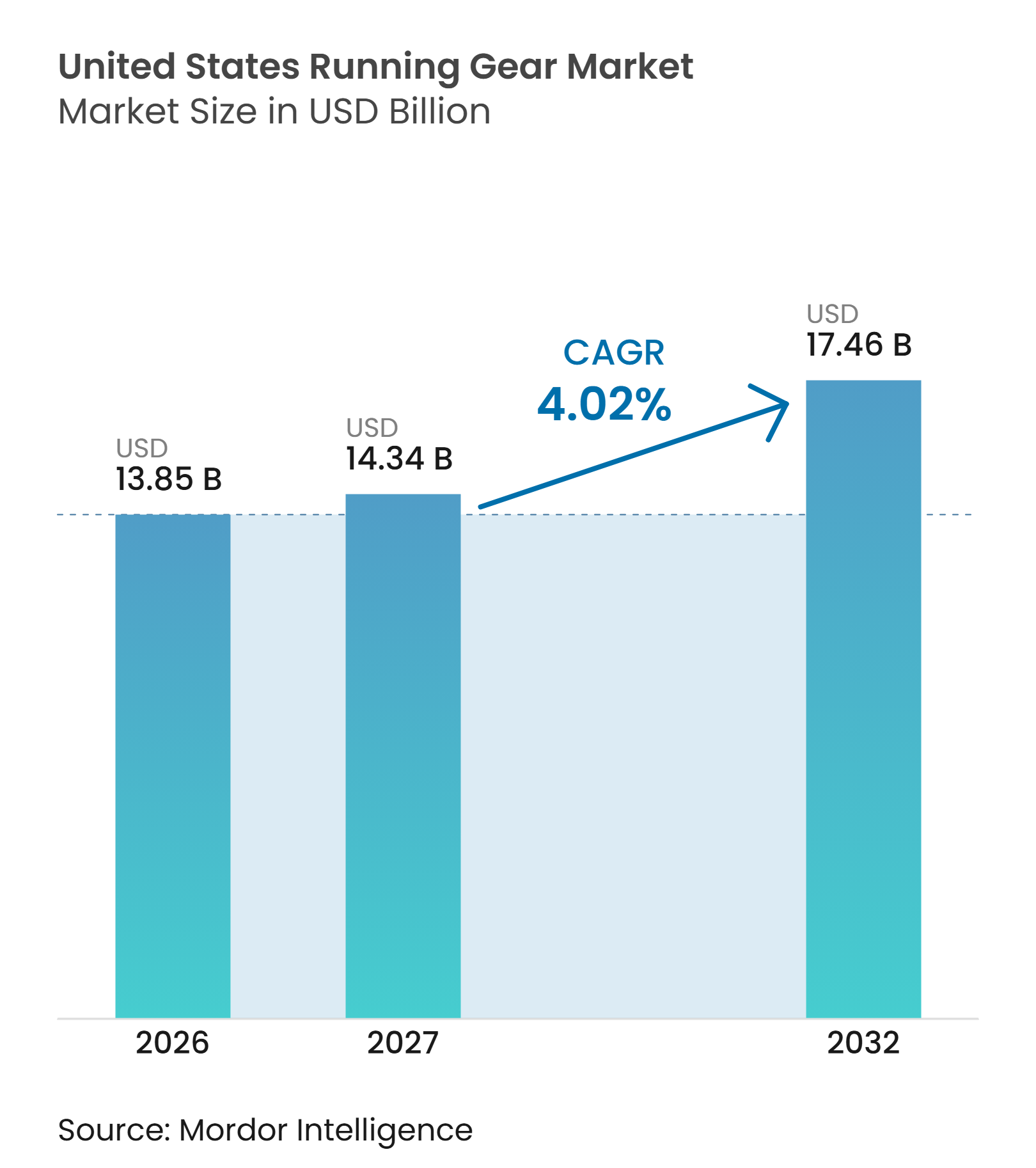
The United States running gear market size was valued at USD 13.85 billion in 2026 and is estimated to grow from USD 14.34 billion in 2027 to reach USD 17.46 billion by 2032, at a CAGR of 4.02% during the forecast period (2027-2032). According to a March 2026 article by the Sports and Fitness Industry Association, the United States running gear market benefits from broader participation in sports and fitness activities, with 250 million Americans participating in at least one activity in 2025[1]. Running and jogging are particularly popular among individuals aged 6 to 34, expanding the customer base beyond competitive athletes. Technical footwear, trail running equipment, and connected devices provide consumers with clear reasons to replace existing gear. However, the United States running gear market faces pressure from import costs and cautious discretionary spending, making price positioning critical for brands and retailers. Specialty fitting services and digital sales channels are developing simultaneously, creating opportunities for companies that can cater to both performance-focused and casual runners.
Key Report Takeaways
- By product type, running footwear led the United States running gear market with a share of 54.78% in 2026, while wearable electronics is anticipated to register the fastest CAGR of 4.89% during 2027-2032.
- By price range, mid-range retained a 44.31% share in 2026, while premium is anticipated to register the fastest CAGR of 5.35% during 2027-2032.
- By gender, men led the United States running gear market in 2026 with a 55.21% share, while women are projected to advance at the fastest CAGR of 4.94% during 2027-2032.
- By distribution channel, specialty stores led the United States running gear market in 2026 with a 36.52% share, while online retail stores are projected to advance at the fastest CAGR of 5.74% during 2027-2032.
Note: Market numbers in this report are based on Mordor Intelligence's proprietary estimation framework, which combines nine months of actuals with Q4 projections for base year 2026.
Market Trends and Insights
Drivers Impact Analysis of United States Running Gear Market*
| Driver | (~) % Impact on CAGR Forecast | Geographic Relevance | Impact Timeline |
|---|---|---|---|
| Rising participation in recreational and fitness running | +0.9% | National, strongest in metro run-club markets including New York, Los Angeles, Chicago, and Austin | Short term (≤ 2 years) |
| Expansion of organized running events and race participation | +0.4% | National, with high event density in the Northeast, Mountain West, and Sun Belt | Short term (≤ 2 years) |
| Growing interest in trail running and outdoor fitness | +0.5% | Mountain West, Pacific Northwest, and Southwest, including Colorado, California, Utah, and Texas | Medium term (2-4 years) |
| Innovation in running footwear technology | +0.8% | National, with premium demand concentrated in higher-income coastal markets | Medium term (2-4 years) |
| Increasing demand for specialized running apparel | +0.6% | National, with stronger demand in California, Texas, Florida, and the Northeast | Medium term (2–4 years) |
| Integration of wearable technology and digital fitness solutions | +0.7% | National, with stronger adoption in major markets such as California, New York, Washington, and Colorado | Medium term (2–4 years) |
| Source: Mordor Intelligence | |||
Rising Participation in Recreational and Fitness Running
Rising participation in recreational and fitness running reflects the accessibility of running as a physical activity, its cardiovascular benefits, and its suitability for individuals across fitness levels. Running requires relatively limited equipment and can be performed in parks, on streets and tracks, and in indoor facilities. These factors encourage consumers to incorporate running into their regular exercise routines. In June 2026, the United States Bureau of Labor Statistics reported that 23.4% of Americans aged 15 and older participated in sports, exercise, or recreation on an average day during 2025[2]. This government-reported activity statistic will reflect the broader participation base for fitness-related activities in the United States and support demand for running footwear, performance apparel, hydration accessories, and wearable fitness devices.
Expansion of Organized Running Events and Race Participation
The growth of organized running events, including marathons, half-marathons, 5K and 10K races, and community running competitions, encourages consumers to participate in structured fitness activities and prepare for race-day performance. Training programs and event requirements drive purchases of running footwear, moisture-wicking apparel, hydration accessories, GPS watches, and other performance-oriented gear. In January 2026, RunSignup released its 2025 race participation analysis, which showed a 5% increase in participation across its tracked endurance events from 2024 to 2025[3]. This growth reflects continued engagement in organized racing activities in the United States and is expected to support demand for specialized running gear as participants prepare for events and replace or upgrade their equipment.
Growing Interest in Trail Running and Outdoor Fitness
Growing interest in trail running and outdoor fitness is driving demand for specialized running gear designed for varied terrain and outdoor conditions. Trail running provides consumers with an alternative to conventional road running by combining physical exercise with access to natural environments, scenic routes, and outdoor recreational experiences. This activity increases demand for trail running footwear with enhanced traction, durable and breathable apparel, hydration vests, weather-resistant jackets, and protective accessories. The need for equipment that performs effectively on uneven surfaces, in changing weather conditions, and during longer-distance outdoor activities encourages consumers to purchase specialized products rather than rely solely on standard running gear. As trail running becomes increasingly integrated into recreational fitness routines, it is expected to support product diversification and demand for performance-oriented running equipment in the United States.
Innovation in Running Footwear Technology
Continuous innovation in running footwear technology is driving demand for performance-oriented shoes in the United States. Manufacturers are developing advanced cushioning systems, lightweight midsole materials, carbon-fiber plates, enhanced outsole traction, and breathable upper constructions to improve comfort and running efficiency. These innovations meet the needs of recreational runners, competitive athletes, and consumers seeking footwear tailored to various running surfaces and training intensities. Specialized designs for road running, trail running, racing, and stability requirements further support product differentiation and encourage footwear upgrades.
Restraints Impact Analysis of United States Running Gear Market*
| Restraint | (~) % Impact on CAGR Forecast | Geographic Relevance | Impact Timeline |
|---|---|---|---|
| High Prices of Premium Running Gear | -0.5% | National, more acute in lower-income and rural markets with limited specialty retail access | Short term (≤ 2 years) |
| Supply Chain Disruptions and Import Cost Pressures | -0.6% | National, with tariff compliance affecting major importers | Short term (≤ 2 years) |
| Intense Competition and Brand Saturation | -0.4% | National, with stronger competitive pressure in major metropolitan markets | Medium term (2–4 years) |
| Uncertainty in Consumer Spending and Discretionary Purchases | -0.5% | National, more pronounced in lower-income households and price-sensitive markets | Short term (≤ 2 years) |
| Source: Mordor Intelligence | |||
High Prices of Premium Running Gear
High prices for premium running gear can restrict market adoption among price-sensitive consumers in the United States. Performance-oriented products, such as advanced running footwear, technical apparel, and specialized accessories, often use high-cost materials, innovative technologies, and brand-specific performance features. These factors increase retail prices, making premium equipment less accessible to beginners, occasional runners, and consumers with limited discretionary spending. Although premium products provide enhanced comfort, durability, and specialized functionality, their higher upfront costs may lead consumers to choose economy or mid-range alternatives, delay purchases, or extend product replacement cycles. This price sensitivity can limit premium running gear penetration and constrain sales growth in selected product categories.
Supply Chain Disruptions and Import Cost Pressures
The United States footwear supply base relies heavily on imports, exposing brand owners to tariff changes and sourcing disruptions. The market faces increased risk when suppliers or brands cannot absorb higher costs without reducing margins. Passing these costs on to consumers may delay replacement purchases among price-sensitive households. Domestic manufacturing capacity cannot replace imported volumes in the short term; therefore, brands will likely continue to manage this exposure through diversified sourcing and selective pricing. Companies with broader supplier networks and disciplined assortment management are better positioned to mitigate disruptions. These cost pressures may also limit promotional flexibility and affect the availability of competitively priced footwear across retail channels.
*Our forecasts treat driver/restraint impacts as directional, not additive. The impact forecasts reflect baseline growth, mix effects, and variable interactions.
United States Running Gear Market Segment Analysis
By Product Type:
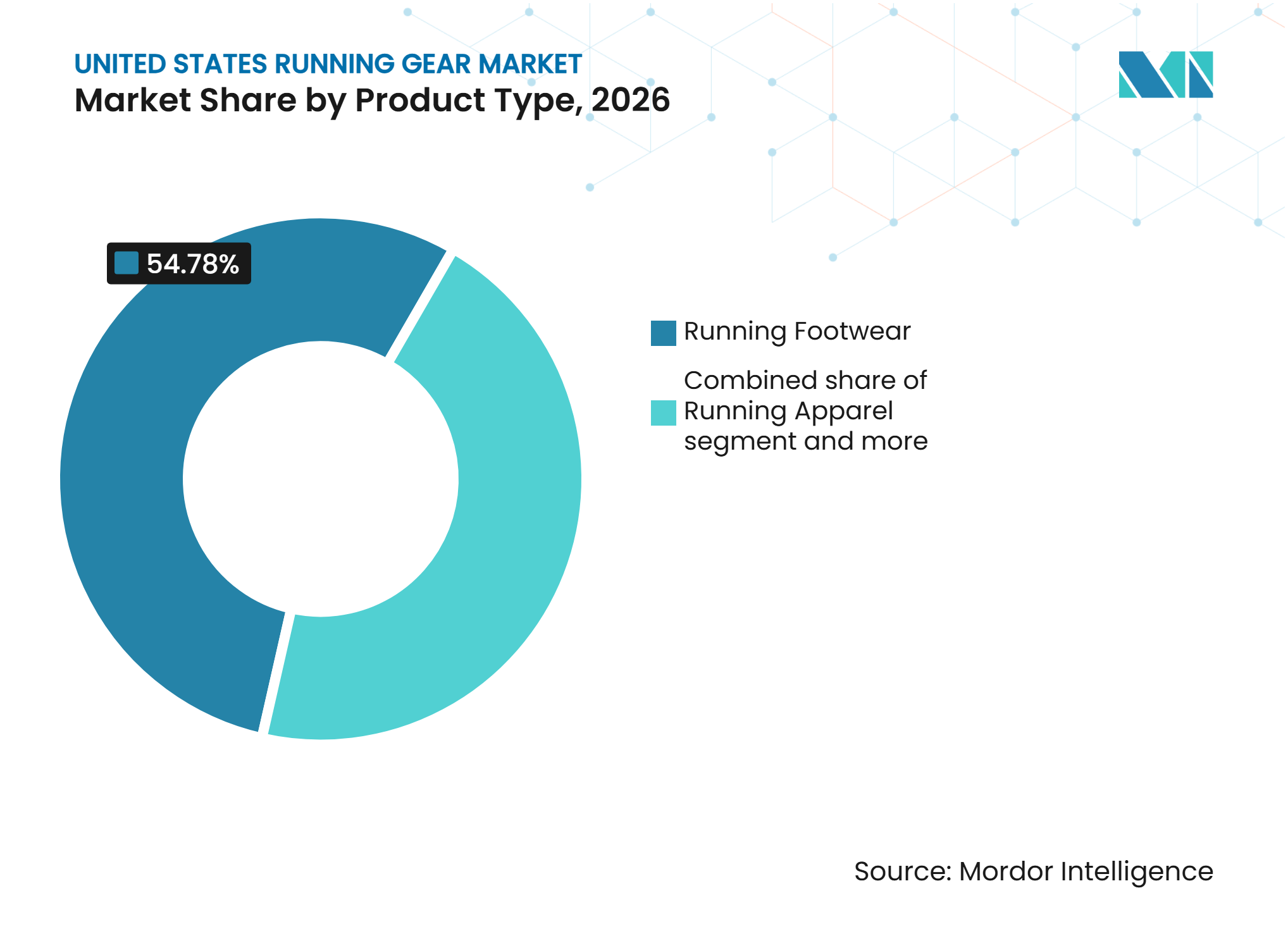
Footwear Anchors Revenue, Wearables Define the Next CycleRunning footwear accounted for 54.78% of the market in 2026. Its leading position reflects the higher selling prices of performance shoes and the need for active runners to replace worn pairs regularly. Advanced foam, carbon-fiber plates, and lightweight construction support premium pricing among runners who prioritize performance. Material innovations by ASICS, adidas, and other brands also make technical product differentiation easier to communicate at retail. Footwear remains the most visible and frequently replaced product category in the United States running gear market.
Wearable electronics are forecast to grow at a CAGR of 4.89% through 2032, the highest among product types. Garmin launched the Forerunner 570 at USD 549.99 and the Forerunner 970 at USD 749.99 in May 2025. Using the HRM 600 monitor, these devices will add metrics such as running economy, running tolerance, and step-speed loss. These capabilities extend measurements previously associated with elite sports science to a broader base of competitive runners. Consequently, the product mix is shifting beyond basic footwear and apparel toward an equipment portfolio that supports training, safety, and performance feedback.



By Price Range:
Mid-Range Leads, Premium Scales FastestMid-range products accounted for 44.31% of revenue in 2026. This tier serves a large base of casual and recreational runners who require reliable performance but are unwilling to pay super-shoe prices. Product features that were considered premium several years ago, including nitrogen-infused foams, enhanced rubber coverage, and engineered mesh uppers, are becoming increasingly common in this range. This shift narrows the performance gap and requires retailers to work harder to justify upgrades. The United States running gear industry relies on this tier to convert broad participation into repeat spending.
Premium products are forecast to grow at a CAGR of 5.35% through 2032. Measurable performance benefits can justify higher prices for runners pursuing personal goals, rather than only elite athletes. Premium technical apparel also appeals to runners who value both functionality and product design in club settings. Meanwhile, the economy tier remains vulnerable when retail price increases cause consumers to postpone purchases. The United States running gear market can address this divide by maintaining clear distinctions between durable, value-oriented products and feature-led premium products.
By Gender:
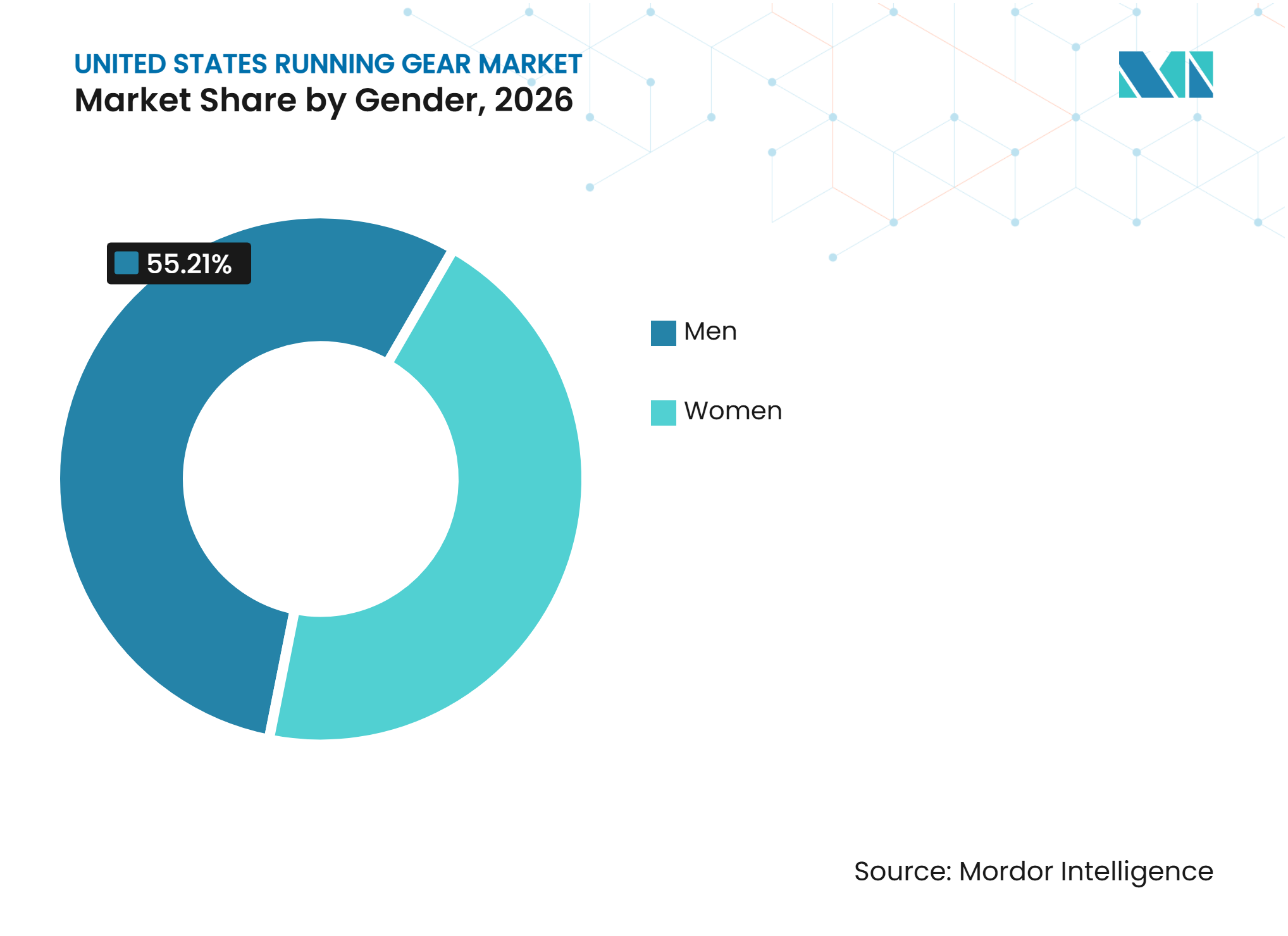
Men Hold Share, Women's Segment Offers Structural UpsideMen accounted for 55.21% of revenue in 2026, reflecting their established participation in recreational running, competitive training, and performance-focused fitness activities. The segment benefits from a broad product portfolio, including running footwear, technical apparel, hydration accessories, and wearable fitness devices designed for men’s sizing and performance preferences. Established purchasing patterns and demand for specialized footwear are expected to support the segment’s continued dominance in the United States running gear market.
Women segment is forecast to grow at a CAGR of 4.94% through 2032, outpacing the men’s segment. Growth is supported by broader participation in fitness running, expanding product offerings tailored to women’s fit and comfort requirements, and increased availability of performance-oriented apparel and footwear. Brands are addressing consumer preferences for supportive designs, varied sizing options, and products that combine technical functionality with style. Participants in the United States running gear market can capitalize on this opportunity by strengthening women-specific product assortments and enhancing fit, performance, and design across economy, mid-range, and premium price tiers.

By Distribution Channel:
Specialty Stores Lead, Online Retail AcceleratesSpecialty stores accounted for 36.52% of revenue in 2026. Their strong position stems from services such as gait analysis, footwear fitting, and expert advice, which help customers select technical products and may reduce return rates. These services also support purchases of higher-priced products. Personalized recommendations and opportunities to test footwear in-store further strengthen consumer confidence in specialized running equipment. In addition, physical stores serve as local hubs for race preparation, club activities, and brand education. These advantages help protect the channel as digital purchasing becomes increasingly common.
Online retail stores are forecast to grow at a CAGR of 5.74% through 2032. Brand-owned websites enable companies to present comprehensive technical product information and strengthen direct-to-consumer relationships. Supermarkets and hypermarkets continue to serve entry-level consumers, while sporting goods chains and department stores target lifestyle-oriented buyers. Therefore, the United States running gear market is likely to retain a mixed distribution channel structure rather than shift entirely online. Companies that integrate digital purchasing with local fitting services and convenient returns can address both convenience-driven and performance-driven demand.
Geography Analysis
Western United States
The Western United States has a high concentration of trail running activity, particularly in California, Colorado, Utah, and the Pacific Northwest. In this region, the United States running gear market benefits from strong demand for trail shoes, hydration systems, and watches with topographic navigation capabilities. Core runners are particularly important, as they run frequently and typically require more specialized equipment. Mild weather conditions in several Western metropolitan areas also support year-round running club activity in Los Angeles, San Francisco, Denver, and Seattle. Nike launched ACG Ultrafly in August 2025, following 13 rounds of testing and more than 30,000 miles of development. This product focus reflects the region’s importance for technical trail footwear.
Northeastern United States
The Northeast has a concentrated road racing and marathon ecosystem centered on New York, Boston, and Philadelphia. These events generate recurring demand for performance running shoes, race-day apparel, and training accessories. Fleet Feet and Marathon Sports maintain established local retail networks that support a specialized retail model focused on footwear fitting, product recommendations, and community engagement. The region’s colder climate also drives demand for thermal layers, wind-resistant jackets, base layers, and other weather-adapted running apparel. Seasonal training needs and race preparation further encourage runners to invest in specialized equipment suited to local conditions.
Midwest, and Southern United States
The Midwest and Southern United States drive demand for running gear through recreational fitness activities, organized races, and well-established local running communities. In the Midwest, seasonal temperature variations increase demand for thermal layers, insulated jackets, and weather-resistant apparel during colder months. In the Southern United States, warmer weather and longer outdoor running seasons support demand for breathable footwear, moisture-wicking apparel, hydration accessories, and sun-protective clothing. These regional climate differences create distinct product requirements and shape consumer purchasing patterns.
Competitive Landscape
Market Concentration
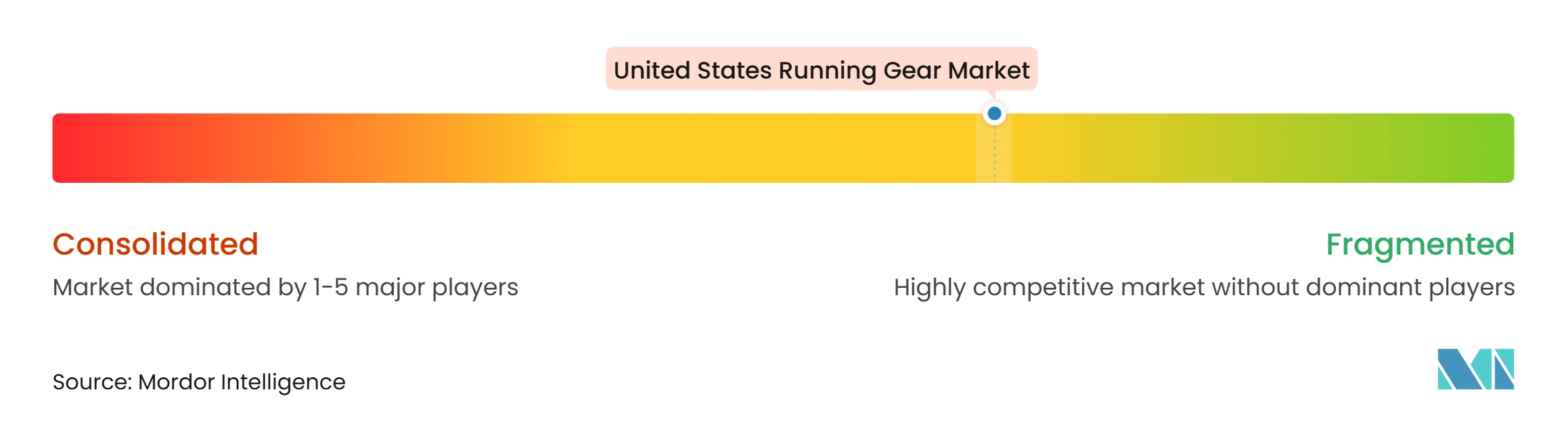
The United States running gear market is moderately fragmented, with established sportswear brands and specialized running footwear manufacturers competing across multiple product categories. Footwear innovation, cushioning technology, product durability, brand reputation, athlete endorsements, and the availability of performance-oriented apparel and accessories influence competitive positioning. Companies differentiate their offerings across recreational running, daily training, and competitive racing segments.
Nike, Inc. competes through advanced cushioning systems, performance footwear, technical apparel, and strong brand visibility. New Balance Athletics, Inc. emphasizes fit, comfort, and cushioning technologies, while ASICS Corporation focuses on running-specific footwear with stability and responsive cushioning features. PUMA SE differentiates its portfolio through NITROFOAM™ technology and performance-focused designs. Brooks Sports, Inc. maintains a specialized position in running footwear, emphasizing support, comfort, and training performance.
Competition also centers on product launches and technology upgrades designed to address diverse runner requirements, ranging from daily training to race-day performance. In February 2026, New Balance announced the Ellipse running shoe, which featured Fresh Foam X cushioning and targets everyday and recovery runs. This launch reflected the continued focus on product differentiation and innovation among major running gear companies.
United States Running Gear Industry Leaders
-
Nike, Inc.
-
Brooks Sports, Inc.
-
New Balance Athletics, Inc.
-
ASICS Corporation
-
PUMA SE
- *Disclaimer: Major Players sorted in no particular order
United States Running Gear Market Companies Covered in this Report
- Nike, Inc.
- Brooks Sports, Inc.
- Deckers Brands
- New Balance Athletics, Inc.
- ASICS Corporation
- Saucony, Inc.
- On Holding AG
- adidas AG
- Skechers U.S.A., Inc.
- PUMA SE
- Under Armour, Inc.
- Amer Sports, Inc.
- Salomon SAS
- VF Corporation
- Altra Running
- Mizuno Corporation
- lululemon athletica inc.
- Oiselle, Inc.
- Newton Running Company, Inc.
- Karhu Holding B.V.
Recent Industry Developments in United States Running Gear Market
- October 2025: Nike, Inc. unveiled Project Amplify, the world’s first powered footwear system for running and walking, developed in partnership with the robotics company Dephy.
- October 2025: Coats Group plc acquired OrthoLite, a global leader in premium footwear insoles and a key supplier of components to major running shoe brands.
- September 2025: Dick's Sporting Goods completed its USD 2.4 billion acquisition of Foot Locker, creating a combined entity with over 3,200 stores and an international footprint spanning 20 countries.
United States Running Gear Market Report Scope
Running gear refers to specialized footwear, apparel, accessories, and wearable equipment designed to support comfort, safety, and performance during running activities. The United States running gear market is segmented by product type, price range, gender, and distribution channel. By product type, the market is segmented into running footwear, running apparel, running accessories, and wearable electronics. By price range, the market is segmented into economy, mid-range, and premium. By gender, the market is segmented into men and women. By distribution channel, the market is segmented into supermarkets/hypermarkets, specialty stores, brand-owned retail stores, online retail stores, and other distribution channels. The market forecasts are provided in terms of value (USD).
Segmentation Overview
| Running Footwear |
| Running Apparel |
| Running Accessories |
| Wearable Electronics |
| Economy |
| Mid-Range |
| Premium |
| Men |
| Women |
| Supermarkets/Hypermarkets |
| Specialty Stores |
| Brand-Owned Retail Stores |
| Online Retail Stores |
| Other Distribution Channels |
| By Product Type | Running Footwear |
| Running Apparel | |
| Running Accessories | |
| Wearable Electronics | |
| By Price Range | Economy |
| Mid-Range | |
| Premium | |
| By Gender | Men |
| Women | |
| By Distribution Channel | Supermarkets/Hypermarkets |
| Specialty Stores | |
| Brand-Owned Retail Stores | |
| Online Retail Stores | |
| Other Distribution Channels |
Key Questions Answered in the Report
What is the current size and future growth outlook of the United States running gear market?
The United States running gear market was valued at USD 13.85 billion in 2026 and is estimated to reach USD 14.34 billion in 2027. The market is projected to grow to USD 17.46 billion by 2032, registering a CAGR of 4.02% during 2027-2032.
Which product type held the largest share of the United States running gear market in 2026?
Running footwear was the largest product type segment in 2026, accounting for 54.78% of the market.
Which price range held the largest share of the United States running gear market in 2026?
Mid-range running gear was the largest price range segment in 2026, accounting for 44.31% of the market.
Which gender segment held the largest share of the United States running gear market in 2026?
Men represented the largest gender segment in 2026, accounting for 55.21% of the United States running gear market.
Which distribution channel held the largest share of the United States running gear market in 2026?
Specialty stores held the largest distribution channel share in 2026, accounting for 36.52% of the market.