
United States Instant Coffee Market Size and Share
Market Overview
| Study Period | 2021 - 2031 |
|---|---|
| Forecast Data Period | 2026 - 2031 |
| Base Year Market Size (2025) | USD 0.96 Billion |
| Market Size (2026) | USD 0.99 Billion |
| Market Size (2031) | USD 1.11 Billion |
| Growth Rate (2026 - 2031) | 2.42 % |
| Market Concentration | Medium |
Major Players *Disclaimer: Major Players sorted in no particular order Image © Mordor Intelligence. Reuse requires attribution under CC BY 4.0. | |
United States Instant Coffee Market Analysis by Mordor Intelligence
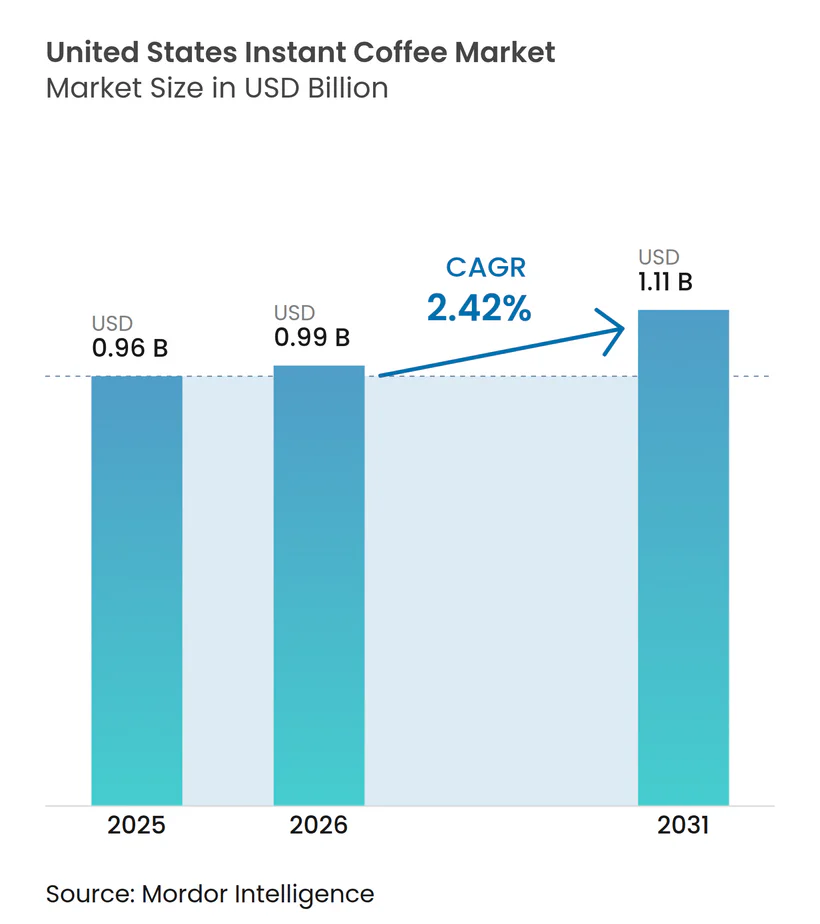
The United States instant coffee market was valued at USD 0.96 billion in 2025 and is estimated to grow from USD 0.99 billion in 2026 to reach USD 1.11 billion by 2031, at a CAGR of 2.42% during the forecast period (2026–2031). Market growth is driven by consumer preference for convenient coffee preparation, evolving consumption habits, and continuous improvements in soluble coffee processing that enhance flavor, aroma, and solubility. Growing interest in premium coffee is encouraging innovation in specialty-inspired blends and refined taste profiles, while advancements in freeze-drying technology are improving the sensory quality of instant coffee. Expanding e-commerce channels, product diversification, and increasing emphasis on sustainable sourcing and packaging are further supporting market growth by improving product accessibility and strengthening consumer interest in quality-focused instant coffee offerings.
Key Report Takeaways
- By product type, unflavored coffee held an 83.23% share in 2026, while flavored coffee is forecast to grow at a 3.49% CAGR through 2032.
- By production technology, spray-dried coffee held a 61.19% share in 2026, while freeze-dried coffee is forecast to grow at a 3.67% CAGR through 2032.
- By price, the mass tier held an 81.34% share in 2026, while the premium tier is forecast to grow at a 3.51% CAGR through 2032.
- By packaging format, jars held a 57.34% share in 2026, while sachets are forecast to grow at a 2.98% CAGR through 2032.
- By distribution channel, supermarkets and hypermarkets held a 50.41% share in 2026, while online retail is forecast to grow at a 4.11% CAGR through 2032.
Note: Market size and forecast figures in this report are generated using Mordor Intelligence’s proprietary estimation framework, updated with the latest available data and insights as of January 2026.
Worldwide, activity is shaped by contributions from multiple countries and regions, with United states representing one among them. The global report on instant coffee market by Mordor Intelligence reflects how these countries and regional layers combine into a single system.
United States Instant Coffee Market Trends and Insights
Drivers Impact Analysis*
| Driver | (~) % Impact on CAGR Forecast | Geographic Relevance | Impact Timeline |
|---|---|---|---|
| Growing preference for convenient coffee preparation | +0.5% | National, with concentrated impact in high-density urban metros (New York, Los Angeles, Chicago) | Short term (≤ 2 years) |
| Increasing popularity of specialty coffee experiences at home | +0.3% | West Coast, Northeast, and major Sunbelt metros | Medium term (2–4 years) |
| Expansion of remote and hybrid working arrangements | +0.4% | National, with stronger pull in suburban and exurban markets | Short term (≤ 2 years) |
| Growing demand for sustainable coffee sourcing and packaging | +0.2% | West, Northeast; spillover to Pacific Northwest and Mountain states | Long term (≥ 4 years) |
| Younger consumers' adoption of portable, customizable coffee formats | +0.3% | National, led by college towns, dense metro areas, and high-mobility demographics | Medium term (2–4 years) |
| Increasing product innovation in instant espresso | +0.2% | National, with early velocity in specialty retail corridors | Medium term (2–4 years) |
| Source: Mordor Intelligence | |||
Growing Preference for Convenient Coffee Preparation
Growing consumer preference for convenient coffee preparation is supporting the United States instant coffee market, as consumers increasingly prioritize ease, speed, and simplicity in their purchasing decisions. According to the 2026 International Food Information Council (IFIC) Food & Health Survey, convenience influenced food and beverage purchasing decisions for 61% of Americans. This trend strengthens demand for instant coffee, as its minimal preparation requirements align with consumers' preference for straightforward beverage choices[1]. The format's ability to deliver a consistent coffee experience without complex preparation steps reinforces its appeal among consumers looking to simplify daily routines. As convenience becomes a more influential factor in food and beverage selection, instant coffee is well positioned to benefit from the growing preference for products that combine ease of use with familiar consumption experiences.
Increasing Popularity of Specialty Coffee Experiences at Home
The growing popularity of specialty coffee experiences at home is prompting instant coffee manufacturers to improve product quality, flavor complexity, and premium positioning. Consumers increasingly seek coffee with distinctive roast characteristics and a refined taste experience, driving interest in premium soluble coffee that offers greater sensory appeal than conventional instant formulations. Freeze-drying and aroma-retention technologies help manufacturers preserve coffee's characteristic flavor, making premium instant varieties more attractive to consumers who prioritize quality alongside convenience. This trend also encourages experimentation with different roast profiles and specialty-inspired coffee styles, strengthening demand for products that offer a more elevated experience without the complexity of traditional brewing.
Expansion of Remote and Hybrid Working Arrangements
The continued prevalence of remote and hybrid working arrangements is supporting the United States instant coffee market by strengthening at-home coffee consumption habits and driving demand for convenient beverage options. According to the Federal Reserve System in 2025, 39% of United States workers worked from home[2]. Flexible working arrangements create opportunities for consumers to establish regular at-home coffee routines while prioritizing simplicity and minimal preparation time. Instant coffee benefits from these evolving workplace patterns through its convenience, consistent preparation, and suitability for frequent consumption during the working day. Hybrid schedules further reinforce demand for adaptable coffee formats that accommodate changing daily routines, supporting sustained interest in instant coffee.
Growing Demand for Sustainable Coffee Sourcing and Packaging
Growing demand for sustainable coffee sourcing is encouraging manufacturers to strengthen agricultural practices, improve supply chain traceability, and reduce the environmental impact of coffee production. Increasing consumer awareness of climate change, soil degradation, and responsible farming is prompting coffee brands to demonstrate greater accountability in raw material sourcing. For instance, Nestlé reported that 53% of Nescafé's green coffee was sourced from farmers adopting regenerative agriculture practices in 2025, reflecting efforts to improve soil health, promote biodiversity, and strengthen the resilience of coffee-growing systems. Such initiatives help address long-term risks to coffee bean quality and availability while supporting sustainability credentials across coffee product portfolios. The adoption of regenerative farming practices can support more resilient sourcing networks and reinforce consumer confidence in brands that demonstrate measurable environmental commitments.
Restraints Impact Analysis*
| Restraint | (~) % Impact on CAGR Forecast | Geographic Relevance | Impact Timeline |
|---|---|---|---|
| Intense competition from single-serve coffee pods | -0.4% | National, with strongest drag in Midwest and suburban markets with high Keurig brewer penetration | Short term (≤ 2 years) |
| Rapid expansion of ready-to-drink coffee | -0.3% | West Coast, Southeast, and college-town markets; urban millennials and Gen Z | Medium term (2–4 years) |
| Consumer perception of inferior taste and aroma | -0.3% | National, with greater intensity among specialty coffee–engaged cohorts in major metros | Long term (≥ 4 years) |
| Climate-induced yield volatility raising costs | -0.4% | National; most acute for premium Arabica-dependent SKUs | Medium term (2–4 years) |
| Source: Mordor Intelligence | |||
Intense Competition from Single-Serve Coffee Pods
Competition from single-serve coffee pods is restraining the growth of the United States instant coffee market. Pod-based systems offer consumers a convenient alternative with consistent flavor and a freshly brewed coffee experience. These systems simplify preparation while providing a wide selection of roast intensities, flavor profiles, and specialty coffee varieties. The ability to deliver standardized servings with minimal preparation effort appeals to consumers who value convenience but prefer the taste and aroma of freshly brewed coffee. The widespread availability of compatible machines in households and workplaces further strengthens the position of pod-based coffee, encouraging repeat use and brand loyalty. This competition pressures instant coffee manufacturers to improve flavor quality, expand premium offerings, and differentiate their products beyond ease of preparation.
Rapid Expansion of Ready-to-Drink Coffee
The rapid expansion of ready-to-drink (RTD) coffee is intensifying competition in the United States instant coffee market by offering consumers convenient, pre-prepared alternatives that eliminate beverage preparation. Bottled and canned cold brews, iced coffees, and espresso-based drinks appeal to consumers seeking immediate consumption, consistent flavor, and a wide range of formulations. The availability of these products across grocery stores, convenience stores, and online retail channels increases their visibility and accessibility across different purchasing occasions. RTD coffee also benefits from product innovation in flavored varieties, milk-based formulations, and specialty-inspired beverages, attracting consumers who prioritize variety and ready-to-consume formats. As these alternatives expand, instant coffee manufacturers face greater pressure to retain consumers through improved taste, product differentiation, and competitive positioning.
*Our forecasts treat driver/restraint impacts as directional, not additive. The impact forecasts reflect baseline growth, mix effects, and variable interactions.
Segment Analysis
By Product Type: Bulk Unflavored Demand Masks a Flavored Pivot
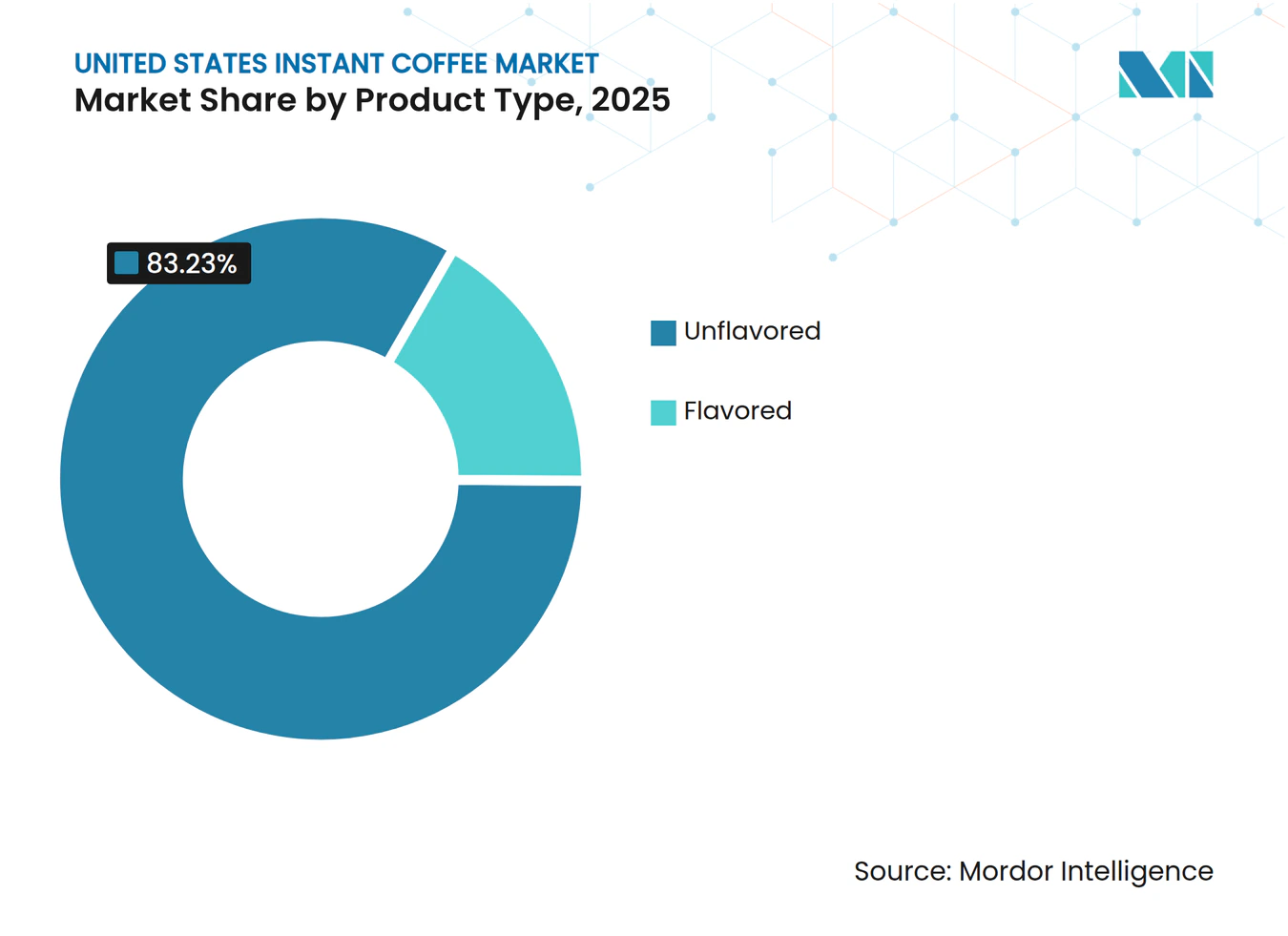
Unflavored instant coffee accounts for 83.23% of the United States instant coffee market in 2025, driven by its suitability for traditional coffee consumption and customized beverage preparation. Unlike flavored alternatives, unflavored varieties allow consumers to retain the natural coffee taste while adjusting sweetness, strength, and creaminess to their preferences. This flexibility supports consumption among both black coffee drinkers and those who incorporate milk, creamers, or plant-based alternatives into their daily routines. The segment also benefits from its versatility across hot coffee, iced coffee, homemade lattes, and other coffee-based preparations, allowing consumers to experiment with different recipes using a single product. Additionally, the absence of added flavorings makes unflavored instant coffee suitable for consumers seeking straightforward formulations and greater control over beverage ingredients. Improvements in soluble coffee processing, particularly in aroma retention and dissolution, further strengthen its appeal by enhancing the overall drinking experience.
Flavored instant coffee is the fastest-growing product type in the United States instant coffee market, projected to register a CAGR of 3.49% from 2026 to 2031. Growth is driven by increasing consumer interest in diverse taste experiences and convenient alternatives to traditional coffee, with varieties such as vanilla, caramel, hazelnut, and mocha offering greater choice and personalization. The segment benefits from café-inspired flavors that allow consumers to recreate indulgent coffee beverages at home without specialized brewing equipment or preparation techniques. Furthermore, flavored formulations help attract consumers who find the bitterness of conventional black coffee less appealing, broadening the category's reach beyond traditional coffee drinkers. The versatility of flavored instant coffee in hot and iced preparations also supports experimentation with seasonal flavors, customized recipes, and milk-based beverages.


By Production Technology: Spray-Dried Scale, Freeze-Dried Premium Traction
Spray-dried instant coffee accounted for 61.19% of the United States instant coffee market by production technology in 2025. This share is driven by its cost-efficient manufacturing process, high production capacity, and suitability for mass-market coffee products. The technology enables rapid moisture removal from concentrated coffee extract, supporting continuous production cycles and consistent powder characteristics. Its compatibility with large-scale automated processing helps manufacturers maintain output efficiency while producing soluble coffee with reliable dissolution properties. Spray-drying also offers flexibility in controlling particle size, bulk density, and powder solubility, allowing manufacturers to meet different product specifications. The resulting powder is suitable for convenient everyday coffee preparation, aligning with consumer demand for quick-dissolving beverages that require minimal effort.
Freeze-dried instant coffee is the fastest-growing production technology in the United States instant coffee market, projected to expand at a CAGR of 3.67% from 2026 to 2031. This growth reflects increasing demand for soluble coffee with improved flavor, aroma, and sensory quality. Unlike spray-drying, freeze-drying removes moisture from frozen coffee extract under vacuum, helping preserve volatile aromatic compounds and the coffee's characteristic flavor profile. This process makes freeze-dried products particularly appealing to consumers seeking a more premium experience without the time and equipment required for traditional brewing. The technology also produces granules that dissolve readily while retaining a texture and appearance associated with higher-quality instant coffee. Growing interest in specialty coffee, distinctive roast profiles, and premium at-home beverage preparation further supports the adoption of freeze-dried varieties.
By Price: Mass Anchors Volume While Premium Rewrites Margins
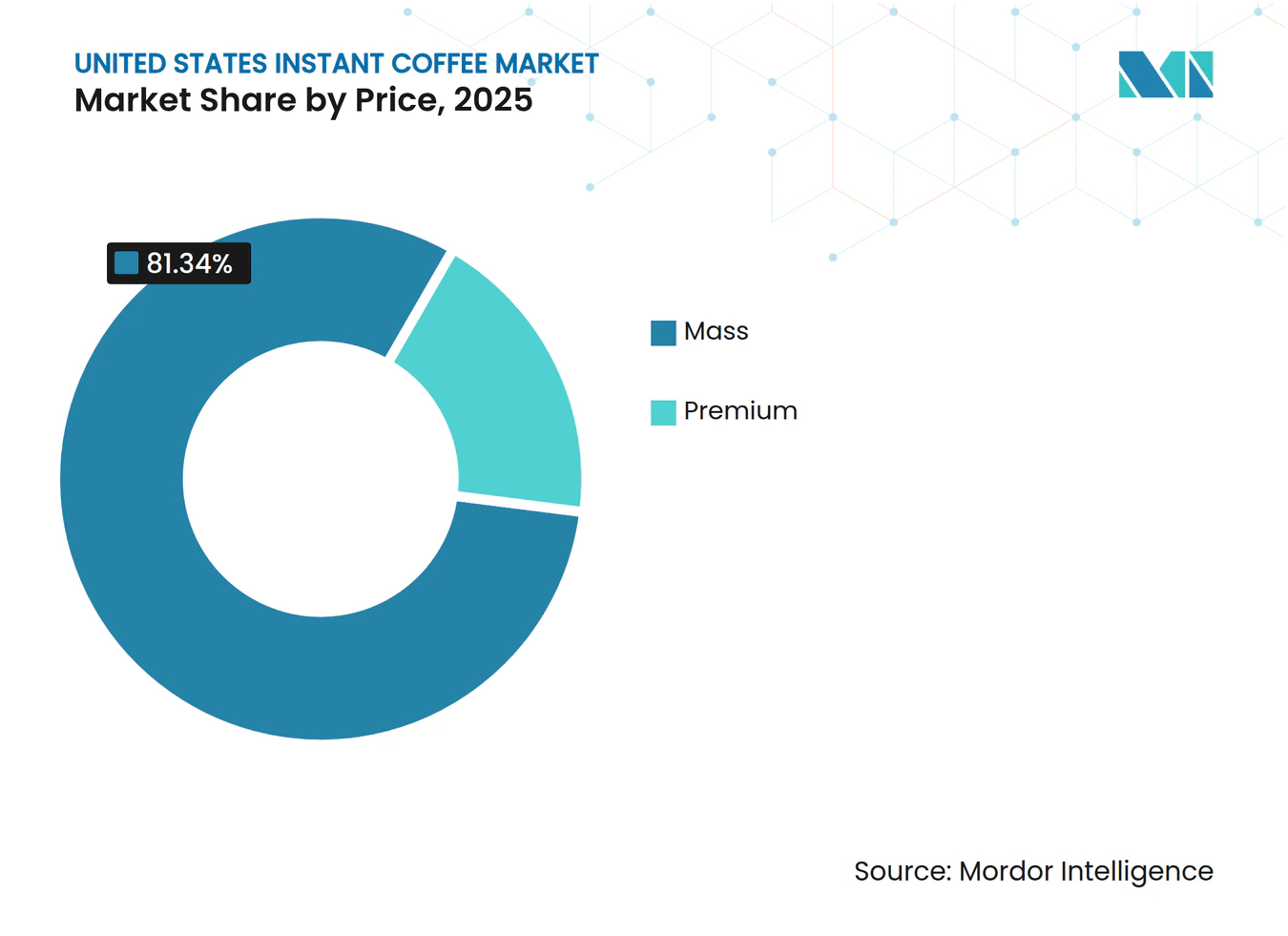
The mass price tier accounted for 81.34% of the United States instant coffee market in 2025, driven by its broad accessibility, established consumer acceptance, and suitability for everyday coffee consumption. Mass-market instant coffee appeals to consumers seeking a straightforward and reliable beverage without the higher price points associated with specialty and premium soluble coffee. Its standardized flavor profiles and familiar product formats encourage repeat purchases among regular coffee drinkers who prioritize consistency and ease of preparation. The segment also benefits from serving a wide range of taste preferences through different roast intensities, jar sizes, and single-serve sachets while maintaining affordability.
The premium price tier of the United States instant coffee market is forecast to grow at a CAGR of 3.51% through 2031, driven by increasing consumer interest in superior flavor profiles, specialty coffee experiences, and higher-quality soluble coffee formulations. Improvements in freeze-drying and aroma-retention technologies are enabling manufacturers to deliver richer flavor and aroma, strengthening the appeal of premium instant coffee among consumers seeking quality without compromising convenience. Growing familiarity with specialty coffee is also driving interest in distinctive roast profiles, single-origin varieties, and carefully sourced coffee beans. Organic certifications, transparent sourcing practices, and refined packaging further differentiate premium products from conventional offerings.

By Packaging Format: Jars Lead While Sachets Expand
Jars accounted for 57.34% of the United States instant coffee market by packaging format in 2025. Their suitability for repeated household use, convenient storage, and ability to maintain product quality between servings support this dominance. Resealable lids limit exposure to moisture and air, preserving aroma and freshness after opening. Jars also allow consumers to measure portions according to their preferred coffee strength, making them practical for regular consumption. Their sturdy construction and familiar presentation support consumer confidence, while transparent or clearly labeled packaging helps shoppers identify products and assess quantities before purchasing. The availability of different jar sizes accommodates varied consumption habits and replenishment preferences. These characteristics reinforce jars as an established packaging format in the market.
Sachets are the fastest-growing packaging format in the United States instant coffee market, projected to register a CAGR of 2.98% from 2026 to 2031, driven by their portability, portion-control benefits, and suitability for on-the-go consumption. Individual packaging allows consumers to prepare a consistent serving without measuring coffee from a larger container, reducing preparation effort and making sachets particularly convenient for busy daily routines. Their lightweight construction and compact size make them easy to carry in bags, store in workplace drawers, and pack for travel or outdoor activities. Sachets also help preserve product quality by limiting repeated exposure of the remaining coffee to air and moisture, an advantage over repeatedly opened bulk packaging.
By Distribution Channel: Supermarket Reach Grounds an Online Retail Surge
Supermarkets and hypermarkets accounted for 50.41% of the United States instant coffee market in 2025, supported by their extensive product availability, convenient shopping experience, and established role in routine grocery purchases. These outlets allow consumers to compare instant coffee varieties across roast profiles, flavors, packaging formats, and price tiers within a single shopping trip, making it easier to select products that match their preferences. According to the National Coffee Association (NCA), 40% of Americans who prepared coffee at home purchased their coffee at a grocery store, highlighting the importance of grocery retail in coffee purchasing behavior[3]. The availability of established brands, private-label alternatives, promotional offers, and different pack sizes further supports consumer access to instant coffee across varied purchasing preferences.
Online retail is the fastest-growing distribution channel for the United States instant coffee market, projected to register a CAGR of 4.11% from 2026 to 2031. Growth is driven by the convenience of home delivery, wider product selection, and easier access to specialty coffee varieties. Online platforms allow consumers to explore different roast profiles, flavored formulations, organic options, and premium freeze-dried products that may have limited shelf space in physical stores. Product descriptions, customer reviews, and ratings help shoppers compare taste profiles, preparation methods, and packaging options before purchasing. Subscription services and repeat-order features simplify replenishment, particularly for consumers who incorporate instant coffee into their daily routines. The availability of multipacks and bulk packages further supports online purchasing by reducing the need for frequent store visits.
Geography Analysis
The United States instant coffee market is shaped by regional differences in coffee consumption habits, retail infrastructure, and consumer preferences for convenient beverage preparation. The Northeast and West benefit from established coffee cultures, growing interest in specialty coffee, and demand for diverse beverage formats, creating opportunities for premium instant coffee, flavored varieties, and freeze-dried products. Urban consumers in these regions are also exposed to a wide range of coffee formats through supermarkets, specialty retailers, and online platforms. The Midwest and South offer opportunities for mainstream instant coffee through established grocery retail networks, familiar flavor profiles, and demand for convenient coffee options for everyday consumption. These regional differences influence product positioning, packaging preferences, and the balance between mass-market and premium instant coffee offerings.
The Western United States presents opportunities for product innovation, particularly in premium soluble coffee, organic varieties, cold coffee preparations, and specialty-inspired products. Consumer interest in alternative beverage formats and customization supports demand for instant coffee that can be adapted to iced beverages, milk-based drinks, and personalized recipes. The region's established specialty coffee culture also creates opportunities for manufacturers to address perceptions of instant coffee as inferior to freshly brewed alternatives through improvements in aroma, flavor retention, and processing quality. In the Northeastern states, dense urban centers, busy daily routines, and established coffee consumption habits support convenient preparation formats, including instant coffee jars and single-serve sachets. Online retail further broadens access to niche products and specialty varieties, particularly where physical retail assortments are limited.
The Southern and Midwestern United States provide an important base for mainstream instant coffee consumption, supported by extensive supermarket networks, mass-market retail availability, and consumer familiarity with conventional coffee products. Supermarkets and hypermarkets enable shoppers to compare brands, pack sizes, and price tiers, helping maintain demand for affordable instant coffee options. In these regions, manufacturers can strengthen market penetration through accessible pricing, familiar roast profiles, and packaging formats suited to regular household consumption. Across the country, e-commerce is complementing physical retail by expanding access to premium and specialty products, while improvements in soluble coffee technology are helping bridge the gap between convenience and sensory quality. Together, these regional characteristics shape competition and create opportunities for both established mass-market products and differentiated instant coffee offerings.
Competitive Landscape
Market Concentration
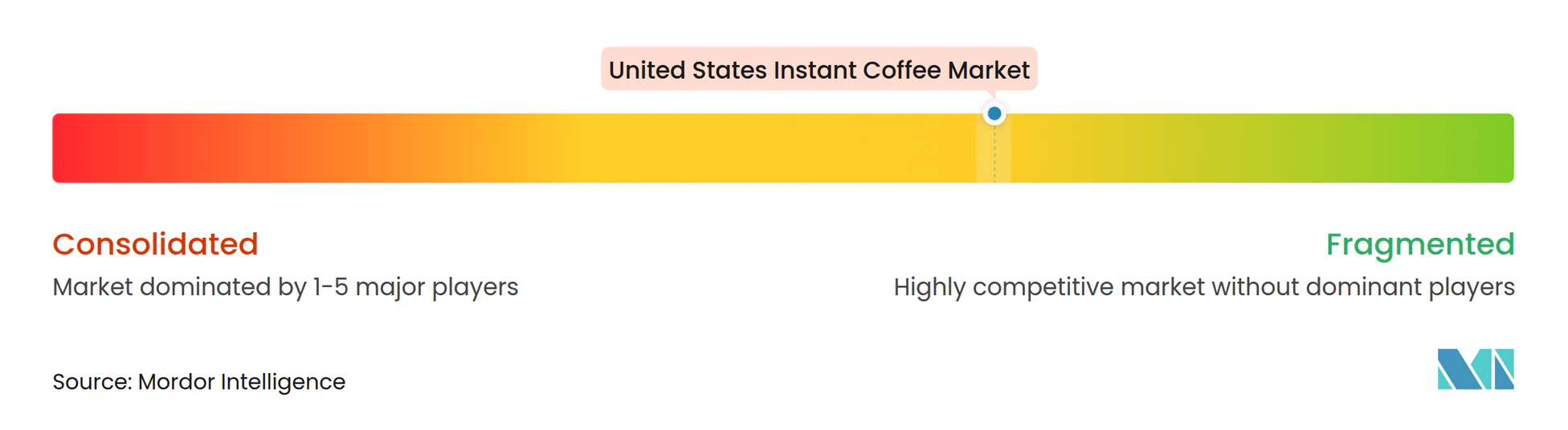
The United States instant coffee market is moderately fragmented, with established multinational companies maintaining their positions through strong brand recognition, extensive retail distribution, product diversification, and investments in coffee processing technologies. Major players include Nestlé S.A., Starbucks Corporation, The J.M. Smucker Company, The Kraft Heinz Company, and Keurig Dr Pepper Inc. These companies compete through established coffee brands, consistent product quality, pricing strategies, and product innovation. Competitive intensity is also influenced by private-label products and specialist coffee brands seeking to differentiate themselves through flavor quality and premium positioning.
Product innovation and technological advancement are key competitive strategies as manufacturers seek to improve instant coffee's flavor, aroma, solubility, and overall sensory quality. Companies are investing in processing techniques, premium soluble coffee formulations, and packaging innovations to address changing consumer expectations. Freeze-drying and aroma-retention technologies support the development of higher-quality instant coffee, while online retail and direct-to-consumer channels create opportunities for specialty brands to reach consumers beyond traditional retail networks. Established companies benefit from their manufacturing scale and distribution capabilities, whereas emerging specialty coffee brands compete through distinctive coffee profiles, small-batch processing, and premium product offerings.
Sustainability and supply chain resilience are becoming increasingly important areas of competition. Major coffee companies are strengthening responsible sourcing initiatives, improving supply chain traceability, and exploring packaging solutions that reduce environmental impact. These efforts help companies address consumer interest in ethical sourcing while managing long-term challenges associated with coffee cultivation and raw material availability. Strategic acquisitions and portfolio expansion are also reshaping the competitive landscape; for instance, Keurig Dr Pepper's acquisition of a majority stake in JDE Peet's expanded its presence across international coffee brands and markets.
United States Instant Coffee Industry Leaders
-
Nestlé S.A.
-
Starbucks Corporation
-
The J.M. Smucker Company
-
The Kraft Heinz Company
-
Keurig Dr Pepper Inc.
- *Disclaimer: Major Players sorted in no particular order
Recent Industry Developments
- June 2026: Waka Coffee & Tea expanded its retail distribution to Target for its direct-to-consumer premium instant brand, while simultaneously launching prebiotic instant teas and Café de Olla-style instant coffee blends, broadening its functional and flavor offerings. This dual expansion marks the brand's transition from specialty e-commerce to mass specialty retail.
- April 2026: Keurig Dr Pepper Inc. completed the acquisition of 96.22% of JDE Peet's N.V., marking a significant step in its strategy to expand its global coffee business. The acquisition integrates JDE Peet's international coffee portfolio with Keurig's existing coffee operations, strengthening its brand portfolio, distribution capabilities, and global market presence.
- June 2025: Onyx Coffee Lab introduced Onyx Instant, a range of specialty instant coffees designed to combine convenience with the flavor complexity of its specialty coffee blends. The product is made by brewing the company's coffee and freeze-drying it in small batches to preserve its aroma, flavor, and balance.
United States Instant Coffee Market Report Scope
Instant coffee, a convenient beverage derived from brewed coffee beans, allows consumers to effortlessly prepare their drink by simply adding water or milk to powdered or crystallized coffee solids and stirring. The United States Instant Coffee Market is segmented by product type, production technology, price, packaging format, and distribution channel. Based on product type, the market is segmented into flavored and unflavored. Based on production technology, the market is segmented into spray-dried instant coffee and freeze-dried instant coffee. Based on price, the market is segmented into mass and premium. Based on packaging format, the market is segmented into sachets, pouches, and jars. Based on distribution channel, the market is segmented into supermarkets/hypermarkets, convenience/grocery stores, specialty stores, online retail stores, and other distribution channels. For each segment, the market sizing and forecast have been done based on value (in USD).
| Flavored |
| Unflavored |
| Spray-Dried Instant Coffee |
| Freeze-Dried Instant Coffee |
| Mass |
| Premium |
| Sachets |
| Pouches |
| Jars |
| Supermarkets/Hypermarkets |
| Convenience/Grocery Stores |
| Specialty Stores |
| Online Retail Stores |
| Other Distribution Channels |
| By Product Type | Flavored |
| Unflavored | |
| By Production Technology | Spray-Dried Instant Coffee |
| Freeze-Dried Instant Coffee | |
| By Price | Mass |
| Premium | |
| By Packaging Format | Sachets |
| Pouches | |
| Jars | |
| By Distribution Channel | Supermarkets/Hypermarkets |
| Convenience/Grocery Stores | |
| Specialty Stores | |
| Online Retail Stores | |
| Other Distribution Channels |
Key Questions Answered in the Report
What is the projected growth rate for instant coffee in the United States?
The category is projected to grow at a 2.42% CAGR from 2026 to 2031, reaching USD 1.11 billion by 2031.
Which product type has the largest share of U.S. instant coffee sales?
Unflavored coffee leads with 83.23% share in 2025 because it remains a familiar product for everyday household use.
Which instant coffee technology is growing the fastest?
Freeze-dried coffee is projected to grow at a 3.67% CAGR through 2031 as consumers seek a higher-quality coffee experience.
Why are premium instant coffee products gaining attention?
Premium offerings use quality cues such as freeze-drying, Arabica beans, origin information, and certifications that appeal to specialty coffee consumers.