
United States Granite Market Size and Share
Market Overview
| Study Period | 2020 - 2031 |
|---|---|
| Forecast Data Period | 2026 - 2031 |
| Base Year Market Size (2025) | USD 2.51 Billion |
| Market Size (2026) | USD 2.58 Billion |
| Market Size (2031) | USD 3.06 Billion |
| Growth Rate (2026 - 2031) | 3.50 % |
| Market Concentration | Low |
Major Players *Disclaimer: Major Players sorted in no particular order Image © Mordor Intelligence. Reuse requires attribution under CC BY 4.0. | |
United States Granite Market Analysis by Mordor Intelligence
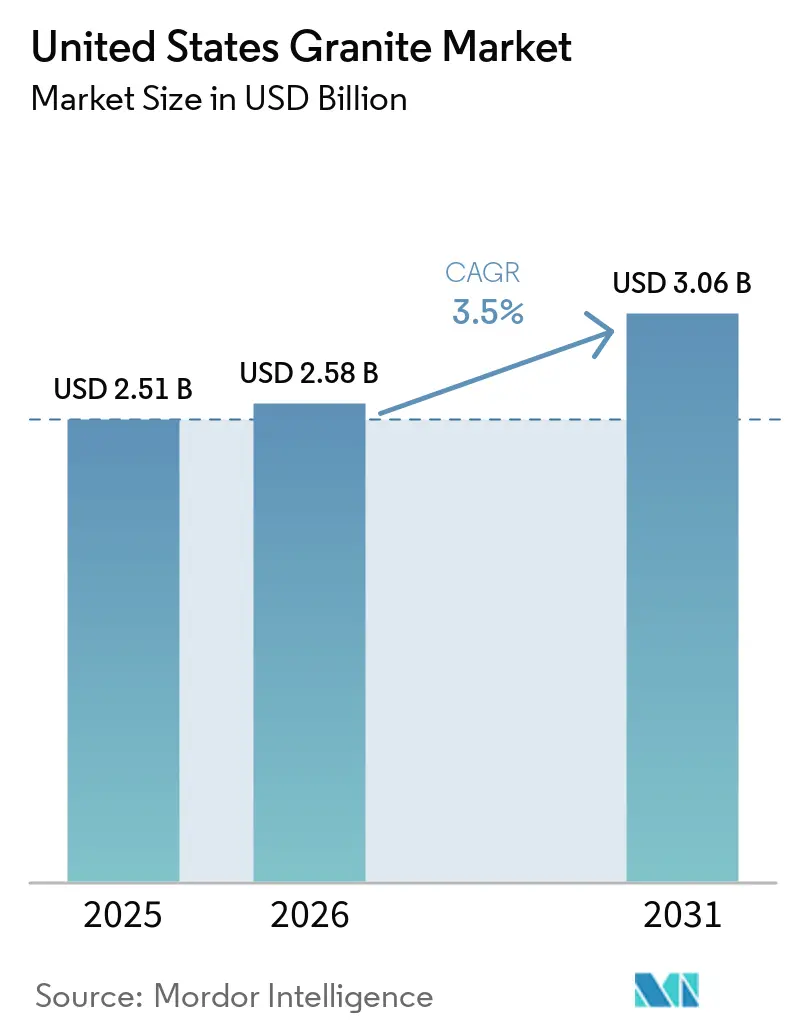
The United States granite market size is expected to grow from USD 2.51 billion in 2025 to USD 2.58 billion in 2026 and is forecast to reach USD 3.06 billion by 2031 at a 3.50% CAGR over 2026-2031. Demand is increasingly tied to renovation because many homeowners are delaying moves and putting money into their existing homes. This supports kitchen and bathroom upgrades, where granite remains a premium material for countertops and other finished surfaces. Public streetscape, transit, and civic projects also provide demand that is less dependent on homebuilding conditions. Import reliance leaves buyers exposed to freight changes and trade measures, while domestic and nearshore sources gain importance for projects that require predictable delivery. Competition from quartz, porcelain, and sintered stone remains strong, although granite retains clear advantages in outdoor settings that require heat resistance and UV stability.
Key Report Takeaways
- By product type, slabs held 56.37% of the United States granite market share in 2025, while tiles are projected to grow at a CAGR of 4.54% through 2031.
- By application, countertops accounted for 39.82% of the United States granite market size in 2025 and are projected to grow at a CAGR of 3.92% through 2031.
- By construction type, renovation and replacement held a 58.46% share in 2025, while new construction is projected to grow at a CAGR of 3.75% through 2031.
- By end user, residential applications accounted for a 57.18% share in 2025, while commercial applications are projected to grow at a CAGR of 3.63% through 2031.
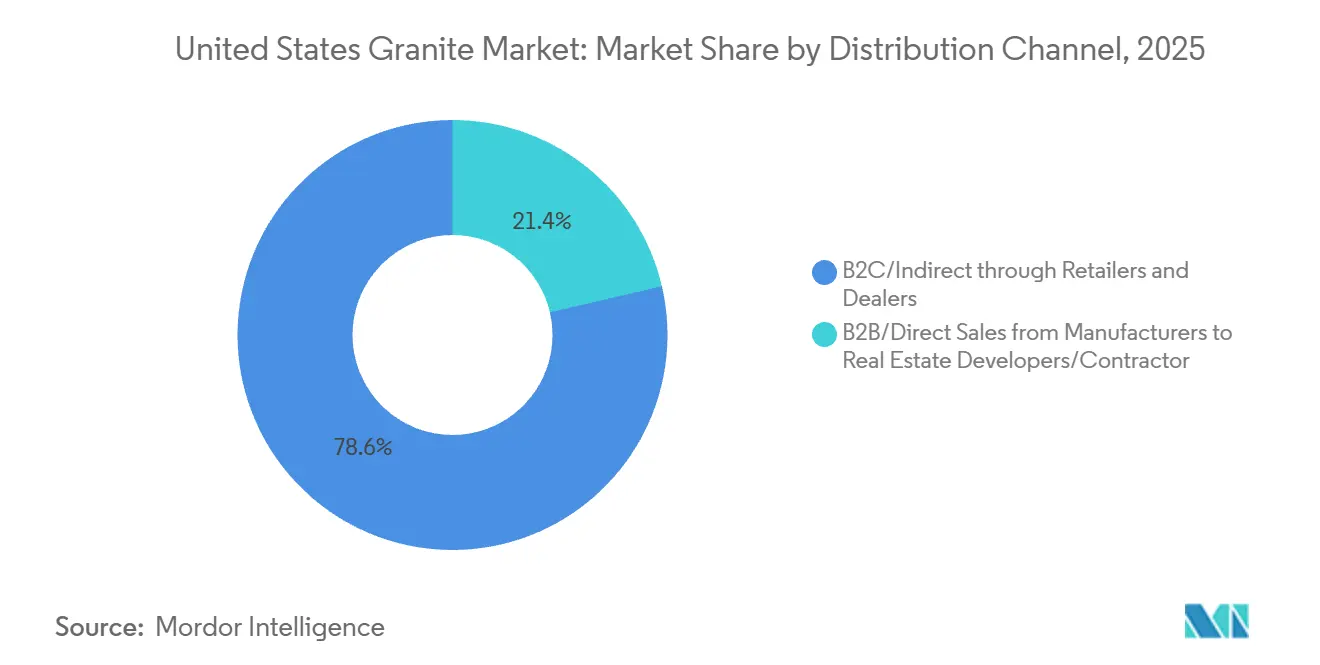
- By distribution channel, B2C and indirect sales held a 78.64% share in 2025 and are projected to grow at a CAGR of 3.81% through 2031.
- By geography, the Southeast held a 31.84% share in 2025, while the Southwest is projected to grow at a CAGR of 3.58% through 2031.
Note: Market size and forecast figures in this report are generated using Mordor Intelligence’s proprietary estimation framework, updated with the latest available data and insights as of January 2026.
United States Granite Market Trends and Insights
Drivers Impact Analysis*
| Driver | (~) % Impact on CAGR Forecast | Geographic Relevance | Impact Timeline |
|---|---|---|---|
| Kitchen and Bathroom Remodeling Under Mortgage Lock-In | +1.0% | National, with concentrated gains in the Southeast and Northeast | Short term (≤ 2 years) |
| Infrastructure and Civic-Realm Stone Specifications | +0.5% | National, with early gains in the Southeast and Mid-Atlantic | Medium term (2-4 years) |
| Premium Natural-Material Preference and Home-Value Signaling | +0.7% | National, with above-average intensity in the Northeast and West | Medium term (2-4 years) |
| Domestic and Nearshore Sourcing for Lead-Time Certainty | +0.4% | National, with supply-side gains in Southeast quarry states | Long term (≥ 4 years) |
| Automated Fabrication and CNC-Driven Yield Optimization | +0.3% | National, concentrated in Southeast and West fabrication hubs | Medium term (2-4 years) |
| Outdoor Living, Hospitality, and High-Heat Application Growth | +0.2% | National, with above-average intensity in the Southwest, Southeast, and West Coast | Short term (≤ 2 years) |
| Source: Mordor Intelligence | |||
Kitchen and Bathroom Remodeling Under Mortgage Lock-In
More than half of the United States homeowners hold mortgage rates below 4%, which makes moving less attractive for many households. The NAHB and Westlake Royal Remodeling Market Index remained above its break-even reading of 50 for 24 consecutive quarters through early 2026, while NAHB expects inflation-adjusted remodeling activity to increase 3% in 2026 and 2% in 2027[1]. The National Kitchen & Bath Association expects home equity lines of credit to remain an important funding source for kitchen and bath projects, with rates expected to end 2026 near 7%[2]. Bathroom remodeling was rated common to very common by 73% of NAHB remodeler members in 2025, and kitchen remodeling ranked second at 3.9 on a 5-point scale. The United States granite market benefits when these projects replace countertop and bathroom surfaces, rather than simply repair them. Many of these projects involve coordinated purchases of countertops, backsplashes, flooring, vanity surfaces, and related finishes, which can increase the practical value of a dependable local fabricator and a broad selection of available slabs. The resulting order flow favors suppliers that can help homeowners and remodelers select materials, confirm availability, and complete fabrication without prolonged delays.
Infrastructure and Civic-Realm Stone Specifications
Public spending on streetscapes, transit facilities, and civic plazas gives the United States granite market a demand channel that does not move in line with residential construction. Granite is specified for curbs, paving, and public-realm surfaces because it offers compressive strength, freeze-thaw resistance, and long service life. ASTM C615 provides a recognized specification framework for granite dimension stone in these uses. Coldspring introduced its TabStone system in September 2025 to speed granite-paver installation and support more consistent spacing on commercial projects[3]. The company used the system at Denver's 16th Street Mall project, which illustrates how installation efficiency can widen granite's use in larger civic projects. Faster placement can make granite more viable for projects where construction windows are short, labor availability is limited, and public owners need surfaces that remain serviceable over long periods. It can also reduce an important barrier for contractors who need predictable installation methods across large paved areas with demanding schedules.
Premium Natural-Material Preference and Home-Value Signaling
Homeowners carrying out higher-value kitchen and bath renovations are giving renewed attention to natural materials. Granite remains relevant where buyers want a durable surface with visible variation and a premium finish. This preference supports leathered and honed products in coastal and urban projects, where design differentiation has greater value. The United States granite market also benefits from greater attention to worker health risks associated with cutting high-silica engineered stone, which has encouraged designers and buyers to reassess material choices. The result is stronger demand for projects where the material is selected for appearance, permanence, and perceived contribution to property value. This emphasis is most relevant to homeowners who view a renovation as a long-term investment and prefer a surface whose natural variation differentiates the finished room from a standardized installation. Granite suppliers can address this demand through finish options and material selection that make individual projects feel more considered and less interchangeable.
Domestic and Nearshore Sourcing for Lead-Time Certainty
Trade measures and volatile ocean freight have made delivery certainty more important for buyers of stone products. The United States Geological Survey reported domestic granite production of 410,000 metric tons in 2025 and import reliance of 85% by value, which shows why sourcing risk is material to the United States granite market[4]. Buyers are looking more closely at domestic quarry output and nearer suppliers when project schedules cannot absorb long ocean transit times. Polycor has invested in North American quarry and manufacturing capacity, presenting domestic sourcing as a reliability advantage for projects. States including Texas, Wisconsin, Vermont, Indiana, and Georgia provide a domestic production base, although output remains concentrated in a limited number of locations. Buyers that use these sources can reduce exposure to ocean schedules. However, they must still manage product availability, color selection, quarry capacity, and the transportation needs of projects far from producing states. This makes early procurement more important for commercial projects that specify a particular color or require consistent material across several spaces.
Restraints Impact Analysis*
| Restraint | (~) % Impact on CAGR Forecast | Geographic Relevance | Impact Timeline |
|---|---|---|---|
| Engineered Quartz, Porcelain, and Sintered-Surface Substitution | -0.8% | National, most acute in the Northeast, West Coast, and urban markets | Short term (≤ 2 years) |
| Import Exposure and Freight-Driven Landed-Cost Volatility | -0.5% | National, with concentrated effects in interior markets far from ports | Medium term (2-4 years) |
| Fabricator Skilled-Labor Shortage and Silica Compliance Cost Escalation | -0.4% | National, most acute in interior markets and smaller metro areas | Medium term (2-4 years) |
| Domestic Quarry Closures and Capacity Contraction | -0.3% | Northeast and Southeast, including historically active quarrying states | Short term (≤ 2 years) |
| Source: Mordor Intelligence | |||
Engineered Quartz, Porcelain, and Sintered-Surface Substitution
Engineered quartz, large-format porcelain, and sintered surfaces compete directly with granite in residential countertop projects. These products appeal to buyers who prefer a uniform appearance and lower perceived maintenance requirements. Their wider availability makes it harder for granite to compete in price-sensitive projects and in design-led urban markets. Granite still has technical advantages in outdoor applications because it tolerates UV exposure and direct heat. However, substitution remains the most immediate restraint on the United States granite market, where interior countertop demand is the main source of revenue. Fabricators must explain granite's practical benefits and distinctive appearance clearly if they are to retain customers who initially compare materials on maintenance claims or uniformity alone. Clear product education can help buyers assess the trade-offs between natural variation, care needs, heat resistance, and a surface's intended setting.
Import Exposure and Freight-Driven Landed-Cost Volatility
The United States granite market depends on imported material for most of its supply by value, which makes it sensitive to tariffs and changes in freight costs. Buyers in interior markets can face greater delivery and handling costs because material must travel farther from ports or distribution centers. Trade uncertainty can delay purchase orders and increase the risk that distributors will carry costly inventory. Domestic quarry capacity and nearshore sourcing can moderate this risk, but permitting and development require time. The constraint therefore affects both price stability and the ability of suppliers to meet fixed project schedules. It also increases the value of inventory planning, alternate sourcing arrangements, and close communication with contractors that need reliable material delivery before installation crews are scheduled. Distributors with several supply options are better able to limit disruption when a shipment, tariff change, or freight movement affects a selected product.
*Our forecasts treat driver/restraint impacts as directional, not additive. The impact forecasts reflect baseline growth, mix effects, and variable interactions.
Segment Analysis
By Product Type: Slabs Hold Structural Lead, Tiles Expand into Mid-Market
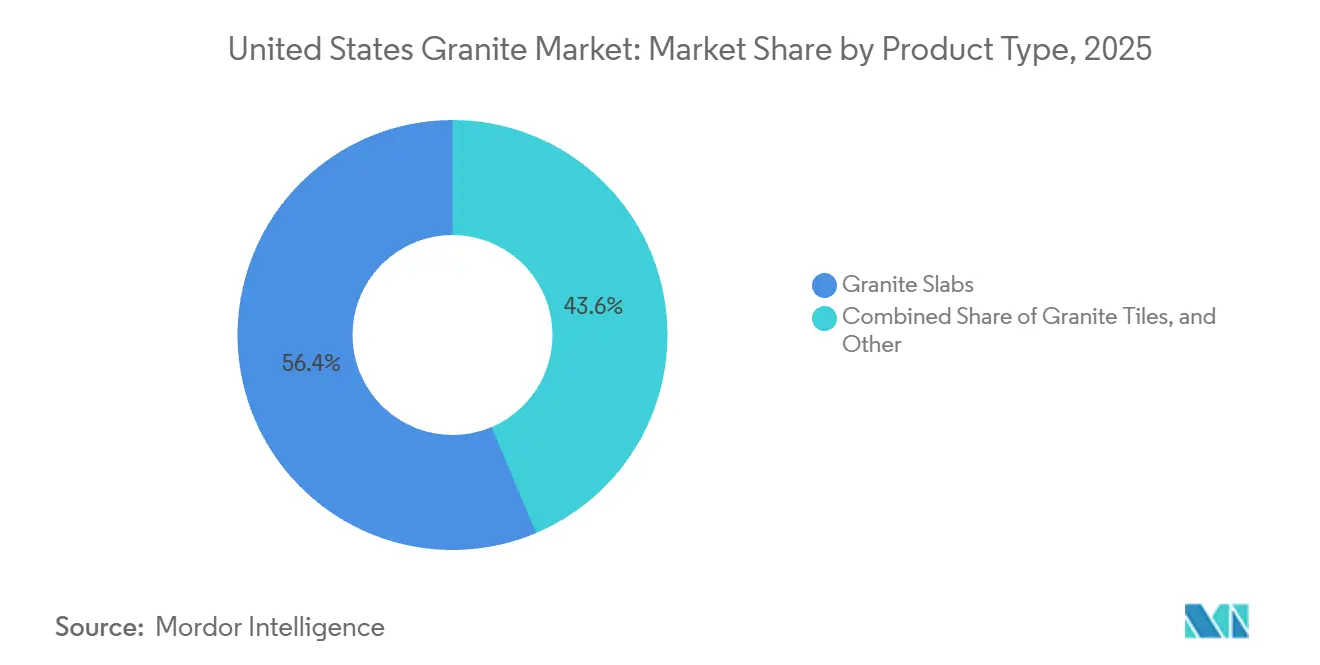
Granite slabs held 56.37% of the United States granite market share in 2025, supported by countertop fabrication and large wall-cladding projects. Continuous slab formats matter where designers and fabricators need uninterrupted stone runs across islands, counters, reception desks, and feature walls. The segment has particular importance in 2 cm and 3 cm products used for premium kitchen and bathroom installations. Its higher value per unit makes slabs a major contributor to revenue even when overall volume conditions are mixed. Other granite formats support curbs, monuments, specialty fabrication, and infrastructure work, giving the product mix a broader base than residential countertops alone.
Granite tiles are projected to grow at a CAGR of 4.54% through 2031. Tiles serve mid-tier renovation, outdoor paving, and commercial flooring projects where modular installation can improve handling and material efficiency. The format is suitable where a project needs the durability and appearance of granite without the size, weight, or fabrication demands of slab products. Calibrated thin tiles can reduce material weight and installation cost while retaining the visual character of natural stone. Wet-process CNC equipment helps fabricators improve cutting consistency for both slabs and tiles, while also supporting silica-control practices. The United States granite market therefore has room for a tile format that gives customers a lower-cost entry point into natural stone.

By Application: Countertops Lead, Outdoor and Specialty Uses Gain Ground
Countertops accounted for 39.82% of the United States granite market size in 2025 and are projected to grow at a CAGR of 3.92% through 2031. Kitchen and bath remodeling gives this application a direct link to home equity spending, home improvement financing, and longer homeowner occupancy. Granite is selected where buyers value a premium surface, heat resistance, and the individual pattern of natural stone. It is also a practical choice for kitchens where users value a resilient surface for regular food preparation and entertaining. Wall cladding and facades provide another specified use in institutional and commercial buildings. These projects value the material's weather resistance, visual permanence, and ability to withstand long service periods.
Flooring continues to supply commercial demand in hospitality, health care, and civic properties. Residential flooring demand is more limited, but commercial projects still use granite where durability, cleaning performance, and a formal appearance matter. Monuments and memorials remain a stable specialty application because of established preferences for dark granite and long-term inscription legibility. Outdoor kitchen countertops, pool surrounds, and hardscaping provide an additional demand stream in warm-climate locations. These uses are important because direct heat and UV exposure are more difficult conditions for many competing engineered materials. Together, these applications improve the outlook for the United States granite market beyond its core indoor-countertop base.
By Construction Type: Renovation Anchors Demand, New Construction Regains Momentum
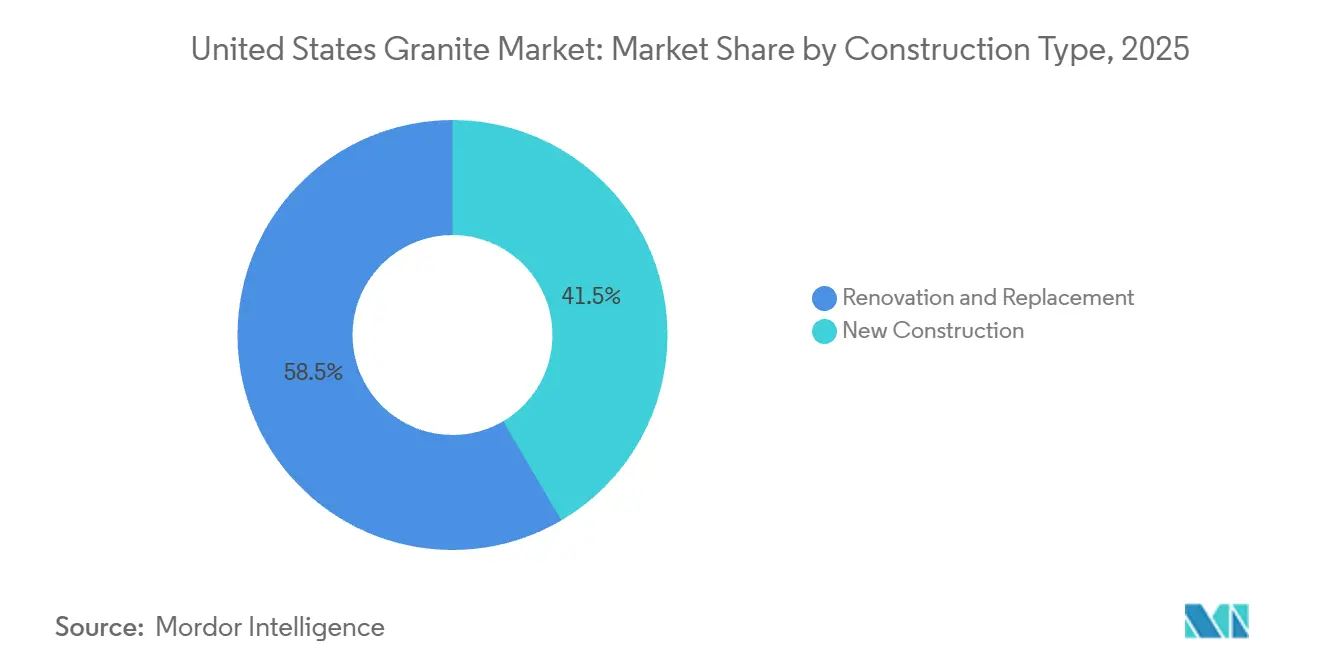
Renovation and replacement accounted for 58.46% of demand in 2025, making it the largest construction type. The segment is supported by homeowners who remain in their properties and upgrade kitchens, bathrooms, flooring, and other highly visible areas. Replacement demand also arises when surfaces no longer fit the design, condition, or functional needs of a renovated room. This gives suppliers a larger base of smaller projects than new construction alone can provide. The United States granite market remains closely linked to the timing, financing, and material choices made in these improvement projects.
New construction is projected to grow at a CAGR of 3.75% through 2031. Multifamily developments can produce sizable orders for lobby flooring, unit countertops, common areas, and exterior cladding. These projects favor suppliers that can provide reliable wholesale supply, consistent quality, and delivery across several buildings. Commercial facilities can also add demand for natural-stone finishes when projects require durable public-facing surfaces with a premium appearance. Single-family construction remains constrained by elevated mortgage rates, which limits some near-term demand for premium slabs. This makes multifamily, hospitality, and other commercial projects more important to the outlook for the United States granite market.
By End User: Residential Leads, Commercial Accelerates Across Sub-Sectors
Residential users accounted for 57.18% of demand in 2025. Countertop renovation remains the primary residential application because kitchen and bathroom projects concentrate spending on visible and long-life surfaces. The aging-in-place trend also creates demand for barrier-free flooring and non-slip shower surrounds. Homeowners who intend to remain in a property have a stronger reason to select finishes that can retain their appeal over a longer period. Health care and education facilities also use granite in areas where durability and cleanability influence material selection. Residential projects will remain the largest customer base for the United States granite market during the forecast period.
Commercial end users are projected to grow at a CAGR of 3.63% through 2031. Hospitality projects use granite in exterior patios, pool decks, bars, and other areas that need UV-stable surfaces. Retail and office renovations can support demand when higher-grade buildings are refreshed for tenants, staff, and visitors. Institutional and infrastructure projects provide more stable demand through courthouses, memorials, government buildings, transit spaces, and civic hardscaping. Commercial customers often place larger orders and require closer coordination between distributors, fabricators, and installers. The segment gives suppliers opportunities to win projects that reward service reliability and specification support.
By Distribution Channel: B2C Retail Dominates, B2B Direct Grows with Commercial Momentum
B2C and indirect channels held 78.64% of demand in 2025. Retailers and dealers remain important because many granite purchases begin with an individual homeowner comparing countertop or surface options. Modern retail includes home centers, specialty flooring stores, showrooms, and online services. These channels improve access to product options for buyers in secondary markets who may not have a local stone supplier. They also give customers a way to view colors and finishes before committing to a larger purchase. MSI opened a 10,000-square-foot showroom in Jacksonville, Florida, in June 2026, extending its showroom network to more than 50 locations.
B2C and indirect sales are projected to grow at a CAGR of 3.81% through 2031. Digital ordering and showroom expansion are helping consumers compare natural-stone options before placing an order. B2B and direct sales remain smaller in revenue, but they are important for multifamily, hospitality, institutional, and commercial construction. Developers and contractors use direct agreements when they need coordinated pricing, supply, fabrication, and installation schedules. Direct business also allows major buyers to standardize material selection across multiple locations or housing units. This balance means the United States granite market needs both broad retail coverage and capable direct-sales teams.
Geography Analysis
The Southeast held 31.84% of the United States granite market in 2025. Florida and Texas support demand through coastal residential development, hospitality projects, and infrastructure activity, while multifamily starts offset weaker single-family permit activity in the first half of 2026 and sustain demand for lobby flooring, cladding, and countertop installations. Georgia's granite production base can shorten restocking times for regional buyers and supports a more responsive supply chain than in markets that rely entirely on imports. The region also benefits from shoreline-management, resort, and public-realm projects that use durable natural stone.
The Northeast has a meaningful renovation base because it contains a large stock of older homes. Kitchen and bath projects support demand for premium surfaces in established urban and suburban communities where homeowners are more likely to renovate in place, while granite curbing and streetscape requirements support public demand where municipal specifications favor long-lasting materials. The Midwest has a stable base in curbing, secondary-market housing, and memorial products, with demand supported by practical infrastructure and commemoration uses. Together, these regions provide steadier demand for the United States granite market when new construction conditions vary across the country.
The Southwest is projected to grow at a CAGR of 3.58% through 2031, the fastest rate among regions. Population inflows into Arizona, Nevada, and Texas support residential, commercial, and infrastructure projects. Outdoor kitchens, pool surrounds, exterior bars, and hardscaping favor granite because it performs well under strong heat and sun and gives fabricators a way to sell the material on durability and service life. The West remains important for premium residential work, although porcelain and quartzite compete strongly in California. California's silica requirements have increased the need for wet-process fabrication controls and investment in compliant equipment. This raises the fixed-cost threshold for fabricators, while helping better-equipped firms deliver more consistent fabrication quality.
Competitive Landscape
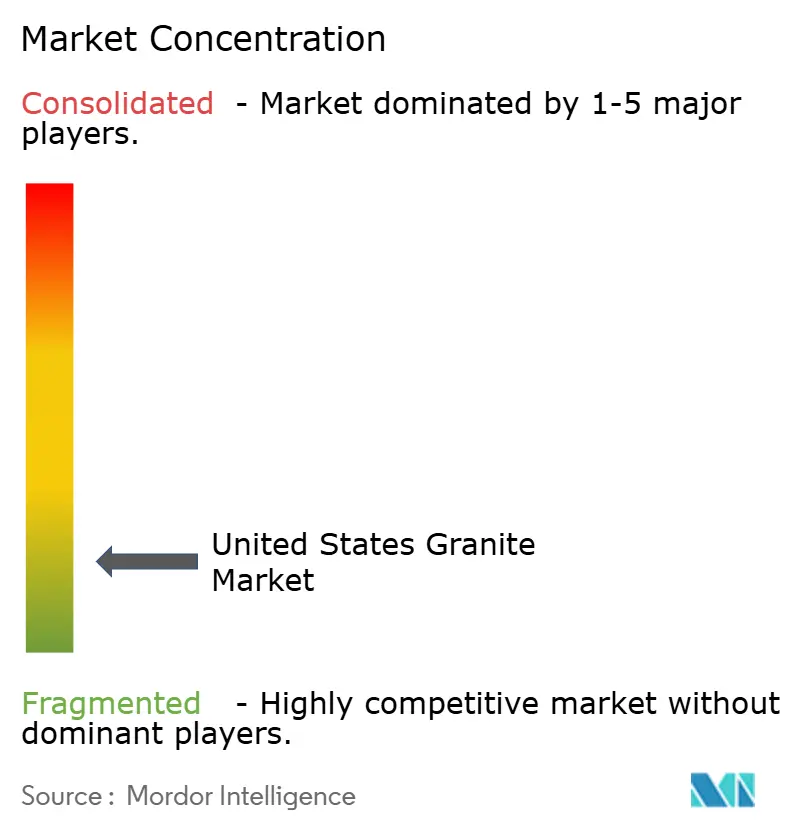
The United States granite market is fragmented, and no single company controls pricing from quarrying through distribution. Polycor, Coldspring, and Dakota Granite compete through domestic quarry access, supply assurance, lead times, and their ability to support projects that need dependable stone availability. MSI and Levantina compete through product range, logistics, showroom reach, and access to imported varieties. Regional fabricators compete on cutting quality, installation support, material selection, and local service. This structure gives customers several sourcing options, but it also makes reliable inventory management and relationships across the value chain important.
Leading companies are responding to tariff and delivery risk by investing in domestic capacity and product systems. Polycor has invested USD 15 million in North American manufacturing, including USD 6.5 million in its Oolitic, Indiana facility, to strengthen supply reliability. Coldspring integrated Stone Panels International as a full division in April 2025, expanding its lightweight natural-stone offering for facade projects and broadening its reach in commercial cladding. The company also introduced TabStone in September 2025, using a pre-tabbed paver design to reduce installation complexity and support more consistent results on large projects, while MSI's Jacksonville showroom opening shows that distributors are expanding retail access in Sun Belt locations.
Fabrication technology is becoming a larger point of difference for suppliers. Digital scanning, automated cutting, waterjet systems, and finishing equipment can improve throughput, reduce waste, and provide more predictable results for commercial projects. These capabilities also help fabricators manage silica-control requirements, which can place significant pressure on smaller operators that rely on older manual processes. OSHA actions against stone fabricators in Georgia during 2025 show the continued importance of effective exposure controls, training, and documented safety practices. Firms with reliable domestic supply, modern fabrication capacity, and strong specification support are better positioned to compete in the United States granite market.
United States Granite Industry Leaders
-
Polycor Inc.
-
M S International, Inc.
-
Coldspring
-
Dakota Granite Company
-
Eagle Granite Company
- *Disclaimer: Major Players sorted in no particular order
Recent Industry Developments
- October 2026: Coldspring completed the revitalization of Denver's 16th Street Mall, installing approximately one million natural granite pavers using its patent-pending TabStone™ technology. The completion has positioned TabStone as a specification-ready option for large-scale civic granite paving nationwide and marked a defining commercial reference for domestic quarried stone.
- June 2026: MSI opened a new 10,000-square-foot showroom in Jacksonville, Florida, extending its national showroom network. The opening reinforces MSI's strategy of expanding premium retail presence across high-growth Sun Belt markets to capture residential renovation demand.
- September 2025: Coldspring introduced TabStone™, a patent-pending pre-tabbed granite paver system providing integrated spacing tabs on all 4 sides of each paver, enabling consistent joint spacing and significantly faster installation on commercial projects. The product launch followed its successful pilot on the Denver 16th Street Mall renovation.
United States Granite Market Report Scope
| Granite Slabs |
| Granite Tiles |
| Other |
| Flooring |
| Countertops |
| Wall Cladding and Facades |
| Monuments and Memorials |
| Other Granite Applications ( Sculptures and decorative items, paving and hardscaping, etc.) |
| New Construction |
| Renovation and Replacement |
| Residential | |
| Commercial | Hospitality |
| Retail and Office | |
| Healthcare and Education | |
| Institutional and Infrastructure | |
| Other Commercial End User |
| B2B/Direct Sales from Manufacturers to Real Estate Developers or Contractors | |
| B2C/Indirect through Retailers and Dealers | Modern Retail (home centers, specialty flooring stores, online, etc.) |
| Traditional Retail |
| Northeast |
| Southeast |
| Midwest |
| Southwest |
| West |
| By Product Type | Granite Slabs | |
| Granite Tiles | ||
| Other | ||
| By Application | Flooring | |
| Countertops | ||
| Wall Cladding and Facades | ||
| Monuments and Memorials | ||
| Other Granite Applications ( Sculptures and decorative items, paving and hardscaping, etc.) | ||
| By Construction Type | New Construction | |
| Renovation and Replacement | ||
| By End User | Residential | |
| Commercial | Hospitality | |
| Retail and Office | ||
| Healthcare and Education | ||
| Institutional and Infrastructure | ||
| Other Commercial End User | ||
| By Distribution Channel | B2B/Direct Sales from Manufacturers to Real Estate Developers or Contractors | |
| B2C/Indirect through Retailers and Dealers | Modern Retail (home centers, specialty flooring stores, online, etc.) | |
| Traditional Retail | ||
| By Geography | Northeast | |
| Southeast | ||
| Midwest | ||
| Southwest | ||
| West | ||
Key Questions Answered in the Report
What is the forecast growth rate for United States granite demand?
The United States granite market is projected to grow at a CAGR of 3.5% and reach USD 3.06 billion by 2031. Renovation, commercial construction, outdoor applications, and public projects support this outlook.
Which product type leads United States granite sales?
Granite slabs lead the product mix, holding a 56.37% share in 2025 because they are widely used in countertops and large-surface cladding. Their format is especially important for premium kitchen and bathroom installations.
What application has the strongest growth outlook for granite?
Countertops are projected to grow at a CAGR of 3.92% through 2031, supported by kitchen and bathroom renovation activity. Outdoor surfaces and hardscaping provide additional uses where heat and UV resistance are important.
Why are renovations important for granite suppliers?
Renovation and replacement accounted for 58.46% of demand in 2025, as homeowners continue to invest in kitchens, bathrooms, and other visible surfaces. Longer homeownership supports surface replacement and design upgrades.
Which United States region is growing fastest for granite use?
The Southwest is projected to grow at a CAGR of 3.58% through 2031, supported by population growth and outdoor living applications. Arizona, Nevada, and Texas are important demand centers.