
United States Gold Analyzer Testing Solutions Market Size and Share
Market Overview
| Study Period | 2027 - 2032 |
|---|---|
| Forecast Data Period | 2027 - 2032 |
| Base Year Market Size (2026) | USD 93.35 Million |
| Market Size (2027) | USD 99.69 Million |
| Market Size (2032) | USD 134.42 Million |
| Growth Rate (2027 - 2032) | 6.16 % |
| Market Concentration | Medium |
Major Players *Disclaimer: Major Players sorted in no particular order Image © Mordor Intelligence. Reuse requires attribution under CC BY 4.0. | |
United States Gold Analyzer Testing Solutions Market Analysis by Mordor Intelligence
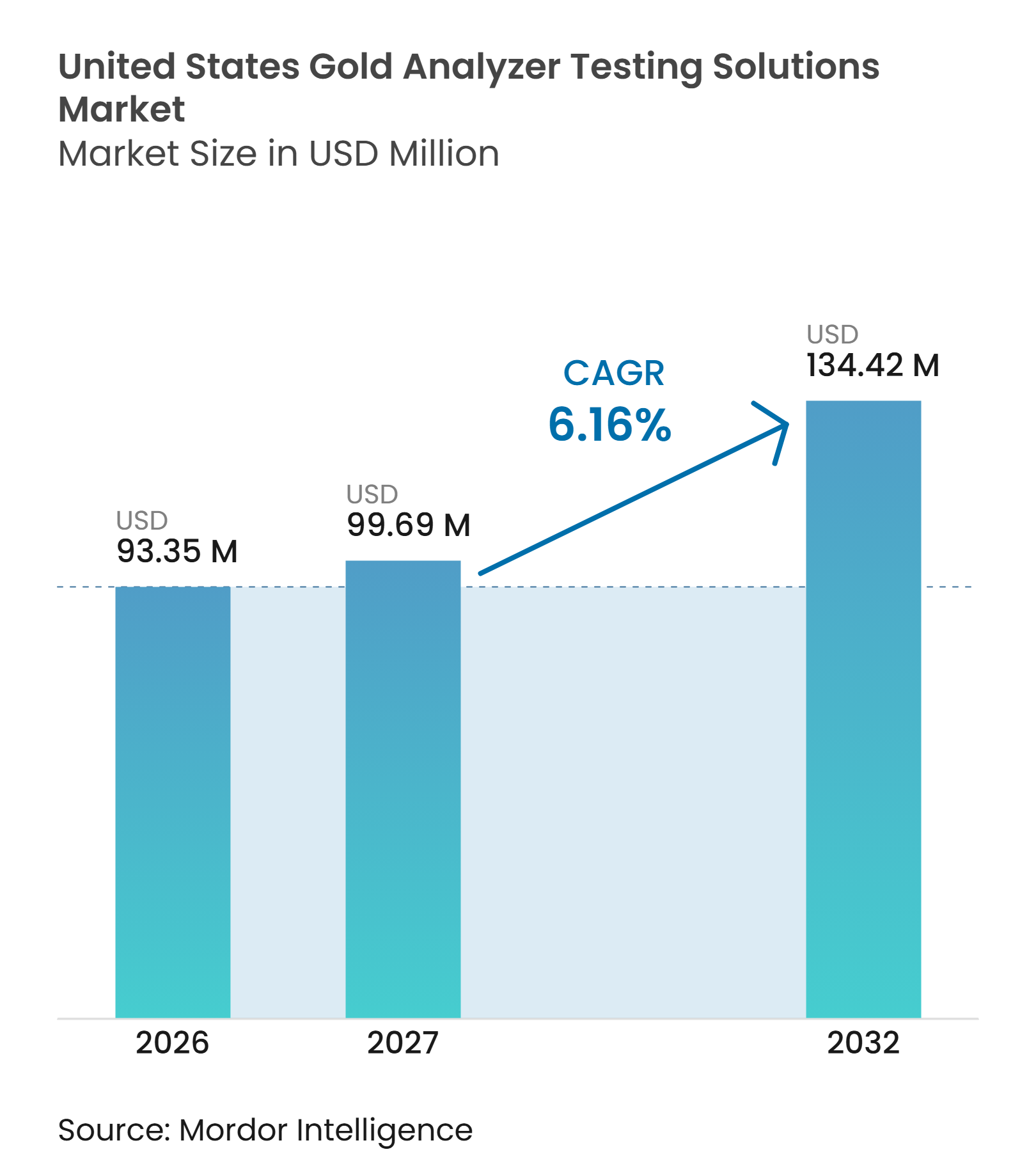
The United States gold analyzer testing solutions market size is expected to increase from USD 93.35 million in 2026 to USD 99.69 million in 2027 and reach USD 134.42 million by 2032, expanding at a CAGR of 6.16% over 2027-2032. Higher gold values have increased the financial exposure created by purity errors, which is strengthening demand for accurate and rapid verification at retail counters, pawn shops, refineries, and bullion dealers. The United States gold analyzer testing solutions market is therefore moving beyond basic purity checks toward documentation, fraud screening, and more consistent operating procedures. XRF remains central because it delivers non-destructive results at the point of transaction, although its surface-only measurement creates a clear need for complementary verification for high-value bars. Vendors are differentiating through portable designs, faster software, connected data management, and service support rather than through hardware accuracy alone. Price pressure from refurbished systems and lower-cost imports continues to limit demand among small operators, while larger chains and refineries can support standardized multi-unit purchases.
Key Report Takeaways
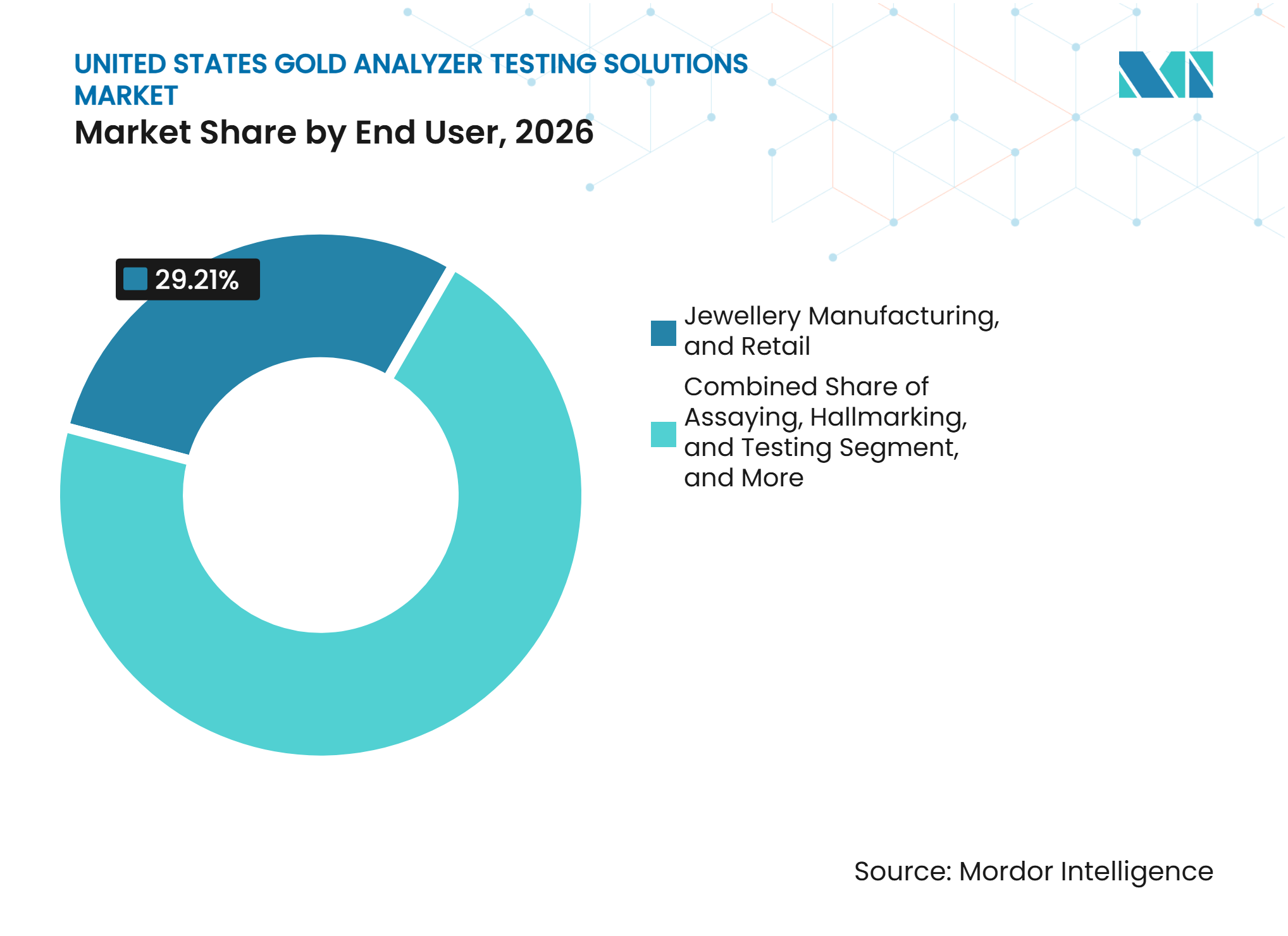
- By end user, Jewelry Manufacturing and Retail held 29.21% of the United States gold analyzer testing solutions market share in 2026, while Gold Buying, Pawn, and Cash-for-Gold is projected to expand at a CAGR of 7.14% through 2032.
- By technology, XRF Benchtop/Handheld accounted for 78.32% of the United States gold analyzer testing solutions market share in 2026.
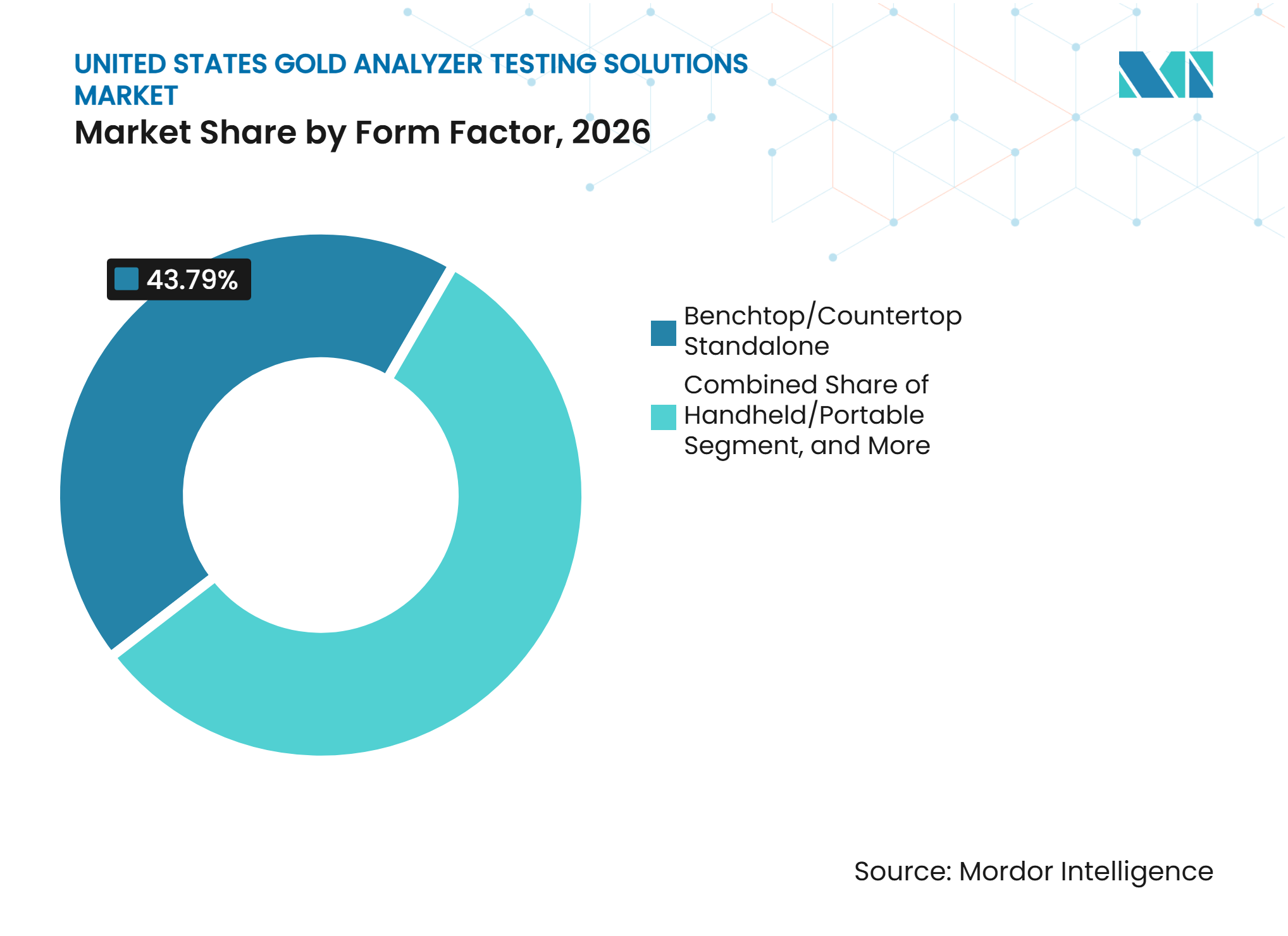
- By form factor, Benchtop/Countertop Standalone held 43.79% of revenue in 2026, while Handheld/Portable analyzers are projected to expand at a CAGR of 6.77% through 2032.
Note: Market numbers in this report are based on Mordor Intelligence's proprietary estimation framework, which combines nine months of actuals with Q4 projections for base year 2026.
Market Trends and Insights
Drivers Impact Analysis of United States Gold Analyzer Testing Solutions Market*
| Driver | (~) % Impact on CAGR Forecast | Geographic Relevance | Impact Timeline |
|---|---|---|---|
| Rapid and Non-Destructive Gold Purity Testing | +1.8% | National, with concentration in Southeast, Texas, and Northeast metro markets | Short term (≤ 2 years) |
| Gold-Backed Lending and Pawn Transactions | +1.4% | National, with early gains in Texas, Florida, California, and metropolitan corridors | Short term (≤ 2 years) |
| Portable XRF Analyzer Advancements | +1.1% | National, with spillover to field acquisition and mobile buying operations | Medium term (2-4 years) |
| Gold Recycling and Precious Metal Refining | +0.8% | Utah, North Carolina, Pennsylvania, and emerging regional refinery nodes | Medium term (2-4 years) |
| On-Site XRF Analyzer Adoption | +0.5% | National, concentrated in multi-location retail and pawn chains | Medium term (2-4 years) |
| Precious Metal Transaction Transparency and Documentation | +0.3% | National, influenced by FTC Jewelry Guides and ASTM B562 compliance | Long term (≥ 4 years) |
| Source: Mordor Intelligence | |||
Demand for Rapid and Non-Destructive Gold Purity Testing
Record gold prices have raised the cost of an incorrect purity decision and made analyzer procurement more relevant to day-to-day risk control in the United States gold analyzer testing solutions market. The LBMA PM gold price averaged USD 4,872.90 per ounce in Q1 2026 and reached USD 5,589 per ounce on January 28, 2026.[1] At these values, a 1% purity error on a 50-gram transaction resulted in a loss of USD 80, which was 4-5 times the exposure at 2024 price levels. Rising fraud incentives have also increased concern over tungsten-core bars and under-karated jewelry. ASTM E1335-04e1 fire assay remains a reference method, but it destroys the sample and requires specialized laboratory work. These constraints favor rapid non-destructive testing where operators must process many items in a working day.
Growth in Gold-Backed Lending and Pawn Transactions
Gold Buying, Pawn, and Cash-for-Gold is creating a larger installed base for counter-based testing in the United States gold analyzer testing solutions market. FirstCash reported USD 831 million in outstanding pawn loans globally at the end of 2025, and its US pawn loan balance increased by 14% year over year. EZCORP reported worldwide outstanding pawn loans of more than USD 387 million as of June 2026, up 33% from the prior year. Its average US loan size reached USD 240 in fiscal Q3 2026, up from USD 159 in fiscal 2022, while jewelry accounted for 69% of US pawn collateral. Higher loan values increase the cost of accepting incorrectly assessed collateral. Testing records also become more useful for internal control and loan book oversight as gold collateral becomes more important to pawn operators.
Technological Advancements in Portable XRF Analyzers
Portable XRF instruments are becoming more capable in field acquisition and mobile buying settings. Silicon drift detector technology has brought portable and laboratory-grade accuracy closer, with gold-content accuracy stated at 0.01% in the supplied evidence. Thermo Fisher Scientific launched the Niton XL5e Handheld XRF Analyzer in January 2026 with Wi-Fi, Bluetooth, thermal management improvements, and a Light Metal Quick Sort mode.[2] Modern handheld units can detect up to 74 elements and weigh as little as 1.6 kg, supporting use at auctions, field buying events, and refinery intake locations. Multi-FP software supports standardless analysis of complex alloys, reducing the need for a separate physical reference sample for each material type. Helmut Fischer introduced FISIQ X software in September 2025 and stated that it calculates material-analysis results up to 13 times faster than the previous generation.[3]
Expansion of Gold Recycling and Precious Metal Refining
Recycling and refining are increasing demand for accurate intake testing in the United States gold analyzer testing solutions market. Recycled gold reached 1,041 tonnes in the first 9 months of 2025, an increase of 6% from the comparable 2024 period. United Precious Metal Refining in Alden, New York, temporarily stopped accepting new clients in January 2026 after volume from existing accounts increased 40% during the gold price increase. Sibanye-Stillwater combined its North American recycling operations into a unified platform in June 2026, bringing Reldan, Metallix Refining, and Columbus autocatalyst recycling together. Asahi Refinery planned a new 12,000-square-foot facility in West Valley City, Utah, for 2026. Recycled feedstock has a more variable composition than primary metal, which supports multi-analysis verification when XRF surface readings need confirmation.
Restraints Impact Analysis of United States Gold Analyzer Testing Solutions Market*
| Restraint | (~) % Impact on CAGR Forecast | Geographic Relevance | Impact Timeline |
|---|---|---|---|
| Equipment Costs and Maintenance Requirements | -1.2% | National, most acute among small independent jewelers and single-location pawnbrokers | Short term (≤ 2 years) |
| XRF Surface Composition and Sample-Heterogeneity Limitations | -0.7% | National, most pronounced in high-value bullion trading and large-format bar verification | Medium term (2-4 years) |
| Traditional Gold Testing Methods | -0.5% | National, concentrated in independent jewelers and informal gold buying markets | Short term (≤ 2 years) |
| Refurbished and Low-Cost Imported Analyzers | -0.4% | National, primarily affecting mid-range and entry-level instruments | Short term (≤ 2 years) |
| Source: Mordor Intelligence | |||
High Equipment Costs and Maintenance Requirements
Equipment costs remain a significant barrier for small businesses in the United States gold analyzer testing solutions market. Premium handheld XRF analyzers carry high prices, while laboratory-grade benchtop systems are priced even higher in recent distributor listings. Annual calibration contracts further increase per-unit ownership costs. Advanced detector and semiconductor supply constraints have at times extended lead times significantly in recent years. The substantial installed base of active units in the United States means that replacement demand accounts for a significant share of purchases. Selling prices are expected to decline annually as silicon drift detector components become more widely available, which may gradually improve access to mid-range systems.
XRF Surface Composition and Sample-Heterogeneity Limitations
XRF analyzes the surface of a sample, with penetration limited to 10-20 microns, and this limits confidence in certain high-value transactions. A tungsten-core bar with sufficient gold plating can pass a standard XRF screen because the instrument reads the plated surface rather than the underlying core. Tungsten has a density of 19.25 g/cm³, close to gold at 19.30 g/cm³, which also reduces the usefulness of basic density checks. The issue is most important for bullion traders and financial institutions handling large bars. Curved, porous, and multi-layer jewelry can instead create variation in surface readings. Operators may combine XRF with visual inspection, conductivity testing, or ultrasound where the confidence level required under ASTM B562 cannot be reached with one method.
*Our forecasts treat driver/restraint impacts as directional, not additive. The impact forecasts reflect baseline growth, mix effects, and variable interactions.
United States Gold Analyzer Testing Solutions Market Segment Analysis
By End User:
Pawn and Cash-for-Gold Demand Gains MomentumJewelry Manufacturing and Retail commanded 29.21% of the United States gold analyzer testing solutions market share in 2026, supported by frequent transactions, alloy verification before resale, and FTC Jewelry Guides requirements for karat-mark accuracy. Gold priced above USD 4,000 per ounce made the cost of accepting under-karated jewelry significant for smaller retailers that had relied on acid testing. Assaying, Hallmarking, and Testing provide stable revenue through private laboratories that need traceability and precision for ASTM B562 refined-gold specifications, and these laboratories commonly replace equipment on 5-8-year cycles. Gold Refining, Recycling, and Processing and Bullion Trading and Financial Institutions require multi-element analysis capable of verifying fineness to 0.01%. That requirement favors silicon drift detector-equipped benchtop and laboratory systems over basic field instruments.
Gold Buying, Pawn, and Cash-for-Gold is projected to expand at a CAGR of 7.14% from 2027 to 2032, driven by rising pawn loan volumes, gold collateral values, and multi-location buying networks. EZCORP stated that jewelry represented 68% of US pawn loans outstanding in Q4 2025, an increase of 220 basis points from the prior year. The segment purchases instruments based on per-counter economics and ease of use rather than on laboratory precision alone. Mid-range silicon drift detector benchtop and handheld systems priced at USD 12,000-25,000 meet requirements for speed, accuracy, and manageable operator training. Standardized instrument fleets, service coverage, and software integration are important for chains deploying equipment across hundreds of sites.



By Technology:
XRF Benchtop/Handheld Anchors Market PerformanceXRF Benchtop/Handheld held 78.32% of the United States gold analyzer testing solutions market share in 2026 because it covers karat identification, jewelry transactions, and multi-element refinery analysis. Silicon drift detector-equipped instruments provide stated gold-content accuracy to 0.01%, measure up to 74 elements, and return results in 3-60 seconds depending on the measurement mode. AMETEK/SPECTRO introduced the SPECTROSCOUT kt in August 2026 for precious metals work across 25 elements in 30-90 seconds, with a 1 mm spot video system. The system supports hallmarking centers, pawn shops, jewelry manufacturing, refining, and recycling, while Thermo Fisher’s AuDIT feature compares elemental profiles against expected karat compositions to screen for gold-plated counterfeits. This broad use explains why XRF equipment remains the main technology in the United States gold analyzer testing solutions market.
Density and specific-gravity instruments support bulk verification where surface XRF readings are inadequate for large gold bars. Electrical, conductivity, and resistivity analyzers provide lower-cost, non-destructive complementary checks at coin and bullion counters. Fire assay furnaces, ICP-OES systems, and photon activation methods support reference work in accredited laboratories, where ISO 15093 and ASTM E1335 requirements are relevant. Laboratory infrastructure and trained-operator requirements limit use of these methods outside larger facilities. No alternative combines non-destructive testing, multi-element coverage, and practical point-of-transaction deployment as effectively as XRF.
By Form Factor:
Portability Reshapes Field-Based Gold TestingHandheld/Portable analyzers are projected to expand at a CAGR of 6.77% from 2027 to 2032 as pawn chains, mobile buyers, and refinery intake teams need field-deployable equipment. Evident Scientific launched the Vanta Element series in January 2025 with a non-slip grip, a smaller carry case, USB data export, and onboard PDF generation for high-volume scrap and precious-metals work. Evident also introduced the Vanta GX benchtop-handheld hybrid in September 2026 with 9 mm, 3 mm, and 1 mm analysis spots in the GX-LTS configuration. Instruments weighing as little as 1.6 kg, with hot-swap batteries and IP54 ratings, reduce the operating difference between mobile and fixed testing. These features make portable systems more practical for field acquisition without requiring a separate fixed installation.
Benchtop/Countertop Standalone instruments accounted for 43.79% of the United States gold analyzer testing solutions market size in 2026 and remain central at high-volume jewelry counters, pawn desks, and assay offices. Helmut Fischer introduced the FISCHERSCOPE XDAL and XDV in September 2025 with 6-times faster Z-axis positioning, 14-times faster autofocus, and 10-times higher resolution than earlier models. Automated and integrated laboratory or inline systems are the smallest but highest-value form-factor category, used where continuous or batch assay is integrated into refinery and industrial workflows. Bruker introduced the S8 TIGER Series 3 WDXRF spectrometer in May 2025 with HighSense XE detection, EasyLoad sample handling, and LabScape Cloud fleet management. Automation, predictive maintenance, laboratory throughput, repeatability, and enclosed radiation chambers guide these form-factor decisions more than counter-based speed.

Geography Analysis
Texas and the Southeast
Texas and the Southeast are major demand areas for the United States gold analyzer testing solutions market due to dense pawn and cash-for-gold networks. Texas had 247 of EZCORP’s 547 US pawn stores, while Florida had 95 stores, together representing 62% of its domestic locations. EZCORP’s average US loan size reached USD 240 in fiscal Q3 2026, up from USD 159 in fiscal 2022, strengthening the case for precision testing over acid or touchstone methods. Unbanked and underbanked communities continue to use pawn credit, while chain operators purchase equipment in batches, standardize procedures across sites, and increasingly connect instruments to inventory systems.
Northeast
The Northeast supports high-precision demand through New York City’s Diamond District, financial institutions in Connecticut and New Jersey, and private assay laboratories in the Mid-Atlantic. The Diamond District is a major wholesale precious-metals center where multi-element XRF equipment supports gold, silver, and platinum-group-metal transactions. Laboratory customers are upgrading from Si-PIN to silicon drift detectors to pursue sub-0.01% accuracy expectations. Financial institutions and non-bank financial companies use gold and precious metals as collateral assets, increasing the value of reference-grade purity documentation. ASTM B562 composition verification and associated quality records influence compliance practices, while blockchain-linked assay certificates support auditable chain-of-custody documentation for recycled and conflict-free gold.
Refining and Recycling Hubs
Utah, North Carolina, the Midwest, and the Pacific Coast represent a mixed geography with an industrial testing profile. Asahi Refinery’s planned 12,000-square-foot West Valley City facility requires incoming assay infrastructure consistent with LBMA Good Delivery List expectations. Metallix Refining in North Carolina, now within Sibanye-Stillwater’s integrated platform, processes industrial precious-metal waste and needs high-throughput XRF testing at intake. Ohio, Michigan, and Illinois contribute industrial scrap and electronic waste, while California adds electronics recycling and import-intensive jewelry wholesale demand. These regions select higher-value laboratory systems on 5-8 year cycles, with ICP-OES and fire assay reference standards carrying more weight than point-of-sale speed; their United States gold analyzer testing solutions market size is supported by the need to assess heterogeneous recycled material.
Competitive Landscape
Market Concentration
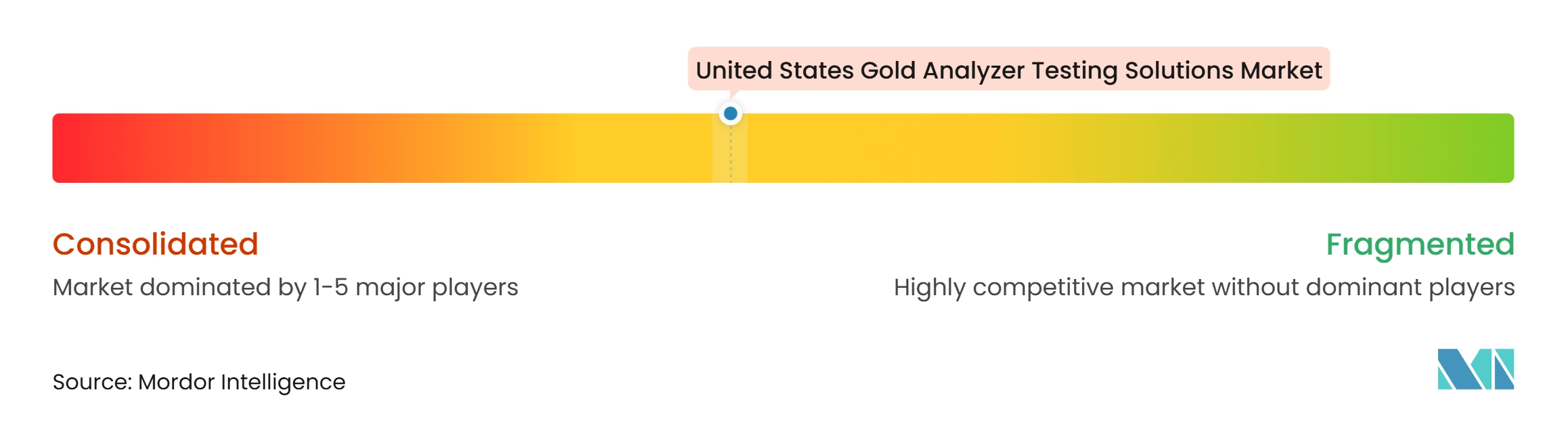
The United States gold analyzer testing solutions market is moderately concentrated in premium XRF instruments and fragmented at the entry level. Thermo Fisher Scientific, Bruker, Hitachi High-Tech Analytical Science, and Helmut Fischer compete through calibration programs, software, and US service coverage. Their 50-100 authorized service centers and 24-72 hour calibration turnaround targets are important for high-volume pawn chains and assay laboratories. Helmut Fischer’s September 2025 FISIQ X release made software-assisted spectrum analysis a key product differentiator. AMETEK/SPECTRO introduced the SPECTROSCOUT kt in August 2026, while Evident Scientific launched the Vanta GX in September 2026 for jewelry assay, pawn, and hallmarking applications.
Jiangsu Skyray Instrument and Guangdong Hongtuo are competing in the USD 8,000-15,000 range by improving silicon drift detectors and offering English-language software with US-compatible calibration curves. Refurbished 3-5-year-old analyzers sell for 40-60% of a new unit’s price, limiting new-unit demand among pawnbrokers and small jewelers while widening access to testing equipment. A gap remains for integrated XRF-plus-ultrasound benchtop systems for large-bar authentication below USD 50,000. Another gap exists for connected field instruments that provide real-time assay transfer, remote management, and centralized calibration records for chain operators. These needs favor vendors with practical software, service capacity, and credible multi-method verification.
SciAps offers a US-based portable XRF alternative with domestic service capabilities and precious-metals modes. Arihant Maxsell Technologies and Maxsell are less relevant because their distribution, service, and calibration orientation are centered on India, while Guangdong Hongtuo’s US distribution presence requires further verification. Established premium suppliers retain advantages in advanced applications, whereas entry-level suppliers remain exposed to imports and refurbished alternatives. The United States gold analyzer testing solutions market therefore rewards total workflow capability and price discipline alongside the quality of a single measurement result.
United States Gold Analyzer Testing Solutions Industry Leaders
-
Thermo Fisher Scientific Inc.
-
Bruker Corporation
-
Hitachi High-Tech Corporation
-
Evident Corporation
-
SPECTRO Analytical Instruments GmbH
- *Disclaimer: Major Players sorted in no particular order
United States Gold Analyzer Testing Solutions Market Companies Covered in this Report
- Thermo Fisher Scientific / Niton
- Hitachi High-Tech Analytical Science
- Helmut Fischer GmbH
- Bruker Corporation
- Evident Scientific (formerly Olympus)
- AMETEK / SPECTRO
- Arihant Maxsell Technologies / Maxsell
- Microanalytik Instruments
- Omio Technologies
- Neo Instrument Co.
- Jiangsu Skyray Instrument
- Guangdong Hongtuo Instrument Technology Co., Ltd.
Recent Industry Developments in United States Gold Analyzer Testing Solutions Market
- September 2026: Evident Scientific launched the Vanta GX benchtop XRF analyzer series, purpose-built for gold, silver, platinum, and other precious metals analysis. The GX-LTS configuration offers three selectable spot sizes, 9 mm, 3 mm, and 1 mm, enabling analysis of fine jewelry details and small irregular samples. The instrument uses an updated SDD detector and redesigned software interface optimized for high-frequency retail and assay workflows.
- August 2026: AMETEK/SPECTRO Analytical Instruments introduced the SPECTROSCOUT kt portable ED-XRF analyzer for precious metals testing. The system delivers non-destructive gold and silver purity analysis across 25 relevant elements in 30-90 seconds using SDD X-ray technology and an integrated 1 mm spot video system. It targets hallmarking centers, pawn shops, jewelry makers, refiners, and recyclers requiring a compact, field-portable system with minimal operator training.
- June 2026: Sibanye-Stillwater consolidated its North American precious metals recycling operations, Reldan, Metallix Refining, and Columbus autocatalyst recycling, into a unified global platform. The combined entity operates analytical laboratories focused on assay accuracy, transparency, and customer confidence for industrial, electronic, jewelry, and autocatalyst recycling streams.
- January 2026: Thermo Fisher Scientific launched the Niton XL5e Handheld XRF Analyzer, expanding its Niton portfolio with enhanced light-metal detection capability, including Light Metal Quick Sort mode reducing aluminum analysis to 2 seconds per scan, integrated Wi-Fi and Bluetooth connectivity, improved thermal management for outdoor and industrial site deployment, and an IP54-rated enclosure. The analyzer targets scrap metal recycling, mining, manufacturing, and metal recovery applications.
United States Gold Analyzer Testing Solutions Market Report Scope
The United States Gold Analyzer Testing Solutions Market comprises instruments, analytical systems, and related services for verifying the purity, composition, and authenticity of gold and other precious metals. These solutions support accurate testing, valuation, quality assurance, certification, and fraud detection across the gold ecosystem. Market growth is driven by increasing demand for reliable precious metal verification, rising gold trading and recycling activities, stricter quality standards, and technological advancements that enhance testing accuracy, speed, and operational efficiency.
The United States Gold Analyzer Testing Solutions Market Report is Segmented by End-User (Jewellery Manufacturing, and Retail, Assaying, Hallmarking, and Testing, Gold Refining, Recycling, and Processing, Gold Buying, Pawn, and Cash-for-Gold, and Bullion Trading, and Financial Institutions (NBFCs and Banks)), Technology (X-Ray Fluorescence (XRF), Density / Specific Gravity Testing, Electrical / Conductivity / Resistivity Testing, and Other Technologies), Form Factor (Benchtop/Countertop Standalone, Handheld/Portable, and Automated / Integrated Laboratory or Inline Systems). The Market Forecasts are Provided in Terms of Value (USD).
Segmentation Overview
| Jewellery Manufacturing, and Retail |
| Assaying, Hallmarking, and Testing |
| Gold Refining, Recycling, and Processing |
| Gold Buying, Pawn, and Cash-for-Gold |
| Bullion Trading, and Financial Institutions (NBFCs and Banks) |
| XRF Benchtop/Handheld |
| Density/Specific Gravity |
| Electrical/Conductivity/Resistivity |
| Other Technologies |
| Benchtop/Countertop Standalone |
| Handheld/Portable |
| Automated/Integrated Laboratory or Inline Systems |
| By End User | Jewellery Manufacturing, and Retail |
| Assaying, Hallmarking, and Testing | |
| Gold Refining, Recycling, and Processing | |
| Gold Buying, Pawn, and Cash-for-Gold | |
| Bullion Trading, and Financial Institutions (NBFCs and Banks) | |
| By Technology | XRF Benchtop/Handheld |
| Density/Specific Gravity | |
| Electrical/Conductivity/Resistivity | |
| Other Technologies | |
| By Form Factor | Benchtop/Countertop Standalone |
| Handheld/Portable | |
| Automated/Integrated Laboratory or Inline Systems |
Key Questions Answered in the Report
What is the size of the United States gold analyzer testing solutions market?
The sector is valued at USD 93.35 million in 2026 and is expected to reach USD 134.42 million by 2032, with a 6.16% CAGR from 2027 to 2032.
Which end user has the largest share of gold analyzer testing solutions?
Jewelry Manufacturing and Retail led end-user demand with 29.21% share in 2026.
Which technology is most widely used for gold purity testing?
XRF Benchtop/Handheld technology accounted for 78.32% share in 2026 because it is non-destructive and supports multi-element analysis.
Why are portable gold analyzers becoming more important?
Handheld and portable systems are projected to expand at a 6.77% CAGR through 2032 as mobile buyers, pawn chains, and refinery teams need field testing.
What limits XRF testing for gold bars?
XRF reads only 10-20 microns of the surface, so it may not detect a tungsten core under thick gold plating without a complementary verification method.
Which buyers are expected to adopt analyzers faster?
Gold Buying, Pawn, and Cash-for-Gold is projected to expand at a 7.14% CAGR through 2032 as collateral values and standardized multi-location purchasing increase.