
United States DIN Rail-Mounted Signal Processing Solutions Market Size and Share
Market Overview
| Study Period | 2021 - 2032 |
|---|---|
| Forecast Data Period | 2027 - 2032 |
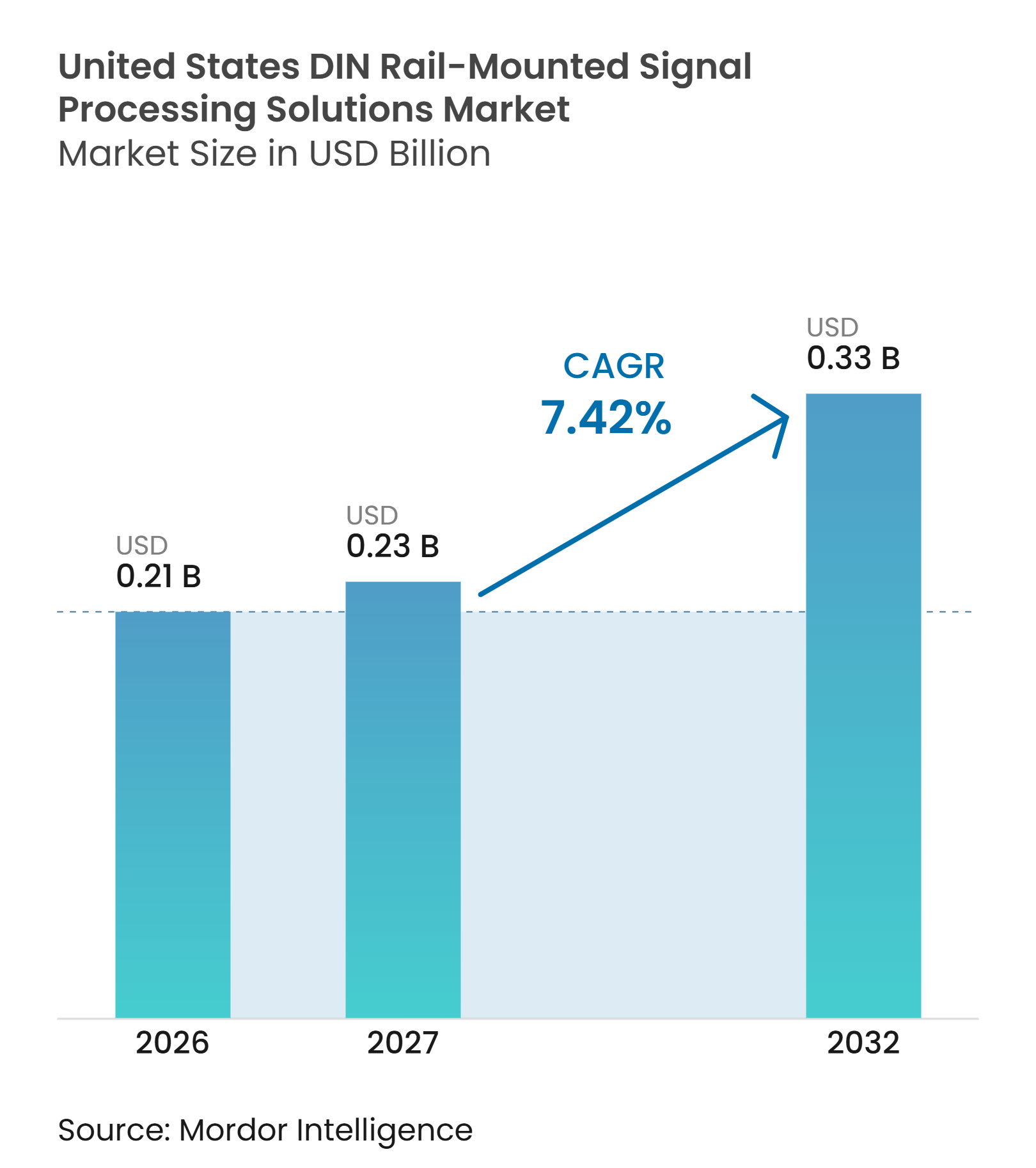
| Base Year Market Size (2026) | USD 0.21 Billion |
| Market Size (2027) | USD 0.23 Billion |
| Market Size (2032) | USD 0.33 Billion |
| Growth Rate (2027 - 2032) | 7.42 % |
| Market Concentration | Medium |
Major Players *Disclaimer: Major Players sorted in no particular order Image © Mordor Intelligence. Reuse requires attribution under CC BY 4.0. | |
United States DIN Rail-Mounted Signal Processing Solutions Market Analysis by Mordor Intelligence
The United States DIN Rail-Mounted Signal Processing Solutions market size is valued at USD 0.21 billion in 2026 and is forecast to reach USD 0.33 billion by 2032, expanding at a CAGR of 7.42% during 2027-2032. Demand is tied to modernization work in industrial facilities where aging distributed control systems, programmable logic controllers, and field instruments need better signal handling without changes to existing field wiring, terminal arrangements, or core control-room layouts. Digitalization programs increase the need for galvanically isolated channels that convert analog signals at the field interface and preserve reliable communication between older sensors and updated automation equipment. Standalone DIN rail modules can provide that function without the cost, shutdown time, engineering effort, and operating disruption associated with replacing complete control cabinets. The United States DIN Rail-Mounted Signal Processing Solutions market also benefits from safety requirements that favor purpose-built modules in certified process loops, particularly where isolation, functional safety, and hazardous-area suitability must be documented together. HART-compatible devices add a durable source of demand because transparent signal conditioners can extract diagnostic data from installed transmitters without rewiring the field network or removing operating assets from service.
Key Report Takeaways
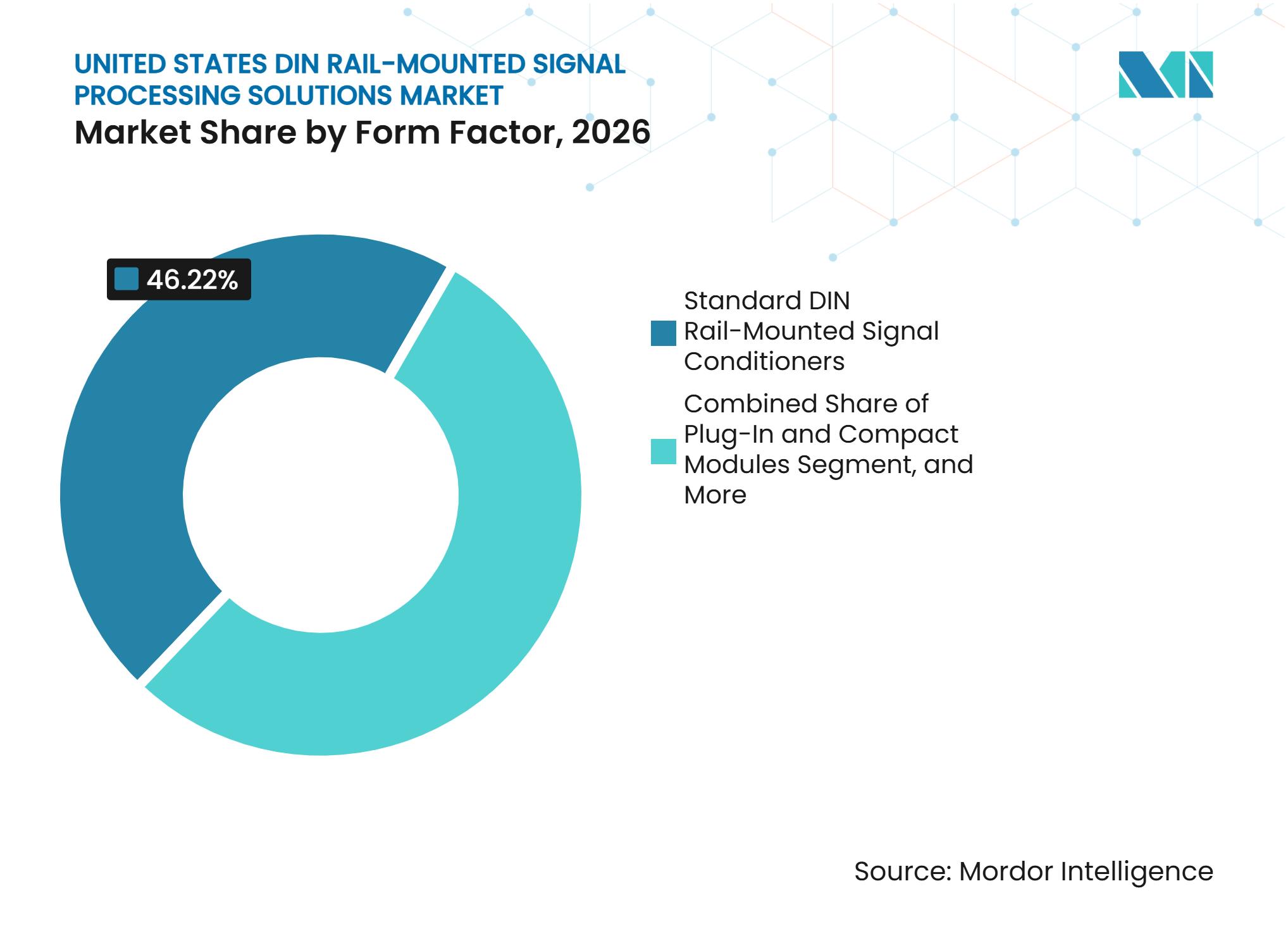
- By form factor, DIN rail-mounted modules held 46.22% of the United States DIN Rail-Mounted Signal Processing Solutions market revenue in 2026, while edge-connected DIN rail signal conditioners are projected to expand at a 7.86% CAGR through 2032.
- By signal and input type, 4-20 mA inputs held 24.31% of revenue share in 2026, while strain gauge, load cell, and bridge inputs are projected to expand at a 7.92% CAGR through 2032.
- By output signal, analog current accounted for 31.77% of revenue share in 2026, while HART-transparent and networked output is projected to expand at a 7.88% CAGR through 2032.
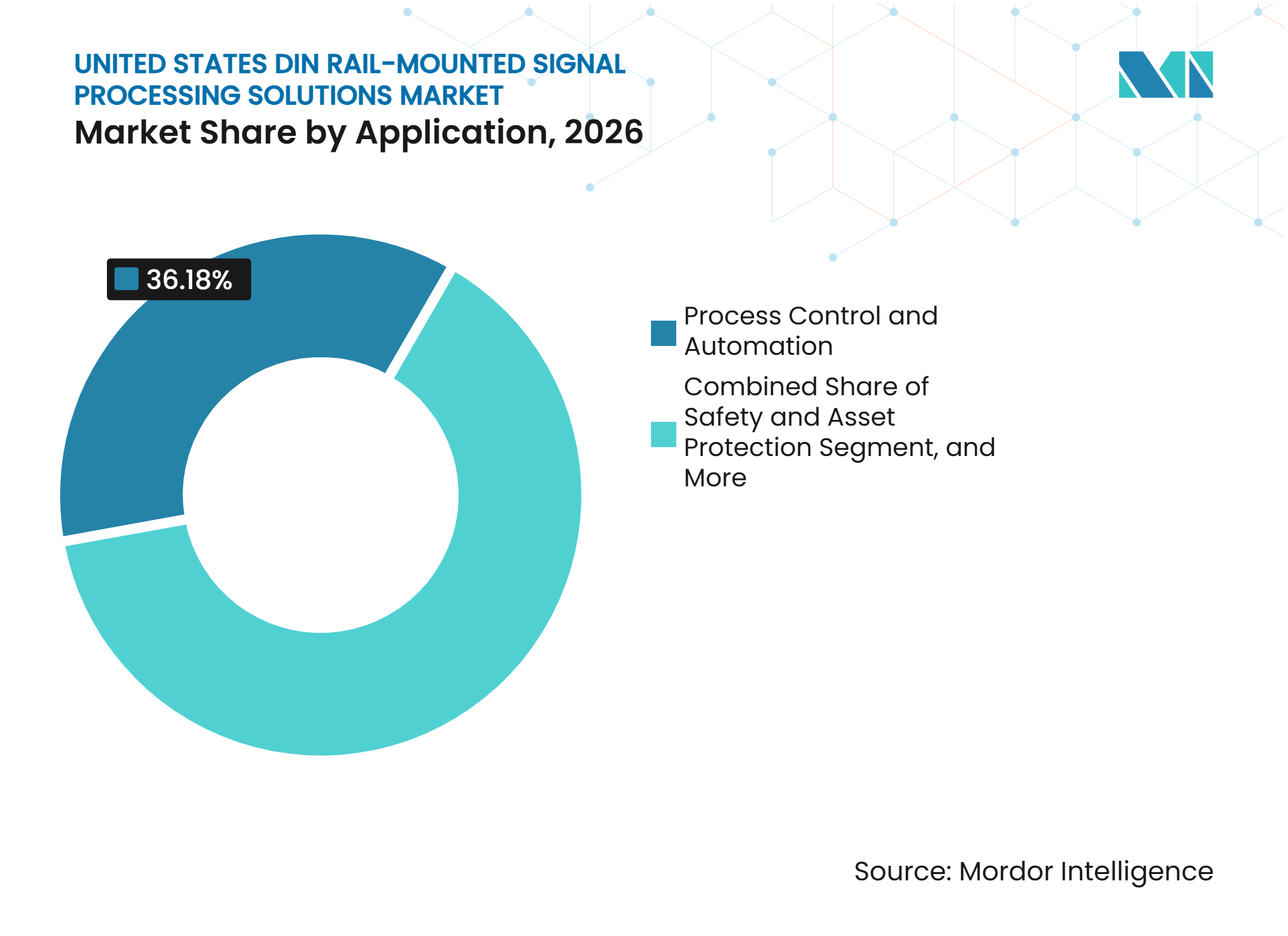
- By application, process control and automation accounted for 36.18% of revenue share in 2026, while condition monitoring and predictive maintenance is projected to expand at an 8.14% CAGR through 2032.
- By end-user industry, oil and gas held 23.44% of revenue share in 2026, while water and wastewater is projected to expand at an 8.23% CAGR through 2032.
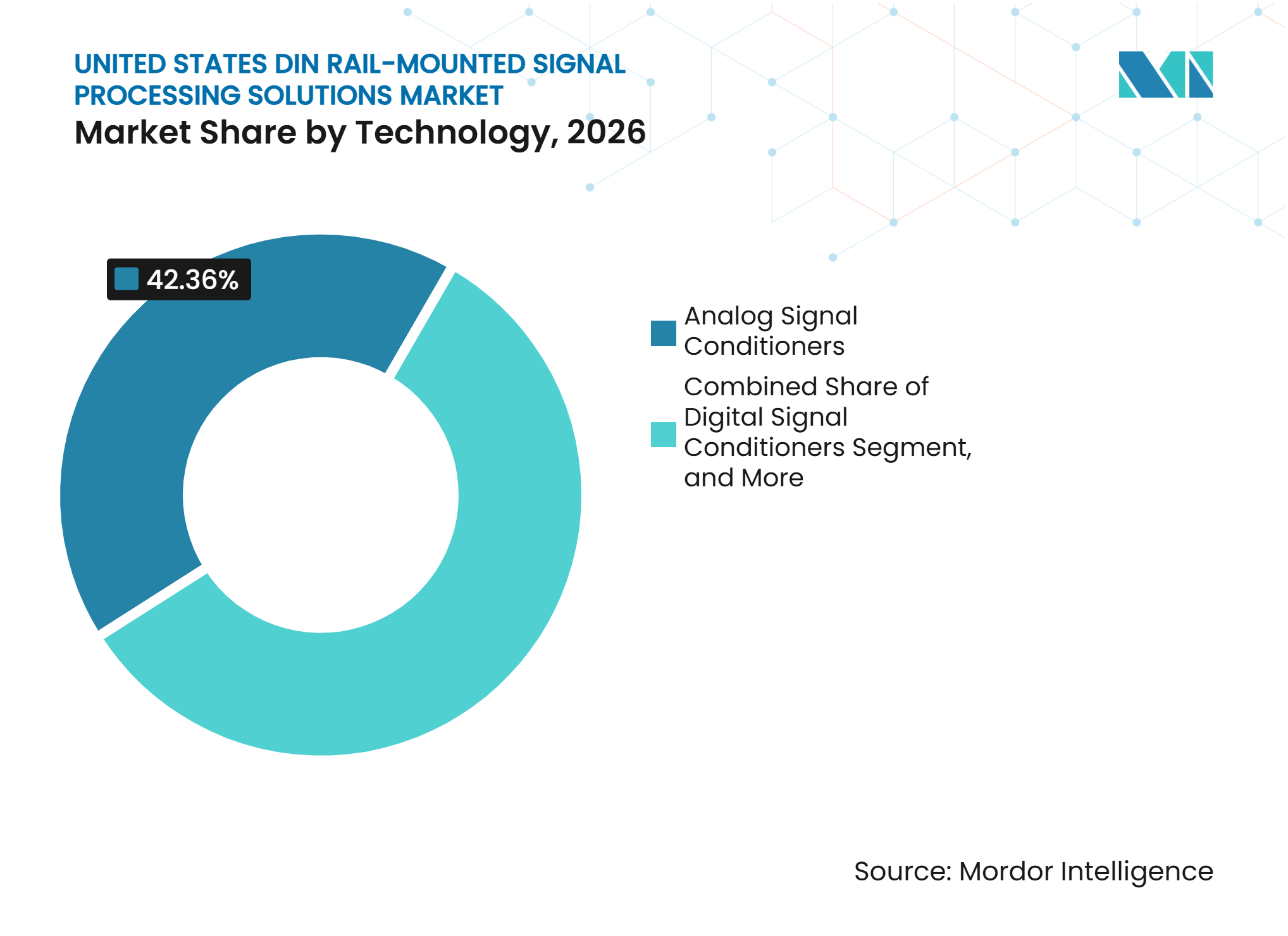
- By technology, analog signal conditioners held 42.36% of revenue share in 2026, while edge-connected and IIoT-enabled signal conditioners are projected to expand at an 8.17% CAGR through 2032.
- By safety and certification, general-purpose modules held 58.26% of the United States DIN Rail-Mounted Signal Processing Solutions market revenue share in 2026, while SIL-rated and functional-safety modules are projected to expand at an 8.26% CAGR through 2032.
Note: Market numbers in this report are based on Mordor Intelligence's proprietary estimation framework, which combines nine months of actuals with Q4 projections for base year 2026.
Market Trends and Insights
Drivers Impact Analysis of United States DIN Rail-Mounted Signal Processing Solutions Market*
| Driver | (~) % Impact on CAGR Forecast | Geographic Relevance | Impact Timeline |
|---|---|---|---|
| Industrial Automation and IIoT Adoption | +2.0% | National, with early gains in the Gulf Coast, Midwest Manufacturing Belt, and Pacific Northwest | Medium term (2-4 years) |
| Legacy PLC and DCS Modernization | +1.5% | National, concentrated in petrochemical, chemical, and power generation corridors | Medium term (2-4 years) |
| Rising Demand for Galvanic Isolation and Intrinsic Safety | +1.2% | National, with acute demand in Texas Gulf Coast, Louisiana, and Appalachian chemical clusters | Medium term (2-4 years) |
| Expansion of Condition Monitoring and Predictive Maintenance | +0.9% | National, with early adoption in automotive, food and beverage, and pharmaceutical facilities | Medium term (2-4 years) |
| Higher Signal Density in Retrofit Control Cabinets | +0.6% | National, concentrated in brownfield refinery and power generation assets | Short term (≤ 2 years) |
| Increased Use of Edge-Connected Signal Processing in Brownfield Plants | +0.5% | National, with early momentum in LNG export terminals and midstream pipeline facilities | Long term (≥ 4 years) |
| Source: Mordor Intelligence | |||
Industrial Automation and IIoT Adoption
Industrial automation is moving beyond limited trials at many United States manufacturers. Auburn University reported that 59% of manufacturers were implementing or actively using automation technologies in 2025, compared with 51% in 2022.[1] This shift creates demand for modules that connect legacy analog sensors to Ethernet-connected PLC and SCADA systems. Each connection point needs isolation and signal conversion where existing field wiring reaches updated control hardware. IIoT projects also add sensors to pumps, heat exchangers, and environmental equipment that were not previously monitored. The United States DIN Rail-Mounted Signal Processing Solutions market therefore gains from additional signal channels instead of only replacement demand.
Legacy PLC and DCS Modernization
Many industrial facilities are replacing control platforms installed in the 1990s and early 2000s. ABB designed its SDe Series to extend the life of Symphony Harmony, Symphony DIN, and INFI 90 systems while retaining established I/O architectures. This approach preserves existing field wiring and leaves room for new DIN rail modules that add HART transparency, signal duplication, or updated safety functions. Modernization can therefore expand the installed base of signal processing hardware rather than replace each existing module on a one-for-one basis. Rockwell Automation committed more than USD 2 billion to plants, digital infrastructure, and talent over 5 years in August 2025, with the United States as the primary beneficiary.[2] Such control-system spending supports related purchases in the United States DIN Rail-Mounted Signal Processing Solutions market during upgrade programs, including signal interfaces that retain proven field devices.
Rising Demand for Galvanic Isolation and Intrinsic Safety
Galvanic isolation has become a compliance need in many safety-instrumented system loops. ANSI/ISA-61511 and IEC 61508 guide the safety lifecycle and functional-safety requirements for electrical and electronic systems. Oil, gas, and chemical facilities need certified signal paths when a loop has a safety function. Phoenix Contact introduced the MINI Analog Pro Ex family in June 2025 with SIL 3 1oo1 certification, a 6.2 mm housing, and international hazardous-area approvals.[3] Product development of this type addresses a need for compact modules that meet functional-safety and explosion-protection requirements. Process hazard reviews can identify older uncertified loops that require component upgrades, supporting demand in the United States DIN Rail-Mounted Signal Processing Solutions market under ongoing operating permits.
Expansion of Condition Monitoring and Predictive Maintenance
Predictive maintenance adoption increased significantly among industrial manufacturers, according to a survey released by Fluke. Fluke also reported that unplanned downtime imposes substantial costs on United States manufacturers, with individual incidents generating significant hourly losses. Signal conditioners for strain gauges, vibration sensors, and temperature inputs provide the front-end data interface for plant monitoring systems. They convert millivolt or other sensor outputs into standard analog or digital signals that monitoring software can use. AssetWatch secured Series C funding to expand its condition monitoring platform. These deployments often instrument equipment for the first time, which expands the total module installation base within the United States DIN Rail-Mounted Signal Processing Solutions market.
Restraints Impact Analysis of United States DIN Rail-Mounted Signal Processing Solutions Market*
| Restraint | (~) % Impact on CAGR Forecast | Geographic Relevance | Impact Timeline |
|---|---|---|---|
| Price Competition From Integrated PLC Analog I/O | -0.8% | National, with strongest effect in discrete manufacturing and OEM machinery sectors | Short term (≤ 2 years) |
| Retrofit Integration and Qualification Complexity | -0.6% | National, with elevated friction in chemical and pharmaceutical facilities requiring full SIL loop validation | Medium term (2-4 years) |
| Limited Availability of Industrial Controls Engineering Talent | -0.4% | National, with acute shortages in rural refining and mining locations | Medium term (2-4 years) |
| Long Replacement Cycles in Continuous-Process Facilities | -0.3% | National, concentrated in petrochemicals and pulp and paper | Long term (≥ 4 years) |
| Source: Mordor Intelligence | |||
Price Competition From Integrated PLC Analog I/O
Modern PLC platforms increasingly include galvanic isolation and multichannel analog I/O within backplane modules. In nonhazardous discrete manufacturing, a PLC analog card can perform some functions historically served by a separate signal conditioner. Hardware, labor, documentation, cabinet space, and wiring costs can favor the integrated option. This pressure is strongest in OEM machinery, packaging, and factory automation, where system integrators seek lower component counts. Dedicated modules still retain an advantage where deep isolation, HART transparency, or hazardous-area certification is required. The narrow boundary between basic and critical loops nevertheless limits pricing power for general-purpose products in the United States DIN Rail-Mounted Signal Processing Solutions market.
Retrofit Integration and Qualification Complexity
Adding a module to a certified control loop can trigger a requalification process under IEC 61511. Operators may need updated process hazard analyses, safety requirement specifications, and functional-safety assessments before returning the loop to service. Management of Change procedures under OSHA process safety management requirements can add review and documentation work for each certified loop modification. This burden can extend project schedules and increase engineering costs for chemical and oil and gas operators. Fluke identified a lack of expertise and skilled labor among reported maintenance obstacles in its 2025 survey. Smaller process facilities are more exposed because they may not have functional-safety specialists in house.
*Our forecasts treat driver/restraint impacts as directional, not additive. The impact forecasts reflect baseline growth, mix effects, and variable interactions.
United States DIN Rail-Mounted Signal Processing Solutions Market Segment Analysis
By Form Factor:
DIN Rail Mounting Retains Cabinet Space AdvantageDIN rail-mounted modules held 46.22% of the United States DIN Rail-Mounted Signal Processing Solutions market share in 2026. Their leading position reflects a large installed base in refinery control rooms, water treatment SCADA panels, power plant marshaling cabinets, and other high-channel-count industrial panels. The 35 mm DIN rail standard enables fast, tool-free module replacement, which is important where maintenance teams must keep field wiring, terminal blocks, and control-cabinet layouts intact. Phoenix Contact, Pepperl+Fuchs, and Weidmüller modules can fit the same standard rail, giving panel builders flexibility in supplier selection and replacement planning. Rack and backplane-mounted modules remain relevant for larger DCS expansion projects where a fixed system architecture already governs module placement.
Edge-connected DIN rail signal conditioners are projected to expand at a 7.86% CAGR through 2032. These modules can place MQTT and OPC UA communication functions in conditioner firmware and send data to cloud historians without a separate gateway, creating a direct path between field signals and supervisory data systems. The approach is useful at remote LNG terminals and pipeline compressor stations because it reduces added hardware, installation work, and potential cyber exposure. Compact modules also help operators increase channel density in brownfield cabinets where a new enclosure is not practical. Form factor competition will continue to center on the balance between space efficiency, connectivity, lifecycle maintenance, and the ease of retaining existing panels.



By Signal and Input Type:
4-20 mA Anchors Demand, Strain Measurement AcceleratesThe 4-20 mA current loop segment held 24.31% of revenue within the United States DIN Rail-Mounted Signal Processing Solutions market in 2026. Its position reflects decades of use across United States process industries, where current loops remain valued for their stable transmission over long cable runs. Temperature inputs, including RTD and thermocouple signals, form another large installed base because continuous processes require close thermal control for yield, equipment protection, and operating safety. Frequency, pulse, and AC RMS inputs support flow measurement, machine status, and energy monitoring across industrial sites. LVDT, RVDT, and displacement signals remain important in precision machine and aerospace testing, while other input types support emerging sensing needs.
Strain gauge, load cell, and bridge inputs are projected to expand at a 7.92% CAGR through 2032. Chemical batching, materials handling, and food processing increasingly use continuous weighing data in automated control decisions, especially where material consistency and loss control are important. ANYLOAD introduced its ACT1 load cell conditioning transmitter in May 2025 with 24-bit A/D conversion, 4-20 mA and 0-10 V outputs, and Modbus RTU communication. Hybrid digital and analog interfaces allow a module to connect to a PLC or DCS card while also providing diagnostics for operators and maintenance personnel. This design reduces instrumentation footprint and makes force data more useful to asset managers across both legacy and modern control environments.
By Output Signal:
Analog Current Leads, HART-Networked Output OutpacesAnalog current output held 31.77% of revenue within the United States DIN Rail-Mounted Signal Processing Solutions market in 2026. The segment benefits from the large installed base of 4-20 mA receivers in industrial facilities, including DCS cards, PLC inputs, and remote I/O installations. Analog voltage output remains common in SCADA cards and data-acquisition systems that accept 0-10 V or 0-5 V signals. Digital, pulse, and frequency outputs support flow integrators, counter functions, and energy-monitoring relays where signal format must match downstream equipment. Relay and alarm outputs connect conditioner logic to discrete interlocks and annunciator panels used for operating alerts.
HART-transparent and networked output is projected to expand at a 7.88% CAGR through 2032. Operators use these interfaces to capture additional HART variables that conventional analog receivers do not use, including device information that can support asset diagnostics. Endress+Hauser reported that a significant share of assets in many plants had already become obsolete. HART gateways can translate field-device data into Modbus TCP, EtherNet/IP, or OPC UA for use across different control and information systems. The resulting architecture allows installed instruments to participate in IIoT monitoring without field hardware replacement or a full redesign of the existing signal path.
By Application:
Process Control Anchors Revenue, Condition Monitoring AcceleratesProcess control and automation accounted for 36.18% of the United States DIN Rail-Mounted Signal Processing Solutions market size in 2026. Refineries, chemical plants, and power stations use these modules between field transmitters and DCS analog input cards to isolate, convert, split, or relay signals. Data acquisition and test measurement support laboratory, quality control, and energy-management work where varied sensor types must connect to common analysis equipment. Safety and asset protection applications use SIL-certified modules in emergency shutdown and fire and gas systems that demand documented signal integrity. Energy and power-quality monitoring serves industrial grid management and renewable-energy integration at manufacturing facilities.
Condition monitoring and predictive maintenance is projected to expand at an 8.14% CAGR through 2032. Fluke reported that predictive maintenance adoption increased significantly among industrial manufacturers. The application relies on accurate front-end conversion of vibration, force, and temperature signals before maintenance software interprets them. Monitoring systems also add sensors to assets that have not been instrumented previously, including rotating equipment that received only periodic inspections. This broadens the demand base beyond replacing existing signal conditioners and supports incremental additions within operating facilities.

By End-User Industry:
Oil and Gas Leads, Water and Wastewater Grows FastestOil and gas held 23.44% of the United States DIN Rail-Mounted Signal Processing Solutions market share in 2026. Refinery marshalling panels, pipeline SCADA systems, and LNG terminal control rooms need galvanic isolation and intrinsic-safety certification because these facilities manage hazardous processes and widely distributed assets. Chemical and petrochemical sites share many of these needs and use high volumes of temperature inputs in reactor and distillation operations. Power generation uses thermocouples and RTDs, while food processing uses load cells and flow sensors that support measurement and batch control. Metals and mining facilities depend on vibration and strain monitoring for extraction, conveying, crushing, and material-handling equipment.
Water and wastewater is projected to expand at an 8.23% CAGR through 2032. The Infrastructure Investment and Jobs Act provided substantial funding for federal Clean Water and Drinking Water State Revolving Funds. These programs support SCADA and automation upgrades at treatment facilities, including integrating field sensors with control systems. Modernized plants need modules that connect level, flow, pressure, and treatment-process sensors to control equipment. Many utilities also need pre-engineered panel-ready assemblies because they have limited in-house signal-conditioning expertise, and procurement teams often favor standardized solutions.
By Technology:
Analog Technology Dominates, Edge IIoT Products Lead GrowthAnalog signal conditioners held 42.36% of revenue share in 2026. Continuous-process facilities often prefer proven single-function modules in safety-critical loops because configuration changes and unplanned behavior can create operational risk. Digital conditioners serve applications that need linearization, multivariable calculations, or protocol conversion beyond basic signal isolation. Hybrid modules combine analog precision with digital configuration and support retrofit projects that need diagnostics without full reinstrumentation. This technology mix allows facilities to modernize at the pace allowed by their installed control systems, maintenance practices, and certification obligations.
Edge-connected and IIoT-enabled signal conditioners are projected to expand at an 8.17% CAGR through 2032. They enable engineers to use data held in legacy 4-20 mA loops through Ethernet, MQTT, or OPC UA communication, rather than leaving it only within local control circuits. Yokogawa received the first process-industry certification to the O-PAS OPC UA profile in April 2026. The certification supports open architectures that can reduce dependence on a single automation ecosystem and facilitate cross-vendor integration. It also provides a standards basis for deploying connected signal processing modules in mixed DCS and PLC environments common in brownfield plants.
By Safety and Certification:
General-Purpose Leads, SIL-Rated Modules AccelerateGeneral-purpose modules held 58.26% of revenue within the United States DIN Rail-Mounted Signal Processing Solutions market in 2026. Most applications operate in nonhazardous locations and do not require ATEX or SIL certification, particularly in general manufacturing and standard utility control panels. Intrinsically safe and hazardous-area modules serve oil, gas, chemical, and pharmaceutical facilities that must meet NEC Article 505 or division-classification requirements. Marine and transportation-approved products serve naval shipbuilding, offshore platforms, and rail control applications where installation environments impose separate approval needs. The certification mix reflects the different risk profiles, engineering standards, and documentation demands of industrial operating environments.
SIL-rated and functional-safety modules are projected to expand at an 8.26% CAGR through 2032. The application of ANSI/ISA-61511 to older process loops is increasing attention to certified signal paths. Phoenix Contact launched the SIL 3 1oo1 MINI Analog Pro Ex family in a 6.2 mm housing in June 2025. Compact certified modules can reduce the rail space needed in high-density cabinets while combining functional safety with intrinsic-safety protection. This is especially relevant in brownfield retrofits where panel space is limited, and operators seek to improve a loop without expanding the control room.
Competitive Landscape
Market Concentration
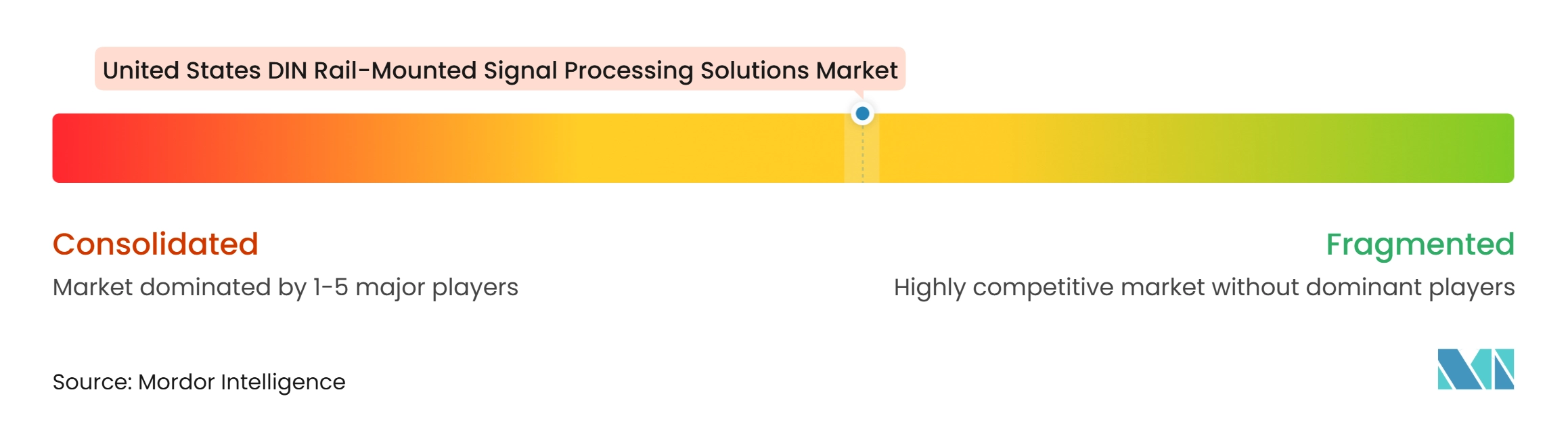
The United States DIN Rail-Mounted Signal Processing Solutions market has moderate concentration. Phoenix Contact, Pepperl+Fuchs, Weidmüller, Siemens, Schneider Electric, Rockwell Automation, OMEGA Engineering, Dataforth, and Moore Industries-International are among the active suppliers. Suppliers differentiate through power rail designs, hazardous-area approvals, configuration tools, and application support. Safety certification and digital connectivity now matter more than small differences in analog precision for many industrial uses. Phoenix Contact's MACX Analog range has undergone NAMUR NE95 type testing, which supports its positioning in process-industry applications. The opportunity for suppliers is to provide preassembled and prevalidated SIL-certified assemblies that lower the qualification workload for smaller process operators.
Smaller United States specialists compete through local support, available inventory, and cost in test and measurement, data acquisition, and energy-monitoring applications. These suppliers can be more competitive where a broad hazardous-area portfolio is not the main selection criterion. Edge connectivity is becoming a major competitive area because it links signal conditioning to wider digital automation architectures. Yokogawa's O-PAS-certified open architecture is one example of a strategic move toward interoperable automation systems. Rockwell Automation introduced the LogixEdge controller at Automation Fair 2026 to combine IT and OT workloads on a single platform. These offerings blur the line between a standalone conditioner and intelligent I/O.
Multi-vendor interoperability is also becoming more practical for process applications. Endress+Hauser reported the results of a May 2026 multi-vendor Ethernet-APL scalability test involving Yokogawa, Endress+Hauser, Samson, R. Stahl, Softing, Phoenix Contact, and Pepperl+Fuchs. Greater confidence in mixed-vendor networks could reduce dependence on a single supplier in future automation projects. Suppliers will need to support open protocols while maintaining the certification depth required for safety-critical loops. Price competition remains strongest in general-purpose applications where integrated PLC I/O can replace a dedicated module. Hazardous-area and functional-safety products remain more defensible because certification, documentation, and qualification requirements increase switching costs. A market concentration score cannot be assigned on the specified scale because the draft does not provide the combined market share of leading suppliers.
United States DIN Rail-Mounted Signal Processing Solutions Industry Leaders
-
Siemens AG
-
Phoenix Contact GmbH & Co. KG
-
ABB Ltd
-
Yokogawa Electric Corporation
-
WAGO Kontakttechnik GmbH & Co. KG
- *Disclaimer: Major Players sorted in no particular order
United States DIN Rail-Mounted Signal Processing Solutions Market Companies Covered in this Report
- Phoenix Contact GmbH & Co. KG
- Siemens AG
- ABB Ltd
- Yokogawa Electric Corporation
- WAGO Kontakttechnik GmbH & Co. KG
- Pepperl+Fuchs SE
- Rockwell Automation, Inc.
- Weidmuller Interface GmbH & Co. KG
- Schneider Electric SE
- OMEGA Engineering, Inc.
- Acromag, Inc.
- PR electronics A/S
- M-System Co., Ltd.
- Dataforth Corporation
- Moore Industries-International, Inc.
- Turck Inc. (Hans Turck GmbH & Co. KG)
- Red Lion Controls, Inc.
- R. Stahl AG
- Advantech Co., Ltd.
- Analog Devices, Inc.
Recent Industry Developments in United States DIN Rail-Mounted Signal Processing Solutions Market
- November 2026: Rockwell Automation unveiled the LogixEdge controller at Automation Fair 2026, integrating IT and OT workloads on a single platform with AI-capable autonomous control, extending the company's signal chain architecture into edge-native industrial applications. The launch represents a material shift in how process signals are conditioned and routed at the point of acquisition, positioning Rockwell's ecosystem to absorb signal processing functions previously handled by standalone DIN rail modules.
- October 2026: Pepperl+Fuchs introduced new surge protection modules for signal, fieldbus, and Ethernet lines in the process industry, available as plug-in modules for the K-System DIN rail portfolio. The modules extend protection to both analog signal lines and industrial communication networks within a single rail-mounted system, reducing panel component count for facilities operating hybrid analog-digital signal architectures.
- June 2026: Endress+Hauser, in collaboration with Covestro, BASF, and Yokogawa, confirmed large-scale Ethernet-APL scalability in a multi-vendor process automation environment during testing at Reinach, Switzerland. The validation specifically integrated Yokogawa CENTUM VP DCS and Plant Resource Manager with Ethernet-APL-connected field instruments and DIN rail signal processing devices from multiple vendors, establishing a commercially relevant reference architecture for open field communication.
- April 2026: Yokogawa Electric Corporation obtained the first industry certification to the O-PAS standard's OPC UA profile for its OpreX Open Automation SI Kit, confirmed by the OPC Foundation. The certification enables Yokogawa-based signal processing modules to participate as interoperable components in vendor-neutral open process automation systems, a milestone relevant to United States oil and gas and chemical end users evaluating open automation architectures.
United States DIN Rail-Mounted Signal Processing Solutions Market Report Scope
The United States DIN Rail-Mounted Signal Processing Solutions Market refers to the national market for compact, modular electronic devices, signal conditioners, isolators, transmitters, converters, splitters, and limit alarms designed to be snap-mounted on standard 35 mm DIN rails within industrial control cabinets, automation panels, and process control systems across the U.S.
The United States DIN Rail-Mounted Signal Processing Solutions Market Report is Segmented by Form Factor (DIN Rail-Mounted Modules, Rack and Backplane-Mounted Modules, Stand-Alone and Panel Modules, and Plug-In and Compact Modules), Signal and Input Type (Temperature Inputs (RTD Inputs and Thermocouple Inputs), Process Voltage and Current Inputs (4-20 mA Inputs and 0-10 V and Related Standard Analog Inputs), Frequency, Pulse, and AC RMS Inputs, Strain Gauge, Load Cell, and Bridge Inputs, LVDT, RVDT, and Displacement Inputs, and Other Signal and Input Types), Output Signal (Analog Current Output, Analog Voltage Output, Digital, Pulse, and Frequency Output, Relay and Alarm Output, and HART-Transparent and Networked Output), Application (Data Acquisition and Test Measurement, Process Control and Automation, Condition Monitoring and Predictive Maintenance, Energy and Power-Quality Monitoring, and Safety and Asset Protection), End-User Industry (Oil and Gas, Chemical and Petrochemical, Water and Wastewater, Power Generation and Utilities, Including Renewable Energy, Food and Beverage, Metals and Mining, and Other End-User Industries), Technology (Analog Signal Conditioners, Digital Signal Conditioners, Hybrid Signal Conditioners, and Edge-Connected and IIoT-Enabled Signal Conditioners), and Safety and Certification (General-Purpose Modules, Intrinsically Safe and Hazardous-Area Modules, SIL-Rated and Functional-Safety Modules, and Marine- and Transportation-Approved Modules). The Market Forecasts Are Provided in Terms of Value (USD).
Segmentation Overview
| DIN Rail-Mounted Modules |
| Rack and Backplane-Mounted Modules |
| Stand-Alone and Panel Modules |
| Plug-In and Compact Modules |
| Temperature Inputs | RTD Inputs |
| Thermocouple Inputs | |
| Process Voltage and Current Inputs | 4-20 mA Inputs |
| 0-10 V and Related Standard Analog Inputs | |
| Frequency, Pulse and AC RMS Inputs | |
| Strain Gauge, Load Cell and Bridge Inputs | |
| LVDT, RVDT and Displacement Inputs | |
| Other Signal and Input Types |
| Analog Current Output |
| Analog Voltage Output |
| Digital, Pulse and Frequency Output |
| Relay and Alarm Output |
| HART-Transparent and Networked Output |
| Data Acquisition and Test Measurement |
| Process Control and Automation |
| Condition Monitoring and Predictive Maintenance |
| Energy and Power-Quality Monitoring |
| Safety and Asset Protection |
| Oil and Gas |
| Chemical and Petrochemical |
| Water and Wastewater |
| Power Generation and Utilities, Including Renewable Energy |
| Food and Beverage |
| Metals and Mining |
| Other End-User Industries |
| Analog Signal Conditioners |
| Digital Signal Conditioners |
| Hybrid Signal Conditioners |
| Edge-Connected and IIoT-Enabled Signal Conditioners |
| General-Purpose Modules |
| Intrinsically Safe and Hazardous-Area Modules |
| SIL-Rated and Functional-Safety Modules |
| Marine- and Transportation-Approved Modules |
| By Form Factor | DIN Rail-Mounted Modules | |
| Rack and Backplane-Mounted Modules | ||
| Stand-Alone and Panel Modules | ||
| Plug-In and Compact Modules | ||
| By Signal and Input Type | Temperature Inputs | RTD Inputs |
| Thermocouple Inputs | ||
| Process Voltage and Current Inputs | 4-20 mA Inputs | |
| 0-10 V and Related Standard Analog Inputs | ||
| Frequency, Pulse and AC RMS Inputs | ||
| Strain Gauge, Load Cell and Bridge Inputs | ||
| LVDT, RVDT and Displacement Inputs | ||
| Other Signal and Input Types | ||
| By Output Signal | Analog Current Output | |
| Analog Voltage Output | ||
| Digital, Pulse and Frequency Output | ||
| Relay and Alarm Output | ||
| HART-Transparent and Networked Output | ||
| By Application | Data Acquisition and Test Measurement | |
| Process Control and Automation | ||
| Condition Monitoring and Predictive Maintenance | ||
| Energy and Power-Quality Monitoring | ||
| Safety and Asset Protection | ||
| By End-User Industry | Oil and Gas | |
| Chemical and Petrochemical | ||
| Water and Wastewater | ||
| Power Generation and Utilities, Including Renewable Energy | ||
| Food and Beverage | ||
| Metals and Mining | ||
| Other End-User Industries | ||
| By Technology | Analog Signal Conditioners | |
| Digital Signal Conditioners | ||
| Hybrid Signal Conditioners | ||
| Edge-Connected and IIoT-Enabled Signal Conditioners | ||
| By Safety and Certification | General-Purpose Modules | |
| Intrinsically Safe and Hazardous-Area Modules | ||
| SIL-Rated and Functional-Safety Modules | ||
| Marine- and Transportation-Approved Modules | ||
Key Questions Answered in the Report
What is the size of the United States DIN Rail-Mounted Signal Processing Solutions market?
The market is valued at USD 0.21 billion in 2026 and is forecast to reach USD 0.33 billion by 2032, at a 7.42% CAGR during 2027-2032.
Which form factor has the largest share in United States DIN rail signal processing solutions?
DIN rail-mounted modules lead the form factor category with a 46.22% share in 2026 because they fit established 35 mm control-panel rails.
What application is expected to expand fastest through 2032?
Condition monitoring and predictive maintenance is projected to expand at an 8.14% CAGR through 2032 as plants add sensors to previously unmonitored equipment.
Why are SIL-rated signal conditioners becoming more important?
SIL-rated and functional-safety modules are projected to expand at an 8.26% CAGR through 2032 as operators apply ANSI/ISA-61511 and IEC 61508 requirements to process loops.
Which end-user sector creates the largest demand for these solutions?
Oil and gas leads end-user demand with a 23.44% share in 2026 because refinery, pipeline, and LNG operations require isolation and hazardous-area certification.
How do HART-enabled conditioners support industrial modernization?
They capture diagnostic data from existing HART-compatible transmitters and enable integration with modern monitoring systems without replacing field wiring.