
United States Container Homes Market Size and Share
Market Overview
| Study Period | 2021 - 2032 |
|---|---|
| Forecast Data Period | 2027 - 2032 |
| Base Year Market Size (2026) | USD 21.94 Billion |
| Market Size (2027) | USD 23.31 Billion |
| Market Size (2032) | USD 31.56 Billion |
| Growth Rate (2027 - 2032) | 6.25 % |
| Market Concentration | Low |
Major Players *Disclaimer: Major Players sorted in no particular order Image © Mordor Intelligence. Reuse requires attribution under CC BY 4.0. | |
United States Container Homes Market Analysis by Mordor Intelligence
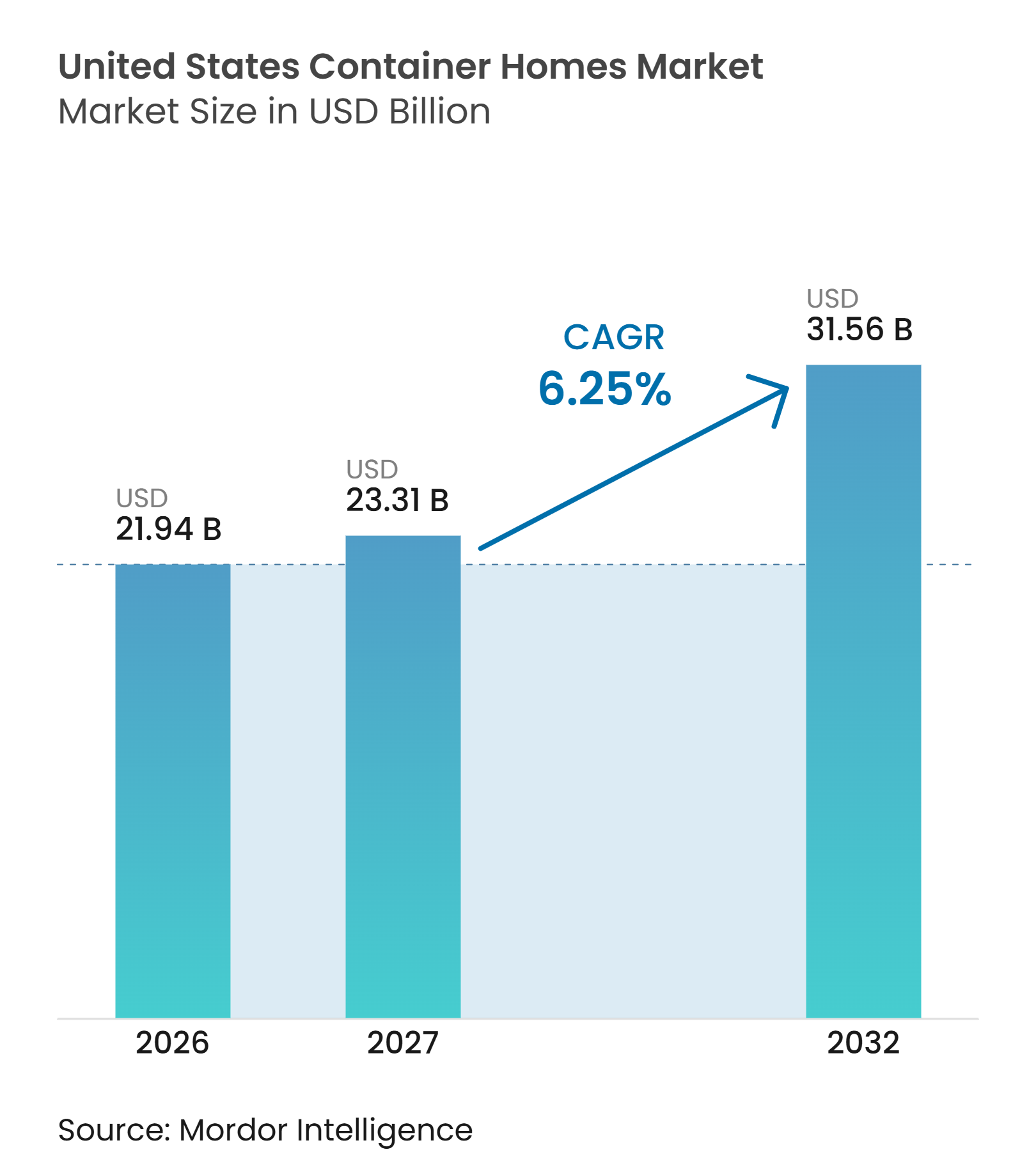
The United States container homes market size was valued at USD 21.94 billion in 2026 and is estimated to grow from USD 23.31 billion in 2027 to reach USD 31.56 billion by 2032, at a CAGR of 6.25% during the forecast period (2027-2032).
Rising housing costs are widening interest in alternatives to conventional construction, particularly where land and labor costs make smaller homes difficult to finance. Accessory dwelling unit (ADU) reforms are opening a clearer route for units placed on existing residential lots. Factory production is also gaining relevance because it can reduce on-site work and give buyers a more standardized product. Disaster recovery programs add a separate source of demand where speed of delivery carries more weight than customization. Growth is still limited by local permitting differences, mortgage qualification rules, and insurance costs that can reduce the affordability benefit for households.
Key Report Takeaways
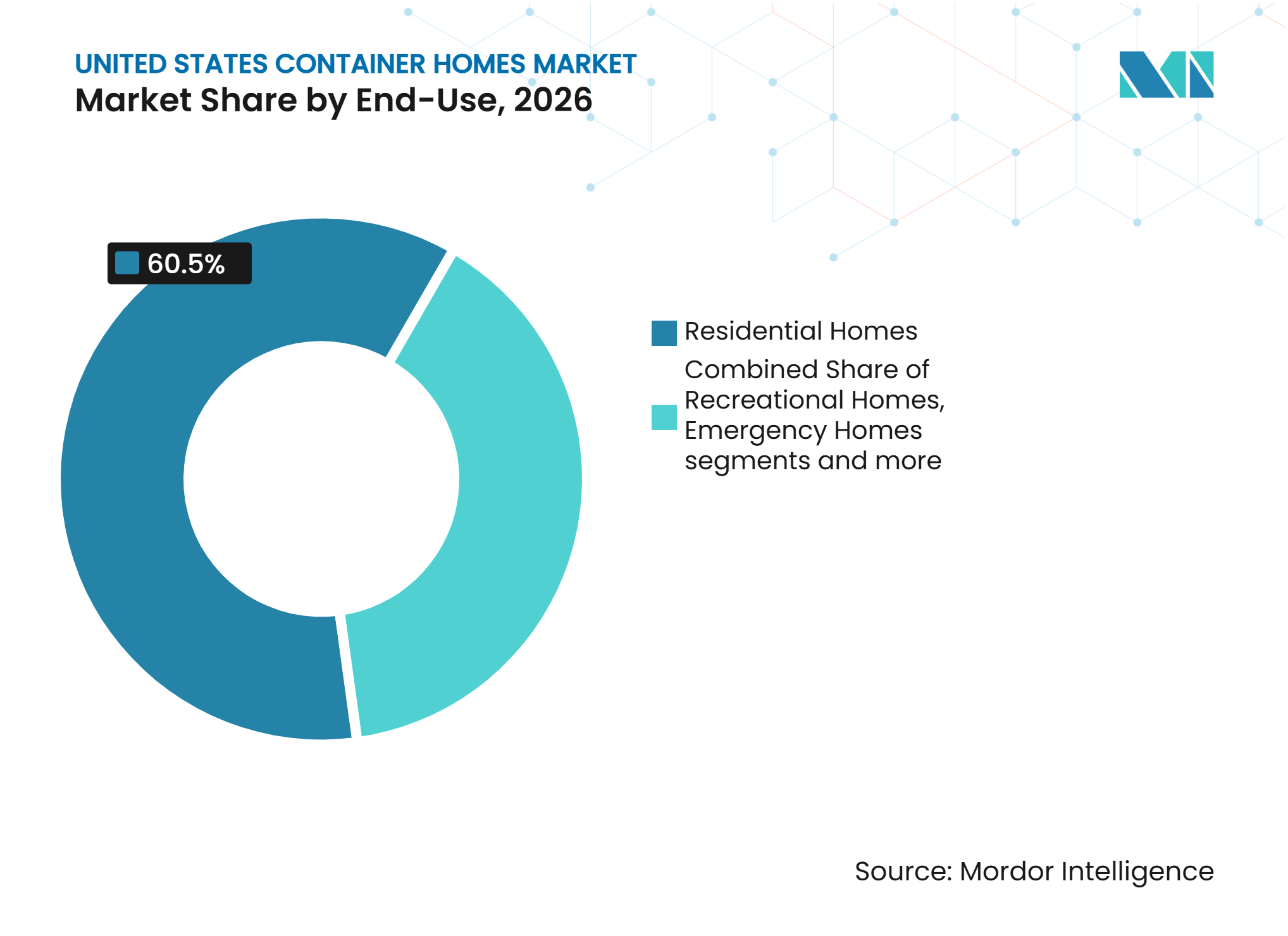
- By end-use, residential homes held 60.5% of the United States container homes market share in 2026, while emergency homes are forecast to grow at a 7.6% CAGR through 2032.
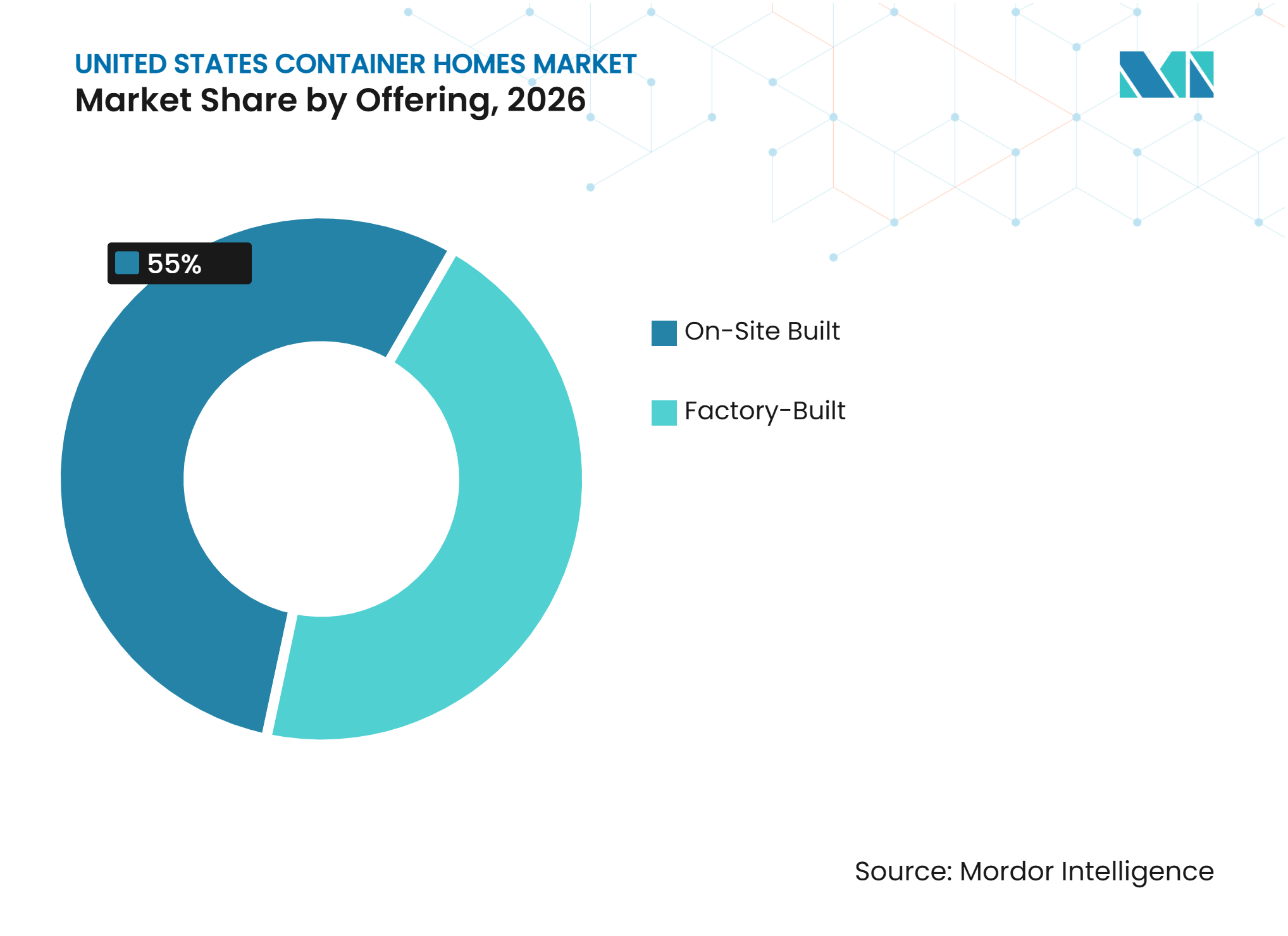
- On-site built configurations accounted for 55% of the United States container homes market size in 2026, while factory-built units are projected to advance at a 7.05% CAGR through 2032.
- By construction type, fixed structures captured 59.8% of the United States container homes market share in 2026, while movable configurations are forecast to expand at a 7.5% CAGR through 2032.
- By State, Texas held 18.5% of the United States container homes market size in 2026, while California is projected to grow at a 7.1% CAGR through 2032.
Note: Market numbers in this report are based on Mordor Intelligence's proprietary estimation framework, which combines nine months of actuals with Q4 projections for base year 2026.
Market Trends and Insights
Drivers Impact Analysis of United States Container Homes Market*
| Drivers | (~) % Impact on CAGR Forecast | Geographic Relevance | Impact Timeline |
|---|---|---|---|
| Rising Housing Costs and Affordability Pressure | +2.5% | National, most acute in Texas, California, New York, and Florida | Short term (≤ 2 years) |
| ADU Policy Reform and Residential-Lot Intensification | +1.8% | National, with highest relevance in California, Texas, Washington, and Arizona | Medium term (2-4 years) |
| Expansion of Permanent Modular Construction | +1.2% | National, with early gains in the Western United States and Mid-Atlantic | Medium term (2-4 years) |
| Wildfire and Hurricane Recovery Housing | +0.7% | California, the Texas Gulf Coast, Florida, and the Pacific Northwest | Short term (≤ 2 years) |
| Sustainability and Circular Use of Steel Containers | +0.5% | National, with spillover into Pacific Coast states | Long term (≥ 4 years) |
| Source: Mordor Intelligence | |||
Rising Housing Costs and Affordability Pressure
Housing affordability is the strongest demand factor for the United States container homes industry. Turnkey container homes in Texas range from USD 95,000 to USD 250,000, while new conventional construction in major Texas metro areas approaches USD 400,000 to USD 550,000. This difference can reduce the capital required for smaller homes and lower the exposure to extended on-site labor schedules. The pressure is most visible in California, Texas, New York, and Florida, where conventional construction costs and housing demand are both high. The 21st Century ROAD to Housing Act includes a Federal Housing Administration, or FHA, pilot for mortgages of USD 100,000 or less, which addresses a financing gap for lower-cost housing formats. It may improve access for qualified buyers if lending rules and local approvals allow container-based homes to meet program requirements.
ADU Policy Reform and Residential-Lot Intensification
ADU reforms are creating a more direct route for the United States container homes market to serve homeowners with unused lot capacity. As of August 2026, 22 states had adopted ADU preemption laws, and 4 additional states passed new laws during 2026. The new state laws permit development by right, which means a special review process is not required when a proposal meets stated conditions. Jurisdictions with permissive ADU rules issued more than 11 times as many permits per 100,000 residents as jurisdictions with restrictive rules. A factory-built 40-foot container unit can be deployed as a code-compliant ADU in 60 to 90 days after permit issuance. BOXABL obtained state-level approvals in 6 states during 2026, while the International Code Council provides municipalities with guidance on ADUs and industrialized off-site construction[1].
Expansion of Permanent Modular Construction
The broader permanent modular construction base supports the United States container homes industry by building factory capacity and more familiar approval pathways. Factory production can reduce on-site construction timelines by 20% to 50% compared with conventional building methods[2]. State modular certification programs also allow inspections and insignia to be completed before units leave the factory. These processes can give lenders and insurers a more consistent record than individually customized site-built work. Cleveland selected MMY US to revive the Wellman-Seaver-Morgan Engineering facility as a modular plant, targeting up to 3 homes per day with a capital stack nearing USD 26 million[3].
Wildfire and Hurricane Recovery Housing
Wildfire and hurricane recovery are expanding an institutional use case for the United States container homes market. When households are displaced, procurement decisions focus on speed, transport, and basic habitability. ReMo Homes received statewide preapproval in California during 2026 for wildfire rebuilds, and its all-electric SupReMo model was listed in the Los Angeles County Pre-Approved Standard Plan Catalog. The unit is certified for High Fire Hazard Severity Zone requirements, which can reduce the time needed to begin a qualifying rebuild. BOXABL also deployed a Casita unit in Pasadena, California, for Altadena wildfire relief.
Restraints Impact Analysis of United States Container Homes Market*
| Restraints | (~) % Impact on CAGR Forecast | Geographic Relevance | Impact Timeline |
|---|---|---|---|
| Fragmented Local Zoning, Permitting, and Code Interpretation | -2.0% | National, most acute in Northeastern states and California unincorporated areas | Long term (≥ 4 years) |
| Limited Mortgage, Insurance, and Appraisal Infrastructure | -1.3% | National, most pronounced in markets with low container home transaction density | Medium term (2-4 years) |
| High Site-Work, Transport, and Skilled-Labor Costs | -0.8% | National, most severe in remote, dense urban, and coastal markets | Short term (≤ 2 years) |
| Hurricane, Cold-Climate, and Corrosion Performance Requirements | -0.5% | Gulf Coast, Southeast, Pacific Northwest coastal zones, and Upper Midwest | Long-term (≥ 4 years) |
| Source: Mordor Intelligence | |||
Fragmented Local Zoning, Permitting, and Code Interpretation
Local regulation remains a major constraint on the United States container homes market. No state law bans container homes, but the absence of a statewide ban does not create a local permitting route. Zoning rules, building code requirements, and homeowners association covenants can each apply to the same proposal. Illinois has no statewide residential building code, while Pennsylvania has more than 2,500 municipalities that set their own zoning ordinances. California's 2025 Building Standards Code, effective January 1, 2026, requires structural reports, field-weld inspection, and condition assessment for container conversions in Los Angeles. These requirements increase documentation, time, and cost for smaller builders and individual buyers.
Limited Mortgage, Insurance, and Appraisal Infrastructure
Financial infrastructure does not yet match the potential demand for the United States container homes market. Fannie Mae, Freddie Mac, the FHA, and the Department of Veterans Affairs (VA) require permanent foundations for mortgage eligibility. Many container configurations can meet that condition, but foundation decisions must be made early in the project. Comparable sales data remains limited in many markets, making conventional appraisals difficult to complete. Insurance premiums are estimated at 10% to 20% above those for a comparable stick-built home, adding to the cost of ownership. These limits place the greatest burden on first-time and middle-income buyers, who are also the buyers most likely to seek a lower-cost housing option.
*Our forecasts treat driver/restraint impacts as directional, not additive. The impact forecasts reflect baseline growth, mix effects, and variable interactions.
United States Container Homes Market Segment Analysis
By Offering:
On-Site Construction Dominates, While Factory-Built Production Gains MomentumOn-site built configurations held 55% of the United States container homes market size in 2026. Buyers use this approach when site-specific design, local contractor access, and phased conversion are more important than production standardization. It allows owners to adapt a raw container to a particular lot, utility arrangement, or household need. The model also suits markets where local builders understand local permitting practices. Its volume position reflects the continued importance of custom residential projects. It can, however, expose buyers to different labor availability, inspection practices, and project schedules from one locality to another.
Factory-built units are forecast to expand at a 7.05% CAGR through 2032. Their growth reflects the ability to complete more work under controlled factory conditions and reduce on-site timelines by 20% to 50%. State modular programs can also provide inspection insignia before a unit leaves a plant. BOXABL launched its Phase 2 catalog in June 2026 with more than 20 home configurations using 3 standardized modules. This approach moves the offering toward configurable products instead of a single-unit format. Factory certification may become more important as lenders and insurers look for more consistent documentation.


By Construction Type:
Fixed Structures Retain Demand While Movable Units Serve Institutional NeedsFixed structures held 59.8% of market share in 2026. Most permanent residential installations require foundations, utility connections, and building permits. Fixed designs can better align with conventional mortgage requirements when they use permanent foundations. That alignment protects their volume position among buyers seeking long-term residences. The construction type also matches common use on private lots and within established residential settings. It remains dependent on zoning acceptance and site preparation, which differ widely across jurisdictions.
Movable configurations are projected to grow at a 7.5% CAGR through 2032. They are used for emergency housing, workforce accommodations, and development projects that need units deployed across more than one location. BOXABL's Build with BOXABL model uses standardized relocatable units for hospitality and affordable housing projects. The Modular Building Institute describes the relocatable sector as moving toward leasing, reuse, and refurbishment models. This changes the role of a unit from a temporary expense to an asset that can be used more than once. The model is particularly relevant where speed and flexibility are valued more highly than permanent financing eligibility.
By End-Use:
Residential Homes Form the Core While Emergency Homes ExpandResidential homes accounted for a 60.5% share in 2026. Primary housing remains the central source of demand, rather than recreational or specialized applications. Single-container studio units range from USD 20,000 to USD 80,000, while 960- to 1,600-square-foot multi-container homes range from USD 80,000 to USD 250,000. These price ranges support interest from buyers who need smaller homes or more flexible construction choices. Residential projects can also use container units as ADUs on existing lots where local rules permit them. LEED Silver and Gold certifications achieved by some projects in California and Texas can support buyer confidence in professionally designed units.
Emergency homes are forecast to post the highest end-use growth at a 7.6% CAGR through 2032. FEMA's Direct Temporary Housing Program and state disaster recovery frameworks provide the relevant institutional context for this demand. Recreational homes also have a role in Colorado, Montana, and other leisure-destination states, where faster installation can be useful for vacation settings. Nursing home applications remain limited, but container buildings are appearing in workforce and assisted-living site plans in underserved rural areas. The common need across these uses is a structure that can be delivered and installed more quickly than conventional construction. The United States container homes industry therefore serves both household-led demand and specific institutional procurement needs.


Geography Analysis
Texas
Texas held 18.5% of the United States container homes market share in 2026. Land availability, a large homeowning population, and less restrictive county-level conditions outside major metro areas support activity in the state. Austin, Dallas-Fort Worth, and Houston face rising conventional construction costs, which have increased interest in steel-frame alternatives. Turnkey container homes in Texas range from USD 95,000 to USD 250,000. BOXABL received approval to sell and deploy the Casita Studio statewide in May 2026. Texas, California, and Washington together account for more than 62% of national ADU permits, supporting an additional channel for units placed on residential lots.
California
California is forecast to expand at a 7.1% CAGR through 2032. The state requires ministerial approval for qualifying ADUs within 60 days, limits setbacks to 4 feet, and exempts units below 750 square feet from impact fees. These provisions support container-based ADU projects where the proposal meets applicable conditions. The 2025 California Building Standards Code took effect on January 1, 2026, and applies requirements under International Building Code Section 3114 to shipping containers repurposed as buildings. ReMo Homes received statewide approval for modular wildfire rebuilds in 2026, including certification for High Fire Hazard Severity Zone requirements. Los Angeles still requires structural reports, weld testing, and deputy inspection, creating a higher compliance standard that established factory builders can use to differentiate their offer.
Florida, New York, Illinois, and Rest of United States
Florida's demand centers on hurricane-resilient steel modular structures and affordable housing needs. The Neighborhood Center of West Volusia announced a USD 1 million project in DeLand to convert shipping containers into 8 affordable homes for people transitioning out of homelessness. New York adopted its 2025 Building Code and Residential Code on December 31, 2025, based on the 2024 International Codes. New York City Local Laws 126 and 127 of 2024 add sprinkler and density requirements for ADU projects, which can increase costs in dense neighborhoods. Illinois has no statewide residential code, leading to different conditions between rural, suburban, and Cook County locations. Cook County's modular homes pilot offers up to USD 75,000 in assistance to qualifying buyers, showing a public-interest route for factory-built homes. These states show that the United States container homes industry depends on local building rules, climate conditions, and the availability of public or institutional support.
Competitive Landscape
Market Concentration
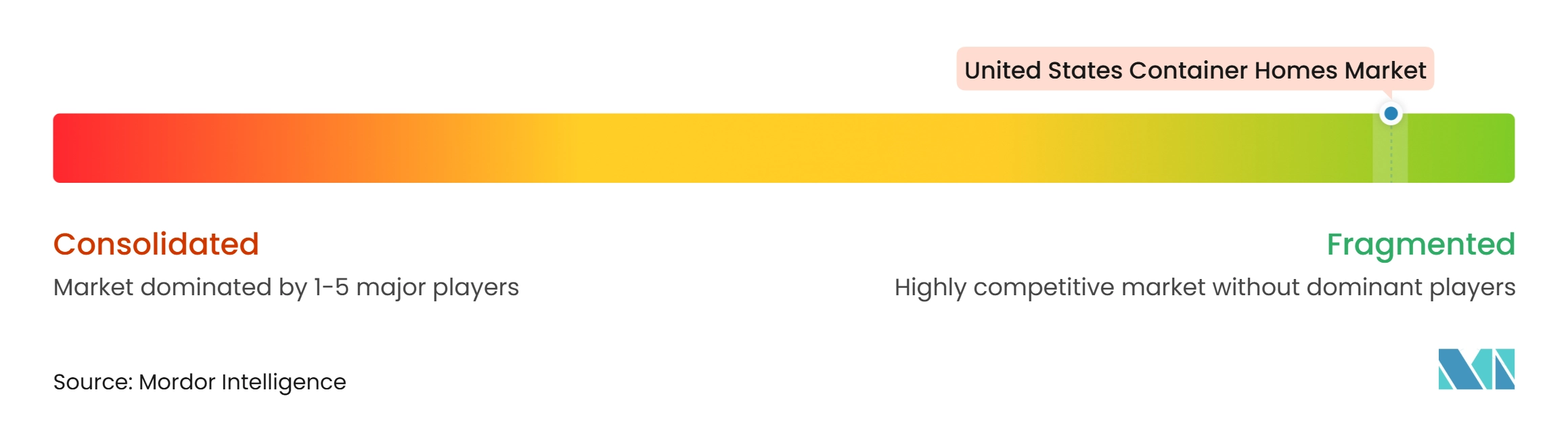
The United States container homes market is fragmented because no single company has a dominant position across residential, emergency, and recreational uses. Boxabl, MODS International, Custom Container Living, Backcountry Containers, and Olenox Industries Inc. compete through customization, regional experience, delivery timing, and specialized project capability. MODS International combines commercial and residential work with a comprehensive warranty program. Backcountry Containers has developed a position in rural and off-grid projects in Texas and the Southwest. These companies serve different project types rather than operating under one standardized national model. The breadth of local rules gives regional builders an advantage when local permitting knowledge is important.
BOXABL became a public company in July 2026 after its business combination with FG Merger II Corp. and began trading on Nasdaq under the symbol BXBL. The transaction gives the company access to public capital for manufacturing scale and state approval work. Filed patents cover its folding module system, while its Phase 2 platform offers configurations for ADUs, single-family homes, townhomes, garden apartments, workforce housing, and HUD-compliant homes. The company signed a multi-year agreement in November 2026 with LC Vegas Acquisitions for up to 1,500 factory-built homes. That agreement provides a potential channel into larger residential development projects. Regional builders without similar factory capacity or product range may face greater pressure in standardized applications.
Technology and production models are becoming more relevant to competitive positioning. Ghost Factory converts shipping containers into mobile cold-formed steel factories using recycled United States metals. This model extends industrialized production beyond a single fixed plant. Mid-income family homes of 1,200 to 1,800 square feet and multi-unit affordable housing remain open areas for companies that can combine stacking designs with state modular certification. International Code Council Guideline G5-2019 provides a nonmandatory framework for repurposed shipping containers. Manufacturers with documented compliance can be better positioned for institutional buyers that specify certified factory-built products.
United States Container Homes Industry Leaders
-
Boxabl
-
MODS International
-
Custom Container Living
-
Backcountry Containers
-
Olenox Industries Inc
- *Disclaimer: Major Players sorted in no particular order
United States Container Homes Market Companies Covered in this Report
- Olenox Industries Inc
- Boxabl
- MODS International
- Custom Container Living
- Backcountry Containers
- Alternative Living Spaces
- Rhino Cubed
- Stackhouse Container Homes
- CargoHome
- SteelBlox
- Relevant Buildings
- Bob's Containers
- SI Container Builds
- Pivot Structures
- Met Company
- Conex Modular
- CHOMEX
- Steele House
- Falcon Structures
- IndieDwell
Recent Industry Developments in United States Container Homes Market
- November 2026: BOXABL Inc. signed a multi-year purchase agreement with LC Vegas Acquisitions for up to 1,500 factory-built homes over approximately 3 years, representing the company's largest announced residential purchase arrangement to date. The developer, with experience involving thousands of residential units and over USD 1 billion in real estate development, provides BOXABL with a potential channel for scaling its modular housing platform into large residential projects.
- February 2026: Olenox Industries Inc. announced that its subsidiary, Giant Containers, was selected to design and build critical infrastructure and community amenities for the Newark segment of New Jersey's newest state park, a 9-mile greenway connecting 8 communities in Essex and Hudson counties.
- January 2026: Safe & Green Holdings Corp. announced its rebranding to Olenox Industries, consolidating subsidiaries, including Giant Containers, into a unified energy and infrastructure platform. It also began manufacturing a modular enclosure under contract at its Conroe, Texas, facility for a global industrial equipment manufacturer.
United States Container Homes Market Report Scope
Segmentation Overview
| Factory-Built |
| On-Site Built |
| Fixed |
| Movable |
| Residential Homes |
| Recreational Homes |
| Emergency Homes |
| Nursing Homes |
| Texas |
| California |
| Florida |
| New York |
| Illinois |
| Rest of United States |
| By Offering | Factory-Built |
| On-Site Built | |
| By Construction Type | Fixed |
| Movable | |
| By End-Use | Residential Homes |
| Recreational Homes | |
| Emergency Homes | |
| Nursing Homes | |
| By State | Texas |
| California | |
| Florida | |
| New York | |
| Illinois | |
| Rest of United States |
Key Questions Answered in the Report
What is the projected value of the United States container homes market by 2032?
The United States container homes market is forecast to reach USD 31.56 billion by 2032, growing at a 6.25% CAGR from 2027.
Which end use has the greatest demand for container homes in the United States?
Residential homes lead demand with a 60.5% share in 2026, while emergency homes have the fastest projected growth at a 7.6% CAGR.
Why are factory-built container homes gaining traction?
Factory-built units are forecast to grow at a 7.05% CAGR because controlled production can reduce on-site timelines and support standardized certification.
Which state has the largest share of container home demand?
Texas leads with an 18.5% share in 2026, supported by land availability, a large homeowning population, and more permissive conditions in many counties.
Which state is expected to grow fastest for container homes?
California is forecast to grow at a 7.1% CAGR through 2032, supported by ADU rules and post-wildfire rebuilding needs.
What are the main barriers to container home adoption?
Local zoning rules, limited comparable sales for appraisal, permanent-foundation requirements, insurance costs, and site-work expenses remain key barriers.