
United States Construction Project Management Services Market Size and Share
Market Overview
| Study Period | 2021 - 2032 |
|---|---|
| Forecast Data Period | 2027 - 2032 |
| Base Year Market Size (2026) | USD 182.70 Billion |
| Market Size (2027) | USD 190.40 Billion |
| Market Size (2032) | USD 233.90 Billion |
| Growth Rate (2027 - 2032) | 4.20 % |
| Market Concentration | Low |
Major Players *Disclaimer: Major Players sorted in no particular order Image © Mordor Intelligence. Reuse requires attribution under CC BY 4.0. | |
United States Construction Project Management Services Market Analysis by Mordor Intelligence
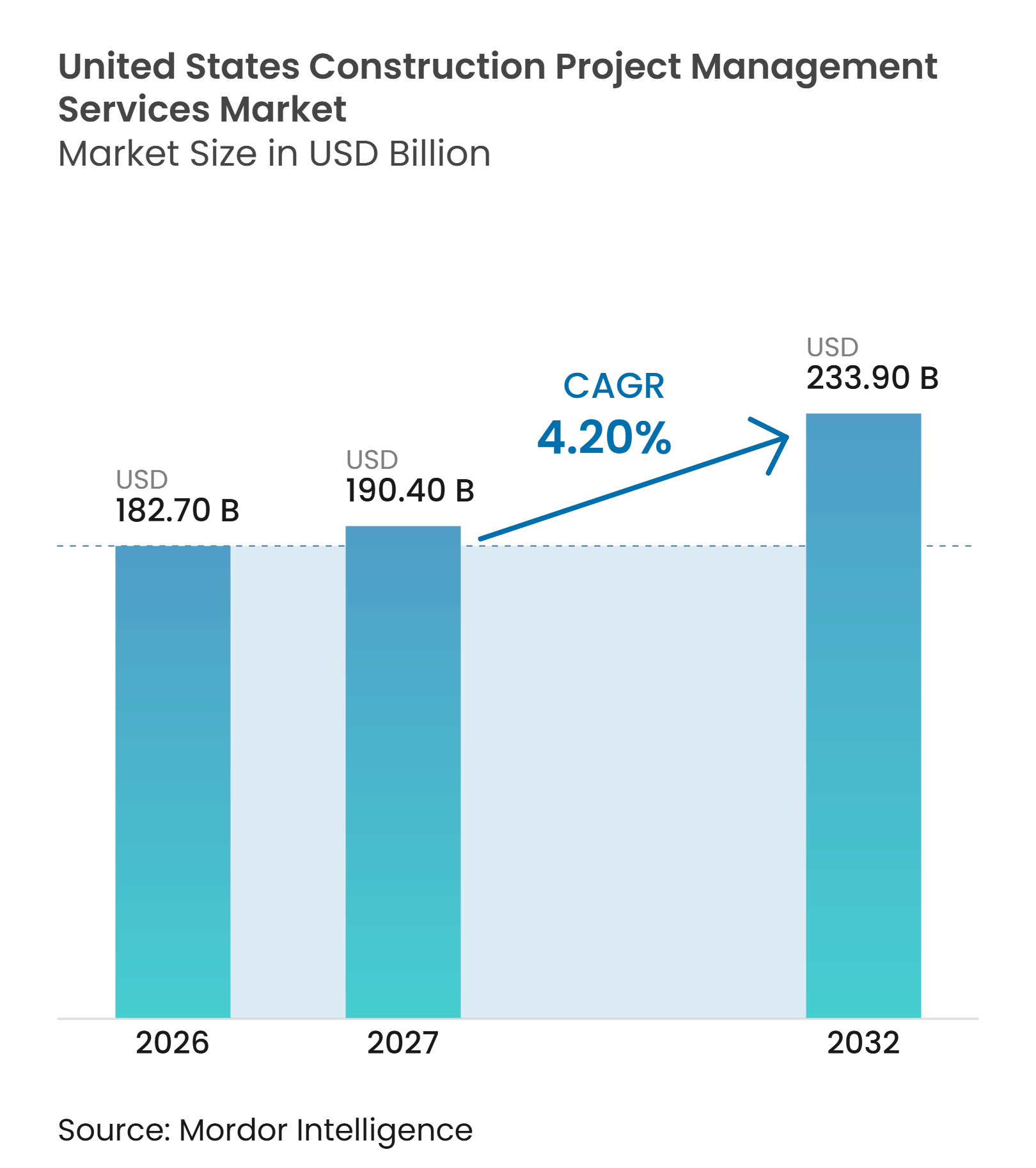
The United States Construction Project Management Services Market size is projected to expand from USD 182.70 billion in 2026 and USD 190.40 billion in 2027 to USD 233.90 billion by 2032, registering a CAGR of 4.20% between 2027 and 2032.
Federal infrastructure programs, advanced manufacturing facilities, and digital infrastructure projects are increasing the need for independent oversight. Owners are using external program managers when their internal teams cannot manage several large projects at the same time. The United States construction project management services market benefits when projects require more detailed procurement, scheduling, compliance, and risk controls. This demand favors firms that can manage programs from early planning through construction and commissioning. Higher material costs and constrained financing may delay some private projects. Still, public infrastructure, power, semiconductor, and data center work continue to support the United States construction project management services industry.
Key Report Takeaways
- By service type, project and program management held 43.0% of the United States construction project management services market share in 2026 and is projected to grow at an 8.20% CAGR through 2032.
- By project type, infrastructure construction accounted for 34.0% of the United States construction project management services market size in 2026, while industrial construction is forecast to advance at a 9.40% CAGR through 2032.
- By service delivery mode, on-site project management held 58.0% of the United States construction project management services market size in 2026, while remote project management is forecast to expand at an 11.20% CAGR through 2032.
- By geography, the Rest of United States accounted for 45.66% of the United States construction project management services market size in 2026, while Texas is forecast to grow at an 8.90% CAGR through 2032.
Note: Market numbers in this report are based on Mordor Intelligence's proprietary estimation framework, which combines nine months of actuals with Q4 projections for base year 2026.
Market Trends and Insights
Drivers Impact Analysis of United States Construction Project Management Services Market*
| Drivers | (~) % Impact on CAGR Forecast | Geographic Relevance | Impact Timeline |
|---|---|---|---|
| Hyperscale data center and artificial intelligence campus build-outs | +2.0% | National, strongest in Texas, Virginia, Illinois, and California | Short term (≤ 2 years) |
| Federal infrastructure funding under the Infrastructure Investment and Jobs Act | +1.8% | National, with early gains in Texas, New York, California, and Florida | Medium term (2-4 years) |
| Semiconductor fabrication and advanced manufacturing megaprojects | +1.3% | Texas, New York, Arizona, Ohio, and Indiana | Medium term (2-4 years) |
| Grid modernization and power-generation investment | +0.9% | National, with substantial activity in Texas | Long term (≥ 4 years) |
| Alternative delivery models requiring owner representation | +0.7% | National, especially states with progressive public procurement rules | Medium term (2-4 years) |
| Shortage of owner-side capital program talent | +0.5% | National, with pressure in the Northeast and South | Medium term (2-4 years) |
| Source: Mordor Intelligence | |||
Hyperscale Data Center and Artificial Intelligence Campus Build-Outs
Data center projects require close coordination across civil works, power systems, mechanical equipment, and information technology infrastructure. The United States construction project management services market gains work when developers deliver several buildings and utility connections at the same time. Such programs need project managers early because owners must align contractors, permits, equipment orders, and site preparation before construction begins. The scale of these assignments also encourages firms to establish dedicated client teams instead of bidding for isolated engagements. This work is particularly valuable where project schedules are compressed, and disruptions can postpone the start of construction operations.
Federal Infrastructure Funding Under the Infrastructure Investment and Jobs Act
The Infrastructure Investment and Jobs Act, known as the IIJA, continues to support a substantial public-project pipeline. The Government Accountability Office reported in July 2026 that federal agencies had obligated 76% of IIJA funds for fiscal years 2022 through 2025 and disbursed 54% of those obligations[1]. The difference between obligations and spending highlights ongoing construction oversight needs as projects move from award to execution. Buy America rules and Davis-Bacon prevailing wage requirements add documentation and contract-management work for owners and their representatives. The United States construction project management services industry therefore benefits from longer project oversight periods on federally supported programs.
Semiconductor Fabrication and Advanced Manufacturing Megaprojects
Semiconductor projects require close management because facility construction and commissioning requirements are demanding. These programs involve cleanrooms, specialized utility systems, supplier coordination, and strict operating standards. ISO 14644 is a cleanroom standard that is relevant to projects where contamination controls affect the facility design and commissioning process. Project managers with experience in commissioning, procurement, and industrial controls are better placed to support owners through delivery. This specialized work supports demand for providers that understand the operating needs of advanced manufacturing facilities.
Grid Modernization and Power-Generation Investment
Power utilities are expanding transmission, distribution, and generation assets as electricity demand rises. Large capital programs require sequencing of equipment purchases, permitting, construction, and system testing. Long lead times for transformers and turbines make procurement sequencing important to the project schedule. This gives project managers a larger role in tracking equipment, managing risks, and coordinating construction with supply delivery. The United States construction project management services industry has an opening where utilities require outside support for programs that were previously handled by internal engineering teams.
Restraints Impact Analysis of United States Construction Project Management Services Market*
| Restraints | (~) % Impact on CAGR Forecast | Geographic Relevance | Impact Timeline |
|---|---|---|---|
| Tariff-driven material cost volatility and schedule delays | -1.4% | National, with exposure in metal- and energy-intensive projects | Short term (≤ 2 years) |
| Elevated interest rates dampening commercial and residential starts | -1.0% | National, with the greatest pressure in coastal commercial real estate markets | Medium term (2-4 years) |
| Construction labor shortages | -0.8% | National, strongest in Texas, New York, Indiana, and Ohio | Medium term (2-4 years) |
| Professional liability exposure and fee pressure on standardized assignments | -0.3% | National, concentrated in high-claim urban markets | Long term (≥ 4 years) |
| Source: Mordor Intelligence | |||
Tariff-Driven Material Cost Volatility and Schedule Delays
Material cost changes can cause owners to postpone, scale back, or reprice projects. The producer price index for inputs to new nonresidential construction rose 8.90% from August 2025 to August 2026, while steel mill products rose 23.4%, aluminum mill shapes rose 27.3%, and diesel fuel rose 77.8%[2]. An Associated General Contractors of America survey found that 55% of respondents had projects canceled, postponed, or scaled back in the preceding 6 months. Project managers can gain additional cost-control work during this period, but fixed-fee engagements may face greater risk. Continued price instability can narrow the pipeline of projects that move from planning into construction.
Elevated Interest Rates Dampening Commercial and Residential Starts
Higher borrowing costs continue to affect projects that depend on private financing. The American Institute of Architects reported that nonresidential building spending fell 2% in 2025, as higher borrowing costs, labor constraints, and material costs reduced activity[3]. Public infrastructure, energy, and large industrial programs provide a partial offset to this pressure. However, project management firms with substantial exposure to speculative office, multifamily, and commercial work can face lower fees and weaker new-business activity. Recovery in these private segments depends on financing conditions and developer confidence.
*Our forecasts treat driver/restraint impacts as directional, not additive. The impact forecasts reflect baseline growth, mix effects, and variable interactions.
United States Construction Project Management Services Market Segment Analysis
By Service Type:
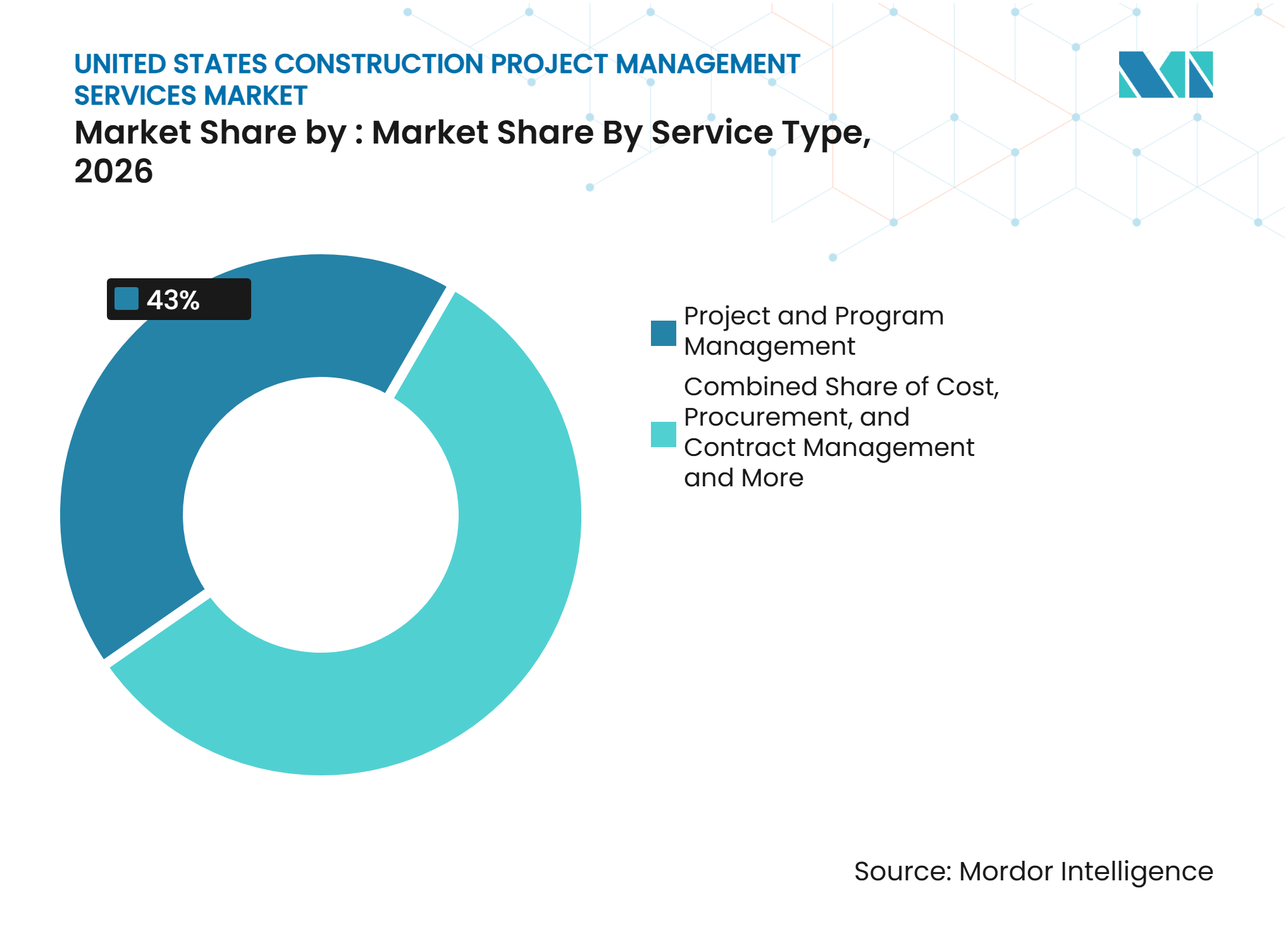
Project and Program Management Leads Client EngagementsProject and program management held 43.0% of the United States construction project management services market share in 2026, making it the largest service type. Owners use this service when they need one team to coordinate budgets, schedules, procurement, risk, and reporting across a group of related projects. The segment also has the fastest forecast growth among service types, with an 8.20% CAGR through 2032. This combination indicates that clients are increasingly assigning governance responsibility at the program level instead of contracting separately for narrow project tasks. The United States construction project management services market for this service grows when IIJA, semiconductor, and utility owners need consistent controls across large capital plans.
Cost, procurement, and contract management remain important for owners that want focused support without giving an external provider full responsibility for program governance. Construction Supervision and Quality Management serves projects where field checks, testing, and documentation are central to delivery. Semiconductor facilities, cleanrooms, and high-capacity data centers need close coordination because failures during construction or commissioning can affect operational readiness. Other Project Management Services include owner representation, commissioning support, and schedule analysis for claims. The Design-Build Institute of America and Project Management Institute certification practices can influence public-sector evaluations because they give agencies a clearer basis for assessing staff capability.



By Project Type:
Infrastructure Holds the Largest Base While Industrial Work Gains SpeedInfrastructure construction accounted for 34.0% of the United States construction project management services market size in 2026. Transportation, water, broadband, and energy projects create steady need for planning, procurement, construction supervision, and closeout support. Public agencies often use owner representatives because they need added capacity to manage complex programs and federal requirements. The IIJA supports this need by funding projects that continue through several stages of development. The largest segment remains tied to long public procurement cycles and ongoing compliance requirements.
Industrial construction is the fastest-growing project type, with a 9.40% CAGR forecast through 2032. Semiconductor plants, pharmaceutical facilities, advanced battery projects, and related supplier sites require specialized management across design, equipment procurement, construction, and commissioning. These facilities have different needs from conventional commercial properties because mechanical, electrical, and process systems must work together before production begins. Industrial owners need clear accountability across contractors and equipment suppliers to protect project schedules. Commercial project management demand remains more exposed to financing conditions, while residential work faces pressure from higher mortgage rates and material costs.
By Service Delivery Mode:
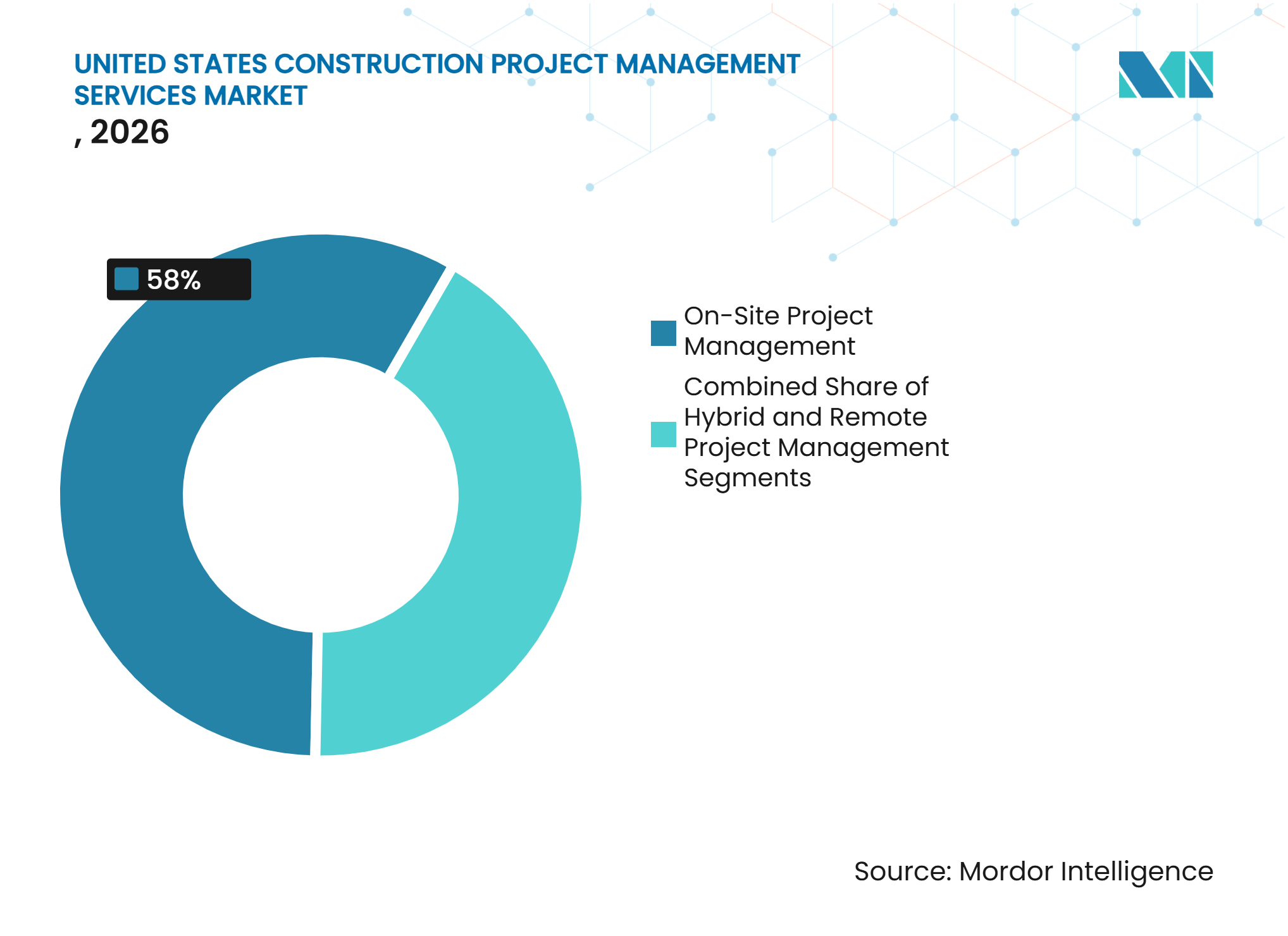
On-Site Project Management Leads, While Remote Project Management Gains TractionOn-site project management held 58.0% of the United States construction project management services market share in 2026. Field presence remains necessary for projects that require inspection, safety coordination, contractor management, and rapid decisions on site. Semiconductor plants, transmission corridors, infrastructure programs, and power facilities often require an owner representative to be physically present. The service mode supports direct communication among the owner, contractor, design team, and regulators. It also helps resolve issues before they affect the construction schedule or quality standards.
Remote project management is the fastest-growing service delivery mode, with an 11.20% CAGR forecast through 2032. The Federal Highway Administration made up to USD 34 million available in fiscal year 2026 grants for Advanced Digital Construction Management Systems, known as ADCMS, to support technology adoption by transportation agencies. Cloud-based project controls, shared document systems, and digital schedule reviews allow teams to monitor parts of a program from centralized locations. Hybrid delivery combines continuous remote monitoring with planned site visits and is useful for dispersed highway, pipeline, and transmission programs. This model can help providers allocate experienced staff across more than 1 project while preserving field oversight where it is required.

Geography Analysis
Rest of United States
The rest of the United States held 45.66% of the United States construction project management services market share in 2026. The category covers a wide group of states with active transportation, water, broadband, industrial, and power projects. This spread reduces reliance on a single state-level spending cycle. State departments of transportation can use digital tools and external teams as their project load expands. The Federal Highway Administration is supporting this shift through fiscal year 2026 ADCMS grants for state and local agencies. The program encourages modern project controls and better data sharing across public works. Compliance requirements under federal funding also increase the need for documentation and reporting. The region gives providers opportunities to combine national practices with local project knowledge.
Texas
Texas is forecast to expand at an 8.90% CAGR through 2032 in the United States construction project management services market. The state’s transport, semiconductor, data center, and power projects create a major delivery pipeline. These programs add pressure to the supply of qualified project staff. The state’s power grid operator is the Electric Reliability Council of Texas, commonly known as ERCOT. Its electricity system is important because digital and manufacturing projects need power infrastructure before operations can begin. Project managers are increasingly needed to coordinate long-lead equipment, contractors, and utility connections. Public procurement requirements and federal funding rules remain relevant where programs use public money.
California, Florida, New York, and Illinois
California, Florida, New York, and Illinois create complex assignments across transit, resilience, life sciences, semiconductor, and data center projects. California’s demand is linked to transit modernization, semiconductor-adjacent manufacturing, and life sciences facilities. Florida combines population growth, tourism assets, and hurricane resilience work. New York has large transportation and semiconductor programs that require detailed coordination among public agencies, contractors, and utilities. Illinois benefits from dense urban infrastructure and data center activity. These states face different permitting, labor, and public procurement conditions, which makes local knowledge important. Digital project controls are becoming more important as owners seek timely reporting across large and complex programs.
Competitive Landscape
Market Concentration
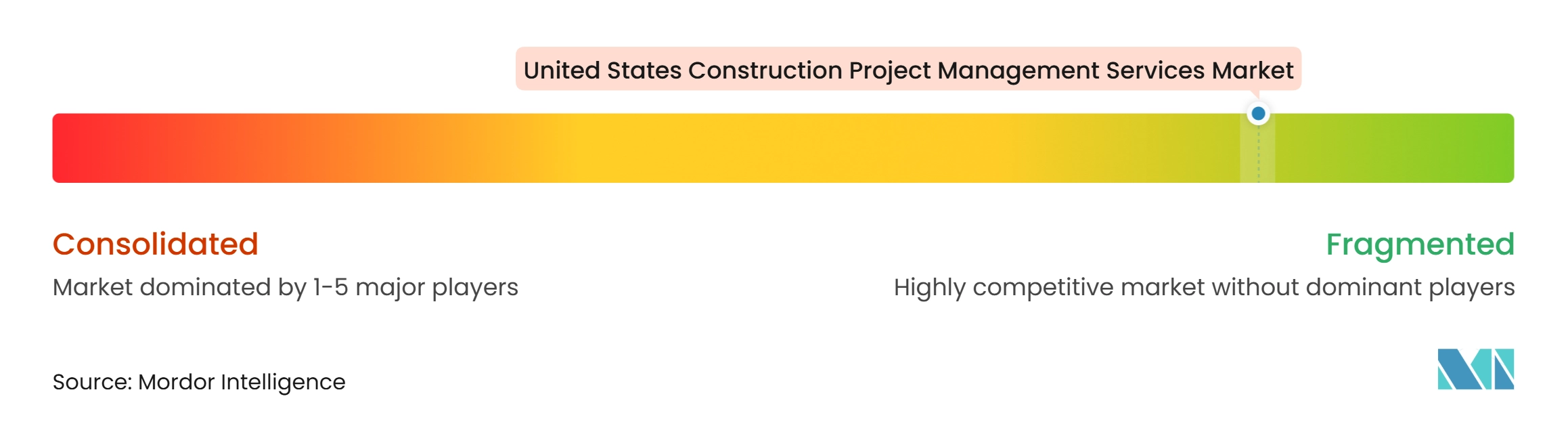
The United States construction project management services market is fragmented in nature. AECOM, Jacobs Solutions Inc., Bechtel Corporation, Parsons Corporation, Hill International, Inc., and Turner Construction Company compete for major program governance assignments. At the same time, regional firms and specialized cost managers serve smaller programs. Competition is based on sector experience, geographic reach, technical capability, and the ability to staff projects quickly. Larger firms can offer broad engineering, planning, and program management resources. Specialized firms can compete when they have strong client relationships or narrow expertise in cost control, commissioning, or owner representation. The United States construction project management services market also attracts investment because project management services do not require the same balance-sheet commitment as general contracting.
Consolidation is shaping how providers build capability and scale. Leonard Green & Partners acquired Cumming Group in June 2026, supporting the growth of a project and cost management platform with more than 4,000 clients. Bernhard Capital Partners completed the acquisition of Bowman Consulting Group in November 2026. These transactions show that investors see value in firms with national coverage and exposure to infrastructure, energy, and industrial construction. Jacobs also completed its acquisition of the remaining equity stake in PA Consulting for USD 1.6 billion in March 2026, extending its advisory and technology capabilities. Firms are using acquisitions to add technical talent, digital capability, and access to new client groups.
Technology is becoming a basic requirement rather than a separate selling point. In October 2026, Accenture acquired Avicado, a digital project management consultancy focused on connected project controls. Building Information Modeling, known as BIM, supports coordinated digital representations of project assets. Artificial intelligence, known as AI, can help teams review schedules and identify potential delivery risks, but client teams still require experienced judgment. The ADCMS program further supports digital adoption by public agencies. Providers that combine technology with trusted on-site and owner-side experience are likely to be more competitive in complex programs.
United States Construction Project Management Services Industry Leaders
-
AECOM
-
Jacobs Solutions Inc.
-
Turner Construction Company
-
Bechtel Corporation
-
Fluor Corporation
- *Disclaimer: Major Players sorted in no particular order
United States Construction Project Management Services Market Companies Covered in this Report
- AECOM
- Jacobs Solutions Inc.
- Turner Construction Company
- Bechtel Corporation
- Fluor Corporation
- CBRE Group, Inc. (incl. Turner & Townsend)
- Jones Lang LaSalle Incorporated (JLL Project and Development Services)
- Hill International, Inc.
- Parsons Corporation
- HDR, Inc.
- Stantec Inc.
- Tetra Tech, Inc.
- KBR, Inc.
- WSP USA Inc.
- Arcadis U.S., Inc.
- Cumming Group
- Gilbane Building Company
- Skanska USA Inc.
- Kiewit Corporation
- STV Inc.
Recent Industry Developments in United States Construction Project Management Services Market
- November 2026: Bernhard Capital Partners completed its approximately USD 1 billion acquisition of Bowman Consulting Group, taking the publicly traded engineering and construction management firm private. The transaction combines Bernhard's critical infrastructure expertise with Bowman's national construction management, commissioning, and environmental consulting capabilities across infrastructure markets.
- October 2026: Accenture acquired Avicado, a Miami-based construction technology consultancy with more than 190 professionals, integrating digital project management and owner-representation capabilities into Accenture Construct. The acquisition targets owners of complex infrastructure and capital programs seeking connected project controls across data centers, transportation, and healthcare sectors.
- June 2026: Leonard Green & Partners completed the acquisition of Cumming Group, a project and cost management advisory platform serving more than 4,000 clients, including 41 Fortune 100 companies. The transaction supports Cumming's geographic expansion and capability development in data centers, healthcare, and infrastructure.
United States Construction Project Management Services Market Report Scope
Segmentation Overview
| Project and Program Management |
| Cost, Procurement and Contract Management |
| Construction Supervision and Quality Management |
| Other Project Management Services |
| Residential Construction |
| Commercial Construction |
| Industrial Construction |
| Infrastructure Construction |
| On-Site Project Management |
| Remote Project Management |
| Hybrid Project Management |
| Texas |
| California |
| Florida |
| New York |
| Illinois |
| Rest of United States |
| By Service Type | Project and Program Management |
| Cost, Procurement and Contract Management | |
| Construction Supervision and Quality Management | |
| Other Project Management Services | |
| By Project Type | Residential Construction |
| Commercial Construction | |
| Industrial Construction | |
| Infrastructure Construction | |
| By Service Delivery Mode | On-Site Project Management |
| Remote Project Management | |
| Hybrid Project Management | |
| By State | Texas |
| California | |
| Florida | |
| New York | |
| Illinois | |
| Rest of United States |
Key Questions Answered in the Report
What is the forecast for United States construction project management services?
The United States Construction Project Management Services Market size is projected to expand from USD 182.70 billion in 2026 and USD 190.40 billion in 2027 to USD 233.90 billion by 2032, registering a CAGR of 4.20% between 2027 and 2032.
Which service type has the largest share in 2026?
Project and Program Management leads with a 43.0% share in 2026 and is forecast to grow at an 8.20% CAGR through 2032.
Which project type is growing fastest through 2032?
Industrial Construction is forecast to grow at a 9.40% CAGR, supported by semiconductor and advanced manufacturing activity.
Why is remote project management expanding?
Remote delivery is forecast to grow at an 11.20% CAGR as digital controls and shared project information systems become more widely used.
Which state is expected to grow fastest for project management services?
Texas is forecast to grow at an 8.90% CAGR through 2032, supported by transport, power, industrial, and digital infrastructure projects.
What could limit demand for project management services?
Higher material costs, financing pressure, labor shortages, and professional liability exposure can delay projects and pressure fees.