
United States Bonsai Market Size and Share
Market Overview
| Study Period | 2021 - 2031 |
|---|---|
| Forecast Data Period | 2026 - 2031 |
| Base Year Market Size (2025) | USD 360.23 Million |
| Market Size (2026) | USD 378.17 Million |
| Market Size (2031) | USD 500.49 Million |
| Growth Rate (2026 - 2031) | 5.80 % |
| Market Concentration | Low |
Major Players *Disclaimer: Major Players sorted in no particular order Image © Mordor Intelligence. Reuse requires attribution under CC BY 4.0. | |
United States Bonsai Market Analysis by Mordor Intelligence
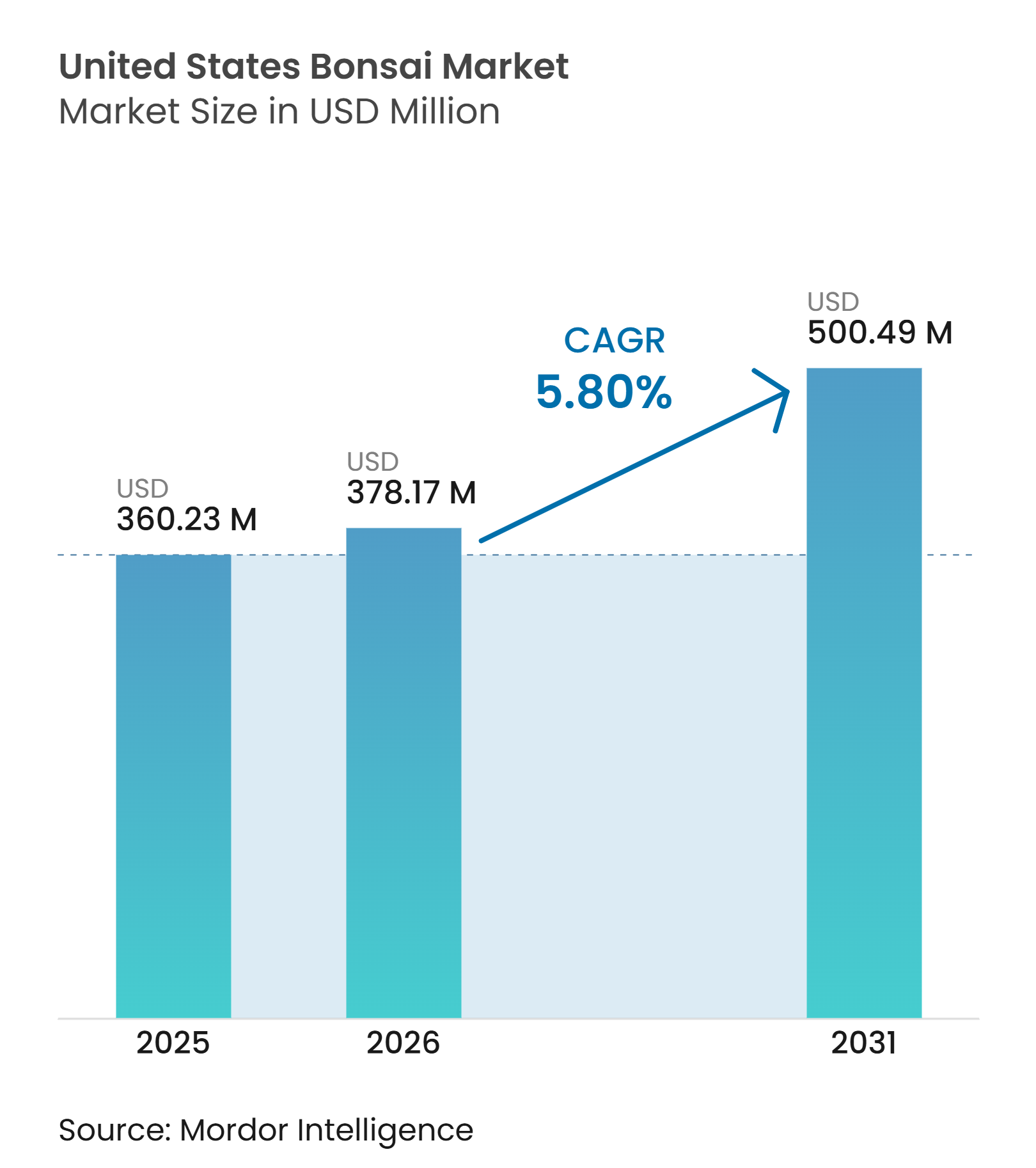
The United States bonsai market size was valued at USD 360.2 million in 2025 and is estimated to grow from USD 378.2 million in 2026 to reach USD 500.5 million by 2031. The United States bonsai market is forecast to grow at a CAGR of 5.8% from 2026 to 2031. Demand centers on committed gardeners, indoor plant buyers, gift purchasers, and commercial users seeking living display plants rather than general nursery stock. Household garden spending reached USD 79 billion in 2025, while average household spending reached USD 740, indicating a spending base that favors specialist products and care inputs. National online fulfillment widens access beyond specialist nursery catchments, while classes and care content reduce the knowledge barrier associated with a living tree. Supply remains constrained by plant health rules, biological shipping risks, and the extended cultivation period for mature specimens. The United States bonsai market, therefore, rewards operators that combine credible plant quality with fulfillment discipline, care guidance, and repeat-purchase accessory sales.
Key Report Takeaways
- By species, Indoor Species held 55.3% of the United States Bonsai Market share in 2025, and is forecast to grow at a CAGR of 6.5% from 2026 to 2031.
- By distribution channel, Online accounted for 58.2% of the United States Bonsai Market size in 2025, and is forecast to grow at a CAGR of 7.3% from 2026 to 2031.
- By application, Residential held 80.6% of market value in 2025, while the Commercial segment is forecast to grow at a CAGR of 6.8% from 2026 to 2031.
Note: Market size and forecast figures in this report are generated using Mordor Intelligence’s proprietary estimation framework, updated with the latest available data and insights as of January 2026.
Market Trends and Insights
Drivers Impact Analysis of United States Bonsai Market*
| Driver | (~) % Impact on CAGR Forecast | Geographic Relevance | Impact Timeline |
|---|---|---|---|
| Expansion of the U.S. Home-Gardening Participant Base | +0.8% | National, with strong relevance in suburban and high-participation urban household areas where committed gardeners support specialty purchases. | Medium term (2-4 years) |
| E-commerce and Digital Education Lowering Bonsai Entry Barriers | +0.9% | National, especially in states without dense specialist nursery coverage, where direct shipping links buyers to dedicated growers. | Short term (≤ 2 years) |
| Wellness, Mindfulness, and Nature-Connection Positioning | +0.6% | National, with relevance in urban and apartment-oriented demand centers where indoor plant care fits home routines. | Medium term (2-4 years) |
| Beginner-Oriented Productization and Guided Purchase | +0.7% | National, particularly for first-time buyers and gift purchasers who need clear selection and care support. | Short term (≤ 2 years) |
| Compact-Living and Indoor/Container-Gardening Fit | +0.5% | Dense metropolitan areas and smaller homes or apartments, where outdoor gardening space is limited. | Medium term (2-4 years) |
| Community-Led Conversion Through Classes, Events, and Demonstrations | +0.5% | Areas around established specialist nurseries and metropolitan bonsai communities, including Florida, California, Illinois, North Carolina, and Pennsylvania. | Medium term (2-4 years) |
| Source: Mordor Intelligence | |||
Expansion of the U.S. Home-Gardening Participant Base
The United States bonsai market derives value from gardeners who devote more of their spending to specialized living plants and their upkeep. The National Gardening Association reported that 4.5 million households left gardening in 2025, yet total lawn and garden spending reached USD 79 billion[1]. The same survey recorded average household spending of USD 740, which shifts the commercial focus toward committed buyers rather than casual participation. Bonsai sellers benefit when customers value a tree, a suitable pot, soil, pruning supplies, and care advice as a combined purchase. The United States Department of Agriculture recorded USD 5.3 billion in nursery stock sales in the 2024 Census of Horticultural Specialties, up 17% from 2019. This backdrop supports a premium specialist model instead of a high-volume, low-service model.
E-commerce and Digital Education Lowering Bonsai Entry Barriers
Online retail removes the distance between specialist growers and buyers without local bonsai stores. Brussels Bonsai operates a drop-ship program in which retail partners sell trees, and the nursery handles fulfillment from Mississippi. The model expands retail reach without requiring every seller to hold live inventory. Bonsaiify combines online sales with educational content and classes, which makes tree selection and early care easier for new customers. Love My Bonsai ships live bonsai and bonsai-specific supplies across the continental United States, including starter products and collector-oriented specimens. Price visibility also pushes physical retailers to compete through rare stock, hands-on advice, workshop access, and post-purchase support.
Wellness, Mindfulness, and Nature-Connection Positioning
Bonsai care gives sellers a clear position within the broader interest in home-based engagement with nature. The Harvard T.H. Chan School of Public Health describes gardening as an activity associated with reduced stress and anxiety, as well as a stronger connection with nature. Pruning, wiring, watering, and seasonal repotting require repeated attention, which distinguishes a bonsai from a purely decorative purchase. That involvement supports demand for care materials and structured guidance after the first sale. The category also suits consumers seeking screen-free routines inside smaller homes. Its commercial value lies in deeper engagement with a living product, rather than in a one-time décor purchase.
Compact-Living and Indoor/Container-Gardening Fit
Indoor bonsai is well-suited to homes where outdoor cultivation space is limited. The Federal Reserve reported that 28% of U.S. adults rented their homes in 2024, which supports demand for portable and container-based plant options. Ficus, jade, and money tree selections suit indoor layouts and do not require a garden plot. Their manageable footprint broadens relevance among apartment residents, smaller households, and gift buyers uncertain about the recipient's outdoor space. Penang Nursery distributes exotic bonsai as part of an indoor plant décor offering through 6 locations and wholesale accounts. The fit between compact housing and indoor trees sustains entry-level demand across metropolitan areas.
Restraints Impact Analysis of United States Bonsai Market*
| Restraint | (~) % Impact on CAGR Forecast | Geographic Relevance | Impact Timeline |
|---|---|---|---|
| High Plant-Health and Import-Compliance Burden | -0.7% | National, with strongest effects on import-dependent sellers and ports handling regulated live plants. | Medium term (2-4 years) |
| Live-Plant Mortality, Transit, and Seasonality Risk | -0.6% | National, with stronger effects on e-commerce routes exposed to severe heat, cold, or long transit distances. | Short term (≤ 2 years) |
| Specialist-Knowledge Bottleneck at General Retailers | -0.3% | National, especially across general garden centers and mass retail outlets without bonsai-trained staff. | Medium term (2-4 years) |
| Limited Supply of Mature, High-Quality Specialty Stock | -0.5% | National, with greatest relevance to collector and premium specimen purchases. | Long term (≥ 4 years) |
| Source: Mordor Intelligence | |||
High Plant-Health and Import-Compliance Burden
United States Department of Agriculture Animal and Plant Health Inspection Service rules create a detailed import process for artificially dwarfed plants over 2 years old. The requirements include source-nursery registration, an official inspection, phytosanitary certification, sterile growing media, and removal of growing media before shipment [2]. Permit processing through the Animal and Plant Health Inspection Service eFile system can take up to 2 months in certain cases. Some taxa also face post-entry quarantine requirements. The process raises landed cost, lengthens replenishment cycles, and concentrates import capability in operators with established compliance systems. Brussels' Bonsai identifies approved import relationships as part of its operating model.
Limited Supply of Mature, High-Quality Specialty Stock
The supply of mature bonsai is structurally limited because premium trees require years of training and cultivation. Collector-grade material, therefore, cannot be replenished on the timetable of a normal retail season. Love My Bonsai lists 36-year-old and 66-year-old specimen trees, illustrating the long-term commitment embodied in mature inventory. Needle and deciduous specimens face additional sourcing complexity where imports are involved. The constraint supports high values for distinctive trees but narrows affordability for first-time buyers. Domestic growers need long investment horizons to build premium stock, which prevents an immediate supply response when collector demand rises.
*Our forecasts treat driver/restraint impacts as directional, not additive. The impact forecasts reflect baseline growth, mix effects, and variable interactions.
United States Bonsai Market Segment Analysis
By Species:
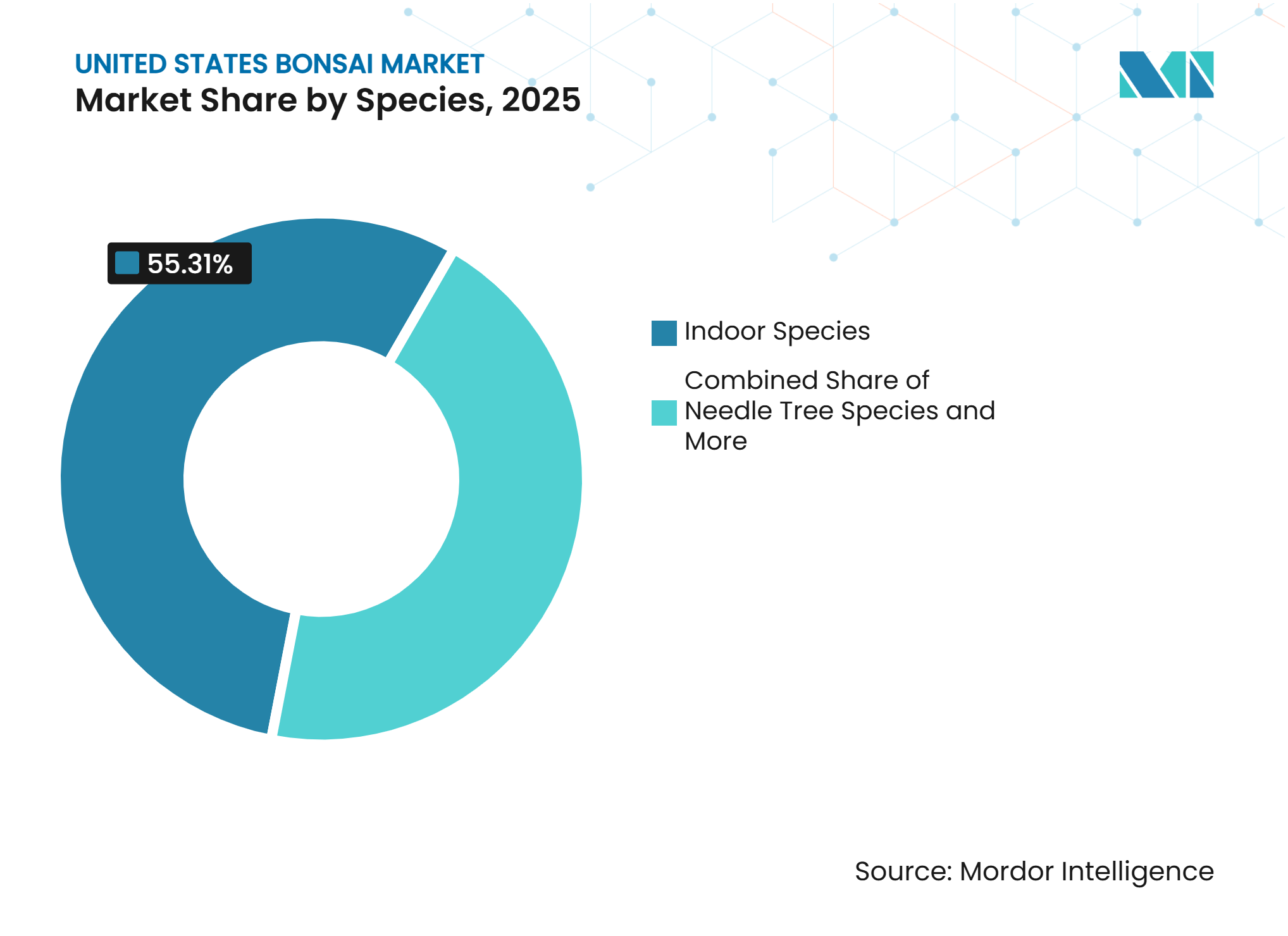
Indoor Cultivars Lead, While Outdoor Trees Serve Advanced BuyersIndoor Species held 55.3% of the United States bonsai market share in 2025. The Indoor Species segment is forecast to grow at a CAGR of 6.5% from 2026 to 2031. Ficus, jade, and money tree products fit indoor settings and reduce dependence on garden space. Their practical care profile also suits gift buyers who do not know the recipient's available outdoor conditions. Penang Nursery distributes exotic bonsai through an indoor décor portfolio, linking the segment to home and office purchasing. The United States bonsai market size for indoor trees benefits from starter formats that provide growers with a more predictable entry point into the category.
Outdoor Species serve buyers seeking seasonal change, trunk character, and long-term tree development. Needle Tree Species, including Shimpaku juniper and Japanese black pine, sit at the collector end of the assortment because quality material takes years to develop. Deciduous Tree Species, such as trident maple and Japanese maple, provide seasonal variation that appeals to experienced hobbyists. Wigert's Bonsai supplies tropical pre-bonsai material to retail buyers and downstream nurseries from its North Fort Myers operation. Outdoor categories need more careful seasonal communication, especially where dormancy changes the tree's appearance. Their higher care requirement supports specialist retail engagement and collector-oriented pricing.



By Distribution Channel:
Online Leads, While Offline Delivers Specialist ServiceOnline accounted for 58.2% of the United States bonsai market value in 2025. The Online segment is forecast to grow at a CAGR of 7.3% from 2026 to 2031. The channel connects specialist inventory with buyers outside traditional nursery catchments. Brussels' Bonsai uses a fulfillment-led drop-ship program that enables partner retailers to offer live bonsai without managing the shipment process[3]. Bonsai's 2026 Limited Release collection uses monthly releases of Dwarf Jade, Olive, Natal Plum, Lavender Star Flower, and European Crabapple to maintain digital engagement. The United States bonsai market relies on clear shipping windows, accurate product information, and care support to convert online discovery into successful ownership.
Offline retail remains important for premium tree assessment, in-person education, and workshop-based selling. House of Bonsai operates a 5.3-acre retail nursery in Lakewood, California, where shoppers assess physical inventory before purchase. D&L Bonsai Nursery uses its monthly Bring Your Own Tree sessions to link consultation with sales of tools, wire, and bonsai-specific soil. In-person visits give customers an opportunity to judge trunk form, branch structure, and plant condition directly. That service layer supports higher-value selections that do not translate easily to a standard product listing. Offline operators also retain a direct advantage in building confidence among customers who are new to living trees.
By Application:
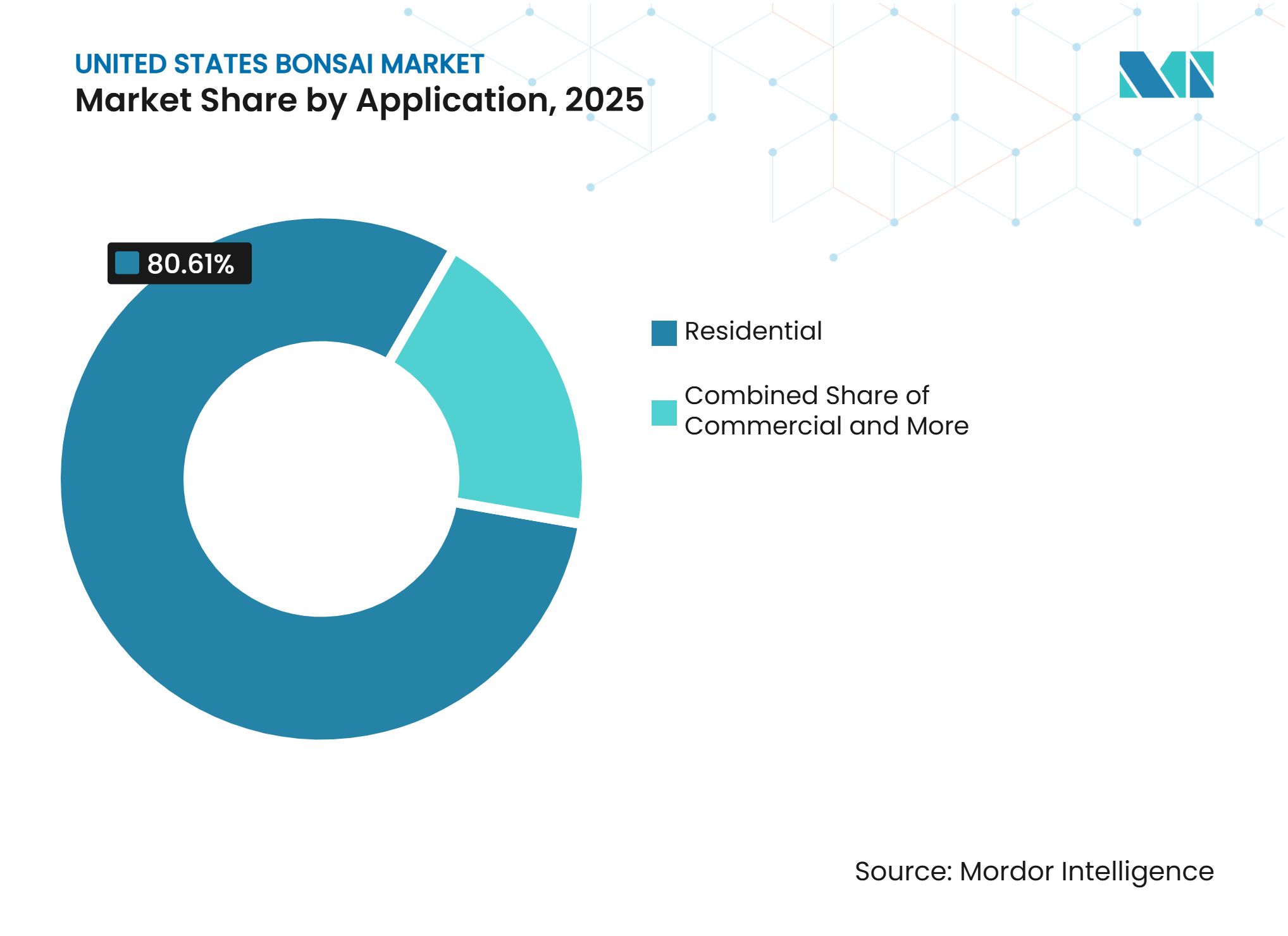
Residential Demand Sets the Base, Commercial Use Gains PaceResidential buyers held 80.6% of the United States bonsai market share in 2025. Home hobbyists, indoor decorators, and gift purchasers form the core demand base. L&J Nursery ships Florida-grown bonsai to 49 states and pairs online availability with Bonsai & Cheers workshops in Venice and Orlando. The first residential tree often leads to later purchases of soil, pots, fertilizers, and pruning tools. Gift-ready assortments matter during Mother's Day and the Christmas buying period because they bring new consumers into the category. Residential demand gives specialist growers a broad base for recurring input sales.
The Commercial segment is forecast to grow at a CAGR of 6.8% from 2026 to 2031. Hospitality venues, corporate spaces, and institutional settings use mature bonsai as distinctive living displays. The American Express Centurion Lounge at Hartsfield-Jackson International Airport used a 50-year-old, 2,500-pound bonsai as the centerpiece of a biophilic installation. Artisan's Bonsai offers rental, leasing, and maintenance services for offices and event venues, as well as nursery sales. The Others category includes institutional gifts and art fairs, where individual specimens support higher-value transactions. Commercial contracts reward operators with installation capability, mature stock, and ongoing plant-care capacity.

Geography Analysis
The United States bonsai market operates as a single national sales environment, although production clusters and customer demand centers vary by region. Mississippi supports national fulfillment through Brussels Bonsai, which operates more than 200,000 square feet of climate-controlled greenhouse space in Olive Branch. Florida serves as a major production corridor for tropical and subtropical material, with growers in North Fort Myers, Ocklawaha, Orlando, Venice, Tampa, and other locations. The United States Department of Agriculture recorded USD 18.3 billion in national horticultural sales in the 2024 Census of Horticultural Specialties, including USD 5.3 billion in nursery stock. his broad nursery base provides relevant labor, inputs, and distribution infrastructure for specialist operations.
California has a mature retail and collector ecosystem across the Los Angeles basin, the San Francisco Bay Area, and the Sierra Nevada foothills. House of Bonsai serves Southern California from Lakewood, while California Bonsai Studio serves buyers in Thousand Oaks and the wider Los Angeles area. Lotus Bonsai Nursery & Gardens held its 20th Annual Spring Sale in Placerville in May 2026 and described it as a potentially final large-format sale. That event highlights succession and labor pressures facing established independent nurseries. Bonsaify operates its direct-to-consumer and class-based activity from San Francisco, which links urban buyers with digital-first specialist retail.
Coastal metropolitan areas such as Los Angeles, San Francisco, Seattle, New York, and Miami concentrate apartment dwellers and discretionary hobby spending. The United States bonsai market size is supported in those places by demand for compact indoor plants, even where tree production occurs elsewhere. New York-based Love My Bonsai ships nationally, showing that nationwide participation does not require location in a southern production cluster. The geographic separation between growers and customers elevates the value of reliable packing, seasonal shipping controls, and direct customer communication. Import routes supplement domestic supply through regulated inspection points before products move into specialist retail networks. The national structure favors nurseries that coordinate production, compliance, and delivery rather than relying solely on local foot traffic.
Competitive Landscape
Market Concentration
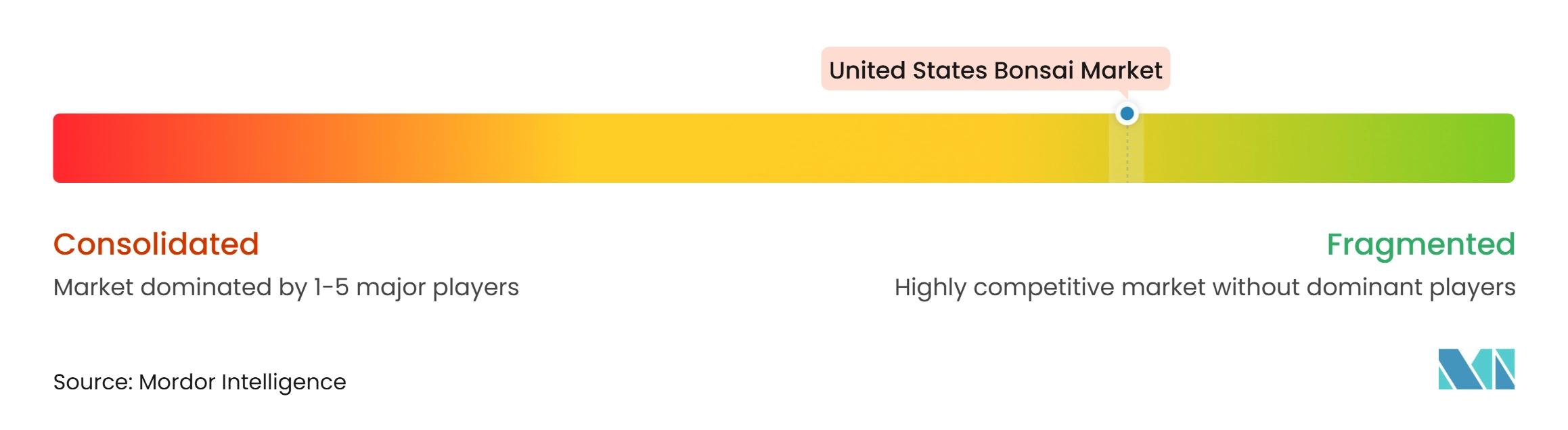
The United States bonsai market is fragmented because specialist nurseries and direct-to-consumer operators serve distinct species, buyers, and channel needs. Brussels' Bonsai combines greenhouse scale, import relationships, and fulfillment capacity from Mississippi. Wigert's Bonsai focuses on tropical pre-bonsai production and wholesale supply from its 8-acre North Fort Myers property. Penang Nursery participates in wholesale distribution across 6 locations and will display exotic bonsai and specialty foliage at MANTS 2026. These operating models show that competitive position depends on access to supply, tree quality, species focus, and customer reach rather than on national-chain scale.
Strategic moves center on customer acquisition, labor continuity, and recurring engagement. Bonsaify uses monthly product releases and a reforestation partnership that has facilitated the planting of more than 10,600 trees as of May 2026, giving value-oriented entry buyers a defined brand proposition. Matsuda Landscape & Bonsai Nursery partnered with PRIDE Industries in 2026 to address staffing needs through supported work crews. L&J Nursery combines nationwide shipping with in-person workshops, joining digital reach with local customer engagement. hese approaches address different constraints, including labor availability, buyer confidence, and repeat visitation. Competition remains moderate among specialists and is more price-sensitive in entry-level online sales.
Commercial demand opens a differentiated path for operators with mature material and care capability. Artisan's Bonsai extends beyond tree sales through leasing and maintenance for offices and events. House of Bonsai competes through physical selection and consultation, while Bonsaify competes through digital education and community formats. The Jonsteen Company remains relevant only through its Bonsai Special product line, not its broader seedling activities. The market structure leaves room for regionally focused nurseries that build trust through tree health, advice, and specialized assortments.
United States Bonsai Industry Leaders
-
Brussel’s Bonsai
-
House of Bonsai
-
Penang Nursery, Inc.
-
Wigert’s Bonsai
-
Bonsaify
- *Disclaimer: Major Players sorted in no particular order
United States Bonsai Market Companies Covered in this Report
- Brussel's Bonsai
- House of Bonsai
- Penang Nursery, Inc.
- Bonsaify
- L&J Nursery
- The Jonsteen Company, Inc.
- Love My Bonsai
- D&L Bonsai Nursery
- Artisan’s Bonsai
- California Bonsai Studio
- Matsuda Landscape & Bonsai Nursery
- Lotus Bonsai Nursery & Gardens
- Florida Bonsai
- Bonsai Oasis
- Wigert’s Bonsai
Recent Industry Developments in United States Bonsai Market
- May 2026: Bonsaify stated that its One Tree Planted partnership had facilitated more than 10,600 trees, with 1% of sales directed to the charity.
- February 2026: Matsuda Landscape & Bonsai Nursery partnered with PRIDE Industries to support nursery operations with work crews employing people with disabilities and embedded job coaches.
- January 2026: Penang Nursery exhibited at MANTS 2026, presenting exotic bonsai and specialty foliage to wholesale buyers.
United States Bonsai Market Report Scope
Our study defines the United States bonsai market as the annual value of miniature, living woody plants intentionally trained to mimic mature trees, plus the pots, soils, and pruning inputs sold with them. Values represent consumer-level spending through both specialty nurseries and general retail, expressed in USD.
Scope Exclusion: Artificial plastic or silk "bonsai" décor items are excluded from this valuation.
The United States Bonsai Market Report is segmented by Species (Indoor Species, Outdoor Species, Needle Tree Species, and Deciduous Tree Species), by Distribution Channel (Online and Offline), and by Application (Residential, Commercial, and Others (institutional gifts, art fairs)). The Market Forecasts are Provided in Terms of Value (USD).
Segmentation Overview
| Indoor Species |
| Outdoor Species |
| Needle Tree Species |
| Deciduous Tree Species |
| Online |
| Offline |
| Residential |
| Commercial |
| Others (institutional gifts, art fairs) |
| By Species | Indoor Species |
| Outdoor Species | |
| Needle Tree Species | |
| Deciduous Tree Species | |
| By Distribution Channel | Online |
| Offline | |
| By Application | Residential |
| Commercial | |
| Others (institutional gifts, art fairs) |
Key Questions Answered in the Report
What is the United States bonsai market size in 2026?
The United States bonsai market is valued at USD 378.2 million in 2026 and projected to reach USD 500.5 million by 2031.
What is the growth rate through 2031?
The United States bonsai market is forecast to grow at a CAGR of 5.8% from 2026 to 2031.
Which sales channel has the largest share?
Online accounted for 58.2% of value in 2025 because specialist nurseries fulfill orders nationally.
What restricts bonsai supply in the United States?
Import compliance, shipping-related plant stress, limited trained retail staff, and the long cultivation cycle for mature trees restrict supply.