
United States Athletic Footwear Market Size and Share
Market Overview
| Study Period | 2022 - 2032 |
|---|---|
| Forecast Data Period | 2027 - 2032 |
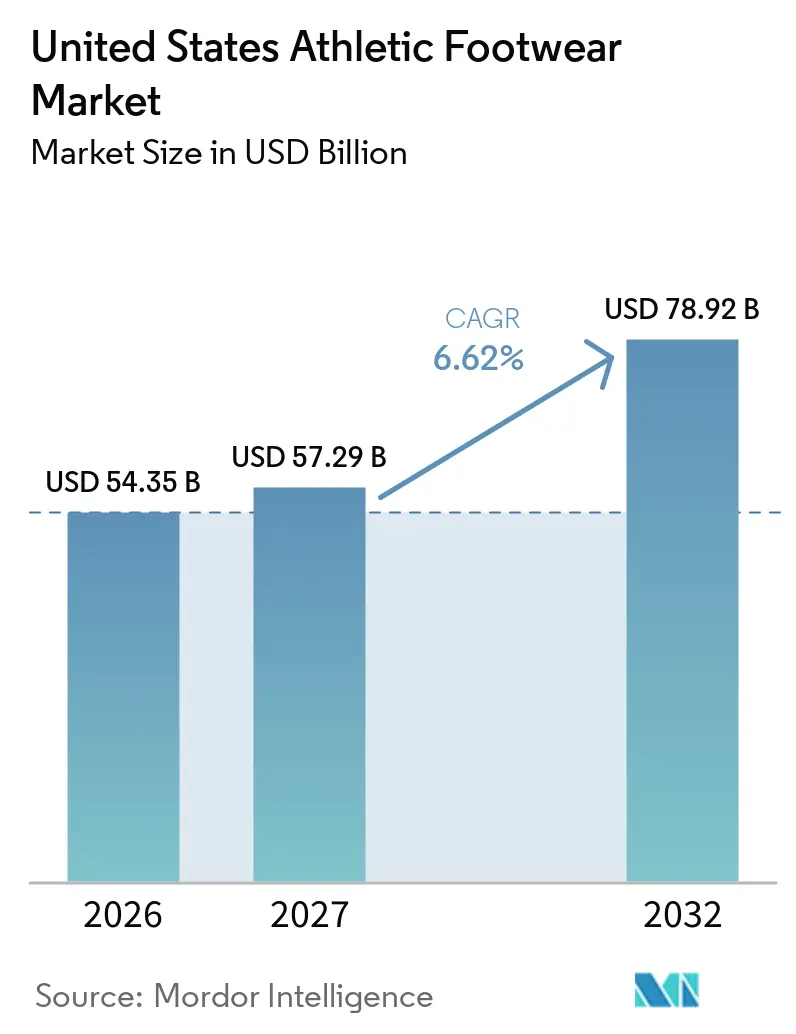
| Base Year Market Size (2026) | USD 54.35 Billion |
| Market Size (2027) | USD 57.29 Billion |
| Market Size (2032) | USD 78.92 Billion |
| Growth Rate (2027 - 2032) | 6.62 % |
| Market Concentration | Medium |
Major Players *Disclaimer: Major Players sorted in no particular order Image © Mordor Intelligence. Reuse requires attribution under CC BY 4.0. | |
United States Athletic Footwear Market Analysis by Mordor Intelligence
The United States athletic footwear market size is expected to grow from USD 54.35 billion in 2026 to USD 57.29 billion in 2027 and is forecast to reach USD 78.92 billion by 2032 at a 6.62% CAGR over 2027-2032. The United States athletic footwear market is supported by growing participation in sports and fitness activities, increasing interest in health and wellness, and the continued adoption of athletic footwear for both performance and everyday use. Demand spans a broad range of consumer needs, including sports participation, running, outdoor activities, comfort, and lifestyle preferences. Product innovation, evolving fashion trends, premiumization, and the expansion of online retail are influencing purchasing behavior and shaping competition across product categories and distribution channels. The market features established global brands and emerging competitors competing through product development, brand positioning, distribution expansion, and differentiated offerings.
Key Report Takeaways
- By activity, sports shoes held 48.17% of the United States athletic footwear market share in 2026, while running shoes are forecast to grow at a 7.17% CAGR from 2027 to 2032.
- By product type, shoes accounted for 84.55% of the United States athletic footwear market size in 2026, while boots are forecast to grow at a 7.94% CAGR from 2027 to 2032.
- By end user, men held 64.63% share in 2026, while kids and children are forecast to grow at a 7.85% CAGR from 2027 to 2032.
- By category, mass footwear held 66.72% share in 2026, while premium footwear is forecast to grow at a 7.71% CAGR from 2027 to 2032.
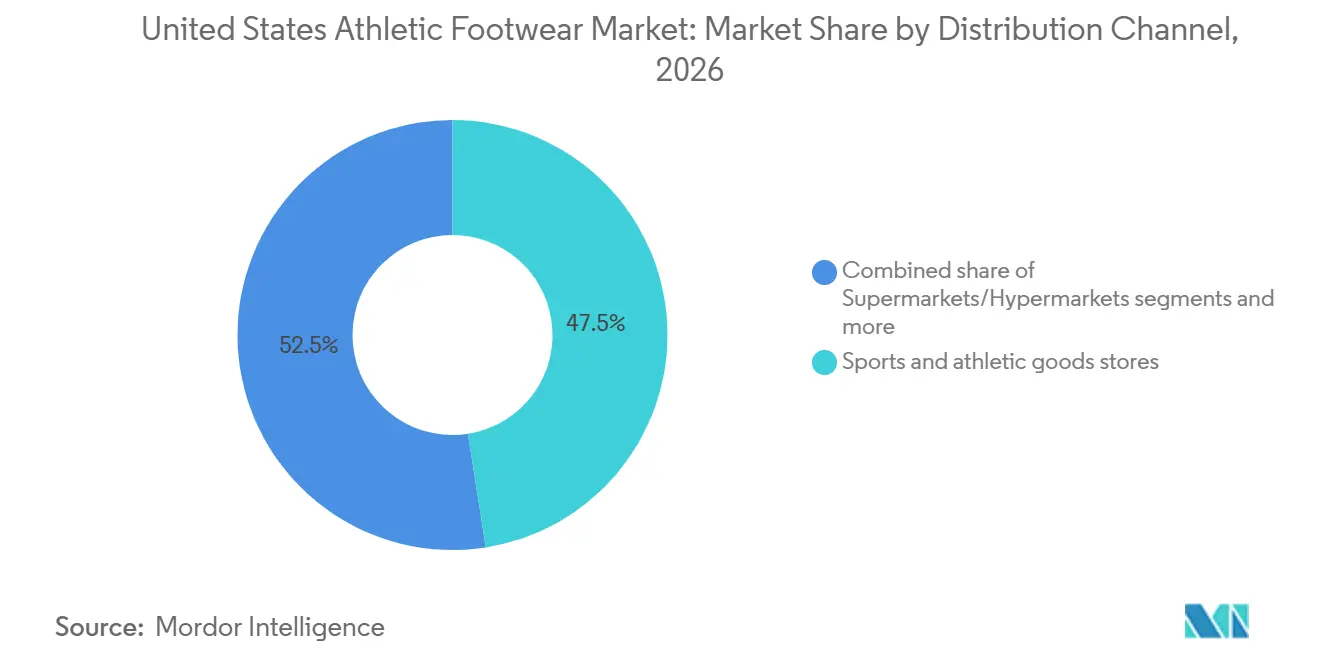
- By distribution channel, sports and athletic goods stores held 47.52% share in 2026, while online retail is forecast to grow at an 8.13% CAGR from 2027 to 2032.
Note: Market numbers in this report are based on Mordor Intelligence's proprietary estimation framework, which combines nine months of actuals with Q4 projections for base year 2026.
United States Athletic Footwear Market Trends and Insights
Drivers Impact Analysis*
| Driver | (~) % Impact on CAGR Forecast | Geographic Relevance | Impact Timeline |
|---|---|---|---|
| Growing participation in running and fitness activities | +1.8% | National, with above-average gains in South Atlantic, Pacific, and West South Central regions | Short term (≤ 2 years) |
| Expanding participation in women's sports | +0.7% | National, with concentration in metro markets with established women's sports leagues and run clubs | Medium term (2-4 years) |
| Adoption of athletic footwear for everyday and casual wear | +1.3% | National, led by urban and suburban markets; high uptake across Gen Z and Millennials | Short term (≤ 2 years) |
| Growth in fitness facility membership and gym usage | +0.8% | National, with disproportionate growth among Gen Z adults and adults aged 65+ | Short term (≤ 2 years) |
| Demand for specialized performance footwear | +0.6% | National, with premium adoption concentrated in top-tier metro markets | Medium term (2-4 years) |
| Advancements in athletic footwear technology | +1.0% | National, with global supply chain implications for innovation leaders | Short-medium term |
| Source: Mordor Intelligence | |||
Growing Participation In Running And Fitness Activities
Growing participation in sports and fitness activities is supporting demand for athletic footwear in the United States, as consumers increasingly incorporate physical activity into their daily routines. According to the Sports & Fitness Industry Association (SFIA), a record 250 million Americans participated in at least one sport, fitness, or leisure activity in 2025, representing a 1.2% increase from the previous year. The association's 2026 Topline Participation Report also recorded 158.8 million core participants, indicating continued engagement in sports and fitness activities[1]. This participation supports demand for athletic footwear designed to provide comfort, cushioning, stability, and performance across different activities. As consumers continue to prioritize active lifestyles, demand for footwear suited to exercise, sports participation, and everyday movement is expected to support market growth.
Expanding Participation In Women’s Sports
Expanding participation in women’s sports is creating opportunities for athletic footwear demand in the United States, as more girls and women engage in organized sports and competitive activities. According to the Women’s Sports Foundation’s 2026 Sport Report, 45% of girls aged 8–18 participated in organized sports, while 54% of girls who had never participated said they wanted to play[2]. The report also found that 93% of surveyed industry experts believed professional women’s sports had improved over the preceding year, reflecting continued momentum at the professional level. These developments are strengthening the relevance of athletic footwear designed for female athletes across different sports and performance needs. As participation opportunities and engagement continue to evolve, brands can address demand through sport-specific designs for their footwear designs.
Adoption Of Athletic Footwear For Everyday And Casual Wear
The increasing adoption of athletic footwear for everyday and casual wear is supporting market growth in the United States, as consumers increasingly prioritize comfort, versatility, and functionality in their footwear choices. Athletic shoes are no longer limited to sports and exercise, with their use expanding across daily routines, travel, leisure activities, and casual social settings. This shift is encouraging manufacturers to combine performance-oriented features with contemporary designs that complement a wide range of clothing styles. The growing overlap between sportswear and casual fashion is also broadening the consumer base for athletic footwear beyond athletes and fitness enthusiasts. As preferences continue to evolve toward comfortable and adaptable footwear, everyday use is expected to remain an important source of market demand.
Growth In Fitness Facility Membership And Gym Usage
Growing membership in fitness facilities and increased gym attendance are supporting demand for athletic footwear in the United States, as consumers seek products suited to regular workouts, strength training, and other exercise activities. According to the Health & Fitness Association (HFA), 81 million Americans were members of a gym, studio, or other fitness facility in 2025, an increase of 5.2% from 2024. The association also estimated that Americans made approximately 7 billion visits to fitness facilities in 2025, surpassing the previous pre-pandemic peak[3]. This sustained engagement in structured exercise supports demand for athletic footwear that offers cushioning, stability, comfort, and performance during physical activity. As gym membership and facility usage expand, demand for footwear designed for indoor training and regular fitness routines is expected to benefit.
Restraints Impact Analysis*
| Restraint | (~) % Impact on CAGR Forecast | Geographic Relevance | Impact Timeline |
|---|---|---|---|
| Limited accessibility in rural and lower-income markets | -0.4% | Rural United States, lower-income urban communities. | Long term (≥ 4 years) |
| High costs of premium athletic footwear | -0.5% | National; most acute among households with annual income below USD 50,000 | Short term (≤ 2 years) |
| Challenges from counterfeit products and brand erosion | -0.3% | National; concentrated in online and grey-market channels | Medium term (2-4 years) |
| Regulatory constraints and import barriers | -0.5% | National; especially impactful for Vietnam- and China-sourced supply chains | Short term (≤ 2 years) |
| Source: Mordor Intelligence | |||
Limited Accessibility In Rural And Lower-Income Markets
Limited accessibility in rural and lower-income markets may constrain growth in the United States athletic footwear market by reducing consumers’ ability to purchase products that meet their performance, comfort, and style preferences. Consumers in rural communities may face longer travel distances to reach specialized footwear retailers and stores offering a broad selection of athletic shoes, limiting their access to different brands, sizes, and product categories. Lower-income households may also prioritize essential expenses over discretionary purchases, making premium athletic footwear less affordable and encouraging consumers to delay replacements or choose lower-priced alternatives. These challenges can restrict purchasing frequency and reduce demand for higher-value products, particularly where access to physical retail outlets and convenient shopping options is limited. Although online channels can improve product availability, delivery costs, fit uncertainty, and the need to try footwear before purchasing may create additional barriers for some consumers.
High Costs Of Premium Athletic Footwear
The high cost of premium athletic footwear may constrain market growth in the United States by limiting affordability among price-sensitive consumers. Advanced materials, specialized cushioning systems, performance-oriented designs, and continuous product innovation can increase manufacturing and retail costs, resulting in higher prices for premium offerings. These prices may discourage budget-conscious consumers from purchasing high-end footwear, particularly when lower-priced alternatives provide adequate comfort and functionality for everyday use. In addition, frequent product launches and the availability of multiple models across different price tiers can make purchasing decisions more dependent on perceived value and individual spending capacity. Consumers may also postpone replacing existing footwear or shift toward discounted products when prices exceed their budgets.
*Our forecasts treat driver/restraint impacts as directional, not additive. The impact forecasts reflect baseline growth, mix effects, and variable interactions.
Segment Analysis
By Activity: Running's Momentum Reshapes the Entire Category
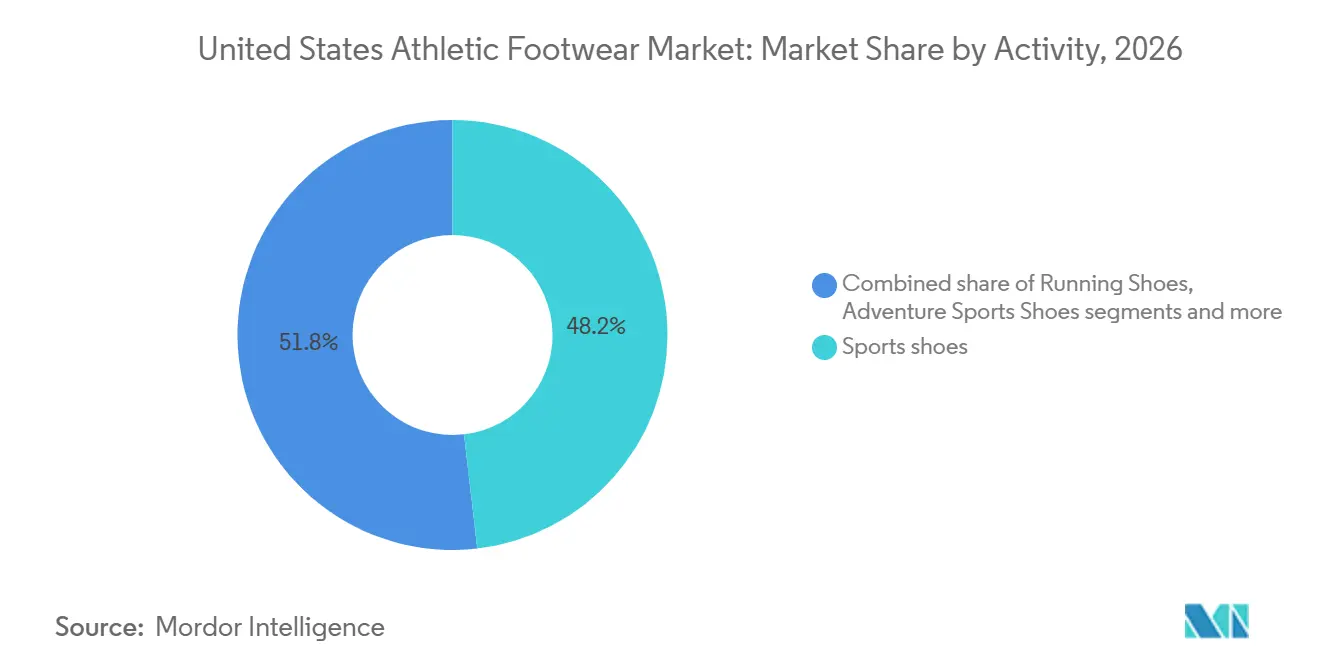
Sports shoes hold the largest share of the United States athletic footwear market in 2026, accounting for 48.17% of the segment, supported by their versatility across multiple sports and suitability for everyday wear. Their broad range of applications appeals to consumers seeking footwear for recreational activities, exercise, and casual use. The overlap between sports participation and lifestyle preferences further supports demand for this category. Established product availability and diverse designs also contribute to its continued relevance across consumer groups. As a result, sports shoes remain the leading activity segment in the market.
Running shoes are the fastest-growing activity segment, projected to register a compound annual growth rate (CAGR) of 7.17% during 2027–2032. Growth is supported by increasing participation in running, greater interest in personal fitness, and demand for footwear that combines cushioning, comfort, and performance. Running shoes also appeal to consumers seeking versatile footwear for walking, training, and everyday activities, extending their use beyond dedicated running routines. Continued product development focused on fit, support, and cushioning is further strengthening their appeal.

By Product Type: Boots Outpace Shoes on Growth Trajectory
Shoes account for the largest share of the United States athletic footwear market, representing 84.55% of market value in 2026. Their dominance reflects their broad suitability for sports participation, exercise, and everyday wear across diverse consumer groups. The availability of products for different performance requirements, comfort preferences, and price points further supports demand. Athletic shoes also offer versatility across running, training, and lifestyle applications, appealing to both active consumers and casual users. These factors are expected to sustain shoes as the leading product type throughout the forecast period.
Boots are the fastest-growing product type, projected to register a compound annual growth rate (CAGR) of 7.94% during 2027–2032. Growth is supported by increasing demand for footwear suited to hiking, trail activities, and outdoor recreation. The integration of athletic technologies into outdoor-oriented designs is further broadening their appeal among consumers seeking functional and versatile products. Features such as enhanced cushioning, durable outsoles, weather resistance, and improved traction support their suitability for varied conditions. Manufacturers are also combining performance features with contemporary styling to attract consumers seeking footwear for both outdoor activities and casual use. These developments are expected to support the expansion of boots within the market.
By End User: Kids Segment Accelerates; Women's Share Expands
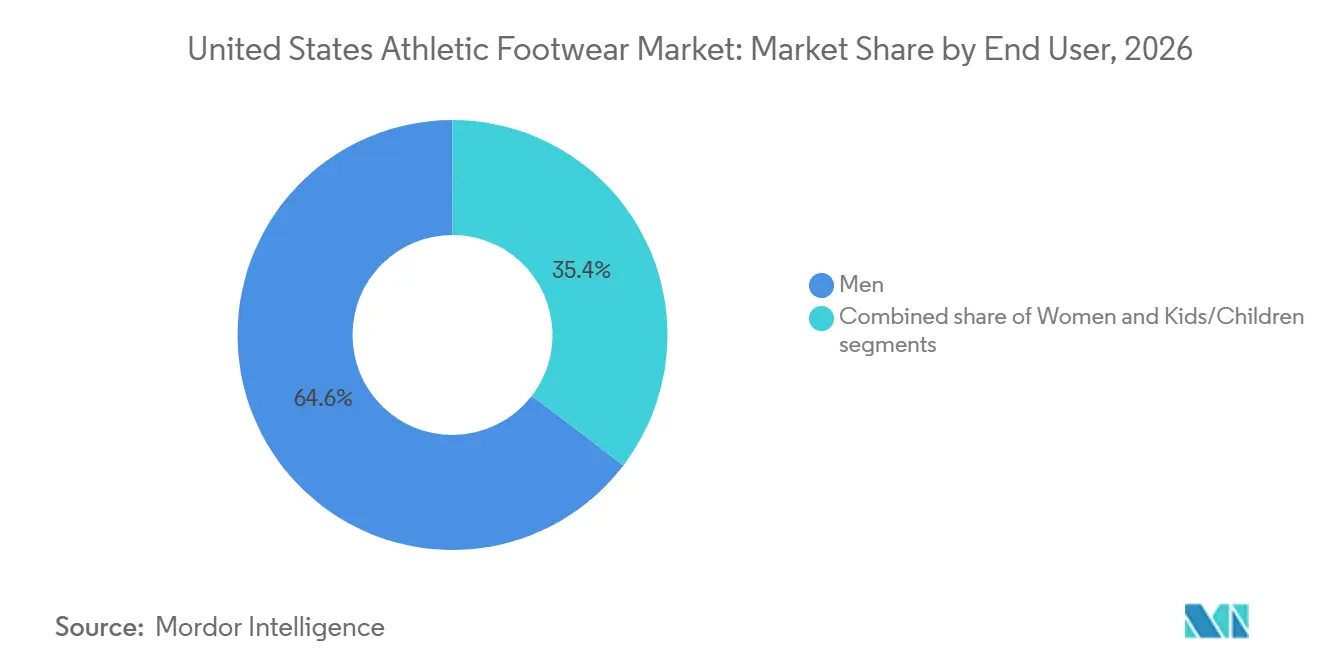
Men account for the largest share of the United States athletic footwear market, representing 64.63% of market value in 2026. This dominance is supported by demand across sports participation, exercise, and everyday footwear applications. Established purchasing habits and the broad availability of products across performance and lifestyle categories further contribute to the segment's leading position. The women's segment is also gaining importance as female participation in sports and fitness activities expands. Growing attention to fit, comfort, and sport-specific requirements is encouraging manufacturers to develop products that better address women's needs. These developments are supporting broader consumer engagement across the market.
Kids and children represent the fastest-growing end-user segment, projected to register a compound annual growth rate (CAGR) of 7.85% during 2027–2032. Growth is supported by participation in youth sports, increasing engagement in recreational activities, and demand for footwear suited to school, exercise, and everyday use. Children's rapidly growing feet also create recurring replacement needs, supporting continued purchasing across different age groups. Parents' emphasis on comfort, durability, proper fit, and activity-specific functionality further influences product selection. Manufacturers are responding by expanding youth-oriented collections and adapting established footwear designs for younger consumers. These factors are expected to support the segment's growth throughout the forecast period.
By Category: Premium Tier Grows Fastest Despite Price Sensitivity
The mass category accounts for the largest share of the United States athletic footwear market, representing 66.72% of market value in 2026. Its dominance reflects broad consumer demand for affordable footwear across sports, exercise, and everyday activities. Established brands benefit from extensive product portfolios, broad distribution networks, and offerings across multiple price points. However, price sensitivity and demand for promotional discounts may influence purchasing decisions and limit manufacturers' pricing flexibility. These factors are expected to sustain the mass category's leading position while intensifying competition on affordability and value.
The premium category is projected to register a compound annual growth rate (CAGR) of 7.71% during 2027–2032, making it an important growth segment within the market. Demand is supported by consumer interest in advanced performance features, innovative materials, distinctive designs, and established brand reputations. Premium athletic footwear also appeals to consumers seeking specialized products for running, training, and other sporting activities. Manufacturers are investing in product differentiation and performance-oriented technologies to strengthen their positions in this category. Despite potentially higher prices limiting adoption among budget-conscious consumers, continued interest in specialized features and differentiated offerings is expected to support premium segment growth.
By Distribution Channel: Online Retail Grows Fastest; Specialty Stores Consolidate
Sports and athletic goods stores account for the largest share of the United States athletic footwear market, representing 47.52% of market value in 2026. Their leading position is supported by consumers' preference for trying on footwear and assessing fit, comfort, and support before purchasing. Specialty retailers also provide access to diverse brands, product categories, and knowledgeable sales assistance, helping consumers select footwear suited to their activities. These advantages remain particularly relevant for performance-oriented products that require appropriate sizing and functionality. Consequently, physical sports and athletic goods stores continue to play a central role in athletic footwear distribution.
Online retail is the fastest-growing distribution channel, projected to register a compound annual growth rate (CAGR) of 8.13% during 2027–2032. Growth is supported by convenient shopping, broader product availability, easy price comparisons, and access to multiple brands through digital platforms. Online channels also enable manufacturers and retailers to reach consumers beyond the geographic coverage of physical stores. Improvements in product information, customer reviews, delivery services, and return policies are further helping address purchasing concerns related to fit and suitability. Meanwhile, supermarkets, hypermarkets, and other retail channels serve consumers seeking accessible and competitively priced footwear.
Geography Analysis
The United States athletic footwear market is influenced by regional differences in consumer preferences, fitness participation, climate, and access to sports infrastructure. Warmer-weather regions and major metropolitan areas support demand through year-round outdoor activities, running, gym workouts, and organized sports. Population distribution and urban development also influence the concentration of potential consumers, while regional variations in recreational habits create differences in demand across athletic footwear categories.
Coastal metropolitan areas and other affluent urban centres support demand for premium athletic footwear, driven by purchasing power, established fitness cultures, specialized retail networks, and interest in performance-oriented products. These markets provide opportunities for brands offering advanced cushioning, specialized running designs, and lifestyle-oriented athletic footwear. However, regional preferences vary according to consumer demographics, sporting activities, and price sensitivity, requiring companies to balance premium product offerings with accessible options across different consumer groups.
Smaller cities, suburban communities, and rural areas contribute to market demand through everyday wear, school sports, recreational activities, and practical footwear requirements. Price sensitivity and differences in retail availability can influence purchasing decisions, particularly among households prioritizing affordability and durability. Manufacturers and retailers can address these variations through differentiated product portfolios, multiple price points, and broad distribution networks. This approach enables companies to serve diverse consumer segments while maintaining a presence across the United States.
Competitive Landscape
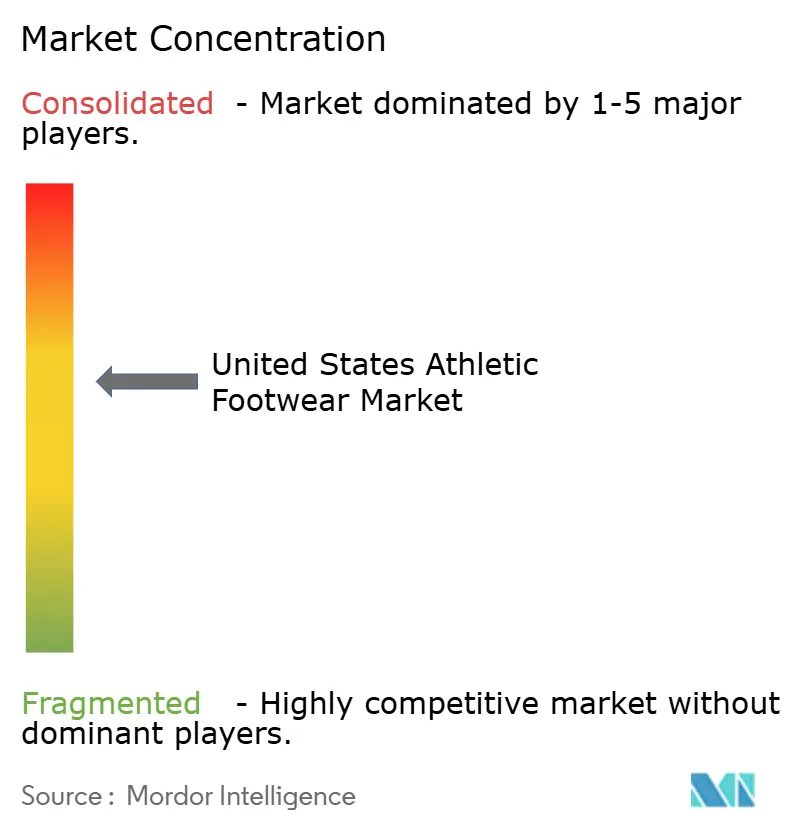
The United States athletic footwear market is moderately concentrated, with competition shaped by established multinational brands and emerging performance-focused companies. Major players include NIKE, Inc., Adidas AG, Skechers U.S.A., Inc., New Balance Athletics, Inc., and On Holding AG. These companies compete through product innovation, brand positioning, distribution networks, and offerings across performance sports and lifestyle footwear. Differences in product specialization, pricing strategies, and consumer reach influence their competitive positions, while changing preferences for comfort, functionality, and design continue to shape market dynamics.
Leading companies are adapting their strategies to evolving consumer preferences and competitive pressures. NIKE, Inc. has undertaken organizational restructuring and cost-realignment initiatives to improve operational efficiency and strengthen its focus on sport-specific categories. Meanwhile, New Balance Athletics, Inc. has expanded its market presence through continued growth in performance and lifestyle footwear, while On Holding AG has emphasized technology-led product development and premium positioning. Adidas AG continues to compete across sports performance and lifestyle categories, while Skechers U.S.A., Inc. maintains a broad footwear portfolio targeting diverse consumer needs. These strategies highlight the importance of product differentiation, brand relevance, and distribution capabilities in maintaining competitive positions.
Emerging competitive opportunities are concentrated in specialized performance footwear, women's athletic products, youth-oriented collections, and digitally enabled shopping experiences. Brands seeking to strengthen their positions are increasingly focusing on distinctive product features, consumer-specific designs, and direct engagement through digital channels. Specialized running and outdoor footwear companies can compete by addressing particular activity requirements and building credibility among targeted consumer groups. At the same time, digital retail expansion and demand for differentiated premium products create opportunities for smaller and newer brands to establish market presence. Competition is therefore likely to remain dynamic as established companies defend their positions and specialized players seek to attract consumers through focused product offerings.
United States Athletic Footwear Industry Leaders
-
NIKE, Inc.
-
Adidas AG
-
Skechers U.S.A., Inc.
-
New Balance Athletics, Inc.
-
On Holding AG
- *Disclaimer: Major Players sorted in no particular order
Recent Industry Developments
- October 2026: Academy Sports + Outdoors entered a multiyear partnership with HYROX North America. On October 21, 2026, Academy Sports + Outdoors announced its appointment as an official partner of HYROX North America. The partnership covers events in Tampa, Dallas, Nashville, Atlanta, and Houston, with Academy named title sponsor of HYROX Houston in 2027. The collaboration strengthens the retailer's engagement with fitness participants and complements its existing assortment of athletic footwear and fitness equipment.
- October 2026: New Balance introduced the Made in USA 990v7 as the latest iteration of its 990 footwear series, combining a mesh and pigskin suede upper with premium tumbled leather accents and synthetic suede overlays. The shoe incorporates a dual-density, full-length FuelCell midsole, ENCAP cushioning and a heel stability device. Priced at USD 199.99, the model is scheduled to become available in the United States in November 2026, through NewBalance.com and select New Balance stores. The launch extends the company's performance-inspired footwear portfolio while continuing the 990 series' established design lineage.
- September 2026: New Balance secured a United States military athletic-footwear supply contract. New Balance announced that it had received a three-year contract from the Defense Logistics Agency to supply its Made in USA 0430 athletic shoe to recruits across the United States Army, Navy, Air Force, and Marine Corps. The shoes will be manufactured at the company's Central Maine facility in Skowhegan, with deliveries scheduled to begin in early 2027. The award expands the brand's institutional supply channel for domestically manufactured athletic footwear.
- March 2026: STOKE Footwear expanded into more than 450 United States retail locations. On March 2, 2026, STOKE Shoes confirmed the nationwide retail rollout of its inaugural footwear collection, following its online debut in January. The collection reached more than 450 retail locations, including Scheels, Academy Sports + Outdoors, Rack Room Shoes, Shoe Department, and Runnings. The performance-lifestyle brand targets men seeking roomier footwear with additional cushioning, broadening the range of athletic-inspired options available through sporting-goods and footwear retailers.
United States Athletic Footwear Market Report Scope
The United States athletic footwear market comprises footwear designed for sports, exercise, and other physical activities. The market is segmented by activity, including running shoes, sports shoes, adventure sports shoes, and other activities; product type, including shoes and boots; end user, including men, women, and kids/children; category, including premium and mass; and distribution channel, including sports and athletic goods stores, supermarkets/hypermarkets, online retail stores, and other channels. The market forecasts are provided in terms of value in USD.
| Running Shoes |
| Sports Shoes |
| Adventure Sports Shoes |
| Others |
| Shoes |
| Boots |
| Men |
| Women |
| Kids/Children |
| Premium |
| Mass |
| Sports and Athletic Goods Stores |
| Supermarkets/Hypermarkets |
| Online Retail Stores |
| Other Distribution Channels |
| By Activity | Running Shoes |
| Sports Shoes | |
| Adventure Sports Shoes | |
| Others | |
| By Product Type | Shoes |
| Boots | |
| By End User | Men |
| Women | |
| Kids/Children | |
| By Category | Premium |
| Mass | |
| By Distribution Channel | Sports and Athletic Goods Stores |
| Supermarkets/Hypermarkets | |
| Online Retail Stores | |
| Other Distribution Channels |
Key Questions Answered in the Report
What is the forecast growth rate for United States athletic footwear?
The United States athletic footwear market is forecast to grow at a 6.62% CAGR from 2027 to 2032, reaching USD 78.92 billion by 2032.
Which activity has the strongest growth outlook for athletic footwear in the United States?
Running shoes have the highest forecast CAGR among activity segments at 7.17% from 2027 to 2032.
Which product type leads athletic footwear sales in the United States?
Shoes led product type sales with 84.55% share in 2026. Boots are forecast to grow faster at a 7.94% CAGR through 2032.
Which consumer group is expected to drive athletic footwear demand?
Kids and children are forecast to grow at a 7.85% CAGR from 2027 to 2032.