
United Kingdom Seed Processing Machinery Market Size and Share
Market Overview
| Study Period | 2021 - 2031 |
|---|---|
| Forecast Data Period | 2026 - 2031 |
| Base Year Market Size (2025) | USD 57.48 Million |
| Market Size (2026) | USD 60.06 Million |
| Market Size (2031) | USD 74.85 Million |
| Growth Rate (2026 - 2031) | 4.50 % |
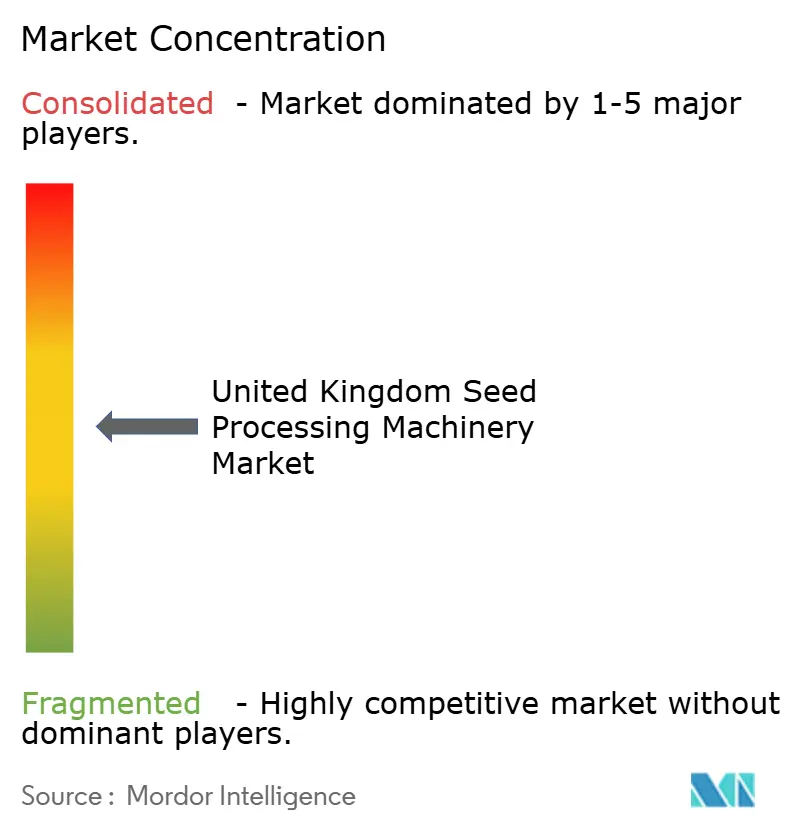
| Market Concentration | Medium |
Major Players *Disclaimer: Major Players sorted in no particular order Image © Mordor Intelligence. Reuse requires attribution under CC BY 4.0. | |
United Kingdom Seed Processing Machinery Market Analysis by Mordor Intelligence
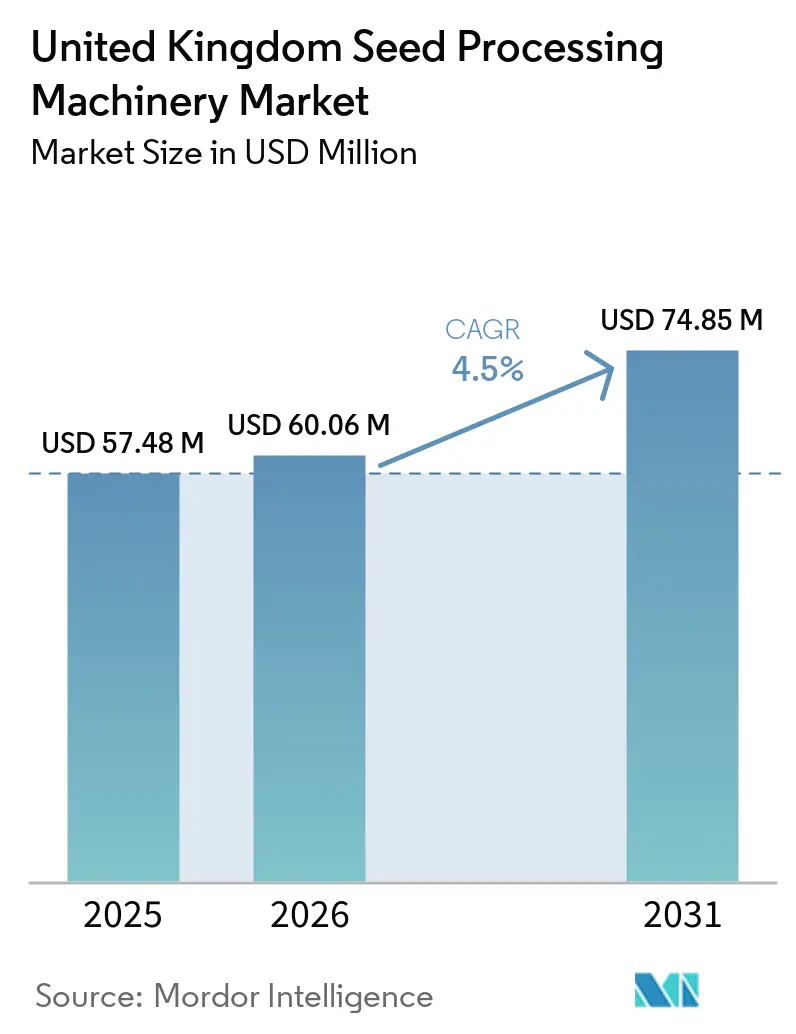
The United Kingdom seed processing machinery market is forecast to grow from USD 57.48 million in 2025 to USD 60.06 million in 2026, reaching USD 74.85 million by 2031, at a CAGR of 4.50% during the forecast period 2026–2031. Certified seed regulations keep equipment spending focused on purity, traceability, and repeatable lot handling, rather than on discretionary capacity additions that do not improve certified lot performance. Rising labor costs and a declining agricultural workforce are strengthening the financial case for automated cleaning and sorting, particularly where plants must maintain quality control across multiple short and intensive processing runs. Mobile contractors are also expanding access to seed-grade equipment for farms without fixed processing facilities. Suppliers that can adapt existing grain assets and provide prompt service are better positioned to capture replacement and upgrade demand, as operators typically require additions compatible with their installed conveyors, dryers, controls, and building layouts. The United Kingdom seed processing machinery market is therefore shaped by compliance requirements, operating costs, and the practical constraints of seasonal processing.
Key Report Takeaways
- By machinery type, cleaners were the largest segment and held 42.7% of the United Kingdom seed processing machinery market share in 2025, while optical sorters are the fastest-growing segment and are anticipated to expand at a 7.6% CAGR between 2026 and 2031.
- By operation mode, automatic systems were the largest segment and held 70.6% of the United Kingdom seed processing machinery market size in 2025, while automatic systems are the fastest-growing segment and are anticipated to expand at an 8.0% CAGR between 2026 and 2031.
- By end user, commercial seed processing plants were the largest segment and held 55.6% of the market share in 2025, while on-farm facilities are the fastest-growing segment and are anticipated to expand at a 6.4% CAGR between 2026 and 2031.
Note: Market size and forecast figures in this report are generated using Mordor Intelligence’s proprietary estimation framework, updated with the latest available data and insights as of January 2026.
Market Trends and Insights
Drivers Impact Analysis of United Kingdom Seed Processing Machinery Market*
| Driver | (~) % Impact on CAGR Forecast | Geographic Relevance | Impact Timeline |
|---|---|---|---|
| Certified cereal and grass-seed purity requirements | +0.9% | National, with greater intensity in England and Scotland | Short term (≤ 2 years) |
| Post-brexit lot documentation and identity preservation | +0.7% | National, with added relevance at English ports and Northern Ireland crossings | Medium term (2-4 years) |
| High UK labor and energy costs favoring automated separation | +0.8% | National, particularly where agricultural labor is limited | Short term (≤ 2 years) |
| Dealer-led retrofit and aftermarket support | +0.5% | National, concentrated in established dealer networks in England and Scotland | Medium term (2-4 years) |
| Mobile and shared-capacity cleaning for distributed farms | +0.5% | England, Wales, and Scotland | Medium term (2-4 years) |
| Repurposing grain infrastructure for seed-grade processing | +0.4% | England, with spillover to Scotland | Long term (≥ 4 years) |
| Source: Mordor Intelligence | |||
Certified Cereal and Grass-Seed Purity Requirements
The United Kingdom seed processing machinery market is driven by stringent seed certification standards that require high levels of seed purity and quality. Under the Seed Marketing Regulations 2011, Basic and Certified Seed categories must achieve a minimum analytical purity of 97% by weight, while grass species are subject to species-purity thresholds ranging from 96% to 99%, depending on the crop. These certification requirements, administered by the National Institute of Agricultural Botany (NIAB) on behalf of the Animal and Plant Health Agency (APHA), necessitate the use of precision cleaning and separation equipment, including air-and-screen cleaners, indented cylinders, and gravity separators. The processing of grass and herbage seeds is particularly demanding due to their low seed weight, susceptibility to shattering, and the presence of weed seeds with similar physical characteristics. Consequently, processors increasingly invest in high-performance seed processing machinery capable of achieving precise separation, minimizing contamination, and maintaining seed quality across diverse crop species.
Post-Brexit Lot Documentation and Identity Preservation
The Border Target Operating Model (BTOM) has increased documentation and phytosanitary requirements for some imported seed lots. Processors are responding with clearer lot segregation, label management, batch recording, and traceability controls. These functions favor integrated lines that link machinery with processing records, allowing operators to maintain a clear record of each lot, processing setting, and movement across the plant. The United Kingdom and European Union (EU) reached an agreement in principle on a Sanitary and Phytosanitary (SPS) agreement in May 2025[1]. The agreement is anticipated to take effect in mid-2027 and may reduce trade friction for plant reproductive material. Domestic compliance with aligned rules will still require identity preservation and reliable process control. This creates a continuing reason to invest in software-upgradeable equipment within the United Kingdom seed processing machinery market, even if trade procedures become simpler after the agreement is implemented.
High UK Labor and Energy Costs Favoring Automated Separation
The United Kingdom seed processing machinery market is supported by the need to reduce manual labor in cleaning, aspiration, calibration, and inspection. According to Low Pay Commission data, the National Living Wage (NLW) increased to GBP 12.71 (USD 16.02) per hour in April 2026, while the employer National Insurance contribution rate stands at 15%[2]. The Farming Profitability Review in 2025 identified wage pressure, energy costs, and higher machinery prices as operating challenges for farms. These conditions make automated aspiration, gravity separation, and optical sorting more viable for processors with moderate throughput. Automation also reduces dependence on seasonal labor during short post-harvest windows. The demand effect extends beyond new plants, as existing lines can be retrofitted with automatic controls and sensors, allowing processors to improve consistency without replacing every productive mechanical component. This supports equipment upgrades across the United Kingdom seed processing machinery market. It also changes how buyers assess a line, as labor savings, process consistency, and recorded quality controls can be evaluated together. A smaller operator may not require a completely new plant but may still find value in automating the stages that involve the most repetitive work or the greatest risk of inconsistent separation.
Mobile and Shared-Capacity Cleaning for Distributed Farms
The United Kingdom seed processing machinery market also serves farms that use mobile contractors instead of owning fixed equipment. Agrii states that 45% of cereal seed planted in the United Kingdom is processed on farm, and its mobile fleet processes more than 50,000 metric tons each year using batch treaters and rotary cleaners[3]. Contractor equipment must be self-contained, generator-powered, and easy to relocate between farms, while maintaining sufficient cleaning and treatment performance to meet the practical needs of multiple growers in a single season. This creates different product requirements compared to the large continuous lines used by commercial plants, with greater emphasis on compact layouts, quick setup, cleaning access, robust transport arrangements, and reliable service coverage during the active harvest period. Mobile processing supports farm-saved seed strategies and allows smaller lots to access modern cleaning and treatment capacity. It also creates demand for modular units that can integrate with existing grain intake, conveying, drying, and storage systems. Buyers in this channel may prefer a staged investment approach, starting with cleaning or treatment capacity and adding sorting, packing, or data controls as volumes and customer requirements justify further expansion.
Restraints Impact Analysis of United Kingdom Seed Processing Machinery Market*
| Restraint | (~) % Impact on CAGR Forecast | Geographic Relevance | Impact Timeline |
|---|---|---|---|
| Seasonal underutilization of specialized equipment | -0.6% | National, strongest in England and Scotland | Short term (≤ 2 years) |
| High changeover cost across small UK seed lots | -0.5% | National, with higher relevance in crop-diverse English regions | Medium term (2-4 years) |
| Imported-system lead times and UK customization requirements | -0.5% | National, affecting commercial processors and larger on-farm investments | Medium term (2-4 years) |
| Limited UK performance data for specialty-seed optical sorting | -0.4% | England and Scotland | Long term (≥ 4 years) |
| Source: Mordor Intelligence | |||
Seasonal Underutilization of Specialized Equipment
The United Kingdom seed processing machinery market faces a short utilization period for specialized seed equipment. Cereal seed processing is often concentrated between harvest and autumn drilling, a period that typically lasts 8-12 weeks. Optical sorters, batch coaters, and specialty graders may remain idle outside this window. Late-season weather stress resulted in elevated barley screenings across parts of Scotland. Higher reject rates can reduce line throughput during the period when plants need to process the largest share of their volume. This lowers asset productivity and makes financing more difficult for equipment with narrowly seasonal use. Suppliers can partly address this by offering flexible lines that support grain, pulse, and seed applications, although each additional use can introduce its own cleaning, setup, and quality-control requirements.
High Changeover Cost Across Small UK Seed Lots
The United Kingdom seed processing machinery market serves a multi-crop seed system that includes cereals, grasses, oilseeds, pulses, and vegetables. Each crop change can require new screens, cylinder changes, aspiration adjustments, and cleaning protocols, consuming 2-4 hours of productive time per changeover. Small and diverse lots can therefore limit the efficiency of fixed lines. This constraint is more pronounced for processors that must prevent varietal admixture while maintaining certified seed standards, as a failure in cleaning or separation can affect the value and marketability of an entire batch. Specialty seed optical sorting faces a related limitation, as validated recipes are less available for these crops than for wheat, barley, and oilseed rape.
*Our forecasts treat driver/restraint impacts as directional, not additive. The impact forecasts reflect baseline growth, mix effects, and variable interactions.
United Kingdom Seed Processing Machinery Market Segment Analysis
By Machinery Type:
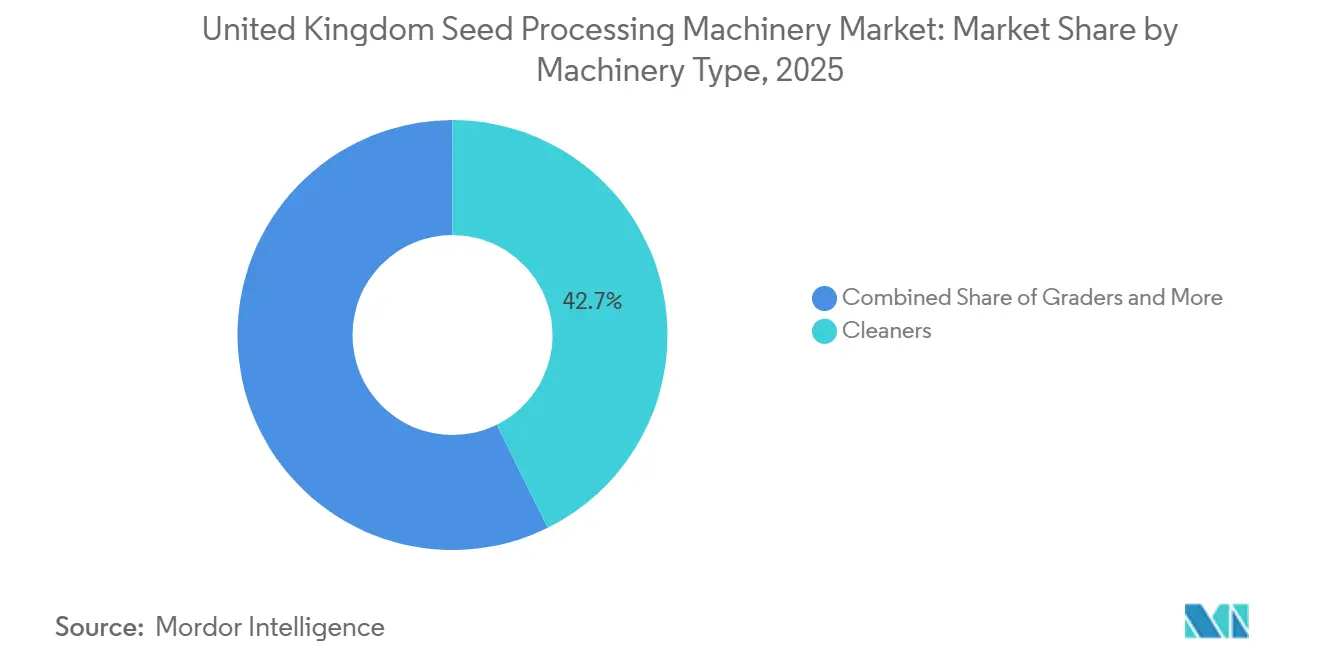
Cleaners Lead as Optical Sorters AccelerateCleaners held 42.7% of the United Kingdom seed processing machinery market share in 2025. This position reflects the central role of air-and-screen separation in meeting certified seed purity requirements. Cleaners support both high-volume cereal processing and more precise handling of oats, beans, and intercrops. Systems can use multiple screens, aspiration, gravity separation, and length separation to manage different lot characteristics. Dryers represent another important machinery category, as variable harvest moisture can affect storage quality and processing schedules. Pre-cleaners, graders, separators, destoners, coaters, treaters, polishers, packagers, and other specialized units serve specific steps in the processing sequence.
Optical sorters are forecast to record a 7.6% CAGR between 2026 and 2031, the highest rate among machinery types. This growth reflects greater attention to food safety, defect removal, and more controlled handling of high-value lots. Bühler launched its SORTEX AI700 in London in May 2025, stating that the system achieved 5-10% better reject concentration than earlier models using artificial intelligence (AI) trained on labeled images. Optical systems can improve recovery where visual defects or contamination are difficult to remove mechanically. However, adoption may remain slower in specialty seeds, as operators require validated sorting recipes and sufficient performance data. Operators must also assess whether the added selectivity will improve recovered seed value enough to offset the costs of purchase, installation, training, maintenance, and changes to established line procedures. This decision is more difficult where lot volumes are small or seed characteristics vary widely between seasons. The United Kingdom seed processing machinery market size for optical systems will also depend on whether suppliers offer modular models that processors can retrofit into existing lines.

By Operation Mode:
Automation Defines Commercial Throughput StandardsAutomatic systems accounted for 70.6% of the United Kingdom seed processing machinery market by automation level in 2025. Large commercial plants and major on-farm facilities require consistent throughput during short seasonal processing windows. Automated controls enable continuous operation, reduce reliance on manual intervention, and improve process consistency across batches. They also facilitate the recording of operating parameters, supporting traceability and quality assurance. The increase in the National Living Wage (NLW) strengthens the business case for automation, encouraging greater adoption of automated controls, sensors, and material handling systems. The integration of Internet of Things (IoT)-enabled monitoring technologies provides real-time equipment and process data, enabling operators to optimize performance, reduce manual supervision, and improve operational efficiency.
Automatic systems are also forecast to grow at an 8.0% CAGR between 2026 and 2031. This rate reflects the continued replacement of manual inspection and adjustment tasks with controls that manage recipes and reporting. Semi-automatic systems remain relevant for smaller processors, mobile contractors, and farms with limited crop varieties. These users often upgrade single modules rather than replace an entire processing line, which favors suppliers that can integrate new controls or sorters with older mechanical equipment and existing operating routines. The United Kingdom seed processing machinery market will continue to include both operating models, as capital capacity and crop mix differ by processor. Automation has a stronger outlook where labor availability and traceability requirements are the primary purchasing factors.
By End User:
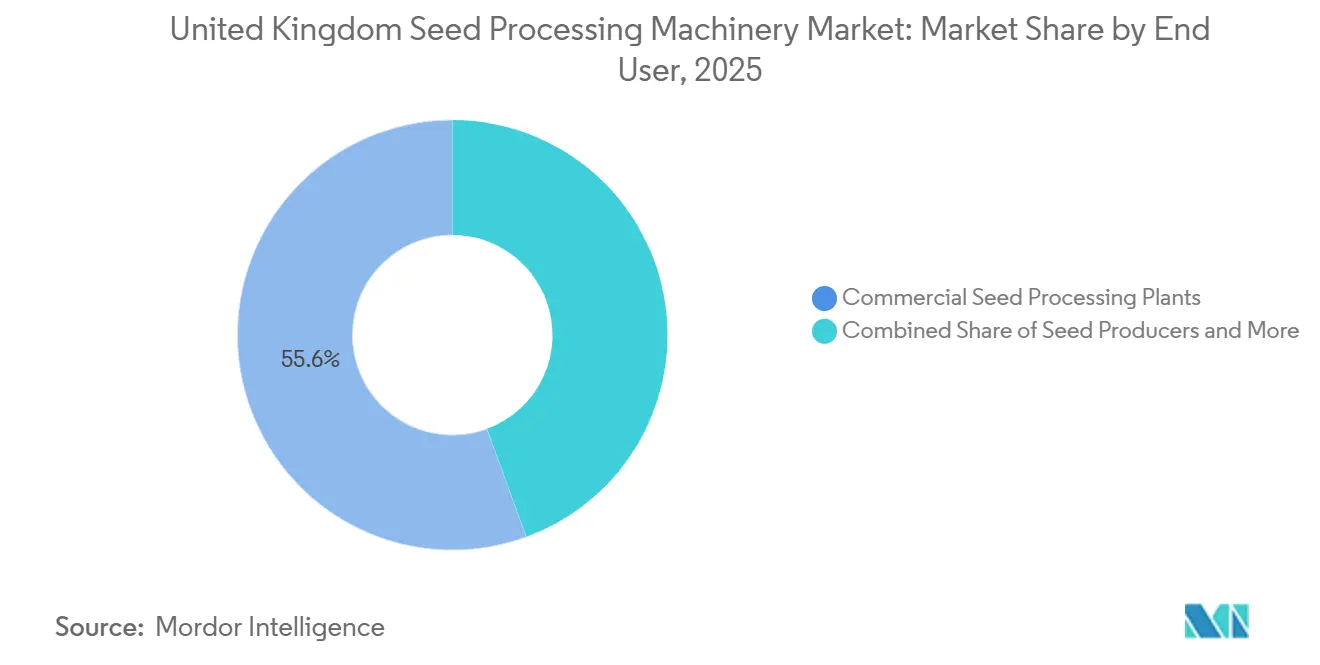
Commercial Plants Anchor Demand as On-Farm Facilities GrowCommercial Seed Processing Plants held 55.6% of the United Kingdom seed processing machinery market share in 2025. These audited and licensed facilities handle a large share of certified seed throughput. Their lines commonly combine pre-cleaning, fine cleaning, gravity separation, optical sorting, coating, treatment, and packing. Commercial plants also require equipment that can preserve lot identity across multiple processing stages. Purchasing decisions at these facilities often prioritize capacity, documented performance, and service coverage, as unplanned downtime during the main processing season can affect delivery schedules and the handling of time-sensitive seed lots. These facilities rely on the United Kingdom seed processing machinery market to supply consistent quality for cereal, grass, oilseed, and specialty seed channels. Research institutions and seed producers represent smaller user groups, but they can influence specifications for precision sensing and specialized sorting equipment.
On-Farm Facilities are forecast to expand at a 6.4% CAGR between 2026 and 2031. Their growth is linked to farm-saved seed and the use of mobile processing contractors. Evans and Pearce reported in 2025 that its mobile units began work earlier and operated at higher throughput than in previous harvests due to dry conditions and greater grower interest in farm-saved seed. Grain handling facilities offer another route to expansion, as farms can adapt existing conveying, drying, and storage assets. The United Kingdom seed processing machinery market gives modular suppliers an opportunity to serve these conversions without requiring greenfield construction. This end-user group is sensitive to equipment portability, integration, and payback timing, as farm operators typically assess investments alongside other demands for storage, drying, labor, and field machinery.
Geography Analysis
England forms the core of the United Kingdom seed processing machinery market, supported by extensive cereal, oilseed, vegetable, and forage seed production across East Anglia, the East Midlands, and Yorkshire and the Humber. The region hosts a high concentration of commercial seed processing facilities, seed merchants, and agricultural service providers, generating sustained demand for seed cleaning, grading, drying, treatment, and optical sorting equipment. According to the United Kingdom Department for Environment, Food & Rural Affairs (DEFRA), the total income from farming reached GBP 8.4 billion (USD 10.67 billion) in 2025, reflecting continued investment across the agricultural value chain. The concentration of large-scale seed processors, coupled with established logistics and supply chains, continues to support investments in automated processing systems that improve throughput, traceability, and certified seed quality.
Scotland has a distinct demand profile, driven by its seed potato industry and spring barley seed production. Variable harvest conditions and stringent seed quality standards increase the need for efficient pre-cleaning, grading, calibration, and optical sorting technologies capable of delivering consistent processing performance. Growing labor costs and the need to improve operational efficiency are encouraging processors to adopt automated equipment that reduces manual handling while enhancing sorting accuracy and product quality. Integrated optical sorting and precision processing technologies are increasingly used in certified seed potato and barley operations to maintain quality and meet market standards.
Wales and Northern Ireland contribute to the market through grass seed, forage crops, oats, and other specialty seed production. Northern Ireland's continued alignment with European Union seed marketing requirements under the Windsor Framework supports demand for processing equipment capable of meeting both United Kingdom and European Union certification standards. While processing facilities in these regions generally operate at smaller scales than those in England and Scotland, they generate demand for compact, modular, and flexible seed processing systems suited to diverse crop types and lower processing volumes. A well-established network of machinery dealers, distributors, and technical service providers supports equipment adoption across the United Kingdom by delivering localized installation, maintenance, and after-sales services.
Competitive Landscape
The United Kingdom seed processing machinery market is characterized by the presence of leading players such as Bühler AG, Cimbria UK Ltd, Satake Europe Limited, Ag Growth International Inc., and Alvan Blanch Development Company Ltd. Other notable participants include PETKUS Technologie GmbH, Westrup ApS, SKIOLD A/S, Oliver Manufacturing Co. Inc., Carter Day International Inc., Lewis M. Carter Manufacturing LLC, Crippen Manufacturing Company, and Tornum Ltd. The competitive landscape comprises full-line system suppliers, specialist equipment manufacturers, distributors, and service providers, enabling customers to procure complete processing lines, retrofit modules, or after-sales maintenance services. Full-line suppliers compete through integrated automation, optical sorting technologies, and engineering expertise, while specialist manufacturers and distributors differentiate themselves by offering modular retrofits, application-specific solutions, extensive installed-base knowledge, and readily available spare parts. This diverse supplier base continues to create opportunities for both established manufacturers and niche equipment providers.
Recent product developments indicate that technology innovation remains a key competitive differentiator. AI-enabled optical sorting systems are increasingly being introduced to improve seed quality assessment, defect detection, and automated sorting accuracy. Advanced optical sorters now integrate red, green, and blue (RGB), near-infrared (NIR), short-wave infrared (SWIR), and ultraviolet (UV) imaging technologies to improve sorting precision for high-value seed lots where conventional mechanical separation may be insufficient. Industry participants are also strengthening AI-assisted color sorting capabilities and expanding technical training programs to improve customer adoption of advanced seed processing technologies. These developments demonstrate that suppliers are increasingly competing on digital capabilities, application expertise, and technical support in addition to machinery performance.
Commercial opportunities remain in specialty crop and herbage seed processing, where optical sorting parameters and application-specific processing solutions continue to evolve. Mobile and semi-portable processing systems also present growth opportunities by serving contractors and smaller seed producers that do not require permanent processing installations. Imported equipment often requires adaptation to United Kingdom electrical standards, dust management requirements, software integration, and site-specific installation, increasing project complexity for smaller processors. Consequently, many customers continue to favor domestically manufactured equipment, modular retrofits, or refurbished systems when seasonal processing volumes do not justify large turnkey investments. Investments in production automation to expand manufacturing capacity and improvements in after-sales service, spare-parts availability, and technical support are expected to remain important competitive strategies as suppliers seek to strengthen their position in the United Kingdom seed processing machinery market.
United Kingdom Seed Processing Machinery Industry Leaders
-
Bühler AG
-
Cimbria UK Ltd (AGCO Corporation)
-
Satake Europe Limited (Satake Corporation)
-
Ag Growth International Inc.
-
Alvan Blanch Development Company Ltd
- *Disclaimer: Major Players sorted in no particular order
United Kingdom Seed Processing Machinery Market Companies Covered in this Report
- Bühler AG
- Cimbria UK Ltd (AGCO Corporation)
- PETKUS Technologie GmbH
- Satake Europe Limited (Satake Corporation)
- Ag Growth International Inc.
- Alvan Blanch Development Company Ltd
- Westrup ApS
- Skiold A/S (Solix Group)
- Oliver Manufacturing Co., Inc.
- Carter Day International, Inc.
- Lewis M. Carter Manufacturing, LLC
- Crippen Manufacturing Company
- Tornum Ltd (Tornum Group)
Recent Industry Developments in United Kingdom Seed Processing Machinery Market
- July 2026: Wild Bio (Oxford University spinout) acquired F1 Seed, a Suffolk-based independent wheat breeding business, forming Britain's first integrated precision-breeding wheat company. The deal followed Wild Bio's EUR 65.8 million (USD 75 million) fundraise from the Ellison Institute of Technology, Oxford Science Enterprises, Braavos Capital, and the University of Oxford. With 12% of the 82 new wheat varieties in 2026 United Kingdom national trials already sourced from F1 Seed's pipeline, the combined entity creates a sustained commercial stream of novel varieties that will require specialized seed processing equipment, particularly optical sorters and graders, to meet certified purity thresholds.
- January 2026: Elsoms Seeds opened a GBP 1.7 million (USD 2.14 million) seed processing facility at its Spalding, Lincolnshire headquarters, England, increasing throughput capacity, grading accuracy, and the ability to apply customer-specific seed treatments. Partners including Bejo, Saaten Union, and Crites Seeds will benefit from enhanced processing standards.
- May 2025: The United Kingdom government and the European Union agreed to pursue a new SPS agreement, targeting alignment on plant reproductive material marketing rules including seed certification frameworks, with effect anticipated from mid-2027.
United Kingdom Seed Processing Machinery Market Report Scope
Seed processing machinery encompasses equipment used in agriculture to clean, sort, grade, dry, treat, and package seeds, improving their quality and viability for planting. These machines play a critical role in removing impurities, ensuring uniformity, and safeguarding seeds from pests and diseases
The United Kingdom Seed Processing Machinery Market Report is Segmented by Machinery Type (Pre-Cleaners, Cleaners, Dryers, Graders, Polishers, Optical Sorters, Seed Packagers, Coaters and Treaters, Separators and Destoners, and Other Specialized Equipment), by Operation Mode (Automatic and Semi-Automatic), and by End-User (Commercial Seed Processing Plants, Seed Producers, On-Farm Facilities, and Grain Handling Facilities). The Market Forecasts are Provided in Terms of Value (USD).
Segmentation Overview
| Pre-Cleaners |
| Cleaners |
| Dryers |
| Graders |
| Coaters and Treaters |
| Separators and Destoners |
| Polishers |
| Optical Sorters |
| Seed Packagers |
| Other Specialized Equipment |
| Automatic |
| Semi-Automatic |
| Commercial Seed Processing Plants |
| Seed Producers |
| Research Institutions |
| On-Farm Facilities |
| Grain Handling Facilities |
| By Machinery Type | Pre-Cleaners |
| Cleaners | |
| Dryers | |
| Graders | |
| Coaters and Treaters | |
| Separators and Destoners | |
| Polishers | |
| Optical Sorters | |
| Seed Packagers | |
| Other Specialized Equipment | |
| By Operation Mode | Automatic |
| Semi-Automatic | |
| By End User | Commercial Seed Processing Plants |
| Seed Producers | |
| Research Institutions | |
| On-Farm Facilities | |
| Grain Handling Facilities |
Key Questions Answered in the Report
What is the size of the United Kingdom seed processing machinery market?
The United Kingdom seed processing machinery market is USD 60.06 million in 2026 and is forecasted to reach USD 74.85 million by 2031 at a 4.50% CAGR.
Which machinery type leads seed processing equipment demand in the United Kingdom?
Cleaners led with 42.7% share in 2025 because certified seed processing depends on reliable air-and-screen separation.
Which segment will grow fastest in United Kingdom seed processing equipment?
Automatic systems are anticipated to expand at an 8.0% CAGR between 2026 and 2031, the highest rate among the reported segments.
What is driving on-farm seed processing investment?
On-farm facilities are forecasted to expand at a 6.4% CAGR as farm-saved seed and mobile contractor services increase equipment access.