
United Kingdom Fresh Herbs Market Size and Share
Market Overview
| Study Period | 2021 - 2031 |
|---|---|
| Forecast Data Period | 2026 - 2031 |
| Base Year Market Size (2025) | USD 397.20 Million |
| Market Size (2026) | USD 421.10 Million |
| Market Size (2031) | USD 564.30 Million |
| Growth Rate (2026 - 2031) | 6.02 % |
| Market Concentration | Medium |
Major Players *Disclaimer: Major Players sorted in no particular order Image © Mordor Intelligence. Reuse requires attribution under CC BY 4.0. | |
United Kingdom Fresh Herbs Market Analysis by Mordor Intelligence
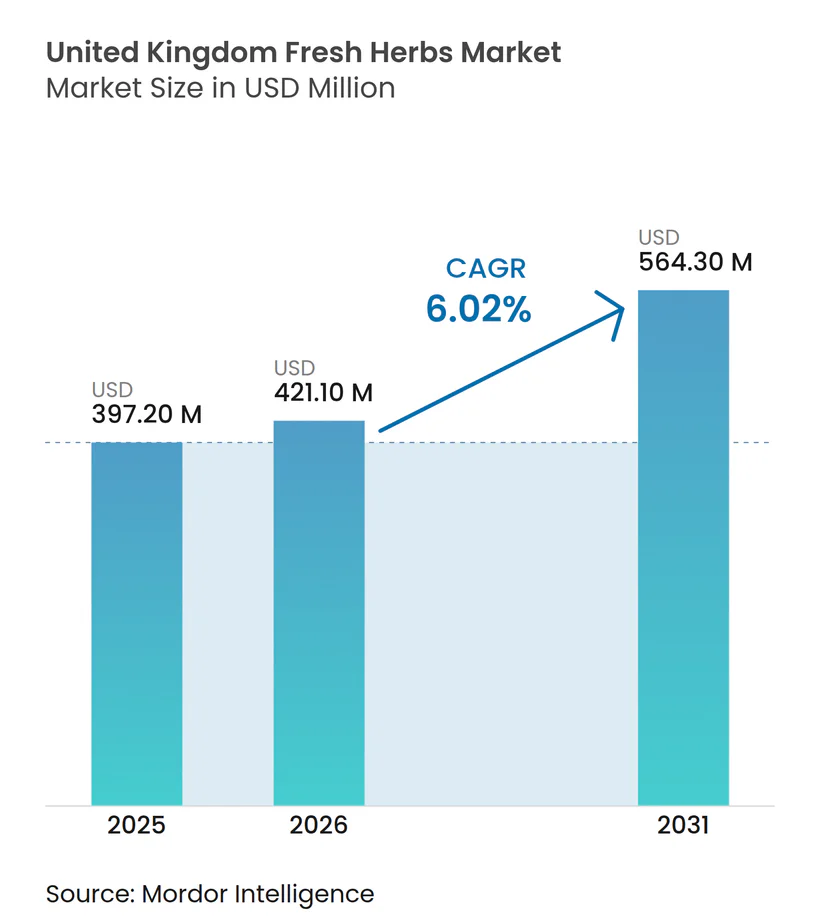
The United Kingdom fresh herbs market size was valued at USD 397.20 million in 2025 and is estimated to grow from USD 421.10 million in 2026 to reach USD 564.30 million by 2031, at a CAGR of 6.02% during the forecast period (2026-2031). The market is supported by domestic sourcing preferences, culinary premiumization, and growth in controlled-environment capacity. Retail sustainability requirements increasingly influence supplier selection, with carbon credentials becoming as important as quality and continuity of supply. Domestic production accounted for 56% of the United Kingdom’s total fresh vegetable supply in 2025, up from 54% in 2024, indicating continued domestic sourcing capacity across the broader fresh-produce sector. Protected-vegetable planted area increased 4.7% to 866 hectares in 2025, supporting year-round domestic production[1]. Long-term agreements between grocers and growers are likely to favor suppliers that can meet audit, traceability, and domestic-supply requirements.
Key Report Takeaways
- By product type, basil accounted for 46.1% of the United Kingdom fresh herbs market share in 2025, while parsley is forecast to grow at a CAGR of 6.7% from 2026 to 2031.
- By category, conventional accounted for 72% of the United Kingdom fresh herbs market size in 2025, while organic is forecast to grow at a CAGR of 8.3% from 2026 to 2031.
- By cultivation method, open-field cultivation accounted for 62% of the market share in 2025, while vertical indoor cultivation is forecast to grow at a CAGR of 9.2% from 2026 to 2031.
- By end user, food retail accounted for 58% of the market share in 2025, while pharmaceutical and nutraceutical applications are forecast to grow at a CAGR of 8.0% from 2026 to 2031.
Note: Market size and forecast figures in this report are generated using Mordor Intelligence’s proprietary estimation framework, updated with the latest available data and insights as of January 2026.
Market Trends and Insights
Drivers Impact Analysis of United Kingdom Fresh Herbs Market*
| Driver | (~) % Impact on CAGR Forecast | Geographic Relevance | Impact Timeline |
|---|---|---|---|
| Growth in Foodservice, Meal Kits, and Global Cuisine | +1.2% | United Kingdom and global cuisine channels | Short term (≤ 2 years) |
| Retail Demand for Convenient Fresh Flavor | +1.0% | United Kingdom | Short term (≤ 2 years) |
| Premiumization of Organic and Pesticide-Free Herbs | +0.9% | United Kingdom and European Union import supply links | Medium term (2-4 years) |
| Controlled-Environment Farming Enables Year-Round Supply | +0.8% | United Kingdom | Long term (≥ 4 years) |
| Retailer Demand for Local, Traceable, and Lower-Carbon Supply | +0.7% | United Kingdom, especially South East England and East Anglia | Medium term (2-4 years) |
| Onshoring and Multi-Country Crop Planning Reduce Seasonal Gaps | +0.5% | United Kingdom and European Union import origins | Long term (≥ 4 years) |
| Source: Mordor Intelligence | |||
Growth in Foodservice, Meal Kits, and Global Cuisine
Foodservice is supporting recurring fresh-herb demand across a wider mix of cuisines in the United Kingdom fresh herbs market. Restaurant, quick-service, and hospitality buyers require dependable supplies throughout the year. Meal kit providers need portioned packs, clear variety labels, and shelf-life compatibility that differ from standard retail packs. South Asian, East Asian, and Mediterranean restaurants are increasing demand for chervil, lemon verbena, and lovage alongside basil and parsley. This wider product mix benefits suppliers that can plan harvests, pack sizes, and delivery schedules around differing customer needs, rather than treating each herb as a standard bulk commodity. Flexible production planning holds greater value because restaurant menus and meal kit recipes can shift demand among varieties, portions, and delivery windows without giving growers the longer planning cycles available for field-scale crops.
Retail Demand for Convenient Fresh Flavor
Retail listings for pre-portioned, pre-cut, and ready-to-use herbs are increasing as convenience becomes more important in household purchasing. Lincolnshire Herbs Ltd launched its Handy Herbs pot-free, one-use living herb line through Morrisons in January 2026, reaching 100 of the retailer's largest stores in the United Kingdom[2]. Vitacress Salads Limited supplies more than 20 million living herb pots and 90 million fresh-cut packs each year in the United Kingdom. The company uses modified-atmosphere films to manage oxygen and carbon dioxide inside packs for fragile coriander and mint. This approach allows retailers to offer smaller quantities suited to planned meals, while suppliers gain a clearer basis for investing in packs designed for specific handling and storage conditions. It can also improve the fit between a household meal occasion and the product on shelf, while helping suppliers limit handling damage and maintain clearer rotation across products with different keeping qualities.
Premiumization of Organic and Pesticide-Free Herbs
Organic and pesticide-free products hold premium shelf positions in the United Kingdom fresh herbs market. The area under organically grown vegetables, including potatoes, increased by 3.3% to 10,000 hectares in 2025, indicating continued expansion of organic horticultural production in the United Kingdom. Certified supply can meet retailer requirements that conventional products may not satisfy without added certification systems. As a result, the category favors growers that can document their cultivation choices and maintain consistent certification records, particularly when their products are sold through major grocery accounts. These systems can make the premium segment more accessible to larger retail programs, but they also require growers to treat certification, residue management, and traceable documentation as routine operating capabilities rather than occasional checks.
Controlled-Environment Farming Enables Year-Round Supply
Greenhouses, hydroponic systems, and vertical farms enable a year-round domestic supply in the United Kingdom fresh herbs market. Fischer Farms operates a vertical farming facility in Norwich with 25,000 square meters of vertically stacked growing space. The site produces 6.5 tonnes of leafy greens and herbs each week, with yields estimated at 250 times conventional farmland per unit area[3]. Langmead Herbs Limited combines a 1,000-hectare West Sussex outdoor farm with a 2.2-hectare glasshouse and 1.5 hectares of polytunnels. This can influence sourcing decisions for short-life products, as a controlled domestic operation can offer consistent quality, known provenance, and a shorter route to the retailer or foodservice customer. The model gives buyers an additional source of supply for fragile herbs, particularly when stable quality and predictable shelf life are required without dependence on longer import routes or a narrow outdoor growing season.
Restraints Impact Analysis of United Kingdom Fresh Herbs Market*
| Restraint | (~) % Impact on CAGR Forecast | Geographic Relevance | Impact Timeline |
|---|---|---|---|
| Short Shelf Life and Retail Shrink | -0.9% | United Kingdom | Short term (≤ 2 years) |
| Energy Intensity of Protected and Indoor Production | -0.7% | United Kingdom | Medium term (2-4 years) |
| Water Stress and Weather-Driven Yield Volatility | -0.6% | United Kingdom, particularly South East England | Medium term (2-4 years) |
| Fragmented Grower Base and Uneven Scale Economics | -0.5% | United Kingdom | Long term (≥ 4 years) |
| Source: Mordor Intelligence | |||
Short Shelf Life and Retail Shrink
Fresh herb perishability creates a persistent cost burden across retail and foodservice supply chains. Basil and shiso have a shelf life of 1 to 2 weeks under appropriate cold-chain conditions, while rosemary and thyme can last 3 weeks at 0°C when properly calibrated packaging is used. Unsold packs raise the cost to serve for growers and grocery buyers when demand changes quickly. As retailers add varieties and formats, a wider assortment increases the challenge of matching short product life with variable store-level demand. The commercial effect extends beyond disposal costs, as frequent short shipments, store handling, and markdown decisions can also influence how retailers set assortment breadth and reorder patterns across the category.
Energy Intensity of Protected and Indoor Production
Protected cultivation supports domestic continuity but requires substantial energy use. High electricity and gas costs can reduce the competitiveness of United Kingdom glasshouse and vertical-farm operators against warmer Mediterranean production areas. Vitacress Salads Limited has progressed a photovoltaic program involving 1,200 solar panels and has trialed peat-free substrates. Renewable generation and hedged supply agreements can reduce exposure to price volatility. The resulting cost pressure can slow the expansion of protected capacity, even when retailers and consumers want more domestically grown herbs available year-round. This creates tension within the category, as the same protected systems that support local continuity can constrain expansion when operating costs rise faster than buyers can absorb in selling prices.
*Our forecasts treat driver/restraint impacts as directional, not additive. The impact forecasts reflect baseline growth, mix effects, and variable interactions.
United Kingdom Fresh Herbs Market Segment Analysis
By Product Type:
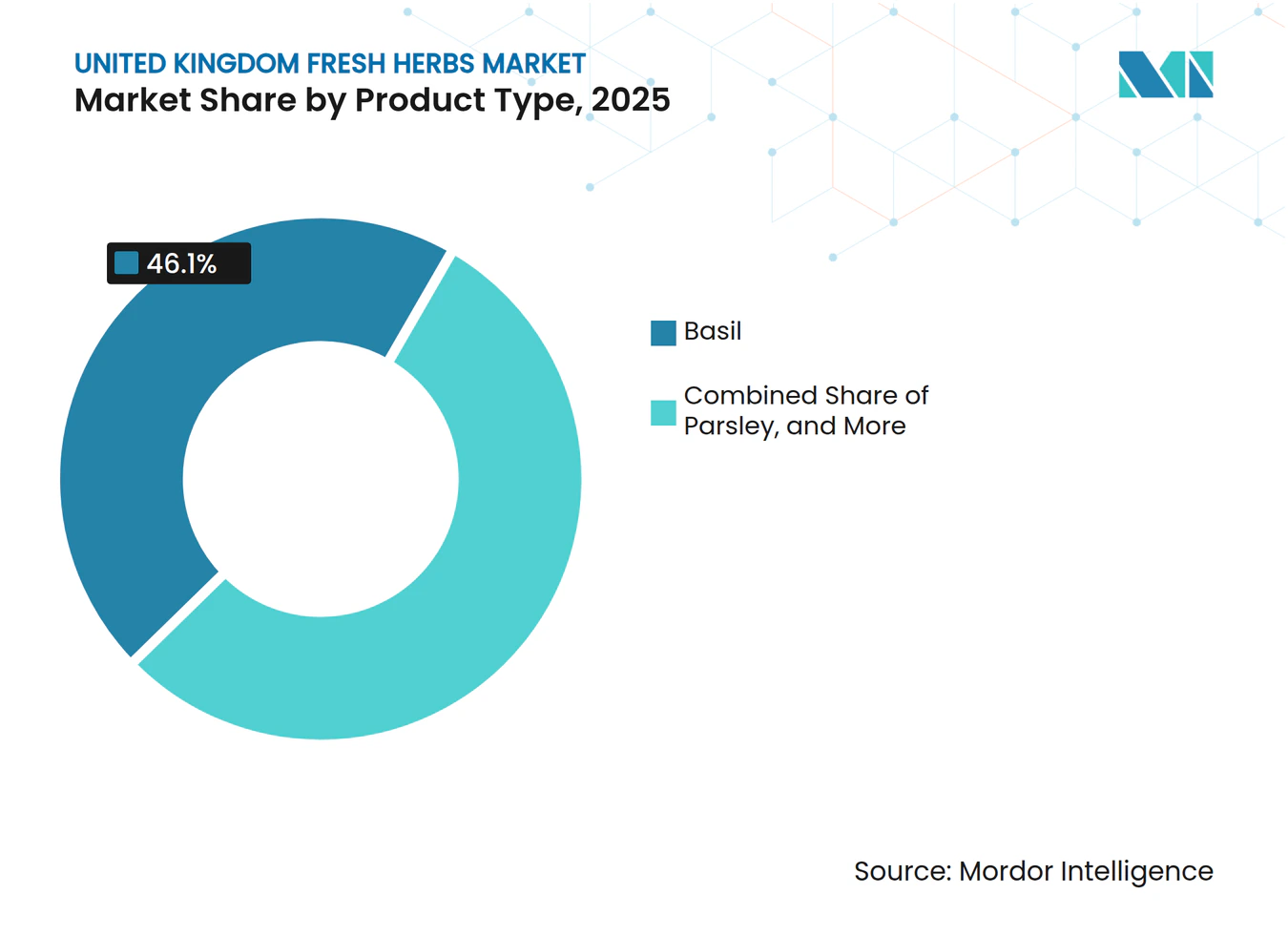
Basil Leads and Parsley Grows FastestBasil accounted for 46.1% of the United Kingdom fresh herbs market share in 2025. Its position reflects demand for fresh bunches, living potted herbs, and foodservice preparation across mainstream and premium cuisine. Glasshouse and vertical-farm production support year-round availability for the category. Vitacress Salads Limited operates a 13.5-hectare West Sussex growing site, while Fischer Farms Ltd operates a Norwich vertical facility. Crate to Plate also uses aeroponic production in London. These production models help maintain availability for a herb that anchors many retail ranges.
Parsley is forecast to grow at a CAGR of 6.7% from 2026 to 2031, supported by its use across meal kits, prepared foods, and cuisines such as Mediterranean and European. Mint serves beverages and South Asian cuisine, while coriander supports South Asian and Mexican cooking. Chives and dill are used in dairy-based prepared foods, while rosemary and thyme are important in ready meals and food manufacturing. Micro herbs and specialty varieties offer a niche for vertically integrated restaurant suppliers. Diversified production locations can also reduce exposure to the concentration of glasshouse basil production in West Sussex.



Category:
Conventional Leads While Organic Grows FastestConventional accounted for 72% the United Kingdom fresh herbs market share in 2025. Mainstream grocery and foodservice buyers continue to use conventional products for high-volume purchasing. Langmead Herbs Limited and Wellington Fresh have established product ranges, retailer certifications, and cold-chain partnerships. These capabilities support conventional supply in mass-market channels. Their scale allows them to serve multiple varieties and formats. The category remains important where affordability is central to purchasing decisions.
Organic is forecast to grow at a CAGR of 8.3% from 2026 to 2031. The United Kingdom fresh herbs market size for organic products is supported by the increase in organically grown vegetable area to 10 thousand hectares in 2025. Retailers are increasingly considering organic certification, residue-free cultivation, and transparent provenance in procurement. Blackdown Growers supplies certified organic basil in several formats for foodservice, retail, and processors. Langmead Herbs Limited acquired R & G Fresh in September 2026, adding the sole fresh-cut herb supplier to Waitrose. This transaction reflects the value of supply-chain control and scale in both conventional and organic herb distribution.
By Cultivation Method:
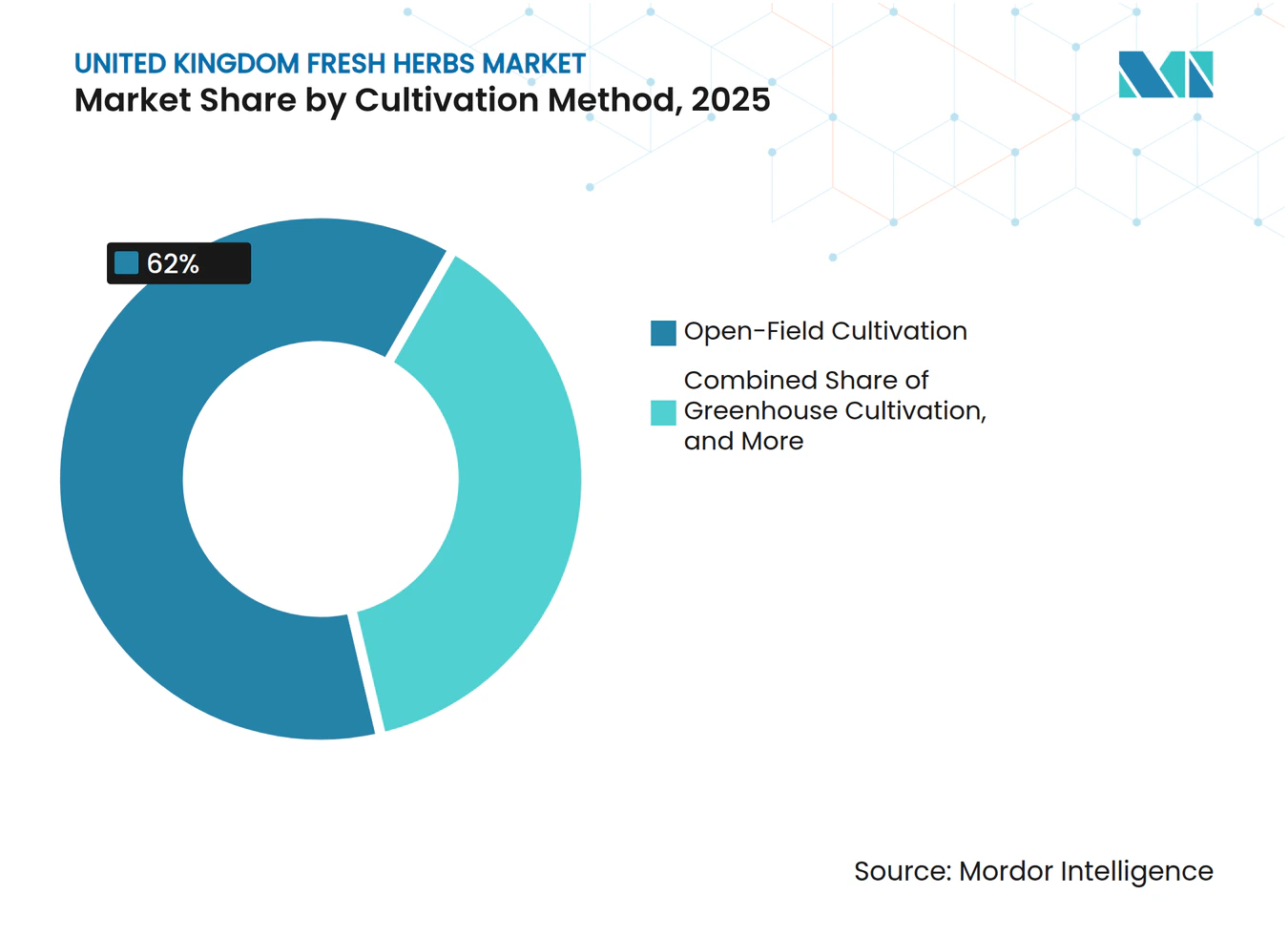
Open-Field Production Leads and Indoor Farming AdvancesOpen-field cultivation accounted for 62% of the United Kingdom fresh herbs market share in 2025. The method offers a cost advantage for hardy herbs such as rosemary, thyme, chives, and parsley during the domestic growing season. Langmead Herbs Limited operates a 1,000-hectare farm in West Sussex and produces 500 tonnes of sustainably farmed herbs annually. Greenhouse production helps suppliers maintain year-round output of fragile basil and mint. Vitacress Salads Limited and Westlands UK use protected growing systems for selected herb varieties. Hydroponic systems also serve urban-adjacent restaurant and specialty retail customers.
Vertical indoor cultivation is forecast to grow at a CAGR of 9.2% from 2026 to 2031. Fischer Farms Ltd uses climate-controlled, biosecure tunnels to provide predictable production conditions. Green Up Farm in Wales and Crate to Plate in London also use controlled systems to supply fresh, consistent output. Improved LED efficiency is supporting the economics of high-value indoor production. Electricity costs remain the central constraint on wider adoption. Producers that combine renewable generation with favorable grid access may build an enduring cost advantage.

By End User:
Food Retail Leads While Pharmaceutical and Nutraceutical Applications Grow FastestFood retail accounted for 58% of the United Kingdom fresh herbs market share in 2025. Tesco, Sainsbury's, Waitrose, and Morrisons influence listing requirements, packaging specifications, and pricing across much of the category. Major store formats expanded their fresh herb ranges from 5-6 varieties to 15-20 varieties after 2024. This creates opportunities for established growers and specialized producers. Foodservice is the next important outlet, with demand for provenance, variety breadth, and frequent delivery. Food processing also uses herbs in flavoring, sauces, and ready meals.
Pharmaceutical and nutraceutical applications are forecast to grow at a CAGR of 8% from 2026 to 2031. Functional foods, supplements, and nutraceutical products use herb-derived ingredients. Parsley, mint, thyme, and sage are valued for antimicrobial, anti-inflammatory, and antioxidant properties. These buyers may specify fresh herb inputs where preservation of bioactive compounds is required. They also require certificates of analysis, residue testing, and supply-chain traceability. These requirements create a capability gap for growers set up only for standard grocery logistics.
Geography Analysis
England represents the largest geographic market within the United Kingdom fresh herbs market, supported by its concentration of population, retail activity, foodservice demand, and controlled-environment production. Norfolk hosts Fischer Farms Ltd's vertical facility at the Food Enterprise Park in Easton. Protected vegetable planted area rose 4.7% to 866 hectares in 2025. Major grocery distribution networks in the Midlands and South reinforce England's central role.
Scotland has a smaller but developing profile within the United Kingdom fresh herbs market. Demand is concentrated in Edinburgh and Glasgow, and much of the supply still comes from England or imports. PeachyKeen entered commercial testing in Kirkcaldy in 2025 with an energy-integrated hydroponic installation in an existing building. The project demonstrates a controlled-environment model suited to local supply. Scotland's colder climate limits open-field growing seasons more than in southern England, making domestic vertical production relevant to areas that depend on inbound fresh herbs.
Wales and Northern Ireland represent smaller but strategically important opportunities. Green Up Farm supplies hydroponic living microgreens and micro herbs in Wales, while Ty Isa Farm produces Genovese basil microherbs throughout the year. These facilities support specialty retail and restaurant accounts. Northern Ireland relies mainly on imports from Great Britain, with limited domestic growing capacity. Its mild and damp climate could support protected-cultivation investment. Domestic vegetables accounted for 56% of the United Kingdom fresh supply in 2025, creating momentum for regional herb production
Competitive Landscape
Market Concentration
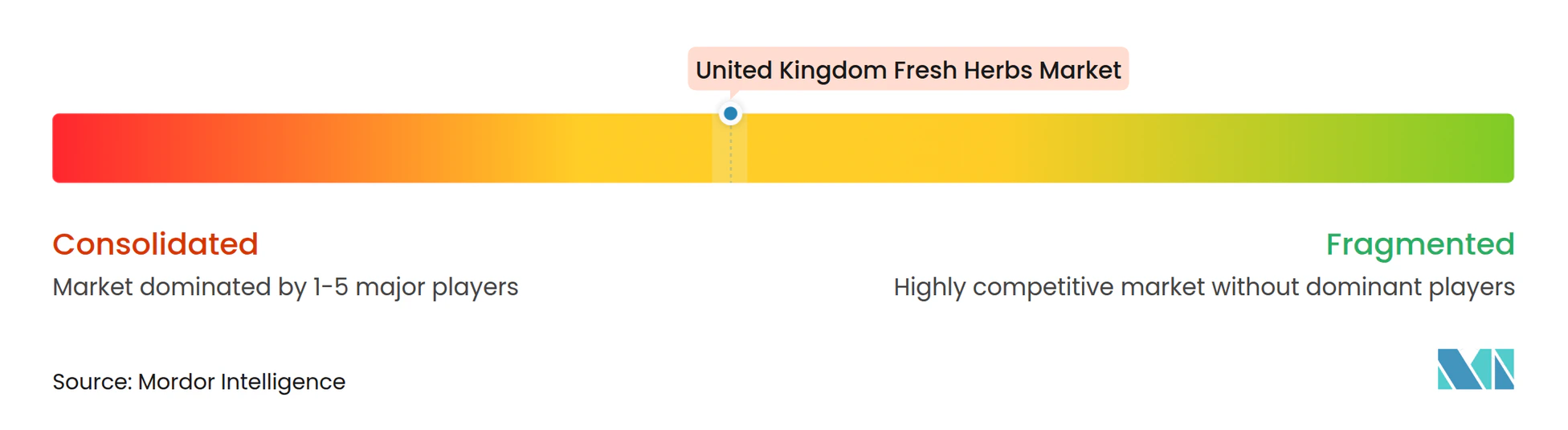
The United Kingdom fresh herbs market is moderately consolidated. Vitacress Salads Limited, Langmead Herbs Limited, Westlands UK, Fischer Farms Ltd, and Herbs Unlimited are among the key companies operating in the market. Vitacress Salads Limited supplies more than 20 million living herb pots and 90 million fresh-cut packs annually in the United Kingdom. Its SEASON herbs brand reaches garden retailers and grocery channels.
Langmead Herbs Limited acquired R & G Fresh in September 2026, adding a packing facility in Farnborough and Kenyan farming operations. The acquired business was Waitrose's sole supplier of fresh-cut herbs. This move strengthens Langmead's supply capacity, geographic resilience, and coverage with major retailers. Fischer Farms Ltd achieved an AA BRCGS food safety rating in 2025. The certification supports engagement with retail and foodservice customers that require verified food safety standards. Competition, therefore, combines scale-based efficiency with technology-driven differentiation.
Vitacress Salads Limited has added photovoltaic capacity, reduced cardboard use by 25,000 kg annually through automated pallet wrapping, and trialed peat-free growing substrates. These actions indicate that environmental performance now affects supplier positioning. Specialist operators compete through freshness, controlled output, and targeted channels rather than national volume. Winter domestic supply, e-commerce packs with longer shelf lives, and portioned formats for quick-service foodservice remain in limited supply. Strong retailer relationships, certification, and delivery reliability will remain important competitive factors.
United Kingdom Fresh Herbs Industry Leaders
-
Vitacress Salads Limited (RAR Group)
-
Langmead Herbs Limited (Langmead Group)
-
Westlands UK
-
Fischer Farms Ltd
-
Herbs Unlimited
- *Disclaimer: Major Players sorted in no particular order
United Kingdom Fresh Herbs Market Companies Covered in this Report
- Vitacress Salads Limited (RAR Group)
- Langmead Herbs Limited (Langmead Group)
- Westlands UK
- Herbs Unlimited
- Blackdown Growers
- Jones Food Company Limited
- Fischer Farms Ltd
- Green Up Farm
- Living Herbs, LLC
- Nurtured in Norfolk
- Rocket Farms, Inc.
- Gotham Greens Holdings LLC
- 80 Acres Farms, Inc.
- Farm.One, Inc.
- Indoor Urban Farming GmbH
Recent Industry Developments in United Kingdom Fresh Herbs Market
- September 2026: Langmead Herbs Limited acquired specialist fresh-cut herbs company R&G Fresh. R&G Fresh operates a packing facility in Farnborough and is the sole supplier of fresh-cut herbs to Waitrose, with farming operations in Kenya. The acquisition expands Langmead Herbs’ fresh herb supply-chain capabilities.
- May 2026: Lincolnshire Herbs showcased its new Handy Herbs range at Farm Fest 2026. The range is designed to make fresh herbs more convenient, accessible, and sustainable for consumers and is currently exclusive to Morrisons, with availability in 100 of its largest stores across the United Kingdom.
- 2025: Fischer Farms Ltd launched Fischer Farms Technology, a modular growing solution designed to provide scalable, controlled, and year-round indoor production. The technology uses modular grow containers with controlled environmental conditions, lighting, irrigation, and crop-management systems.
United Kingdom Fresh Herbs Market Report Scope
The fresh herbs market refers to the production and commercialization of fresh culinary and aromatic herbs. It covers fresh herbs supplied through various distribution channels for foodservice, retail, food processing, pharmaceutical and nutraceutical, and other applications.
The United Kingdom Fresh Herbs Market is Segmented by Product Type (Basil, Cilantro/Coriander, Mint, Parsley, Chives, Rosemary, Thyme, Dill, Sage, and Other Fresh Herbs), by Category (Conventional and Organic), by Cultivation Method (Open-Field Cultivation, Greenhouse Cultivation, Hydroponic Cultivation, Aeroponic Cultivation, and Vertical Indoor Cultivation), and by End User (Foodservice, Food Retail, Food Processing, Pharmaceutical and Nutraceutical, and Others). The Market Forecasts are Provided in Terms of Value (USD).
Segmentation Overview
| Basil |
| Cilantro/Coriander |
| Mint |
| Parsley |
| Chives |
| Oregano |
| Rosemary |
| Thyme |
| Sage |
| Dill |
| Other Fresh Herbs |
| Conventional |
| Organic |
| Open-Field Cultivation |
| Greenhouse Cultivation |
| Hydroponic Cultivation |
| Aeroponic Cultivation |
| Vertical Indoor Cultivation |
| Foodservice |
| Food Retail |
| Food Processing |
| Pharmaceutical and Nutraceutical |
| Others |
| By Product Type | Basil |
| Cilantro/Coriander | |
| Mint | |
| Parsley | |
| Chives | |
| Oregano | |
| Rosemary | |
| Thyme | |
| Sage | |
| Dill | |
| Other Fresh Herbs | |
| By Category | Conventional |
| Organic | |
| By Cultivation Method | Open-Field Cultivation |
| Greenhouse Cultivation | |
| Hydroponic Cultivation | |
| Aeroponic Cultivation | |
| Vertical Indoor Cultivation | |
| By End User | Foodservice |
| Food Retail | |
| Food Processing | |
| Pharmaceutical and Nutraceutical | |
| Others |
Key Questions Answered in the Report
What is the value of the United Kingdom fresh herbs market?
The United Kingdom fresh herbs market size was valued at USD 397.20 million in 2025 and is estimated to grow from USD 421.10 million in 2026 to reach USD 564.30 million by 2031, at a CAGR of 6.02% during the forecast period (2026-2031).
Which fresh herb has the largest share in the United Kingdom?
Basil accounted for 46.1% of the market share in 2025, supported by its use in fresh bunches, living pots, foodservice preparation, and broad retail availability throughout the year.
Which cultivation method is growing fastest for United Kingdom fresh herbs?
Vertical indoor cultivation is forecast to grow at a CAGR of 9.2% from 2026 to 2031, as controlled production supports a consistent supply of high-value herbs, although energy costs remain an important constraint.
What is driving demand for fresh herbs in the United Kingdom?
Demand is supported by convenient formats, foodservice, wider cuisine preferences, organic products, and year-round controlled-environment supply.