
United Kingdom Fixed Wireless Access Market Size and Share
Market Overview
| Study Period | 2020 - 2031 |
|---|---|
| Forecast Data Period | 2026 - 2031 |
| Base Year Market Size (2025) | USD 1.60 Billion |
| Market Size (2026) | USD 1.85 Billion |
| Market Size (2031) | USD 3.63 Billion |
| Growth Rate (2026 - 2031) | 14.43 % |
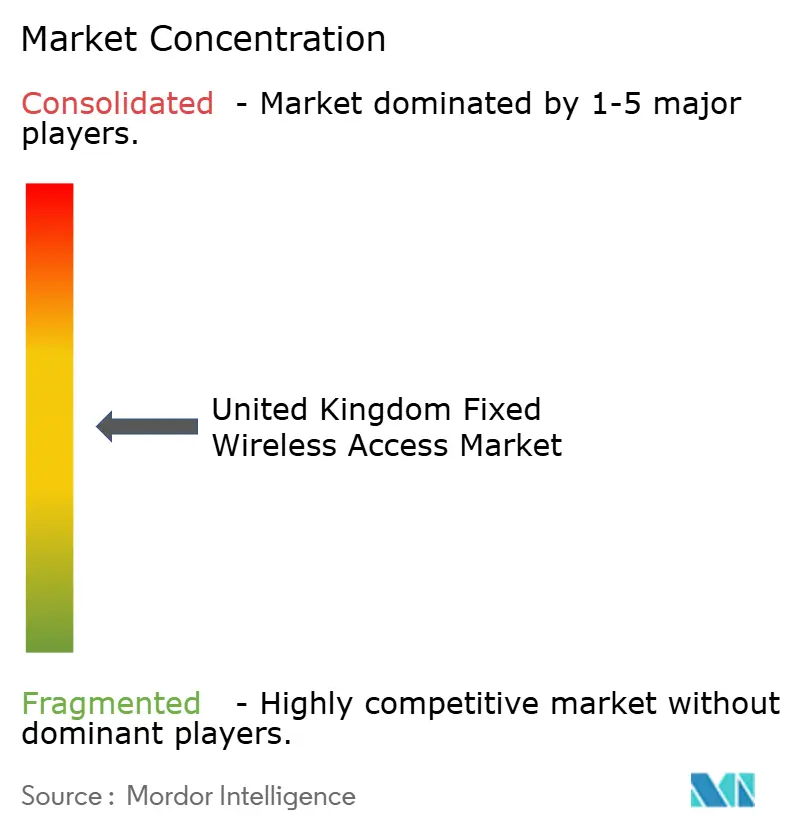
| Market Concentration | Medium |
Major Players *Disclaimer: Major Players sorted in no particular order Image © Mordor Intelligence. Reuse requires attribution under CC BY 4.0. | |
United Kingdom Fixed Wireless Access Market Analysis by Mordor Intelligence
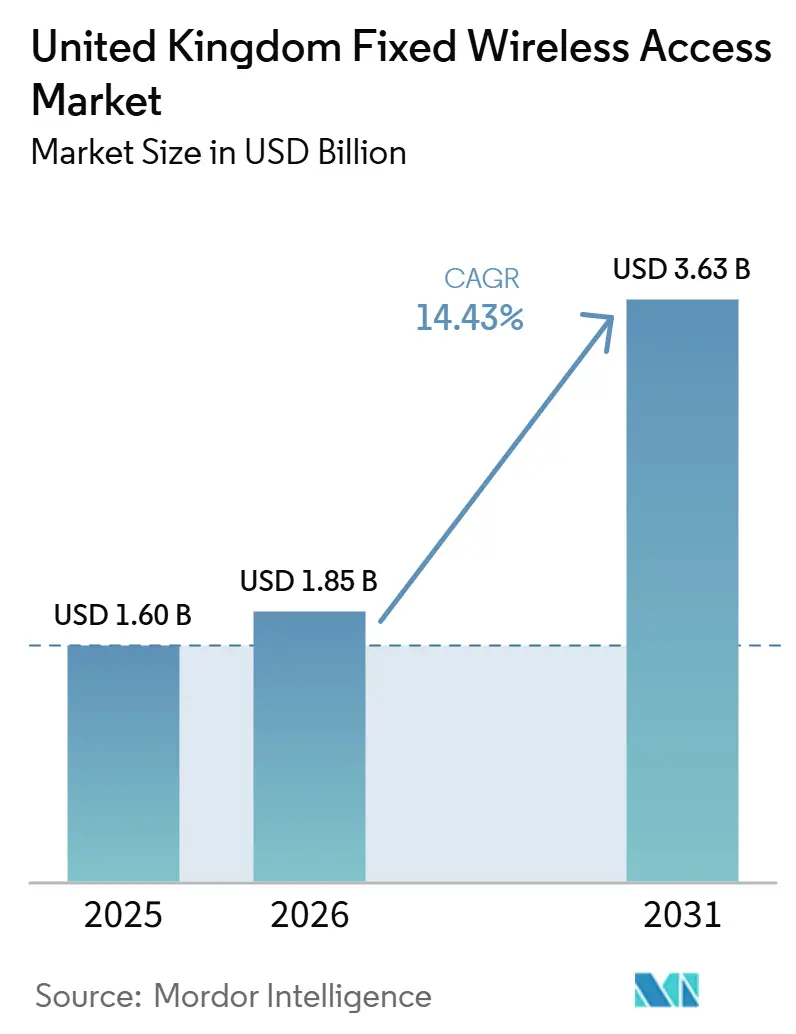
The United Kingdom Fixed Wireless Access Market size is expected to increase from USD 1.60 billion in 2025 to USD 1.85 billion in 2026 and reach USD 3.63 billion by 2031, growing at a CAGR of 14.43% over 2026-2031. Growth no longer depends solely on gaps in fiber deployment, because mobile network operators now treat fixed wireless access as a separate revenue line with its own pricing, bundles, and customer-premises equipment distribution model. VodafoneThree’s May 2026 5G Broadband launch showed that mass-market 5G fixed wireless access had entered a more commercial phase in the United Kingdom, especially for homes that still lacked full-fiber access. Rising 5G coverage across the major operators is also providing the market with the geographic density needed for broader launches, improved network utilization, and more consistent service positioning. Rural wireless internet service providers are expanding at the same time under Project Gigabit, which keeps a multi-year demand window open for fixed wireless access in hard-to-reach areas and supports hybrid delivery models alongside fiber. Fiber overbuild, spectrum limits, and strong broadband pricing from incumbent providers still create pressure, but managed connectivity offers and public-sector demand continue to support expansion across the UK fixed wireless access market.
Key Report Takeaways
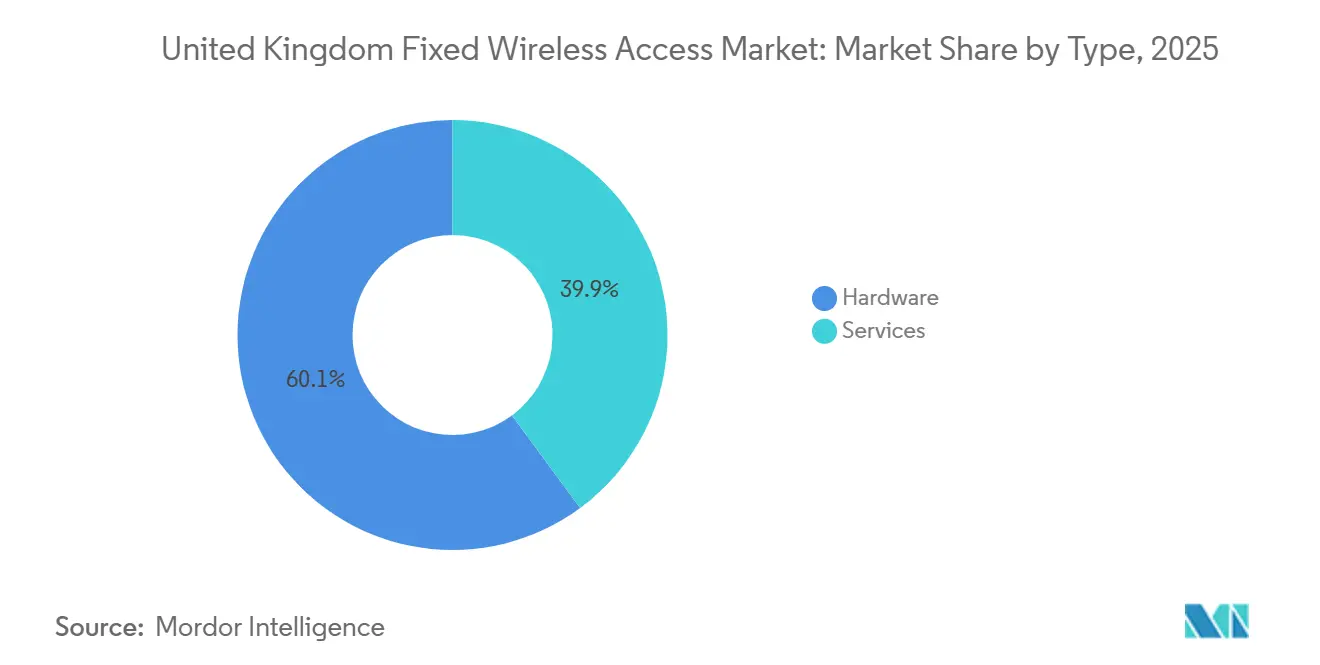
- By type, hardware accounted for 60.13% of the revenue share of the United Kingdom fixed wireless access market in 2025, while services are projected to expand at a 15.10% CAGR through 2031.
- By application, residential held a 65.13% of the revenue share of the United Kingdom fixed wireless access market in 2025, while government and public safety are projected to record the fastest growth at a 15.76% CAGR through 2031.
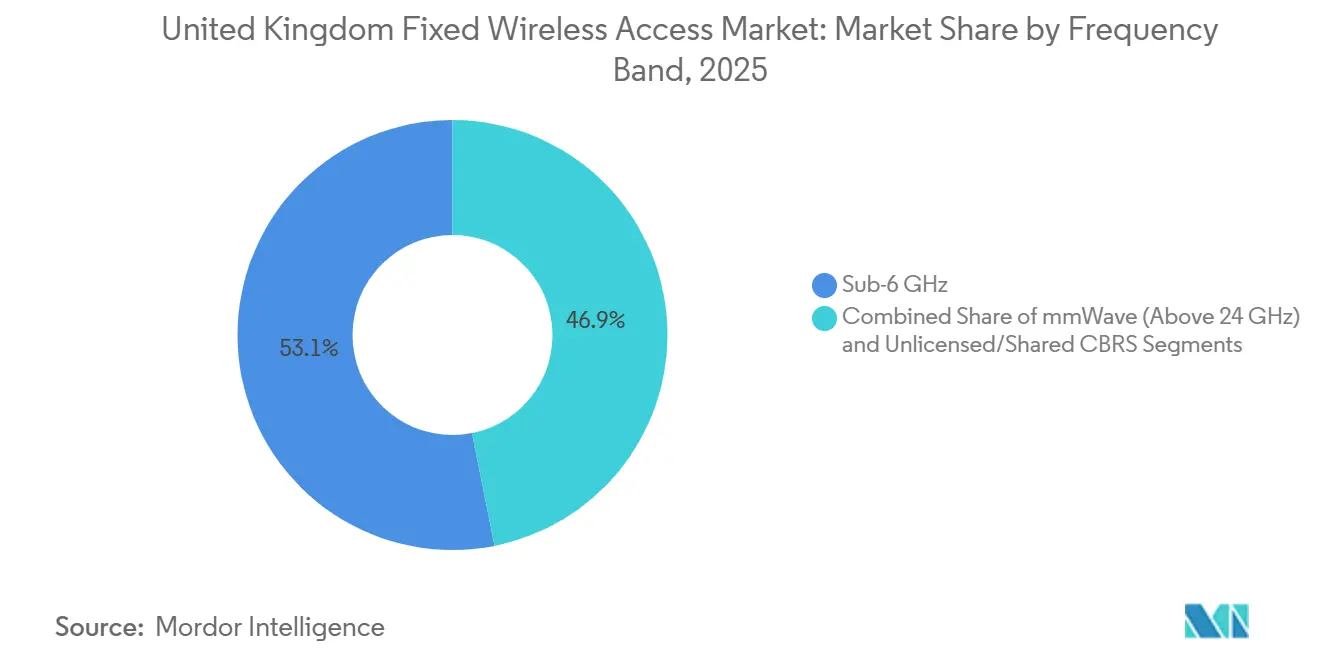
- By frequency band, sub-6 GHz captured 53.12% of the revenue share of the United Kingdom fixed wireless access market in 2025, while mmWave (above 24 GHz) is expected to expand at a 14.88% CAGR through 2031.
- By deployment mode, indoor CPE commanded 62.33% of the revenue share of the United Kingdom fixed wireless access market in 2025, while self-install window-mount CPE is projected to grow at a 15.99% CAGR through 2031.
Note: Market size and forecast figures in this report are generated using Mordor Intelligence’s proprietary estimation framework, updated with the latest available data and insights as of January 2026.
United Kingdom Fixed Wireless Access Market Trends and Insights
Drivers Impact Analysis*
| Driver | (~) % Impact on CAGR Forecast | Geographic Relevance | Impact Timeline |
|---|---|---|---|
| 5G Roll-Out Expanding Gigabit-Grade Fixed Wireless Access Coverage | +4.2% | National, with strongest gains in urban cores and suburban corridors, including London, Manchester, and Birmingham | Short term (≤ 2 years) |
| Rural Broadband Gap Sustaining Demand for Rapid Last-Mile Deployment | +3.1% | Rural England, Wales, Scotland, and Northern Ireland, especially BDUK-targeted underserved premises | Medium term (2-4 years) |
| Fixed Wireless Access as a Cost-Effective Alternative to Fiber in Hard-to-Reach Locations | +2.4% | Scottish Highlands, upland Wales, rural Yorkshire and Lincolnshire, and dispersed Northern Ireland settlement clusters | Medium term (2-4 years) |
| Enterprise Backup Connectivity Demand From SMB and Branch Networks | +1.8% | National, concentrated in enterprise parks, retail chains, and distributed branch networks across England and Scotland | Medium term (2-4 years) |
| Private 5G and Edge Use Cases Expanding Enterprise Fixed Wireless Access Adoption | +1.2% | Industrial corridors and logistics hubs across England, Scotland, and Wales, especially Ofcom shared access spectrum zones | Long term (≥ 4 years) |
| Self-Install Consumer Premise Equipment Reducing Installation Friction and Truck Rolls | +0.8% | National, with stronger effect in high-density rental markets such as London, Bristol, Leeds, and Manchester | Short term (≤ 2 years) |
| Source: Mordor Intelligence | |||
5G Roll-Out Expanding Gigabit-Grade Fixed Wireless Access Coverage
The shift toward 5G Standalone infrastructure is turning network capacity into services that can be sold and supported at scale across the UK fixed wireless access market. VodafoneThree said its GBP 11 billion (USD 14.8 billion) investment plan targets 99% 5G Standalone population coverage by 2030, and the company is using Multi Operator Core Network infrastructure across more than 10,000 shared sites to widen addressable fixed wireless access coverage without a matching rise in capital intensity. Virgin Media O2 activated 5G Standalone for large enterprise, public-sector, and SME customers across 500 UK towns and cities in February 2025, which improved the network baseline for enterprise-grade fixed wireless access use cases. Ofcom reported in Spring 2026 that 5G outdoor coverage from all major operators had moved to a 76%-94% range, up from 47%-65% in mid-2025, which materially increased the addressable premises base for the UK fixed wireless access market. This stage differs from earlier 4G-led cycles because operators are tying product launches to 5G Standalone capability, which supports service differentiation, lower latency, and more stable performance. The regulatory push behind the UK Wireless Infrastructure Strategy is also helping convert coverage obligations into commercial momentum, which strengthens the operating case for the UK fixed wireless access market.
Rural Broadband Gap Sustaining Demand for Rapid Last-Mile Deployment
The rural demand base remains important because public funding continues to recognize that many areas are expensive to connect with fixed-line infrastructure, thereby preserving a clear role for the UK fixed wireless access market. Building Digital UK allocated GBP 1.9 billion (USD 2.43 billion) in capital investment through 2029-2030, and the revised Project Gigabit target of 99% gigabit coverage by 2032 extends the demand window for fixed wireless access operators in underserved areas. BDUK also confirmed that 89% of all premises connected through subsidy in fiscal 2024/25 were in rural areas, indicating that these geographies still account for a large share of intervention-led broadband spending.[1]Building Digital UK, “Bulletin, BDUK Delivery Performance, Annual, April 2024 to March 2025,” GOV.UK, gov.uk Airband’s network covered more than 440,000 premises across Wales and South West England by December 2025, and Quickline delivered 36,650 Project Gigabit connections during 2025 before passing more than 40,000 premises by early 2026, which shows that rural fixed wireless access can scale to meaningful volumes under live delivery programs. Ofcom also reported that 39,000 UK premises still could not access decent broadband from any fixed-line or fixed-wireless network in January 2026, leaving a priority group that is more likely to be served by wireless solutions than by expensive trenching projects. That backdrop keeps rural providers relevant even as larger operators expand, and it supports a longer runway for the UK fixed wireless access market in low-density areas.
Fixed Wireless Access as a Cost-Effective Alternative to Fiber in Hard-to-Reach Locations
Fixed wireless access is competing more directly on economics, not only on coverage, in difficult service areas across the UK. Vodafone’s 5G broadband offer started at GBP 21 (USD 26.88) per month on a 24-month contract, with no installation cost and no engineer visit, removing a key source of customer friction in locations where fiber build economics remain difficult. The report also noted that traditional truck-roll expenses often ranged from GBP 50 (USD 65.88) to GBP 300 (USD 395.26) per premise, which helps explain why self-install and low-touch operating models matter so much in rural and semi-rural deployments.[2]IRS, “Yearly Average Currency Exchange Rates,” IRS, irs.gov Quickline introduced a 2.3 Gbps symmetric broadband package in February 2026, challenging the view that wireless access must sit below fiber speeds in residential and SMB settings. As speed expectations move closer to what households need for common sub-500 Mbps usage, price and ease of setup become more important, and that gives the UK fixed wireless access market a durable opening in areas where trenching costs are hard to justify. Ofcom’s July 2025 revision of Three UK’s 3.9 GHz license to support 5G technology for home broadband also widened the spectrum tools available for cost-competitive service deployment.
Enterprise Backup Connectivity Demand From SMB And Branch Networks
Enterprise demand is becoming a more visible growth path because distributed businesses want faster provisioning, better resilience, and more flexibility than many fixed-line alternatives can provide in the UK fixed wireless access market. The source content linked this demand to the growing adoption of SD-WAN solutions that can balance traffic across fiber, fixed wireless access, and satellite for branch networks and smaller business sites. Virgin Media O2’s February 2025 5G Standalone activation for enterprise and public-sector customers broadened the quality baseline for fixed wireless access beyond standard consumer broadband portfolios. Vodafone’s next-day delivery model and self-install approach also address a speed-to-service gap that leased-line and fiber-heavy solutions often cannot solve for temporary locations, retail branches, and newly opened offices. The United Kingdom’s large base of distributed retail, logistics, and professional services sites provides this use case with a practical, addressable pool rather than a narrow niche. This means enterprise backup connectivity is not only a secondary application, because it is becoming part of mainstream resilience planning across the UK fixed wireless access market.
Restraints Impact Analysis*
| Restraint | (~) % Impact on CAGR Forecast | Geographic Relevance | Impact Timeline |
|---|---|---|---|
| Spectrum Availability Constraints and Licensing Uncertainty | -1.8% | National, with greater pressure on WISPs in 3.8-4.2 GHz and 5.8 GHz bands and in urban licence contention zones | Medium term (2-4 years) |
| Weather Sensitivity Affecting High-Band Performance and Reliability | -1.3% | Scottish Highlands, Northern Ireland, coastal areas, and upland rural zones with high precipitation | Short term (≤ 2 years) |
| Fiber Substitution and Aggressive Broadband Pricing Limiting Premium Uptake | -1.1% | Urban and suburban England, especially Greater London, the South East, and the Midlands, where FTTP overbuild is more advanced | Long term (≥ 4 years) |
| Planning, Backhaul, and Rooftop Access Constraints Slowing Network Densification | -0.8% | Dense urban areas, conservation zones, and listed buildings across England, Scotland, and Wales | Medium term (2-4 years) |
| Source: Mordor Intelligence | |||
Spectrum Availability Constraints and Licensing Uncertainty
Spectrum access remains one of the clearest structural limits on the UK fixed wireless access market, because the same regulatory system that opens bands for use also creates uneven access between national operators and smaller rural providers. Ofcom completed the mmWave auction in October 2025 and awarded EE, O2, and VodafoneThree each 800 MHz at 26 GHz and 1 GHz at 40 GHz for GBP 13 million (USD 16.64 million) per operator across 68 high-density areas, improving high-capacity urban availability but concentrating those assets among 3 large players.[3]Ofcom, “Ofcom Spectrum Auction, Final Results Announced,” Ofcom, ofcom.org.uk At the same time, the United Kingdom had 575 active shared access licenses in the 3.8-4.2 GHz band by October 2025, which increased interference management complexity and technical overhead for operators without exclusive holdings. A government-backed dynamic spectrum assignment research program led by Queen Mary University of London is exploring more flexible models in bands including 1.8 GHz, 3.8-4.2 GHz, and the upper 6 GHz, but the work remains in the research phase and has not provided immediate relief. Ofcom’s October 2025 decision to make 5.8 GHz fixed wireless access equipment license-exempt helped reduce entry barriers for WISPs, but it only eased part of the pressure rather than resolving the broader access imbalance. This leaves spectrum strategy as a lasting competitive divider inside the UK fixed wireless access market, especially between scale operators and rural specialists.
Weather Sensitivity Affecting High-Band Performance and Reliability
Weather remains a practical operating constraint for the UK fixed wireless access market, especially where operators want to use high-band spectrum for premium throughput. The report stated that frequencies above 24 GHz can face rain fade, atmospheric absorption, and line-of-sight obstruction, and that heavy rainfall can reduce throughput by 20%-40% on links above 200 meters. This matters because the same dense urban areas that make mmWave financially attractive also require dependable fixed-broadband performance for enterprise and government buyers. Sub-6 GHz deployments are much less exposed to these effects, which is one reason they continue to anchor broad coverage and dependable service across the UK fixed wireless access market. Vendors are working on adaptive beamforming and atmospheric compensation, but full commercial scaling of these mitigations still sits further out. As a result, weather sensitivity places a real ceiling on how quickly premium mmWave service models can translate into revenue across the UK fixed wireless access market.
*Our forecasts treat driver/restraint impacts as directional, not additive. The impact forecasts reflect baseline growth, mix effects, and variable interactions.
Segment Analysis
By Type: Hardware Anchors Volume While Services Build Recurring Revenue
Hardware accounted for 60.13% of the UK fixed wireless access market in 2025, while services are projected to expand at a 15.10% CAGR through 2031, indicating a clear shift in how value is expected to grow over time. Hardware remained dominant because consumer premise equipment volumes rose across residential and commercial deployments, especially indoor Wi-Fi 6 and Wi-Fi 7 routers and outdoor directional units tied to household broadband rollouts. Access units, including femtocells and picocells, are also gaining importance as operators densify service in multi-dwelling buildings and enterprise settings, and the source content identified Nokia and Ericsson as core suppliers in these buildouts. Services, however, are expanding faster because enterprise buyers increasingly want managed connectivity with service-level commitments, monitoring, and fault support rather than a device-only offer, and that aligns with the broader commercial preferences of operators in the UK fixed wireless access market.
The type mix is also changing because mobile operators are selling fixed wireless access as part of converged bundles that combine broadband, mobile, and media, which increases measured services revenue as subscriber bases mature. The source content also noted that Ericsson and Nokia’s professional services businesses are supporting UK operators with network design, spectrum optimization, and managed CPE fleet operations, thereby shifting part of the value chain away from one-time equipment sales. Ofcom's performance expectations for fixed broadband add another reason for operators to favor managed service layers, as providers need to sustain quality commitments after installation rather than simply complete a hardware shipment. Over the forecast period, this should keep hardware central to volume while allowing services to capture a larger share of future value creation in the UK fixed wireless access market.


By Application: Residential Holds Scale While Government and Public Safety Advance Faster
Residential accounted for 65.13% of the UK fixed wireless access market share in 2025, while government and public safety are projected to expand at a 15.76% CAGR through 2031, reflecting the divide between current scale and future momentum. Government demand is rising because public-sector digital programs need resilient connectivity for remote sites, emergency services, local authority operations, and field infrastructure where fixed-line deployment is slower or harder to justify. Virgin Media O2’s February 2025 5G Standalone activation for public-sector and business customers across 500 towns and cities widened the quality baseline for those use cases. BDUK procurement frameworks also support this pattern because they can move faster on targeted connectivity needs than commercially led fiber rollouts in many rural or strategic locations.
Industrial applications remain small, but the segment is growing steadily as manufacturers and logistics operators use private 5G and shared-access spectrum for automation, IoT links, and process digitization. Residential scale still reflects the strength of branded consumer broadband products from Three UK, BT/EE, and VodafoneThree, which continue to carry the largest subscriber base in the UK fixed wireless access market. Three UK’s Summer Sale 2026 priced 5G Home Broadband from GBP 18 (USD 22.86) per month on 24-month terms, which helped position fixed wireless access against lower-end fiber tariffs in coverage areas where performance expectations are comparable. Commercial applications sit between these two ends of demand, because they combine the volume logic of branch connectivity with a need for resilience that is stronger than in typical household use.
By Frequency Band: Sub-6 GHz Supports Coverage While mmWave Targets Capacity
Sub-6 GHz held 53.12% of segment revenue in 2025, and mmWave (above 24 GHz) is projected to record the fastest growth at a 14.88% CAGR through 2031 in the UK fixed wireless access market. Sub-6 GHz remained the core coverage layer because it provides stronger propagation over distance and better suitability for rural deployments and suburban multi-dwelling settings. Ofcom’s shared access framework had 575 active licenses in the 3.8-4.2 GHz band by October 2025, underscoring the centrality of this range to wireless internet service provider activity. Ofcom’s July 2025 revision of Three UK’s 3.9 GHz license also added incremental support for 5G home broadband use, which strengthened the role of sub-6 GHz in mobile operator fixed wireless access capacity.
The UK fixed wireless access market for high-band deployments is expected to deepen in urban and enterprise settings after Ofcom completed the mmWave auction in October 2025 across 68 densely populated areas. The award of 26 GHz and 40 GHz licenses also put the United Kingdom ahead of many European peers in opening the 40 GHz band for commercial mobile use. Airband’s 60 GHz Gigabit FWA rollout, which supported 1 Gbps service across more than 11,000 properties by September 2025, showed that above-24 GHz spectrum can also work in organized rural designs when site placement is disciplined. Ofcom’s decision to make 5.8 GHz fixed wireless access equipment license-exempt further lowered barriers to unlicensed and shared-style deployment, giving smaller providers another way to participate in the UK fixed wireless access market.

By Deployment Mode: Indoor CPE Leads Installed Base While Self-Install Formats Expand Faster
Indoor CPE held 62.33% of the UK fixed wireless access market share in 2025, while self-install window-mount CPE is projected to grow at a 15.99% CAGR through 2031, underscoring the deployment format as a major factor in subscriber acquisition. Self-install window-mount units address a long-standing barrier in the private rental sector by allowing indoor attachment without exterior works or landlord approval processes that often delay outdoor installs. The source content highlighted England’s 4.6 million households in the private rented sector as the main addressable base for this format, underscoring why low-friction installation matters for the UK fixed wireless access market. VodafoneThree’s May 2026 plan to introduce an outdoor self-install hub also points to convergence between window-mount and outdoor self-install options in signal-constrained and rural settings.
Arcadyan Technology Corporation and Sercomm Corporation were identified as active developers of self-install and window-mount form factors, suggesting that device innovation is now focusing on ease of use rather than raw radio performance. Indoor CPE remains the volume leader because many consumers still prefer a plug-and-play router that works without structural modification, and Three UK’s ZTE MC888AD Wi-Fi 6 hub, available from GBP 18 (USD 22.86) per month, shows how accessible that proposition has become. Outdoor CPE still plays an important role in rural service areas where indoor reception is weaker, and operators such as Airband and Quickline use directional antennas on walls and masts to stabilize service in those locations. The wider mix is shifting toward low-touch installation, which should help the UK fixed wireless access market reduce acquisition friction while preserving a practical path for rural and higher-signal-demand households.
Geography Analysis
The UK fixed wireless access market was valued at USD 1.6 billion in 2025, and England accounted for the dominant share of revenue, subscriber volume, and operator investment within that national footprint. Greater London, the South East, the Midlands, and northern English cities such as Manchester, Leeds, and Birmingham remain the heaviest concentration points for 5G fixed wireless access subscribers and commercial CPE deployment. Ofcom reported in January 2026 that full-fiber coverage reached 82% of UK residential premises, equal to 24.9 million homes, meaning a large urban and suburban base can consider fixed wireless access as a price or convenience alternative rather than solely as a coverage fallback. VodafoneThree’s May 2026 5G Broadband launch extended reach to an additional 3.7 million homes without fiber access and relied on more than 10,000 shared sites, thereby increasing competitive intensity in the UK fixed wireless access market's strongest consumer geographies. BT/EE’s role as the first UK operator to launch 5G and 5G+ private networks also keeps England at the center of enterprise fixed wireless access competition in 2026.
Scotland, Wales, and Northern Ireland exhibit different demand patterns because remoteness, dispersed settlement, and older infrastructure gaps make fixed wireless access a primary broadband option rather than a secondary one in many locations. Airband’s Gigabit FWA network across North Wales, Herefordshire, Shropshire, Worcestershire, and South West England stands out as one of the strongest examples of WISP-led permanent broadband infrastructure in the UK fixed wireless access market. BDUK’s fiscal 2024/25 delivery data showed that 89% of all subsidized gigabit-capable connections were in rural areas, which confirms that these geographies continue to absorb a high share of public connectivity support. Clear Mobitel’s May 2026 application to build a 5G Standalone FWA network in Wales, targeting 5,000 premises in year 1 and 25,000 by year 5, also shows that rural Welsh demand is still open to new entrants.
Northern England, especially Yorkshire and Lincolnshire, is one of the most active buildout zones in the UK fixed wireless access market because Quickline is executing multiple Project Gigabit contracts there. Quickline passed 40,000 subsidized premises in February 2026, connected 10,980 North Yorkshire premises by July 2026, and operated a combined fixed wireless access and full-fiber footprint of more than 400,000 premises, with a target to reach 360,000 additional premises across rural communities. The South West of England, including Devon and parts of Oxfordshire, is another active area where Airband and Openreach-backed work under Project Gigabit is increasing direct competition between fiber-to-the-premise and wireless last-mile models. Across all of these areas, Ofcom’s Connected Nations reporting cycle remains the common measurement framework that shapes how operators plan investment and how the UK fixed wireless access market is judged on coverage progress.
Competitive Landscape
The UK fixed wireless access market is moderately fragmented and organized into 2 broad competitive tiers that differ in spectrum positions, customer priorities, and deployment economics. BT/EE, VodafoneThree, and Virgin Media O2 form the upper tier, and the source content described them as controlling most branded consumer 5G fixed wireless access acquisition through scale networks, bundle pricing, and stronger spectrum ownership. Airband, Quickline, and Connexin sit in a lower but growing tier that is more active in rural last-mile delivery, where shared and licensed sub-6 GHz spectrum and public funding create room for focused operators. Competitive strategy in 2026 is centered on converged offers that bundle mobile and broadband services, as these bundles can boost revenue per user while also making customer switching less likely. VodafoneThree’s GBP 11 billion (USD 14.8 billion) network commitment and its mmWave holdings across 68 high-density areas give it one of the strongest near-term expansion positions in the UK fixed wireless access market.
On the infrastructure side, Nokia and Ericsson anchor much of the radio access layer for large operator fixed wireless access buildouts, while the source content identified them as important to small-cell and densification programs in the United Kingdom. Arcadyan, Sercomm, and Samsung’s Exynos Connect product line compete for CPE supply roles across consumer and enterprise device formats, which makes the hardware layer more contested than the network ownership layer. Cambium Networks and Airspan Networks remain better aligned with WISP needs because their sub-6 GHz systems support shared-access spectrum and rural deployment economics. Mavenir’s cloud-native RAN and core approach also gives smaller operators and newer entrants a lower-cost path into enterprise-focused opportunities where national scale matters less than deployment speed and flexibility.
The source content also pointed to industrial private fixed wireless access as an open, competitive space, particularly in manufacturing, logistics, and energy use cases running on Ofcom shared access spectrum. Another important layer is device approval, because UK-retained rules based on the EU Radio Equipment Directive still govern CPE certification and set the baseline for what can reach the market. Those certification cycles can slow the commercial arrival of new self-install and window-mount products, which matters because simpler installation is central to future subscriber growth in the UK fixed wireless access market. Over the forecast period, competitive position is likely to depend on who can combine spectrum access, certified equipment, service bundling, and low-friction installation most effectively across the UK fixed wireless access market.
United Kingdom Fixed Wireless Access Industry Leaders
BT Group plc
Virgin Media O2 Limited
Vodafone Group Plc
Hutchison 3G UK Limited
Airband Community Internet Limited
- *Disclaimer: Major Players sorted in no particular order

Recent Industry Developments
- July 2026: Quickline connected 10,980 North Yorkshire premises to subsidized gigabit-capable broadband under its Project Gigabit contracts, continuing multi-year BDUK-funded rural connectivity delivery across Yorkshire and Lincolnshire. The milestone reinforced Quickline's position as the leading rural FWA and FTTP provider under public-subsidy frameworks in Northern England.
- June 2026: Three UK (VodafoneThree) launched its Summer Sale 2026, pricing 5G Home Broadband from GBP 18 (USD 22.86) per month on a 24-month contract, intensifying FWA price competition and narrowing the pricing gap between fixed wireless access and entry-level fiber tariffs across urban and suburban UK.
- May 2026: VodafoneThree launched Vodafone 5G Broadband, extending 5G FWA reach to an additional 3.7 million UK homes without fiber access and expanding its combined broadband reach to over 26 million homes, making it the UK's largest broadband provider by reach. The launch was backed by a GBP 11 billion (USD 14.8 billion) network investment plan targeting 99% 5G SA population coverage by 2030.


United Kingdom Fixed Wireless Access Market Report Scope
The United Kingdom fixed wireless access (FWA) market's revenue is generated through the sale of FWA hardware, including customer premises equipment (CPE) and access units, as well as recurring subscription fees, installation and activation services, managed connectivity services, maintenance, and network support provided by fixed wireless service providers operating across Sub-6 GHz, mmWave, and CBRS frequency bands. The United Kingdom fixed wireless access market report is segmented by type (hardware and services), application (residential, commercial, industrial, and government and public safety), frequency band (Sub-6 GHz, mmWave (above 24 GHz), and unlicensed/shared CBRS), and deployment mode (indoor CPE, outdoor CPE, and self-install window-mount CPE). The market forecasts are provided in value (USD).
| Hardware | Consumer Premise Equipment (CPE) |
| Access Units (Femto and Picocells) | |
| Services |
| Residential |
| Commercial |
| Industrial |
| Government and Public Safety |
| Sub-6 GHz |
| mmWave (Above 24 GHz) |
| Unlicensed / Shared CBRS |
| Indoor CPE |
| Outdoor CPE |
| Self-Install Window-Mount CPE |
| By Type | Hardware | Consumer Premise Equipment (CPE) |
| Access Units (Femto and Picocells) | ||
| Services | ||
| By Application | Residential | |
| Commercial | ||
| Industrial | ||
| Government and Public Safety | ||
| By Frequency Band | Sub-6 GHz | |
| mmWave (Above 24 GHz) | ||
| Unlicensed / Shared CBRS | ||
| By Deployment Mode | Indoor CPE | |
| Outdoor CPE | ||
| Self-Install Window-Mount CPE |


Key Questions Answered in the Report
What is the size of the United Kingdom fixed wireless access market?
The United Kingdom fixed wireless access market was valued at USD 1.6 billion in 2025, reached USD 1.85 billion in 2026, and is forecast to reach USD 3.63 billion by 2031 at a 14.43% CAGR.
What is driving demand for fixed wireless access in the United Kingdom?
The main demand drivers are wider 5G Standalone coverage, persistent rural broadband gaps, lower deployment friction than fiber in hard-to-reach areas, and rising enterprise need for backup connectivity.
Which application leads adoption in the United Kingdom?
Residential remained the largest application with a 65.13% share in 2025, supported by consumer broadband offers from major mobile operators.
Which segment is growing the fastest by application?
Government and public safety is projected to grow the fastest, with a 15.76% CAGR through 2031, supported by public-sector digital programs and resilient connectivity needs.
Why does sub-6 GHz remain important in the United Kingdom?
Sub-6 GHz held a 53.12% share in 2025 because it offers stronger propagation and broader coverage, which makes it more practical for rural and suburban deployment.
How are operators competing in this space?
Competition is centered on bundle pricing, 5G coverage depth, self-install CPE, and hybrid rural delivery models, with major operators leading urban consumer offers and WISPs remaining strong in underserved regions.
Page last updated on:





