
United Kingdom Bonsai Market Size and Share
Market Overview
| Study Period | 2021 - 2031 |
|---|---|
| Forecast Data Period | 2026 - 2031 |
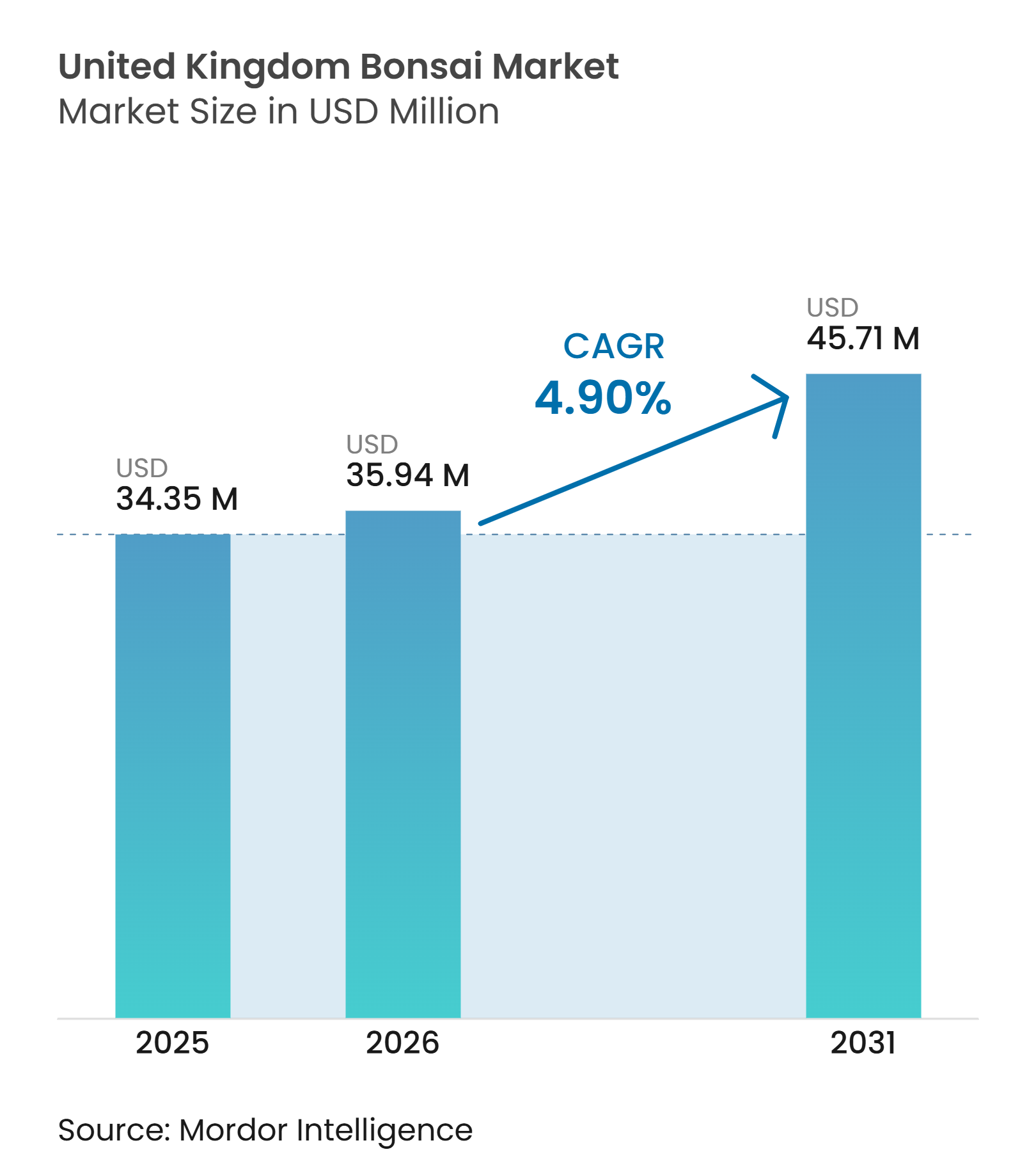
| Base Year Market Size (2025) | USD 34.35 Million |
| Market Size (2026) | USD 35.94 Million |
| Market Size (2031) | USD 45.71 Million |
| Growth Rate (2026 - 2031) | 4.90 % |
| Market Concentration | Medium |
Major Players *Disclaimer: Major Players sorted in no particular order Image © Mordor Intelligence. Reuse requires attribution under CC BY 4.0. | |
United Kingdom Bonsai Market Analysis by Mordor Intelligence
The United Kingdom bonsai market size was valued at USD 34.4 million in 2025 and is estimated to grow from USD 35.9 million in 2026 to USD 45.7 million by 2031. The market is projected to grow at a 4.9% CAGR during 2026–2031. It is expanding beyond established collectors because gift purchases, compact home settings, and commercial interiors are broadening its buyer base, and it also benefits when buyers can move from a first tree to a deeper interest in species, styling, and care. Specialist nurseries remain central to the purchase journey because buyers often assess the form and health of a live tree before making a purchase, while online sellers are widening access for households outside established nursery areas and using care content to support first-time buyers. Supply relationships with domestic growers and Japanese specialists give retailers the scope to serve entry-level customers and collectors without relying on a single product tier, thereby keeping the market dependent on retailers that translate specialist knowledge into clear choices for these different buyers. The United Kingdom bonsai market can sustain a broader customer base when access, support, and live-plant quality develop in tandem, so it relies on both specialist expertise and a purchase process that feels manageable for new owners. Plant-health controls, long lead times for mature trees, and the risk of buyer failure after purchase will continue to limit the pace of expansion.
Key Report Takeaways
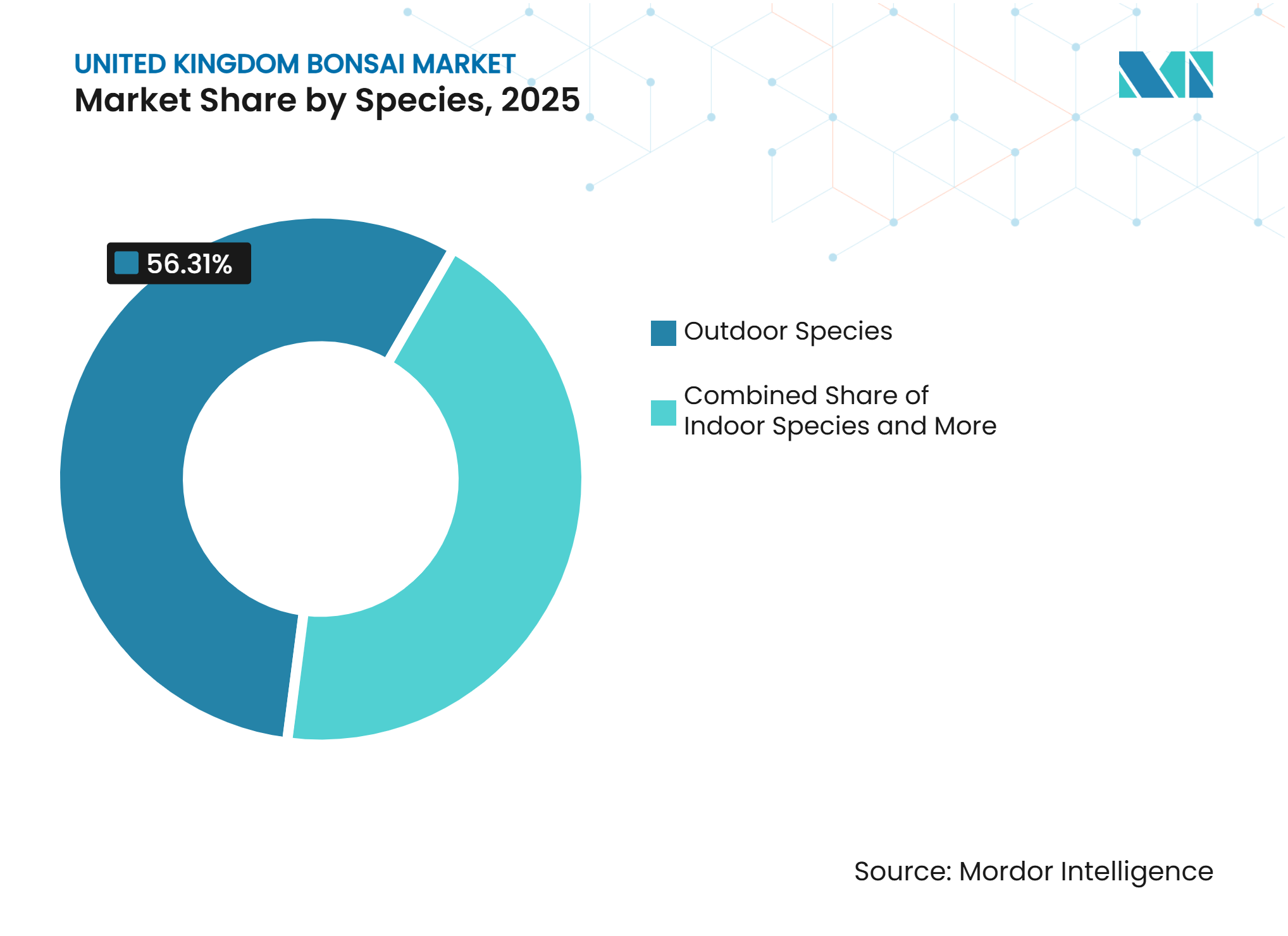
- By species, outdoor species held 56.3% of the United Kingdom bonsai market share in 2025. Indoor species is anticipated to grow at a 5.2% CAGR during 2026–2031.
- By distribution channel, offline held 63.8% of the United Kingdom bonsai market share in 2025. The online segment is projected to grow at a 6.8% CAGR during 2026–2031.
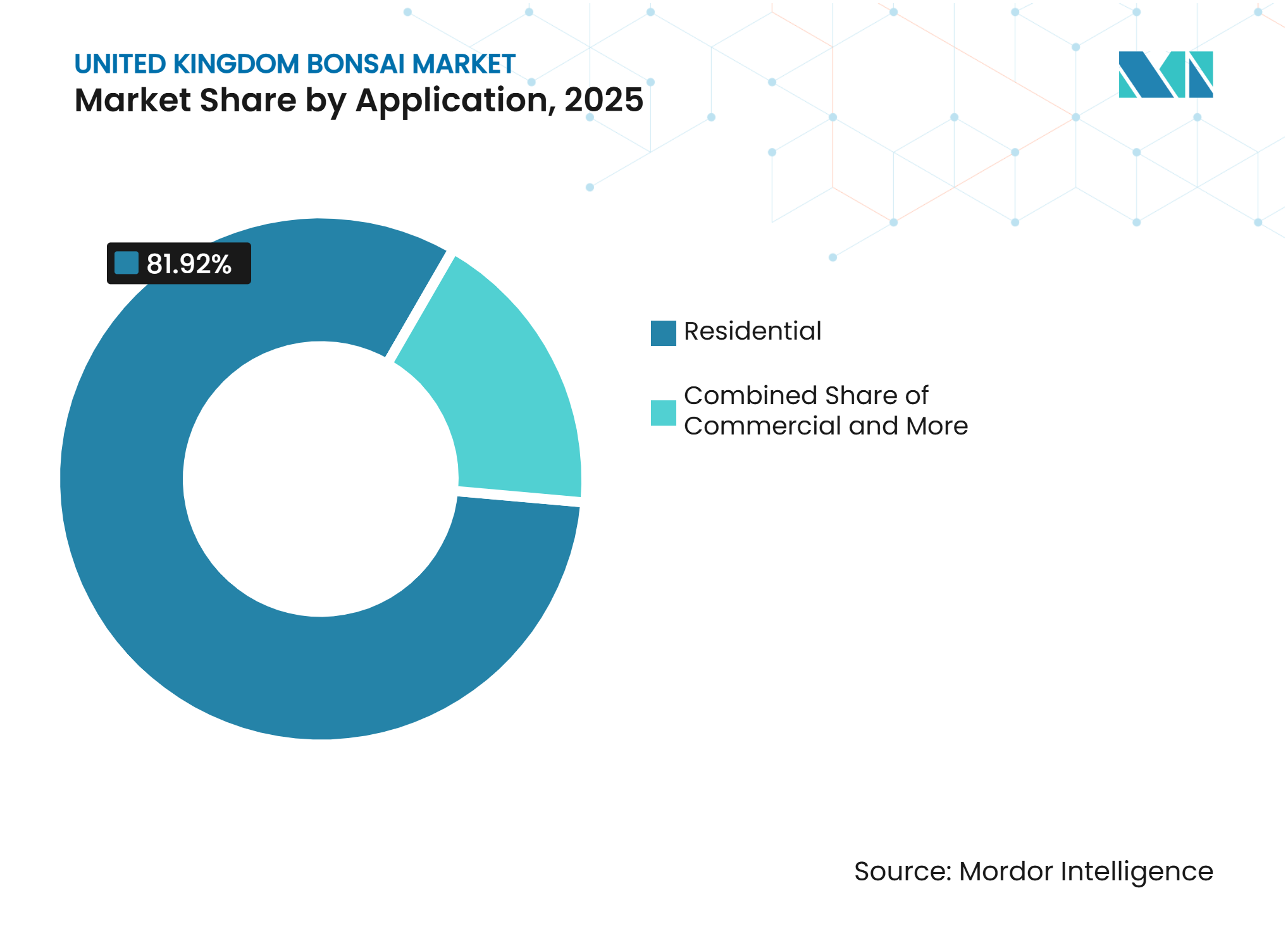
- By application, residential accounted for 81.9% of the United Kingdom bonsai market size in 2025. The commercial segment is anticipated to grow at a 7.6% CAGR during 2026–2031.
Note: Market size and forecast figures in this report are generated using Mordor Intelligence’s proprietary estimation framework, updated with the latest available data and insights as of January 2026.
Market Trends and Insights
Drivers Impact Analysis of United Kingdom Bonsai Market*
| Driver | (~) % Impact on CAGR Forecast | Geographic Relevance | Impact Timeline |
|---|---|---|---|
| Beginner And Gift-Oriented Bonsai Purchasing | +1.1% | National, with the strongest effect in urban England, Greater London, and the South East where gifting demand and specialist retail access are concentrated. | Short term (≤ 2 years) |
| Specialist Online Retail And Nationwide Delivery | +0.9% | National, with the greatest effect in Scotland, Wales, Northern England, and other areas outside established nursery clusters. | Short term (≤ 2 years) |
| Broadening Domestic And Imported Species Availability | +0.8% | National, with the strongest effect around specialist nursery and importer hubs in England. | Medium term (2-4 years) |
| Availability Of UK-Adapted And Locally Grown Trees | +0.7% | National, especially England, Wales, Scotland, and the South West where locally adapted stock can reduce establishment risk. | Medium term (2-4 years) |
| Bonsai Education And Specialist Community Infrastructure | +0.5% | National, with the clearest effect in regions served by specialist nurseries, public gardens, and bonsai clubs. | Medium term (2-4 years) |
| Premium Collector Demand Supported By Direct Japanese Sourcing | +0.6% | National, concentrated among collectors and higher-income urban buyers with access to specialist importers. | Long term (≥ 4 years) |
| Source: Mordor Intelligence | |||
Beginner And Gift-Oriented Bonsai Purchasing
Gift buying and beginner purchases are bringing people into the United Kingdom bonsai market who would not have entered through collecting, particularly when the purchase combines a compact tree with a clear starting point for care. Retailers offer Chinese elm and ficus trees with starter sets, gift packaging, and basic care information. These offers reduce the initial decisions required from a first-time buyer. A successful first purchase can also lead to later spending on pots, soil, pruning tools, and additional trees. The Royal Horticultural Society (RHS) explains that bonsai grown in small containers need regular watering and feeding during the growing season, along with periodic root pruning and repotting, which creates an ongoing need for aftercare products and advice[1].
Specialist Online Retail And Nationwide Delivery
Specialist e-commerce is making the United Kingdom bonsai market more accessible in areas without a dedicated nursery, linking dispersed customers to sellers who can explain the practical differences among available trees. Online sellers can reach customers in Scotland, Wales, Northern England, and remote parts of England through national delivery. Bonsai Direct marked 20 years of trading in July 2026 and continued to sell live trees and accessories online, offering free next-working-day delivery to most UK addresses with a printed care guide included with every tree. Digital care guides and species-selection tools can help customers match a tree to their home conditions. Faster delivery also lowers the inconvenience of sourcing a live plant from distant specialist suppliers. The channel is projected to grow faster than the wider United Kingdom bonsai market because it reduces the importance of proximity to a nursery.
Broadening Domestic And Imported Species Availability
A wider range of species and tree maturity levels lets sellers address a range of customer budgets and skill levels, from an inexpensive first tree to a mature specimen for an established collection. Kyoto Bonsai, a trade-only wholesaler established in 1987, states that it imports bonsai from Japan and China, carries more than 30 species most of the time, and supplies garden centers, specialist nurseries, and online retailers via its own temperature-controlled transport. Retailers can use that supply base to combine lower-priced imported trees with mature specimen material. LV Bonsai states that its imported trees are handpicked by its founder from leading Japanese growers during frequent buying trips, which supports demand from collectors seeking specimen Japanese material. Konishi Shorakuen, a Japanese exporter, states that under current quarantine conditions, only the European Union and the United Kingdom allow bonsai to be shipped from Japan with soil attached. This wider supply base supports a more varied product range without making one supplier or one species the sole basis for retail demand.
Availability Of UK-Adapted And Locally Grown Trees
Locally grown and UK-adapted trees can reduce the adjustment period that some imported material needs after arrival, giving retailers a practical alternative when buyers want stock that already suits local growing conditions. This matters because trees that settle more readily into local conditions can reduce early losses for residential buyers. Greenwood Bonsai Studio, founded in 1978 and set on 12 acres just north of Nottingham, serves customers through its nursery and online store. Domestic stock also gives sellers an option when import timing becomes uncertain. Native material, including juniper, yew, and hawthorn, can appeal to buyers seeking shorter supply chains and trees suited to local weather. The resulting choice strengthens the United Kingdom bonsai market by balancing collector demand for imports with practical demand for established local material.
Restraints Impact Analysis of United Kingdom Bonsai Market*
| Restraint | (~) % Impact on CAGR Forecast | Geographic Relevance | Impact Timeline |
|---|---|---|---|
| Import Quarantine, Plant-Health Controls, And Compliance Costs | -0.40% | National, with the strongest impact on importers and specialist retailers in England, Scotland, and Wales that source from Japan and Korea. | Short term (≤ 2 years) |
| High Care Intensity And Buyer Failure Risk | -0.30% | National, affecting residential and commercial buyers because care knowledge varies across all regions. | Short term (≤ 2 years) |
| Long Production And Import Lead Times For Mature Trees | -0.20% | National, with the strongest effect in premium imported and specimen-tree categories. | Long term (≥ 4 years) |
| Live-Plant Shipping Fragility And Geographic Access Limits | -0.20% | National, especially Northern Scotland, islands, and areas without a specialist nursery. | Short term (≤ 2 years) |
| Source: Mordor Intelligence | |||
Import Quarantine, Plant-Health Controls, And Compliance Costs
Plant-health requirements raise the cost and time required to bring some Japanese and Korean bonsai into Great Britain, because compliance requires planning before stock can enter the retailer's regular sales cycle. Importers must have their quarantine facilities approved by the Plant Health and Seeds Inspectorate (PHSI), source trees from nurseries registered with Japan's or Korea's national plant protection organization, provide phytosanitary certificates, and pre-notify the PHSI before consignments move directly from the border control post to the approved facility, where inspectors check them on arrival, during active growth, and before release. Juniperus can only be imported between November 1 and March 31 and must remain in quarantine from April 1 to June 30, while Pinus and Chamaecyparis require at least three months of active growth under containment. The Phytosanitary Conditions (Amendment) (No. 2) Regulations 2025 updated Great Britain's pest-related import conditions on November 30, 2025. These obligations favor importers with existing facilities and established procedures. They also make it harder for small retailers to build a premium imported-tree range quickly.
High Care Intensity And Buyer Failure Risk
A bonsai requires care that is more demanding than the care expected for many ordinary indoor plants, so the gap between a buyer's expectations and daily care routines can be commercially significant. The Royal Horticultural Society (RHS) advises that bonsai grown in small containers need regular watering and feeding through the growing season, along with periodic root pruning and repotting. A buyer who loses a first tree may not return for another purchase, which weakens repeat demand. Retailers can reduce that risk with printed guidance, digital support, and staff advice, but these measures cannot fully replace regular care. Regional bonsai societies can provide practical education and mentoring for enthusiasts. The Federation of British Bonsai Societies (FoBBS), established in 1982, has grown from 15 member clubs and societies to nearly 60, which supports continued learning among a portion of the buyer base.
*Our forecasts treat driver/restraint impacts as directional, not additive. The impact forecasts reflect baseline growth, mix effects, and variable interactions.
United Kingdom Bonsai Market Segment Analysis
By Species:
Outdoor Species Hold the Larger Position While Indoor Species Attract New BuyersOutdoor Species held 56.3% of bonsai sales in 2025. The segment reflects the country's established interest in hardy outdoor forms such as juniper, pine, and Japanese maple. Experienced collectors often value the seasonal character and traditional form of these trees. LV Bonsai and Wattston Bonsai focus on specialist Japanese material for buyers seeking mature outdoor specimens[2]. Plant health requirements remain relevant for imported conifers, especially where species-specific quarantine applies.
Indoor Species is anticipated to grow at a 5.2% CAGR during 2026–2031. Chinese elm, ficus, and Buddhist pine offer accessible options for people living in apartments or purchasing their first tree. Their smaller scale and indoor suitability make them suitable for gifting and home use. Online specialists can present these trees with care guides that explain watering and light requirements. Strong aftercare can determine whether a beginner advances to higher-value outdoor or collector material. The species mix, therefore, allows the United Kingdom bonsai market to serve both established enthusiasts and new customers.



By Distribution Channel:
Offline Retail Remains Important While Online Access ExpandsOffline sales accounted for 63.8% of bonsai sales in 2025. A nursery visit lets customers inspect the health, shape, and appearance of a live tree before buying it. Herons Bonsai operates a dedicated nursery near Lingfield in Surrey and has sponsored the bonsai collection at RHS Garden Wisley, known as the Herons Bonsai Walk, since 1997. Greenwood Bonsai Studio also combines a physical nursery with online retail, preserving a direct route for collectors who prefer personal selection. In-person advice has additional value where buyers need help selecting a suitable species or understanding care needs.
The Online segment is projected to grow at a 6.8% CAGR during 2026–2031. National delivery helps sellers reach buyers who do not live near a specialist nursery. It also gives retailers a way to offer a broad range without requiring customers to travel for every purchase. Online channels depend on reliable packing, dispatch, and live-plant handling because damage during shipment can discourage repeat purchases. Kyoto Bonsai's temperature-controlled distribution model demonstrates the logistics capability to support specialist retail supply. The channel is likely to be most valuable in regions where specialist nursery coverage is limited.
By Distribution Channel:
Offline Retail Remains Important While Online Access ExpandsOffline sales accounted for 63.8% of bonsai sales in 2025. A nursery visit lets customers inspect the health, shape, and appearance of a live tree before buying it. Herons Bonsai operates a dedicated nursery near Lingfield in Surrey and has sponsored the bonsai collection at RHS Garden Wisley, known as the Herons Bonsai Walk, since 1997. Greenwood Bonsai Studio also combines a physical nursery with online retail, preserving a direct route for collectors who prefer personal selection. In-person advice has additional value where buyers need help selecting a suitable species or understanding care needs.
The Online segment is projected to grow at a 6.8% CAGR during 2026–2031. National delivery helps sellers reach buyers who do not live near a specialist nursery. It also gives retailers a way to offer a broad range without requiring customers to travel for every purchase. Online channels depend on reliable packing, dispatch, and live-plant handling because damage during shipment can discourage repeat purchases. Kyoto Bonsai's temperature-controlled distribution model illustrates the logistics capability that can support specialist retail supply. The channel is likely to be most valuable in regions where specialist nursery coverage is limited.
By Application:
Residential Demand Provides the Base While Commercial Use BroadensResidential buyers accounted for 81.9% of bonsai sales in 2025. The segment includes entry-level indoor trees bought as gifts and established outdoor specimens acquired by collectors. British Bonsai supplies raw and semi-trained trees, including native British trees and those originating from Korea, China, Japan, and Europe. That range allows a specialist retailer to serve different budgets and stages of buyer experience. Smaller demand from institutional gifts and art fairs creates an additional outlet for distinctive or specially packaged trees.
The Commercial segment is anticipated to grow at a 7.6% CAGR during 2026–2031. Workplace and hospitality buyers can use bonsai in reception areas, boardrooms, and premium guest settings where space is limited. Research led by the University of Surrey and published in February 2026 found that indoor plants can increase indoor humidity and improve thermal comfort and indoor environmental quality. Bonsai offers a long-lived visual element for businesses that want plant-based interior features without large floor-space requirements. The opportunity requires retailers to provide selection advice, maintenance guidance, and dependable replacement arrangements.

Geography Analysis
The United Kingdom bonsai market is concentrated in urban and suburban England, particularly Greater London, the South East, the East Midlands, and parts of the South West. Surrey, Kent, Warwickshire, Shropshire, West Sussex, and Nottinghamshire contain several specialist nursery or importer locations. Those areas combine accessible road links with relatively dense pools of potential customers. The Royal Horticultural Society (RHS) maintains the Herons Bonsai Walk at RHS Garden Wisley in Surrey, which gives the South East a prominent public display of bonsai[3]. RHS Garden Wisley also held a Bonsai Show themed "Autumn Bonsai" on September 19–20, 2026, with plants and bonsai equipment available for sale.
The East Midlands and Yorkshire have specialist activity delivered by providers in Nottingham, Doncaster, and across the broader Yorkshire area. Greenwood Bonsai Studio provides a physical reference point in Nottingham for buyers in central England. Driftwood Bonsai received a Gold medal at the RHS Chelsea Flower Show in 2026, increasing its visibility beyond Doncaster. These regional sites reduce travel barriers for collectors who would otherwise rely entirely on national shipping.
Scotland, Wales, Northern Ireland, and more remote parts of England depend more heavily on online suppliers because permanent specialist nursery coverage is less dense. The United Kingdom bonsai market size in these areas is supported by delivery rather than a dense local retail network. In the northwest, Manchester Bonsai Society staged a bonsai display at RHS Garden Bridgewater on April 3–4, 2026. The Federation of British Bonsai Societies (FoBBS) and its regional clubs give buyers access to local learning networks. These clubs can support retention where direct access to experienced nursery staff is limited.
Competitive Landscape
Market Concentration
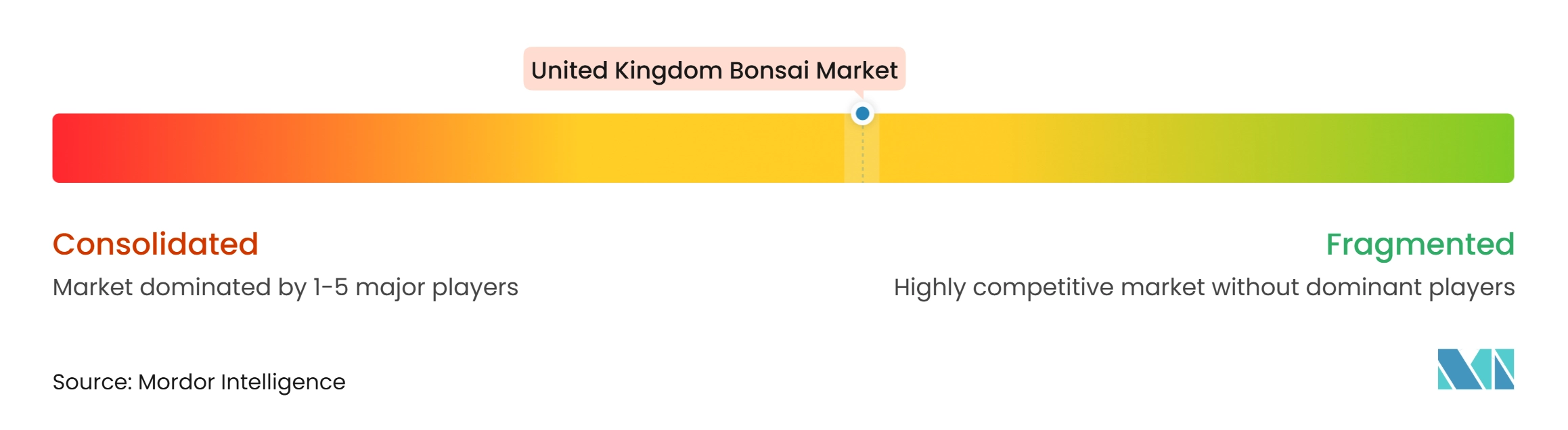
The United Kingdom bonsai industry has moderate concentration because no single participant dominates every product tier, buyer group, or channel. Herons Bonsai and Greenwood Bonsai Studio represent large-format specialist nursery models with national visibility. Bonsai Direct and Bonsai2U represent online-focused retail routes for live trees and care-related products. LV Bonsai and Wattston Bonsai address collector demand through specialist imported material. Kyoto Bonsai occupies a wholesale role as a trade-only supplier to specialist nurseries, garden centers, and online retailers rather than to end customers.
Competition depends on access to trees, sales reach, practical advice, and the capacity to protect live plants during delivery. Established Japanese sourcing relationships can support a premium position for specimen trees, while domestic production can improve the availability of acclimated stock. Herons Bonsai's long-term relationship with RHS Garden Wisley, where it has sponsored the Herons Bonsai Walk since 1997, provides public visibility and connects the business with an established horticultural destination. Bonsai Direct used its July 2026 20th anniversary sale, backed by free next-working-day delivery to most UK addresses, to promote its national online offering. Driftwood Bonsai's Gold medal at the 2026 RHS Chelsea Flower Show provided a separate example of how show recognition can increase visibility for a specialist nursery.
Smaller regional specialists compete through curated stock, in-person service, and local customer relationships. The wide geographic spread of specialists limits the likelihood that a single retailer can control access across the country. Market-share data for individual companies is not available, so the relative position of individual firms cannot be quantified. The United Kingdom bonsai market has room for more structured commercial supply and gift-focused offers, but established growers and importers retain advantages in cultivation knowledge and sourcing networks.
United Kingdom Bonsai Industry Leaders
-
Herons Bonsai
-
Bonsai Direct
-
Kyoto Bonsai
-
LV Bonsai
-
Mori Bonsai
- *Disclaimer: Major Players sorted in no particular order
United Kingdom Bonsai Market Companies Covered in this Report
- Herons Bonsai
- Kyoto Bonsai
- Bonsai Direct
- LV Bonsai
- Mori Bonsai
- Wattston Bonsai
- David Cheshire Nurseries Ltd
- Driftwood Bonsai
- British Bonsai
- Devon Bonsai, Springfield Bonsai Nursery
- Greenwood Bonsai Studio
- All Things Bonsai
- Bonsai2U
- Beechfield Bonsai
- Prestige Pines
Recent Industry Developments in United Kingdom Bonsai Market
- November 2025: The UK government made the Phytosanitary Conditions (Amendment) (No. 2) Regulations 2025, effective November 30, 2025, updating Great Britain's phytosanitary regime for plant imports. The changes added Toumeyella parvicornis to the quarantine pest list with new import requirements for Pinus plants, updated import requirements for Bursaphelenchus xylophilus, and added Homona magnanima to the provisional quarantine pest list, all relevant to conifer bonsai imports.
- January 2025: The Official Controls (Plant Health) and Phytosanitary Conditions (Amendment) Regulations 2025 came into force on January 30, 2025, requiring plants for planting from any third country to be grown in a place of production registered and supervised by the exporting country's national plant protection organization and inspected before export.
United Kingdom Bonsai Market Report Scope
The United Kingdom bonsai market encompasses the value of miniature, living woody plants intentionally trained to mimic mature trees, as well as the pots, soils, and pruning supplies sold with them. Values represent consumer-level spending through both specialty nurseries and general retail, expressed in USD.
United Kingdom Bonsai Market Report is Segmented by Species (Indoor Species, Outdoor Species, Needle Tree Species, and Deciduous Tree Species), by Distribution Channel (Online and Offline), and by Application (Residential, Commercial, and Others).
Segmentation Overview
| Indoor Species |
| Outdoor Species |
| Needle Tree Species |
| Deciduous Tree Species |
| Online |
| Offline |
| Residential |
| Commercial |
| Others (institutional gifts, art fairs) |
| By Species | Indoor Species |
| Outdoor Species | |
| Needle Tree Species | |
| Deciduous Tree Species | |
| By Distribution Channel | Online |
| Offline | |
| By Application | Residential |
| Commercial | |
| Others (institutional gifts, art fairs) |
Key Questions Answered in the Report
What is the value of bonsai sales in the United Kingdom?
The United Kingdom bonsai market is valued at USD 35.9 million in 2026 and is anticipated to reach USD 45.7 million by 2031. Growth reflects wider demand from homes, gifts, and commercial spaces.
Which bonsai species category has the largest share in the United Kingdom?
Outdoor Species led with 56.3% share in 2025, supported by established collector demand for hardy outdoor trees. Indoor Species is the faster-growing category.
Who buys bonsai in the United Kingdom?
Residential buyers accounted for 81.9% of sales in 2025 and remain the core revenue base. The Commercial segment is projected to grow at a 7.6% CAGR during 2026–2031, with demand coming from workplace and hospitality settings.
What limits the growth of bonsai sales in the United Kingdom?
Plant-health controls on some imports and the high level of care required after purchase can constrain supply and repeat buying. Shipping risks and long lead times also affect availability.