
United Arab Emirates Crowdsourced (Gig Economy Couriers) Delivery Service Market Size and Share
Market Overview
| Study Period | 2021 - 2032 |
|---|---|
| Forecast Data Period | 2027 - 2032 |
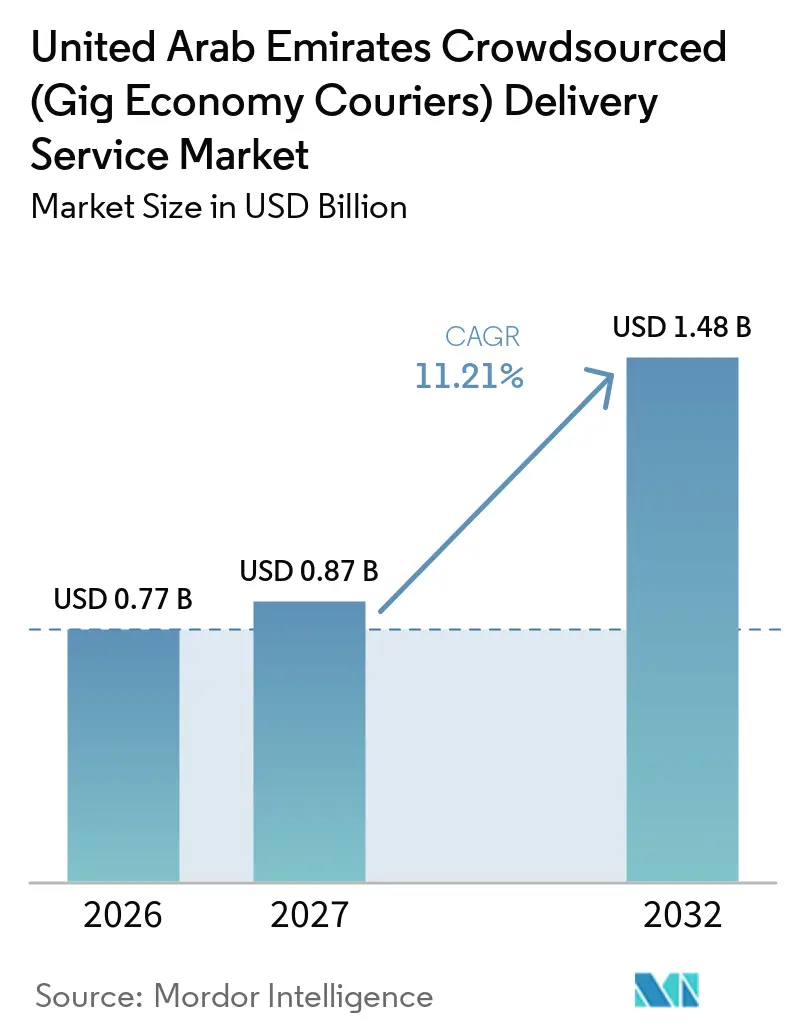
| Base Year Market Size (2026) | USD 0.77 Billion |
| Market Size (2027) | USD 0.87 Billion |
| Market Size (2032) | USD 1.48 Billion |
| Growth Rate (2027 - 2032) | 11.21 % |
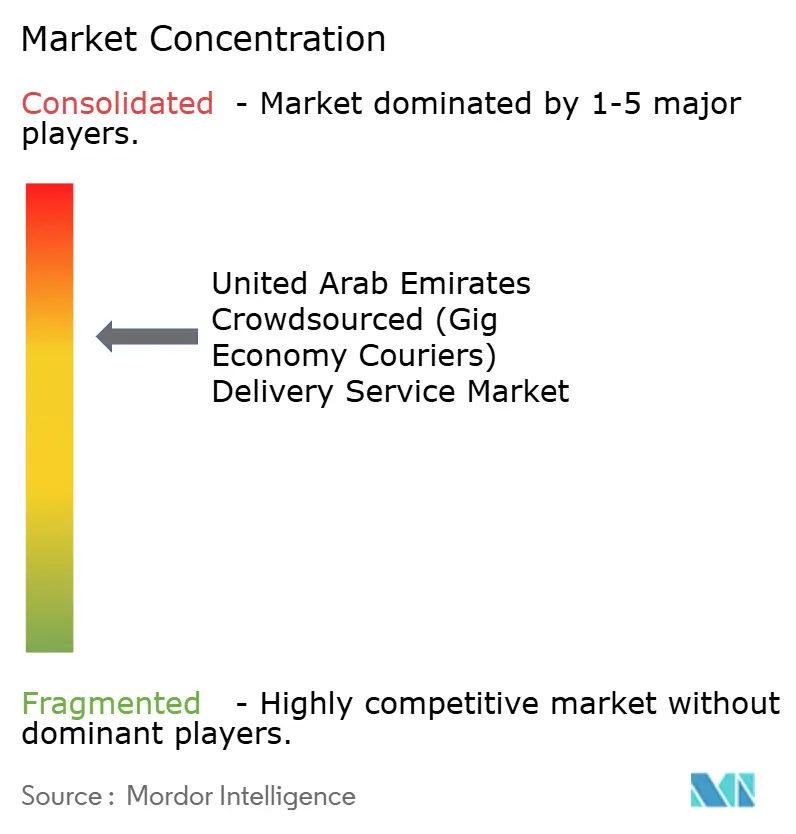
| Market Concentration | Medium |
Major Players *Disclaimer: Major Players sorted in no particular order Image © Mordor Intelligence. Reuse requires attribution under CC BY 4.0. | |
United Arab Emirates Crowdsourced (Gig Economy Couriers) Delivery Service Market Analysis by Mordor Intelligence
The United Arab Emirates crowdsourced (gig economy couriers) delivery service market size is valued at USD 0.77 billion in 2026 and is estimated to grow from USD 0.87 billion in 2027 to reach USD 1.48 billion by 2032, at a CAGR of 11.21% during the forecast period (2027-2032).
The United Arab Emirates crowdsourced (gig economy couriers) delivery service market has moved beyond early platform adoption, and operators now compete on route economics, fleet composition, and the number of orders served across multiple categories. Dubai remains the central operating base because dense neighborhoods, extensive app use, and free-zone commerce support high order volumes. Sharjah is expanding as residential areas grow and platforms establish wider coverage. Government activity in drone and autonomous delivery is creating a clearer path for technology investment across the United Arab Emirates crowdsourced (gig economy couriers) delivery service market. Heat-protection rules and licensing requirements raise operating costs, yet online retail demand and public investment in delivery infrastructure continue to support the outlook.
Key Report Takeaways
- By delivery type, on-demand and instant delivery held 36.88% of the United Arab Emirates crowdsourced (gig economy couriers) delivery service market share in 2026, while same-day delivery recorded the highest projected CAGR at 13.93% through 2032.
- By business model, B2C held 64.23% of the United Arab Emirates crowdsourced (gig economy couriers) delivery service market share in 2026 and recorded the highest projected CAGR at 13.57% through 2032.
- By delivery distance, urban and intra-city delivery held a 43.38% share of the United Arab Emirates crowdsourced (gig economy couriers) delivery service market size in 2026, while extended urban and peri-urban delivery recorded the highest projected CAGR at 13.85% through 2032.
- By courier engagement model, independent gig couriers held a 56.42% share of the United Arab Emirates crowdsourced (gig economy couriers) delivery service market size in 2026, while part-time contracted drivers recorded the highest projected CAGR at 12.37% through 2032.
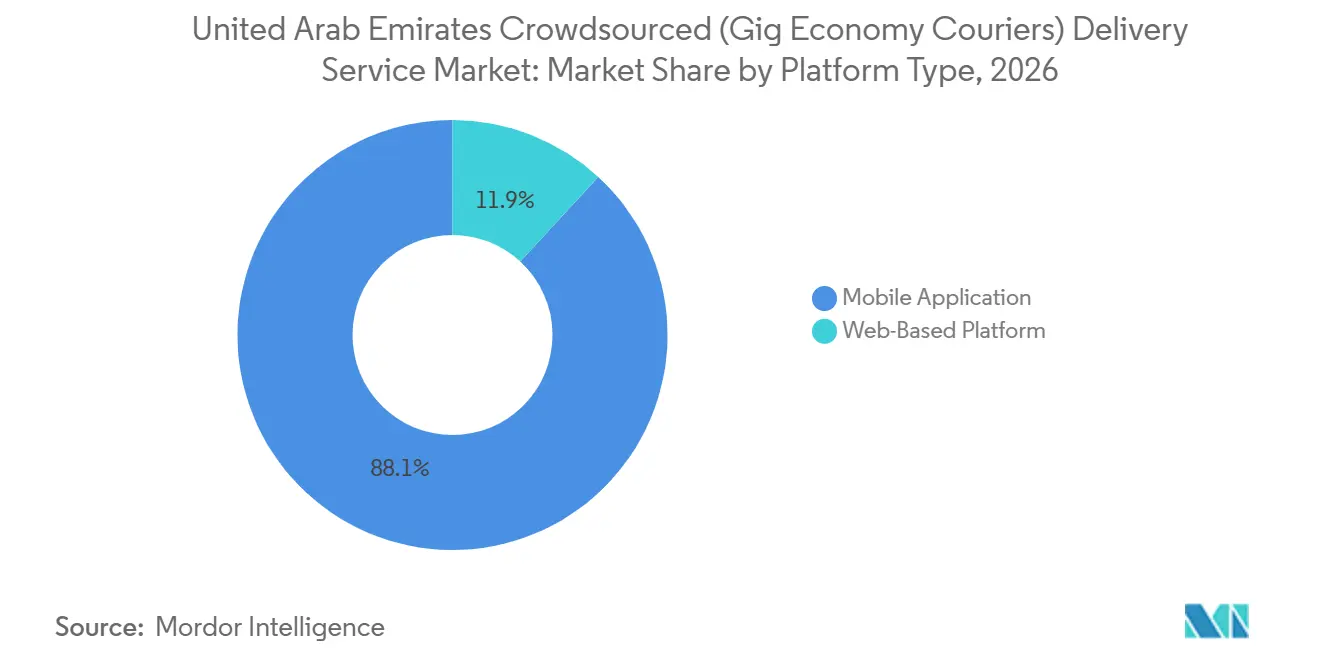
- By platform type, mobile applications held an 88.14% of the United Arab Emirates crowdsourced (gig economy couriers) delivery service market share in 2026, while web-based platforms recorded the highest projected CAGR at 11.84% through 2032.
- By vehicle type, two-wheelers held 62.62% of the United Arab Emirates crowdsourced (gig economy couriers) delivery service market share in 2026, while drones and autonomous vehicles recorded the highest projected CAGR at 22.26% through 2032.
- By end user, e-commerce and online retail held 32.35% share of the United Arab Emirates crowdsourced (gig economy couriers) delivery service market size in 2026, while q-commerce recorded the highest projected CAGR at 14.08% through 2032.
- By geography, Dubai held 56.58% share of the United Arab Emirates crowdsourced (gig economy couriers) delivery service market size in 2026, while Sharjah recorded the highest projected CAGR at 13.73% through 2032.
Note: Market numbers in this report are based on Mordor Intelligence's proprietary estimation framework, which combines nine months of actuals with Q4 projections for base year 2026.
Market Trends and Insights
Drivers Impact Analysis of United Arab Emirates Crowdsourced (Gig Economy Couriers) Delivery Service Market*
| Driver | (~) % Impact on CAGR Forecast | Geographic Relevance | Impact Timeline |
|---|---|---|---|
| E-Commerce and Q-Commerce Parcel Density | +2.8% | Global with concentration in Dubai and Abu Dhabi | Medium term (2-4 years) |
| Smartphone-Led On-Demand Convenience | +2.1% | UAE urban centers, primarily Dubai and Sharjah | Short term (≤ 2 years) |
| SME Outsourcing of Flexible Delivery Capacity | +1.9% | UAE-wide, early density in Dubai commercial zones | Medium term (2-4 years) |
| High-Density Dubai and Abu Dhabi Route Economics | +1.7% | Dubai and Abu Dhabi core, spill-over to Sharjah | Short term (≤ 2 years) |
| Platform Aggregation and Multi-Vertical Orders | +1.5% | UAE urban centers and GCC-wide through platform networks | Medium term (2-4 years) |
| Foot-Courier and Low-Emission Delivery Pilots | +0.8% | Dubai core residential zones | Long term (≥ 4 years) |
| Source: Mordor Intelligence | |||
E-Commerce and Q-Commerce Parcel Density Drive Core Demand
The United Arab Emirates crowdsourced (gig economy couriers) delivery service market benefits when food, grocery, pharmacy, and impulse retail orders are handled through the same delivery network. This broader order mix can raise courier utilization without requiring a matching increase in fleet size. Operators with dark-store networks can combine replenishment and consumer delivery activity more effectively than single-category providers.[1] The Abu Dhabi Investment Office announced 29 autonomous mobility partnerships in 2025, including initiatives that supported the commercialization of autonomous transport solutions.
Smartphone-Led On-Demand Convenience Sustains Mobile Platform Dominance
Mobile applications account for the majority of platform revenue in 2026, confirming that app-led ordering remains the operating center of the United Arab Emirates crowdsourced (gig economy couriers) delivery service market. Native applications support real-time dispatch, location tracking, order updates, and repeat purchasing. Super-app models also allow providers to place several services in a single customer interface.[2] Careem expanded food delivery and ride services in Abu Dhabi, Al Ain, and Sharjah during 2025, widening the service area available to its network. This expansion gives more customers access to a common platform and strengthens the value of local courier availability.
SME Outsourcing of Flexible Delivery Capacity Broadens the Platform Supplier Base
Small and medium-sized enterprises increasingly use external delivery networks rather than operating dedicated fleets. This approach changes delivery from a fixed operating cost into a service purchased when needed. Lalamove launched UAE operations in May 2025 to serve small and medium-sized enterprises with instant delivery services. Dubai SME and Deliveroo also signed an agreement in September 2025 to provide Emirati-owned food and beverage businesses with preferential commercial terms and digital support. These arrangements broaden the merchant base available to the United Arab Emirates crowdsourced (gig economy couriers) delivery service market and improve access to flexible order fulfillment.
High-Density Dubai and Abu Dhabi Route Economics Create Structural Efficiency Advantages
Dense residential districts, commercial clusters, and restaurant areas support more stops per hour for delivery riders in Dubai and Abu Dhabi. These conditions favor two-wheelers, which can move efficiently through urban traffic and serve small parcels. Abu Dhabi Mobility launched the emirate's first autonomous delivery vehicle trial in September 2025 under Smart and Autonomous Systems Council supervision. Dubai's Roads and Transport Authority also adopted a framework for autonomous heavy vehicles on initial logistics routes linking Jebel Ali Port and Al Maktoum International Airport. These initiatives give the United Arab Emirates crowdsourced (gig economy couriers) delivery service market a regulatory base for future automation.
Restraints Impact Analysis of United Arab Emirates Crowdsourced (Gig Economy Couriers) Delivery Service Market*
| Restraint | (~) % Impact on CAGR Forecast | Geographic Relevance | Impact Timeline |
|---|---|---|---|
| Courier Safety and Heat-Exposure Compliance Costs | -1.4% | UAE-wide, highest intensity in Dubai and Abu Dhabi from June to September | Short term (≤ 2 years) |
| Platform Commission and Rider Earnings Pressure | -1.2% | Global, with highest sensitivity in the UAE's multi-platform environment | Medium term (2-4 years) |
| Fragmented Licensing and Third-Party Logistics Accountability | -0.9% | UAE-wide, acute in northern emirates and peri-urban zones | Medium term (2-4 years) |
| Low-Density Northern Emirate Economics | -0.7% | Sharjah outskirts, Ras Al Khaimah, Umm Al Quwain, and Fujairah | Long term (≥ 4 years) |
| Source: Mordor Intelligence | |||
Courier Safety and Heat-Exposure Compliance Costs Raise the Platform Cost Floor
The Ministry of Human Resources and Emiratisation bars outdoor work from 12:30 PM to 3:00 PM between June 15 and September 15 under its midday-break policy. The policy narrows the operating window for delivery services during the hottest months. Same-day formats face the greatest scheduling pressure because their value depends on short fulfillment periods. Platforms supported more than 10,000 air-conditioned rest stations in 2025, compared with 6,000 in the preceding year, through initiatives coordinated with government bodies.[3] This expenditure is a recurring compliance cost that rises with fleet size in the United Arab Emirates crowdsourced (gig economy couriers) delivery service market.
Platform Commission and Rider Earnings Pressure Challenge Sustainable Fleet Supply
Independent gig couriers hold the largest share in 2026, leaving a large part of the workforce outside standard full-time employment structures. The operating model must balance platform commission income with rider earnings that can sustain courier availability. Lower-margin grocery orders can place additional pressure on the delivery economics of multi-vertical platforms. The United Arab Emirates crowdsourced (gig economy couriers) delivery service market also depends on reliable rider availability during peak ordering periods. Providers that improve rider support, safety arrangements, or predictable earnings can build a more stable courier base.[4] These choices may distinguish operators that rely mainly on transactional contractor engagement.
*Our forecasts treat driver/restraint impacts as directional, not additive. The impact forecasts reflect baseline growth, mix effects, and variable interactions.
United Arab Emirates Crowdsourced (Gig Economy Couriers) Delivery Service Market Segment Analysis
By Delivery Type:
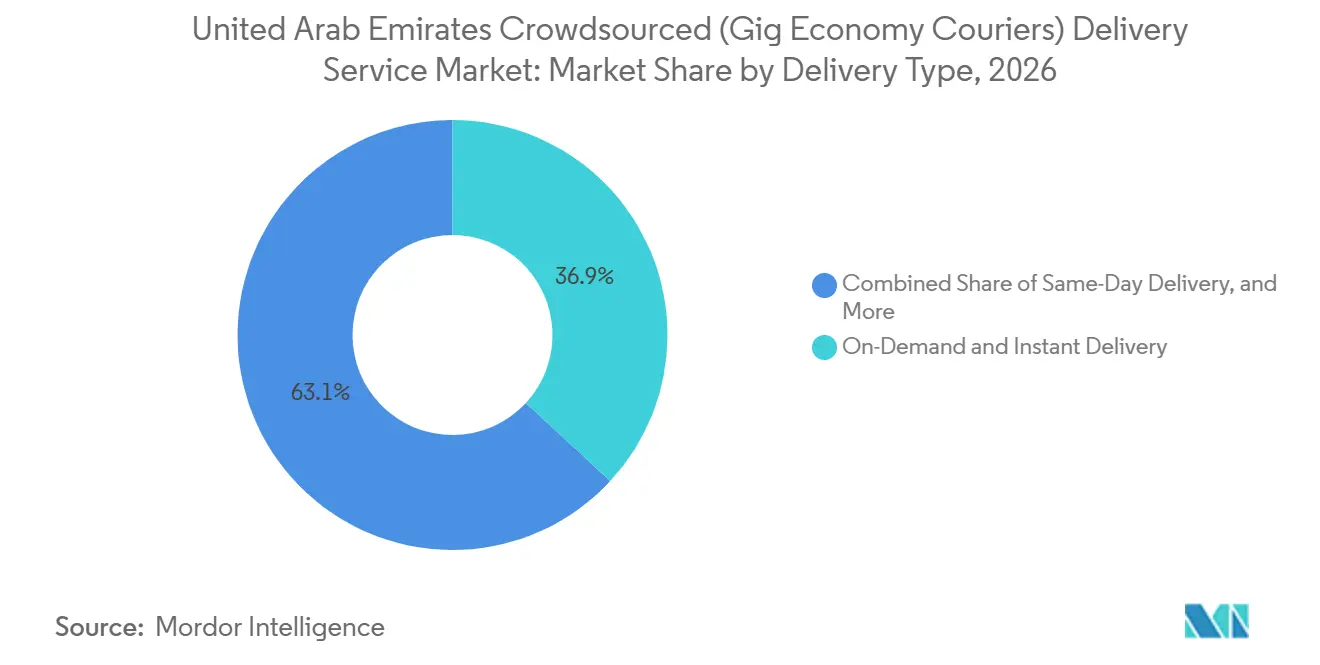
Instant Formats Define the Competitive BaselineOn-demand and instant delivery holds a 36.88% share in 2026, making it the largest delivery format in the United Arab Emirates crowdsourced (gig economy couriers) delivery service market. Major platforms use routing systems and local fulfillment networks to support short delivery windows. These formats serve food, grocery, pharmacy, and other urgent consumer orders. The model relies on dense demand, nearby merchants, and a fleet that can be dispatched quickly.
Same-day delivery is the fastest-growing format at a 13.93% CAGR through 2032. Same-day delivery broadens the types of goods customers can receive within a single day. Electronics, personal care products, and pharmaceuticals are among the categories that fit this format. Next-day and express delivery remain relevant for scheduled and cross-emirate shipments. Scheduled delivery and other services serve business documents and orders placed in advance. Dubai Civil Aviation Authority signed an agreement with Keeta Drones in January 2025 to assess drone delivery zones, airspace, infrastructure, and safety requirements.

By Business Model:
B2C Architecture Defines the Operating ModelB2C holds a 64.23% share of the United Arab Emirates crowdsourced (gig economy couriers) delivery service market size in 2026 and is also the fastest-growing model at a 13.57% CAGR through 2032. This reflects the central role of consumer-facing apps in the market. Platforms bring together customer demand, merchant listings, and courier dispatch within the same service structure. Merchants use these systems as integration partners for order fulfillment. The result is that pricing, demand information, and customer access are often concentrated at the platform layer.
B2B delivery has a separate role in commercial routes, bulk shipments, and document services. Aramex, iMile Delivery, Lalamove, and Jeebly have offerings aimed at business users with different payload and routing needs. iMile's Jebel Ali warehouse became operational in May 2026 to support quick-commerce and express delivery activity. Lalamove also introduced 1-ton and 3-ton truck options after its first year in the UAE. C2C delivery remains smaller and mainly supports peer-to-peer parcels and resale activity.
By Delivery Distance:
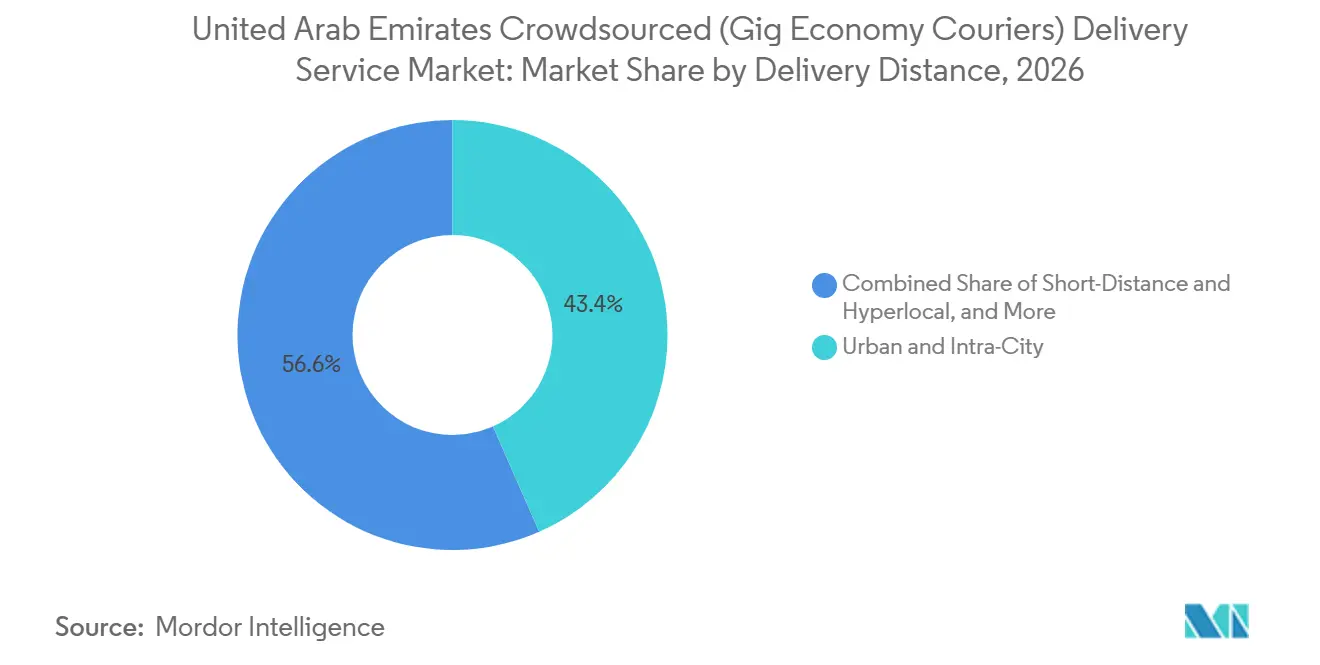
Urban Density Anchors Share While Peri-Urban Routes ScaleUrban and intra-city delivery holds 43.38% of the United Arab Emirates crowdsourced (gig economy couriers) delivery service market share in 2026, reflecting the high-volume corridors in Dubai and Abu Dhabi. This segment has the most favorable operating conditions for two-wheeler couriers. Shorter travel distances enable more frequent drops and tighter dispatch cycles. In these locations, nearby retailers and residential buildings create the order density needed for rapid service. The United Arab Emirates crowdsourced (gig economy couriers) delivery service market size for urban and intra-city delivery is supported by its central role in last-mile operations.
Extended urban and peri-urban delivery is the fastest-growing distance segment at a 13.85% CAGR through 2032. Residential growth is expanding demand beyond the core city districts. Lalamove began Sharjah pickup operations in July 2025, while Keeta extended its service reach across the UAE during 2025. These expansions bring more outer urban corridors into active platform coverage. Hyperlocal delivery remains important for convenience-store, pharmacy, and short grocery trips in dense neighborhoods.
By Courier Engagement Model:
Gig Independence Dominates While Contracted Work ExpandsIndependent gig couriers hold a 56.42% share of the United Arab Emirates crowdsourced (gig economy couriers) delivery service market size in 2026, which confirms the continuing importance of flexible rider supply. This model allows platforms to increase available capacity around changing order volumes. It also places strong emphasis on recruitment, safety, equipment access, and earnings conditions. The United Arab Emirates crowdsourced (gig economy couriers) delivery service industry continues to depend on this broad pool of independent riders.
Part-time contracted drivers are the fastest-growing engagement model at a 12.37% CAGR through 2032. Part-time contracted arrangements can offer defined availability windows and clearer operational oversight. They also support compliance with rider-safety requirements and service-quality commitments. Full-time partnered drivers remain relevant for enterprise accounts that value consistent scheduling. Pharmaceutical cold-chain services and high-value document delivery are examples where dependable attendance can matter more than the lowest operating cost. The mix of independent and contracted models allows platforms to match different service needs.
By Platform Type:
Mobile Applications Shape Customer AccessMobile applications account for an 88.14% share of the United Arab Emirates crowdsourced (gig economy couriers) delivery service market size in 2026, showing their central role in ordering and dispatch. Mobile applications support real-time location services, route assignment, push notifications, and delivery tracking. These features are important for consumer orders with short fulfillment windows. The United Arab Emirates crowdsourced (gig economy couriers) delivery service market share held by mobile applications reflects their practical advantage for frequent consumer transactions.
Web-based platforms are the fastest-growing platform type at an 11.84% CAGR through 2032. Web-based tools are useful for commercial customers that handle bulk bookings and multi-stop orders. Logistics managers can use browser interfaces to manage dispatches and administrative tasks. Lalamove uses mobile ordering for consumer activity while providing business-facing tools for larger delivery requirements. Careem and talabat also expanded service categories during 2025, strengthening the role of multi-service applications. This split allows one courier network to serve both consumer and business demand.
By Vehicle Type:
Two-Wheelers Lead While Automation ExpandsTwo-wheelers hold 62.62% of the United Arab Emirates crowdsourced (gig economy couriers) delivery service market share in 2026 because they are well suited to dense traffic and smaller delivery loads. Food, grocery, and pharmacy orders commonly fit the payload profile of motorcycles and scooters. Their operating cost per delivery can also support frequent urban dispatch. Four-wheelers serve higher-payload consumer orders, while vans and light commercial vehicles cover multi-stop commercial work. The United Arab Emirates crowdsourced (gig economy couriers) delivery service industry uses several vehicle types because order sizes and route lengths vary widely.
Drones and autonomous vehicles are the fastest-growing vehicle category at a 22.26% CAGR through 2032. Dubai Municipality and Keeta Drones have worked on delivery trials in park and beach locations, while Dubai's aviation authority has worked on drone safety and operating requirements. Abu Dhabi Mobility also supervised autonomous delivery vehicle pilots involving AutoGo and Noon during 2025. These trials provide a practical basis for technology-led delivery services.
By End User:
E-Commerce Anchors Revenue While Q-Commerce Sets Growth DirectionE-commerce and online retail hold a 32.35% share in the United Arab Emirates crowdsourced (gig economy couriers) delivery service market size in 2026 as the largest end-user segment. Online merchants use crowdsourced networks to avoid maintaining delivery fleets for every order. This activity gives platforms a large base of parcel volume across consumer categories. It also links merchant growth with the availability of dependable last-mile service.
Q-Commerce is the fastest-growing end-user segment at a 14.08% CAGR through 2032. Q-Commerce shortens delivery expectations for grocery, food, pharmacy, and convenience orders. Foodservice and restaurant delivery remains a mature, high-volume part of platform operations. Grocery and traditional retail delivery is expanding as local fulfillment facilities lower delivery distances. Healthcare and pharmaceutical services require temperature control, chain-of-custody documentation, and adherence to Ministry of Health and Prevention requirements. Jeebly has introduced cold-chain delivery services for products including cosmetics, chocolates, and pharmaceuticals.
Geography Analysis
Dubai holds a 56.58% share of the United Arab Emirates crowdsourced (gig economy couriers) delivery service market size in 2026 and remains the largest geography in the market. Dense population centers, app adoption, restaurant supply, free-zone commerce, residential districts, and commercial districts support delivery activity and shorter routes. Dubai Civil Aviation Authority has worked with Keeta Drones on zone evaluation, airspace assessment, infrastructure requirements, and delivery safety. The Roads and Transport Authority created an autonomous heavy-vehicle framework for logistics routes linking Jebel Ali Port and Al Maktoum International Airport.
Sharjah is the fastest-growing geography at a 13.73% CAGR through 2032. Its growth is linked to population expansion, logistics development, and broader platform presence. Sharjah Airport handled 204,323 tons of cargo in 2025, compared with 195,909 tons in 2024. Abu Dhabi is developing its delivery technology base through autonomous ground and drone projects, including an autonomous delivery vehicle trial with AutoGo and 7X's EMX network in September 2025. It also oversaw a drone delivery test flight that examined delivery applications in the Emirate.
Ras Al Khaimah, Fujairah, Ajman, and Umm Al Quwain form a growth frontier for the United Arab Emirates crowdsourced (gig economy couriers) delivery service market, although lower population density creates longer distances between orders and can reduce courier utilization. Providers are responding by combining different delivery volumes within the same operating network. Jeebly has coverage across all 7 emirates, and ZAJEL expanded with branches in Abu Dhabi and Al Ain during 2025. The Abu Dhabi Investment Office partnership portfolio includes autonomous mobility activity that can serve agricultural areas, remote islands, and harder-to-reach communities.
Competitive Landscape
The United Arab Emirates crowdsourced (gig economy couriers) delivery service market has a moderately concentrated upper tier led by Talabat, Careem, Keeta, and Amazon Logistics, with more than 15 specialist and regional providers operating below this group. Multi-vertical platforms hold an advantage because they can combine food, grocery, pharmacy, and retail orders through the same courier base and sustain delivery density without volume guarantees for each vertical. This structure also gives platforms several ways to deepen merchant and customer relationships.
Keeta entered the UAE in September 2025 through an agreement with the Ministry of Investment to establish its UAE headquarters. In October 2025, Dubai Taxi Company and Keeta signed a partnership for last-mile delivery in Dubai. The arrangement began with 150 delivery motorbikes and planned a scale-up to 500 by year-end. The parties also planned to explore drone and autonomous vehicle integration. These moves show how entrants are pairing fleet capacity with technology development.
Mid-market providers are competing through specialized capabilities rather than the same broad aggregator model. iMile Delivery's Jebel Ali warehouse supports quick-commerce and express delivery flows. Jeebly expanded its service portfolio with international shipping and a redesigned mobile application during 2026. Lalamove built a small and medium-sized enterprise delivery model and expanded its UAE activity after launching in 2025. Emirates Post, through 7X, also partnered with Amazon UAE to use EMX dark stores as hyperlocal delivery hubs.
United Arab Emirates Crowdsourced (Gig Economy Couriers) Delivery Service Industry Leaders
-
Talabat
-
Deliveroo
-
Careem
-
Aramex
-
Emirates Post Group
- *Disclaimer: Major Players sorted in no particular order
United Arab Emirates Crowdsourced (Gig Economy Couriers) Delivery Service Market Companies Covered in this Report
- talabat
- Deliveroo
- Careem
- Aramex
- Emirates Post Group
- Amazon, Inc.
- Keeta
- Lalamove
- DHL Express
- FedEx
- United Parcel Service of America, Inc. (UPS)
- iMile Delivery
- Quiqup
- Jeebly
- Shipa Delivery
- Noon
- SMSA Express
- SkyNet Worldwide Express
- InstaShop
- ZAJEL Courier Services
Recent Industry Developments in United Arab Emirates Crowdsourced (Gig Economy Couriers) Delivery Service Market
- October 2025: Dubai Taxi Company PJSC and Keeta signed a strategic partnership during GITEX for last-mile delivery across Dubai, with Dubai Taxi Company deploying 150 delivery motorbikes, scaling to 500 by year-end, and projecting revenues exceeding AED 10 million (USD 2.72 million) in the first 12 months. The agreement also covers joint exploration of drone and autonomous vehicle integration into Keeta's logistics operations.
- September 2025: UAE Ministry of Investment and Keeta signed an agreement establishing Keeta's UAE headquarters, with Keeta committing hundreds of millions of USD over 3 to 5 years, creating more than 350 skilled jobs, and integrating more than 5,000 UAE-based small and medium-sized enterprises onto its platform.
- September 2025: Abu Dhabi Mobility launched Abu Dhabi's first autonomous delivery vehicle pilot with K2 AutoGo and 7X's EMX. A November 2025 follow-on pilot integrated AutoGo vehicles into Noon's logistics network for mini-fulfillment center replenishment.
- August 2025: Dubai Future Foundation and Amazon UAE launched a gig economy foot-courier pilot under Sandbox Dubai. The program enables individuals and small-business owners to deliver Amazon packages on foot in densely populated Dubai neighborhoods.
United Arab Emirates Crowdsourced (Gig Economy Couriers) Delivery Service Market Report Scope
Segmentation Overview
| On-Demand and Instant Delivery |
| Same-Day Delivery |
| Next-Day and Express Delivery |
| Scheduled Delivery |
| Other Delivery Types |
| Business-to-Business (B2B) |
| Business-to-Consumer (B2C) |
| Consumer-to-Consumer (C2C) |
| Short-Distance and Hyperlocal |
| Urban and Intra-City |
| Extended Urban and Peri-Urban |
| Independent Gig Couriers |
| Part-Time Contracted Drivers |
| Full-Time Partnered Drivers |
| Mobile Application |
| Web-Based Platform |
| Two-Wheelers |
| Four-Wheelers |
| Vans and Light Commercial Vehicles |
| Drones and Autonomous Vehicles |
| Other Vehicle Types |
| E-Commerce and Online Retail |
| Quick Commerce (Q-Commerce) |
| Foodservice and Restaurant |
| Grocery and Traditional Retail |
| Healthcare and Pharmaceuticals |
| Business, Document and Professional Courier Services |
| Other Commercial and Specialized Deliveries |
| Dubai |
| Abu Dhabi |
| Sharjah |
| Rest of the Emirates |
| By Delivery Type | On-Demand and Instant Delivery |
| Same-Day Delivery | |
| Next-Day and Express Delivery | |
| Scheduled Delivery | |
| Other Delivery Types | |
| By Business Model | Business-to-Business (B2B) |
| Business-to-Consumer (B2C) | |
| Consumer-to-Consumer (C2C) | |
| By Delivery Distance | Short-Distance and Hyperlocal |
| Urban and Intra-City | |
| Extended Urban and Peri-Urban | |
| By Courier Engagement Model | Independent Gig Couriers |
| Part-Time Contracted Drivers | |
| Full-Time Partnered Drivers | |
| By Platform Type | Mobile Application |
| Web-Based Platform | |
| By Vehicle Type | Two-Wheelers |
| Four-Wheelers | |
| Vans and Light Commercial Vehicles | |
| Drones and Autonomous Vehicles | |
| Other Vehicle Types | |
| By End User | E-Commerce and Online Retail |
| Quick Commerce (Q-Commerce) | |
| Foodservice and Restaurant | |
| Grocery and Traditional Retail | |
| Healthcare and Pharmaceuticals | |
| Business, Document and Professional Courier Services | |
| Other Commercial and Specialized Deliveries | |
| By Geography | Dubai |
| Abu Dhabi | |
| Sharjah | |
| Rest of the Emirates |
Key Questions Answered in the Report
What is the value of UAE crowdsourced delivery services?
The United Arab Emirates crowdsourced (gig economy couriers) delivery service market is valued at USD 0.77 billion in 2026 and is projected to reach USD 1.48 billion by 2032 at an 11.21% CAGR (2027-2032). Growth is linked to app-based ordering, flexible courier capacity, and investment in automated delivery infrastructure.
Which delivery format has the largest share in the UAE?
On-demand and instant delivery holds 36.88% share in 2026. It serves urgent food, grocery, pharmacy, and retail orders through nearby merchants and rapid courier dispatch. Same-day delivery is the fastest-growing format at a 13.93% CAGR through 2032.
Why do mobile applications lead delivery bookings in the UAE?
Mobile applications hold 88.14% share in 2026 because they support immediate ordering, real-time tracking, route assignment, customer notifications, and repeat transactions. Web-based tools retain a separate role for business users that manage bulk orders and multi-stop delivery work.
Which vehicle type is growing fastest for UAE delivery providers?
Drones and autonomous vehicles record the highest projected CAGR at 22.26% through 2032. Formal pilots and operating frameworks in Dubai and Abu Dhabi support this growth, while two-wheelers remain the dominant vehicle type with 62.62% share in 2026.
Which emirate is expanding fastest for crowdsourced delivery?
Sharjah records the highest projected CAGR at 13.73% through 2032. Population growth, cargo activity, logistics development, and wider platform coverage are strengthening delivery activity beyond the largest urban centers.
What rules affect courier operations during the UAE summer?
The Ministry of Human Resources and Emiratisation restricts outdoor work from 12:30 PM to 3:00 PM from June 15 to September 15 under its midday-break policy. The requirement narrows peak-season delivery windows and leads providers to support rider welfare through rest arrangements and adjusted schedules.