
United Arab Emirates Bonsai Market Size and Share
Market Overview
| Study Period | 2022 - 2032 |
|---|---|
| Forecast Data Period | 2027 - 2032 |
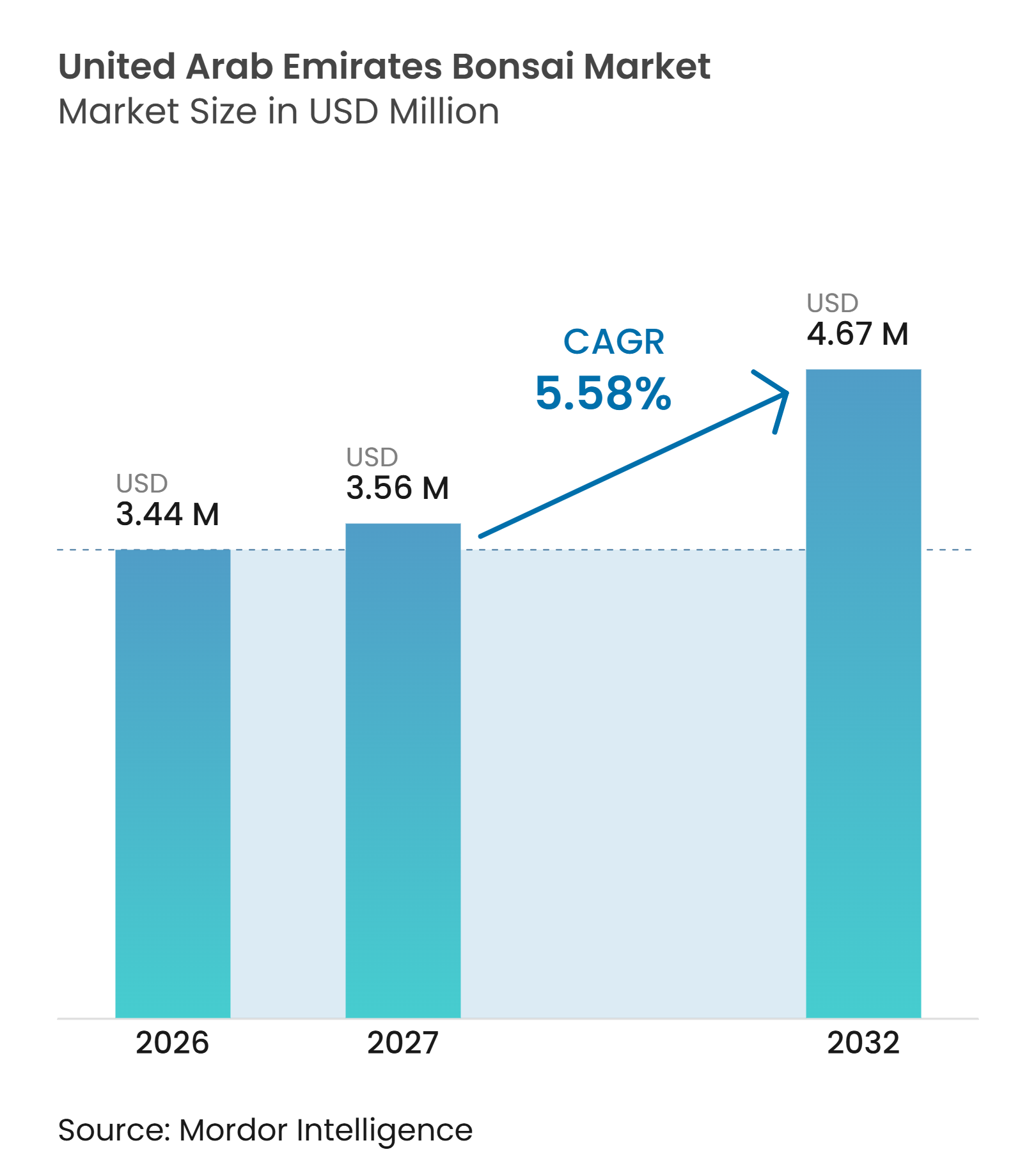
| Base Year Market Size (2026) | USD 3.44 Million |
| Market Size (2027) | USD 3.56 Million |
| Market Size (2032) | USD 4.67 Million |
| Growth Rate (2027 - 2032) | 5.58 % |
| Market Concentration | Medium |
Major Players *Disclaimer: Major Players sorted in no particular order Image © Mordor Intelligence. Reuse requires attribution under CC BY 4.0. | |
United Arab Emirates Bonsai Market Analysis by Mordor Intelligence
The United Arab Emirates bonsai market size was valued at USD 3.44 million in 2026 and is estimated to grow from USD 3.56 million in 2027 to USD 4.67 million by 2032. The market is projected to grow at a 5.58% CAGR during 2027–2032. Demand centers on compact, living woody plants that suit air-conditioned homes, premium hospitality settings, and landscaped developments. Dubai and Abu Dhabi concentrate high-value demand because residential, retail, hotel, and office projects place greater value on finished specimens and reliable maintenance support. The market also depends on imported trees and specialized inputs, which places plant-health compliance and supplier relationships at the center of pricing and inventory planning. Online retail broadens access to first-time buyers, while specialist nurseries retain a role in premium purchases that require visual inspection and care advice.
Key Report Takeaways
- By species, indoor species held 64.71% of the United Arab Emirates bonsai market share in 2026. The outdoor species segment is projected to grow at a 6.2% CAGR during 2027–2032.
- By distribution channel, offline held 58.24% of the United Arab Emirates bonsai market share in 2026. The online segment is anticipated to grow at a 7.9% CAGR during 2027–2032.
- By application, residential accounted for 77.94% of the United Arab Emirates bonsai market size in 2026. The others segment is projected to grow at a 9.1% CAGR during 2027–2032.
Note: Market numbers in this report are based on Mordor Intelligence's proprietary estimation framework, which combines nine months of actuals with Q4 projections for base year 2026.
Market Trends and Insights
Drivers Impact Analysis of United Arab Emirates Bonsai Market*
| Driver | (~) % Impact on CAGR Forecast | Geographic Relevance | Impact Timeline |
|---|---|---|---|
| Growing Interest in Indoor Gardening | +1.61% | Dubai and Abu Dhabi, where apartment living and air-conditioned interiors support demand for compact indoor greenery | Medium term (2–4 years) |
| Premium Residential and Commercial Décor Demand | +1.32% | Dubai and Abu Dhabi, where hotels, branded residences, retail, and offices procure statement planting | Short term (≤ 2 years) |
| Rising Demand for Bonsai Gifting | +0.88% | Dubai, Abu Dhabi, and Sharjah, where corporate and seasonal gifting activity is concentrated | Short term (≤ 2 years) |
| Expansion of Online Bonsai Distribution | +1.17% | All emirates, including Northern Emirates locations reached through national delivery networks | Short term (≤ 2 years) |
| Multi-Year Indoor Acclimatization as a Differentiated Product Attribute | +1.02% | Dubai and Abu Dhabi, where air-conditioned indoor settings raise the value of proven plant survival | Medium term (2–4 years) |
| Demand for Climate-Adapted Species and Specimens in the United Arab Emirates | +0.88% | Dubai, Abu Dhabi, and Al Ain, where outdoor heat conditions influence species selection | Long term (≥ 4 years) |
| Source: Mordor Intelligence | |||
Growing Interest in Indoor Gardening
Apartment living supports demand for compact living décor that fits interiors without requiring a large balcony or garden. Bonsai offers a sculptural alternative to standard foliage plants because each tree delivers a finished visual form within a small footprint. The Dubai 2040 Urban Master Plan, which targets doubling the size of green and recreational spaces, links development policy with more green space, supporting the wider use of living greenery in buildings and public environments[1]. The United Arab Emirates bonsai market benefits when buyers view plants as part of a home setup rather than as a later discretionary purchase. Specialist retailers benefit most when they match species, light conditions, watering needs, and planter size to apartment interiors. That service reduces the gap between a first purchase and long-term ownership.
Premium Residential and Commercial Décor Demand
The United Arab Emirates bonsai market supports sales of mature, styled trees that carry a higher per-unit value than entry-level bonsai. Hotels, branded residences, restaurants, and upscale retail spaces use living trees to create focal points in reception, dining, and amenity areas. The National reported that Bonsai Middle East’s retail prices ranged from United Arab Emirates dirham (AED) 490 (USD 133) to hundreds of thousands of dirhams, including a ghaf bonsai sold for AED 250,000 (USD 68,100). Such purchases follow design specification and client presentation requirements rather than routine household buying patterns. The resulting demand favors suppliers that have access to large specimens, documented care practices, and delivery capabilities suited to commercial sites. Premium demand also supports replacement and maintenance-related sales where interior standards require plants to remain visually consistent.
Rising Demand for Bonsai Gifting
Bonsai is well-suited for gifting occasions because a living tree conveys permanence and visual distinction. Eid Al Fitr, Eid Al Adha, National Day, corporate milestones, and formal openings create recurring purchasing occasions across the United Arab Emirates. Wooden Art Dubai markets bonsai as corporate gifts for clients and employees and as festive gifts for occasions such as Eid, with special discounts on corporate orders and delivery across the United Arab Emirates. Gift buyers often require a ready presentation, delivery coordination, and species that remain presentable after transfer to the recipient. That requirement supports bundled planter-and-packaging offers rather than sales of unprepared nursery stock. Corporate orders also offer suppliers repeat demand because procurement aligns with annual events, recognition programs, and client relationship activities.
Expansion of Online Bonsai Distribution
The United Arab Emirates bonsai market gains reach when digital catalogs connect specialist inventory with buyers outside established nursery districts. MyPlants for Landscape Gardening Works LLC listed Ficus Table Bonsai at United Arab Emirates dirham (AED) 90 (USD 24.5) and Ficus S-Shape Bonsai at AED 180 (USD 49.0), with next-day express delivery for orders placed before 5 pm and a 14-day plant guarantee. Growhub lists ficus bonsai at AED 60 (USD 16.3) and delivers through its own in-house team to six of the seven emirates, covering all except Fujairah. The online channel gives first-time buyers access to lower-priced trees and care information without a dedicated nursery visit. It also gives suppliers a direct route to Northern Emirates customers, where specialist retail density is lower than in Dubai. Online growth depends on accurate product descriptions, safe packaging, disciplined delivery, and follow-up guidance upon arrival.
Restraints Impact Analysis of United Arab Emirates Bonsai Market*
| Restraint | (~) % Impact on CAGR Forecast | Geographic Relevance | Impact Timeline |
|---|---|---|---|
| High Care and Maintenance Requirements | -0.40% | Dubai and Abu Dhabi, where apartment occupancy and continuous air conditioning intensify indoor care needs | Short term (≤ 2 years) |
| Dependence on Imported Bonsai and Imported Inputs | -0.35% | All emirates, with the strongest exposure at Dubai’s import and logistics gateways | Medium term (2–4 years) |
| Limited Suitability of Temperate and Deciduous Species | -0.25% | Lowland urban areas throughout the United Arab Emirates, where prolonged heat restricts temperate species | Long term (≥ 4 years) |
| Long Production and Acclimatization Cycle for Premium Bonsai | -0.30% | Dubai and Abu Dhabi, where premium specimen demand is concentrated | Long term (≥ 4 years) |
| Source: Mordor Intelligence | |||
High Care and Maintenance Requirements
In the United Arab Emirates bonsai market, bonsai requires more frequent care than many standard indoor foliage plants because tree health depends on precise watering, pruning, light, and humidity management. Outdoor trees face intense summer conditions, while indoor trees experience dry air from continuous cooling. The National reported that outdoor bonsai in the United Arab Emirates' summer conditions require watering up to 3 times daily. This care burden narrows the customer base among buyers seeking low-maintenance greenery. It also increases the importance of care education, rescue services, and holiday support from specialist retailers. Shohin Bonsai Dubai and Bonsai Middle East provide care advice and support as part of their specialist offering, including repotting, pruning, styling, and seasonal care.
Dependence on Imported Bonsai and Imported Inputs
The United Arab Emirates bonsai market relies heavily on stock and inputs originating outside the country. Importers must meet inspection, documentation, and phytosanitary requirements administered by the Ministry of Climate Change and Environment (MOCCAE). Federal Law No. 7 of 2025 regarding Agricultural Quarantine entered into force on January 30, 2026, replacing the previous agricultural quarantine law from 1979, and applies to regulated plants, plant products, and related articles moving into, out of, or through the country[2]. The framework gives MOCCAE authority to reject, return, treat, or destroy non-compliant consignments at the owner’s expense. Importers, therefore, carry compliance costs, lead-time exposure, and inventory risk before a tree reaches retail sale. The United States Department of Agriculture Foreign Agricultural Service (USDA FAS) also identifies MOCCAE as the authority responsible for managing plant import regulations, with phytosanitary certificates and official procedures required for agricultural consignments entering the United Arab Emirates.
*Our forecasts treat driver/restraint impacts as directional, not additive. The impact forecasts reflect baseline growth, mix effects, and variable interactions.
United Arab Emirates Bonsai Market Segment Analysis
By Species:
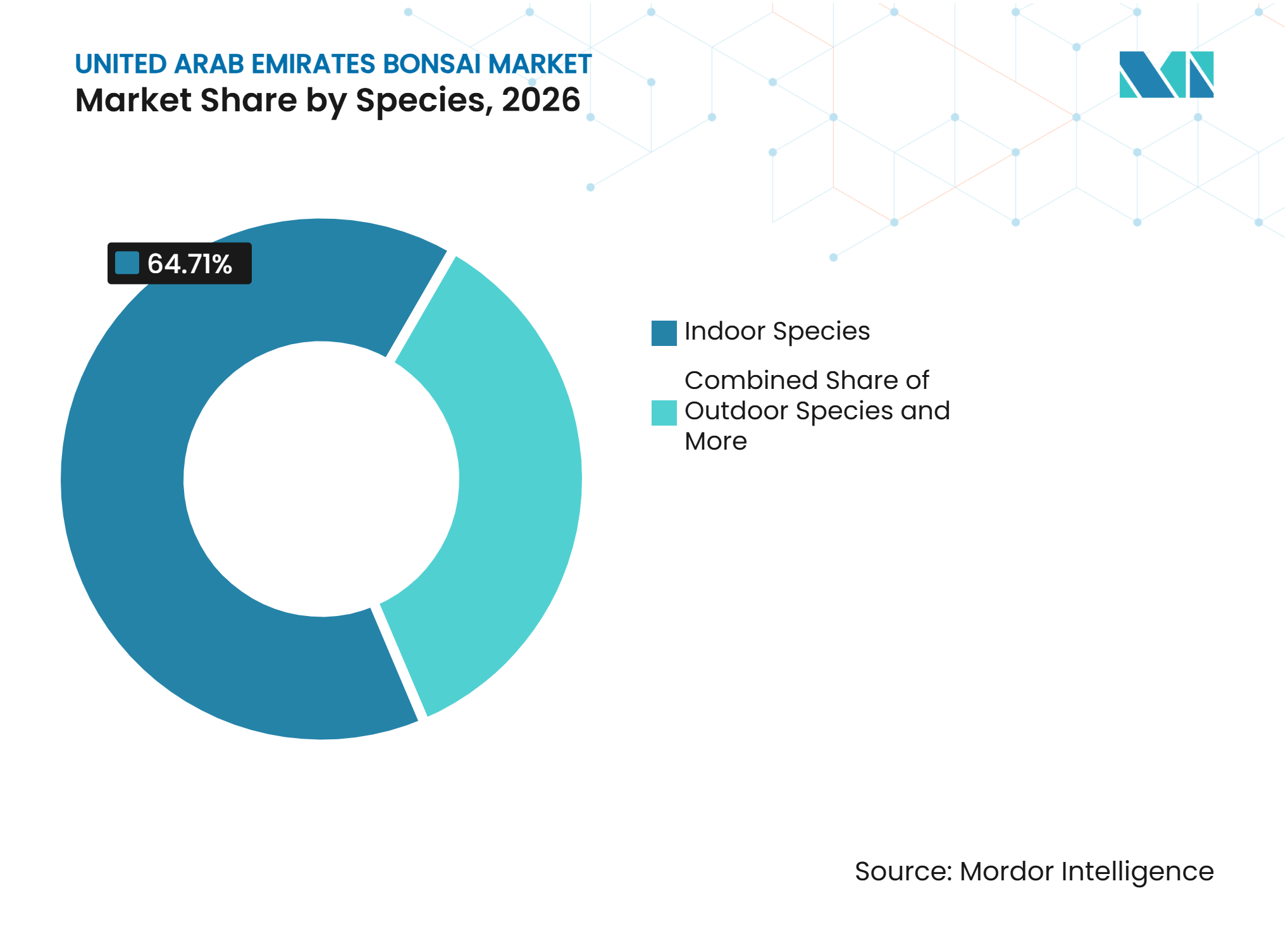
Indoor Species Lead as Outdoor Formats Support Project DemandIndoor species held 64.71% of the United Arab Emirates bonsai market share in 2026. The segment leads because indoor settings protect trees from extreme heat, although dry air and limited light still require careful species selection. Ficus, Carmona retusa, golden dewdrop, and Premna are established choices in the local assortment[3]. Their familiarity improves buyer confidence because retailers have accumulated expertise in caring for these trees. Apartment buyers also prefer compact species that suit interior surfaces and limited floor space.
The outdoor species segment is projected to grow at a 6.2% CAGR during 2027–2032. Luxury villa gardens, hospitality sites, commercial landscaping, and public-facing developments support demand for larger specimens. MyPlants for Landscape Gardening Works LLC lists mature sculpted ficus bonsai grown for outdoor villa landscaping, including a Large Multi-Head Ficus Bonsai Tree at United Arab Emirates dirham (AED) 7,250 (USD 1,970) and a Giant Ficus Dragon Bonsai Tree at AED 23,500 (USD 6,400). Most needle and deciduous species remain specialized choices because their care needs do not align closely with prevailing local conditions.



By Distribution Channel:
Offline Supports Evaluation, While Online Widens AccessOffline held 58.24% of the market value in 2026. Physical retail retains value because buyers of finished specimens inspect trunk structure, root flare, branching, foliage health, and overall proportions before purchase. Bonsai Middle East operates from Dubai and supports direct engagement with customers seeking specialist advice. Wahat Al Sahraa Nurseries, part of Desert Group, operates more than 10 million square feet of nursery land in the United Arab Emirates. This physical infrastructure supports viewing, handling, collection, and project-oriented selection for large trees.
The online segment is anticipated to grow at a 7.9% CAGR during 2027–2032. The segment reaches customers who do not live near a specialist nursery and supports smaller purchases suited to delivery. Growhub operates a physical store in Warsan 3, Dubai, alongside its online shop and in-house delivery to most emirates. Lower-priced ficus products provide a logical entry point because they reduce the financial risk of a first purchase. Online expansion increases reach while placing greater responsibility on product descriptions, safe delivery, and post-delivery advice.
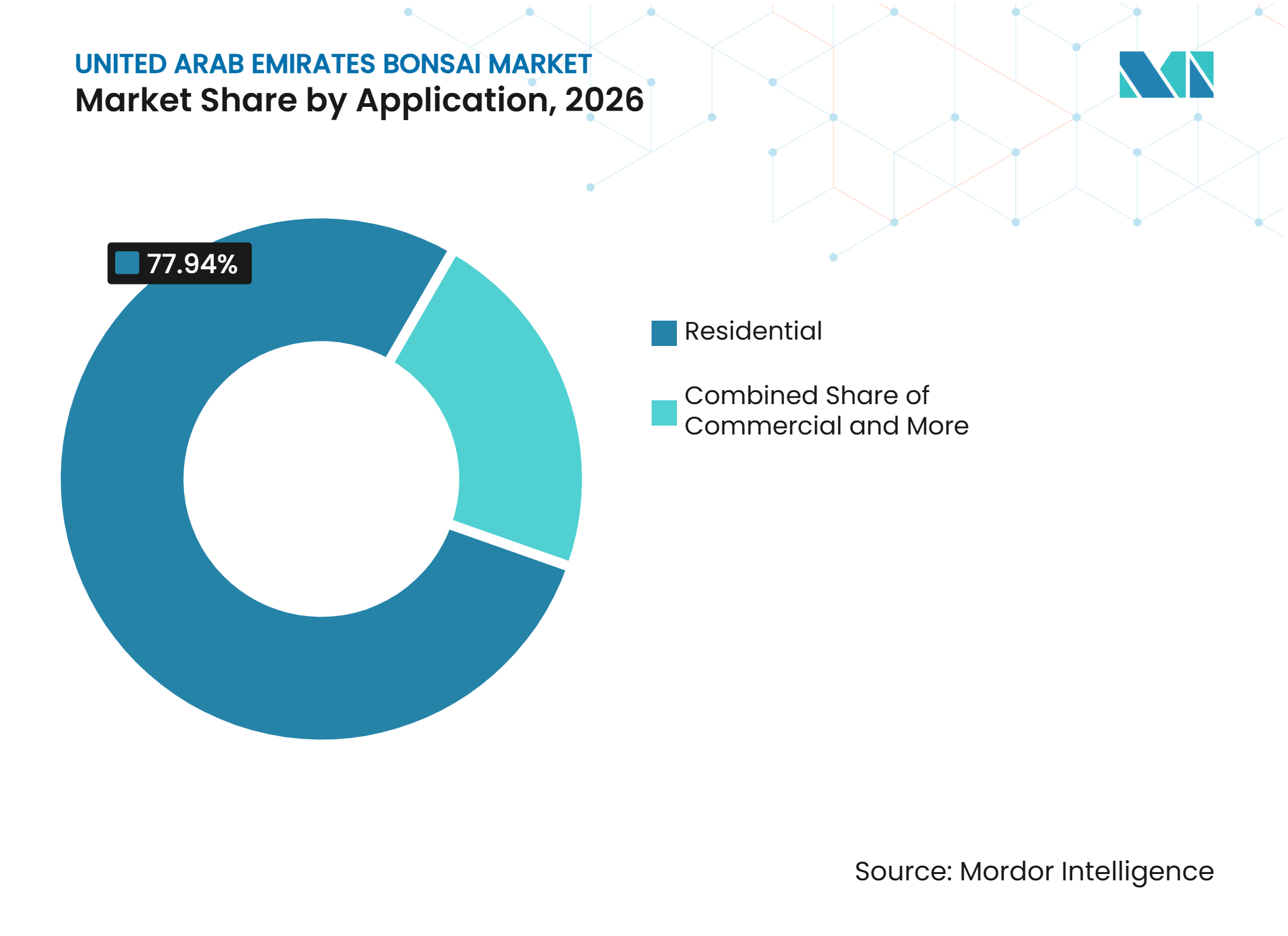
Residential accounted for 77.94% of the United Arab Emirates bonsai market size in 2026. The segment includes first-time plant buyers, enthusiasts, expatriate households, and residents who use bonsai as a compact decorative feature. Smaller trees suit apartments because they require less space and provide an immediate visual impact. Entry-level pricing through digital channels broadens access beyond dedicated collectors. Larger residential purchases also support demand for refined trees in villas and high-value homes.
The others segment is projected to grow at a 9.1% CAGR during 2027–2032. It includes institutional gifts, art fairs, event procurement, formal openings, and related uses outside residential and routine commercial interiors. These purchases support repeat order patterns because they are tied to planned occasions and formal presentation requirements. Commercial applications form a separate segment, particularly in hotels, offices, restaurants, and retail interiors. The United Arab Emirates bonsai market, therefore, has several demand routes beyond individual household ownership.

Geography Analysis
Dubai is the principal commercial center for the United Arab Emirates bonsai market because it concentrates specialist retailers, online fulfillment, luxury development, hotels, and high-density apartment living. Bonsai Middle East, Shohin Bonsai Dubai, MyPlants for Landscape Gardening Works LLC, Growhub, Mughel Landscaping LLC (Mughel Gardens), and Wahat Al Sahraa Nurseries all have documented operations in Dubai. Dubai’s buyer base includes collectors, residents furnishing apartments, and project professionals selecting large specimens. The city also serves as an import and delivery hub, linking local retail demand to the broader national supply chain.
Abu Dhabi supports a separate high-value demand base through villas, hospitality assets, corporate settings, and landscape projects. Royal Roots LLC, established in 2023, operates a 3-hectare nursery in the Bahia region of Abu Dhabi dedicated to medium, large, and mature specimen trees, with a range that includes olives and ficus bonsai. The city’s demand aligns with premium residential and institutional applications where mature trees serve a defined visual role, and its project-oriented buyer profile supports larger specimens and specialist advice. Abu Dhabi, therefore, complements Dubai’s retail depth with demand for landscape and premium-format stock.
Sharjah participates in household, corporate gifting, and nearby retail demand, supported by its proximity to Dubai’s nursery and logistics network. Northern Emirates customers are served on scheduled delivery cycles, with Growhub delivering to Sharjah and Ajman twice a week and to Umm Al Quwain and Ras Al Khaimah once a week. Al Ain has particular relevance for climate-adapted and landscape-oriented plant selection because outdoor conditions guide buyer and supplier choices. Across the country, geography affects channel access and application mix rather than creating separate quantified market segments.
Competitive Landscape
Market Concentration
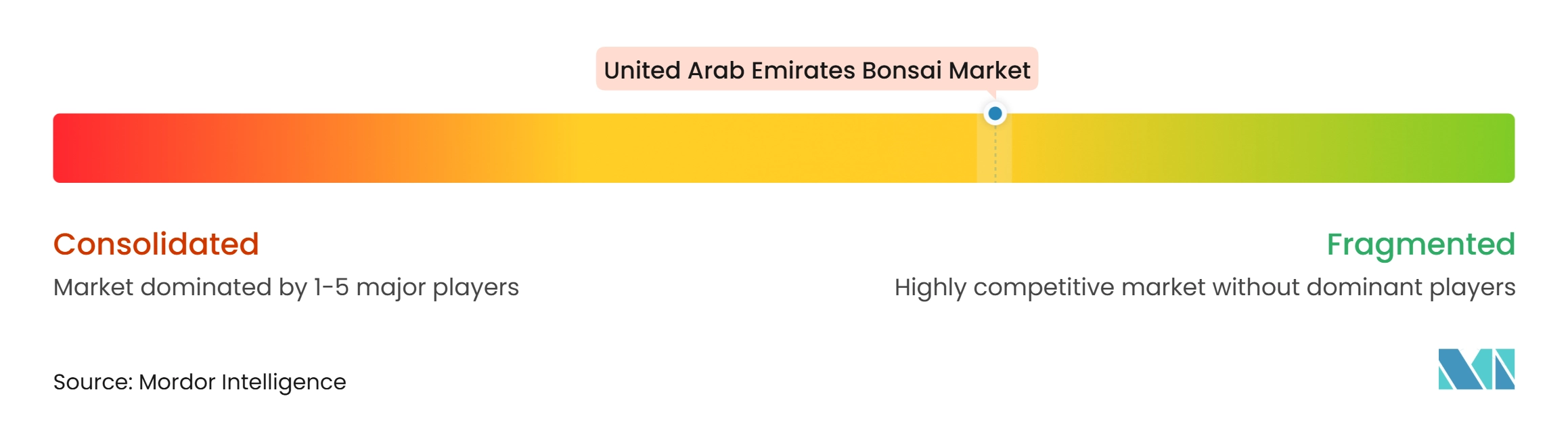
The United Arab Emirates bonsai market is moderately concentrated around specialist sellers, diversified nurseries, and digital plant retailers with differentiated roles. Bonsai Middle East differentiates through specialist sourcing, imported trees, and attention to acclimatization, while Shohin Bonsai Dubai emphasizes educational support, which addresses the care barrier that affects buyer retention. Mughel Landscaping LLC (Mughel Gardens) maintains a nursery in Al Warsan Third, Dubai, and offers bonsai through its own retail channel. Wahat Al Sahraa Nurseries serves larger landscape and project requirements through its nursery base and Desert Group affiliation, while Royal Roots LLC serves similar specimen-tree demand from Abu Dhabi.
MyPlants for Landscape Gardening Works LLC combines an online bonsai range with delivery and plant-guarantee messaging, while Growhub targets entry-level demand with lower-priced ficus stock. Greensouq extends the online range into larger indoor formats, offering ficus bonsai of up to 2.0 meters, and Wooden Art Dubai focuses on corporate and occasion-led gifting. These strategic positions create different routes to the customer rather than a single uniform retail model. Competition is strongest where suppliers overlap on indoor ficus and accessible price points.
The competitive advantage in premium bonsai rests on supply access, horticultural care, specimen quality, and trust rather than volume alone. Mature trees are difficult to standardize, and buyers often value direct evaluation before committing to a purchase. Digital sellers hold an advantage in discovery and geographic reach, but they face higher fulfillment sensitivity with live stock. Large nurseries hold an advantage where buyers require landmark trees or project-scale delivery. No validated combined market-share data for the top players is available, so individual shares are not assigned.
United Arab Emirates Bonsai Industry Leaders
-
Wahat Al Sahraa Nurseries (Desert Group)
-
Bonsai Middle East
-
Shohin Bonsai Dubai
-
MyPlants for Landscape Gardening Works LLC
-
Mughel Landscaping LLC (Mughel Gardens)
- *Disclaimer: Major Players sorted in no particular order
United Arab Emirates Bonsai Market Companies Covered in this Report
- Bonsai Middle East
- Shohin Bonsai Dubai
- Mughel Landscaping LLC (Mughel Gardens)
- Wahat Al Sahraa Nurseries
- Growhub
- MyPlants for Landscape Gardening Works LLC
- Royal Roots LLC
- Wooden Art Dubai
- Greensouq
- Acacia Garden Center LLC
Recent Industry Developments in United Arab Emirates Bonsai Market
- May 2026: Acacia Garden Center LLC, part of Tanseeq Investment Group, listed an Olea europaea bonsai specimen measuring 1.5 to 2.0 meters in height with a 70 to 80 centimeter trunk girth at United Arab Emirates dirham (AED) 6,500 (USD 1,770) on its UAE e-commerce platform.
- February 2026: Tanseeq Investment Group, the parent company of Acacia Garden Center LLC, incorporated Acacia Nurseries in Riyadh, Saudi Arabia, to supply mature trees and landscaping plants, marking the group’s expansion beyond the United Arab Emirates.
- January 2026: Federal Law No. 7 of 2025 regarding Agricultural Quarantine entered into force on January 30, 2026, establishing the current framework for regulated plant consignments.
United Arab Emirates Bonsai Market Report Scope
United Arab Emirates's bonsai market has an annual value of miniature, living woody plants intentionally trained to mimic mature trees, plus the pots, soils, and pruning inputs sold with them. Values represent consumer-level spending through both specialty nurseries and general retail, expressed in USD.
The United Arab Emirates Bonsai Market Report is Segmented by Species (Indoor Species, Outdoor Species, Needle Tree Species, and Deciduous Tree Species), by Distribution Channel (Online and Offline), and by Application (Residential, Commercial, and Others).
Segmentation Overview
| Indoor Species |
| Outdoor Species |
| Needle Tree Species |
| Deciduous Tree Species |
| Online |
| Offline |
| Residential |
| Commercial |
| Others (institutional gifts, art fairs) |
| By Species | Indoor Species |
| Outdoor Species | |
| Needle Tree Species | |
| Deciduous Tree Species | |
| By Distribution Channel | Online |
| Offline | |
| By Application | Residential |
| Commercial | |
| Others (institutional gifts, art fairs) |
Key Questions Answered in the Report
What is the value of the United Arab Emirates bonsai market in 2026?
The United Arab Emirates bonsai market was valued at USD 3.44 million in 2026 and is anticipated to reach USD 4.67 million by 2032.
What is the growth rate of the United Arab Emirates bonsai market?
The market is projected to grow at a 5.58% CAGR during 2027–2032.
What is driving bonsai sales in the United Arab Emirates?
Indoor gardening, premium décor demand, gifting, online access, acclimatized trees, and climate-suitable species support sales.
Which distribution channel is growing fastest for bonsai in the United Arab Emirates?
The online segment is anticipated to grow at a 7.9% CAGR during 2027–2032, supported by digital discovery and wider delivery reach.