
Underwater Concrete Market Size and Share
Market Overview
| Study Period | 2021 - 2031 |
|---|---|
| Market Size (2026) | USD 180.95 Billion |
| Market Size (2031) | USD 220.36 Billion |
| Growth Rate (2026 - 2031) | 4.02 % |
| Fastest Growing Market | Asia-Pacific |
| Largest Market | Asia-Pacific |
| Market Concentration | Medium |
Major Players *Disclaimer: Major Players sorted in no particular order Image © Mordor Intelligence. Reuse requires attribution under CC BY 4.0. | |
Underwater Concrete Market Analysis by Mordor Intelligence
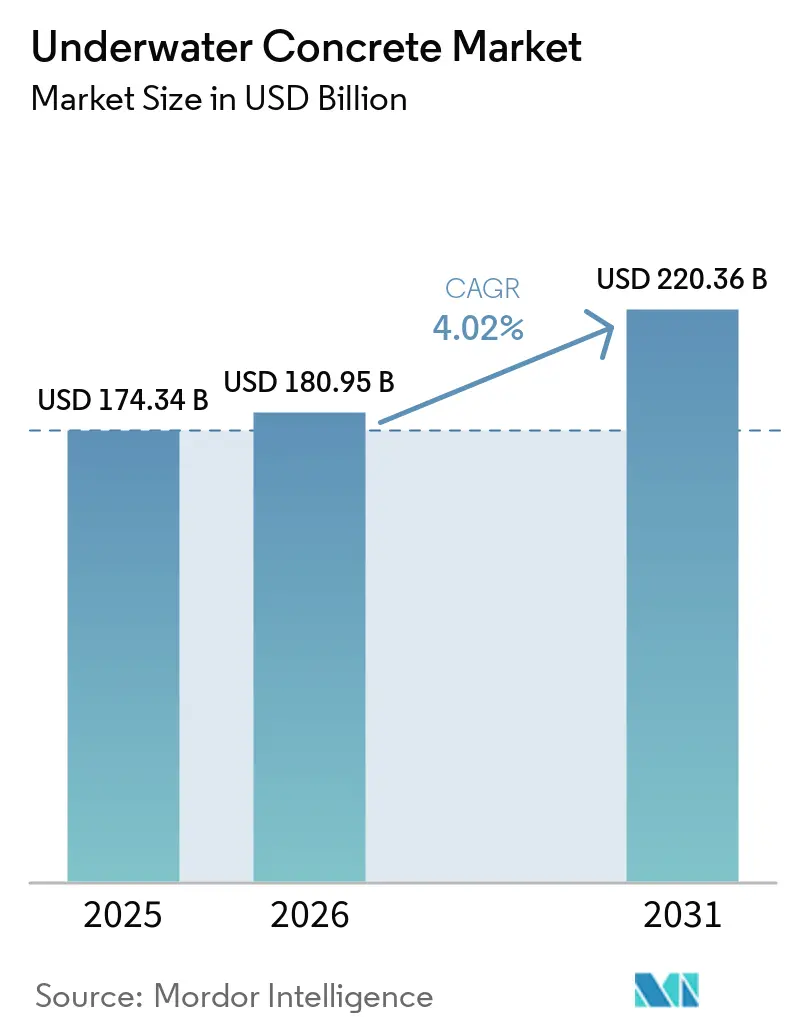
The Underwater Concrete Market size is estimated at USD 174.34 billion in 2025 and is estimated to grow from USD 180.95 billion in 2026 to USD 220.36 billion by 2031, at a CAGR of 4.02% during the forecast period (2026-2031). The underwater concrete market is driven by port reconstruction, offshore energy construction, and repairs to aging marine structures. Larger container vessels require deeper berths and stronger quay aprons, increasing demand for caisson placement, pile encasement, and underwater grouting. Offshore wind projects use specialized grouted foundations and high-performance mixes, creating opportunities for suppliers with strong material and site-service capabilities. Rehabilitation demand remains steady as many damaged assets cannot be removed from service or dewatered for repair. Cost pressure, washout risk, and limited contractor availability can slow execution, but they also increase the value of proven formulations and reliable placement services.
Key Report Takeaways
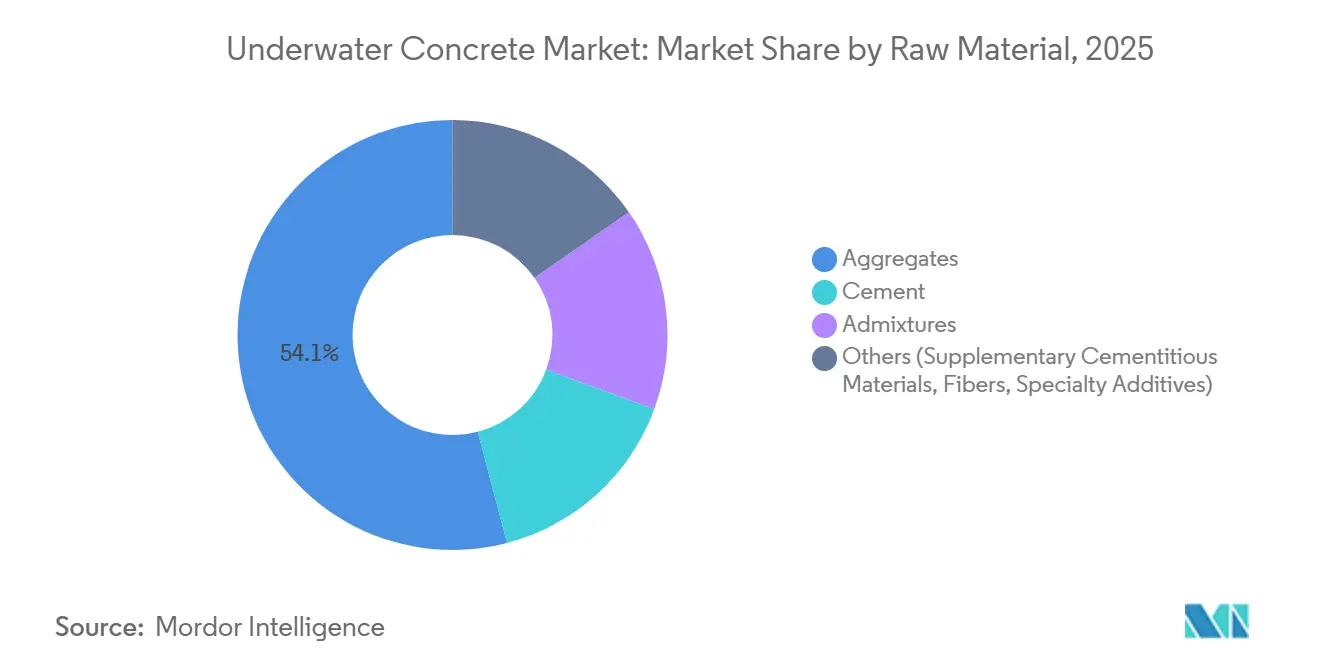
- By raw material, aggregates held 54.07% of the Underwater Concrete Market share in 2025, while admixtures are forecast to grow at a 4.88% CAGR through 2031.
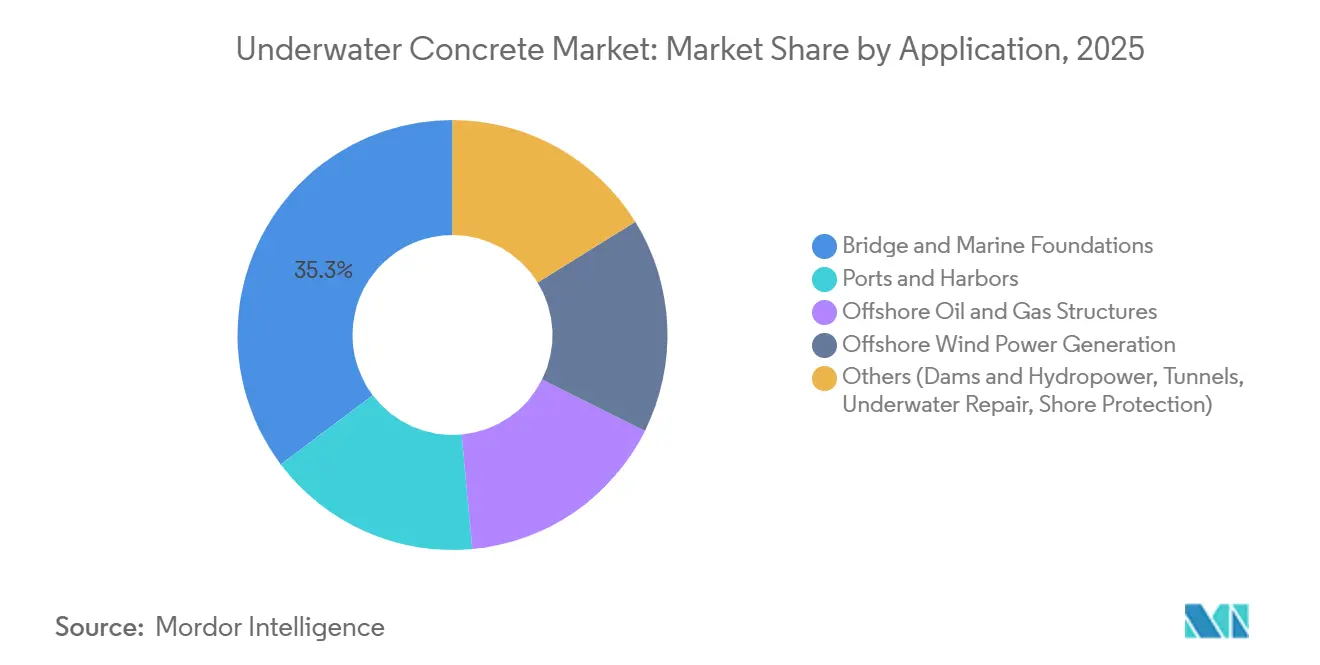
- By application, bridge and marine foundations accounted for 35.28% of the Underwater Concrete Market share in 2025, while offshore wind power generation is projected to expand at a 5.13% CAGR through 2031.
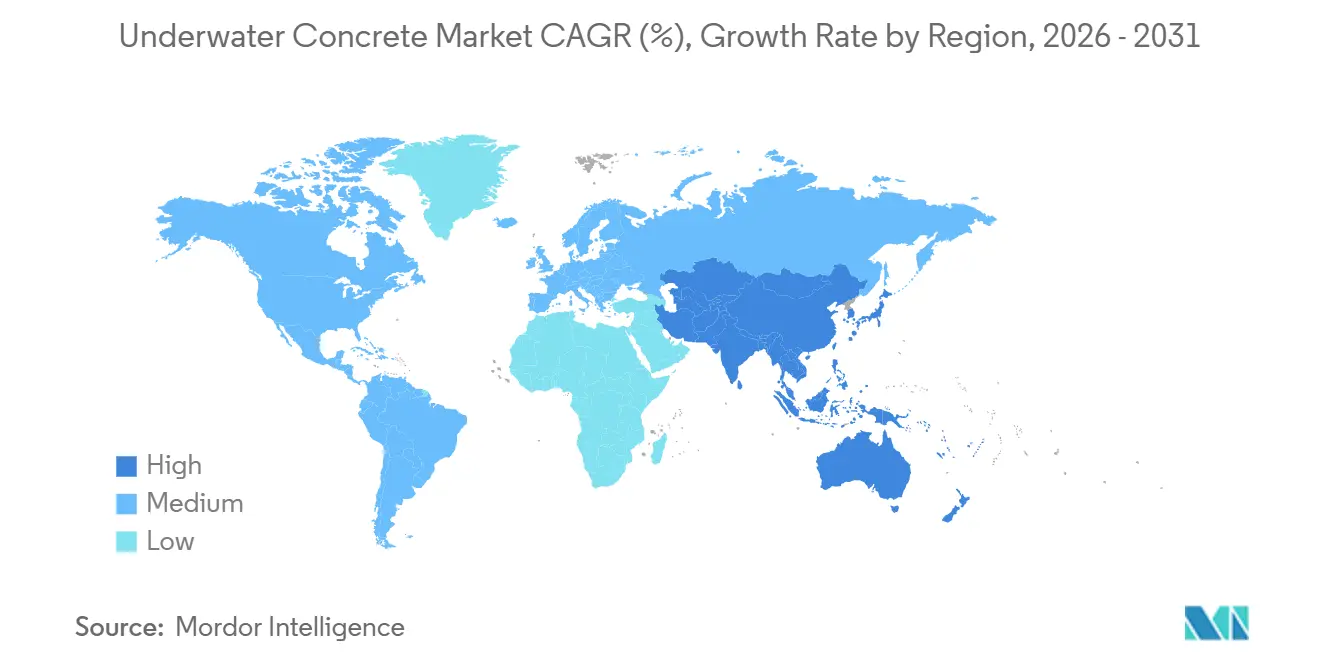
- By geography, Asia-Pacific captured 33.19% of the global share in 2025 and is projected to grow at a 5.06% CAGR through 2031.
Note: Market size and forecast figures in this report are generated using Mordor Intelligence’s proprietary estimation framework, updated with the latest available data and insights as of January 2026.
Market Trends and Insights
Drivers Impact Analysis of Underwater Concrete Market*
| Drivers | (~) % Impact on CAGR Forecast | Geographic Relevance | Impact Timeline |
|---|---|---|---|
| Expansion of Coastal Infrastructure and Port Modernization | +1.2% | Global, concentrated in APAC, MEA, and South America | Short term (≤ 2 years) |
| Growth of Offshore Wind and Subsea Energy Construction | +1.0% | North Sea, APAC, and U.S. East Coast | Medium term (2-4 years) |
| Rehabilitation of Aging Dams, Bridges, and Marine Assets | +0.8% | North America, Europe, India, and China | Short term (≤ 2 years) |
| Adoption of Anti-Washout and Self-Compacting Mix Designs | +0.6% | Global | Medium term (2-4 years) |
| Demand for Low-Carbon and Longer-Life Marine Concrete | +0.3% | Europe, APAC, and North America | Long term (≥ 4 years) |
| Underwater Placement as an Alternative to Cofferdams and Dewatering | +0.4% | North America and APAC, with spillover to MEA | Medium term (2-4 years) |
| Source: Mordor Intelligence | |||
Expansion of Coastal Infrastructure and Port Modernization
Port operators are adapting quays, aprons, and channels for vessels with drafts above 16 meters. This work may require new caissons, quay walls, breakwaters, and pile foundations that use specialized underwater placement techniques. The underwater concrete market benefits because several older ports in Southeast Asia and West Africa need full quay reconstruction rather than minor upgrades. The United Nations Conference on Trade and Development (UNCTAD) reported more than 300 major port development or modernization projects with a combined planned capital expenditure above USD 250 billion over the next decade. In April 2024, the U.S. government committed USD 20 billion to strengthen maritime infrastructure, including shipyard upgrades and port modernization. Procurement rules increasingly refer to recognized marine construction standards, which favor suppliers that can document mix design, testing, and placement performance.
Growth of Offshore Wind and Subsea Energy Construction
Offshore wind is increasing demand for high-performance grouting, even while conventional marine foundations remain important in quantity. The Global Wind Energy Council recorded 11 GW of new offshore wind capacity in 2023. The U.S. Department of Energy reported that the potential U.S. offshore wind pipeline expanded 53% to 80,523 MW in 2024. Grouted jacket and monopile connections require cementitious materials with performance standards that exceed those of standard tremie concrete. In June 2026, Sika supported the 112 MW Ishikari Bay New Port Offshore Wind Farm in Japan by grouting 14 jacket-based turbines with SikaGrout-9500. These projects expand the role of advanced grouting materials in offshore construction.
Rehabilitation of Aging Dams, Bridges, and Marine Assets
Repair spending supports the underwater concrete market because dams, bridge substructures, and marine assets require ongoing maintenance. A scientific review found that many underwater concrete structures in hydraulic engineering have sustained damage, and that deterioration of bridge substructures is widely documented across several countries. Repair windows can be narrow because operators must maintain navigation, water control, or transport access. Underwater placement is particularly relevant where lowering water levels creates structural or environmental concerns. Emerging repair technologies, including robotic placement and automated concrete methods, can reduce lifecycle repair costs and improve access to hard-to-reach locations. These conditions make rehabilitation a recurring source of demand rather than a one-time construction cycle.
Adoption of Anti-Washout and Self-Compacting Mix Designs
Anti-washout admixtures are becoming standard inputs for offshore, tidal-zone, and deep-water projects. Research on underwater anti-washout self-compacting concrete has improved the ability to define mix proportions that remain workable under variable shallow-water conditions. A separate scientific study found that Ground Granulated Blast-furnace Slag (GGBS) substitution with anti-washout admixtures can improve chloride penetration resistance, which is important in saltwater exposure[1]. Self-compacting mixes can reduce dependence on diver judgment during placement and support more consistent execution. Research on engineered cementitious composites has also shown that anti-washout admixtures and Polyvinyl Alcohol (PVA) fibers can support high dynamic modulus and rigidity in wave-loaded applications. The underwater concrete market, therefore, gains value through material performance, not only through total placement quantity.
Restraints Impact Analysis of Underwater Concrete Market*
| Restraints | (~) % Impact on CAGR Forecast | Geographic Relevance | Impact Timeline |
|---|---|---|---|
| High Placement Complexity and Specialized Equipment Requirements | -0.5% | Global, most acute in deep-water and tidal-zone applications | Medium term (2-4 years) |
| Washout, Segregation, and Quality-Control Risk | -0.3% | Global, most acute in sub-Saharan Africa and Southeast Asia | Short term (≤ 2 years) |
| Shortage of Qualified Underwater Concrete Contractors | -0.2% | APAC emerging markets, MEA, and South America | Long term (≥ 4 years) |
| Volatility in Cement, Admixture, and Aggregate Costs | -0.4% | Global | Short term (≤ 2 years) |
| Source: Mordor Intelligence | |||
High Placement Complexity and Specialized Equipment Requirements
Underwater concrete placement requires equipment and procedures that many regional contractors do not maintain. Projects require calibrated tremie pipes, verified anti-washout mixes, suitable pumps, and adequate concrete head pressure. Deep-water and tidal-zone work imposes logistical constraints not present in standard construction. Heidelberg Materials Italy supported the Genoa Breakwater through an offshore batching operation on a floating barge, demonstrating the specialized production model required for some open-sea projects. Such systems concentrate large contracts among established marine contractors and suppliers. The underwater concrete market may therefore face slower project delivery where equipment, testing capacity, and trained crews are limited.
Washout, Segregation, and Quality-Control Risk
Washout and segregation can reduce structural strength and create environmental concerns during placement. A scientific review found that underwater repair materials can achieve 80% to 90% of the compressive strength of equivalent dry-placed materials, depending on execution quality. Water temperature, turbulence, and current velocity can widen the gap between laboratory performance and field results. Scientific research links anti-washout formulations with better resistance to chloride penetration in submerged exposure. Quality assurance remains difficult because verifying performance after underwater placement is more complex than testing a dry pour. The underwater concrete market must therefore rely on stronger controls over mix design, batching, placement, and inspection.
*Our forecasts treat driver/restraint impacts as directional, not additive. The impact forecasts reflect baseline growth, mix effects, and variable interactions.
Underwater Concrete Market Segment Analysis
By Raw Material:
Aggregates Lead by Quantity While Admixtures Drive Value GrowthAggregates accounted for 54.07% of the raw material share in 2025, reflecting their role as the largest material input by both weight and quantity. They form the cost base for breakwater caissons, bridge pier foundations, quay walls, and other marine placements. Locally available coarse- and fine-aggregate blends help contractors manage per-cubic-meter costs in coastal projects. This is particularly relevant in APAC and the Middle-East construction sectors, where large infrastructure programs require substantial quantities. Cement is the next significant material component, used in both conventional tremie pours and specialized foundation grouting. The material mix varies with the required workability, strength, durability, and exposure resistance. Supplementary cementitious materials, including slag, fly ash, and metakaolin, fall within the other materials category. Seawater-compatible blends incorporating supplementary cementitious materials can maintain structural performance while reducing lifecycle carbon emissions. The underwater concrete market continues to rely on aggregates, as even highly specified projects require a stable quantity base.
Admixtures are projected to be the fastest-growing raw material category, with a 4.88% CAGR through 2031. Anti-washout and viscosity-modifying agents are moving from optional materials to required inputs for tidal-zone repairs, deep-water foundations, and offshore wind grouting. Their higher unit value shifts the commercial mix even when their physical quantity remains low. A precision polymer system can command a significantly higher unit value than aggregate because it directly affects washout resistance, flow, and placement stability. This gives admixture suppliers a stronger margin position within the underwater concrete market. This effect is reinforced when project specifications require documented material testing and site support. Research on self-compacting underwater concrete provides a technical basis for repeatable mix designs under variable water conditions. Evidence on Ground Granulated Blast-furnace Slag (GGBS) and anti-washout admixtures also supports their role in improving chloride resistance. The underwater concrete market is therefore moving toward higher-value formulation content while retaining aggregate-led quantity economics.

By Application:
Bridge and Marine Foundations Lead by Quantity While Offshore Wind Drives GrowthBridge and marine foundations accounted for 35.28% of the application share in 2025. The segment is supported by new coastal bridges, port-access upgrades, quay reconstruction, and repairs to existing bridge substructures. Chloride ingress, scour erosion, and freeze-thaw exposure can accelerate deterioration below the waterline. A review of underwater concrete infrastructure documented widespread damage to bridge substructures, sustaining the need for repair programs. The segment benefits from both new construction and rehabilitation, making demand less dependent on a single project type. Ports and harbors represent another major application, as new port investments require quay walls, breakwaters, caissons, and berth upgrades. The United Nations Conference on Trade and Development (UNCTAD) identified more than 300 major port projects worldwide, providing a broad base of activity for the underwater concrete market. Offshore oil and gas structures also use specialized underwater grouting in relevant coastal regions. In June 2026, Sika supplied more than 600 tons of SikaGrout-9610 Ultra-High-Performance Concrete (UHPC) for 17 anchor mooring piles at the Eni Congo Litchendjili Floating Liquefied Natural Gas (FLNG) Mooring System.
Offshore wind power generation is forecast to expand at a 5.13% CAGR through 2031. Each grouted jacket or monopile connection uses high-performance cementitious materials that can achieve higher strength than conventional tremie concrete, supporting faster value growth even when total material quantity is lower than in bridge and harbor works. The addition of 11 GW of offshore wind capacity in 2023 demonstrates the scale of global deployment that supports demand for foundations and grouting. The potential U.S. pipeline of 80,523 MW adds another source of future activity. In June 2026, Sika mobilized to the 500 MW Fengmiao 1 Offshore Wind Project in Taiwan to supply grouting material for 33 jacket foundations. Floating foundations can further expand this opportunity, as concrete is also being developed for floating wind platform systems. The underwater concrete market serves a broader range of applications, including dams, hydropower, tunnels, shore protection, and underwater repair.
Geography Analysis
APAC Underwater Concrete Market
Asia-Pacific accounted for 33.19% of the regional market share in 2025 and is projected to grow at a CAGR of 5.06% through 2031. The region's demand is driven by coastal infrastructure construction, offshore energy development, and repair activity across ports, dams, and waterways. China's port construction activity, including the Yangshan Deep Water Port and other coastal infrastructure programs, relies on durable marine concrete. National research programs also address repair technologies and damage identification in concrete structures for port assets. In July 2026, Japan's AquaMarionette remote-operation system demonstrated centimeter-level underwater construction at a depth of 32 m, indicating a regional need for more reliable concrete placement in deep or turbid waters[2]. The Asia-Pacific underwater concrete market also benefits from offshore wind activity in China, Japan, and Taiwan.
North America and Europe Underwater Concrete Market
North America and Europe have different demand profiles, but both support high-specification work. North America has a strong rehabilitation need, as its bridges and marine assets are experiencing underwater deterioration. The April 2024 USD 20 billion U.S. maritime infrastructure commitment supports upgrades to port facilities, shipyards, and related assets. The U.S. offshore wind pipeline of 80,523 MW adds demand for grouting and foundation materials. Europe has an active marine infrastructure base and a growing focus on lower-carbon construction materials. Webuild and Heidelberg Materials Italy have operated an offshore concrete production system for the Genoa Breakwater, illustrating the specialized logistics used in large Mediterranean projects. In July 2026, CEMEX supplied 1,000 cubic meters of lower-carbon Vertua concrete for riverbank rehabilitation in Rives-en-Seine, France. The underwater concrete market in these regions is shaped by rehabilitation standards, offshore energy requirements, and demand for lower-carbon materials.
MEA and South America Underwater Concrete Market
The Middle-East and Africa represent an expanding opportunity for high-performance concrete in saline coastal conditions. Large infrastructure programs in the Gulf support demand for cementitious materials and ready-mix concrete solutions. West Africa is also emerging as a market for offshore specialty applications, as demonstrated by Sika's work on the Eni Congo mooring system, which required high-performance grouting across 17 anchor piles. South America's demand is tied to port modernization and offshore energy activity in Brazil and Argentina, with Chile and Peru adding infrastructure investment along Pacific trade routes. Contractor availability and quality-control capacity will affect how quickly these projects translate into placed output. The underwater concrete market in these regions has growth potential, but execution capability remains a key requirement.
Competitive Landscape
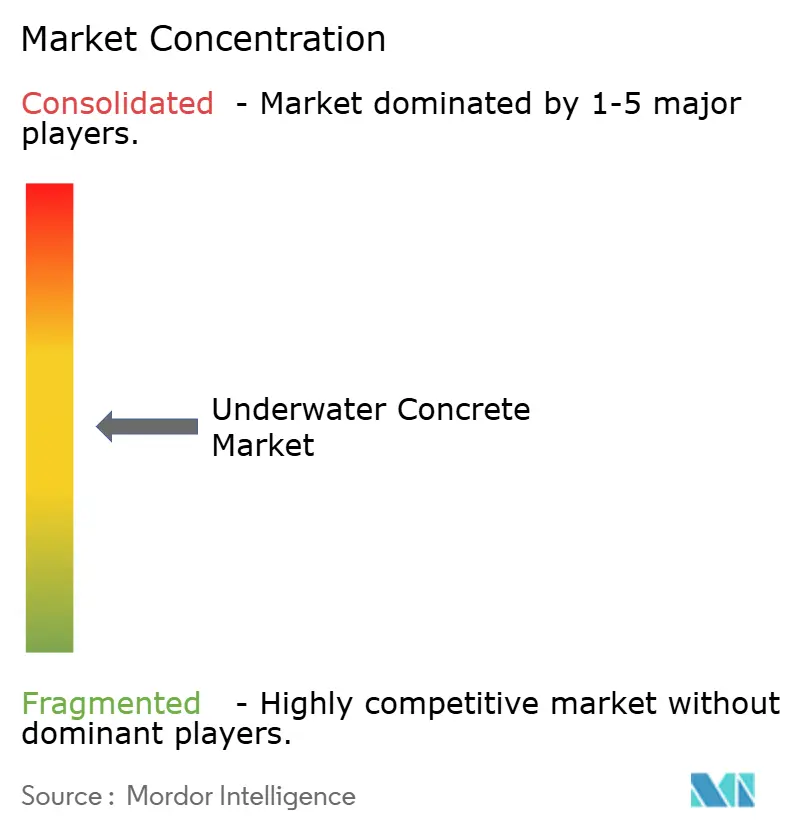
The underwater concrete market is moderately fragmented. Heidelberg Materials, CRH, Sika, Mapei, and other large suppliers compete alongside regional producers and specialist repair firms. Aggregates and conventional concrete favor companies with local production and logistics networks, while offshore grouting, marine repair, and floating-foundation work favor companies with tested formulations, engineering support, and project experience. Heidelberg Materials expanded its presence through several acquisitions in 2025, including Giant Cement Holding, BURNCO Rock Products, Island Aggregates, Walan Specialty Construction Products, and Cava Nord. These acquisitions strengthened its supply base in aggregates, cementitious materials, and specialty construction products. The underwater concrete market rewards this type of vertical coverage because coastal projects require dependable sourcing and specialized placement support.
Sika is moving beyond material supply by combining grouting products, offshore equipment, mobile laboratories, and on-site technical supervision. This model was evident in its 2026 work at Fengmiao 1 in Taiwan, Ishikari Bay in Japan, and the Eni Congo project. This approach helps suppliers retain control over specifications and reduce execution uncertainty for project owners. Smaller specialists, including MUHU Construction Materials, Rockbond SCP, and Five Star Products, compete in high-specification repair and grouting niches. Their positions depend on documented application results and mix-design capability rather than scale. Testing and performance control favor suppliers able to provide validated material data. The underwater concrete market therefore has room for both integrated material groups and focused technical specialists.
Low-carbon marine concrete and floating offshore wind are becoming important areas for competitive differentiation. Suppliers must meet tighter performance requirements around washout resistance, chloride protection, and lifecycle durability. Large contractors can gain an advantage by operating dedicated offshore batching and logistics systems. Regional producers remain important for standard near-shore placements, where local access to aggregate and delivery capacity are key factors. The underwater concrete market is likely to remain fragmented in output supply while becoming more concentrated in advanced offshore and repair applications.
Underwater Concrete Industry Leaders
-
Cemex S.A.B DE C.V.
-
Heidelberg Materials AG
-
Sika AG
-
Five Star Products, Inc.
-
Conmix
- *Disclaimer: Major Players sorted in no particular order
Underwater Concrete Market Companies Covered in this Report
- Buzzi S.p.A.
- Cemex S.A.B DE C.V.
- China National Building Material Co., Ltd.
- Conmix
- CRH
- Five Star Products, Inc.
- Heidelberg Materials AG
- Mapei S.p.A.
- MUHU (China) Construction Materials Co., Ltd.
- Rockbond SCP
- Saint-Gobain
- Sika AG
- Taiheiyo Cement Corporation
- Tarmac
- UltraTech Cement Ltd.
- Unibeton Ready Mix
Recent Industry Developments in Underwater Concrete Market
- August 2026: Porto Torres port in Sardinia, Italy, began installing concrete caissons for a new breakwater, driving demand for underwater concrete in harbor construction on maritime routes toward mainland Italy, France, and Spain
- July 2026: The French government allocated EUR 258.5 million (~USD 285 million) under the France 2030 program to five ports: Cherbourg, Brest, Nantes–Saint-Nazaire, Port-la-Nouvelle, and Marseille-Fos, supporting underwater concrete applications in port infrastructure development.
Global Underwater Concrete Market Report Scope
Underwater concrete is a specially formulated, highly cohesive concrete mixture designed for placement in submerged or wet environments, with minimal washout of cement paste and minimal material segregation. It flows smoothly, self-compacts without vibration, and hardens reliably underwater.
The underwater concrete market is segmented by raw material, application, and geography. By raw material, the market is segmented into cement, aggregates, admixtures, and others (supplementary cementitious materials, fibers, and specialty additives). By application, the market is segmented into bridge and marine foundations, ports and harbors, offshore oil and gas structures, offshore wind power generation, and others (dams and hydropower, tunnels, underwater repair, shore protection, and water-retaining structures). The report also covers market size and forecasts for underwater concrete across 15 countries in major regions. The market sizes and forecasts are provided in terms of value (USD).
Segmentation Overview
| Cement |
| Aggregates |
| Admixtures |
| Others (Supplementary Cementitious Materials, Fibers, and Specialty Additives) |
| Bridge and Marine Foundations |
| Ports and Harbors |
| Offshore Oil and Gas Structures |
| Offshore Wind Power Generation |
| Others (Dams and Hydropower, Tunnels, Underwater Repair, Shore Protection, and Water-Retaining Structures) |
| Asia-Pacific | China |
| India | |
| Japan | |
| South Korea | |
| ASEAN Countries | |
| Rest of Asia-Pacific | |
| North America | United States |
| Canada | |
| Mexico | |
| Europe | Germany |
| United Kingdom | |
| France | |
| Italy | |
| NORDIC Countries | |
| Rest of Europe | |
| South America | Brazil |
| Argentina | |
| Rest of South America | |
| Middle-East and Africa | Saudi Arabia |
| South Africa | |
| Rest of Middle-East and Africa |
| By Raw Material | Cement | |
| Aggregates | ||
| Admixtures | ||
| Others (Supplementary Cementitious Materials, Fibers, and Specialty Additives) | ||
| By Application | Bridge and Marine Foundations | |
| Ports and Harbors | ||
| Offshore Oil and Gas Structures | ||
| Offshore Wind Power Generation | ||
| Others (Dams and Hydropower, Tunnels, Underwater Repair, Shore Protection, and Water-Retaining Structures) | ||
| By Geography | Asia-Pacific | China |
| India | ||
| Japan | ||
| South Korea | ||
| ASEAN Countries | ||
| Rest of Asia-Pacific | ||
| North America | United States | |
| Canada | ||
| Mexico | ||
| Europe | Germany | |
| United Kingdom | ||
| France | ||
| Italy | ||
| NORDIC Countries | ||
| Rest of Europe | ||
| South America | Brazil | |
| Argentina | ||
| Rest of South America | ||
| Middle-East and Africa | Saudi Arabia | |
| South Africa | ||
| Rest of Middle-East and Africa | ||
Key Questions Answered in the Report
What is current market size of Underwater Concrete Market?
The Underwater Concrete Market size is estimated at USD 174.34 billion in 2025 and is estimated to grow from USD 180.95 billion in 2026 to USD 220.36 billion by 2031, at a CAGR of 4.02% during the forecast period (2026-2031).
Which raw material has the largest share of underwater concrete?
Aggregates held a 54.07% share in 2025, as they represented the largest material input by quantity in most marine concrete placements.
Which application is growing fastest through 2031?
Offshore wind power generation is forecast to grow at a 5.13% CAGR through 2031, driven by demand for high-performance grouting and foundation materials.
Which region leads to global demand for underwater concrete?
Asia-Pacific led with a 33.19% share in 2025 and is forecast to grow at a 5.06% CAGR through 2031.