
Ultrafast Industrial Imaging Systems Market Size and Share
Market Overview
| Study Period | 2020 - 2031 |
|---|---|
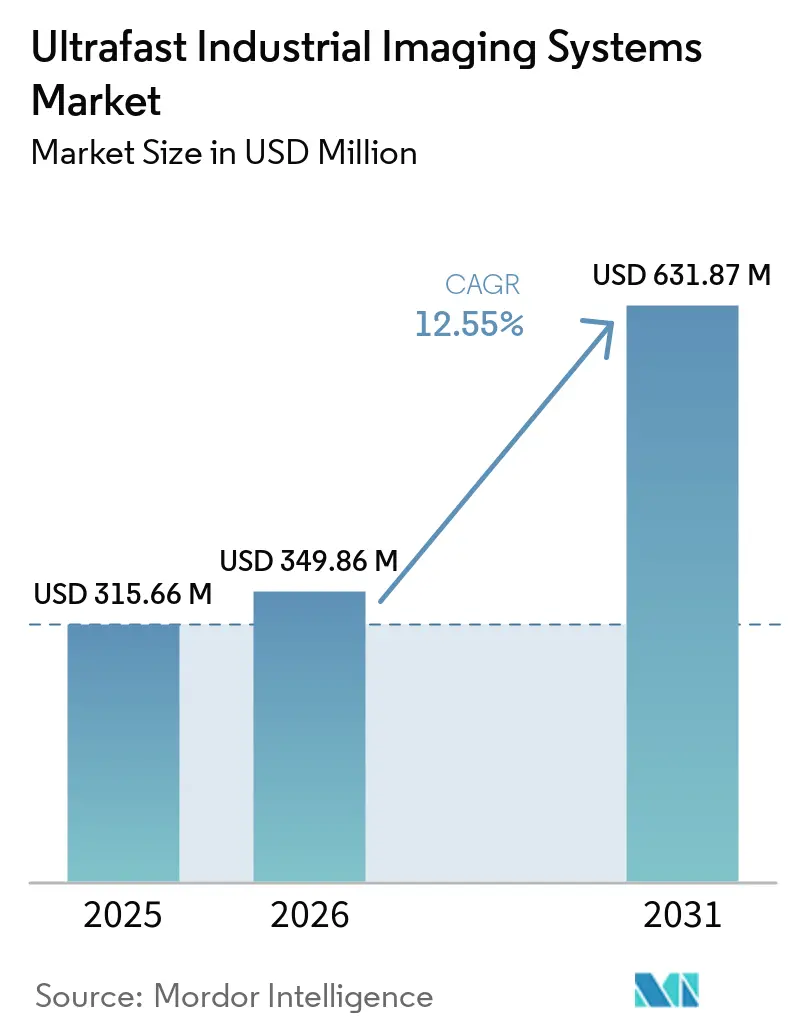
| Market Size (2026) | USD 349.86 Million |
| Market Size (2031) | USD 631.87 Million |
| Growth Rate (2026 - 2031) | 12.55 % |
| Fastest Growing Market | Asia-Pacific |
| Largest Market | North America |
| Market Concentration | Medium |
Major Players *Disclaimer: Major Players sorted in no particular order Image © Mordor Intelligence. Reuse requires attribution under CC BY 4.0. | |
Ultrafast Industrial Imaging Systems Market Analysis by Mordor Intelligence
The Ultrafast Industrial Imaging Systems Market size is projected to expand from USD 315.66 million in 2025 to USD 349.86 million in 2026, and to USD 631.87 million by 2031, registering a CAGR of 12.55% between 2026 and 2031. Manufacturers are using these systems to identify defects within machine cycles and to support documented quality controls. Automotive electrification, semiconductor packaging, and battery production are increasing the need for faster inspection. System suppliers are responding with lower-power CMOS sensors, high-bandwidth interfaces, and synchronized camera systems. The Ultrafast Industrial Imaging Systems Market also benefits when captured images reduce the number of destructive tests needed during product validation. Supply constraints in specialized sensors, controlled components, and calibration skills may favor vendors with established optics and integration capabilities.
Key Report Takeaways
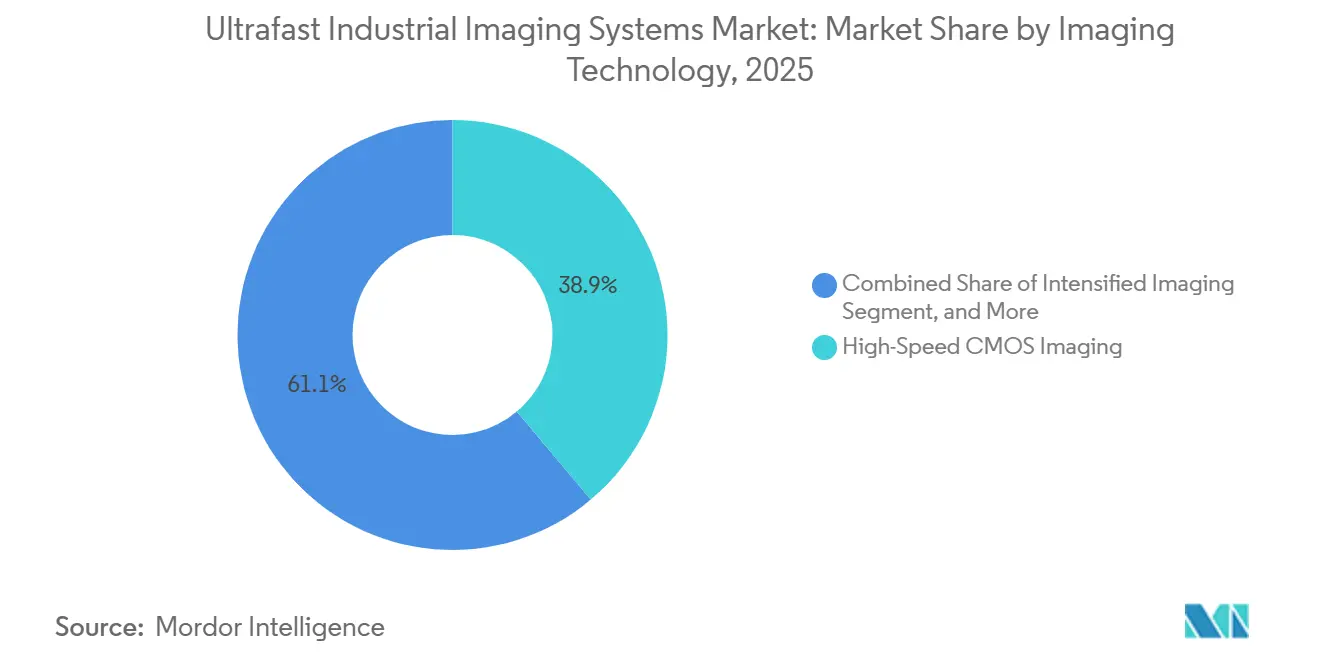
- By imaging technology, High-Speed CMOS Imaging held 38.88% of the Ultrafast Industrial Imaging Systems Market share in 2025, while Intensified Imaging is projected to expand at a 15.41% CAGR through 2031.
- By form factor, Modular Camera Head and Controller systems accounted for 35.56% of revenue in 2025, while Multi-Camera Synchronized Systems are projected to expand at a 14.31% CAGR through 2031.
- By frame rate, the 1,001-10,000 FPS segment held 34.91% of Ultrafast Industrial Imaging Systems Market revenue in 2025, while the Above 50,000 FPS segment is projected to expand at a 15.98% CAGR through 2031.
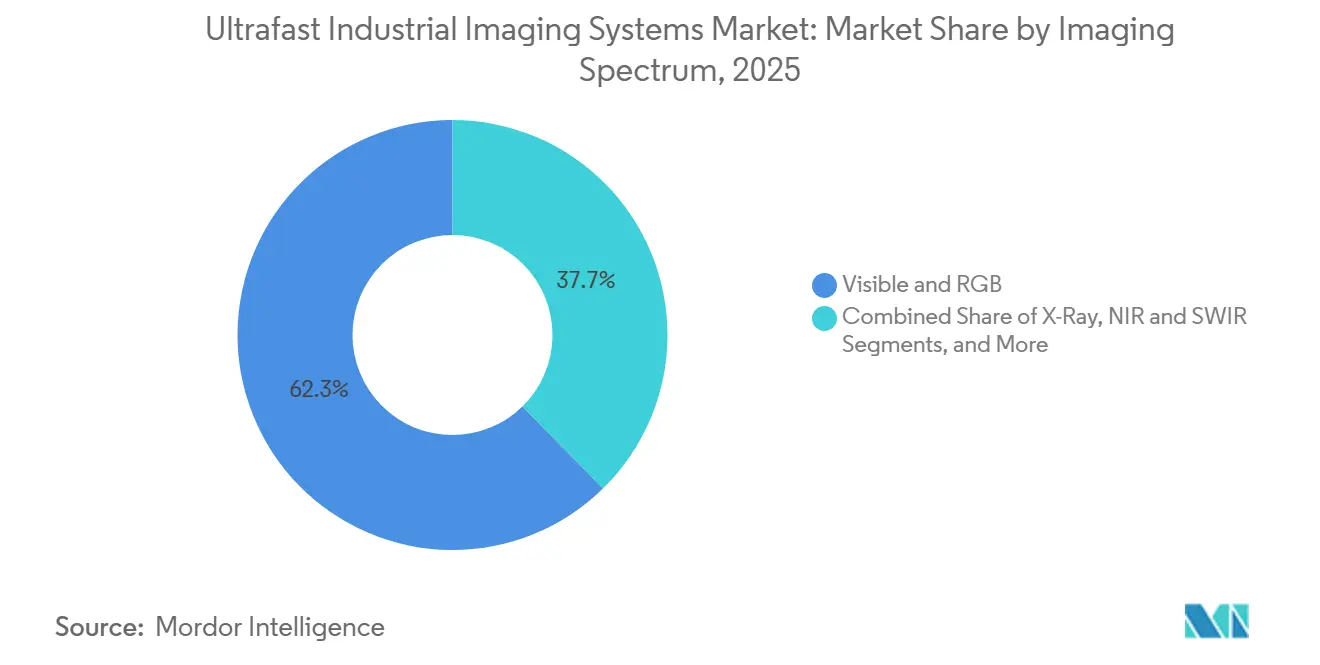
- By imaging spectrum, Visible and RGB accounted for 62.34% of revenue in 2025, while X-Ray is projected to expand at a 15.71% CAGR through 2031.
- By end-user industry, Automotive and Transportation held 22.84% of the Ultrafast Industrial Imaging Systems Market revenue in 2025, while Aerospace and Defense is projected to expand at a 14.52% CAGR through 2031.
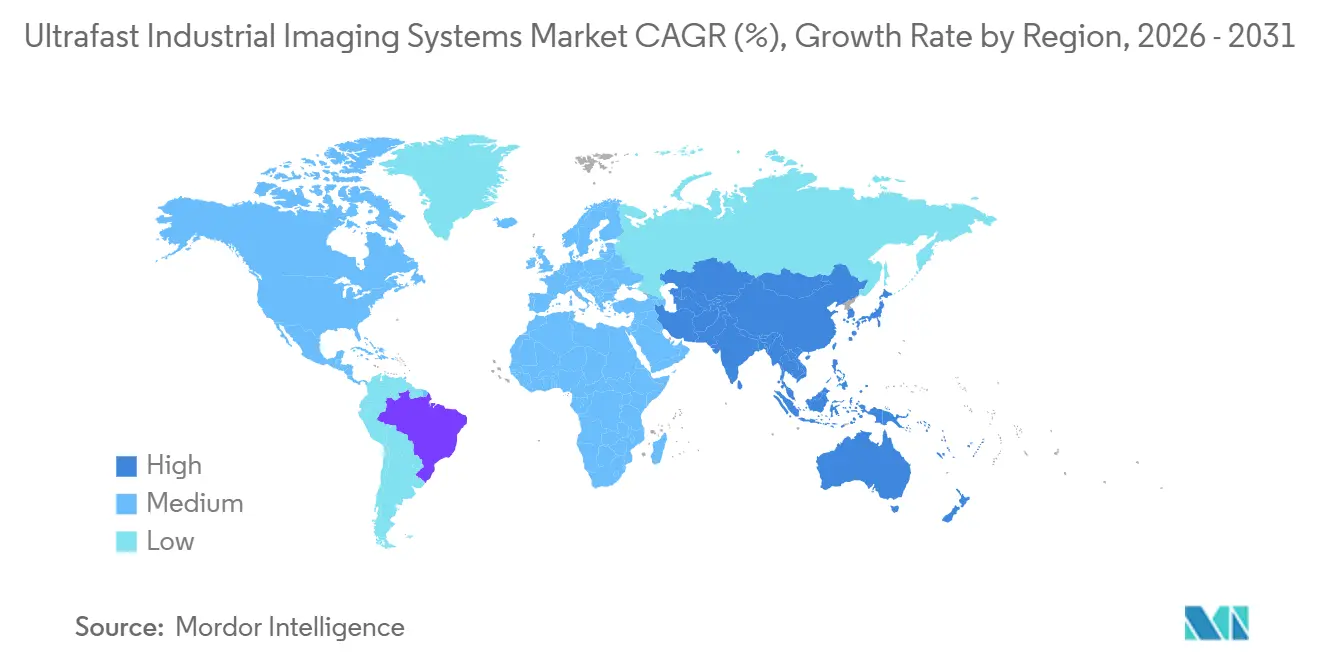
- By geography, North America held 31.29% of revenue in 2025, while Asia-Pacific is projected to expand at a 14.45% CAGR through 2031.
Note: Market size and forecast figures in this report are generated using Mordor Intelligence’s proprietary estimation framework, updated with the latest available data and insights as of January 2026.
Market Trends and Insights
Drivers Impact Analysis of Ultrafast Industrial Imaging Systems Market*
| Driver | (~) % Impact on CAGR Forecast | Geographic Relevance | Impact Timeline |
|---|---|---|---|
| Industrial Automation and Inline Process Visibility | +2.8% | Global, concentrated in North America, Germany, China, and South Korea | Medium term (2-4 years) |
| High-Speed Motion Analysis in Automotive and Aerospace Testing | +2.2% | North America, Europe, and Japan | Medium term (2-4 years) |
| CMOS Sensor Cost Reduction and Higher Light Sensitivity | +1.8% | Global | Short term (≤ 2 years) |
| Semiconductor, Battery, and Electronics Inspection | +1.6% | Asia-Pacific, with demand extending to North America | Short term (≤ 2 years) |
| Edge Analytics and Deterministic High-Bandwidth Interfaces | +1.2% | North America and Europe, with early adoption in Asia-Pacific | Medium term (2-4 years) |
| Replacement of Destructive Testing With Digital Evidence | +0.8% | Global | Long term (≥ 4 years) |
| Source: Mordor Intelligence | |||
Industrial Automation and Inline Process Visibility
Manufacturers in automotive stamping, wafer handling, and battery formation need inspection that works within cycle times measured in milliseconds. Inline ultrafast cameras can identify a fault when it occurs, rather than after a production batch has been completed. This shortens the period between a defect and the corrective response. A 2026 study found that RDMA-enabled multi-camera edge architectures reduced latency by 57% against standard GigE Vision pipelines.[1] The same architecture can make sub-frame-time inspection practical on factory infrastructure already in use. Process records from these systems can also support traceable evidence of production compliance, which is important under ISO 9001:2015 and IATF 16949 requirements.
High-Speed Motion Analysis in Automotive and Aerospace Testing
Crash tests require high frame rates to capture airbag deployment and seatbelt pretensioner motion during events that occur in less than 100 milliseconds. Automotive testing under Euro NCAP protocols and U.S. side-impact requirements, therefore, depends on calibrated imaging. Aerospace work can require still faster sampling during short impulse tests. A 2025 study recorded spatial and spectral flow data at 100 kHz using a Phantom v2012 and a HiCATT 25 intensifier.[2] Prescriptive test methods create a durable demand base because alternative cameras may not meet the specified performance threshold. The Ultrafast Industrial Imaging Systems Market is supported when these systems are incorporated into validated test procedures.
CMOS Sensor Cost Reduction and Higher Light Sensitivity
Backside-illuminated CMOS development is improving the performance available from industrial high-speed sensors. The ForzaFAST581 used a 65 nm, 4-metal BSI process and delivered 1,141 fps at UHD 12-bit resolution with 3.04 e⁻ read noise and 5.5 W power use.[3] Its 73% quantum efficiency at 530 nm can reduce the lighting demand for high-speed capture. Lower illumination needs may reduce LED array costs and ease thermal management in hot production settings. These changes improve the business case for users in food processing, pharmaceutical packaging, and electronics assembly. They also broaden access to ultrafast inspection without eliminating the need for application-specific integration.
Semiconductor, Battery, and Electronics Inspection
Battery scale-up and advanced semiconductor packaging require inspection methods that can see through materials at production speed. Sony Semiconductor Solutions began mass production and shipment of its IMX711 direct-conversion X-ray CMOS sensor in June 2026. The sensor delivered 26,100 fps and employed a charge-integrating design developed in collaboration with RIKEN.[4] Fraunhofer EMI and PowerCo also reported an X-ray system that recorded 1,000 images per second inside prismatic lithium-ion cells during thermal runaway. These capabilities can reveal gas formation, material displacement, and crack propagation without relying solely on destructive tests. IEC 62133 and SEMI E187 requirements can further encourage documented in-process inspection in relevant applications.
Restraints Impact Analysis of Ultrafast Industrial Imaging Systems Market*
| Restraint | (~) % Impact on CAGR Forecast | Geographic Relevance | Impact Timeline |
|---|---|---|---|
| High System, Lighting, and Integration Costs | -1.4% | Global, most acute in emerging markets and small and medium-sized enterprise economies | Short term (≤ 2 years) |
| Data Storage, Processing, and Bandwidth Burden | -1.0% | Global, most pronounced where data infrastructure is developing | Medium term (2-4 years) |
| Shortage of Specialized Application and Calibration Skills | -0.7% | Global | Long term (≥ 4 years) |
| Export Controls and Fragmented Safety-Critical Procurement | -0.5% | North America and European systems affecting select Middle East and Africa and Asia-Pacific markets | Medium term (2-4 years) |
| Source: Mordor Intelligence | |||
High System, Lighting, and Integration Costs
A production-grade system requires more than a camera body. It can require synchronized lighting, vibration-isolated mounts, high-speed frame grabbers, and software licenses. High frame rates demand short exposures, which can require pulsed LED arrays or laser-based lighting. Those additions increase procurement, safety, and calibration requirements. Battery and chemical facilities may also require ATEX- or IECEx-compliant equipment. Lower-cost entry systems have become more accessible, but ultra-high-speed installations still create a split customer base between users with dedicated engineering support and those without.
Data Storage, Processing, and Bandwidth Burden
A system operating at 50,000 fps and megapixel resolution can generate tens of gigabytes of data each second. A 100 GigE camera at full throughput produces 12.5 GB/s of uncompressed image data. That can consume a full 100 Gbps connection before capacity is reserved for metadata or control traffic. RDMA and CoaXPress 2.0 can reduce CPU bottlenecks through direct memory transfer, but they require dedicated host infrastructure. Lossless compression remains difficult when image integrity is needed for scientific measurement or calibration. The Ultrafast Industrial Imaging Systems Market remains constrained, where users cannot support high-throughput storage and processing.
*Our forecasts treat driver/restraint impacts as directional, not additive. The impact forecasts reflect baseline growth, mix effects, and variable interactions.
Ultrafast Industrial Imaging Systems Market Segment Analysis
By Imaging Technology:
CMOS Supports Broad Adoption While Intensified Imaging Serves Low-Light ApplicationsHigh-Speed CMOS Imaging held 38.88% of the Ultrafast Industrial Imaging Systems Market share in 2025. Its position reflects use in industrial inspection, crash-test facilities, and general research settings. Falling sensor costs have supported broader deployment across mainstream applications. Global-shutter designs also prevent rolling-shutter artifacts during rapid motion. This is important where images support safety certification or measured analysis. Ultra-High-Speed CMOS and High-Speed sCMOS systems serve more demanding applications. High-Speed sCMOS is gaining use in pharmaceutical spray characterization and combustion research. Its quantitative photometry can meet needs that standard industrial CMOS cameras may not address. High-Speed CCD systems remain in use at some aerospace and government facilities, with long replacement cycles.
Intensified Imaging is projected to expand at a 15.41% CAGR through 2031. The segment serves defense and industrial applications that require gated capture in low-light conditions. It can also enable UV or X-ray-to-visible conversion where a CMOS sensor alone is insufficient. Exosens released the iLumos RED 5G intensified camera in 2025 with a fifth-generation Photonis image intensifier tube. The product reported a 30% figure-of-merit improvement and 35% longer detection ranges than standard intensifier technology. Intensified systems also support non-destructive testing near nuclear applications. Their radiation sensitivity can create specialized demand where standard CMOS devices are unsuitable. The Ultrafast Industrial Imaging Systems industry, therefore, retains room for technologies outside the mainstream CMOS base.

By Form Factor:
Modular Systems Lead Installed Demand While Synchronized Arrays AdvanceModular Camera Head and Controller systems accounted for 35.56% of the Ultrafast Industrial Imaging Systems Market size in 2025. The arrangement allows a camera head to operate in a confined test area while controllers remain accessible to operators. This is useful in engine bays, crash sleds, and wind-tunnel sections. The separated design can protect electronic components from shock, vibration, and electromagnetic interference. It also supports flexible placement in automotive and aerospace testing. Compact and Handheld systems address field applications such as blast testing and airfield evaluation. Integrated Imaging Workstations are used where a self-contained, calibrated system can reduce setup time. These formats continue to meet distinct operating and installation requirements in the Ultrafast Industrial Imaging Systems Market.
Multi-Camera Synchronized Systems are projected to expand at a 14.31% CAGR through 2031. Industrial inspection is moving from a single viewing angle toward multi-angle and volumetric analysis. CoaXPress 2.0 and GigE Vision 3.0 with RDMA support can provide synchronization across camera arrays. This reduces timing variation that can compromise a multi-camera recording. Emergent Vision Technologies began shipping dual-sensor ZENITH cameras in June 2026 for synchronized deployments through QSFP28 100 GigE interfaces. The hardware supports high-resolution inspection with multiple cameras operating together. This improves the ability to observe rapid events from several directions. The Ultrafast Industrial Imaging Systems Market has a clearer path to wider adoption of synchronized arrays as the supporting interfaces mature.
By Frame Rate:
Mid-Range Systems Lead Volume While Extreme-Speed Systems Expand FasterThe 1,001-10,000 FPS segment held 34.91% of revenue in 2025. It covers automotive component testing, electronics inspection, fluid-dynamics research, and manufacturing quality assurance. The range balances CMOS performance with integration costs for many qualified users. It also fits users who can operate high-speed equipment without a specialist ultrafast imaging team. The Up to 1,000 FPS category serves entry-level inspection and food-and-beverage monitoring. The 10,001-30,000 FPS and 30,001-50,000 FPS categories support specialized automotive and aerospace tests. These systems respond to more demanding capture specifications. The range remains the commercial center of the Ultrafast Industrial Imaging Systems industry and the Ultrafast Industrial Imaging Systems Market.
The Above 50,000 FPS segment is projected to expand at a 15.98% CAGR through 2031. Defense testing, hypersonic research, and digital image correlation for material failures support demand. Shimadzu launched the HyperVision HPV-X3 in February 2025. It recorded at 20 million fps with 300,000 image pixels, which was 3 times the preceding model. The FTCMOS3 sensor was co-developed with Tohoku University. The camera addresses material deformation, shock-wave imaging, plasma diagnostics, and aerospace development. Vision Research's Phantom T2110 can record at 483,300 fps on a BSI sensor. These products indicate ongoing investment in the highest-speed part of the Ultrafast Industrial Imaging Systems Market.
By Imaging Spectrum:
Visible and RGB Remains the Mainstream Choice While X-Ray AdvancesVisible and RGB held 62.34% of the Ultrafast Industrial Imaging Systems Market share in 2025. CMOS manufacturing in the visible band is mature, and factory lighting infrastructure is widely available. Software tools for RGB image processing are also established in machine vision. These factors make visible imaging suitable for a broad range of industrial uses. NIR/SWIR systems are used for semiconductor inspection and agricultural sorting, where reflectance varies outside the visible range. IR/Thermal systems are used for noncontact temperature measurement during casting, welding, and battery formation. Other spectra, including ultraviolet, support specialized diagnostics for plasma, arcs, and electrical discharge. Visible and RGB remain the broadest foundation for industrial deployments in the Ultrafast Industrial Imaging Systems Market.
X-Ray is projected to expand at a 15.71% CAGR through 2031. Battery producers need through-material inspection for electrode alignment, anode overhang, and separator integrity. Semiconductor packaging also requires inspection of die-to-die connections at very small scales. Sony's IMX711 was announced in June 2026 with 26,100 fps and photon-energy discrimination. Its charge-integrating architecture was intended to avoid photon-counting errors under high-flux conditions. This can support inspection at the throughput required by semiconductor and EV battery production lines. The technology reduces the need for separate measurement systems. X-Ray systems are therefore moving beyond laboratory use in the Ultrafast Industrial Imaging Systems Market.
By End-User Industry:
Automotive Leads Demand While Aerospace and Defense Requires Higher PerformanceAutomotive and Transportation held 22.84% of revenue in 2025. The segment uses ultrafast imaging for crash testing, airbag validation, fuel-injection analysis, and EV battery safety certification. OEMs and tier-1 suppliers deploy the systems during product development and regulatory testing. They also use them for monitoring rapid assembly activities such as resistance spot welding and injection molding. Electrification is extending requirements to X-Ray and high-speed thermal imaging. These methods can assess cell behavior that visible imaging cannot show. Fraunhofer EMI's collaboration with PowerCo demonstrated high-speed X-Ray diagnostics for prismatic cells in August 2026. Semiconductor and Electronics, Industrial Manufacturing and Machinery, Energy and Power, Chemicals and Process Industries, and Mining and Heavy Industry each provide additional demand.
Aerospace and Defense is projected to expand at a 14.52% CAGR through 2031. Hypersonic programs, directed-energy testing, and foreign military sales require certified imaging systems. These buyers may require systems that meet ITAR-related procurement needs. The resulting demand is less price-sensitive once equipment is accepted under a test protocol. IATF 16949 and AS9100 quality frameworks reinforce the need for documented evidence in safety-critical component work. This supports an installed base in both automotive and aerospace operations across the Ultrafast Industrial Imaging Systems Market. Aerospace test programs also require high frame rates and careful calibration. The Ultrafast Industrial Imaging Systems Market benefits from this requirements-driven demand, even though specialized procurement may limit access to suppliers.
Geography Analysis
North America Ultrafast Industrial Imaging Systems Market
North America held 31.29% of the Ultrafast Industrial Imaging Systems Market share in 2025. Aerospace and defense contractors, automotive crash-test facilities, and national laboratories support the region's position. U.S. defense procurement often specifies performance requirements rather than choosing systems based solely on price, which can support established suppliers such as Vision Research and Photron. Canada and Mexico also add automotive manufacturing demand as tier-1 investment moves closer to North American production sites in the Ultrafast Industrial Imaging Systems Market.
Europe Ultrafast Industrial Imaging Systems Market
Europe held the second-largest geographic position in 2025. Germany's automotive and industrial machinery base provides steady demand for validation equipment. Euro NCAP testing creates a standards-based procurement base for automotive imaging. Fraunhofer EMI and PowerCo reported work on high-speed X-Ray battery diagnostics in August 2026. The installation at Salzgitter is expected in 2028, while France adds aerospace and defense demand through Airbus and MBDA supply chains. Italy and Spain contribute through automotive component clusters in Turin and the Basque Country.
APAC, South America and MEA Ultrafast Industrial Imaging Systems Market
Asia-Pacific is projected to expand at a 14.45% CAGR through 2031. China is expanding semiconductor fabrication, while South Korea is adding EV battery capacity through LGES and Samsung SDI, and Japan combines domestic demand with camera manufacturing by Shimadzu, Photron, NAC Image Technology, and Hamamatsu Photonics. India is building an electronics manufacturing base through the Production Linked Incentive scheme for semiconductors, which may add demand for inspection-grade systems as fabrication capacity expands later in the forecast period. South America remains at an earlier stage, led by Brazil's automotive sector and Argentina's industrial manufacturing base. Opportunities in the Middle East and Africa for Ultrafast Industrial Imaging Systems are concentrated in energy processing, petrochemical manufacturing, and defense procurement, with industrial diversification programs such as Saudi Vision 2030 supporting selective demand.
Competitive Landscape
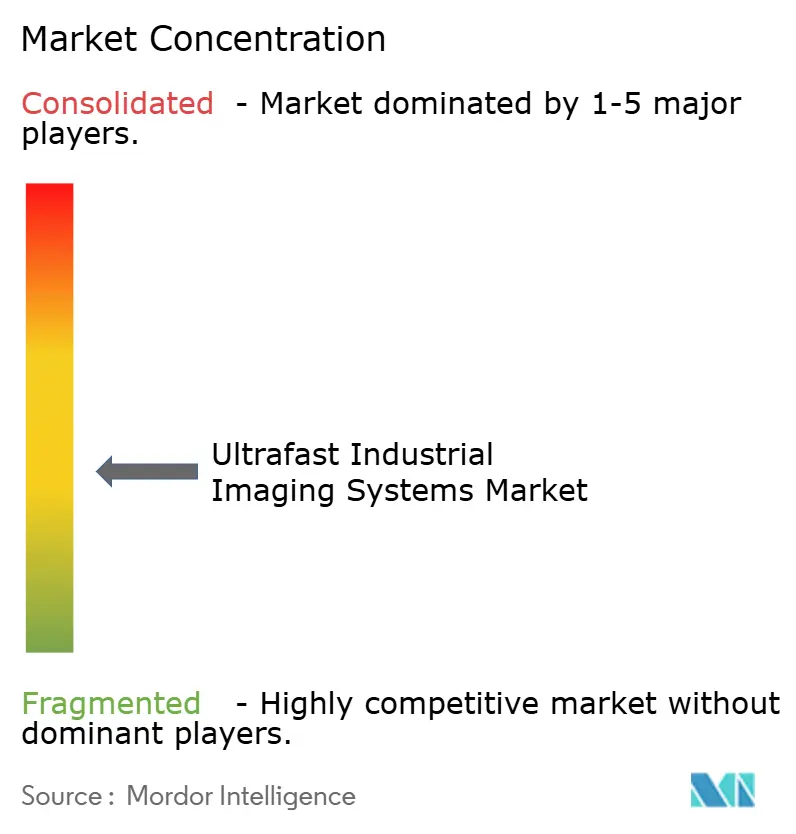
The Ultrafast Industrial Imaging Systems Market is moderately fragmented, and no single supplier holds more than a mid-teens share. Vision Research, Photron, Shimadzu, Specialized Imaging, and Cordin Company compete through sensor performance, frame rate, and calibration credibility. Excelitas Technologies, PCO AG, Hamamatsu Photonics, LaVision, and Teledyne Technologies add system integration and software capabilities. Competition differs between safety-critical testing and mainstream industrial inspection, where qualification and documented performance can influence purchase decisions. In the second, integration quality and the value of usable data are increasingly important for the Ultrafast Industrial Imaging Systems Market.
Excelitas Technologies has built coverage across industrial and scientific cameras through PCO AG and its broader photonics portfolio. The company highlighted the pco. pixelfly 26 CLHS at MAF 2026, combining a global-shutter sensor with 5,120 × 5,120-pixel resolution at up to 29 fps. Emergent Vision Technologies started shipping ZENITH 100 GigE cameras in June 2026 for synchronized, high-throughput deployments. Sony Semiconductor Solutions started mass production of the IMX711 X-Ray CMOS sensor in June 2026. These moves show that performance competition now includes interfaces, system design, and specialized inspection capability.
A potential opportunity remains in X-Ray ultrafast imaging at 500-5,000 fps. Direct-conversion CMOS X-Ray products remain less common despite the growing demand from battery and semiconductor producers. Cognex launched the In-Sight 3900 Vision System in May 2026, featuring Qualcomm Dragonwing processing and embedded AI capabilities for automotive, electronics, and packaging inspection. Vendors that lack edge-compute capability may face pressure where buyers prioritize usable inspection output over frame-rate specifications. Patent activity in global-shutter pixels, region-of-interest processing, and CoaXPress 2.0 serialization can raise barriers to entry for new hardware suppliers. The Ultrafast Industrial Imaging Systems industry is consequently becoming more dependent on application software and integration expertise.
Ultrafast Industrial Imaging Systems Industry Leaders
-
Vision Research, Inc.
-
Photron Limited
-
PCO AG
-
Optronis GmbH
-
NAC Image Technology, Inc.
- *Disclaimer: Major Players sorted in no particular order
Ultrafast Industrial Imaging Systems Market Companies Covered in this Report
- Vision Research, Inc.
- Photron Limited
- PCO AG
- Optronis GmbH
- NAC Image Technology, Inc.
- Mikrotron GmbH
- AOS Technologies AG
- Fastec Imaging Corporation
- iX Cameras Inc.
- Del Imaging Systems LLC
- Motion Capture Technologies, Inc.
- Specialised Imaging Ltd.
- Shimadzu Corporation
- Hamamatsu Photonics K.K.
- Sydor Technologies
- Cordin Company
- Excelitas Technologies Corp.
- LaVision GmbH
- Teledyne Technologies Incorporated
- Basler AG
Recent Industry Developments in Ultrafast Industrial Imaging Systems Market
- August 2026: Fraunhofer Institute for High-Speed Dynamics, Ernst-Mach-Institut (EMI), and PowerCo (Volkswagen Group) announced a high-speed X-Ray system recording up to 1,000 images per second inside large-format prismatic lithium-ion battery cells, revealing gas formation, material displacement, and crack propagation during thermal runaway in real time. Installation at PowerCo's Salzgitter site is targeted for 2028, marking the anticipated first transition of this capability from scientific laboratory to industrial production environment.
- June 2026: Sony Semiconductor Solutions announced mass-production shipment of the IMX711 direct-conversion X-Ray CMOS image sensor, delivering an industry-leading 26,100 fps with charge-integrating architecture co-developed with RIKEN. The sensor targets inline inspection of advanced batteries and semiconductors and enables photon-energy discrimination, integrating 2 previously separate measurement functions on a single device.
- June 2026: Emergent Vision Technologies began shipping 2 new ZENITH 100 GigE camera models, the HZ-65000-SB with a Sony IMX928 sensor and HZ-25000-SBS with a Sony IMX947 sensor. The models support synchronized multi-camera deployments through QSFP28 100 GigE interfaces for high-resolution, high-throughput industrial inspection.
- June 2026: Cognex Corporation launched the In-Sight 3900 Vision System, powered by Qualcomm Dragonwing, integrating advanced AI with high-speed imaging at the edge for automotive, electronics, and packaging inspection applications without sacrificing throughput. The product positions AI-embedded vision as a workflow competitor to traditional ultrafast imaging pipelines.
Global Ultrafast Industrial Imaging Systems Market Report Scope
Ultrafast Industrial Imaging Systems are advanced high-speed camera and sensor solutions designed to capture and analyze extremely rapid, transient phenomena in industrial environments, enabling precise motion analysis, real-time defect detection, and process optimization at frame rates far exceeding standard machine vision capabilities.
The Ultrafast Industrial Imaging Systems Market Report is Segmented by Imaging Technology (High-Speed CMOS Imaging, Ultra-High-Speed CMOS Imaging, High-Speed sCMOS Imaging, High-Speed CCD Imaging, Intensified Imaging, and Other Imaging Technologies), Form Factor (Compact and Handheld, Modular Camera Head and Controller, Integrated Imaging Workstation, and Multi-Camera Synchronized System), Frame Rate (Up to 1,000 FPS, 1,001-10,000 FPS, 10,001-30,000 FPS, 30,001-50,000 FPS, and Above 50,000 FPS), Imaging Spectrum (Visible and RGB, NIR and SWIR, IR and Thermal, X-Ray, and Other Imaging Spectrums), End-User Industry (Automotive and Transportation, Aerospace and Defense, Semiconductor and Electronics, Industrial Manufacturing and Machinery, Energy and Power, Chemicals and Process Industries, Mining and Heavy Industry, and Other End-User Industries), and Geography (North America, South America, Europe, Asia-Pacific, Middle East and Africa). The Market Forecasts are Provided in Terms of Value (USD).
Segmentation Overview
| High-Speed CMOS Imaging |
| Ultra-High-Speed CMOS Imaging |
| High-Speed sCMOS Imaging |
| High-Speed CCD Imaging |
| Intensified Imaging |
| Other Imaging Technologies |
| Compact and Handheld |
| Modular Camera Head and Controller |
| Integrated Imaging Workstation |
| Multi-Camera Synchronized System |
| Up to 1,000 FPS |
| 1,001-10,000 FPS |
| 10,001-30,000 FPS |
| 30,001-50,000 FPS |
| Above 50,000 FPS |
| Visible and RGB |
| NIR and SWIR |
| IR and Thermal |
| X-Ray |
| Other Imaging Spectrums |
| Automotive and Transportation |
| Aerospace and Defense |
| Semiconductor and Electronics |
| Industrial Manufacturing and Machinery |
| Energy and Power |
| Chemicals and Process Industries |
| Mining and Heavy Industry |
| Other End-User Industries |
| North America | United States | |
| Canada | ||
| Mexico | ||
| South America | Brazil | |
| Argentina | ||
| Rest of South America | ||
| Europe | Germany | |
| United Kingdom | ||
| France | ||
| Italy | ||
| Spain | ||
| Rest of Europe | ||
| Asia-Pacific | China | |
| Japan | ||
| India | ||
| South Korea | ||
| Rest of Asia-Pacific | ||
| Middle East and Africa | Middle East | Saudi Arabia |
| Turkey | ||
| United Arab Emirates | ||
| Rest of the Middle East | ||
| Africa | South Africa | |
| Kenya | ||
| Rest of Africa | ||
| By Imaging Technology | High-Speed CMOS Imaging | ||
| Ultra-High-Speed CMOS Imaging | |||
| High-Speed sCMOS Imaging | |||
| High-Speed CCD Imaging | |||
| Intensified Imaging | |||
| Other Imaging Technologies | |||
| By Form Factor | Compact and Handheld | ||
| Modular Camera Head and Controller | |||
| Integrated Imaging Workstation | |||
| Multi-Camera Synchronized System | |||
| By Frame Rate | Up to 1,000 FPS | ||
| 1,001-10,000 FPS | |||
| 10,001-30,000 FPS | |||
| 30,001-50,000 FPS | |||
| Above 50,000 FPS | |||
| By Imaging Spectrum | Visible and RGB | ||
| NIR and SWIR | |||
| IR and Thermal | |||
| X-Ray | |||
| Other Imaging Spectrums | |||
| By End-User Industry | Automotive and Transportation | ||
| Aerospace and Defense | |||
| Semiconductor and Electronics | |||
| Industrial Manufacturing and Machinery | |||
| Energy and Power | |||
| Chemicals and Process Industries | |||
| Mining and Heavy Industry | |||
| Other End-User Industries | |||
| By Geography | North America | United States | |
| Canada | |||
| Mexico | |||
| South America | Brazil | ||
| Argentina | |||
| Rest of South America | |||
| Europe | Germany | ||
| United Kingdom | |||
| France | |||
| Italy | |||
| Spain | |||
| Rest of Europe | |||
| Asia-Pacific | China | ||
| Japan | |||
| India | |||
| South Korea | |||
| Rest of Asia-Pacific | |||
| Middle East and Africa | Middle East | Saudi Arabia | |
| Turkey | |||
| United Arab Emirates | |||
| Rest of the Middle East | |||
| Africa | South Africa | ||
| Kenya | |||
| Rest of Africa | |||
Key Questions Answered in the Report
What is the size of the Ultrafast Industrial Imaging Systems Market?
The market is projected to be USD 349.86 million in 2026 and reach USD 631.87 million by 2031 at a 12.55% CAGR.
Which imaging technology held the largest share in 2025?
High-Speed CMOS Imaging led with 38.88% in 2025, supported by broad use in inspection, testing, and research.
Which frame-rate category is projected to expand fastest?
The Above 50,000 FPS category is projected to expand at a 15.98% CAGR through 2031.
Why is X-Ray imaging gaining importance in industrial inspection?
X-Ray systems can inspect battery cells and semiconductor packages through materials at production-relevant speeds.
Which region is projected to expand fastest through 2031?
Asia-Pacific is projected to expand at a 14.45% CAGR, supported by semiconductor fabrication and EV battery investment.
What limits adoption of ultrafast industrial imaging systems?
High integration costs, data-handling needs, calibration skills shortages, and export controls can limit adoption.