
Turnkey Visual Inspection Cells Market Size and Share
Market Overview
| Study Period | 2020 - 2031 |
|---|---|
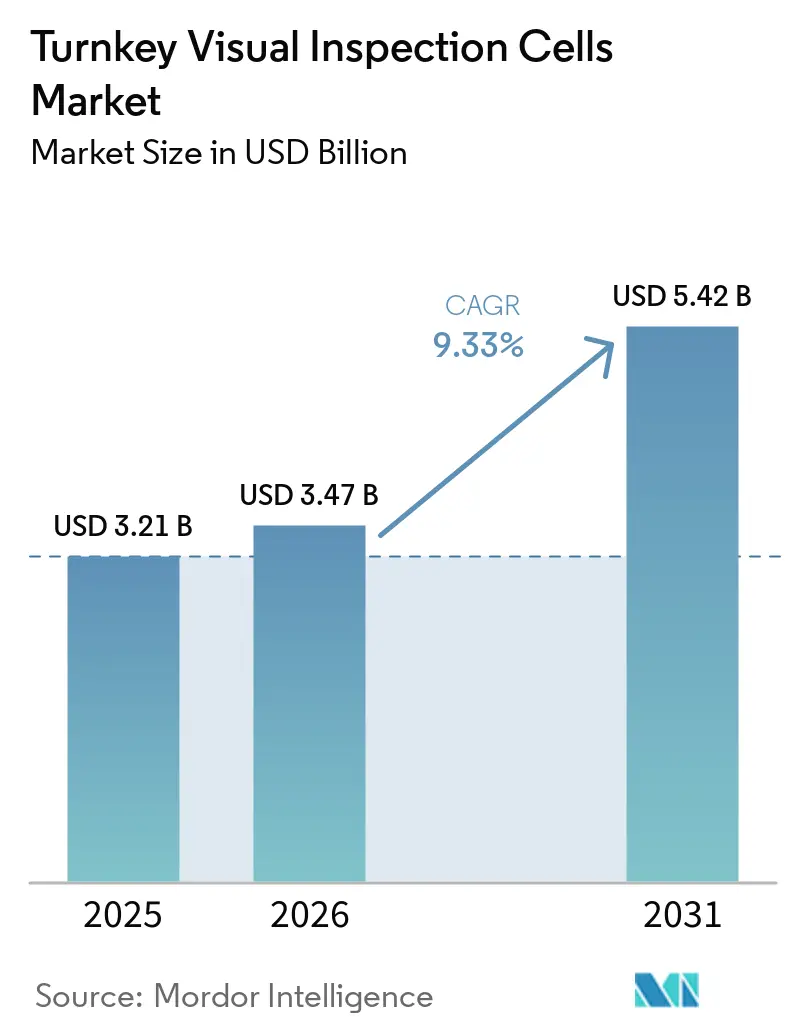
| Market Size (2026) | USD 3.47 Billion |
| Market Size (2031) | USD 5.42 Billion |
| Growth Rate (2026 - 2031) | 9.33 % |
| Fastest Growing Market | Asia-Pacific |
| Largest Market | Asia-Pacific |
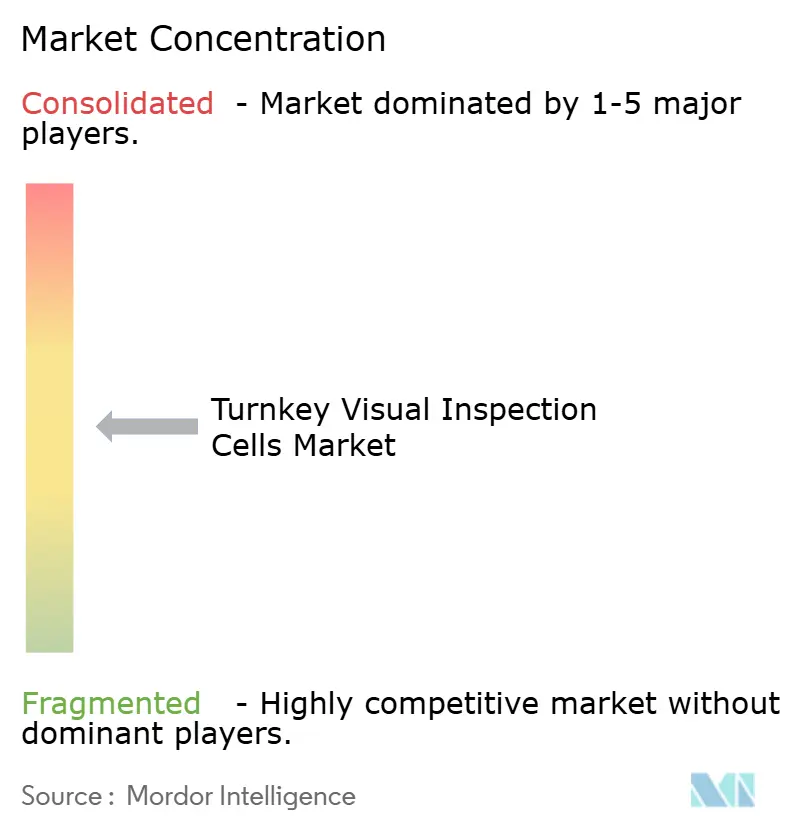
| Market Concentration | Medium |
Major Players *Disclaimer: Major Players sorted in no particular order Image © Mordor Intelligence. Reuse requires attribution under CC BY 4.0. | |
Turnkey Visual Inspection Cells Market Analysis by Mordor Intelligence
The turnkey visual inspection cells market size is expected to increase from USD 3.21 billion in 2025 to USD 3.47 billion in 2026 and reach USD 5.42 billion by 2031, expanding at a CAGR of 9.33% over 2026-2031. Deep learning is making automated inspection more practical for defect types that were difficult to identify with fixed rules, particularly where products, materials, and defect appearances vary. Battery and semiconductor plants are increasing the need for continuous quality checks as tolerances tighten and production steps become more closely linked. Labor shortages also make manual inspection harder to sustain across multiple shifts, especially where consistent attention is needed for repetitive checks. Suppliers are responding by combining cameras, lighting, software, edge computing, and line controls into more integrated systems that are easier to commission and maintain. Competition increasingly centers on how quickly a supplier can validate an inspection process and deploy it across several plants, while maintaining traceable inspection records and consistent line performance.
Key Report Takeaways
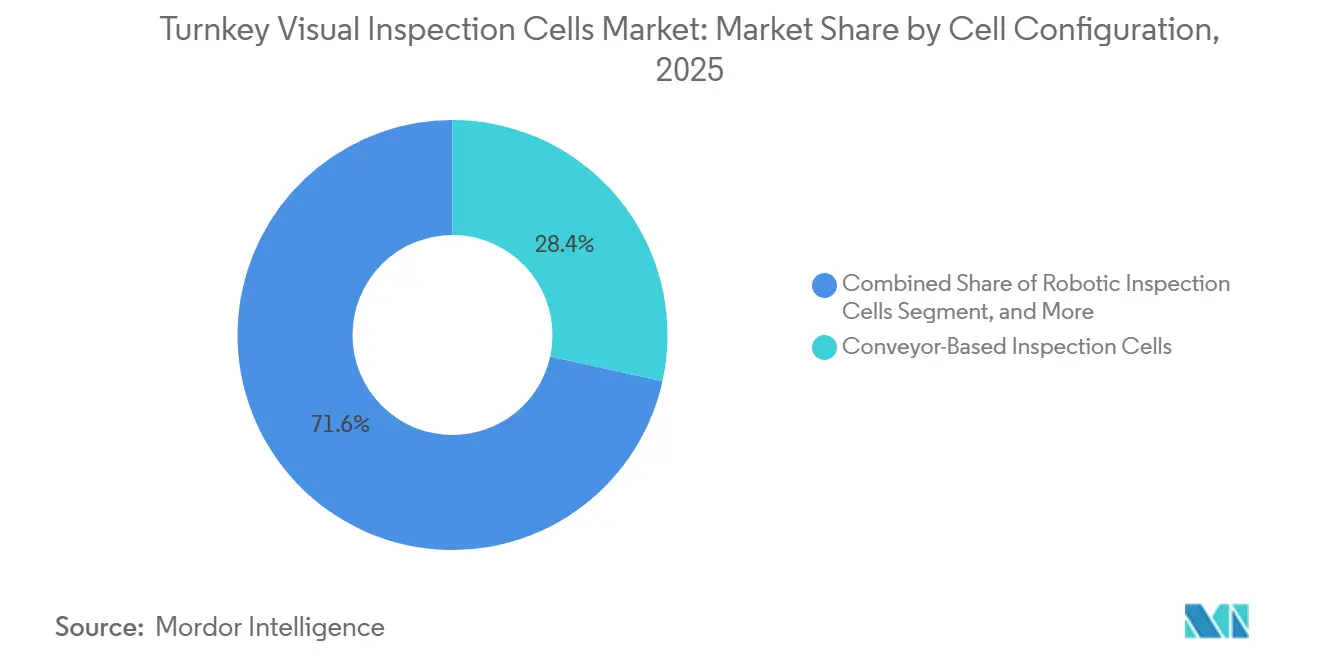
- By cell configuration, conveyor-based inspection cells held 28.45% of the turnkey visual inspection cells market share in 2025, while robotic inspection cells are projected to expand at an 11.21% CAGR through 2031.
- By inspection technology, 2D vision inspection held 64.32% of the turnkey visual inspection cells market share in 2025, while 3D vision inspection is projected to expand at an 11.08% CAGR through 2031.
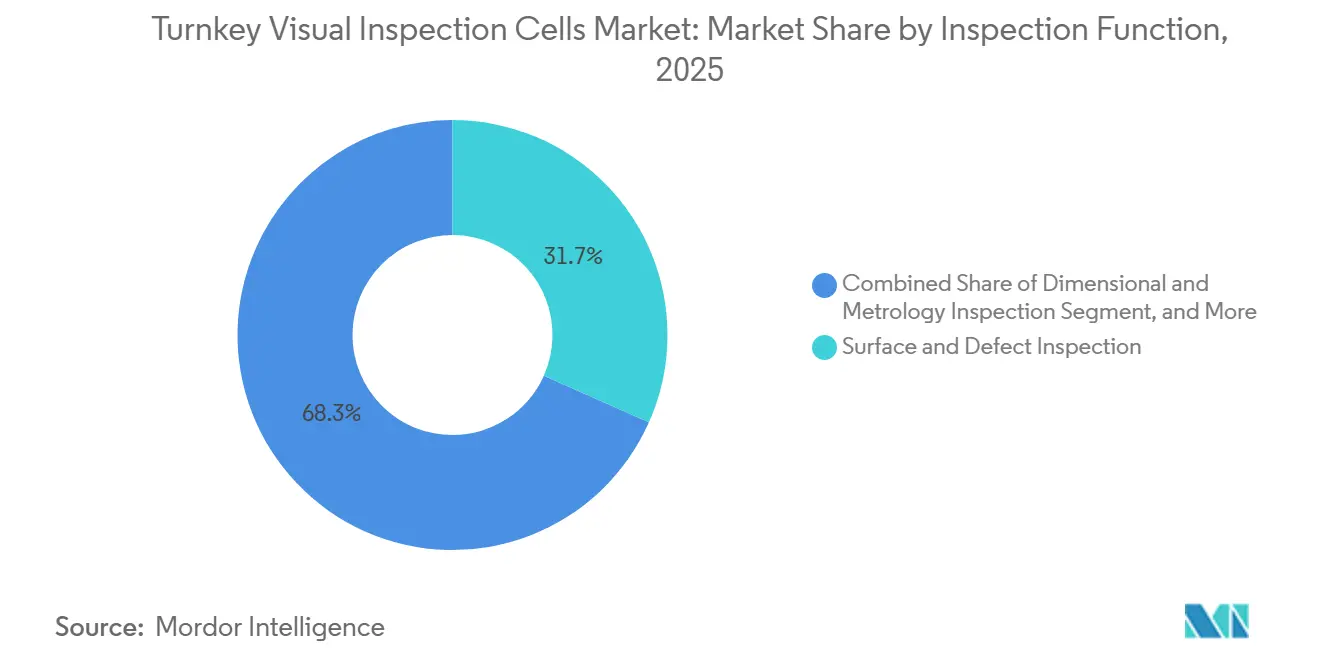
- By inspection function, surface and defect inspection accounted for 31.66% of the turnkey visual inspection cells market size in 2025, while dimensional and metrology inspection is projected to expand at an 11.72% CAGR through 2031.
- By industry vertical, automotive and mobility held 24.34% of revenue in 2025, while EV and battery manufacturing is projected to expand at a 11.48% CAGR through 2031.
- By geography, Asia-Pacific held 33.24% of revenue in 2025 and is projected to expand at an 11.78% CAGR through 2031.
Note: Market size and forecast figures in this report are generated using Mordor Intelligence’s proprietary estimation framework, updated with the latest available data and insights as of January 2026.
Global Turnkey Visual Inspection Cells Market Trends and Insights
Drivers Impact Analysis*
| Driver | (~) % Impact on CAGR Forecast | Geographic Relevance | Impact Timeline |
|---|---|---|---|
| Deep Learning Accuracy in Defect Detection | +2.8% | Global | Short term (≤ 2 years) |
| EV and Battery Manufacturing Quality Requirements | +2.3% | Asia-Pacific core, spillover to Europe and North America | Short term (≤ 2 years) |
| Shift From Manual Inspection to Vision-Guided Robotics | +1.8% | North America and Europe, expanding globally | Medium term (2-4 years) |
| Edge AI for Deterministic Line-Speed Decisions | +1.4% | Global | Short term (≤ 2 years) |
| Labor Shortages in Repetitive Quality Inspection | +1.0% | North America and Europe | Medium term (2-4 years) |
| Modular Cells Lowering Multi-Line Deployment Friction | +0.7% | Global | Long term (≥ 4 years) |
| Source: Mordor Intelligence | |||
Deep Learning Accuracy in Defect Detection
Deep learning has become more suitable for primary inspection tasks on high-speed production lines. A 2026 study of connector-terminal inspection reported a mean average precision of 92.2% on production data and a performance improvement of up to 8.9 percentage points over an earlier model. The study also sustained 26-27 frames per second at full inspection resolution. Cognex launched the In-Sight 6900 in April 2026 with 157 TOPS of edge computing and few-sample classification, using 10-20 training images per defect class.[1]Cognex Corporation, “Cognex Launches In-Sight Vision Controller Powered by NVIDIA,” Cognex Corporation, investor.cognex.com. This reduces the amount of data preparation that can delay the implementation of new inspection programs at plants with limited internal machine-vision resources. The turnkey visual inspection cells market, therefore, places greater value on data preparation, validation, and support for plant-level deployment.
EV and Battery Manufacturing Quality Requirements
EV and battery plants require inspection across more steps because defects can affect safety, yield, and traceability. Optical inspection combined with thermography has shown stronger detection of subsurface anode coating defects than standalone optical inspection. This capability supports in-line checks before materials move into later battery assembly stages. Battery producers also need inspection records that can be tied to individual cells and production lots. That requirement extends demand beyond final inspection to electrode coating, welding, dimensions, and appearance checks. The turnkey visual inspection cells market benefits when inspection is specified as part of a new battery line rather than added after production begins.
Shift From Manual Inspection to Vision-Guided Robotics
Manufacturers are replacing some manual inspection tasks because output requirements and consistency demands are difficult to meet with multi-shift teams. A 2025 study validated an edge-optimized vision approach at 98.1% precision and 25 frames per second on a conveyor-mounted application. Robotic cells add flexibility because they can present different part shapes to a camera without a fixed mechanical setup. This is useful for facilities that produce several part variants on the same line. New manufacturing lines in North America and Europe can specify automation from commissioning instead of adapting older manual stations. The turnkey visual inspection cells market also gains from modular designs that make automated quality systems more accessible to mid-sized plants.
Edge AI for Deterministic Line-Speed Decisions
Edge AI allows an inspection cell to process images near the production line rather than waiting for a remote computing system. Cognex introduced the In-Sight 3900 in May 2026 for embedded AI inspection at full line speed without external computing equipment. Local inference helps manufacturers maintain consistent response times at high production speeds. Central teams can still manage approved models while individual cells operate without a cloud connection. SICK launched its Nova Machine Vision Platform in August 2026, combining on-device deep learning with per-pixel height data for 3D quality inspection. This approach supports repeatable deployment across plants, allowing a validated inspection recipe to be reused.
Restraints Impact Analysis*
| Restraint | (~) % Impact on CAGR Forecast | Geographic Relevance | Impact Timeline |
|---|---|---|---|
| High Initial Cost and Integration Complexity | -1.4% | Global | Medium term (2-4 years) |
| Training Data and Model Validation Burden | -0.8% | Global | Short term (≤ 2 years) |
| Model Drift From Lighting, Materials, and Product-Mix Changes | -0.5% | Global | Medium term (2-4 years) |
| Cybersecurity and Intellectual-Property Exposure in Connected Cells | -0.3% | North America and Europe | Long term (≥ 4 yea |
| Source: Mordor Intelligence | |||
High Initial Cost and Integration Complexity
A turnkey cell must connect cameras, lighting, mechanical equipment, AI models, programmable logic controllers, and plant software. This raises initial costs even when individual hardware components become less expensive. The burden is greater for suppliers that lack dedicated automation and data engineering teams. Large automotive suppliers can make multi-site commitments, while smaller suppliers often need staged investments. Modular platforms can reduce the need to purchase every capability at the first installation. Integration engineering, however, remains a material hurdle for the turnkey visual inspection cells market, especially in lower-volume facilities.
Training Data and Model Validation Burden
Reliable inspection models need defect images, labels, and documented testing before they can be used in production. A 2026 review identified limited annotated data on rare and atypical defects as a persistent constraint on machine vision quality control. Few-shot and semi-supervised methods can reduce the data requirement, but they may require additional production validation. Lighting changes, new material lots, and product-mix changes can also reduce a model's accuracy after commissioning. Pharmaceutical producers face further requirements because finished-drug inspection systems must be validated and auditable under 21 CFR Part 211.[2]U.S. Food and Drug Administration, “Current Good Manufacturing Practice for Finished Pharmaceuticals,” Electronic Code of Federal Regulations, ecfr.gov. The validation process can limit adoption where production volumes are low or parts vary frequently. In the turnkey visual inspection cells market, suppliers that simplify model updates can reduce this barrier for plants with changing product mixes.
*Our forecasts treat driver/restraint impacts as directional, not additive. The impact forecasts reflect baseline growth, mix effects, and variable interactions.
Segment Analysis
By Cell Configuration: Conveyor-Based Lines Support Continuous Production While Robotics Adds Flexibility
Conveyor-based inspection cells held 28.45% of revenue in 2025. Their position reflects direct integration with established material flow in electronics, automotive body shops, and food packaging lines. These cells often require less additional part-handling equipment than robotic alternatives. This can reduce project risk and shorten commissioning when a site has limited automation resources. The turnkey visual inspection cells market continues to use these cells where output is predictable, and parts move in a consistent direction. Standalone cells serve quality laboratories and near-line applications where parts are inspected outside the main flow. Rotary and indexing cells support multi-sided checks for products such as tablets, fasteners, and precision-machined components.
In-line modular cells extend standardized inspection across several stations while retaining a shared recipe structure. This model can help manufacturers expand capacity as demand rises, rather than funding a complete system at once. The turnkey visual inspection cells market size for conveyor-based designs remains supported by high-volume plants that value stable material flow. Robotic inspection cells are projected to expand at an 11.21% CAGR through 2031. They can inspect multiple part families without a mechanical changeover because robot motion changes the camera angle and part presentation. A 2025 study of reconfigurable robotic inspection covered more than 200 part variants in under 30 seconds per cycle and detected more than 60 defect types. Collaborative robots can also operate in constrained areas when their safety arrangements meet applicable requirements. The turnkey visual inspection cells market can benefit when this flexibility helps a plant avoid major changes to established line layouts.



By Inspection Technology: 2D Vision Retains Broad Use While 3D Inspection Extends Depth Measurement
2D vision inspection held 64.32% of revenue in 2025, making it the largest technology category. It is widely integrated with line-control systems and addresses surface defects, barcode verification, optical character recognition, and assembly checks. OMRON introduced the VHV5 inline verifier in European markets in March 2026 for ISO-compliant barcode quality control. The system supports inspection of 1D, 2D, and direct-part-mark codes at up to 1,000 codes per minute. Thermography, X-ray computed tomography, and hyperspectral imaging remain specialized choices when a defect cannot be seen with conventional optics. The turnkey visual inspection cells market retains these options for safety-critical or material-specific inspection needs.
3D vision inspection is projected to expand at an 11.08% CAGR through 2031. Its growth is linked to applications that require height, shape, or depth information at production speed. The turnkey visual inspection cells market share for 2D systems remains high because many routine checks do not need depth sensing. 3D systems are especially relevant in battery manufacturing, where cell-stacking tolerances can require depth checks at several stations. SICK's Nova platform combines height data with deep learning to identify anomalies on reflective and low-contrast materials. Research on battery electrodes also found that 3D scanning combined with thermography can identify subsurface coating defects that 2D optical inspection cannot see. The turnkey visual inspection cells market uses this capability, in which depth data must be linked to thermal evidence.
By Inspection Function: Surface Inspection Leads Volume While Dimensional Checks Move In Line
Surface and defect inspection held 31.66% of revenue in 2025. It is used across automotive paint, printed circuit board solder joints, pharmaceutical blister packs, and food package seals. The function has broad camera and lighting compatibility, which supports a large installed base. It also benefits from mature libraries for common surface defect categories. The turnkey visual inspection cells market relies on this familiarity because surface inspection can be deployed across several production settings. Identification, OCR, and traceability inspection are important where labels, codes, or serialized products must be verified. FDA rules require finished pharmaceutical products to be examined for correct labeling during finishing operations.
Dimensional and metrology inspection is projected to expand at an 11.72% CAGR through 2031. Demand comes from EV battery-pack assembly and advanced semiconductor packaging, where small variations can affect downstream yield. Manufacturers are moving coordinate measurement from offline laboratories to in-line stations that provide faster process feedback. SHINING3D's Inspect 2026 supports dimensional inspection workflows aligned with ISO and ASME GD&T requirements. Assembly and presence verification also matter in battery modules, where connectors, seals, and cable clips must be confirmed. The turnkey visual inspection cells market size for surface inspection remains substantial, while buyers increasingly request cells that combine surface, dimensional, and identification tasks in one station.
By Industry Vertical: Automotive Provides the Base While EV and Battery Plants Expand Faster
Automotive and mobility held 24.34% of revenue in 2025. The sector has a long history of automated inspection and strict tolerance requirements across OEM supply chains. Body-in-white, powertrain, and exterior trim inspection provides much of the installed base. EV production adds battery-housing dimensional checks, high-voltage connector verification, and cable-harness presence checks to those established tasks. Electronics demand also supports inspection equipment through semiconductor packaging and optical component production. Koh Young reported a 79% year-over-year increase in semiconductor packaging inspection equipment revenue in 2025, linked to AI server infrastructure and optical transceiver demand.
EV and battery manufacturing is projected to expand at a 11.48% CAGR through 2031, the highest rate among the listed verticals. New gigafactories and stricter requirements for cell and pack inspection support this pace. Pharmaceutical and medical-device producers maintain demand because their processes require documented visual checks and clear categorization of defects. Food, beverage, and packaging applications focus on seal integrity, label accuracy, and contamination detection. KPM Analytics expanded its Italian inspection manufacturing facility in July 2025 to serve baking and snack food producers. Metals, plastics, machinery, aerospace, logistics, and consumer electronics drive demand for modular cells that simplify the adoption of automated quality control.
Geography Analysis
Asia-Pacific accounted for 33.24% of revenue in 2025 and is projected to grow at an 11.78% CAGR through 2031. China, Japan, South Korea, India, and ASEAN provide the region with a dense base of electronics, automotive, and battery manufacturing. Battery plants in China create a strong demand for cell, coating, weld, dimensional, and appearance inspection. South Korea adds semiconductor and display production, while Japan contributes precision automotive and component manufacturing. India is becoming a second growth area as contract electronics and pharmaceutical production expand. The turnkey visual inspection cells market can gain as these facilities move from manual checks to automated line inspection.
Koh Young established a branch office in Noida, Uttar Pradesh, in 2026 to support India's electronics manufacturing ecosystem. ASEAN also benefits as electronics contract manufacturing spreads to Vietnam, Thailand, and Indonesia. North America and Europe were the second- and third-largest regional clusters. North America gains from semiconductor, automotive, and near-shoring investments. Europe has demand centers in Germany's automotive sector, France's semiconductor inspection activities, and Italy's machinery and packaging equipment base. Merck KGaA opened a EUR 20 million (USD 21.8 million) metrology and inspection site in Saint-Ismier, France, in May 2026.[3]Merck KGaA, “Merck KGaA Opens EUR 20 Million Metrology and Inspection Site in France,” Merck KGaA, emdgroup.com.
The site increases Merck KGaA's semiconductor inspection capacity fivefold, and targets advanced packaging and heterogeneous integration. The Middle East, Africa, and South America remain early-stage areas for the turnkey visual inspection cells market. Saudi Arabia and the United Arab Emirates are adding greenfield manufacturing capacity in food, pharmaceuticals, and petrochemicals packaging. Brazil supports demand through automotive assembly and food processing. Mexico serves as a nearshoring hub in the North American automotive supply chain. Its suppliers face inspection requirements closely aligned with those of the United States and Canadian OEMs. The turnkey visual inspection cells market can therefore extend through supplier networks rather than remain limited to final assembly plants.
Competitive Landscape
The turnkey visual inspection cells market is moderately fragmented because global specialists compete with regional and application-focused suppliers. Cognex Corporation, KEYENCE CORPORATION, and SICK AG serve high-volume automotive and electronics lines. Vitrox Corporation Berhad, Koh Young Technology, and Wuhan Jingce Electronic Group Co., Ltd. compete in Asian EV battery and electronics applications. Suppliers now compete on the time needed to create, validate, and deploy an inspection program across several sites. Camera resolution remains important, but it is no longer the only basis for supplier selection. Cybersecurity is also becoming more relevant in connected European automotive supply chains.
Cognex made OneVision generally available in May 2026 to support central model development and deployment across plant networks. The platform supports a cloud-to-edge model in which validated inspection models are managed centrally and executed locally. Mycronic released the MYPro I Series 3D AOI in April 2026, featuring GenI generative AI to turn component placement data into inspection programs. These moves address the application-engineering workload that can slow new product introduction. SICK's August 2026 3D AI launch further shows the shift toward systems that combine sensor data and local AI processing.
Opportunities remain in mid-sized factories that cannot justify custom integration. Pharmaceutical and food applications also require systems that combine vision performance with documented validation and audit records. The market can favor providers that offer long-term software support alongside hardware and integration. Large OEMs may develop more inspection logic internally, increasing the importance of model integration and validation services. Regional suppliers retain an advantage where customers need rapid local support and pricing suited to high-throughput lines. The turnkey visual inspection cells market also rewards providers that can support commissioning and follow-up model validation close to customer sites. The competitive structure remains consistent with a moderately fragmented market because no combined share figure for the leading companies is provided.
Turnkey Visual Inspection Cells Industry Leaders
Cognex Corporation
KEYENCE CORPORATION
OMRON Corporation
Teledyne DALSA Inc.
Koh Young Technology, Inc.
- *Disclaimer: Major Players sorted in no particular order

Recent Industry Developments
- August 2026: SICK AG launched its AI-powered 3D quality inspection solution built on the Nova Machine Vision Platform, integrating deep learning neural network algorithms with per-pixel height data for color-contrast-independent defect and anomaly detection. The launch marked the first time SICK embedded intelligent AI into its high-precision 3D vision technology. SICK AG reported EUR 1.8 billion (USD 1.96 billion) in group revenue for fiscal 2025.
- June 2026: OMRON Automation released the VHV5-SRV Barcode Verification System, enabling 100% inline barcode-quality verification at up to 1,200 parts per minute. The system complies with ISO/IEC 15416, ISO/IEC 15415, and ISO/IEC TR 29158. It targets pharmaceutical, food, automotive, and aerospace manufacturers requiring continuous inline verification.
- May 2026: Cognex announced the general availability of OneVision, its cloud-to-edge AI vision development environment. More than 100 customers deployed it since the June 2025 beta launch. Early adopters, including Essity and Schneider Electric, reported inspection validation compressed from more than 1 year to under 1 day and multi-site scaling costs reduced by up to 50%.
- May 2026: Merck KGaA opened a EUR 20 million (USD 21.8 million) Metrology and Inspection site in Saint-Ismier, France. The site expanded semiconductor inspection capacity fivefold across 4,500 m². It targets advanced packaging and heterogeneous integration inspection for AI and HPC chip manufacturers, with 100 additional engineering jobs planned over 4 years.


Global Turnkey Visual Inspection Cells Market Report Scope
The Turnkey Visual Inspection Cells Market comprises integrated, ready-to-deploy automated inspection workstations designed to perform visual quality inspection, measurement, verification, identification, and traceability tasks within manufacturing and production environments. Turnkey visual inspection cells combine imaging systems, machine vision hardware and software, lighting, sensors, automation and robotic components, control systems, fixtures, conveyors or indexing mechanisms, and inspection software into a pre-engineered solution supplied by a single provider or integrated solution vendor.
The Turnkey Visual Inspection Cells Market Report is Segmented by Cell Configuration (Standalone Inspection Cells, Robotic Inspection Cells, Conveyor-Based Inspection Cells, Rotary and Indexing Inspection Cells, and In-Line Modular Inspection Cells), Inspection Technology (2D Vision Inspection, 3D Vision Inspection, and Other Inspection Technologies), Inspection Function (Surface and Defect Inspection, Dimensional and Metrology Inspection, Assembly and Presence Verification, Identification, OCR and Traceability, Completeness and Orientation Inspection, and Other Inspection Functions), Industry Vertical (Automotive and Mobility, Electronics and Semiconductors, EV and Battery Manufacturing, Pharmaceuticals and Medical Devices, Food, Beverage, and Packaging, Metals, Plastics, and Machinery, and Other Industry Verticals), and Geography (North America, South America, Europe, Asia-Pacific, and Middle East and Africa). The Market Forecasts are Provided in Terms of Value (USD).
| Standalone Inspection Cells |
| Robotic Inspection Cells |
| Conveyor-Based Inspection Cells |
| Rotary / Indexing Inspection Cells |
| In-Line Modular Inspection Cells |
| 2D Vision Inspection |
| 3D Vision Inspection |
| Other Inspection Technologies |
| Surface and Defect Inspection |
| Dimensional and Metrology Inspection |
| Assembly and Presence Verification |
| Identification, OCR and Traceability |
| Completeness and Orientation Inspection |
| Other Inspection Functions |
| Automotive and Mobility |
| Electronics and Semiconductors |
| EV and Battery Manufacturing |
| Pharmaceuticals and Medical Devices |
| Food, Beverage, and Packaging |
| Metals, Plastics, and Machinery |
| Other Industry Verticals |
| North America | United States | |
| Canada | ||
| Mexico | ||
| South America | Brazil | |
| Argentina | ||
| Rest of South America | ||
| Europe | Germany | |
| United Kingdom | ||
| France | ||
| Italy | ||
| Spain | ||
| Rest of Europe | ||
| Asia-Pacific | China | |
| Japan | ||
| India | ||
| South Korea | ||
| ASEAN | ||
| Rest of Asia-Pacific | ||
| Middle East and Africa | Middle East | Saudi Arabia |
| United Arab Emirates | ||
| Rest of the Middle East | ||
| Africa | South Africa | |
| Rest of Africa | ||
| By Cell Configuration | Standalone Inspection Cells | ||
| Robotic Inspection Cells | |||
| Conveyor-Based Inspection Cells | |||
| Rotary / Indexing Inspection Cells | |||
| In-Line Modular Inspection Cells | |||
| By Inspection Technology | 2D Vision Inspection | ||
| 3D Vision Inspection | |||
| Other Inspection Technologies | |||
| By Inspection Function | Surface and Defect Inspection | ||
| Dimensional and Metrology Inspection | |||
| Assembly and Presence Verification | |||
| Identification, OCR and Traceability | |||
| Completeness and Orientation Inspection | |||
| Other Inspection Functions | |||
| By Industry Vertical | Automotive and Mobility | ||
| Electronics and Semiconductors | |||
| EV and Battery Manufacturing | |||
| Pharmaceuticals and Medical Devices | |||
| Food, Beverage, and Packaging | |||
| Metals, Plastics, and Machinery | |||
| Other Industry Verticals | |||
| By Geography | North America | United States | |
| Canada | |||
| Mexico | |||
| South America | Brazil | ||
| Argentina | |||
| Rest of South America | |||
| Europe | Germany | ||
| United Kingdom | |||
| France | |||
| Italy | |||
| Spain | |||
| Rest of Europe | |||
| Asia-Pacific | China | ||
| Japan | |||
| India | |||
| South Korea | |||
| ASEAN | |||
| Rest of Asia-Pacific | |||
| Middle East and Africa | Middle East | Saudi Arabia | |
| United Arab Emirates | |||
| Rest of the Middle East | |||
| Africa | South Africa | ||
| Rest of Africa | |||


Key Questions Answered in the Report
What is the size of the turnkey visual inspection cells market?
The turnkey visual inspection cells market is expected to increase from USD 3.21 billion in 2025 to USD 3.47 billion in 2026 and reach USD 5.42 billion by 2031.
What is driving demand for turnkey visual inspection cells?
Deep learning, battery and semiconductor production, labor shortages, and the need for faster, repeatable quality checks are supporting demand.
Which cell configuration is expanding fastest?
Robotic inspection cells are projected to expand at an 11.21% CAGR through 2031 because they can inspect several part families without mechanical changeover.
Why is 3D vision inspection gaining adoption?
3D inspection provides height and depth data for applications such as battery cell stacking, metrology, and reflective material inspection.
Which end-use sector has the highest projected expansion?
EV and battery manufacturing is projected to expand at a 11.48% CAGR through 2031, supported by new gigafactories and comprehensive inspection needs.
Which region leads demand for automated visual inspection cells?
Asia-Pacific held 33.24% of revenue in 2025 and is projected to expand at an 11.78% CAGR through 2031.
Page last updated on:





