
Trusted Execution Environment Management Market Size and Share
Market Overview
| Study Period | 2020 - 2031 |
|---|---|
| Market Size (2026) | USD 2.01 Billion |
| Market Size (2031) | USD 5.57 Billion |
| Growth Rate (2026 - 2031) | 22.61% CAGR |
| Fastest Growing Market | Asia-Pacific |
| Largest Market | North America |
| Market Concentration | Medium |
Major Players *Disclaimer: Major Players sorted in no particular order Image © Mordor Intelligence. Reuse requires attribution under CC BY 4.0. | |
Trusted Execution Environment Management Market Analysis by Mordor Intelligence
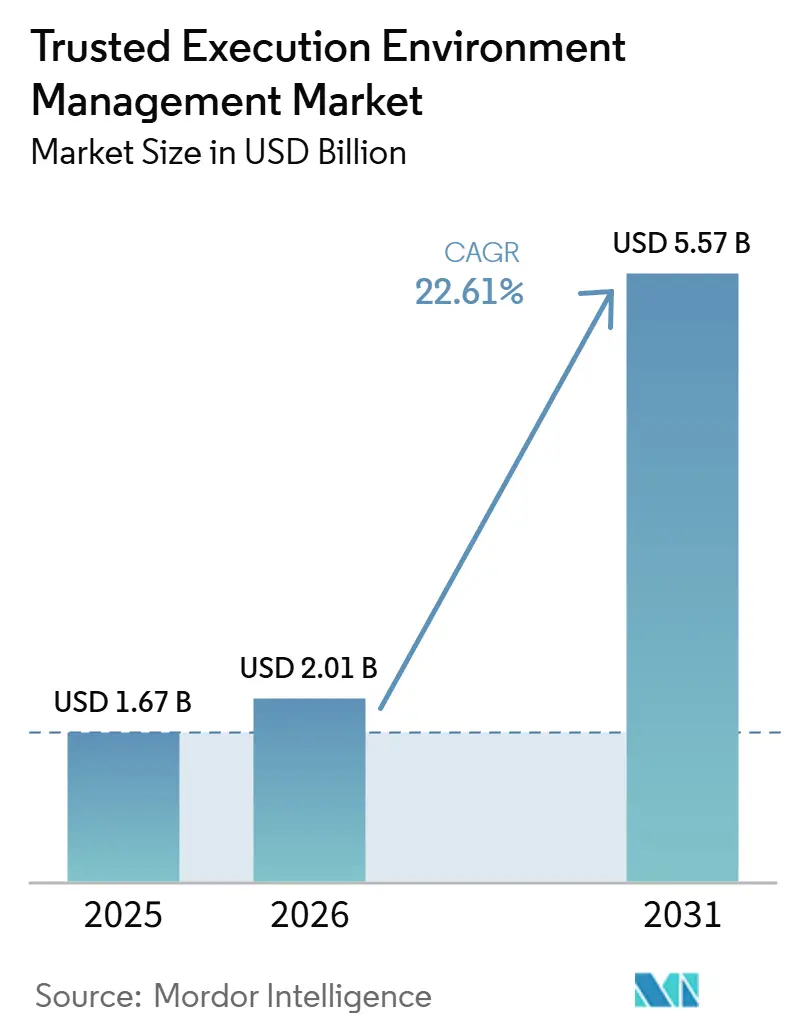
The Trusted Execution Environment Management Market size was valued at USD 1.67 billion in 2025 and estimated to grow from USD 2.01 billion in 2026 to reach USD 5.57 billion by 2031, at a CAGR of 22.61% during the forecast period 2026-2031. Enterprise security spending is moving toward hardware-enforced isolation because supply-chain intrusions, firmware attacks, and AI-enabled threats can bypass perimeter controls. Sovereign AI rules, 5G edge deployment, and post-quantum migration are creating a longer investment cycle than conventional incident-led security spending. Vendors are responding with attestation tools, key-release controls, and managed services that reduce the difficulty of working across different chip architectures. GPU-attached TEE capabilities in NVIDIA H100 and H200 platforms are also supporting confidential AI inference, which requires policy enforcement across CPU and GPU enclaves. The Trusted Execution Environment Management Market therefore has opportunities in regulated AI, long-lived device upgrades, and security operations that need verifiable workload isolation.
Key Report Takeaways
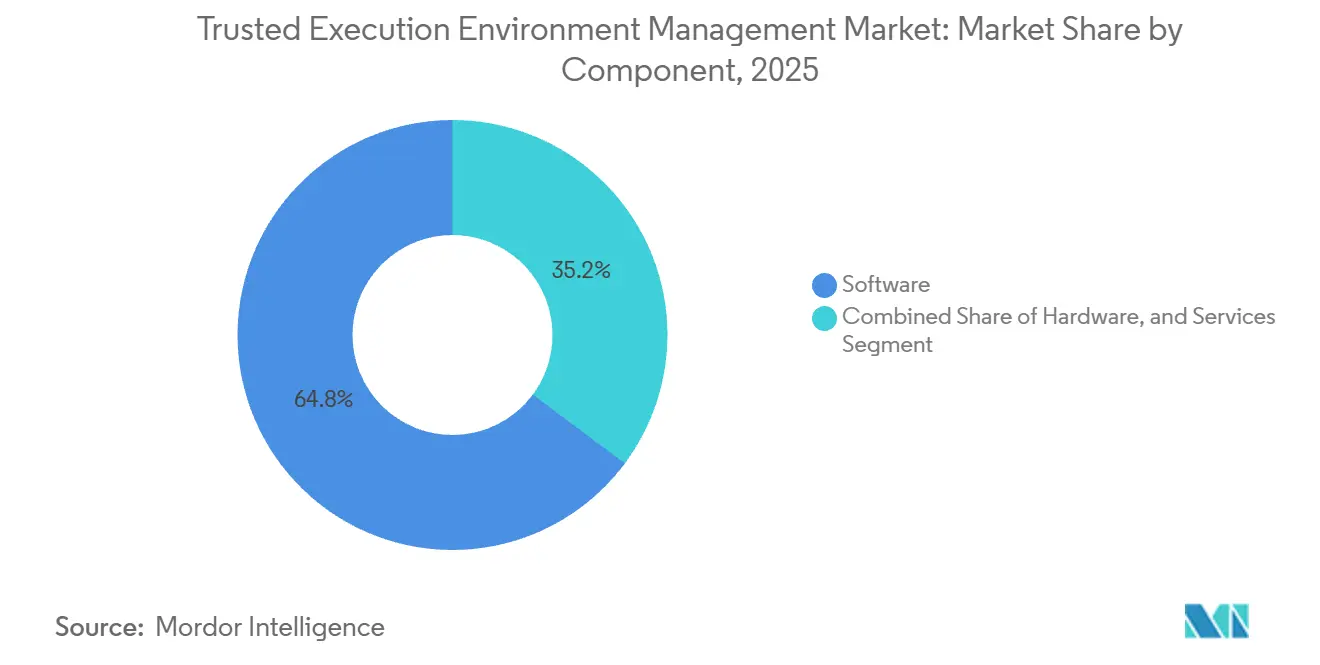
- By component, software held 64.82% of the Trusted Execution Environment Management Market revenue in 2025, while services are projected to expand at a 24.73% CAGR through 2031.
- By deployment model, cloud accounted for 68.41% of revenue in the Trusted Execution Environment Management Market in 2025, while hybrid deployment is projected to expand at a 23.84% CAGR through 2031.
- By application, mobile security and digital payments held 28.19% of revenue in the Trusted Execution Environment Management Market in 2025, while automotive security is projected to expand at a 24.16% CAGR through 2031.
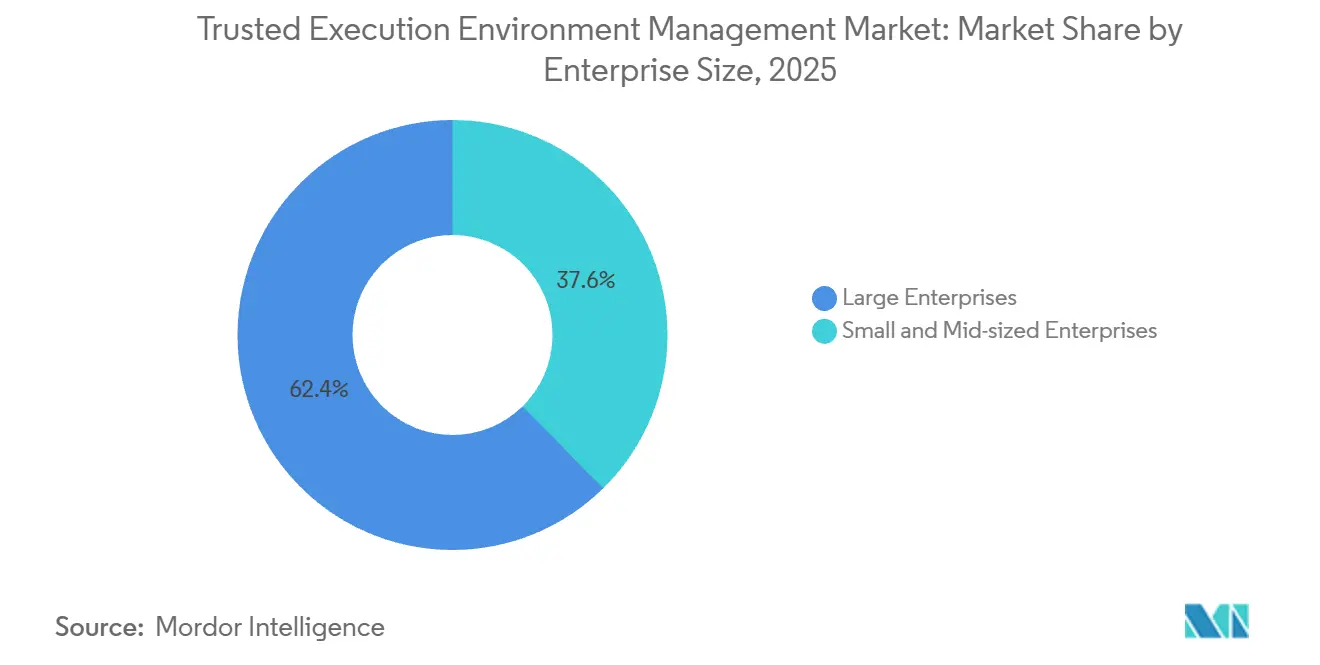
- By enterprise size, large enterprises held 62.36% of revenue in the Trusted Execution Environment Management Market in 2025, while small and mid-sized enterprises are projected to expand at a 23.92% CAGR through 2031.
- By end user, IT and telecommunications held 24.73% of revenue in 2025, while healthcare and life sciences are projected to expand at a 24.41% CAGR through 2031.
- By geography, North America held 34.62% of global revenue in 2025, while Asia-Pacific is projected to expand at a 23.68% CAGR through 2031.
Note: Market size and forecast figures in this report are generated using Mordor Intelligence’s proprietary estimation framework, updated with the latest available data and insights as of January 2026.
Global Trusted Execution Environment Management Market Trends and Insights
Drivers Impact Analysis*
| Driver | (~) % Impact on CAGR Forecast | Geographic Relevance | Impact Timeline |
|---|---|---|---|
| Rising Cybersecurity Threats and Data-Breach Costs | +4.8% | Global, North America and Europe as primary cost centers | Short term (≤ 2 years) |
| Data Protection and Digital Resilience Rules | +4.2% | European Union, with effects in North America, Asia-Pacific, and the Middle East and Africa | Medium term (2-4 years) |
| Cloud, Edge, and Connected Device Expansion | +3.8% | Global, with Asia-Pacific and North America leading deployment volume | Medium term (2-4 years) |
| Mobile Payments and Digital Identity Growth | +3.2% | Asia-Pacific, North America, Europe, and emerging Middle East and Africa markets | Short term (≤ 2 years) |
| Confidential AI and Privacy-Preserving Analytics Adoption | +2.8% | North America and Europe, with early use in Asia-Pacific | Medium term (2-4 years) |
| Portable Attestation Across Diverse Compute Environments | +1.8% | Global, particularly multi-cloud and edge-heavy deployments | Long term (≥ 4 years) |
| Source: Mordor Intelligence | |||
Rising Cybersecurity Threats and Data-Breach Costs
The financial impact of security incidents supports the Trusted Execution Environment Management Market. IBM reported a global average breach cost of USD 4.44 million in 2025, while the U.S. average reached USD 10.22 million.[1]IBM Security, “Cost of a Data Breach Report 2025,” IBM, ibm.com. Verizon documented 12,195 confirmed breaches in its 2025 report and found ransomware in 44% of incidents. The same report found third-party involvement in 30% of breaches, which highlights weaknesses across supplier and infrastructure trust chains. IBM also found that 97% of organizations that experienced an AI-related security incident lacked proper AI access controls. TEE management platforms can isolate model weights and inference workloads, while linking key access to attestation evidence.
Data Protection and Digital Resilience Rules
The Trusted Execution Environment Management Market benefits as cybersecurity requirements move from policy statements into product and operational controls. Regulation EU 2024/2847, known as the Cyber Resilience Act, entered into force on December 10, 2024.[2]European Commission, “Regulation EU 2024/2847,” EUR-Lex, eur-lex.europa.eu. Reporting obligations for actively exploited vulnerabilities apply from September 11, 2026, and full product lifecycle requirements will apply from December 11, 2027. Sweden’s privacy authority published GDPR guidance on TEE deployments in May 2026 and treated properly implemented TEEs as a technical safeguard under Article 32. The guidance places accountability with the party that controls attestation and encryption keys. These requirements make hardware-backed evidence more relevant to healthcare, financial services, automotive, and other regulated users.
Cloud, Edge, and Connected Device Expansion
The Trusted Execution Environment Management Market expands as more workloads run across cloud servers, edge nodes, and connected devices. Japan’s National Institute of Advanced Industrial Science and Technology has contributed to the IETF TEEP working group since 2020, supporting lifecycle management standards for mixed device fleets.[3]National Institute of Advanced Industrial Science and Technology, “TEE and Supporting Technologies,” AIST Cybersecurity Research Institute, cpsec.aist.go.jp. The work is relevant to industrial IoT and automotive deployments that need repeatable provisioning and updates. Research presented at NDSS 2026 found that an ARM TrustZone architecture for connected vehicles maintained V2X communication integrity with 6.5% transmission overhead. This result supports the use of TEEs for real-time vehicle communications, though deployment still depends on workload and system design. Organizations consequently need attestation orchestration that can operate across endpoints, edge infrastructure, and AI servers.[4]Martin Kayondo, Junseung You, Eunmin Kim, Jiwon Seo, and Yunheung Paek, “SECV: Securing Connected Vehicles with Hardware Trust Anchors,” Network and Distributed System Security Symposium, doi.org.
Mobile Payments and Digital Identity Growth
Mobile payments and digital identity systems are supporting demand for transaction-level TEE protection. EMVCo’s Software-Based Mobile Payments TEE Approval provides an independent security benchmark for mobile wallet environments. Licel confirmed a second consecutive renewal of its vTEE approval across Android and iOS in June 2026. The IETF TEEP architecture identifies payment applications as a core use case, with biometric credentials and transaction-signing keys retained in hardware-isolated environments. In Japan and South Korea, toll collection, EV charging authentication, and in-vehicle SoftPOS are bringing together vehicle and payment use cases. TEE managers must therefore support key rotation, enclave updates, and attestation refresh across credentials that may be both mobile and vehicle-resident.
Restraints Impact Analysis*
| Restraint | (~) % Impact on CAGR Forecast | Geographic Relevance | Impact Timeline |
|---|---|---|---|
| Integration Complexity and Skills Scarcity | -3.2% | Global, most acute for small and mid-sized enterprises and emerging markets | Short term (≤ 2 years) |
| Performance Overhead and Limited Workload Fit | -2.4% | Global, concentrated in latency-sensitive finance and industrial operational technology | Medium term (2-4 years) |
| Cross-Vendor Attestation and Interoperability Gaps | -1.8% | Global, especially multi-cloud and diverse IoT settings | Long term (≥ 4 years) |
| Long-Lived Device Fleets and Post-Quantum Migration Uncertainty | -1.4% | Global, especially automotive, industrial, and government sectors | Long term (≥ 4 years) |
| Source: Mordor Intelligence | |||
Integration Complexity and Skills Scarcity
The Trusted Execution Environment Management Market faces a near-term constraint because strong security value does not remove implementation difficulty. Intel TDX, AMD SEV-SNP, ARM TrustZone, and RISC-V enclaves use different APIs, attestation processes, and threat models. Security teams must often support multiple of these environments simultaneously. ESET found cloud security was the second-highest planned investment area for small and mid-sized businesses in 2026. However, implementing TEE requires skills beyond typical cloud security training. Managed attestation services and confidential containers can reduce this burden, but adoption will remain slower where organizations lack dedicated security engineers.
Performance Overhead and Limited Workload Fit
TEE memory encryption can introduce latency, limiting its suitability for some real-time and high-frequency workloads. A 2024 study of AMD SEV-SNP and Intel TDX reported performance penalties in I/O-intensive work and context-switch operations. The study also identified memory-management inefficiencies that current hardware generations had not fully removed. This creates a distinction between workloads that can accept TEE overhead and those in high-frequency transactions or industrial operations that cannot. Some clinical AI implementations have shown that confidentiality and throughput can coexist, but these systems require tailored engineering rather than a standard deployment. Selective-enclave designs can help protect cryptographic operations without placing the entire workload inside an enclave.
*Our forecasts treat driver/restraint impacts as directional, not additive. The impact forecasts reflect baseline growth, mix effects, and variable interactions.
Segment Analysis
By Component: Hardware Anchors Revenue, Services Capture Growth
Software held 64.82% of the Trusted Execution Environment Management Market share in 2025. Although silicon-based trust remains critical because a compromised hypervisor may undermine software-only attestations, secure chips, embedded hardware security modules, and system-on-chip security functions act primarily as the foundational investment layer. Advanced hardware, such as the Rambus CryptoManager RT-648, an automotive embedded hardware security module with ISO 26262 and ISO/SAE 21434 support, as well as post-quantum algorithms aligned with FIPS 203, 204, and 20, continues to proliferate. It is, however, software that commands the majority of the market by providing essential policy management, key orchestration, and confidential container tools that enable this diverse TEE hardware to actually operate at scale.
Services are projected to grow at a 24.73% CAGR from 2026 to 2031. Managed attestation and professional integration are driving growth in the Trusted Execution Environment Management Market because many users need help connecting hardware, workloads, and security policies. The Trusted Execution Environment Management Market size for hardware will also be affected by post-quantum readiness. NIST finalized its first 3 post-quantum cryptography standards in 2024, creating a replacement cycle for devices that lack cryptographic agility. Vendors that embed update paths and quantum-resistant support can benefit, while systems without modular upgrades may face earlier replacement.



By Deployment Model: Cloud Dominates, Hybrid Deployment Accelerates
Cloud deployment held 68.41% of revenue in 2025. Confidential virtual machines using Intel TDX and AMD SEV-SNP have reduced the capital investment previously needed for hardware-isolated computing. The on-premises model remains important for air-gapped government and defense settings that require direct infrastructure control. Cloud platforms also offer a practical route into the Trusted Execution Environment Management Market for organizations that need TEE-grade isolation without building server fleets.
Hybrid deployment is projected to grow at a 23.84% CAGR from 2026 to 2031. Organizations are connecting sensitive on-premises data with cloud-scale AI inference through attestation pipelines and cryptographic controls. Intel’s TD Preserving Architecture supports runtime TDX Module updates in milliseconds rather than reboot windows that can last minutes. This capability supports production AI environments where 99.999% availability is a contractual requirement. Edgeless Systems offers confidential container orchestration that keeps application data inaccessible even to customer-side Kubernetes administrators in the Trusted Execution Environment Management Market.
By Application: Mobile Security Leads, Automotive Security Defines Future Growth
Mobile security and digital payments held 28.19% of revenue in 2025. Hardware wallets, biometric authentication, and SIM abstraction have made TEEs a core trust anchor in premium smartphones. IoT and edge security is another large application area as organizations replace software-only isolation with hardware-attested enclaves. Government and defense applications require high levels of certification. ProvenRun states that its ProvenCore is EAL7 certified, a level relevant to high-assurance defense and critical infrastructure settings.
Automotive security is projected to grow at a 24.16% CAGR from 2026 to 2031. UN-R155 and ISO/SAE 21434 are increasing the demand for hardware-level key protection in security-critical electronic control units. GlobalPlatform held its Cybersecurity Vehicle Forum in Tokyo in May 2026 to advance the Micro-TEE specification for automotive high-performance security environments. The program included Trustonic, Hitachi, ARM, and Woven by Toyota. This part of the Trusted Execution Environment Management Market also extends into health data environments that require confidential computing.
By Enterprise Size: Large Enterprises Lead, Small and Mid-Sized Enterprises Close the Gap
Large enterprises held 62.36% of revenue in 2025. These organizations have the capital and engineering capacity to connect TEE platforms across multi-cloud environments with different security requirements. They are also more likely to operate complex, confidential data collaboration programs. Secretarium and FutureFlow won the Bank for International Settlements Innovation Hub Analytics Challenge in 2025 with a TEE-based data-sharing solution for public and private financial institutions. The deployment model allows sensitive transaction information to be analyzed without exposing underlying records.
Small and mid-sized enterprises are projected to grow at a 23.92% CAGR from 2026 to 2031. ESET reported that 43% of cyberattacks targeted small businesses in 2026. Managed TEE services can remove integration work that previously restricted adoption in the Trusted Execution Environment Management Market to larger organizations. Confidential containers can isolate existing workloads without code changes. This approach gives teams without dedicated TEE specialists a way to use hardware-enforced protection through established Kubernetes processes.
By End Users: IT and Telecommunications Anchors Demand, Healthcare Drives Fastest Expansion
IT and telecommunications held 24.73% of revenue in 2025. Network operators use TEEs for subscriber identity management and 5G core authentication isolation. BFSI is the second-largest end-user area, supported by payment certification, high-value transaction signing, and cross-institutional analytics. Retail and e-commerce adoption is supported by PCI DSS v4.0 requirements for protecting cardholder data. Industrial manufacturing follows longer operational technology modernization cycles, while automotive and transportation use TEE-secured electronic control units to address ISO/SAE 21434 requirements.
Healthcare and life sciences are projected to grow at a 24.41% CAGR from 2026 to 2031. The Cloud Security Alliance describes TEEs as a foundational architecture for HIPAA technical safeguards when AI inference uses protected health information. Hardware-enforced isolation can prevent an infrastructure provider from viewing patient data in plaintext. A 2025 study found that Azure Confidential Computing architectures supported HIPAA-compliant patient readmission prediction at clinical throughput levels. Healthcare raises performance and compliance demands for the Trusted Execution Environment Management Market.
Geography Analysis
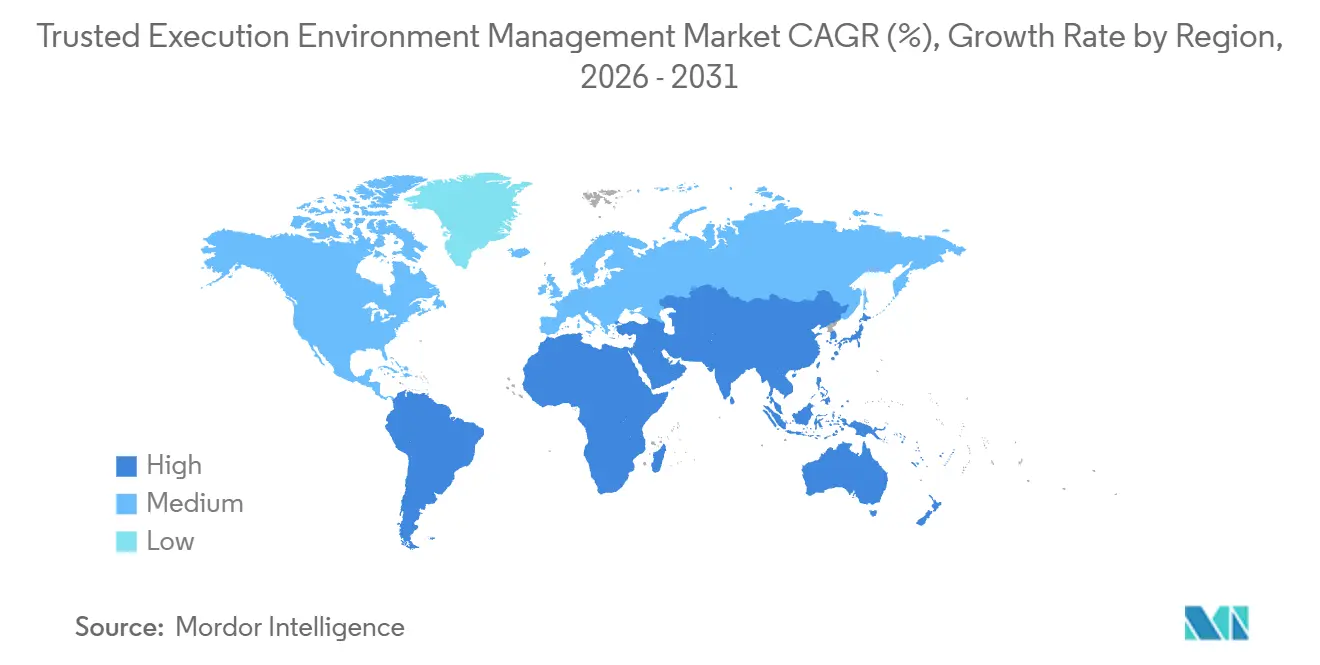
North America held 34.62% of the Trusted Execution Environment Management Market share in 2025. U.S. federal procurement supports hardware-attested security for defense and intelligence workloads. The concentration of enterprise cloud deployments makes confidential virtual machine adoption commercially practical. IBM reported an average breach cost of USD 10.22 million in the United States in 2025, 2.3 times the global average. This gap is increasing board-level interest in verifiable compute isolation.
Europe is the second-largest region in the Trusted Execution Environment Management Market, and Cyber Resilience Act reporting obligations are due in September 2026. Sweden’s privacy authority issued GDPR guidance on TEE deployments in May 2026, which other European Union regulators are studying. Edgeless Systems reported that its Privatemode AI operates within Germany’s ePA system and protects the data of 50 million patients. France’s ProvenRun has built high-assurance credentials around ProvenCore and ProvenHSM.
Asia-Pacific is projected to grow at a 23.68% CAGR from 2026 to 2031. Japan’s AIST has supported IETF TEEP work for automotive and industrial IoT lifecycle management. South Korea has supported connected-vehicle research, while India’s data protection rules are encouraging sovereign AI deployments. China’s domestic ecosystem is expanding through RISC-V-based approaches for sensitive deployments. South America, the Middle East, and Africa are early-stage regions where BFSI compliance, digital identity programs, data-residency laws, Brazil’s LGPD, and sovereign cloud investments can support adoption.

Competitive Landscape
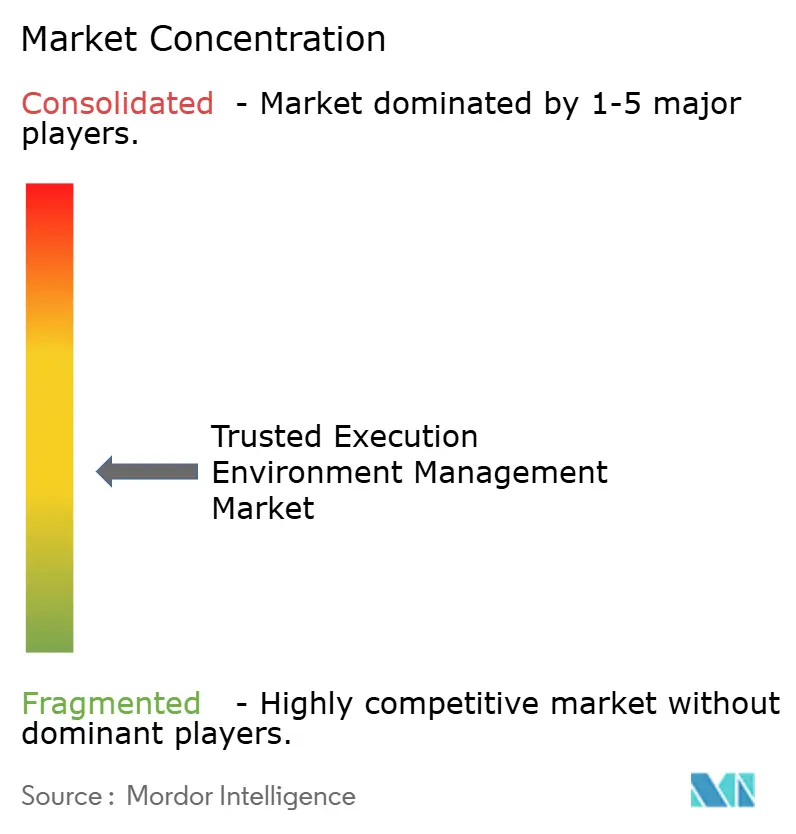
The Trusted Execution Environment Management Market is moderately fragmented because no vendor controls hardware intellectual property, TEE operating systems, attestation orchestration, and managed services across the full stack. Fortanix expanded its Confidential AI offering in March 2026 using NVIDIA Confidential Computing for enterprise AI factories. The company presented the offering as a way to run proprietary AI inference within hardware-attested environments. Edgeless Systems announced Privatemode AI, powered by NVIDIA Blackwell GPU confidential computing, for European government and healthcare users. These partnerships give software specialists a route to enterprise distribution without proprietary silicon.
Certification is becoming a distinct competitive tool in the Trusted Execution Environment Management Market. ProvenRun’s EAL7-certified ProvenCore targets defense and critical infrastructure users that require high assurance. Licel’s vTEE received its second consecutive EMVCo Software-Based Mobile Payments TEE Approval across Android and iOS in June 2026. This approval provides a standards-based barrier in mobile payments. ProvenRun and Andes Technology are working to certify ProvenCore on RISC-V processors.
Open opportunities in the Trusted Execution Environment Management Market include post-quantum-ready management for long-lived device fleets. Vendors also need better portable attestation across Intel TDX, AMD SEV-SNP, and ARM Confidential Compute Architecture. Managed services with simpler APIs can address the requirements of small and mid-sized enterprises. GlobalPlatform’s SESIP framework is becoming a relevant procurement consideration in automotive and IoT programs.
Trusted Execution Environment Management Industry Leaders
Fortanix, Inc.
Anjuna Security, Inc.
ProvenRun S.A.S.
TrustKernel Technology Co., Ltd.
Edgeless Systems GmbH
- *Disclaimer: Major Players sorted in no particular order

Recent Industry Developments
- July 2026: ProvenRun relaunched around ProvenHSM (EAL5+/FIPS 140-3), built on the EAL7-certified ProvenCore OS, extending its digital trust stack from embedded automotive to cloud-hybrid environments and signaling a move into enterprise and defense key management markets dominated by legacy HSM vendors.
- June 2026: Anjuna Security launched Anjuna Overwatch, the industry’s first Trusted Control Plane for autonomous AI, governing agent behavior, data use, compliance, and cost within hardware-attested TEE boundaries, and the solution targets banking and government sectors, capitalizing on existing Anjuna Seaglass deployments in both verticals.
- June 2026: Licel vTEE renewed its EMVCo Software-Based Mobile Payments TEE Approval across Android and iOS, the second consecutive annual renewal and the only cross-platform secure execution environment with this independent validation, enabling payment wallet, digital identity, and SoftPOS developers to maintain a single certified security stack across major mobile operating systems.
- April 2026: CryptoNext Security and ProvenRun announced the integration of post-quantum cryptography into ProvenHSM, with CryptoNext Security becoming the first EU company to achieve full NIST quantum-safe certification, and the platform delivers a crypto-agile HSM for defense, automotive, industrial, and semiconductor markets.


Global Trusted Execution Environment Management Market Report Scope
The trusted execution environment management market encompasses the ecosystem of hardware, software, and services that provision, orchestrate, monitor, and secure trusted execution environments. A TEE is a highly secure, isolated area within a main processor that guarantees the confidentiality and integrity of the code and data processed inside it, protecting them from unauthorized access by the host operating system, hypervisors, or malicious actors. This market encompasses the management of TEEs across diverse applications, including mobile security and digital payments, IoT and edge devices, automotive systems, industrial operational technology, and confidential computing workloads. Deployed via cloud, hybrid, or on-premises models, these solutions cater to organizations of varying sizes across industries such as BFSI, automotive, healthcare, and manufacturing. By providing robust lifecycle management, cryptographic key protection, and remote attestation capabilities, TEE management solutions enable enterprises to secure sensitive workloads, mitigate advanced cyber threats, ensure regulatory compliance, and confidently execute critical operations in zero-trust environments.
The Trusted Execution Environment Management Market Report is Segmented by Component (Hardware, Software, and Services), Deployment Model (Cloud, Hybrid, and On-Premises), Application (Mobile Security and Digital Payments, IoT and Edge Security, Automotive Security, Industrial and Operational Technology Security, Confidential Computing and Data Privacy, Government and Defense, and Others), Enterprise Size (Large Enterprises, and Small and Mid-sized Enterprises), End Users (IT and Telecommunication, BFSI, Automotive and Transportation, Healthcare and Life Sciences, Retail and E-Commerce, Industrial Manufacturing, and Other End Users), and Geography (North America, South America, Europe, Asia-Pacific, and Middle East and Africa). The Market Forecasts are Provided in Terms of Value (USD).
| Hardware |
| Software |
| Services |
| Cloud |
| Hybrid |
| On-Premises |
| Mobile Security and Digital Payments |
| IoT and Edge Security |
| Automotive Security |
| Industrial and Operational Technology Security |
| Confidential Computing and Data Privacy |
| Government and Defense |
| Other Applications |
| Large Enterprises |
| Small and Mid-sized Enterprises |
| IT and Telecommunication |
| BFSI |
| Automotive and Transportation |
| Healthcare and Life Sciences |
| Retail and E-Commerce |
| Industrial Manufacturing |
| Other End Users |
| North America | United States | |
| Canada | ||
| Mexico | ||
| South America | Brazil | |
| Argentina | ||
| Rest of South America | ||
| Europe | Germany | |
| United Kingdom | ||
| France | ||
| Russia | ||
| Spain | ||
| Rest of Europe | ||
| Asia-Pacific | China | |
| Japan | ||
| India | ||
| South Korea | ||
| Southeast Asia | ||
| Rest of Asia-Pacific | ||
| Middle East and Africa | Middle East | Saudi Arabia |
| United Arab Emirates | ||
| Rest of Middle East | ||
| Africa | South Africa | |
| Nigeria | ||
| Rest of Africa | ||
| By Component | Hardware | ||
| Software | |||
| Services | |||
| By Deployment Model | Cloud | ||
| Hybrid | |||
| On-Premises | |||
| By Application | Mobile Security and Digital Payments | ||
| IoT and Edge Security | |||
| Automotive Security | |||
| Industrial and Operational Technology Security | |||
| Confidential Computing and Data Privacy | |||
| Government and Defense | |||
| Other Applications | |||
| By Enterprise Size | Large Enterprises | ||
| Small and Mid-sized Enterprises | |||
| By End Users | IT and Telecommunication | ||
| BFSI | |||
| Automotive and Transportation | |||
| Healthcare and Life Sciences | |||
| Retail and E-Commerce | |||
| Industrial Manufacturing | |||
| Other End Users | |||
| By Geography | North America | United States | |
| Canada | |||
| Mexico | |||
| South America | Brazil | ||
| Argentina | |||
| Rest of South America | |||
| Europe | Germany | ||
| United Kingdom | |||
| France | |||
| Russia | |||
| Spain | |||
| Rest of Europe | |||
| Asia-Pacific | China | ||
| Japan | |||
| India | |||
| South Korea | |||
| Southeast Asia | |||
| Rest of Asia-Pacific | |||
| Middle East and Africa | Middle East | Saudi Arabia | |
| United Arab Emirates | |||
| Rest of Middle East | |||
| Africa | South Africa | ||
| Nigeria | |||
| Rest of Africa | |||


Key Questions Answered in the Report
What is the size of the Trusted Execution Environment Management Market?
The Trusted Execution Environment Management Market was valued at USD 1.67 billion in 2025 and is estimated at USD 2.01 billion in 2026. It is projected to reach USD 5.57 billion by 2031 at a 22.61% CAGR.
What is driving adoption of trusted execution environment management?
Breach costs, data protection rules, cloud and edge expansion, mobile payments, and confidential AI are supporting adoption.
Which component leads spending?
Software held 64.82% of revenue in 2025. Services are projected to grow faster at a 24.73% CAGR.
Which deployment model is growing fastest?
Hybrid deployment is projected to grow at a 23.84% CAGR through 2031 as organizations connect sensitive on-premises data with cloud AI workloads.
Which application is projected to grow fastest?
Automotive security is projected to expand at a 24.16% CAGR through 2031, supported by vehicle cybersecurity and key-protection requirements.
Which region has the fastest projected growth?
Asia-Pacific is projected to grow at a 23.68% CAGR through 2031, supported by automotive, industrial IoT, data protection, and sovereign AI activity.
Page last updated on:






