
Transformer Protection Equipment Market Size and Share
Market Overview
| Study Period | 2021 - 2031 |
|---|---|
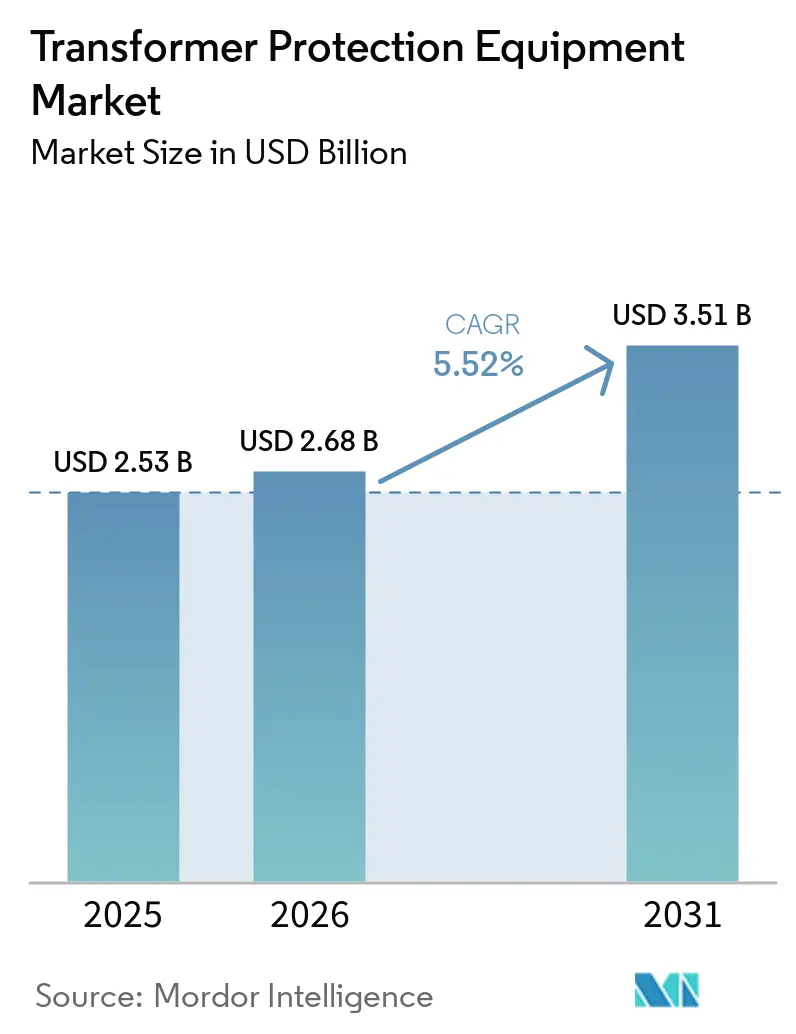
| Market Size (2026) | USD 2.68 Billion |
| Market Size (2031) | USD 3.51 Billion |
| Growth Rate (2026 - 2031) | 5.52 % |
| Fastest Growing Market | Asia-Pacific |
| Largest Market | Asia-Pacific |
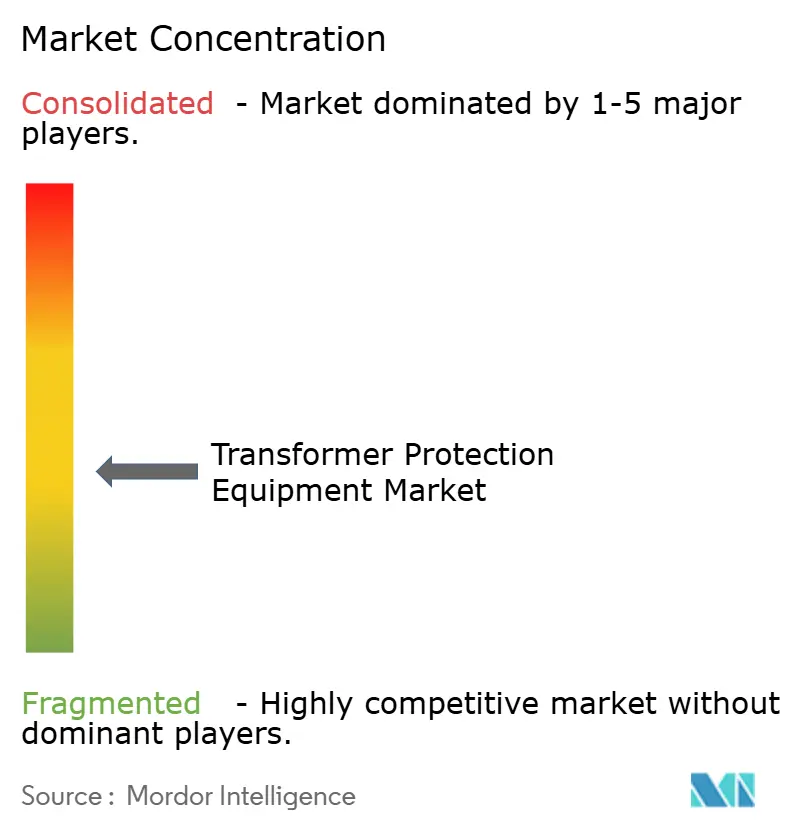
| Market Concentration | Medium |
Major Players *Disclaimer: Major Players sorted in no particular order Image © Mordor Intelligence. Reuse requires attribution under CC BY 4.0. | |
Transformer Protection Equipment Market Analysis by Mordor Intelligence
The Transformer Protection Equipment Market size is expected to increase from USD 2.53 billion in 2025 to USD 2.68 billion in 2026 and reach USD 3.51 billion by 2031, growing at a CAGR of 5.52% over 2026-2031. Grid expansion, renewable generation, and data-center construction are increasing the need to protect transformers that are difficult to replace. Utilities are also placing more value on monitoring and digital protection because aging assets must remain in service for longer periods. Digital substations are changing specifications toward connected devices that support protection, control, monitoring, and metering. Suppliers with reliable software, cybersecurity features, and service capabilities are likely to have stronger positions as utilities standardize their procurement requirements. These conditions create opportunities for equipment that improves transformer availability across new substations and retrofit projects.
Key Report Takeaways
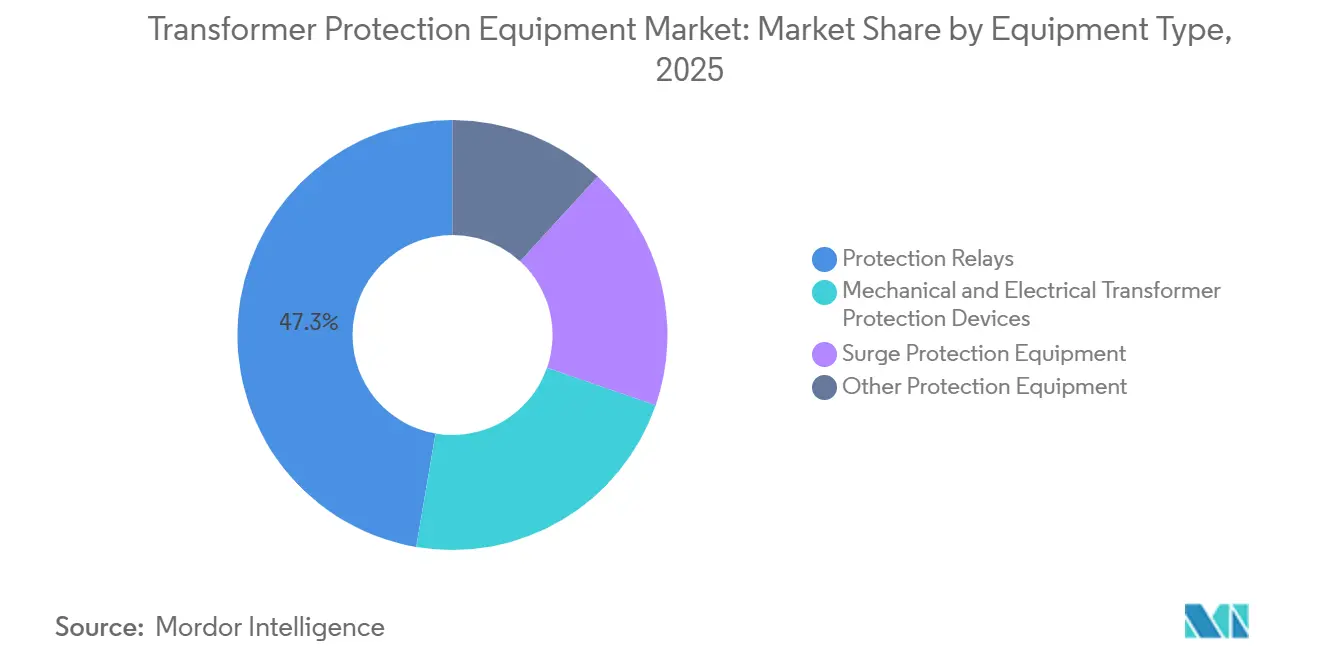
- By equipment type, protection relays held 47.3% of the transformer protection equipment market share in 2025 and are forecast to expand at a 6.3% CAGR through 2031.
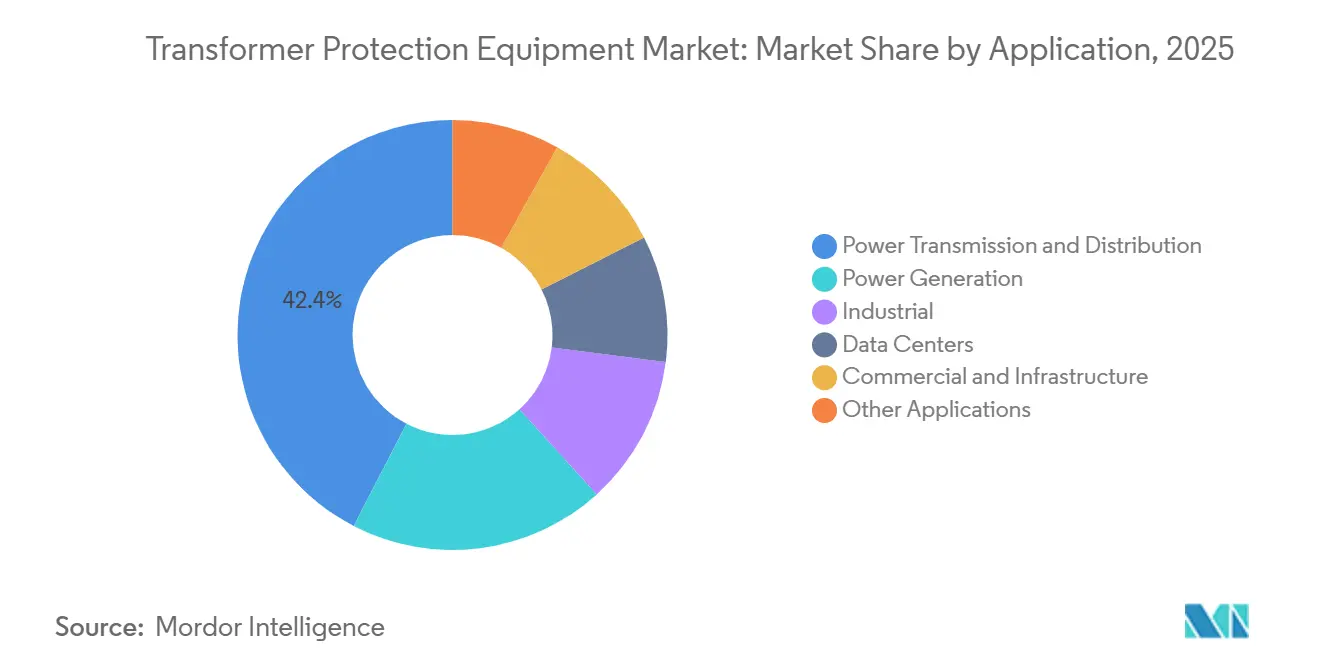
- By application, power transmission and distribution accounted for 42.4% of the transformer protection equipment market size in 2025 and is projected to grow at a 6.7% CAGR through 2031.
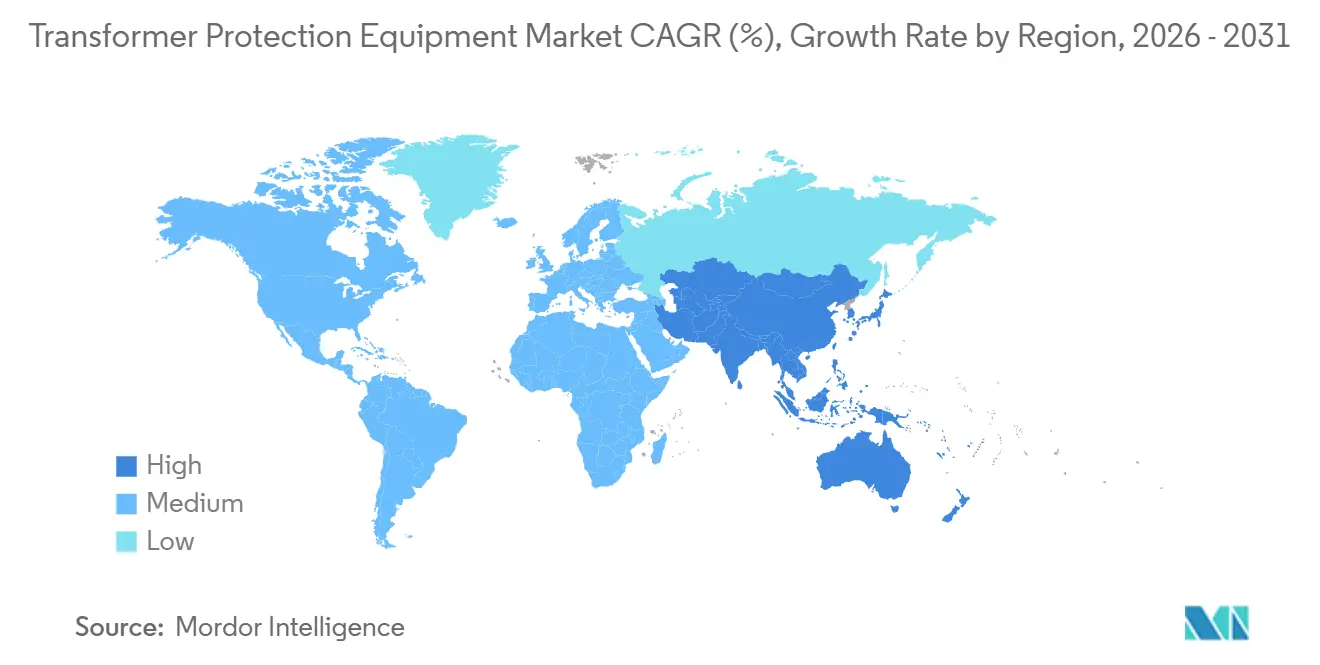
- By geography, Asia-Pacific held 37.6% of revenue in 2025 and is forecast to grow at a 7.4% CAGR through 2031.
Note: Market size and forecast figures in this report are generated using Mordor Intelligence’s proprietary estimation framework, updated with the latest available data and insights as of January 2026.
Market Trends and Insights
Drivers Impact Analysis of Transformer Protection Equipment Market*
| Driver | (~) % Impact on CAGR Forecast | Geographic Relevance | Impact Timeline |
|---|---|---|---|
| Grid Modernization and Digital-Substation Deployment | +1.40% | Global - most acute in China, EU, and Middle East | Medium term (2–4 years) |
| Renewable-Energy and Distributed-Generation Integration | +1.10% | Global - APAC and EU leading; North America accelerating | Medium term (2–4 years) |
| Aging Transformer Fleet Replacement and Retrofit Programs | +1.00% | North America and Europe primary; APAC secondary | Short to medium term (≤4 years) |
| Rising Data-Center and Critical-Infrastructure Reliability Requirements | +0.70% | North America, Europe, and East Asia hyperscale corridors | Short term (≤2 years) |
| Adaptive Protection for Bidirectional Power Flows and Weak Grids | +0.60% | APAC, EU renewable corridors, and South America | Long term (≥4 years) |
| Transformer Shortage and National-Resilience Monitoring Requirements | +0.30% | North America; spill-over to EU and APAC | Short term (≤2 years) |
| Source: Mordor Intelligence | |||
Grid Modernization and Digital-Substation Deployment
Utilities are moving from hardwired protection systems to digital substations built around IEC 61850 communication standards. This change makes compatible protection relays a more common requirement in new substation tenders. RTE is advancing its R#SPACE program to develop digital and multi-vendor substations across its network. Hitachi Energy and Türkiye’s transmission system operator TEİAŞ began a pilot for the country’s first digital substation in May 2026[1]. The project shows how national grid operators are testing digital protection before applying it more widely. The transformer protection equipment market benefits because operators need devices that can exchange dependable data across the substation while supporting protection functions.
Renewable-Energy and Distributed-Generation Integration
Inverter-based resources can reduce fault-current levels and introduce bidirectional power flows into distribution and transmission networks. These conditions make static overcurrent settings less dependable and can lead to poor coordination or unnecessary trips. A 2026 scientific review identified hybrid, adaptive, and data-driven protection approaches as important responses to renewable-integrated network conditions. Hitachi Energy and Ørsted developed an adaptive model-based line differential protection method for offshore wind export cables using the Relion RED670 device. The work addresses the operating issues that can occur on long submarine alternating-current cables. The transformer protection equipment market, therefore, favors numerical relays that can apply multiple setting groups and adapt to changing system conditions.
Aging Transformer Fleet Replacement and Retrofit Programs
Aging assets are increasing the need for protection, condition monitoring, and controlled loading across existing transformer fleets. American Transmission Company reported that more than half of U.S. distribution transformers, representing nearly 40 million units, had exceeded their expected service life in 2025. The same assessment stated that more than 35% of large transmission-class transformers at typical U.S. utilities were older than 35 years. This condition makes a protection upgrade more practical when a transformer cannot be taken out of service for replacement. Maschinenfabrik Reinhausen acquired a minority stake in BSS Hochspannungstechnik in May 2025 to add UHF partial-discharge sensing capabilities to its ETOS platform[2]. The transformer protection equipment market gains from retrofit programs that combine relays with dissolved gas, partial-discharge, and thermal monitoring.
Data-Center and Critical-Infrastructure Reliability Requirements
Large data centers require dependable transformer protection because a failure can interrupt computing operations and delay restoration. Operators are specifying differential protection, redundant protection arrangements, and fast operating times for facilities with high uptime requirements. Eaton and Siemens Energy formed a 2025 partnership to provide integrated onsite power systems for data centers, including medium-voltage switchgear, protection systems, and modular uninterruptible power supply equipment[3]. China’s National Energy Administration stated that data-center electricity additions are expected to reach at least 100 billion kWh annually during the Fifteenth Five-Year Plan period. These projects increase demand for transformer differential protection in addition to conventional utility applications. The transformer protection equipment market also benefits when campus developers combine power equipment, monitoring, and maintenance requirements under a single reliability plan.
Restraints Impact Analysis of Transformer Protection Equipment Market*
| Restraint | (~) % Impact on CAGR Forecast | Geographic Relevance | Impact Timeline |
|---|---|---|---|
| High Installation, Calibration, and Retrofit Costs | -0.90% | Global - most constraining in South America, MEA, and SEA | Medium term (2–4 years) |
| Legacy-System Interoperability and Protocol Fragmentation | -0.60% | North America and Europe with mixed-vintage substation fleets | Medium to long term (≥2 years) |
| Extended Lead Times for Specialized Semiconductors and Metal-Oxide Components | -0.50% | Global - concentrated in high-voltage relay segments | Short to medium term (≤4 years) |
| IEC 61850 Engineering and Cybersecurity Skills Gap | -0.40% | Global - most acute in emerging markets and second-tier utilities | Long term (≥4 years) |
| Source: Mordor Intelligence | |||
High Installation, Calibration, and Retrofit Costs
The move from electromechanical equipment to digital protection can require a significant investment beyond the relay itself. A full bay retrofit may require merging units, process-bus cabling, device configuration, testing, and changes to existing panels. In smaller substations, these activities can cost 2.5 to 3 times the equipment price. Operators may also need to modify civil works when new protection panels do not fit the original substation layout. Utilities in South America, Southeast Asia, and sub-Saharan Africa can defer upgrades when budgets are restricted. The transformer protection equipment market faces delayed procurement in these cases until reliability risks or equipment failures make action unavoidable.
Legacy-System Interoperability and Protocol Fragmentation
Many utility networks use a mix of IEC 61850, IEC 60870-5-101/104, DNP3, Modbus, and proprietary protocols. This mix increases the engineering work needed to connect modern devices to older substation systems. Mixed-vintage networks are common in North America and Western Europe because asset investment cycles extend over many years. Protocol conversion gateways can add cost and may introduce delay into protection communications. Suppliers that support legacy protocols alongside IEC 61850 can reduce the scale of a retrofit for the customer. The transformer protection equipment market has a clear need for hybrid platforms that limit disruption while allowing staged modernization.
*Our forecasts treat driver/restraint impacts as directional, not additive. The impact forecasts reflect baseline growth, mix effects, and variable interactions.
Transformer Protection Equipment Market Segment Analysis
By Equipment Type:
Numerical Relays Remain Central to Digital ProtectionProtection relays held 47.3% of the transformer protection equipment market size in 2025 and are forecast to grow at a 6.3% CAGR through 2031. Their position reflects the standard use of numerical relays in new substations and the replacement of older electromechanical devices in existing sites. These relays can combine differential protection, overcurrent backup, thermal overload functions, and links to monitoring systems in one device. This combination reduces the number of separate devices that a utility needs to configure and maintain. The transformer protection equipment industry is increasingly using these platforms to support both local protection and digital-substation communication.
Mechanical and electrical protection devices remain important because oil-immersed transformers commonly require Buchholz relays, pressure-relief devices, oil-level indicators, and winding-temperature instruments. These devices provide direct alarms or trips when conditions inside a transformer indicate a developing fault. ABB introduced the REX600 compact protection and control device for digital substations in 2026, combining protection and control capabilities in a smaller design[4]. Surge protection equipment is gaining relevance in renewable interconnections and data centers, where switching events and changing grid conditions can create transient voltage exposure. Other protection equipment also has a role in improving earth-fault sensitivity for networks that connect distributed solar and wind resources. The transformer protection equipment market continues to require a mix of numerical devices, mechanical safeguards, and specialized monitoring tools.

By Application:
Power Transmission and Distribution Leads While Data Centers Raise RequirementsPower transmission and distribution accounted for 42.4% of the transformer protection equipment market share in 2025 and is projected to register a 6.7% CAGR through 2031. The application includes new transmission corridors in Asia and the Middle East, as well as upgrade cycles in North America and Europe. India’s National Electricity Plan targets a 776,330 MVA increase in transformer capacity to 1,847,280 MVA by FY27, and 30% of that target had been achieved through FY25. GE Vernova received an order from POWERGRID in 2025 for more than 70 units of 765 kV transformers and shunt reactors, with deliveries starting in 2026. These investments create demand for protection systems that serve large and complex transformer installations.
Data centers are growing from a smaller base, but they require high specifications for transformer differential protection and redundancy. Their equipment selection is shaped by uptime commitments and the need to protect high-value computing capacity. Power generation remains a steady application because generator step-up transformers require dedicated protection as thermal and renewable capacity expand. Industrial users in oil and gas, mining, and heavy manufacturing are upgrading their substation protection as cybersecurity requirements become more important. Commercial and infrastructure applications include rail traction and public buildings, where electrification supports continuing equipment demand. The transformer protection equipment industry therefore serves both large grid projects and a wider set of critical power users.
Geography Analysis
APAC Transformer Protection Equipment Market
Asia-Pacific held 37.6% of the transformer protection equipment market size in 2025 and is forecast to grow at a 7.4% CAGR through 2031. China’s National Energy Administration stated in July 2026 that grid fixed-asset investment under the Fifteenth Five-Year Plan would exceed CNY 5 trillion, which was cited as USD 689 billion, and that 15 new ultra-high-voltage direct-current channels were planned. The plan also indicated grid capital spending growth of more than 80% compared with the preceding planning period. State Grid placed its first active transformer fault-prevention system into commercial operation at the Tianjin South UHV substation in July 2026. Hitachi Energy announced a INR 2,000 crore investment, cited as USD 240 million, in June 2026 for a large power transformer factory in Karjan, Vadodara. Southeast Asian countries, including Vietnam, Indonesia, and Thailand, are adding grid capacity and beginning to adopt IEC 61850 under updated grid codes.
North America Transformer Protection Equipment Market
North America is the second-largest region in the transformer protection equipment market. Its demand is shaped by grid modernization, data-center construction, clean-energy interconnections, and limits in transformer availability. The U.S. Government Accountability Office reported that the Department of Energy has worked on common transformer configurations to support industry efforts on transformer supply. Common designs can encourage more standardized specifications for related protection equipment. NERC cybersecurity requirements also make hardened firmware and auditable security documentation more important in relay procurement. These factors favor suppliers that can support utilities through both equipment selection and compliance work.
EMEA and South America Transformer Protection Equipment Market
Europe has substantial demand because energy-transition plans, grid codes, and equipment efficiency rules support new projects and retrofit work. Hitachi Energy signed an agreement with E.ON in July 2025 worth up to USD 700 million for transformer deliveries across Germany. The agreement reflects the scale of grid investment required to connect new generation and reinforce existing networks. In the Middle East and Africa, full-digital substation projects are creating an early demand channel for standards-compliant devices. South America is expanding more gradually, but Brazil commissioned its first fully digital substation at Itajaí in 2025 with 600 MVA of capacity. The project provides a reference point for real-time monitoring, remote control, and predictive maintenance in the region.
Competitive Landscape
The transformer protection equipment market is moderately consolidated among ABB, Hitachi Energy, Siemens Energy, GE Vernova, Schneider Electric, and Eaton. These companies compete through broad product portfolios, international service coverage, and established relationships with utilities and industrial users. Their offerings combine protection relays, control devices, monitoring tools, switchgear connections, and engineering support. This breadth matters because customers increasingly prefer systems that work together across a substation. ABB’s 2026 REX600 launch demonstrates continued product development around compact protection and control designs for digital substations. The transformer protection equipment market favors companies that can demonstrate reliable performance across a long installed asset life.
Maschinenfabrik Reinhausen is strengthening its condition-monitoring position through its ETOS platform and its investment in BSS Hochspannungstechnik. The transaction adds UHF partial-discharge sensing to an asset-monitoring offering that serves aging transformer fleets. Eaton and Siemens Energy are also addressing data-center needs through their integrated on-site power partnership. These moves show that differentiation increasingly depends on monitoring, system integration, and protection that support critical power users. Cybersecurity features and documented support for IEC standards can further influence purchasing decisions. The transformer protection equipment market remains less exposed to simple price competition, where engineering support and dependable firmware are decisive.
Schweitzer Engineering Laboratories and NR Electric hold strong positions in utility-grade and high-reliability applications. SEL introduced the SEL-9 Series in September 2025 as a three-relay family for transformer, line, and feeder protection. The design aims to simplify protection schemes for utilities with limited engineering resources. NR Electric is increasing its visibility in grid-forming and protection applications as inverter-based generation grows. Chinese suppliers can gain regional traction where intelligent protection terminals are adopted under smart-grid standards. Competition will remain centered on proven protection functions, communication compatibility, cybersecurity, and service rather than relay hardware alone.
Transformer Protection Equipment Industry Leaders
-
Hitachi Energy Ltd.
-
Siemens Energy AG
-
GE Vernova Inc.
-
Schneider Electric SE
-
ABB Ltd.
- *Disclaimer: Major Players sorted in no particular order
Transformer Protection Equipment Market Companies Covered in this Report
- ABB Ltd.
- Arteche Group
- Camlin Energy
- CG Power and Industrial Solutions Limited
- Eaton Corporation plc
- GE Vernova Inc.
- Hitachi Energy Ltd.
- Hyundai Electric and Energy Systems Co., Ltd.
- Maschinenfabrik Reinhausen GmbH
- Mitsubishi Electric Corporation
- NR Electric Co., Ltd.
- Qualitrol Company LLC
- Schneider Electric SE
- Schweitzer Engineering Laboratories, Inc.
- Siemens Energy AG
- Toshiba Energy Systems and Solutions Corporation
- Vaisala Oyj
- WIKA Alexander Wiegand SE and Co. KG
Recent Industry Developments in Transformer Protection Equipment Market
- June 2026: Hitachi Energy announced an investment of INR 2,000 crore, cited as USD 240 million, to build a large power transformer factory in Karjan, Vadodara, India. The facility is scheduled for completion in FY28 and will support high-voltage transmission, HVDC, power generation, AI data centers, and large-scale industrial applications. The investment expands manufacturing capacity within India as grid developers plan projects that require larger and more reliable transformers. It also provides a downstream base for protection systems, monitoring devices, and related services that are selected with new transformer installations.
- June 2026: Hitachi Energy contracted with Fingrid to deliver 7 large power transformers rated at 400 MVA and 400 kV each, with an option for 2 additional units. Delivery is scheduled between 2029 and 2032 to reinforce Finland’s national transmission grid. The order supports the planned expansion and reinforcement of a network that will carry changing generation and demand patterns. Each installation requires coordinated transformer and protection engineering that supports dependable operation over the equipment's life.
- July 2025: Hitachi Energy signed a framework agreement with E.ON worth up to USD 700 million to deliver power and distribution transformers across Germany’s grid. The agreement supports grid expansion in Germany and reflects the continuing need to replace and add equipment across transmission and distribution systems. Transformer deliveries of this scale also require utilities to consider the protection and monitoring arrangements that will be used at each installation. The agreement, therefore, supports a broad equipment pipeline rather than a single product procurement.
- May 2025: GE Vernova secured an order from India’s POWERGRID for more than 70 units of 765 kV class extra-high-voltage transformers and shunt reactors for renewable energy evacuation corridors. Manufacturing is taking place at GE Vernova’s Vadodara facility, and deliveries began in 2026. The order directly supports the development of high-voltage infrastructure used to connect renewable generation to the grid. These projects require protection designs that can protect large transformers and accommodate changing power flows.
Global Transformer Protection Equipment Market Report Scope
Transformer protection equipment refers to a range of electrical protection devices, monitoring systems, and control components designed to detect, isolate, and mitigate electrical faults, thermal stress, overvoltage, overcurrent, and other abnormal operating conditions in power and distribution transformers. These systems help prevent transformer damage, reduce downtime, improve grid reliability, and protect personnel and connected electrical equipment.
The Transformer Protection Equipment Market is segmented by equipment type, application, and geography. By equipment type, the market is segmented into protection relays, mechanical and electrical devices, surge protection equipment, and other equipment. By application, the market is segmented into power generation, power transmission and distribution (T&D), industrial, commercial and infrastructure, data centers, and other applications. The report also covers the market size and forecasts for the global transformer protection equipment market across 26 countries in key regions. For each segment, the market sizing and forecasts have been provided on the basis of value (USD).
Segmentation Overview
| Protection Relays |
| Mechanical and Electrical Transformer Protection Devices |
| Surge Protection Equipment |
| Other Protection Equipment |
| Power Generation |
| Power Transmission and Distribution |
| Industrial |
| Commercial and Infrastructure |
| Data Centers |
| Other Applications |
| North America | United States |
| Canada | |
| Mexico | |
| Europe | Germany |
| France | |
| Italy | |
| Spain | |
| United Kingdom | |
| Poland | |
| Russia | |
| Rest of Europe | |
| Asia-Pacific | China |
| India | |
| Japan | |
| South Korea | |
| Australia | |
| Indonesia | |
| Vietnam | |
| Thailand | |
| Rest of Asia-Pacific | |
| South America | Brazil |
| Argentina | |
| Chile | |
| Rest of South America | |
| Middle East and Africa | Saudi Arabia |
| United Arab Emirates | |
| Egypt | |
| South Africa | |
| Morocco | |
| Rest of Middle East and Africa |
| By Equipment Type | Protection Relays | |
| Mechanical and Electrical Transformer Protection Devices | ||
| Surge Protection Equipment | ||
| Other Protection Equipment | ||
| By Application | Power Generation | |
| Power Transmission and Distribution | ||
| Industrial | ||
| Commercial and Infrastructure | ||
| Data Centers | ||
| Other Applications | ||
| By Geography | North America | United States |
| Canada | ||
| Mexico | ||
| Europe | Germany | |
| France | ||
| Italy | ||
| Spain | ||
| United Kingdom | ||
| Poland | ||
| Russia | ||
| Rest of Europe | ||
| Asia-Pacific | China | |
| India | ||
| Japan | ||
| South Korea | ||
| Australia | ||
| Indonesia | ||
| Vietnam | ||
| Thailand | ||
| Rest of Asia-Pacific | ||
| South America | Brazil | |
| Argentina | ||
| Chile | ||
| Rest of South America | ||
| Middle East and Africa | Saudi Arabia | |
| United Arab Emirates | ||
| Egypt | ||
| South Africa | ||
| Morocco | ||
| Rest of Middle East and Africa | ||
Key Questions Answered in the Report
What is the projected value of transformer protection equipment in 2031?
The sector is projected to reach USD 3.51 billion by 2031, rising at a 5.52% CAGR from 2026. Growth is linked to grid expansion, digital protection upgrades, renewable integration, and more demanding reliability requirements for critical power assets.
Which equipment type leads transformer protection demand?
Protection relays led with 47.3% of revenue in 2025 and are forecast to grow at a 6.3% CAGR through 2031. Utilities use these devices to combine differential, overcurrent, thermal, control, and communication functions in a practical protection architecture.
Why are utilities upgrading transformer protection systems?
Utilities are replacing older equipment, supporting digital substations, and protecting assets that must remain in service longer. Upgrades can add condition data and coordinated protection functions that help operators manage faults, loading, and maintenance decisions more effectively.
Which application has the highest growth rate through 2031?
Power transmission and distribution is projected to grow at a 6.7% CAGR through 2031. New transmission corridors and utility retrofit work make this application the main source of demand for protection systems used with large transformer installations.
Which region is growing fastest for transformer protection equipment?
Asia-Pacific is expected to record a 7.4% CAGR through 2031, supported by grid investment and digitalization. China, India, Vietnam, Indonesia, and Thailand are strengthening network capacity and increasing their use of modern protection and automation systems.
How do data centers affect demand for protection devices?
Data centers require differential protection, redundancy, and fast operation to protect transformers that support high-value computing loads. Their procurement practices also increase demand for integrated onsite power systems that link protection, switchgear, monitoring, and maintenance planning.