
Transformer Ester Fluids Market Size and Share
Market Overview
| Study Period | 2021 - 2031 |
|---|---|
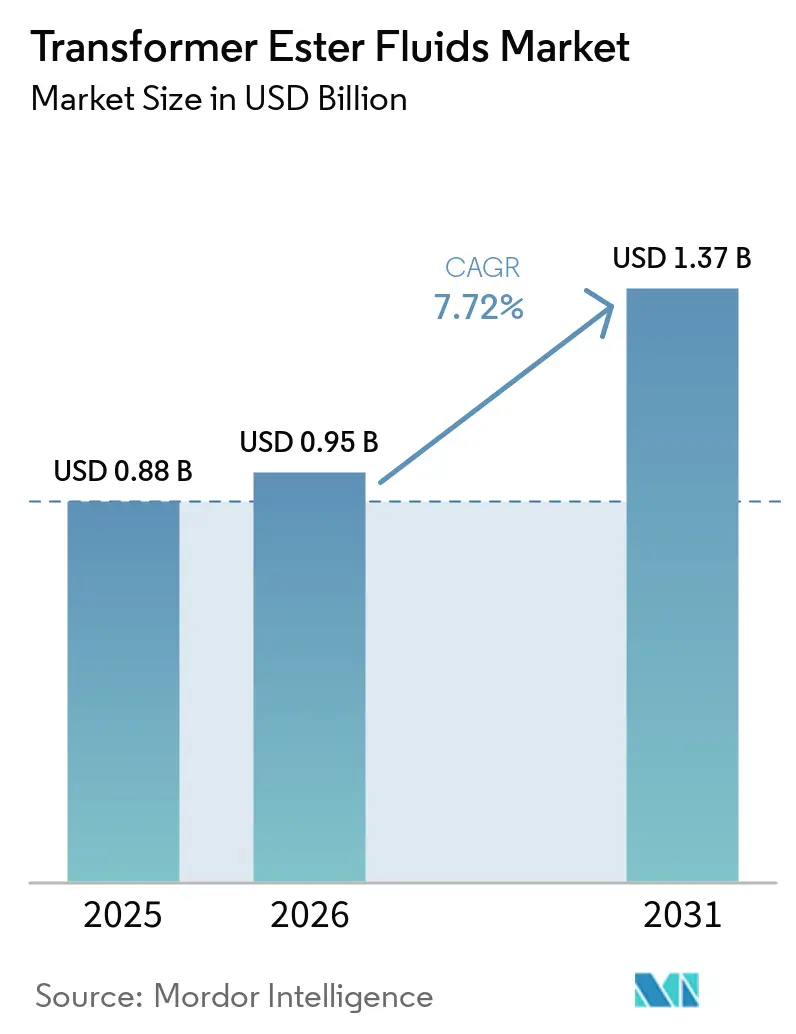
| Market Size (2026) | USD 0.95 Billion |
| Market Size (2031) | USD 1.37 Billion |
| Growth Rate (2026 - 2031) | 7.72 % |
| Fastest Growing Market | Asia-Pacific |
| Largest Market | Asia-Pacific |
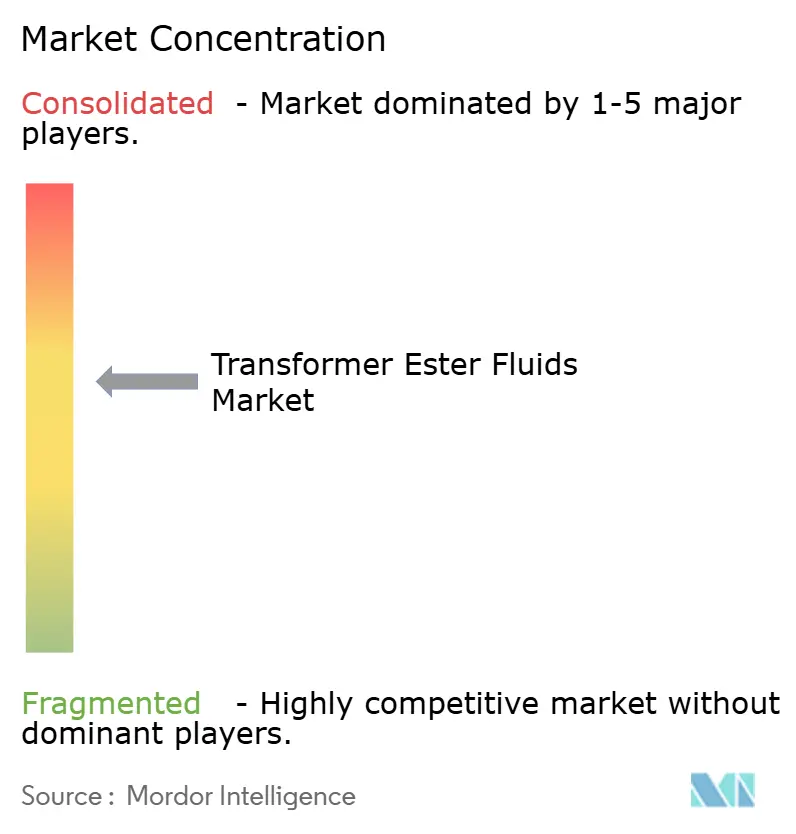
| Market Concentration | Medium |
Major Players *Disclaimer: Major Players sorted in no particular order Image © Mordor Intelligence. Reuse requires attribution under CC BY 4.0. | |
Transformer Ester Fluids Market Analysis by Mordor Intelligence
The Transformer Ester Fluids Market was valued at USD 0.88 billion in 2025 and is estimated to grow from USD 0.95 billion in 2026 to reach USD 1.37 billion by 2031, at a CAGR of 7.72% during the forecast period (2026–2031). Grid replacement programs, renewable power connections, and urban fire-safety requirements are increasing demand for transformer fluids with a high fire point and lower environmental risk. Utilities are also considering ester fluids during asset replacement because they can protect cellulose insulation and reduce the need for some fire-protection measures. The transformer ester fluids market is gaining support from transmission projects in China and India, where new capacity requires large volumes of insulating fluid. State Grid Corporation of China allocated USD 89 billion to grid investment in 2025, while India earmarked USD 109 billion for 1,274 gigavolt-amperes of transformation capacity through 2032. Price premiums, feedstock volatility, and lengthy qualification processes remain important constraints for the transformer ester fluids market.
Key Report Takeaways
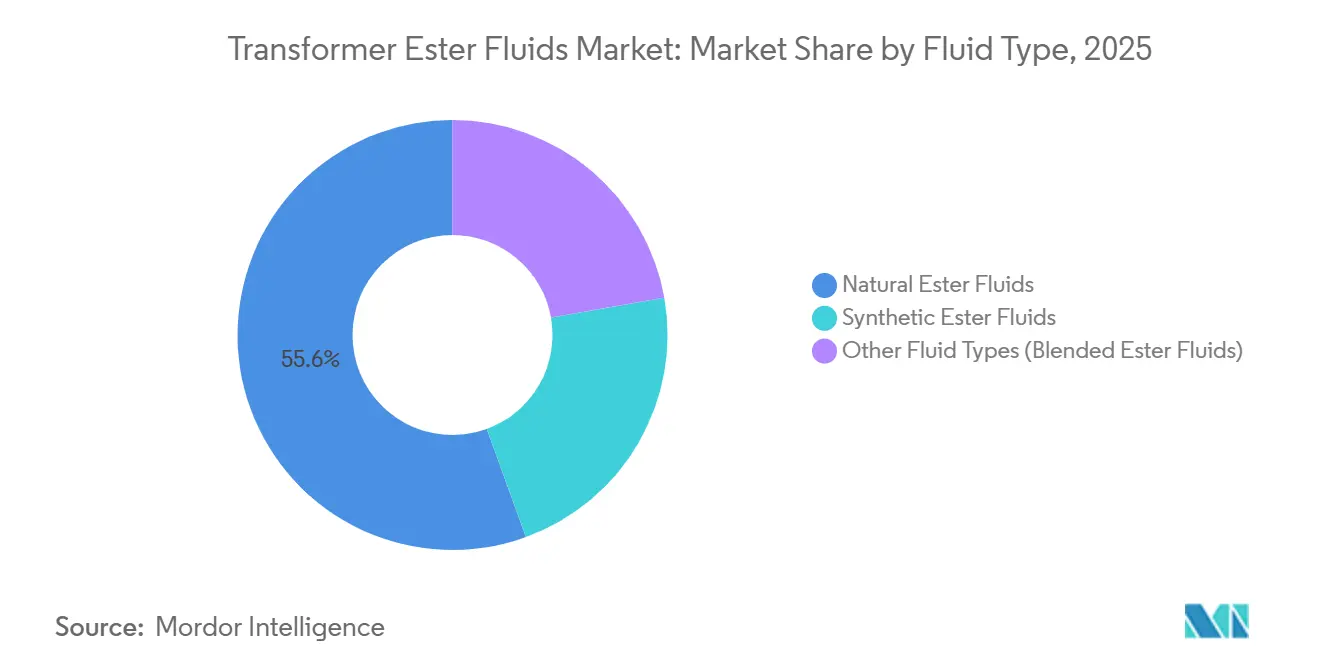
- By fluid type, natural ester fluids held 55.56% of the transformer ester fluids market share in 2025, while synthetic ester fluids are projected to advance at an 8.45% CAGR through 2031.
- By transformer type, distribution transformers held 53.12% of the transformer ester fluids market share in 2025, while power transformers are projected to advance at an 8.29% CAGR through 2031.
- By application, new transformer fill held 59.40% of the transformer ester fluids market share in 2025, while renewable energy transformers are projected to advance at an 8.72% CAGR through 2031.
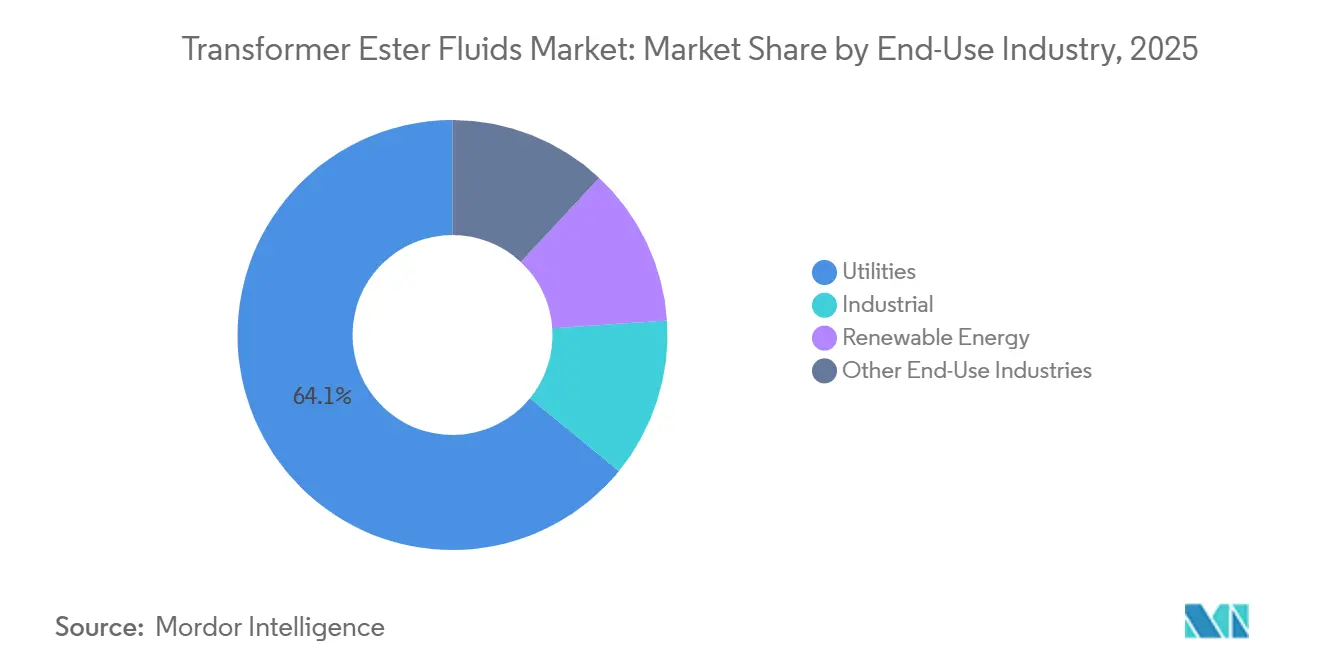
- By end-use industry, utilities held 64.11% of the transformer ester fluids market share in 2025, while renewable energy is projected to advance at a 9.02% CAGR through 2031.
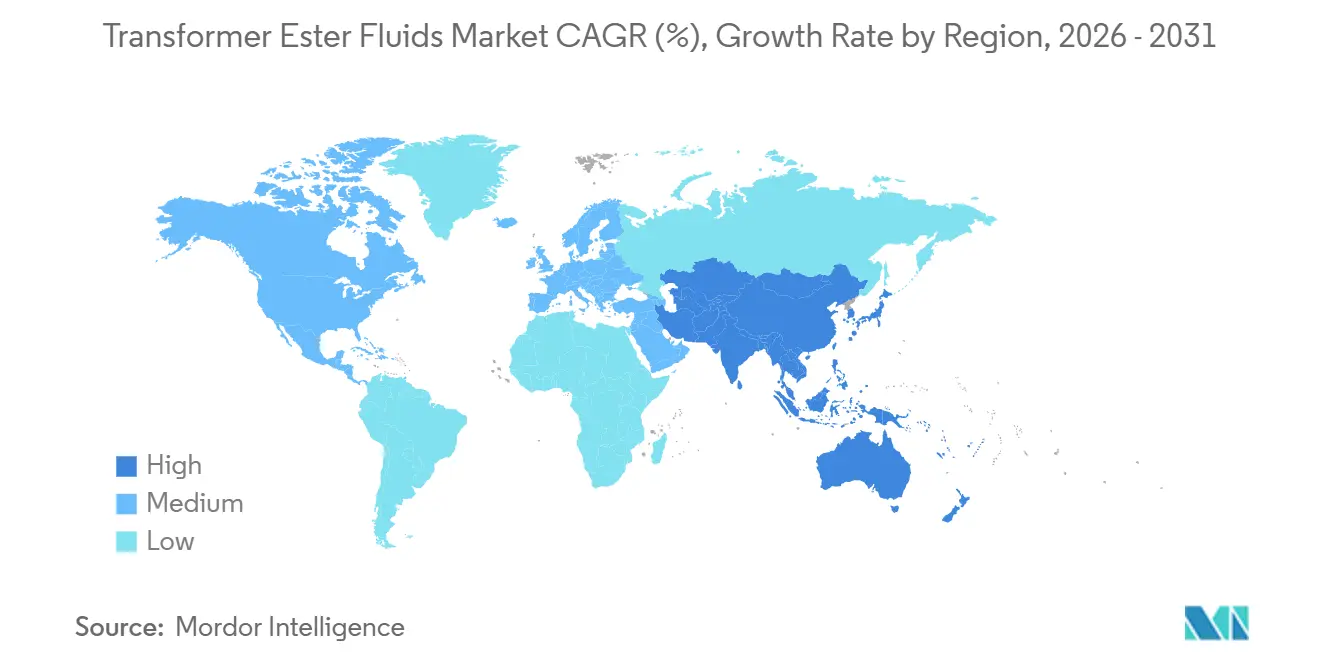
- By geography, Asia-Pacific held 46.05% of the transformer ester fluids market share in 2025 and is projected to advance at an 8.66% CAGR through 2031.
Note: Market size and forecast figures in this report are generated using Mordor Intelligence’s proprietary estimation framework, updated with the latest available data and insights as of January 2026.
Market Trends and Insights
Drivers Impact Analysis of Transformer Ester Fluids Market*
| Driver | (~) % Impact on CAGR Forecast | Geographic Relevance | Impact Timeline |
|---|---|---|---|
| Grid Modernization and Aging Transformer Replacement | +2.0% | Global; concentrated in Asia-Pacific and North America | Long term (≥ 4 years) |
| Renewable Energy and Battery Storage Integration | +1.7% | Global; strongest in Asia-Pacific and Europe | Medium term (2–4 years) |
| Fire-Safety Requirements for Urban and Environmentally Sensitive Sites | +1.4% | North America & EU; spillover to APAC urban centers | Medium term (2–4 years) |
| Retrofill Demand for Existing Mineral-Oil Transformers | +0.9% | North America & EU; APAC core | Medium term (2–4 years) |
| Transformer Procurement for Data Centers and Electrification Loads | +0.8% | North America, Asia-Pacific, Europe | Short term (≤ 2 years) |
| Circular and Regenerated Ester Fluid Adoption | +0.3% | Europe, North America | Long term (≥ 4 years) |
| Source: Mordor Intelligence | |||
Grid Modernization and Aging Transformer Replacement
Aging grid assets are raising replacement needs across Europe and North America, while utilities also need new equipment for renewable connections and electrification loads. Replacements give utilities an opportunity to specify ester fluids rather than mineral oil where fire and environmental requirements are stricter. Karnataka Power Transmission Corporation Limited retrofilled 3,754 aging transformers with ester oil in 2025, citing lower capital expenditure than full transformer replacement. Cargill, Incorporated’s FR3 fluid has accumulated more than 5 million installations over 30 years, showing that the technology has a substantial operating history. This installed base supports specifications that can extend insulation life and defer replacement costs within the transformer ester fluids market.
Renewable Energy and Battery Storage Integration
In renewable energy and battery storage integration, demand extends beyond wind and solar step-up transformers because battery energy storage system (BESS) projects require equipment with strong thermal stability and fire-resistant dielectric fluids. Westrafo reported in June 2026 that its use of Cargill, Incorporated’s FR3 natural ester fluid was 4 times greater than its use of mineral oil across its photovoltaic, BESS, and wind power projects. Offshore wind and cold-climate applications also create demand for synthetic esters, which have lower pour-point limitations than natural esters. A 2025 peer-reviewed study found viscosity-related constraints in natural ester-filled offshore wind transformers at low ambient temperatures. These performance differences widen the range of applications addressed by the transformer ester fluids market.
Fire-Safety Requirements for Urban and Environmentally Sensitive Sites
The International Electrotechnical Commission (IEC) 62770:2024 standard established requirements for unused natural esters used in transformers and similar electrical equipment[1]. This framework has supported tender specifications for biodegradable insulating fluids in locations where a mineral oil spill or transformer fire creates greater site risk. Natural ester fluids classified as K-class liquids can reduce setback distances and may remove the need for a 3-hour fire-rated concrete vault in relevant designs. Hitachi Energy Ltd successfully tested a 765 kilovolt (kV), 400 kV, 250 megavolt-ampere (MVA) natural ester-filled power transformer in May 2025. The test showed that the transformer ester fluids market can address voltage classes once served mainly by mineral oil.
Retrofill Demand for Existing Mineral-Oil Transformers
Retrofill projects allow utilities to improve fire safety and environmental performance without replacing the transformer itself. The International Council on Large Electric Systems, known as CIGRE, formed Joint Working Group A2/D1.72 to develop guidance on retrofilling mineral oil transformers with alternative fluids. A 2025 field study of a 630 kilovolt-ampere transformer retrofilled with synthetic ester monitored paper insulation using dissolved gas analysis and degree-of-polymerization measurements. The findings supported the ability of retrofilled units to achieve a remaining useful life comparable to factory-filled units. NYNAS AB’s NYTRO BIO 300X fluid was validated with Dutch distribution system operator Alliander and demonstrated 10% additional loadability after retrofill. This service pathway expands the addressable base for the transformer ester fluids market.
Restraints Impact Analysis of Transformer Ester Fluids Market*
| Restraint | (~) % Impact on CAGR Forecast | Geographic Relevance | Impact Timeline |
|---|---|---|---|
| Ester Price Premium Versus Mineral Oil | -1.8% | Global; highest sensitivity in APAC developing markets and South America | Medium term (2–4 years) |
| Vegetable-Oil Feedstock Price and Availability Volatility | -1.1% | Global; concentrated in soybean/rapeseed import-dependent markets | Short term (≤ 2 years) |
| Extended OEM and Utility Qualification Cycles | -0.8% | Global; most acute in North America and Europe | Long term (≥ 4 years) |
| Fluid Compatibility and Retrofit Execution Risk | -0.5% | Asia-Pacific core, North America | Medium term (2–4 years) |
| Source: Mordor Intelligence | |||
Ester Price Premium Versus Mineral Oil
Ester fluids carried a 60%-120% premium over mineral oil at procurement, which created affordability challenges for utilities with annual budgets and strict capital limits. This issue is most pronounced where procurement decisions prioritize initial equipment cost over lifecycle costs. The premium can be offset when projects avoid vault construction, reduce insurance exposure, lower spill-remediation risk, and extend insulation life. These benefits require utilities to evaluate the total cost of ownership rather than the purchase price alone. Wider use of lifecycle cost models could improve the commercial case for the transformer ester fluids market in sophisticated utility markets.
Vegetable-Oil Feedstock Price and Availability Volatility
Natural ester fluids use soybean, rapeseed, and high-oleic sunflower oil, so their production costs respond to agricultural supply conditions and food-market demand. A 2025 study identified lower oxidation stability in natural esters than in synthetic alternatives under high-temperature sealed-unit conditions. Antioxidant packages can address this technical limitation, but can add to formulation costs when feedstock prices rise. Synthetic ester producers face similar cost exposure through petrochemical raw materials and crude oil cycles. IEC 61203:2025 provides maintenance, reconditioning, and reclaiming guidance that can extend synthetic ester service life and lower fluid consumption over an asset cycle.
*Our forecasts treat driver/restraint impacts as directional, not additive. The impact forecasts reflect baseline growth, mix effects, and variable interactions.
Transformer Ester Fluids Market Segment Analysis
By Fluid Type:
Natural Ester Fluids Lead, While Synthetic Ester Fluids Gain Specialized ApplicationsNatural ester fluids held 55.56% of the transformer ester fluids market share in 2025. Their lead reflected lower relative cost, supply-chain maturity, and regulatory acceptance in distribution transformer applications. Natural ester fluids have a flash point above 300 °C, compared with 145 °C for mineral oil. They can reach 100% biodegradability within 28 days and can absorb 1,000 parts per million of moisture, compared with 50 parts per million for mineral oil. These characteristics are relevant in humid tropical locations and applications that prioritize cellulose insulation protection. Other Fluid Types include blended ester formulations that address specific performance and cost requirements at distribution voltage.
Synthetic ester fluids are projected to advance at an 8.45% CAGR through 2031, the fastest rate in this segmentation. Offshore wind turbines, high-voltage direct current converter transformers, and marine installations support the transformer ester fluids market size for synthetic fluids. These applications require strong low-temperature performance where natural ester viscosity can limit operating performance. The 2025 IOPscience study confirmed that low ambient temperatures can create viscosity-related constraints for natural ester-filled offshore wind transformers. IEC 61203:2025 gives utilities a lifecycle framework for selecting, testing, reconditioning, and reclaiming synthetic organic esters. The standard can make qualification processes more consistent for this part of the transformer ester fluids market.

By Transformer Type:
Distribution Transformers Lead While Power Transformers AccelerateDistribution transformers held 53.12% of the transformer ester fluids market share in 2025. Their position reflected long operating experience with ester fluids in medium-voltage urban networks. Fire-safety pressure is highest at this level because many distribution transformers are installed indoors or underground. Grid operators also replace or install large numbers of distribution units as they connect residential loads, commercial sites, electric vehicle charging, and distributed generation. This creates a recurring demand base for ester-filled equipment. Other transformer types include traction, instrument, specialty, and renewable energy transformers that add breadth to the transformer ester fluids market.
Power transformers are projected to advance at an 8.29% CAGR through 2031. Ultra-high-voltage corridors in China and India, along with generator step-up requirements at data centers, are supporting this expansion. Hitachi Energy Ltd’s May 2025 test of a 765 kV, 400 kV, 250 MVA natural ester-filled power transformer demonstrated that ester fluids can operate at high voltage. This test supported further specification activity for high-voltage transformer applications. The result also demonstrated a technical route for ester fluid use beyond distribution voltage.
By Application:
New Transformer Fill Leads While Renewable Energy Transformers Grow FastestNew transformer fill held 59.40% of the transformer ester fluids market share in 2025. Original equipment manufacturers increasingly specified ester fluid at the factory stage rather than as a field-applied option. Factory filling gives manufacturers closer control over fluid quality and can support warranty outcomes. It can also lower the risk of early-life insulation degradation associated with inconsistent field practices. Other applications include rail and traction, industrial units, and mobile substations. Rail electrification in Europe and Southeast Asia adds further demand for high-fire-point transformer fluids.
Renewable energy transformers are projected to advance at an 8.72% CAGR through 2031. Offshore and other environmentally sensitive projects favor ester fluid because mineral oil spills can create substantial environmental and reputational liability. Renewable developers also use ester fill to reduce fire-protection requirements and support permitting in coastal and agricultural areas. The retrofit and replacement gains support as older mineral-oil-filled units reach suitable retrofill windows. Fluid management, dissolved gas analysis, and condition-based retrofilling services are building a related service base for the transformer ester fluids market.
By End-Use Industry:
Utilities Lead While Renewable Energy AcceleratesUtilities held 64.11% of the transformer ester fluids market share in 2025. This concentration reflected their role as the main purchaser of distribution and power transformers. Utility procurement cycles are long and based on approved technical specifications. Once a utility qualifies a fluid, it can retain that fluid in its specification for many years. This supports durable demand relationships for Cargill, Incorporated, Shell plc, and APAR Industries Ltd. The Industrial segment also provides demand from mining operations, petrochemical plants, and heavy manufacturing sites that require fire-safe transformer fluids near hazardous process areas.
Renewable energy is projected to advance at a 9.02% CAGR through 2031. The transformer ester fluids market size for this end-use is supported by project needs for insurance management, fire safety, and environmental permitting. Developers select ester fluid for compliance and operational reasons, not only for sustainability objectives. Research published in Scientific Reports in 2025 found that natural ester oil enhanced with aluminum oxide nanoparticles showed improved breakdown strength and lower degradation than mineral oil. This research points to future product development that could improve ester-fluid performance. Data centers, railways, mining, commercial infrastructure, and other end-use industries also expand the transformer ester fluids market beyond utilities.
Geography Analysis
APAC Transformer Ester Fluids Market
Asia-Pacific held 46.05% of the transformer ester fluids market share in 2025 and is projected to advance at an 8.66% CAGR through 2031. China and India drive regional demand through investment in transformer fleets, rural electrification, and renewable energy connections. China’s State Grid Corporation allocated USD 89 billion to grid investment in 2025. India’s utility investment is also creating a larger base for high-voltage ester-fluid applications. Japan and South Korea remain more mature regional markets for synthetic esters in high-voltage applications.
Europe and North America Transformer Ester Fluids Market
Europe and North America are mature markets with evolving requirements for fire safety and environmental performance. European rules place more demanding hazard classifications on mineral oil than on readily biodegradable ester fluids, while Germany’s Störfall-Verordnung requires stronger fire-safety measures near residential areas. Cargill, Incorporated opened a USD 30 million FR3 natural ester dielectric fluid plant in Gouda, Netherlands, in March 2026. The facility tripled the company’s European production capacity. North America’s grid replacement requirements and infrastructure investment continue to support the transformer ester fluids market.
MEA and South America Transformer Ester Fluids Market
South America, and Middle-East and Africa remain earlier-stage markets, but major projects are establishing technical references. Hitachi Energy Ltd delivered South America’s first 460 kV natural ester-filled shunt reactor to the Bauru Substation in São Paulo in May 2026. The installation comprised 4 single-phase units rated at 66.67 megavolt-amperes reactive each. A 2025 Saudi Arabia study found that a natural ester-filled 1,000 kilovolt-ampere transformer could extend service life to 52 years, compared with 21.8 years for a mineral oil unit.
Competitive Landscape
The transformer ester fluids market is moderately concentrated, with the top five players including Cargill, Incorporated, Shell plc, NYNAS AB, APAR Industries Ltd., and Savita Oil Technologies Limited. APAR Industries Ltd., Savita Oil Technologies Limited, Hyrax Oil Sdn Bhd, and Jiangsu Gaoke Petrochemical Co., Ltd. compete through regional supply chains, product certifications, and lower logistics costs. This mix of multinational specialists and regional suppliers creates differentiated competition across product grades and geographies. Companies are expanding their portfolios and distribution coverage to participate in high-growth regions.
Shell plc launched the Shell MIDEL brand globally in April 2025, incorporating the MIDEL ester transformer fluid range acquired from M&I Materials Ltd in 2023[2]. Shell plc then launched Shell MIDEL transformer fluids in Indonesia in November 2025 for power and distribution transformers, renewable energy systems, railways, mining, and industrial applications. Savita Oil Technologies Limited commissioned Phase 2 of its synthetic ester manufacturing plant at Mahad, Maharashtra, in February 2026. The company became the only company globally to manufacture mineral oil, natural ester, and synthetic ester transformer fluids under one roof. Cargill, Incorporated’s Gouda facility expanded European supply capacity as grid, data center, renewable energy, and battery storage projects increased demand.
NYNAS AB’s NYTRO RR 900X re-refined transformer fluid was selected for Sweden’s first wooden substation at Karlshammar, which is planned for commissioning in late 2026. The fluid offers a reduction of more than 70% in greenhouse gas emissions compared with virgin transformer oil over the asset lifecycle. New IEC standards can lower qualification friction for synthetic ester suppliers. Mid-voltage industrial and electric vehicle charging infrastructure remains an opportunity where qualification costs have limited smaller entrants.
Transformer Ester Fluids Industry Leaders
-
Cargill, Incorporated
-
Shell plc
-
NYNAS AB
-
APAR Industries Ltd.
-
Savita Oil Technologies Limited
- *Disclaimer: Major Players sorted in no particular order
Transformer Ester Fluids Market Companies Covered in this Report
- Aevitas Inc.
- APAR Industries Ltd.
- Cargill, Incorporated
- DONGNAM Petroleum Ind. Co. Ltd.
- Eden Transformer Oil Ltd
- Hyrax Oil Sdn Bhd
- Jiangsu Gaoke Petrochemical Co., Ltd.
- M&I Materials Ltd
- NYNAS AB
- Repsol
- Savita Oil Technologies Limited
- Shell plc
- Sinopec
Recent Industry Developments in Transformer Ester Fluids Market
- March 2026: Cargill, Incorporated invested USD 30 million to open a new FR3 natural ester dielectric fluid plant in Gouda, Netherlands, tripling its European production capacity. The facility meets growing demand from regional power grid expansions, renewable energy integration, battery energy storage systems, and digital data center infrastructure.
- February 2026: Savita Oil Technologies Limited commissioned Phase 2 of its synthetic ester fluid manufacturing plant at Mahad, Maharashtra, India. The products are manufactured under the Transol brand and are known for their high thermal stability and dielectric properties.
Global Transformer Ester Fluids Market Report Scope
Transformer ester fluids are insulating liquids used in transformers to provide electrical insulation and dissipate heat generated during operation. They offer high fire points, good biodegradability, and suitable dielectric performance, making them increasingly relevant for transformers installed in urban, industrial, and renewable energy environments.
The Transformer Ester Fluids Market is segmented by fluid type, transformer type, application, end-use industry, and geography. By fluid type, the market is segmented into natural ester fluids, synthetic ester fluids, and other fluid types (including blended ester fluids). By transformer type, the market is segmented into distribution transformers, power transformers, and other transformer types (including traction transformers, instrument transformers, and specialty and renewable energy transformers). By application, the market is segmented into new transformer fill, retrofit and replacement, renewable energy transformers, and other applications (including rail and traction and industrial and mobile substations). By end-use industry, the market is segmented into utilities, industrial, renewable energy, and other end-use industries (including commercial and infrastructure, railways, data centers, and mining). The report also covers the market size and forecasts for transformer ester fluids in 15 countries across major regions. For each segment, the market sizing and forecasts have been done on the basis of value (USD).
Segmentation Overview
| Natural Ester Fluids |
| Synthetic Ester Fluids |
| Other Fluid Types (Blended Ester Fluids) |
| Distribution Transformers |
| Power Transformers |
| Other Transformer Types (Traction Transformers, Instrument Transformers, Specialty and Renewable Energy Transformers) |
| New Transformer Fill |
| Retrofit and Replacement |
| Renewable Energy Transformers |
| Other Applications (Rail and Traction, Industrial and Mobile Substations) |
| Utilities |
| Industrial |
| Renewable Energy |
| Other End-Use Industries (Commercial and Infrastructure, Railways, Data Centers, Mining) |
| Asia-Pacific | China |
| India | |
| Japan | |
| South Korea | |
| ASEAN Countries | |
| Rest of Asia-Pacific | |
| North America | United States |
| Canada | |
| Mexico | |
| Europe | Germany |
| United Kingdom | |
| France | |
| Italy | |
| NORDIC Countries | |
| Rest of Europe | |
| South America | Brazil |
| Argentina | |
| Rest of South America | |
| Middle-East and Africa | Saudi Arabia |
| South Africa | |
| Rest of Middle-East and Africa |
| By Fluid Type | Natural Ester Fluids | |
| Synthetic Ester Fluids | ||
| Other Fluid Types (Blended Ester Fluids) | ||
| By Transformer Type | Distribution Transformers | |
| Power Transformers | ||
| Other Transformer Types (Traction Transformers, Instrument Transformers, Specialty and Renewable Energy Transformers) | ||
| By Application | New Transformer Fill | |
| Retrofit and Replacement | ||
| Renewable Energy Transformers | ||
| Other Applications (Rail and Traction, Industrial and Mobile Substations) | ||
| By End-Use Industry | Utilities | |
| Industrial | ||
| Renewable Energy | ||
| Other End-Use Industries (Commercial and Infrastructure, Railways, Data Centers, Mining) | ||
| By Geography | Asia-Pacific | China |
| India | ||
| Japan | ||
| South Korea | ||
| ASEAN Countries | ||
| Rest of Asia-Pacific | ||
| North America | United States | |
| Canada | ||
| Mexico | ||
| Europe | Germany | |
| United Kingdom | ||
| France | ||
| Italy | ||
| NORDIC Countries | ||
| Rest of Europe | ||
| South America | Brazil | |
| Argentina | ||
| Rest of South America | ||
| Middle-East and Africa | Saudi Arabia | |
| South Africa | ||
| Rest of Middle-East and Africa | ||
Key Questions Answered in the Report
What is the size of the transformer ester fluids market?
The transformer ester fluids market stands at USD 0.95 billion in 2026 and is projected to reach USD 1.37 billion by 2031.
What is driving demand for transformer ester fluids?
Grid modernization, renewable energy and battery storage projects, urban fire-safety requirements, and retrofilling of aging transformers support demand.
Which fluid type led the market demand in 2025?
Natural ester fluids held a 55.56% share in 2025.
Which transformer type is expected to grow fastest through 2031?
Power transformers are projected to advance at an 8.29% CAGR through 2031 as high-voltage grid corridors and large power applications expand.