
Trade Show Marketing Services Market Size and Share
Market Overview
| Study Period | 2020 - 2031 |
|---|---|
| Market Size (2026) | USD 43.08 Billion |
| Market Size (2031) | USD 96.40 Billion |
| Growth Rate (2026 - 2031) | 17.48 % |
| Fastest Growing Market | Asia-Pacific |
| Largest Market | North America |
| Market Concentration | Medium |
Major Players *Disclaimer: Major Players sorted in no particular order Image © Mordor Intelligence. Reuse requires attribution under CC BY 4.0. | |
Trade Show Marketing Services Market Analysis by Mordor Intelligence
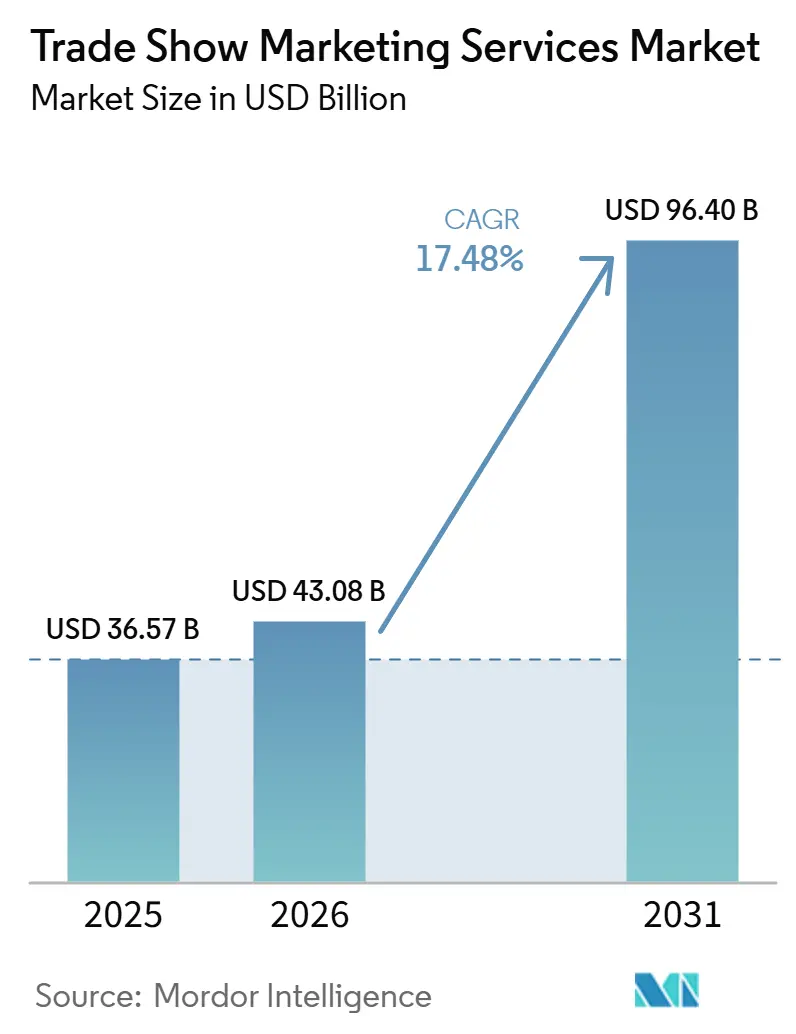
The trade show marketing services market size is projected to expand from USD 36.57 billion in 2025 and USD 43.08 billion in 2026 to USD 96.40 billion by 2031, registering a CAGR of 17.48% between 2026 to 2031. The trade show marketing services market is benefiting from exhibitors treating face-to-face events as a core part of revenue generation, especially where several decision-makers need to evaluate complex products together. B2B exhibiting accounted for 40.8% of exhibitor marketing budgets in 2026, while exhibition Net Promoter Scores improved to 35 from -6 in 2021. The trade show marketing services market is also shifting toward connected programs that link pre-show outreach, on-site engagement, and post-show follow-up. Service providers are responding through broader technology, design, measurement, and campaign capabilities. Cost pressure, tighter return-on-investment review, and data privacy obligations are separating exhibitors that can expand high-value programs from those that must reduce event portfolios.
Key Report Takeaways
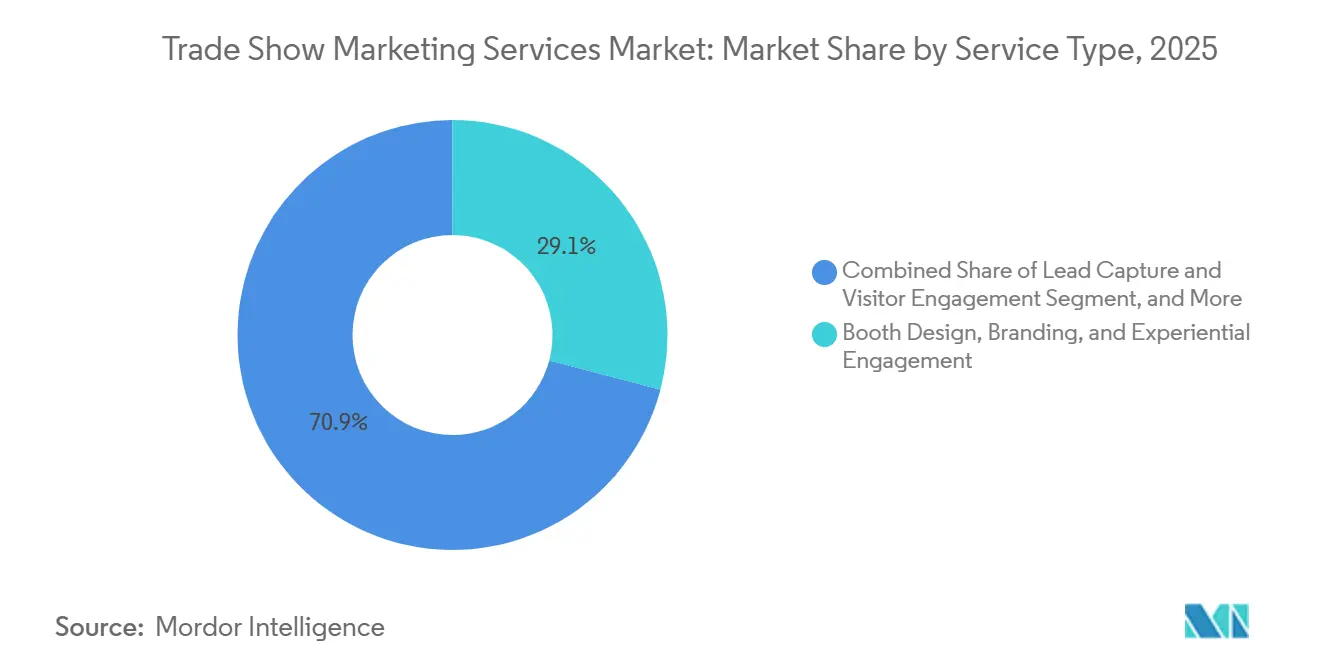
- By service type, Booth Design, Branding, and Experiential Engagement held 29.10% of the trade show marketing services market share in 2025, while Lead Capture and Visitor Engagement are projected to expand at an 18.63% CAGR through 2031.
- By enterprise size, Large Enterprises held 66.34% of the trade show marketing services market share in 2025, while Small and Medium-Sized Enterprises are projected to expand at a 19.10% CAGR through 2031.
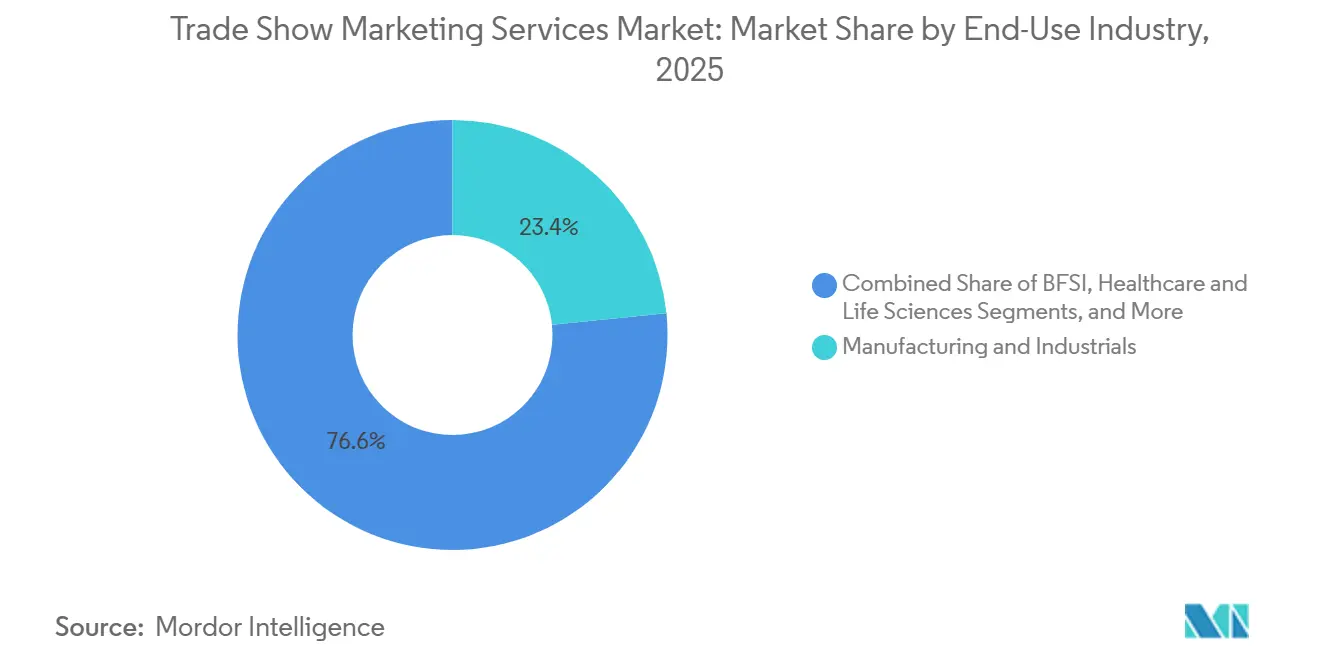
- By end-use industry, Manufacturing and Industrials held 23.38% revenue share in 2025, while Healthcare and Life Sciences are projected to expand at a 19.37% CAGR through 2031.
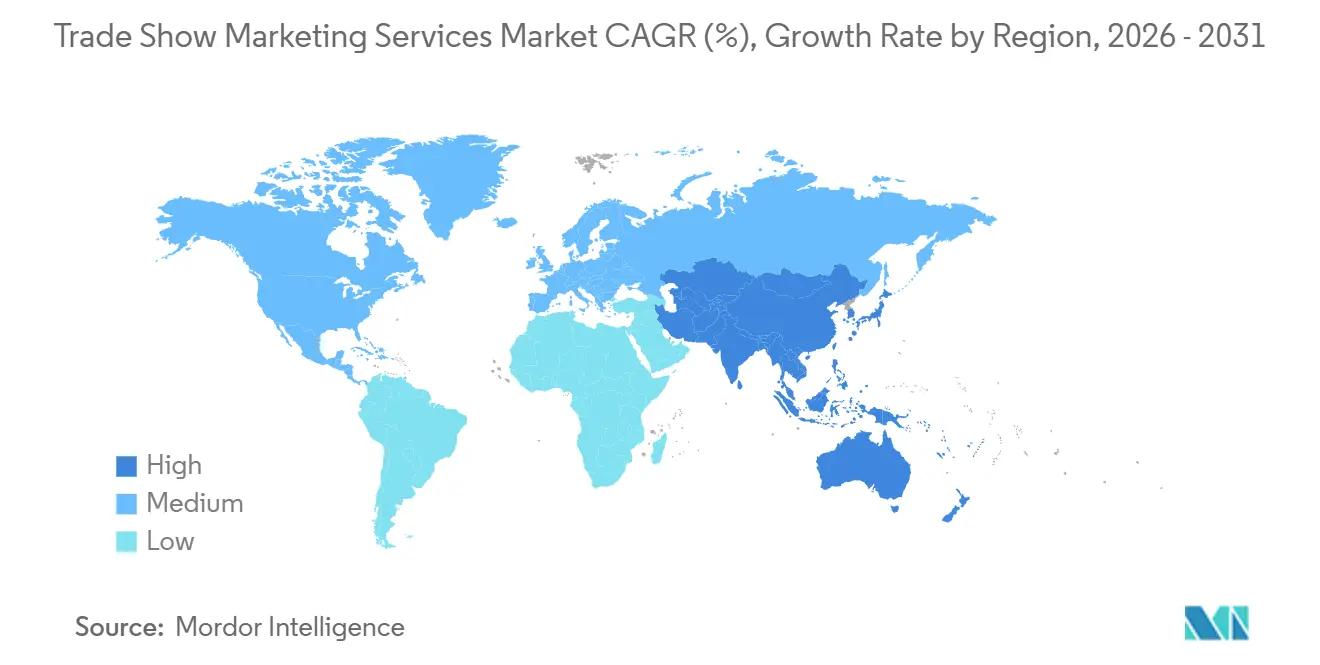
- By Geography, North America held 37.21% revenue share in 2025, while Asia-Pacific is projected to expand at a 18.92% CAGR through 2031.
Note: Market size and forecast figures in this report are generated using Mordor Intelligence’s proprietary estimation framework, updated with the latest available data and insights as of January 2026.
Market Trends and Insights
Drivers Impact Analysis of Trade Show Marketing Services Market*
| Driver | (~) % Impact on CAGR Forecast | Geographic Relevance | Impact Timeline |
|---|---|---|---|
| Rising Exhibitor Dependence on Qualified Lead Generation | +4.5% | Global, particularly North America and Europe | Short term (≤ 2 years) |
| AI-Enabled Measurement, Attribution, and Audience Personalization | +3% | North America and Europe, early gains in Asia-Pacific | Medium term (2-4 years) |
| Demand for Immersive Booth Design and Experiential Engagement | +2.8% | Global, with the highest density in North America and Asia-Pacific | Short term (≤ 2 years) |
| Integrated Pre-Show, On-Site, and Post-Show Campaigns | +2.5% | Global, strongest in large-budget exhibitor programs | Medium term (2-4 years) |
| Sponsorship Inventory Monetization | +1.8% | North America and Europe, with spillover to the Middle East | Medium term (2-4 years) |
| Preference for Appointment-Led Floor Engagement | +1.4% | Global, particularly B2B-intensive sectors | Short term (≤ 2 years) |
| Source: Mordor Intelligence | |||
Rising Exhibitor Dependence on Trade Shows for Qualified Lead Generation
The trade show marketing services market is supported by the growing role of exhibitions in complex B2B sales programs. CEIR reported that exhibitors are expected to allocate a significant share of their annual marketing budgets to B2B exhibiting, making it the leading channel ahead of individual digital formats. Larger buying groups give exhibitors a setting where multiple stakeholders can meet product specialists and compare offerings at the same time. This format can reduce the coordination required to engage distributed purchasing teams through separate digital interactions. Three-quarters of exhibitors integrate digital channels with exhibitions, which places the show floor within a longer customer engagement process.[1]Center for Exhibition Industry Research, “Trade Shows Remain Top Marketing Investment,” PCMA, pcma.org That integration raises demand for providers that can coordinate outreach, event execution, and follow-up activities in one program.
AI-Enabled Measurement, Attribution, and Audience Personalization
clearer evidence of event performance. RFID-integrated sensors, lead-scoring tools, and real-time analytics help teams adjust booth content, staffing, and conversation prompts while an event is underway. Freeman launched its Blue Echo AI-powered 3D venue visualization platform in March 2026 across 20 major U.S. convention centers, including McCormick Place and the Las Vegas Convention Center. The platform allows teams to examine venue layouts before arriving on site and shorten design approval cycles. Freeman also introduced an AI-powered sponsorship marketplace with Clarity Media Partners in December 2025 to automate inventory setup and performance reporting. These capabilities support more detailed reporting on leads and post-show opportunities.
Growing Demand for Immersive Booth Design and Experiential Engagement
The trade show marketing services market continues to rely on booth environments that help exhibitors demonstrate products and hold visitor attention. Interactive demonstrations, custom sound, gamification, and AR or VR applications are being used alongside conventional displays to encourage longer and more focused engagement. Pharmapack Europe 2026 reported that exhibitors using digital lead-capture systems generated 258% more unique leads per exhibitor than traditional methods. HANNOVER MESSE 2026 brought together 3,000 exhibiting companies from more than 50 countries and attracted senior industry and political participants.[2]Deutsche Messe AG, “HANNOVER MESSE 2026: Industrial AI as Competitive Game-Changer,” Deutsche Messe, messe.de Such events increase the value of booths that can support product demonstrations and executive-level meetings. This demand helps explain the continuing scale of design and experiential services within the trade show marketing services market.
Expansion of Integrated Pre-Show, On-Site, and Post-Show Campaigns
The trade show marketing services market is moving beyond services that begin only when a booth is installed. Three-quarters of exhibitors connect digital channels to their physical exhibition presence, according to CEIR. Programs now include pre-show invitations, audience acquisition, on-site social activity, and post-show customer relationship management follow-up. High-budget exhibitors can increase campaign spending even when they keep booth footprints stable. Freeman acquired London-based Tag Digital in March 2025 to combine digital event marketing capabilities with its mdg agency. Providers that connect these stages can reduce the coordination work required from exhibitor marketing teams.
Restraints Impact Analysis of Trade Show Marketing Services Market*
| Restraint | (~) % Impact on CAGR Forecast | Geographic Relevance | Impact Timeline |
|---|---|---|---|
| Escalating Show Services, Labor, Freight, and Material Handling Costs | -3.5% | North America core, with spillover to Europe and Asia-Pacific | Short term (≤ 2 years) |
| Heightened ROI Scrutiny and Event Portfolio Rationalization | -2.5% | Global, highest in private equity-backed and cost-managed organizations | Medium term (2-4 years) |
| Lead Capture Privacy Compliance Complexity | -1.5% | Europe, North America, and Brazil | Medium term (2-4 years) |
| Visa Delays and Cross-Border Participation Friction | -0.7% | Asia-Pacific, Middle East, and South America | Short term (≤ 2 years) |
| Source: Mordor Intelligence | |||
Escalating Show Services, Labor, Freight, and Material Handling Costs
Rising delivery, installation, labor, and material handling expenses can limit the amount exhibitors spend on the trade show marketing services market. Higher cost exposure encourages companies to review freight, storage, electrical work, and sponsorship commitments before approving event budgets. It also increases interest in modular displays that can be reused across several events. Providers with logistics planning and reusable exhibit systems can help clients lower on-site labor requirements and reduce material handling exposure. The cost issue is most visible in North America, but it can influence exhibitor decisions across international show portfolios. It may shift demand toward services that show a direct link to lead quality, visitor engagement, or sales follow-up.
Heightened ROI Scrutiny and Event Portfolio Rationalization
The trade show marketing services market faces a more structured evaluation of whether individual events create sufficient commercial value. Management teams increasingly examine lead volume and post-show closed deals when reviewing exhibition investment. This approach favors providers that can connect booth activity with lead records and downstream sales reporting. It can also lead exhibitors to focus spending on fewer events that have stronger audiences or clearer strategic relevance. Large established exhibitions may benefit when budgets move away from less proven events. For service providers, reporting tools can strengthen client retention when they turn an event program into a documented revenue discussion.
*Our forecasts treat driver/restraint impacts as directional, not additive. The impact forecasts reflect baseline growth, mix effects, and variable interactions.
Trade Show Marketing Services Market Segment Analysis
By Service Type:
Experiential Design Anchors Revenue While Tech-Led Capture AcceleratesBooth Design, Branding, and Experiential Engagement accounted for 29.10% of the trade show marketing services market size in 2025. The segment reflects sustained exhibitor spending on physical spaces that support product demonstration and longer visitor conversations. Its role extends beyond visual presentation because booth layout can influence how visitors move, meet staff, and evaluate products. Strategy and Planning Services, Pre-Show Promotion, and Attendee Outreach occupy important positions around the design assignment. These services are increasingly sold with design work when exhibitors want a coordinated campaign rather than a stand-alone booth. Sales Enablement and Product Demonstration provide on-floor support for product specialists and customer discussions. Event Staffing and On-Site Promotional Services support execution during periods of high visitor traffic. These execution services can benefit from event volume, even where their margin profile differs from design-intensive work.
Lead Capture and Visitor Engagement is projected to grow at a CAGR of 18.63% through 2031. The segment is supported by AI-assisted qualification and the need to manage consent records during visitor interactions. GDPR, CPRA, and LGPD requirements make auditable lead-capture processes important for exhibitors operating across jurisdictions. Digital platforms can record visitor permissions while routing potential customers to appropriate follow-up teams. Pharmapack Europe reported a substantial increase in unique leads per exhibitor for users of digital lead-capture systems compared with traditional methods. This result supports the case for replacing manual processes where lead volume and compliance needs are high. The trade show marketing services industry is therefore placing greater value on technology that can support both engagement and recordkeeping. International exhibitors may regard compliant capture capability as a requirement for participation rather than an optional feature.



By Enterprise Size:
Large Enterprises Dominate While SMEs Drive Incremental ExpansionLarge Enterprises held 66.34% of total sector revenue in 2025. These customers often maintain year-round event calendars and use major exhibitions for supply chain, customer, and investor engagement. Their programs can require premium exhibits, hospitality, portfolio management, and measurement tools across many events. HANNOVER MESSE 2026 attracted record participation from board members of DAX-listed companies, which illustrates the executive role of major industrial shows. Large companies can use these events to bring senior stakeholders into a shared setting. Their buying requirements also favor providers with a broad geographic footprint and consistent delivery standards. Enterprise clients create demand for technology that can combine performance information from several shows. This makes large accounts important to the high-value revenue mix of the trade show marketing services market.
Small and Medium-Sized Enterprises are projected to grow at a CAGR of 19.10% through 2031. Modular exhibit systems and AI planning tools can reduce the cost and complexity of joining targeted events. These companies often value smaller formats where meetings can be scheduled around focused buyer groups. Skyline Exhibits expanded its Amplify modular system in June 2026 with new wall heights, enclosed spaces, and ExhibitNow Kits for 10x10 to 20x20 booth footprints. The kits have a 7-day ship commitment and address exhibitors seeking scalable, logistics-efficient solutions. Accessible configurations can allow smaller exhibitors to build a more consistent event presence. Providers can serve this group through clear pricing, reusable components, and planning support. These needs are helping broaden participation in the trade show marketing services market.
By End-Use Industry:
Manufacturing Anchors Share While Life Sciences Drives GrowthManufacturing and Industrials held 23.38% of total sector revenue in 2025. Industrial trade fairs bring together equipment suppliers, technology companies, buyers, and public-sector stakeholders. HANNOVER MESSE 2026 included 3,000 exhibiting companies from more than 50 countries. Applied industrial AI, robotics, and energy infrastructure were central topics at the event. These themes can increase the need for product demonstrations that make technical offerings easier to assess. Retail and e-commerce, IT and telecommunications, and BFSI also use trade events to support customer acquisition and relationship development. Technology exhibitors in particular often connect digital activity with physical demonstrations and meetings. Manufacturing, therefore, remains a central source of demand for the trade show marketing services industry.
Healthcare and Life Sciences is projected to grow at a CAGR of 19.37% through 2031. The segment serves regulated companies that need precise product communication and controlled customer engagement. CPHI Frankfurt 2025 attracted more than 62,000 visitors and more than 2,400 exhibitors from 166 countries. CPHI Milan in October 2026 expects 2,990 exhibiting companies. Pharmapack Europe 2026 reported its highest attendance and announced a Pharmapack Asia event in Singapore. Healthcare exhibitors must account for FDA and European Medicines Agency promotional material rules, as well as country-specific anti-bribery requirements. These obligations add a specialized service layer that generalist providers may not be equipped to deliver. The trade show marketing services market can benefit where providers combine event expertise with the governance needs of life sciences clients.
Geography Analysis
North America Trade Show Marketing Services Market
North America held 37.21% of the trade show marketing services market size in 2025. The region has a high concentration of large corporate exhibitors and a broad agency network. Major venues include McCormick Place in Chicago, the Las Vegas Convention Center, and the Javits Center in New York. CEIR confirmed that exhibitions remained the highest-ranked marketing investment channel among the North American exhibitors included in its 2026 research. The region also faces wide variation in the cost of exhibiting across cities. This encourages exhibitors to review location, freight, labor, and event portfolio choices. Providers with national infrastructure can support customers who shift programs between established and lower-cost event locations.
Europe Trade Show Marketing Services Market
Europe holds the second-largest regional position in the trade show marketing services market. Germany, the United Kingdom, France, and Italy support a mature calendar of industrial, technology, pharmaceutical, and consumer events.[3]Hannover Messe, “HANNOVER MESSE 2026: How Industry Masters Change,” Hannover Messe, hannovermesse.de 2026 reinforced Germany's role in industrial exhibitions through its focus on industrial AI, robotics, and energy infrastructure. European clients also face GDPR requirements when collecting and using attendee information. This increases demand for lead-capture systems that document consent and support controlled follow-up. The region remains important for providers that can combine physical event delivery with digital campaign services.
APAC, MEA and South America Trade Show Marketing Services Market
Asia-Pacific is projected to grow at a CAGR of 18.92% through 2031. China's manufacturing base, India's pharmaceutical and automotive export activity, and venue development in Southeast Asia support demand for event services. The Canton Fair in Guangzhou draws more than 200,000 attendees from 215 countries annually. Singapore, South Korea, and Australia are emerging hubs for pharmaceutical, technology, and food-sector events. Hannover Messe's Industrial Transformation ASIA-PACIFIC series extends European industrial event formats into the region. South America, the Middle East, and Africa are smaller but expanding areas of the trade show marketing services market. Brazil was the official partner country for HANNOVER MESSE 2026. Saudi International Pharma Expo 2026 in Riyadh indicates growing demand for specialized events in the Middle East. POPIA is also increasing attention to lead-capture governance at African events.

Competitive Landscape
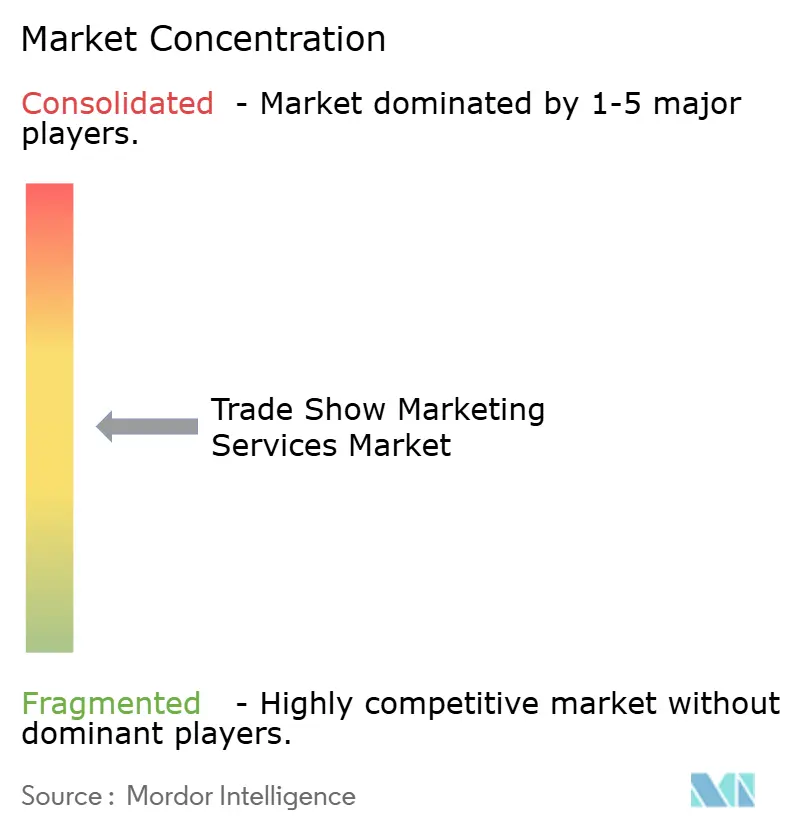
The trade show marketing services market is moderately concentrated at the high end, while regional and specialist firms remain fragmented. The Freeman Company, Global Experience Specialists, Nth Degree, and Pico Group compete across full-service exhibit, event, and experiential assignments. Consolidation was a defining feature of 2025 and 2026. Impact XM and Jack Morton Worldwide announced their merger in January 2026 to create a global experiential agency with more than 1,000 employees across 20 offices. The combined business targets enterprise clients that need integrated exhibit, event, and brand experience management. Nth Degree acquired INVNT in April 2026 with Shamrock Capital backing, while its trade show and general contracting division continued separately. GES became privately held after its acquisition by Truelink Capital in late 2024. These transactions expand the reach of larger platforms in the trade show marketing services market.
The Freeman Company relaunched as TFC in February 2026 and brought 9 live-experience brands under one parent company. The portfolio includes 3D Exhibits, Sparks, mdg, and Studio Blue. The move gives clients access to several live-experience services under a single commercial relationship. Freeman's Blue Echo platform is another example of a strategic move that uses technology to improve pre-show planning. Technology differentiation is becoming more important as basic exhibit construction becomes easier to compare across suppliers. Firms are developing capabilities in AI-assisted design, behavioral analytics, and multichannel attribution.
ISO 20121 certification and GDPR-aligned data governance are increasingly relevant in procurement decisions. These requirements can favor established providers that have the resources to build certification and compliance processes. Smaller providers can still compete through local relationships, specialist production skills, or focused service models. Private equity activity is placing greater attention on proprietary technology, geographic reach, and enterprise customer retention. No combined market share for the leading companies is available in the supplied information. The trade show marketing services market, therefore, remains characterized by a concentrated group of large full-service firms alongside a broad group of regional specialists.
Trade Show Marketing Services Industry Leaders
The Freeman Company
Global Experience Specialists
Nth Degree
Czarnowski Collective
Pico Group
- *Disclaimer: Major Players sorted in no particular order
Trade Show Marketing Services Market Companies Covered in this Report
- The Freeman Company
- Global Experience Specialists
- Nth Degree
- Czarnowski Collective
- Pico Group
- George P. Johnson Experience Marketing
- Derse
- Hargrove
- Impact XM
- MCI Group
- Jack Morton Worldwide
- Skyline Exhibits
- Hamilton
- Condit Exhibits
- Classic Exhibits
- ProExhibits
- Exhibit Options
- Exponents
- Metro Exhibits
- Local Exhibits

Recent Industry Developments in Trade Show Marketing Services Market
- June 2026: Skyline Exhibits launched an expansion of its Amplify modular display system, adding 8-foot and 12-foot wall heights, closets, conference rooms, and pre-configured ExhibitNow Kits for 10x10 to 20x20 booth footprints with a 7-day ship commitment. The update explicitly targets SME exhibitors seeking scalable, logistics-efficient solutions and marks a deliberate segment expansion strategy for one of the leading modular-system manufacturers.
- April 2026: Nth Degree, backed by Shamrock Capital, acquired INVNT, a global brand storytelling agency. The combined entity operates under the INVNT banner for corporate events while Nth Degree's core trade show and general contracting division continues separately, positioning the parent as a diversified live events platform.
- April 2026: HANNOVER MESSE 2026, held April 20-24, drew 3,000 exhibiting companies from more than 50 countries under the "Think Tech Forward" theme, with applied industrial AI, robotics, and energy infrastructure as core topics. Record DAX board-member participation reinforced the show's dual role as both a trade floor and executive strategy forum.
- March 2026: Freeman launched Freeman Blue Echo, an AI-powered 3D venue visualization platform covering 20 major U.S. convention centers, including McCormick Place and the Las Vegas Convention Center. The platform converts physical venue data into photorealistic, navigable 3D environments for pre-show planning, reducing design iteration cycles and enabling spatial risk identification before crews arrive on site.


Global Trade Show Marketing Services Market Report Scope
Trade Show Marketing Services Market refers to the ecosystem of services that help companies plan, promote, and execute their presence at trade shows, exhibitions, and industry events. It includes booth design, event strategy, lead generation, attendee engagement, branding, staffing, logistics, and follow-up support.
The Trade Show Marketing Services Market Report is Segmented by Service Type (Strategy and Planning Services, Booth Design, Branding, and Experiential Engagement, Pre-Show Promotion and Attendee Outreach, Lead Capture and Visitor Engagement, Sales Enablement and Product Demonstration, and Event Staffing and On-Site Promotional Services), Enterprise Size (Large Enterprises and Small and Medium-Sized Enterprises), End-Use Industry (Retail and E-commerce, IT and Telecommunications, BFSI, Healthcare and Life Sciences, Media and Entertainment, Travel and Hospitality, and Manufacturing and Industrials), and Geography (North America, South America, Europe, Asia-Pacific, Middle East, and Africa). The Market Forecasts are Provided in Terms of Value (USD).
| Strategy and Planning Services |
| Booth Design, Branding, and Experiential Engagement |
| Pre-Show Promotion and Attendee Outreach |
| Lead Capture and Visitor Engagement |
| Sales Enablement and Product Demonstration |
| Event Staffing and On-Site Promotional Services |
| Other Service Types |
| Large Enterprises |
| Small and Medium-Sized Enterprises |
| Retail and E-commerce |
| IT and Telecommunications |
| BFSI |
| Healthcare and Life Sciences |
| Media and Entertainment |
| Travel and Hospitality |
| Manufacturing and Industrials |
| Other End-Use Industries |
| North America | United States |
| Canada | |
| Mexico | |
| South America | Brazil |
| Argentina | |
| Chile | |
| Rest of South America | |
| Europe | Germany |
| United Kingdom | |
| France | |
| Italy | |
| Spain | |
| Rest of Europe | |
| Asia-Pacific | China |
| Japan | |
| India | |
| South Korea | |
| Australia | |
| Rest of Asia-Pacific | |
| Middle East | United Arab Emirates |
| Saudi Arabia | |
| Qatar | |
| Rest of Middle East | |
| Africa | South Africa |
| Egypt | |
| Nigeria | |
| Rest of Africa |
| By Service Type | Strategy and Planning Services | |
| Booth Design, Branding, and Experiential Engagement | ||
| Pre-Show Promotion and Attendee Outreach | ||
| Lead Capture and Visitor Engagement | ||
| Sales Enablement and Product Demonstration | ||
| Event Staffing and On-Site Promotional Services | ||
| Other Service Types | ||
| By Enterprise Size | Large Enterprises | |
| Small and Medium-Sized Enterprises | ||
| By End-Use Industry | Retail and E-commerce | |
| IT and Telecommunications | ||
| BFSI | ||
| Healthcare and Life Sciences | ||
| Media and Entertainment | ||
| Travel and Hospitality | ||
| Manufacturing and Industrials | ||
| Other End-Use Industries | ||
| By Geography | North America | United States |
| Canada | ||
| Mexico | ||
| South America | Brazil | |
| Argentina | ||
| Chile | ||
| Rest of South America | ||
| Europe | Germany | |
| United Kingdom | ||
| France | ||
| Italy | ||
| Spain | ||
| Rest of Europe | ||
| Asia-Pacific | China | |
| Japan | ||
| India | ||
| South Korea | ||
| Australia | ||
| Rest of Asia-Pacific | ||
| Middle East | United Arab Emirates | |
| Saudi Arabia | ||
| Qatar | ||
| Rest of Middle East | ||
| Africa | South Africa | |
| Egypt | ||
| Nigeria | ||
| Rest of Africa | ||


Key Questions Answered in the Report
What is the trade show marketing services market size?
The trade show marketing services market is projected to grow from USD 43.08 billion in 2026 to USD 96.40 billion by 2031, at a 17.48% CAGR. This reflects broader use of connected event campaigns and technology-enabled engagement.
Which service category leads trade show marketing services?
Booth Design, Branding, and Experiential Engagement led with 29.10% share in 2025. The category supports product demonstrations, visitor flow, and in-person meetings.
Which service is growing fastest in trade show marketing services?
Lead Capture and Visitor Engagement is projected to grow at an 18.63% CAGR through 2031. AI-enabled qualification and privacy-compliant consent workflows support this demand.
Why are exhibitors investing in trade show programs?
B2B exhibiting accounted for 40.8% of exhibitor marketing budgets in 2026. Exhibitors use events to engage several decision-makers and connect physical activity with follow-up programs.
Which end-use sector is expanding fastest?
Healthcare and Life Sciences is projected to grow at a 19.37% CAGR through 2031. Regulated product communication and governance requirements create demand for specialized event services.
Which region is expected to grow fastest?
Asia-Pacific is projected to expand at an 18.92% CAGR through 2031. Manufacturing, exports, and venue development support regional event activity.
Page last updated on:





