
Trace Metal Analysis Market Size and Share
Market Overview
| Study Period | 2021 - 2032 |
|---|---|
| Market Size (2027) | USD 8.66 Billion |
| Market Size (2032) | USD 13.25 Billion |
| Growth Rate (2027 - 2032) | 8.88 % |
| Fastest Growing Market | Asia-Pacific |
| Largest Market | North America |
| Market Concentration | Medium |
Major Players *Disclaimer: Major Players sorted in no particular order Image © Mordor Intelligence. Reuse requires attribution under CC BY 4.0. | |
Trace Metal Analysis Market Analysis by Mordor Intelligence
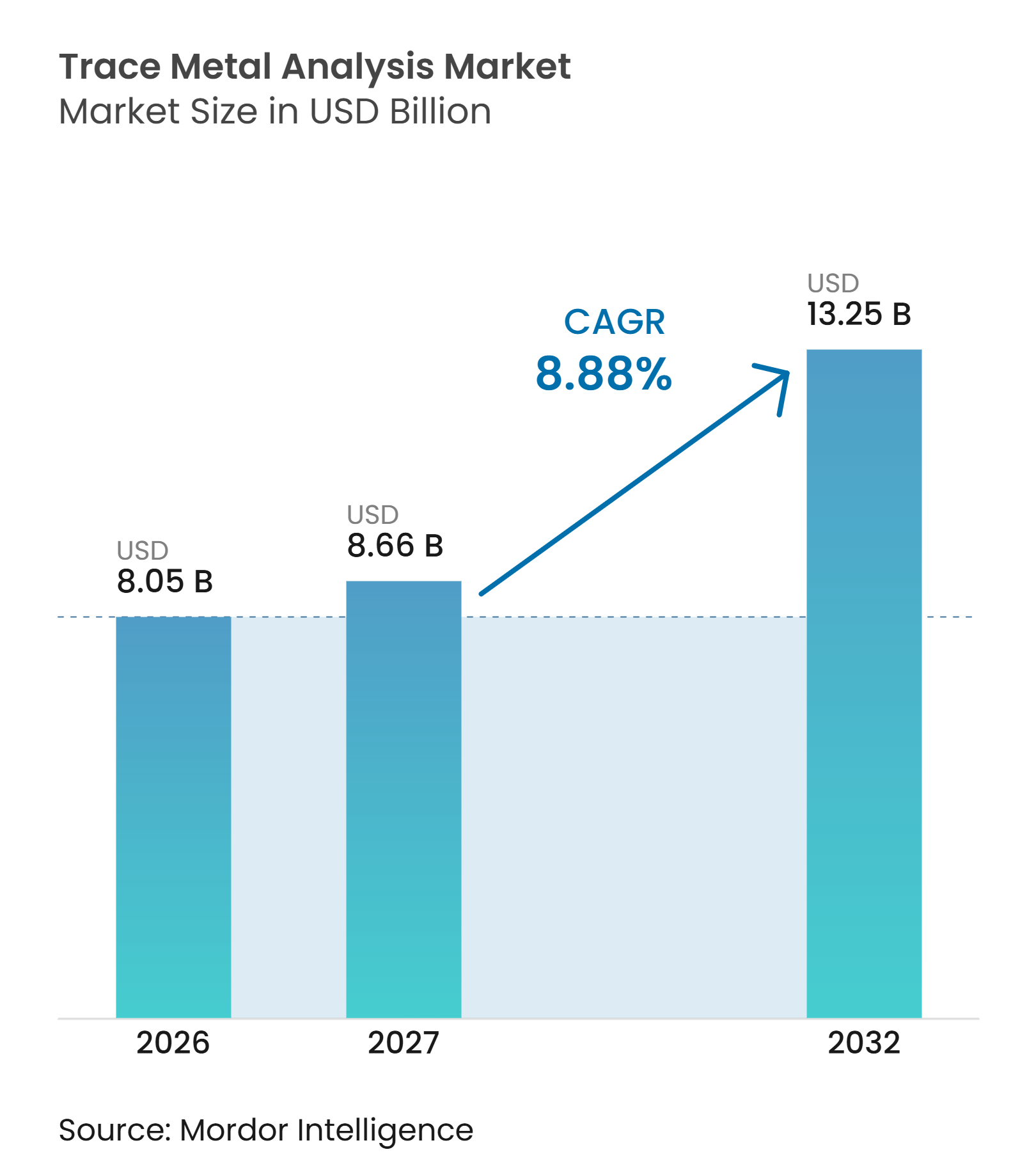
The Trace Metal Analysis Market size is expected to increase from USD 8.05 billion in 2026 to USD 8.66 billion in 2027 and reach USD 13.25 billion by 2032, growing at a CAGR of 8.88% over 2027-2032.
The trace metal analysis market is being shaped by tighter elemental impurity controls for medicines, lower contamination limits in semiconductor production, and broader public monitoring of metals in water, soil, and air. These requirements are moving demand beyond periodic laboratory upgrades toward equipment that can support routine release testing, field decisions, and continuous process checks. Instrument suppliers are emphasizing automation, lower argon use, and easier workflows as laboratories face pressure to maintain throughput with limited specialist staff. Testing providers are expanding accredited networks through acquisitions, while manufacturers of advanced instruments compete on sensitivity, reliability, and compliance support. The trace metal analysis market also has openings in emerging mining regions and pharmaceutical production centers where accredited local capacity remains limited.
Key Report Takeaways
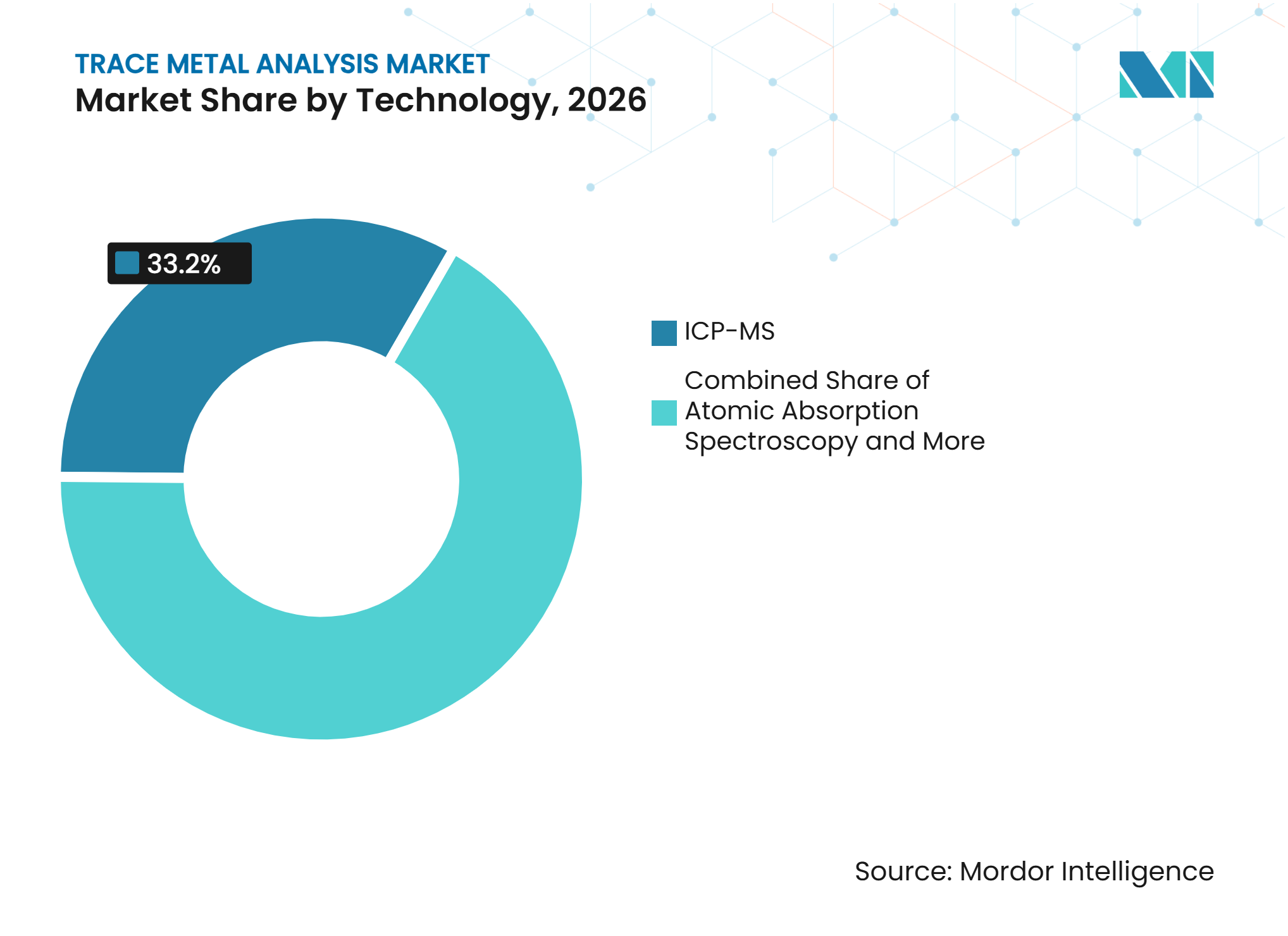
- By technology, ICP-MS held 33.16% revenue share in 2026, while atomic absorption spectroscopy is forecast to grow at a 9.41% CAGR through 2032.
- By instrument type, benchtop systems accounted for 68.14% revenue share in 2026, while portable systems are projected to expand at a 10.91% CAGR through 2032.
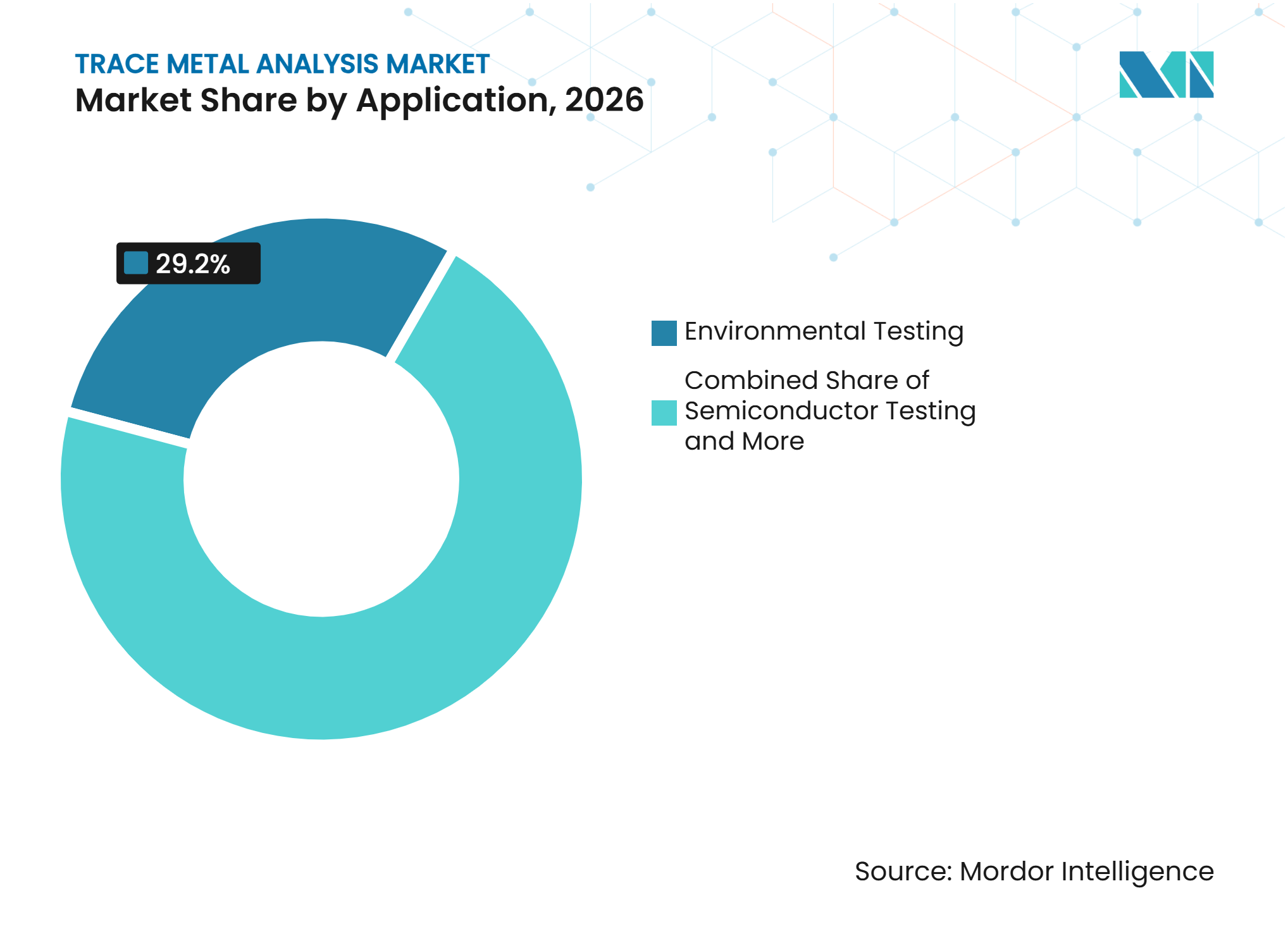
- By application, environmental testing held 29.20% revenue share in 2026, while semiconductor testing is forecast to grow at a 9.54% CAGR through 2032.
- By end user, testing laboratories held 26.04% revenue share in 2026, while food and beverage companies are projected to grow at a 10.13% CAGR through 2032.
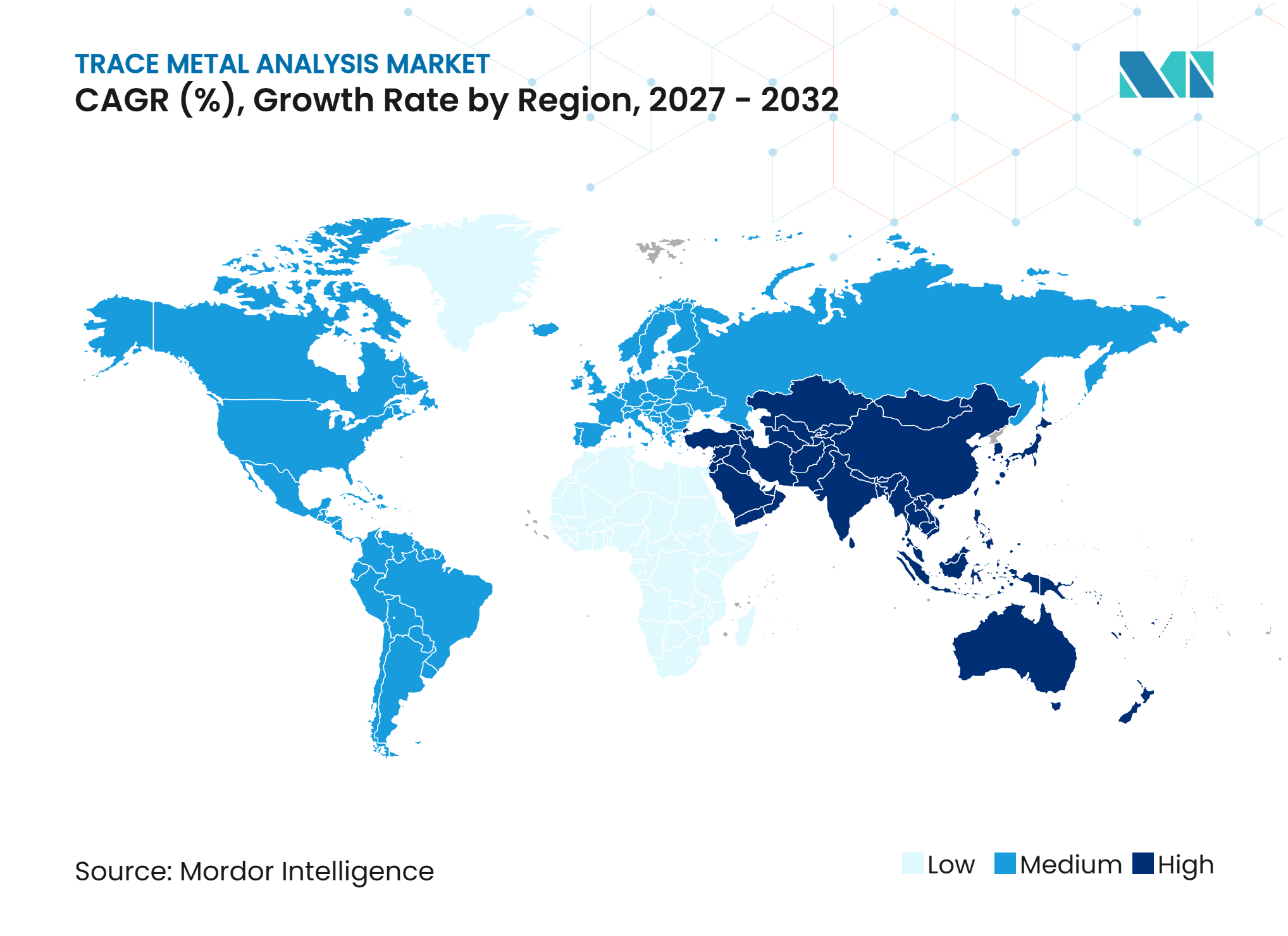
- By geography, North America held 33.14% revenue share in 2026, while Asia-Pacific is forecast to grow at a 10.45% CAGR through 2032.
Note: Market numbers in this report are based on Mordor Intelligence's proprietary estimation framework, which combines nine months of actuals with Q4 projections for base year 2026.
Market Trends and Insights
Drivers Impact Analysis of Trace Metal Analysis Market*
| Driver | (~) % Impact on CAGR Forecast | Geographic Relevance | Impact Timeline |
|---|---|---|---|
| Tightening Elemental Impurity Limits | +1.6% | Global, with strongest concentration in North America and Europe | Medium term (2-4 years) |
| Semiconductor Ultra-Purity Requirements | +1.4% | Asia-Pacific core, with spillover to North America | Long term (≥ 4 years) |
| Expansion of Environmental Metals Monitoring | +1.2% | Global, with acute demand in North America, Africa, and Central Asia | Short term (≤ 2 years) |
| Growth of Outsourced Contract Testing | +1.1% | Global, with early gains in North America, Europe, and Asia-Pacific | Short term (≤ 2 years) |
| Portable Testing for Mine-Site and Contaminated-Site Decisions | +0.8% | Australia, South America, Africa, and North America | Medium term (2-4 years) |
| Multi-Element Speciation Demand in Food and Biopharma | +0.9% | Europe, North America, and Asia-Pacific import-screening hubs | Long term (≥ 4 years) |
| Source: Mordor Intelligence | |||
Tightening Elemental-Impurity Limits Drive Systematic Pharma Testing
The ICH Q3D guideline and United States Pharmacopeia chapters <232> and <233> require validated elemental impurity methods for 24 classified elements in oral, parenteral, and inhalation drug products. Routine testing is required when an impurity exceeds 30% of its permitted daily exposure, raising the need for defensible batch data. A 2025 Product Quality Research Institute study found strong ICP-MS reproducibility for most Class 1 and Class 2A elements, while mercury and vanadium still required method harmonization. The result supports continued spending on validated reference materials, service support, and methods that meet release-testing expectations. EDQM revised European general chapters for elemental analysis in 2025 to align Ph. Eur. Chapter 2.4.20 with ICH Q3D and strengthen method precision expectations for European authorizations. A 2025 study also applied ICP-MS to pharmaceutical components and packaging, showing that container-closure systems fall within the analytical scope of current compliance work[1].
Semiconductor Ultra-Purity Requirements Raise Detection Benchmarks
The trace metal analysis market benefits from semiconductor process requirements that can place metallic contamination at the sub-ppt level. SEMI F63-0918 identifies target concentrations below 1 ppt for 26 metallic contaminants in ultrapure water used for silicon wafer processing. ICP-MS is used for these low detection limits, while vapor phase decomposition coupled with ICP-MS remains important for wafer-surface analysis. Single-particle ICP-MS is also being used to characterize nanoscale metallic particles in process chemicals, which conventional testing may not identify. Hiyoshi launched an ultra-trace ICP-QQQ service in an ISO Class 1 cleanroom in October 2025, with 1 ng/L detection for high-purity semiconductor reagents. Fraunhofer IKTS awarded a July 2025 contract for a triple-quadrupole ICP-MS for semiconductor ceramics and functional materials work, showing parallel investment in research infrastructure.
Expansion of Environmental Metals Monitoring Broadens Demand
The trace metal analysis market is supported by public programs that require ongoing monitoring rather than one-time surveys. The U.S. Environmental Protection Agency’s Lead and Copper Rule Improvements took effect in October 2024 and lowered the lead action level in drinking water from 15 ppb to 10 ppb. EPA Method 200.8 remains a core ICP-MS method for compliance sampling in this work. The UCMR 5 cycle requires public water systems to monitor priority contaminants through 2027, helping laboratories plan multiyear capacity needs. Mongolia expanded a national laboratory’s ability to detect heavy metals from 8 to more than 70 analytes across over 400 monitoring locations in October 2025. North Macedonia also received an ICP-MS through a European Union-supported clean-air initiative in August 2025 for monitoring heavy metals in soil, water, and air.
Growth of Outsourced Contract Testing Concentrates Capacity in Specialist Networks
ISO/IEC 17025 accreditation directs pharmaceutical, mining, and public environmental work toward laboratories that can provide validated and traceable results. This favors specialist networks because smaller in-house sites may not be able to maintain the equipment, quality systems, and staff needed for advanced trace metal methods. Eurofins completed 40 business combinations in fiscal year 2025 and added EUR 286 million in pro-forma revenue. In October 2026, Eurofins completed its acquisition of Element Materials Technology’s Life Sciences Testing Services business in North America for USD 400 million, adding 27 laboratories. SGS expanded its North American environmental testing footprint through the 2025 acquisitions of RTI Laboratories and APPL Laboratory. Intertek acquired Envirolab in Australia in September 2025, adding environmental testing capability in Asia-Pacific.
Restraints Impact Analysis of Trace Metal Analysis Market*
| Restraint | (~) % Impact on CAGR Forecast | Geographic Relevance | Impact Timeline |
|---|---|---|---|
| High Instrument and Operating Costs | -0.9% | Global, with strongest impact in emerging markets | Short term (≤ 2 years) |
| Shortage of Skilled Analytical Chemists | -0.7% | Asia-Pacific emerging markets, Africa, and Latin America | Medium term (2-4 years) |
| Argon Supply Exposure for Plasma Techniques | -0.5% | Acute in Europe and North America | Medium term (2-4 years) |
| Matrix Effects and Sample-Preparation Burden | -0.4% | Global, concentrated in regulated industries | Long term (≥ 4 years) |
| Source: Mordor Intelligence | |||
High Instrument and Operating Costs Constrain Adoption in Price-Sensitive Markets
High capital and operating costs limit access to advanced systems in the trace metal analysis market, particularly for independent laboratories and buyers in emerging economies. A triple-quadrupole ICP-MS procured by Fraunhofer IKTS through a public tender cost EUR 172,804 in July 2025. Plasma-based methods also need high-purity argon and controlled laboratory conditions, which makes the lifetime cost more material than the initial purchase price alone. This can defer upgrades where budgets are tied to public funding or low testing volumes. Analytik Jena states that its Eco Plasma approach can reduce argon consumption by up to 50% against conventional ICP-MS designs. Leasing and pay-per-analysis models can spread the capital burden, especially for contract laboratories that expect volumes to rise over time.
Shortage of Skilled Analytical Chemists Limits Throughput Growth
Specialist staffing remains a constraint where laboratories must operate, troubleshoot, and validate ICP-MS, AAS, and hyphenated methods. The issue is more evident in expanding semiconductor and pharmaceutical testing centers, where demand can rise faster than the local supply of trained analytical chemists. Lower staffing levels can reduce instrument utilization, slow method development, and raise the risk of repeat analyses in regulated work. Agilent introduced the 9500 Triple Quadrupole ICP-MS in May 2026 with an Advanced Helium Mode designed to reduce tuning steps and cut data acquisition time by over 33%. The system also supports migration from single-quadrupole workflows without extensive retraining. Automation can reduce routine work per sample, but complex semiconductor and speciation methods still require experienced staff.
*Our forecasts treat driver/restraint impacts as directional, not additive. The impact forecasts reflect baseline growth, mix effects, and variable interactions.
Trace Metal Analysis Market Segment Analysis
By Technology:
ICP-MS Retains Analytical Leadership While AAS Gains GroundICP-MS held a 33.16% revenue share in 2026 because it supports multi-element and isotope-resolved detection at ppt and sub-ppt concentrations. It remains central to semiconductor water and chemical testing because the method can meet the detection requirements described in SEMI F63-0918. ICP-OES continues to serve environmental bulk-metals testing and industrial process control where ppb sensitivity and high throughput are sufficient. Its role is strongest where laboratories manage difficult matrices and do not need the lowest achievable detection level. These methods give the trace metal analysis industry a broad technical base across regulated and routine use cases. The trace metal analysis market therefore depends on several analytical routes rather than a single platform, even though ICP-MS remains the reference method where very low limits apply. This technical spread lets laboratories select the method that matches the sample matrix, the detection limit, and the regulatory protocol without giving up traceability.
Atomic absorption spectroscopy is the fastest-growing technology and is forecast to grow at a 9.41% CAGR through 2032. New graphite furnace AAS systems provide sub-ppb detection with lower capital requirements than many ICP-MS configurations. This matters for environmental laboratories in emerging markets that run prescriptive methods and prioritize the cost of each test. Portable XRF is also extending screening work because it can support direct field analysis with limited preparation. Shimadzu released the ALTRACE energy-dispersive XRF spectrometer in February 2025 with a 0.1 ppm detection limit for cadmium and lead in organic matrices and capacity for 48 consecutive samples. Eurofins Japan introduced glow discharge mass spectrometry in March 2025 for bulk semiconductor and battery materials where solution-based techniques can face dissolution constraints. SPECTRO introduced its SPECTROGREEN MS Quadrupole ICP-MS in July 2025 for routine work under EPA, USP, and ISO methods.



By Instrument Type:
Benchtop Systems Remain the Core Installed BaseBenchtop systems accounted for 68.14% revenue share in 2026. Fixed laboratory settings remain necessary for pharmaceutical, semiconductor, and environmental compliance work that requires validated methods, controlled conditions, and chain-of-custody documentation. The concentration of benchtop equipment within ISO/IEC 17025-accredited laboratories creates meaningful switching costs. Laboratories also need stable platforms for requalification, method transfer, calibration, and reference-standard verification. These requirements keep benchtop equipment central to the trace metal analysis market even as instrument generations change.
Portable systems are projected to expand at a 10.91% CAGR through 2032. Their adoption is linked to mine sites, contaminated land, and food-safety screening, where moving large sample volumes to a central laboratory can delay decisions. A 2025 scientific study found that a machine-learning-enhanced portable XRF approach achieved R² values above 0.85 for key metals in high-sulfur mining soils. This supports risk classification at site level, although full laboratory confirmation can still be necessary for regulated decisions. Thermo Fisher introduced the AnStat-430 and MSA-430 in October 2025 for real-time slurry monitoring in mineral processing, with a 10-fold improvement in copper detection limits. Portable tools therefore extend the addressable use of trace metal measurement while benchtop systems retain the highest-confidence analytical work. The trace metal analysis market can grow in both settings because field screening helps users decide which samples need subsequent laboratory confirmation. In the trace metal analysis market, this approach can reduce unnecessary transport and concentrate laboratory capacity on samples that need formal compliance data.
By Application:
Environmental Testing Leads While Semiconductor Testing AcceleratesEnvironmental testing commanded 29.20% of the trace metal analysis market share in 2026. Drinking-water standards, wastewater discharge permits, and soil remediation projects create recurring demand for accredited laboratory capacity. U.S. lead requirements and UCMR 5 monitoring support a multiyear testing base for public systems and contracted laboratories[2]. The European Union is also supporting broad soil testing through a 38-month SGS contract covering more than 35,000 topsoil samples. Environmental work gives the trace metal analysis market a steady demand stream because compliance sampling is often repeated on defined schedules. The trace metal analysis market also gains continuity when utilities replace infrastructure, because follow-up sampling is needed to demonstrate that projects meet health-protection requirements. The same systems can support wastewater and remediation work, which improves equipment utilization across environmental laboratories.
Semiconductor testing is forecast to grow at a 9.54% CAGR through 2032. Smaller process nodes increase the number of contaminants tested at each chemical, water, and wafer-surface point. Single-particle ICP-MS adds the ability to assess particle number, size, and composition in process baths. Pharmaceutical and biotechnology testing remains a major application because ICH Q3D requirements now extend from drug products to packaging and process components. Food and beverage testing is also moving toward element speciation rather than total-element screening. A 2025 study validated rapid HPLC-ICP-MS arsenic speciation across diverse food matrices. Mining and geochemical users require multi-element data for lithium, cobalt, nickel, and niobium projects, while clinical research is assessing SEC-ICP-MS for metallobiomolecule measurement.

By End User:
Testing Laboratories Lead Despite Growing In-House CapacityTesting laboratories held a 26.04% revenue share in 2026. Their position reflects the cost of maintaining ISO/IEC 17025 systems, validated equipment, and staff across pharmaceutical and environmental methods. Smaller manufacturers may not be able to justify a dedicated GMP trace-metals department. Contract laboratories can use expensive triple-quadrupole platforms across a wider sample base and offer method development alongside routine testing. This keeps laboratories central to the trace metal analysis market where regulators, financiers, and customers must accept results. The trace metal analysis market is also supported when testing providers can operate common quality systems across several nearby locations. Networked laboratories can route specialized samples to the site with the right method while retaining a local customer relationship.
Food and beverage companies are forecast to grow at a 10.13% CAGR through 2032 as import requirements increase attention to arsenic, mercury, and selenium speciation. Larger producers are building in-house ICP-MS capability under food safety management systems, particularly where routine releases and export work justify direct investment. Pharmaceutical and biotechnology companies also retain in-house capacity for real-time batch disposition but use accredited labs for specialist methods and reference testing. Environmental agencies form a public demand base tied to mandate and procurement cycles. The City of Olathe issued an October 2025 request for proposals for combined ICP-OES and ICP-MS replacement equipment valued at USD 500,000 to USD 1.5 million. Mining and metallurgy companies are also investing directly because investor-grade assay data and accreditation are increasingly required for project financing.
Geography Analysis
North America
North America held a 33.14% revenue share in 2026. The region has extensive rules for metallic-contaminant monitoring in drinking water, pharmaceuticals, and industrial environmental work. The EPA’s Lead and Copper Rule Improvements lowered the lead action level to 10 ppb and require full lead service line replacement within 10 years. EPA Method 200.8 provides a recognized ICP-MS route for the resulting compliance sampling. FDA and USP expectations also sustain a large base of GMP-validated systems that need requalification and method verification. Eurofins Lancaster Laboratories announced a USD 147.5 million, 300,000-square-foot biopharma testing expansion in Pennsylvania during December 2025, with 250 projected jobs. Canadian and Mexican capacity is also linked to critical-mineral supply chains, where ISO/IEC 17025 assay packages are used in lithium, cobalt, and nickel project financing.
Asia-Pacific
Asia-Pacific is forecast to grow at a 10.45% CAGR through 2032, the highest rate among geographic segments in the trace metal analysis market. South Korea, Taiwan, and Japan require high-sensitivity qualification across chemicals, ultrapure water, and wafer surfaces in advanced fabrication. China’s semiconductor buildout is creating procurement demand for ICP-MS systems, specialized reagents, reference standards, and cleanroom consumables. India’s pharmaceutical production also needs elemental impurity testing aligned with USP requirements for export access. Australia maintains demand for ICP-OES and XRF from mineral exploration and mining. SGS opened a feeder laboratory in Port Hedland in January 2025 to provide field analytical services to iron ore, lithium, and base-metal programs. The region combines fast capacity investment with a growing local services base, which supports instrument sales and follow-on consumables.
Europe, Middle East and Africa, and South America
Europe remains supported by industrial chemistry, semiconductor precursor materials, and soil-monitoring programs. Fraunhofer IMWS is developing sub-ppb to ppt ICP-MS methods for high-purity precursor qualification for photovoltaic and semiconductor applications. The European Commission’s soil-health work adds repeated analysis of metal and trace-element concentrations across member states. In the Middle East and Africa, Saudi Arabia’s mining development is increasing the need for multi-element geochemical characterization. Alfred H. Knight’s 2025 partnership includes an advanced metals and minerals analytical facility in Saudi Arabia. Mining in Brazil and Argentina leads South American demand, while Peru’s health observatory broadens monitoring from environmental samples to people exposed near extraction zones. The trace metal analysis market in these regions is tied to both resource development and stronger public oversight. This connection can bring environmental laboratories, mining groups, public-health programs, and contract laboratories into the same supply chain. It also increases the value of methods that can reliably compare results across locations and over time.
Competitive Landscape
Market Concentration
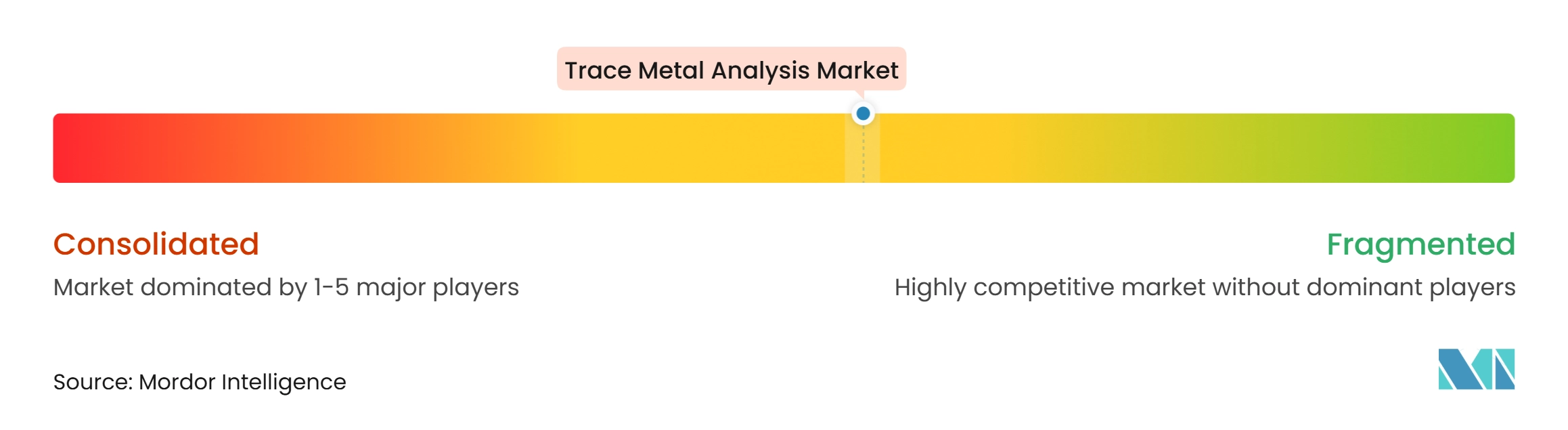
The trace metal analysis market has two main competitive groups: instrument manufacturers and analytical testing service providers. Thermo Fisher Scientific, Agilent Technologies, PerkinElmer, and Shimadzu hold large installed bases across ICP-MS, ICP-OES, and AAS platforms. Competition among instrument suppliers centers on automation, argon efficiency, throughput, and interference management. Agilent introduced the 9500 Triple Quadrupole ICP-MS in May 2026 with a Dual-Cell System and Advanced Helium Mode that reduces acquisition time by over 33%. SPECTRO introduced the SPECTROGREEN MS in July 2025 for routine elemental work that meets EPA 200.8, USP 232 and 233, and ISO 17294-2 requirements.
Testing services are more fragmented, although large providers are building scale through local acquisitions. Eurofins, SGS, Intertek, and Bureau Veritas compete through geographic coverage, accreditation breadth, and the ability to report structured digital data. Eurofins completed the USD 400 million acquisition of Element Materials Technology’s North American life-sciences testing business in October 2026, adding 27 laboratories. SGS purchased APPL Laboratory in California during November 2025, adding a DoD-certified facility to its U.S. network. Intertek’s purchase of Envirolab in Australia during September 2025 expanded its environmental laboratory footprint.
Accreditation under ISO/IEC 17025 remains essential because results must be accepted by regulators, pharmaceutical customers, mining financiers, and public agencies. Digital traceability has become material where customers require structured electronic reports and repeatable audit trails. Smaller laboratories can still compete in local field work, rapid screening, and specialized sample preparation. The trace metal analysis market gives established networks an advantage in regulated work while leaving openings in ASEAN pharmaceutical centers and sub-Saharan African mining areas where accredited local capacity remains limited.
Trace Metal Analysis Industry Leaders
-
Agilent Technologies
-
HORIBA Ltd
-
PerkinElmer
-
Shimadzu Corporation
-
Thermo Fisher Scientific Inc.
- *Disclaimer: Major Players sorted in no particular order
Trace Metal Analysis Market Companies Covered in this Report
- Agilent Technologies
- Analytik Jena
- Analytik Jena GmbH
- Bruker
- Bureau Veritas SA
- Elemental Scientific Inc.
- Eurofins
- Hitachi
- HORIBA
- Intertek Group
- LECO
- Malvern Panalytical Ltd
- Oxford Instruments
- PerkinElmer
- Rigaku
- SGS
- Shimadzu
- SPECTRO Analytical Instruments GmbH
- Teledyne Technologies
- Thermo Fisher Scientific
Recent Industry Developments in Trace Metal Analysis Market
- October 2026: Eurofins Scientific completed the acquisition of Element Materials Technology's Life Sciences Testing Services business in North America for USD 400 million, adding 27 laboratories and approximately USD 150 million in annual revenues covering biopharma product testing, environmental testing, and food metals testing. The deal extends Eurofins' hub-and-spoke network into key U.S. and Canadian regions where it was previously underrepresented.
- May 2026: Agilent Technologies launched the 9500 Triple Quadrupole ICP-MS, featuring Advanced Helium Mode via a Dual-Cell System that consolidates multiple cell-tuning steps, reduces data acquisition time by over 33%, and allows laboratories to migrate from single-quadrupole methods without expert-level retraining. The system targets environmental, food, pharmaceutical, and advanced materials testing markets globally, and was also launched in India to meet rising pharmaceutical and food testing demand
Global Trace Metal Analysis Market Report Scope
As per the report's scope, the trace metal analysis market covers instruments, systems, and related analytical solutions used to identify, quantify, and characterize trace metals and elemental impurities in samples across environmental, pharmaceutical, food and beverage, semiconductor, oil and gas, medical device, clinical, mining, chemical, and research settings, including laboratory and field-based measurement performed through defined technologies, instrument types, applications, end-user groups, and geographies.
The market is segmented by technology, instrument type, application, end user, and geography. By technology, the market is segmented into ICP-MS, ICP-OES, atomic absorption spectroscopy, X-ray fluorescence, and other technologies. By instrument type, the market is segmented into benchtop systems and portable systems. By application, the market is segmented into environmental testing, pharmaceutical and biotechnology products testing, food and beverage testing, semiconductor testing, oil and gas testing, medical device testing, clinical diagnostics, mining and geochemical analysis, cosmetics and chemicals testing, and research and other applications. By end user, the market is segmented into testing laboratories, pharmaceutical and biotechnology companies, food and beverage companies, environmental agencies, mining and metallurgy companies, and other end users. By geography, the market is segmented into North America, Europe, Asia-Pacific, the Middle East and Africa, and South America. The market report also covers estimated market sizes and trends for 17 countries across major regions worldwide. The report offers market size and forecasts in value (USD) for the above segments.
Segmentation Overview
| ICP-MS |
| ICP-OES |
| Atomic Absorption Spectroscopy |
| X-ray Fluorescence |
| Other Technologies |
| Benchtop Systems |
| Portable Systems |
| Environmental Testing |
| Pharmaceutical and Biotechnology Products Testing |
| Food and Beverage Testing |
| Semiconductor Testing |
| Oil and Gas Testing |
| Medical Device Testing |
| Clinical Diagnostics |
| Mining and Geochemical Analysis |
| Cosmetics and Chemicals Testing |
| Research and Other Applications |
| Testing Laboratories |
| Pharmaceutical and Biotechnology Companies |
| Food and Beverage Companies |
| Environmental Agencies |
| Mining and Metallurgy Companies |
| Other End Users |
| North America | United States |
| Canada | |
| Mexico | |
| Europe | Germany |
| United Kingdom | |
| France | |
| Italy | |
| Spain | |
| Rest of Europe | |
| Asia-Pacific | China |
| Japan | |
| India | |
| Australia | |
| South Korea | |
| Rest of Asia-Pacific | |
| Middle East and Africa | GCC |
| South Africa | |
| Rest of Middle East and Africa | |
| South America | Brazil |
| Argentina | |
| Rest of South America |
| By Technology | ICP-MS | |
| ICP-OES | ||
| Atomic Absorption Spectroscopy | ||
| X-ray Fluorescence | ||
| Other Technologies | ||
| By Instrument Type | Benchtop Systems | |
| Portable Systems | ||
| By Application | Environmental Testing | |
| Pharmaceutical and Biotechnology Products Testing | ||
| Food and Beverage Testing | ||
| Semiconductor Testing | ||
| Oil and Gas Testing | ||
| Medical Device Testing | ||
| Clinical Diagnostics | ||
| Mining and Geochemical Analysis | ||
| Cosmetics and Chemicals Testing | ||
| Research and Other Applications | ||
| By End User | Testing Laboratories | |
| Pharmaceutical and Biotechnology Companies | ||
| Food and Beverage Companies | ||
| Environmental Agencies | ||
| Mining and Metallurgy Companies | ||
| Other End Users | ||
| By Geography | North America | United States |
| Canada | ||
| Mexico | ||
| Europe | Germany | |
| United Kingdom | ||
| France | ||
| Italy | ||
| Spain | ||
| Rest of Europe | ||
| Asia-Pacific | China | |
| Japan | ||
| India | ||
| Australia | ||
| South Korea | ||
| Rest of Asia-Pacific | ||
| Middle East and Africa | GCC | |
| South Africa | ||
| Rest of Middle East and Africa | ||
| South America | Brazil | |
| Argentina | ||
| Rest of South America | ||
Key Questions Answered in the Report
What is the forecast growth rate for trace metal analysis through 2032?
The trace metal analysis market is projected to grow at an 8.88% CAGR from 2027 to 2032 and reach USD 13.25 billion by 2032.
Which technology has the largest role in trace metal testing?
ICP-MS led technology demand with a 33.16% share in 2026 because it supports multi-element analysis at ppt and sub-ppt concentrations.
Why is semiconductor testing expanding?
Semiconductor testing is forecast to grow at a 9.54% CAGR through 2032 as fabrication facilities monitor more contaminants in process chemicals, water, and wafer surfaces.
Which end users create the most demand for trace metal analysis?
Testing laboratories held a 26.04% share in 2026, supported by ISO/IEC 17025 requirements and the high cost of maintaining validated analytical operations.
What is driving portable trace metal instruments?
Portable systems are forecast to grow at a 10.91% CAGR through 2032 because mine sites and contaminated-land projects need faster field decisions.
Which region is growing fastest for trace metal analysis?
Asia-Pacific is projected to grow at a 10.45% CAGR through 2032, supported by semiconductor investment, pharmaceutical manufacturing, and mining activity.