
Tipper Body Equipment Market Size and Share
Market Overview
| Study Period | 2020 - 2032 |
|---|---|
| Market Size (2027) | USD 8.24 Billion |
| Market Size (2032) | USD 10.47 Billion |
| Growth Rate (2027 - 2032) | 4.91 % |
| Fastest Growing Market | Middle East and Africa |
| Largest Market | Asia-Pacific |
| Market Concentration | Medium |
Major Players *Disclaimer: Major Players sorted in no particular order Image © Mordor Intelligence. Reuse requires attribution under CC BY 4.0. | |
Tipper Body Equipment Market Analysis by Mordor Intelligence
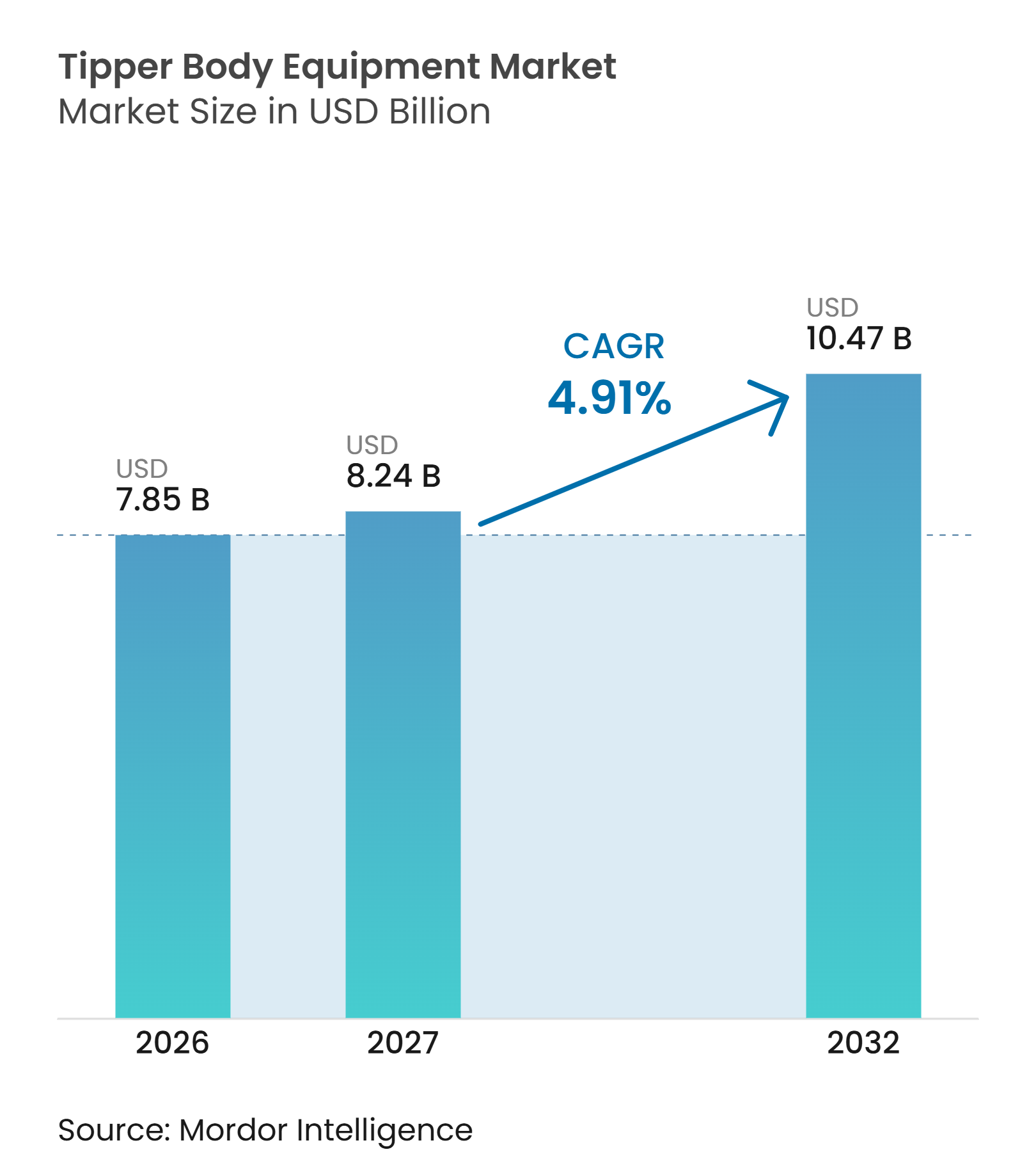
The tipper body equipment market size was valued at USD 7.85 billion in 2026 and is estimated to grow from USD 8.24 billion in 2027 to reach USD 10.47 billion by 2032, at a CAGR of 4.91% during the forecast period (2027-2032). The tipper body equipment market is supported by civil works, fleet replacement, municipal collection, quarrying, and agricultural bulk transport. Demand is increasingly linked to body weight, payload capacity, and the ability to fit bodies safely to diesel and electric chassis. Buyers are also placing more value on factory-approved integrations, because these reduce installation complexity and support warranty coverage. Regional demand remains uneven, with large earthworks programs supporting Asia-Pacific and infrastructure investment expanding the addressable opportunity in the Middle East and Africa. Suppliers that pair durable body construction with hydraulic, digital, and electric-compatible systems are better placed to serve changing fleet requirements.
Key Report Takeaways
-
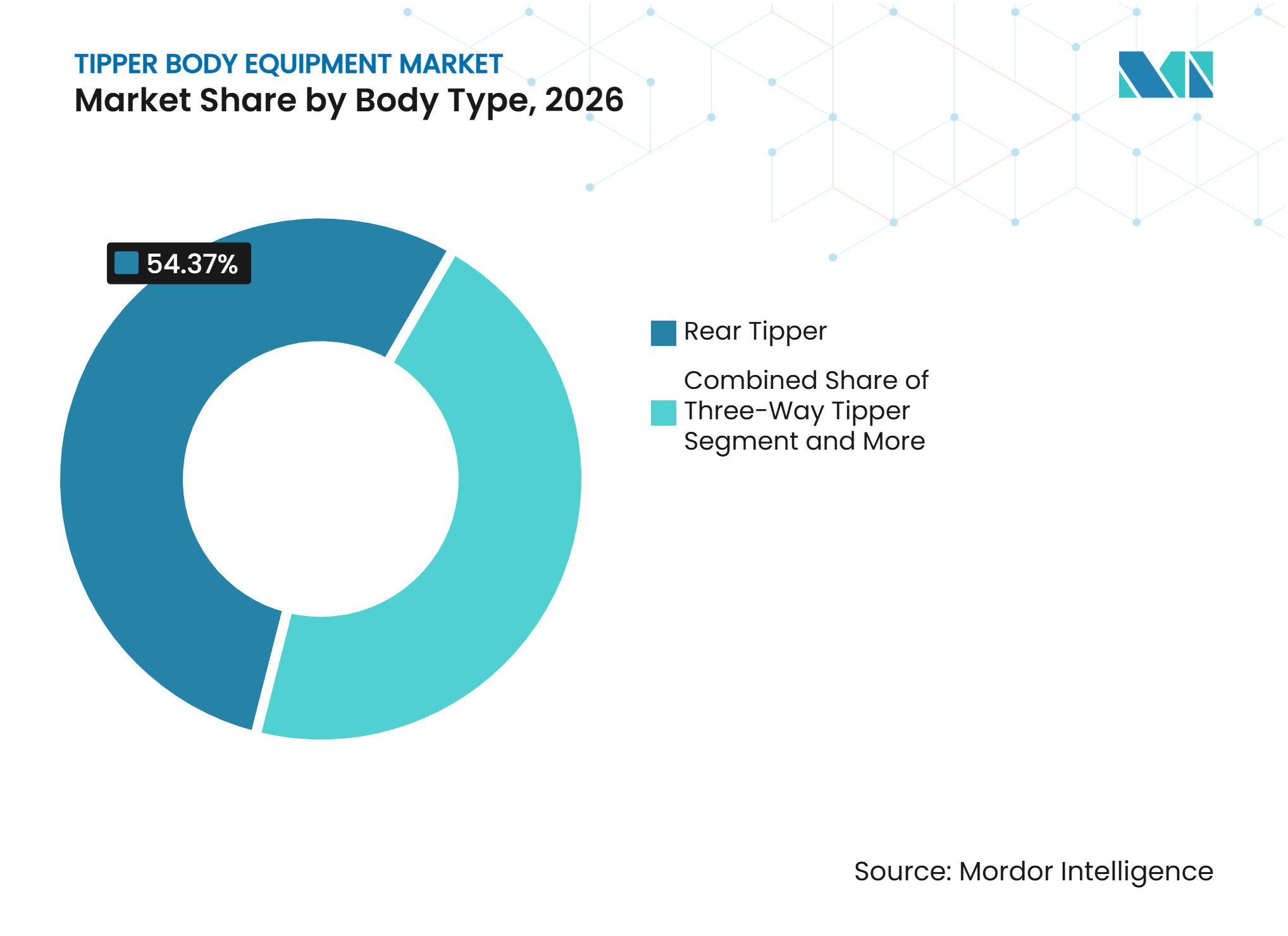
By body type, rear tippers held 54.37% of the tipper body equipment market share in 2026, while Others, including roll-off, hooklift, and half-pipe bodies, are projected to grow at a 6.12% CAGR through 2032.
-
By tipping mechanism, front-end telescopic hoists held 52.18% of the tipper body equipment market share in 2026, while underbody hoists are projected to grow at a 5.43% CAGR through 2032.
-
By frame material, steel held an 81.46% share in 2026, while aluminum is projected to grow at a 7.38% CAGR through 2032.
-
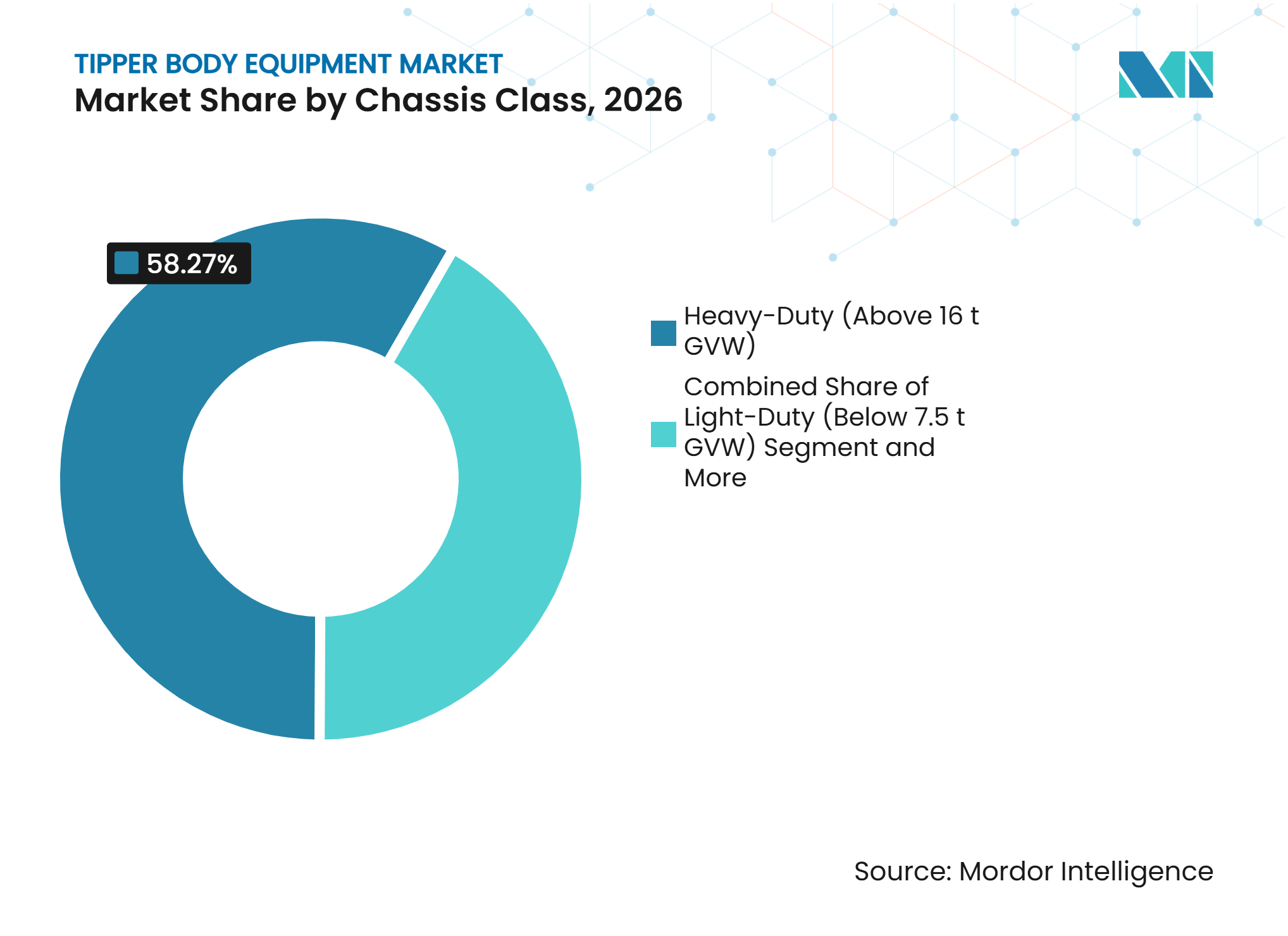
By chassis class, heavy-duty chassis held a 58.27% share in 2026, while light-duty chassis are projected to grow at a 5.67% CAGR through 2032.
-
By end-use industry, construction held a 46.38% share in 2026, while waste management is projected to grow at a 6.04% CAGR through 2032.
-
By geography, Asia-Pacific held a 47.26% share in 2026, while the Middle East and Africa is projected to grow at a 5.83% CAGR through 2032.
Note: Market numbers in this report are based on Mordor Intelligence's proprietary estimation framework, which combines nine months of actuals with Q4 projections for base year 2026.
Market Trends and Insights
Drivers Impact Analysis of Tipper Body Equipment Market*
| Driver | (~) % Impact on CAGR Forecast | Geographic Relevance | Impact Timeline |
|---|---|---|---|
| Construction and Infrastructure Spending | +1.8% | Global, concentrated in Asia-Pacific, Middle East and Africa, and North America | Medium term (2-4 years) |
| Replacement of Aging Truck Bodies and Hoists | +1.2% | North America, Europe, and Oceania | Short term (≤ 2 years) |
| Waste and Municipal Collection Fleet Modernization | +0.9% | Europe, North America, and Asia-Pacific urban centers | Medium term (2-4 years) |
| Quarry and Agricultural Bulk-Material Transport Demand | +0.7% | Global, with concentration in Asia-Pacific, Middle East and Africa, and South America | Medium term (2-4 years) |
| Payload Monetization Through High-Strength Lightweight Bodies | +0.5% | Europe, North America, and Australia | Short term (≤ 2 years) |
| Telematics and Interlocks Reducing Tip-Over Downtime and Insurance Exposure | +0.3% | Europe, North America, with adoption extending to Asia-Pacific | Long term (≥ 4 years) |
| Source: Mordor Intelligence | |||
Construction and Infrastructure Spending
Construction is the principal demand base for the tipper body equipment market because earthworks, road construction, aggregate delivery, and demolition all require repeatable bulk-material movement. Large civil programs create demand for rear bodies, heavy-duty chassis installations, and hydraulic systems that can operate across varied ground conditions. Asia-Pacific demand is not uniform, as construction activity in Southeast Asia and India provides a different volume profile from the more moderated procurement environment in China[1]. This makes local distribution, service capacity, and the availability of body variants important to suppliers serving the region. The Middle East and Africa also provide sustained opportunities in which transport corridors, urban projects, and site preparation require heavy bulk haulage. Construction buyers generally favor equipment that minimizes downtime and supports rapid access for repairs because utilization is central to project economics.
Replacement of Aging Truck Bodies and Hoists
Replacement demand supports the tipper body equipment market in mature fleets where steel fatigue, corrosion, hydraulic wear, and rising repair needs affect operating availability. Fleet managers must weigh the cost of continued repair against the safety and payload benefits of a new body and hoist. Imported equipment cost pressure has encouraged investment in domestic fabrication, automation, and remanufacturing capacity in North America. This also creates a service opportunity for body builders that can repair bodies, renew hoists, and manage parts supply through established workshops. A delayed replacement decision can lower immediate capital spending, but it may also increase the chance of unplanned maintenance and vehicle downtime. Suppliers with both new-build and refurbishment offerings can therefore address different fleet budgets without losing the customer relationship.
Waste and Municipal Collection Fleet Modernization
Municipal fleet modernization is broadening the addressable applications for the tipper body equipment market, especially for roll-off, skip, and collection-related formats. Zero-emission zones and public procurement rules are directing attention toward electric-compatible collection vehicles. Detroit deployed its first fully electric solid-waste collection vehicles in September 2025 with support from a USD 1.2 million state grant[2]. Battery mass reduces the payload available for bodies and collected material, which raises interest in lower-tare aluminum and composite solutions. Electric vehicles also require electro-hydraulic arrangements rather than conventional engine-driven power take-off systems. Body builders that can supply compliant equipment for those architectures have a clearer route into municipal replacement programs.
Quarry and Agricultural Bulk-Material Transport Demand
Quarries, mines, and farms provide recurring demand for the tipper body equipment market because aggregates, minerals, grain, fertilizer, and other bulk goods must move between sites and terminals. These applications place a premium on abrasion resistance, structural strength, and dependable unloading. Rear tippers remain common where a simple discharge pattern is suitable, while side tipper configurations can support open-air unloading and field-to-terminal logistics. Electric high-payload tipper chassis are beginning to appear in quarry and construction duty, widening the body builder's technical requirements. Agricultural fleets also value flexible three-way arrangements where access conditions and load types vary. The result is continuing demand for hydraulic systems that can manage both high payloads and frequent operating cycles.
Restraints Impact Analysis of Tipper Body Equipment Market*
| Restraint | (~) % Impact on CAGR Forecast | Geographic Relevance | Impact Timeline |
|---|---|---|---|
| Volatile Steel and Aluminum Input Costs | -0.8% | Global, amplified in North America by Section 232 tariffs | Short term (≤ 2 years) |
| Upfront Equipment Capex and Financing Constraints for Small Fleets | -0.6% | South America, Middle East and Africa, Southeast Asia, and Eastern Europe | Medium term (2-4 years) |
| Body-to-Chassis Integration and Homologation Complexity Across Jurisdictions | -0.4% | Europe, North America, and India | Long term (≥ 4 years) |
| Payload Trade-Offs from EV Battery Mass and Retrofit Packaging Limits | -0.3% | Europe, North America, and Asia-Pacific urban electric-vehicle corridors | Medium term (2-4 years) |
| Source: Mordor Intelligence | |||
Volatile Steel and Aluminum Input Costs
Steel and aluminum costs can constrain the tipper body equipment market when body builders commit to fixed fleet pricing before materials are purchased and processed. Steel bodies face both commodity movement and regional tariff exposure, while aluminum prices can materially affect lightweight-body quotations. The difference between order timing and final delivery can leave suppliers exposed when they cannot fully pass higher input costs to the customer. This is more difficult for smaller builders with limited purchasing scale or limited options for holding inventory. Higher costs may also cause fleets to defer a new body in favor of repair, even where a replacement would improve payload or reliability. Material selection and contract terms have therefore become central commercial decisions rather than only engineering choices.
Upfront Equipment Capex and Financing Constraints for Small Fleets
Upfront equipment cost limits adoption among owner-operators and smaller fleets in South America, sub-Saharan Africa, and Southeast Asia. A complete heavy-duty body and hoist system requires a meaningful capital commitment, particularly when high-strength steel, aluminum, or electric-compatible hydraulic equipment is specified. Leasing and specialized equipment finance are less developed in many of these locations than in mature truck markets. Smaller operators may keep older mild-steel bodies in service longer and direct spending toward maintenance rather than replacement. This can slow adoption of new technology even when operating efficiency would improve over the equipment life. It also gives body builders a reason to offer repair services, simpler configurations, and financing partnerships where practical.
*Our forecasts treat driver/restraint impacts as directional, not additive. The impact forecasts reflect baseline growth, mix effects, and variable interactions.
Tipper Body Equipment Market Segment Analysis
By Body Type:
Rear Tippers Lead While Flexible Formats Gain GroundRear tippers accounted for 54.37% of the tipper body equipment market in 2026, reflecting their broad fit with construction, aggregate, and demolition work. Their single-direction discharge arrangement is familiar to drivers, easy for fleet workshops to maintain, and supported by a wide selection of hydraulic hoist kits. Three-way tippers add flexibility for confined construction sites, mixed-load routes, and municipal work because they can discharge to the rear or either side. Side tippers serve more focused applications where open-air stockpiles and field-to-terminal movements reduce dependence on fixed unloading infrastructure. The usual load, discharge area, chassis platform, repair access, and acquisition budget determine which of these configurations is most appropriate.
Others, including roll-off, hooklift, and half-pipe bodies, are projected to advance at a 6.12% CAGR through 2032. These formats support waste and recycling customers that need one vehicle to exchange or move different containers during the same operating cycle. Integrated solutions that combine a crane, hookloader, and body can simplify procurement, although they require careful attention to mounting, hydraulic interfaces, operator training, and ongoing service. Half-pipe bodies provide another option where demanding materials require controlled unloading and strong structural performance. This category can command higher equipment value because it provides load-handling flexibility that a fixed rear body does not offer.



By Tipping Mechanism:
Telescopic Hoists Lead While Underbody Systems GainFront-end telescopic hoists held a 52.18% share in 2026, making them the leading mechanism in the tipper body equipment market. They are widely used with heavy rear bodies because their lifting force, extended stroke, and compatibility with varied body lengths suit high-payload earthworks, mining, and quarry operations. Their established design and familiar maintenance requirements reduce operational uncertainty for fleets with standard heavy-duty specifications. Site conditions still matter, since uneven ground can increase risk when a body is raised to a high angle. Proper body design, safety procedures, and operator guidance therefore remain essential alongside cylinder capability.
Underbody hoists are projected to grow at a 5.43% CAGR through 2032. Their lower mounting position can improve stability and suit urban construction or waste operations where compact packaging, maneuverability, and overhead clearance matter. Scissor and double-acting systems can also be well-suited to electric chassis, where hydraulic demand, battery capacity, and the placement of high-voltage components must be managed carefully. Formal body-builder approvals help reduce integration risk for these applications as regulatory requirements become more demanding. These factors provide underbody systems with a path to broader use beyond their established applications.
By Frame Material:
Steel Retains Scale While Aluminum Protects PayloadSteel held an 81.46% share in 2026, retaining its central role in the tipper body equipment market. High-strength wear-resistant grades are suited to quarrying, mining, demolition, and other work where abrasion and impact loads are sustained. Manufacturers increasingly specify steel by body zone, matching floor panels, sidewalls, and structural members to the anticipated material and working environment. This improves body performance and can support a more differentiated offering than a basic mild-steel build. Steel remains practical where strength, local repair capability, and acquisition cost have greater weight than tare mass.
Aluminum is projected to grow at a 7.38% CAGR through 2032. A lighter body can preserve legal payload capacity, which is valuable for high-frequency fleets and especially relevant when batteries consume part of the allowable vehicle weight. Aluminum also offers corrosion resistance that is useful in municipal and waste operations, although buyers must consider purchase cost, expected duty cycle, structural needs, and local repair access. Composite and hybrid alternatives remain smaller categories, but they can serve contamination-sensitive or corrosion-prone bulk transport. Material selection will continue to shape how suppliers position products within the tipper body equipment market.
By Chassis Class:
Heavy-Duty Platforms Anchor Demand While Light-Duty Use BroadensHeavy-duty chassis held a 58.27% share in 2026, giving them the largest position in the tipper body equipment market, mining, and quarrying use these platforms because they need high payload capacity, durable components, and bodies that can withstand demanding material transport. Rear bodies and front-end hoists are common specifications, while electric heavy-duty platforms are beginning to extend the class beyond conventional diesel operation. Fleet managers must balance frame strength, hydraulic equipment, body geometry, battery weight, and revenue payload for each chassis family. The resulting specification is a combined chassis-and-body engineering decision rather than a simple body purchase.
Light-duty chassis are projected to grow at a 5.67% CAGR through 2032. Urban construction, green-space maintenance, and municipal collection create demand for compact vehicles that can access restricted streets and operate on shorter routes. Electric platforms in the lower vehicle-weight range support caged tipper, compact three-way, and collection-oriented body configurations. Buyers in this class focus on turning space, payload, range, body versatility, and access for the driver. Modular mounting can further improve utilization by allowing the same chassis to serve several daily tasks.

By End-Use Industry:
Construction Leads While Waste Management ExpandsConstruction accounted for 46.38% of the market in 2026, making it the largest end-use in the tipper body equipment market. Earthworks, road building, demolition, and aggregate delivery require bodies that can withstand frequent loading cycles, varying material densities, and repeated discharge. Rear tippers match the workflow of many sites, while three-way and specialized bodies are selected where access limits or mixed loads justify added flexibility. Mining, quarrying, and agriculture provide related demand through the movement of aggregates, minerals, grain, fertilizer, sugar beet, and similar materials. Suppliers with broad body ranges can serve these needs without treating every haulage task as the same application.
Waste management is projected to grow at a 6.04% CAGR through 2032. Collection systems need equipment that can handle container changes, recycling routes, public operating schedules, and an increasing number of electric-compatible installations. Roll-off, hooklift, skiploader, and lighter-body arrangements are particularly relevant where fleets need both flexibility and practical payload capacity. The City of Casey expanded its hard-waste electric fleet to 6 fully electric compactor trucks in July 2026. This direction increases the value of safe body packaging, electro-hydraulic systems, dependable service, and documented chassis integration.
Geography Analysis
Asia-Pacific held a 47.26% share in 2026, making it the leading regional position in the tipper body equipment market. China, India, and Southeast Asia support large volumes of construction, earthworks, quarrying, and municipal infrastructure needs. Demand in China is more measured than in earlier cycles, while India and Southeast Asia add volume through roads, urban development, and industrial projects. The region also shows early activity in electric heavy-duty tipper body applications. Local manufacturers are developing electric dump body solutions alongside conventional equipment. Regional suppliers need broad product ranges because operating conditions, body preferences, and service capacity vary substantially across countries.
North America shows steady demand from public road work, fleet replacement, municipal collection, and construction activity. U.S. public construction spending on highways reached a seasonally adjusted annual rate of USD 150.6 billion in August 2026. Domestic body builders benefit when customers seek reliable delivery, local service, and compatible replacement parts. Europe has more restrained private construction conditions, so fleet renewal and regulatory compliance support a greater share of demand. The revised European type-approval framework increases the value of formal body-builder approvals and documented integration procedures. These conditions favor established suppliers with engineering, homologation, and service capabilities.
The Middle East and Africa is projected to grow at a 5.83% CAGR through 2032, the fastest regional rate in the tipper body equipment market. Large transport and site-development programs create a continued need for bodies for earthworks, aggregates, and road-base delivery. Morocco's planned transport investment related to the 2030 FIFA World Cup and Saudi Arabia's infrastructure allocations support this direction. South America provides additional demand through construction, agriculture, hydrocarbon activity, and mineral transport. Argentina's energy and mining logistics requirements underscore the need for heavy rear- and side-tipper configurations. Across the Middle East, Africa, and South America, new equipment sales are complemented by opportunities for body repair, hoist reconditioning, and parts distribution in older fleets.

Competitive Landscape
Market Concentration

The tipper body equipment market is moderately concentrated, with global hydraulic specialists, regional fabricators, and chassis-aligned upfitters serving different parts of demand. Competition is based on body design, hydraulic performance, payload, service coverage, digital safety, and approval capability rather than price alone. Hyva Global B.V., F.X. Meiller, CIMC Vehicles, Schmitz Cargobull, and Bing Power Systems are among the recognizable suppliers in the field. No single company has structural control over all body types, vehicle classes, or regions. This leaves room for regional body builders that understand local transport conditions and provide fast support. At the same time, greater integration requirements can favor larger suppliers with formal engineering and approval resources.
JOST completed its acquisition of Hyva Global in February 2025, combining JOST vehicle systems with Hyva hydraulic, tipping, loading, and collection equipment capabilities. In August 2026, JOST agreed to transfer Hyva's tipper body business in India to Belrise Industries, while keeping attention on hydraulic components and digital tipping solutions. Schmitz Cargobull standardized TrailerConnect telematics across its S.KI tipper semi-trailer range in February 2025, strengthening its digital offering for fleet operators. These moves show how suppliers are seeking deeper positions in connected equipment, body integration, and high-value component systems. Meiller has also used application-specific steel selection and crane-tipper integration to differentiate its product range. These strategies are designed to improve customer retention where basic body fabrication remains widely available.
Low-tare bodies designed for electric chassis are a meaningful opening for suppliers because battery mass makes payload efficiency more important. Digital tipping guidance, load controls, and safe-tip systems may also gain relevance as fleets seek to reduce incidents and improve asset use. Smaller body builders can compete on local pricing, repair access, and customization, particularly in Africa and Southeast Asia. However, cross-border sales and advanced chassis programs often require type approvals that smaller firms may find harder to obtain.
Tipper Body Equipment Industry Leaders
-
Schmitz Cargobull AG
-
Bing Power Systems GmbH
-
F. X. Meiller Fahrzeug- und Maschinenfabrik GmbH & Co. KG
-
Hyva Global B.V.
-
CIMC Vehicles (Group) Co., Ltd.
- *Disclaimer: Major Players sorted in no particular order
Tipper Body Equipment Market Companies Covered in this Report
- JOST Werke SE
- F. X. Meiller Fahrzeug- und Maschinenfabrik GmbH & Co. KG
- Schmitz Cargobull AG
- Cantoni & C. S.p.A.
- Fassi Gru S.p.A.
- Orsan Industries Incorporated
- Thompsons UK Ltd
- Somerset Welding and Steel, Inc.
- Palfinger AG
- Ingimex Ltd
- BION Group
- Kröger Fahrzeugbau GmbH
- Bing Power Systems GmbH
- Hyva Global B.V.
- CIMC Vehicles (Group) Co., Ltd.
- Belrise Industries Limited
- JPM Group
- Scattolini S.p.A.
- Knapheide Manufacturing Company
- Godwin Manufacturing Company, Inc.
- Binotto S.r.l.
Recent Industry Developments in Tipper Body Equipment Market
- September 2026: KH-KIPPER introduced two new tipping bodies at Hanover: the Bitum Bull+, designed for asphalt transport, and the Mini Bull, designed for compact 7.49-tonne chassis.
- August 2026: Belrise Industries Limited acquired Hyva India Private Limited's tipper body business, a subsidiary of JOST Werke SE, for approximately USD 5.65 million.
- February 2026: Schmitz Cargobull reworked the lightweight aluminum body of its S.KI LIGHT tipper semi-trailer, improving robustness, service life, and maintenance access while keeping unladen weight low, with reinforced wear areas and application-specific slide gates.
- May 2025: Meiller Kipper introduced the Maxtreme P436 and H436 rear tippers, rated for up to 41 tonnes and 22 cubic meters, for demanding bulk transport in civil engineering, quarrying, and urban construction.
Global Tipper Body Equipment Market Report Scope
Segmentation Overview
| Rear Tipper |
| Three-Way Tipper |
| Side Tipper |
| Others (Roll-off/Hooklift Tipping Bodies, Half-Pipe) |
| Front-End Telescopic Hoist |
| Underbody Hoist (Scissor, Double-Acting) |
| Others |
| Steel (High-Strength Wear-Resistant, Mild) |
| Aluminum |
| Others (Composite, Hybrid) |
| Light-Duty (Below 7.5 t GVW) |
| Medium-Duty (7.5 to 16 t GVW) |
| Heavy-Duty (Above 16 t GVW) |
| Construction |
| Mining and Quarrying |
| Waste Management |
| Agriculture |
| Others (Municipal, Utilities) |
| North America | United States |
| Canada | |
| Mexico | |
| Europe | Germany |
| France | |
| United Kingdom | |
| Italy | |
| Spain | |
| Russia | |
| Rest of Europe | |
| Asia-Pacific | China |
| India | |
| Japan | |
| South Korea | |
| Australia | |
| Southeast Asia | |
| Rest of Asia-Pacific | |
| South America | Brazil |
| Argentina | |
| Chile | |
| Colombia | |
| Rest of South America | |
| Middle East and Africa | Saudi Arabia |
| United Arab Emirates | |
| Turkey | |
| South Africa | |
| Egypt | |
| Rest of Middle East and Africa |
| By Body Type | Rear Tipper | |
| Three-Way Tipper | ||
| Side Tipper | ||
| Others (Roll-off/Hooklift Tipping Bodies, Half-Pipe) | ||
| By Tipping Mechanism | Front-End Telescopic Hoist | |
| Underbody Hoist (Scissor, Double-Acting) | ||
| Others | ||
| By Frame Material | Steel (High-Strength Wear-Resistant, Mild) | |
| Aluminum | ||
| Others (Composite, Hybrid) | ||
| By Chassis Class | Light-Duty (Below 7.5 t GVW) | |
| Medium-Duty (7.5 to 16 t GVW) | ||
| Heavy-Duty (Above 16 t GVW) | ||
| By End-Use Industry | Construction | |
| Mining and Quarrying | ||
| Waste Management | ||
| Agriculture | ||
| Others (Municipal, Utilities) | ||
| By Geography | North America | United States |
| Canada | ||
| Mexico | ||
| Europe | Germany | |
| France | ||
| United Kingdom | ||
| Italy | ||
| Spain | ||
| Russia | ||
| Rest of Europe | ||
| Asia-Pacific | China | |
| India | ||
| Japan | ||
| South Korea | ||
| Australia | ||
| Southeast Asia | ||
| Rest of Asia-Pacific | ||
| South America | Brazil | |
| Argentina | ||
| Chile | ||
| Colombia | ||
| Rest of South America | ||
| Middle East and Africa | Saudi Arabia | |
| United Arab Emirates | ||
| Turkey | ||
| South Africa | ||
| Egypt | ||
| Rest of Middle East and Africa | ||
Key Questions Answered in the Report
What is the projected value of the Tipper Body Equipment Market by 2032?
The tipper body equipment market is projected to reach USD 10.43 billion by 2032, from USD 8.21 billion in 2027. This projection reflects demand from construction, fleet replacement, municipal collection, quarrying, and agricultural bulk transport.
What is the forecast growth rate for tipper body equipment?
The market is projected to grow at a 4.90% CAGR from 2027 to 2032. Growth depends on body replacement, infrastructure work, waste fleet modernization, and the need for equipment that fits electric truck platforms.
Which body type leads demand for tipper equipment?
Rear tippers lead with a 54.37% share in 2026 because they are widely used for construction, aggregate delivery, and demolition work. Their simple rear discharge, widespread service support, and familiar hydraulic layouts help maintain this position.
Which material is growing fastest for tipper bodies?
Aluminum is the fastest-growing frame material, with a projected 7.38% CAGR through 2032, helped by the need to protect payload on electric chassis. Its lower weight can preserve useful carrying capacity where battery systems occupy part of the permitted vehicle weight.