
Tiger Nuts Market Size and Share
Market Overview
| Study Period | 2022 - 2032 |
|---|---|
| Market Size (2027) | USD 291.40 Million |
| Market Size (2032) | USD 418.34 Million |
| Growth Rate (2027 - 2032) | 7.50 % |
| Fastest Growing Market | Asia-Pacific |
| Largest Market | Europe |
| Market Concentration | Low |
Major Players *Disclaimer: Major Players sorted in no particular order Image © Mordor Intelligence. Reuse requires attribution under CC BY 4.0. | |

Tiger Nuts Market Analysis by Mordor Intelligence
The tiger nuts market size was valued at USD 274.23 million in 2026 and is estimated to grow from USD 291.4 million in 2027 to reach USD 418.34 million by 2032, at a CAGR of 7.5% during the forecast period (2027-2032). Tiger nuts are tubers rather than true nuts, and their resistant starch, dietary fiber, oleic-acid-rich oil, and phytosterols support use across foods, personal care, and ingredient applications. The tiger nuts market benefits from demand for plant-based drinks, gluten-free foods, and products with simple ingredient lists. Its breadth across several end uses reduces reliance on a single specialty-food category. Processing capability and traceable procurement are becoming important competitive factors because raw material quality varies across origins. Supply risks remain material because premium production is concentrated in Valencia and sourcing routes from the Sahel can face operational disruption.
Key Report Takeaways
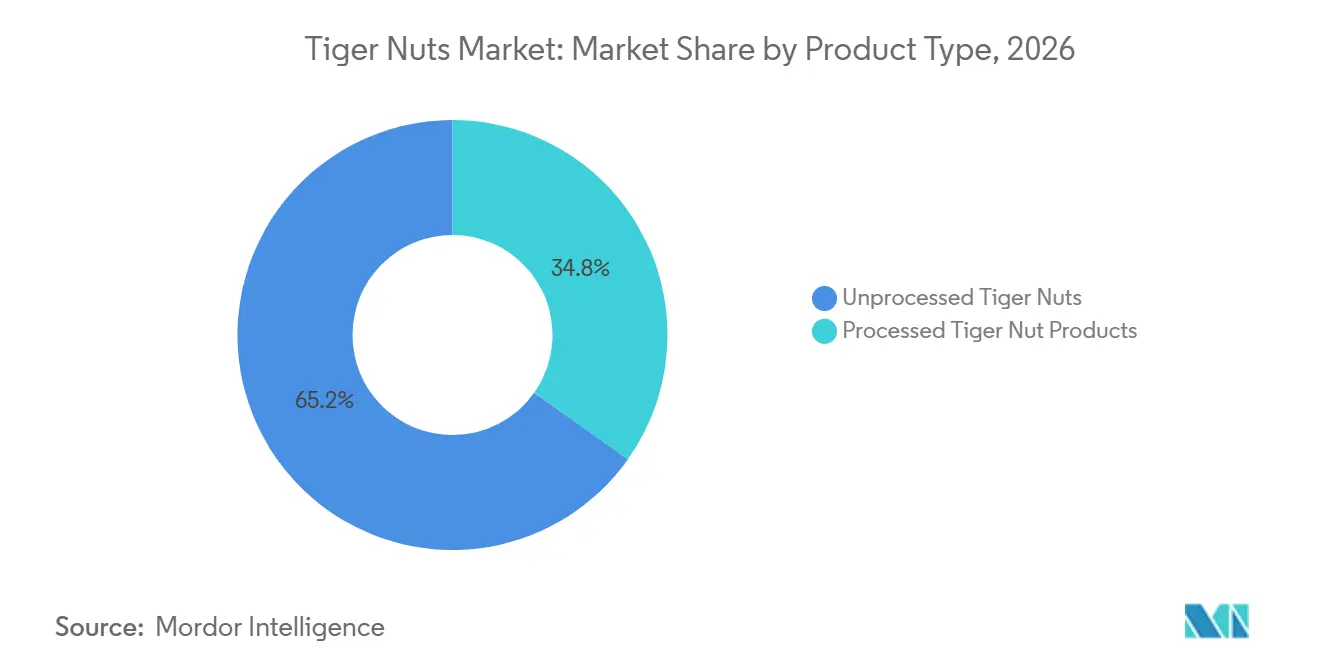
- By product type, unprocessed tiger nuts held 65.2% of the segment share in 2026, while processed tiger nut products are projected to grow at an 8.3% CAGR through 2032.
- By form, whole form held 55.7% of the segment share in 2026, while liquid form is projected to grow at an 8.6% CAGR through 2032.
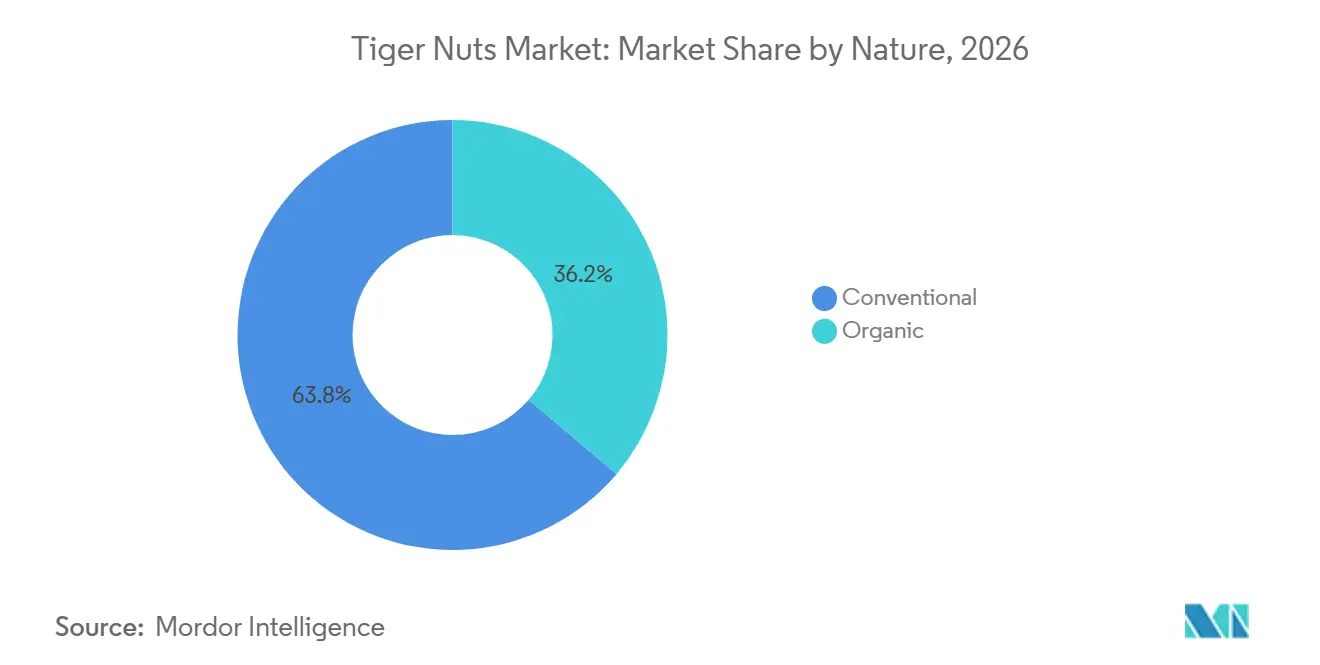
- By nature, conventional tiger nuts held 63.8% of the segment share in 2026, while organic tiger nuts are projected to grow at a 9.1% CAGR through 2032.
- By application, food and beverages held 62.3% of the tiger nuts market share in 2026, while agriculture and animal feed is projected to grow at an 8.7% CAGR through 2032.
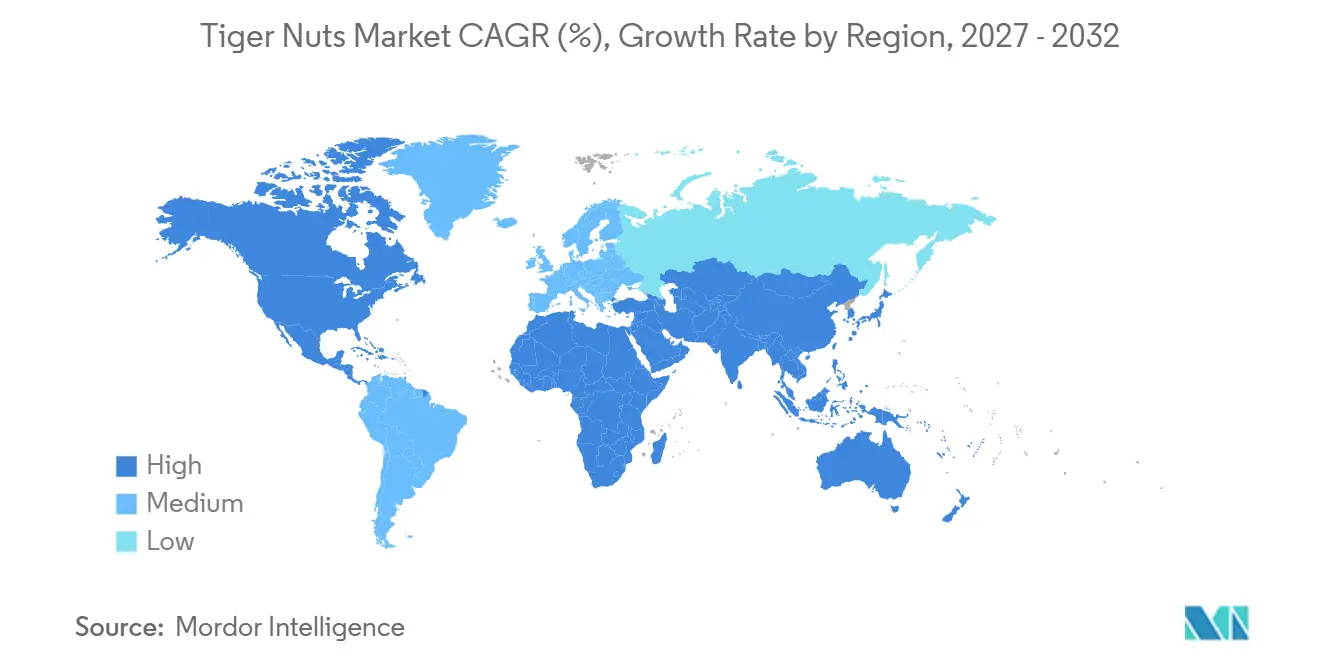
- By geography, Europe held 38.2% of the tiger nuts market share in 2026, while Asia-Pacific is projected to grow at a 9.2% CAGR through 2032.
Note: Market numbers in this report are based on Mordor Intelligence's proprietary estimation framework, which combines nine months of actuals with Q4 projections for base year 2026.
Global Tiger Nuts Market Trends and Insights
Drivers Impact Analysis*
| Driver | (~) % Impact on CAGR Forecast | Geographic Relevance | Impact Timeline |
|---|---|---|---|
| Prebiotic and Digestive Health Benefits of Tiger Nuts | +2.0% | Global; most pronounced in North America and Europe | Medium term (2–4 years) |
| Rising Consumer Awareness of Nutritional and Functional Foods | +1.5% | Global; fastest adoption in Asia-Pacific and North America | Medium term (2–4 years) |
| Demand for Gluten-Free Products and Suitable Dietary Alternatives | +1.5% | North America and Europe (celiac prevalence); APAC gaining | Short term (≤ 2 years) |
| Growing Demand for Organic, Natural, and Clean-Label Ingredients | +1.2% | Global; particularly strong in Europe and North America | Short term (≤ 2 years) |
| Expanding Applications of Tiger Nut Oil in Cosmetic and Personal Care Products | +0.9% | Europe and Asia-Pacific beauty markets | Medium term (2–4 years) |
| Emerging Pharmaceutical and Other Industrial Applications of Tiger Nut Derivatives | +0.7% | Global; R&D concentrated in Europe and China | Long term (≥ 4 years) |
| Source: Mordor Intelligence | |||
Prebiotic and Digestive Health Benefits of Tiger Nuts
Tiger nuts contain compact starch granules that measure 6-11 µm and contain 19-21% amylose. This profile is consistent with resistant starch type RS2, which resists digestion in the small intestine and can be fermented in the colon. A 2025 systematic review reported that tiger nut tubers protected occludin and ZO-1 in Salmonella-challenged cell models and reduced TNF-α expression. The review also recorded promotion of Lactobacillus plantarum growth in intestinal systems. It identified the tiger nut pentapeptide SFRWQ as an activator of the Keap1-Nrf2 pathway, with a binding energy of -49.35 kJ/mol, alongside higher superoxide dismutase and catalase activity. These findings give food manufacturers a scientific basis to develop whole-food digestive-health products, although any consumer-facing claims must comply with local rules.
Rising Consumer Awareness of Nutritional and Functional Foods
The tiger nuts market is supported by consumer interest in foods that combine recognizable ingredients with nutrition. Tiger nuts provide their fiber and oil profile in a minimally processed tuber, which suits products positioned around natural ingredients. City University of Hong Kong documented Tiga Milk in January 2025, a plant-based blend of tiger nuts, non-GMO soybeans, and oats developed after 8 years of organic farming research[1]. The formulation shows how tiger nuts can work with other plant ingredients rather than compete only as a direct dairy substitute. Their absence of tree nuts, soy, dairy, and gluten broadens potential use in products designed for multiple dietary needs. This positioning supports functional snacks and beverages where ingredient transparency can matter as much as nutrient content.
Demand for Gluten-Free Products and Suitable Dietary Alternatives
Gluten-free food demand supports tiger nut flour because the ingredient must deliver both nutrition and functional performance. The 2025 systematic review found that tiger nut flour combined with rice flour improved the quality and structure of gluten-free bread. It also found that tiger nut starch can act as a thickener with greater gel hardness than conventional corn starch. A 50% tiger nut flour substitution in steamed bun formulations improved chewiness and core structure in the reviewed research. Such performance allows manufacturers to test tiger nut ingredients in bread, biscuits, pasta, and snacks. This range can lower formulation risk when companies evaluate several product formats before committing to larger supply agreements.
Expanding Applications of Tiger Nut Oil in Cosmetic and Personal Care Products
Tiger nut oil offers a route to higher-value processing because the oil can be used in food and personal care formulations. Commission Implementing Regulation (EU) 2025/1528 authorized Cyperus esculentus oil as a novel food in July 2025[2]. The authorization allows use in pasta, bread, snacks, salad dressings, fine bakery wares, and milk-based products in the European Union. The regulated specification sets an oleic acid range of 65-69% and includes mycotoxin requirements. These specifications support quality control for culinary applications and can strengthen traceability systems used for premium oil positioning. European and Asia-Pacific personal care suppliers may also view the oil as a differentiated plant-derived input. Processing investments therefore have value beyond commodity raw material trade.
Restraints Impact Analysis*
| Restraint | (~) % Impact on CAGR Forecast | Geographic Relevance | Impact Timeline |
|---|---|---|---|
| Regulatory and labeling barriers | -0.5% | Global; most pronounced for non-EU exporters | Short term (≤ 2 years) |
| Limited processing and value-added infrastructure | -0.6% | West Africa (Nigeria, Niger, Burkina Faso, Mali) | Medium term (2–4 years) |
| Fragmented and inefficient supply chains | -0.5% | Global; centered on Sahel and West African origins | Short term (≤ 2 years) |
| Geographic concentration of cultivation | -0.4% | Spain (Valencia); risk spillover to global premium supply | Long term (≥ 4 years) |
| Source: Mordor Intelligence | |||
Regulatory and Labeling Barriers
Regulatory requirements can slow the cross-border expansion of processed tiger nut products, particularly as food safety, ingredient approval, and labeling standards vary across markets. In the European Union, novel food authorization for tiger nut oil provides a defined framework for its use in specified food categories and requires manufacturers to meet authorized composition and contaminant limits. This framework benefits EU-based manufacturers that can document compliance and maintain consistent product quality. However, exporters outside the EU must comply with the regulatory requirements of each destination market, which may involve additional product testing, documentation, and approval processes. In addition, digestive health and nutrition claims must be supported by evidence and comply with local labeling regulations. These requirements can increase compliance costs and delay market entry, especially for smaller processors without established regulatory teams.
Limited Processing and Value-Added Infrastructure
Limited processing capacity in origin countries reduces the value retained near cultivation areas and limits the development of integrated tiger nuts supply chains. In 2025, the Raw Materials Research and Development Council reported that producers in Nigeria's Borno State lacked modern processing and packaging facilities despite commercial-scale cultivation across all 27 local government areas. As a result, producers have limited ability to convert raw tiger nuts into standardized flour, oil, beverages, and packaged products that meet consistent quality and food safety requirements. The lack of local facilities also restricts control over drying, grading, storage, and packaging, increasing the risk of post-harvest losses and quality inconsistencies. Expanding local processing capacity could improve product quality, reduce waste, create higher-value employment opportunities, and strengthen direct links between producers and ingredient buyers. Until this capacity expands, processors in destination markets will continue to retain a significant share of value-added activities in the tiger nuts market.
*Our forecasts treat driver/restraint impacts as directional, not additive. The impact forecasts reflect baseline growth, mix effects, and variable interactions.
Segment Analysis
By Product Type: Unprocessed Forms Underpin Trade and Processed Derivatives Drive Value
Unprocessed tiger nuts held 65.2% of the product type segment in 2026. This segment share reflects trade in raw, peeled, and sliced material from West Africa and Spain to processors in Europe and North America. Much of the value addition occurs after import through flour milling, oil extraction, and ingredient manufacturing. This leaves origin markets with a smaller share of the economic value created from their crops. Spain's horchata sector provides recurring demand that helps stabilize raw-form volumes. The 2025 systematic review documented uses for tiger nut ingredients in gluten-free bread, extruded snacks, pasta, fermented dairy alternatives, and starch-thickened beverages.
Processed tiger nut products are forecast to expand at an 8.3% CAGR through 2032. Flour, defatted flour, oil, and other derivatives allow suppliers to serve specific formulation requirements and earn more per unit than raw material trade. The July 2025 EU authorization for tiger nut oil widened permitted food uses across pasta, bread, snacks, salad dressings, fine bakery wares, and milk-based products. The tiger nuts market size for processed products benefits from the oil specification, which requires 65-69% oleic acid and controlled mycotoxin levels. Defatted flour from oil extraction can be used as a high-fiber ingredient in bakery products. These linked outputs improve processing economics when manufacturers can market both oil and flour fractions.
By Form: Whole Form Anchors Volume and Liquid Form Records Fastest Growth
Whole form held 55.7% of the form segment in 2026. This segment share is supported by purchases for Spanish horchata production and for the health snack category. Whole dried tiger nuts are steeped, milled, and pressed for horchata de chufa and are also used in West African kunun aya beverages. The intact structure retains resistant starch and provides the mildly sweet, chewy characteristics associated with the ingredient. Storage at moisture content at or below 11% can avoid cold-chain needs and support longer shelf life. Powder form serves bakeries and protein-blend manufacturers seeking a gluten-free functional flour.
Liquid form is expected to grow at an 8.6% CAGR from 2027 to 2032. The category includes ready-to-drink plant milks, cold-pressed tiger nut oil, and fermented dairy alternatives. Tigernuts Traders and Sigma Biotech completed the FERCHU project in August 2026 with CDTI funding. The project reported allergen-free fermented tiger nut dairy alternatives with stable texture and balanced sensory profiles. Such products need specialized processing because raw tiger nuts require controlled soaking, milling, filtration, and stabilization. The technical work can help product developers assess liquid applications in the tiger nuts market.
By Nature: Conventional Volume Dominates and Organic Commands Premium and Growth
Conventional tiger nuts held 63.8% of the nature segment in 2026. The volume comes from sun-dried chufa sourced in West Africa and from Spanish farms outside protected-origin and organic systems. Conventional material remains the default for large horchata makers and commodity flour producers that prioritize volume and cost. Its broad availability supports baseline supply for the tiger nuts market. Import traceability remains important because buyers need confidence in phytosanitary controls, moisture levels, and handling practices. Suppliers that standardize these processes can improve access to food manufacturers with formal procurement requirements.
Organic tiger nuts are projected to grow at a 9.1% CAGR through 2032. Ingredion's 2025 consumer research found willingness among Millennials and Gen Z to pay 20-30% more for natural, organic, or allergen-free products. This premium can offset the higher certification and segregation costs associated with organic supply. The DO Chufa de Valencia council has indicated an intention to expand certified organic cultivation within the protected-origin area. Tigernuts Traders also reported food company development activity around plant-based beverages, functional snacks, fermented foods, and natural emulsions. Organic supply may therefore be particularly relevant to retail brands that require both simple labels and verified sourcing.
By Application: Food and Beverages Lead and Agriculture and Animal Feed Gains Fastest Ground
Food and beverages accounted for 62.3% of the application segment in 2026. This segment share is anchored by Spanish horchata and by plant-based milks, flour, and functional snack products. The application covers beverages, bakery, confectionery, and fermented dairy alternatives. That breadth gives the category resilience because demand can shift across adjacent food formats. The DO Chufa de Valencia designation governs quality within its protected origin area. City University of Hong Kong's Tiga Milk project also illustrates how tiger nuts are entering plant-based beverage development in Asia.
Agriculture and animal feed are forecast to grow at an 8.7% CAGR through 2032. The opportunity is linked to tiger nut meal and press cake from oil extraction, which can be used as a high-fiber feed input. A 2025 study found that diets containing up to 16% tiger nut meal for rabbits produced growth performance and feed conversion results comparable to the control diet while reducing feed cost per kilogram of gain. Another 2025 study reported that 15% tiger nut seed meal in lactating doe diets increased daily milk yield to 400.89 g per day and recorded feed conversion efficiency of 0.63. These results suggest a use for by-products that might otherwise have lower value. This circular use can improve the economics of oil extraction in the tiger nuts market.
Geography Analysis
Europe held 38.2% of the segment share in 2026. Spain is the key regional center because it combines protected-origin cultivation, horchata production, ingredient processing, and distribution. The DO Chufa de Valencia covers L'Horta Nord and establishes traceability and quality controls for chufa. The supplied research estimates production at 3 million kilograms of dry chufa each year across 400 hectares. Germany, the United Kingdom, the Netherlands, France, and Spain form the principal consumption base for flour, plant-based drinks, and organic retail products. The July 2025 novel food authorization gives EU manufacturers clearer rules for tiger nut oil use in several food formats.
North America is a strategic expansion region for the tiger nuts market because gluten-free and clean-label demand supports product launches. The region offers scope for flour, snacks, beverages, and other ingredient formats that align with dietary restrictions. Food makers can use the allergy-free profile of tiger nuts when they need alternatives to dairy, tree nuts, soy, and gluten. South America remains a medium-term opportunity as health food retail expands in Brazil and Argentina. The Middle East and Africa are important both as consumption areas and as origin regions. RMRDC's 2025 work with a Borno State women's group shows public-sector interest in developing processing and packaging capability in Nigeria.
Asia-Pacific is forecast to expand at a 9.2% CAGR from 2027 to 2032. This tiger nuts market size outlook is supported by functional food demand in China, Japan, Australia, and India. The Journal of Food Science review found that tiger nut starch showed better freeze-thaw stability than corn starch, which can be relevant to cold-drink and frozen-food formulations. City University of Hong Kong's Tiga Milk research provides a regional example of plant-based beverage development using tiger nuts. Japan's premium health snack category and South Korea's clean-beauty ingredient demand can provide higher-value entry points for oil and extract formats. Suppliers will need consistent specifications and clear regulatory documentation to serve these markets.
Competitive Landscape
The tiger nuts market is fragmented, comprising specialist ingredient suppliers, regional processors, and niche health-food brands rather than global consumer goods companies. Spanish companies, including Tigernuts Traders, S.L., Chufas Bou, Levantex Bocairent, and XUFEX, benefit from proximity to processing facilities in Valencia and established sourcing networks. Dutch intermediaries, such as KCB International B.V. and Tradin Organic Agriculture B.V., compete through organic certification and traceability capabilities. The market structure favors companies that can secure raw materials, process them reliably, and provide documented product specifications. Tigernuts Traders developed its oil authorization over five years, establishing a compliance advantage for a regulated food ingredient. Competitors pursuing similar product routes must develop comparable technical and regulatory evidence.
Product development is emerging as a clearer source of differentiation in the tiger nuts market. Tigernuts Traders and Sigma Biotech are expected to complete the FERCHU project in August 2026. The project aims to develop fermented tiger nut-based dairy alternatives with stable texture and balanced sensory properties. Tigernuts Traders plans to introduce retail-ready jar formats for Tigernuts Butt3r in July 2026, enabling partners to stock finished products without repacking or relabeling. The company also plans to introduce roasted tiger nut flour, diced tiger nuts, and sliced tiger nuts in October 2025 following roasting trials. These initiatives will expand the range of formats available to food manufacturers and retailers. They also demonstrate how processing expertise can create differentiation beyond raw ingredient sales.
Infrastructure constraints in origin countries present a potential competitive opportunity. The Raw Materials Research and Development Council (RMRDC) identified a lack of modern processing and packaging facilities in Borno State, despite widespread tiger nut cultivation. A vertically integrated model could connect farm-level sourcing in Nigeria with processors and ingredient customers in Europe or North America. This approach would require investment in drying, quality testing, packaging, logistics, and traceable procurement systems. Established Spanish and Dutch suppliers retain advantages through their distribution relationships and established compliance systems. Therefore, the tiger nuts market offers opportunities for new entrants; however, successful expansion depends more on reliable supply control than on brand promotion alone.
Tiger Nuts Industry Leaders
-
Tigernuts Traders, S.L.
-
Tiger Nuts USA
-
Chufas Bou, José María Bou, S.L.
-
KCB International B.V.
-
The Tiger Nut Company Ltd
- *Disclaimer: Major Players sorted in no particular order

Recent Industry Developments
- August 2026: Tigernuts Traders, S.L. and Sigma Biotech completed the FERCHU project, “Research into and Application of Tigernut Derivatives for the Development of Fermented Protein-Based Dairy Analogues,” funded by Spain's CDTI. The project produced allergen-free, additive-free fermented tiger nut dairy analogues with stable texture and balanced sensory profiles.
- July 2026: Tigernuts Traders, S.L. launched retail-ready jar formats for Tigernuts Butt3r for direct consumer distribution, allowing partners to stock finished products without repacking or relabeling.
- October 2025: Tigernuts Traders, S.L. launched roasted tiger nut flour, diced, and sliced formats following roasting trials, expanding its processed ingredient catalog.
Global Tiger Nuts Market Report Scope
The Tiger Nuts Market refers to the market for tiger nuts (Cyperus esculentus) and their processed products, including whole, prepared, and value-added forms used as food ingredients, edible products, oils, nutraceutical ingredients, personal care ingredients, and animal feed. By product type, the market is segmented into unprocessed tiger nuts, including raw tiger nuts, peeled tiger nuts, and sliced and diced tiger nuts, and processed tiger nut products, including tiger nut flour, defatted tiger nut flour, tiger nut oil, and others. By form, the market is segmented into whole form, powder form, and liquid form. By nature, the market is divided into organic and conventional products. By application, the market is segmented into food and beverages, personal care and cosmetics, pharmaceuticals and nutraceuticals, agriculture and animal feed, and other applications. Geographically, the market covers North America, Europe, Asia-Pacific, South America, and the Middle East and Africa, with country-level coverage across major markets. Market forecasts are presented in terms of value (USD).
| Unprocessed Tiger Nuts | Raw Tiger Nuts |
| Peeled Tiger Nuts | |
| Sliced and Diced Tiger Nuts | |
| Processed Tiger Nut Products | Tiger Nut Flour |
| Defatted Tiger Nut Flour | |
| Tiger Nut Oil | |
| Others |
| Whole Form |
| Powder Form |
| Liquid Form |
| Organic |
| Conventional |
| Food and Beverages |
| Personal Care and Cosmetics |
| Pharmaceuticals and Nutraceuticals |
| Agriculture and Animal Feed |
| Other Applications |
| North America | United States |
| Canada | |
| Mexico | |
| Rest of North America | |
| Europe | Germany |
| United Kingdom | |
| Italy | |
| France | |
| Spain | |
| Netherlands | |
| Poland | |
| Belgium | |
| Sweden | |
| Rest of Europe | |
| Asia-Pacific | China |
| India | |
| Japan | |
| Australia | |
| Indonesia | |
| South Korea | |
| Thailand | |
| Singapore | |
| Rest of Asia-Pacific | |
| South America | Brazil |
| Argentina | |
| Colombia | |
| Chile | |
| Peru | |
| Rest of South America | |
| Middle East and Africa | South Africa |
| Saudi Arabia | |
| United Arab Emirates | |
| Nigeria | |
| Egypt | |
| Morocco | |
| Turkey | |
| Rest of Middle East and Africa |
| By Product Type | Unprocessed Tiger Nuts | Raw Tiger Nuts |
| Peeled Tiger Nuts | ||
| Sliced and Diced Tiger Nuts | ||
| Processed Tiger Nut Products | Tiger Nut Flour | |
| Defatted Tiger Nut Flour | ||
| Tiger Nut Oil | ||
| Others | ||
| By Form | Whole Form | |
| Powder Form | ||
| Liquid Form | ||
| By Nature | Organic | |
| Conventional | ||
| By Application | Food and Beverages | |
| Personal Care and Cosmetics | ||
| Pharmaceuticals and Nutraceuticals | ||
| Agriculture and Animal Feed | ||
| Other Applications | ||
| By Geography | North America | United States |
| Canada | ||
| Mexico | ||
| Rest of North America | ||
| Europe | Germany | |
| United Kingdom | ||
| Italy | ||
| France | ||
| Spain | ||
| Netherlands | ||
| Poland | ||
| Belgium | ||
| Sweden | ||
| Rest of Europe | ||
| Asia-Pacific | China | |
| India | ||
| Japan | ||
| Australia | ||
| Indonesia | ||
| South Korea | ||
| Thailand | ||
| Singapore | ||
| Rest of Asia-Pacific | ||
| South America | Brazil | |
| Argentina | ||
| Colombia | ||
| Chile | ||
| Peru | ||
| Rest of South America | ||
| Middle East and Africa | South Africa | |
| Saudi Arabia | ||
| United Arab Emirates | ||
| Nigeria | ||
| Egypt | ||
| Morocco | ||
| Turkey | ||
| Rest of Middle East and Africa | ||
Key Questions Answered in the Report
What is the projected value of the tiger nuts market by 2032?
The tiger nuts market is forecast to reach USD 418.34 million by 2032 from USD 291.4 million in 2027. The forecast reflects a 7.5% CAGR during 2027-2032, with growth supported by food, beverage, and processed ingredient demand across the tiger nuts market, including horchata, bakery, snack, and newer dairy-alternative categories.
Which tiger nut product category is growing fastest?
Processed tiger nut products are projected to expand at an 8.3% CAGR through 2032. Flour, defatted flour, oil, and other derivatives let suppliers serve specific product formulation needs and can create more value than raw material trade.
Which region has the largest tiger nut demand?
Europe held 38.2% of demand in 2026, supported by Spain's horchata production and ingredient processing base. The region also has defined EU rules for approved tiger nut oil uses in several food categories.
What makes organic tiger nuts attractive to food brands?
Organic tiger nuts are projected to grow at a 9.1% CAGR through 2032. They fit products positioned around organic, allergen-free, and simple ingredient labels, while certification and traceability help brands meet formal sourcing requirements.